Billboards near Forest Park, OH
No Minimum Spend. No Long-Term Contracts. Just Results.
Trusted by Leading Brands


Billboard advertising
near Forest Park has never been easier



How much is a billboard near Forest Park?
Why Choose Blip for Billboard Advertising near Forest Park
Blip lets you launch Forest Park billboards in minutes and target I-275 commuters near Winton Road and I-75 for quick reach.
Start with any budget in Forest Park and scale up for peak morning and evening commute traffic without overcommitting.
No contracts means you can test Forest Park campaigns around Winton Woods weekends, then shift spend to what works.
Use Blip's real-time analytics to see what Forest Park ads drive action from suburban shoppers and Cincinnati-bound drivers.
Blip's creative tools make it easy to build bold Forest Park billboards for diverse families, retail trips, and local services.
Frequently Asked Questions About Billboard Advertising near Forest Park
How much does a billboard cost near Forest Park, Ohio with Blip?
With Blip, you control exactly what you spend on Forest Park billboards by setting a daily budget that works for you, whether you’re a small local business or testing a new message in the Forest Park area. Each 7.5–10 second “blip” is individually priced based on when and where it runs and on current advertiser demand, so you only pay for the blips you actually receive. The total cost of your digital campaign is simply the sum of each blip shown on billboards near Forest Park, Ohio over time.
Where can I advertise with Blip near Forest Park, Ohio?
There are 6 digital billboards serving the Forest Park area from nearby Cincinnati, all within about 10 miles. This cluster of signs provides a flexible, cost-effective way to reach both neighborhood and regional audiences. The boards are best used to capture I-275 and I-75 commuters, reach residents moving between Forest Park and Cincinnati, and influence visitors from other suburbs.
Who does Forest Park, Ohio billboard advertising reach with Blip?
Forest Park is one of the most diverse and active suburbs in the Cincinnati region, making it ideal for digital billboard campaigns aimed at everyday consumers. Roughly 65–70% of residents identify as non-white, with a large Black community, a growing Latino population, and notable international communities. The area also has a strong working-age population, commuter traffic, and retail shoppers moving through the I-275 corridor.
When is the best time to run billboards in Forest Park, Ohio with Blip?
For boards serving Forest Park, the morning commute from 6:30–9:00 a.m. and the evening commute from 4:00–7:00 p.m. are especially valuable. Peak periods can carry 2–3 times the hourly traffic volume of mid-day or late evening. Blip can increase bids during commute windows and lower them during softer times of day, helping stretch budgets while still owning key moments.
What roads near Forest Park, Ohio get the most billboard traffic?
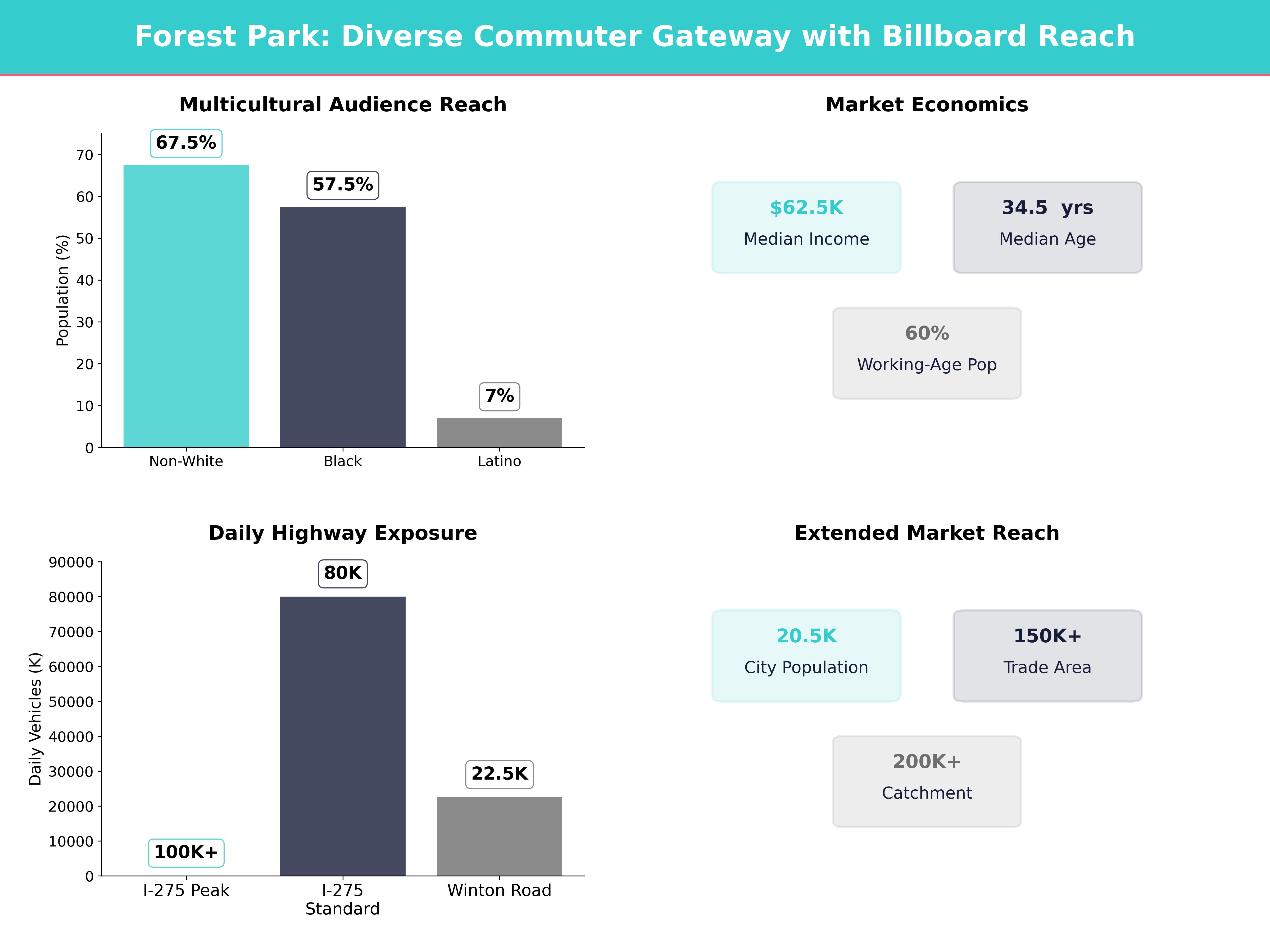
Key corridors influencing the Forest Park area include I-275, Winton Road, and State Route 4 (Dixie Highway). I-275 segments across northern Hamilton County often carry 70,000–90,000 vehicles per day, with some stretches near I-75 exceeding 100,000. Winton Road typically reaches 20,000–25,000 vehicles per day on key segments, while many areas of State Route 4 exceed 30,000 vehicles per day.
Do I need a contract to advertise with Blip near Forest Park?
No, Blip has no long-term contracts or minimum commitments. You can start, pause, or stop your campaign at any time.
How fast can I launch a billboard campaign with Blip near Forest Park?
You can have your campaign live in minutes. Create a free account, select your locations, set your budget, upload your design, and start running once approved.
Where can I advertise with Blip near Forest Park?
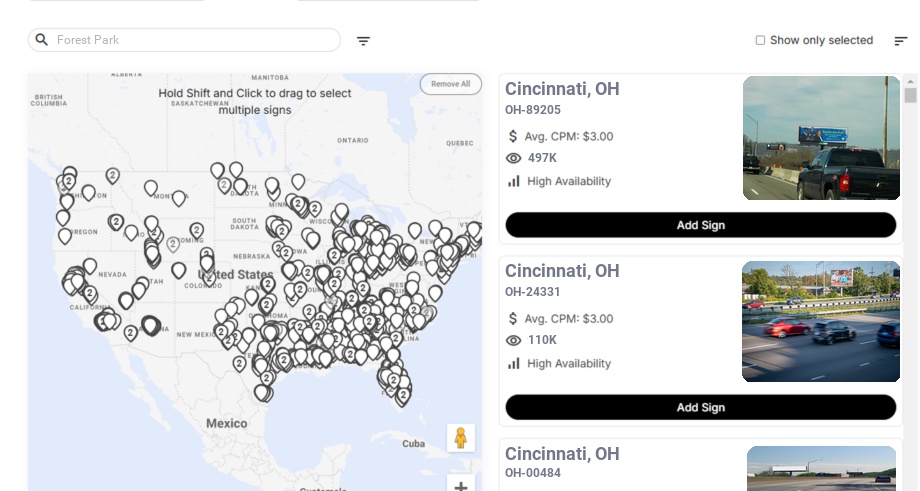
Blip has digital billboards near Forest Park. You can browse available locations on a map, choose the ones that fit your audience, and start advertising right away.
Still have questions? Launch a campaign in minutes — no contracts, no commitments.
Start Your CampaignForest Park Billboard Advertising Guide
Forest Park, Ohio sits at a powerful crossroads of suburban neighborhoods, regional retail, and commuter traffic feeding into Cincinnati. With 6 digital billboards serving the Forest Park area from nearby Cincinnati (all within about 10 miles), we can run highly targeted campaigns that speak directly to local residents, workers, and shoppers moving through this hub of northwest Hamilton County. For advertisers specifically seeking billboards near Forest Park, this cluster of signs provides a flexible, cost-effective way to reach both neighborhood and regional audiences.
Why the Forest Park Area Is a High-Value Out-of-Home Market
Forest Park is one of the most diverse and active suburbs in the Cincinnati region, making it ideal for digital billboard campaigns aimed at everyday consumers. When planned well, Forest Park billboards can consistently reach shoppers and commuters who rely on nearby retail, services, and job centers.
Key market facts (rounded from 2020–2023 public data for the City of Forest Park and Hamilton County):
- Population: Forest Park has roughly 20,000–21,000 residents (about 20,200 in 2020), within a larger northwest Cincinnati trade area of 150,000+ when you include nearby communities like Springdale Fairfield, Greenhills, and Colerain Township.
- Age: median age around 34–35, younger than Hamilton County overall (which is closer to 37–38), with roughly 60%+ of residents in the working-age 18–64 range and a strong core in the 25–54 bracket.
- Income: median household income in Forest Park is around $60,000–65,000, compared with roughly $62,000–$64,000 countywide, with sizeable segments of both blue‑collar and white‑collar commuters heading toward major job centers.
- Diversity: Forest Park is majority-minority; roughly 65–70% of residents identify as non‑white, with a large Black community (around 55–60% of residents), a growing Latino population (around 6–8%), and notable international communities—especially West African and Caribbean.
- Housing: approximately 45–50% of housing units are owner‑occupied and 50–55% renter‑occupied, with a mix of single-family neighborhoods and apartment communities that supports campaigns for both everyday necessities and aspirational purchases.
- Retail spending: Hamilton County residents generate more than $14–15 billion in annual retail sales, and the Forest Park/Springdale/Fairfield cluster is one of the largest suburban retail concentrations on Cincinnati’s north side.
Local context that matters for advertisers:
- Forest Park is a First Suburb of Cincinnati and actively promotes business growth through the City of Forest Park and its Economic Development Department, which highlights more than 700+ local businesses and several hundred acres of commercial and industrial land.
- It sits directly along the I‑275 beltway, just off major exits like Winton Road and Hamilton Avenue, connecting easily to I‑75 and I‑74 and into the City of Cincinnati via routes supported by the City of Cincinnati.
- The broader Hamilton County region, overseen by Hamilton County, Ohio, supports more than 400,000+ jobs; the Forest Park area’s retail and employment centers attract visitors from a much wider radius than the city limits alone—especially from northern Cincinnati and Butler County to the north.
Digital billboards near Cincinnati that serve the Forest Park area let us tap into both local neighborhood traffic and regional pass‑through traffic with flexible, precisely timed messaging. National out‑of‑home studies show that 60–70% of travelers notice digital billboards each month, and around 35–45% report taking an action such as visiting a website, searching online, or visiting a business—making these boards strong demand drivers for local advertisers evaluating billboard advertising near Forest Park.
Understanding the Forest Park Audience
To build effective billboard campaigns near Forest Park, we should treat the area as a set of overlapping audiences rather than a single generic market. Matching the message to each audience is what makes Forest Park billboards perform at a higher level.
1. Commuters and Workers
Many residents commute toward:
- Job hubs along I‑75 (Sharonville, Evendale, downtown Cincinnati)
- Industrial and logistics corridors along I‑275
- Major employers in the Tri-County and Springdale areas
Regional transportation analyses from groups like the OKI Regional Council of Governments indicate that Hamilton County’s outer-ring suburbs have some of the highest outbound-commute rates in the metro. For Forest Park, data suggest that roughly 50–60% of employed residents commute out of the city each day, with average one-way travel times around 25–28 minutes. More than 80% of commuters drive alone or carpool, meaning a very high proportion of residents pass nearby digital billboards during weekday morning and evening rush hours. This makes billboard advertising near Forest Park especially effective for reaching on-the-go professionals.
Commuter traffic is further reinforced by regional transit: Metro (Cincinnati’s bus system) carries more than 10 million passenger trips annually across Hamilton County, with routes that intersect the I‑275 and Winton Road corridors, adding additional eyeballs to key approaches.
Ideal messaging: banking, healthcare, education, quick‑service restaurants, automotive, home services, and job recruitment—categories that commuters frequently respond to in out‑of‑home campaigns.
2. Local Families and Neighborhood Consumers
Forest Park has:
- A large share of households with children (roughly 30–35% of households), higher than many core urban neighborhoods in Cincinnati.
- Multiple schools in the Winton Woods City School District, which reports 3,600+ students district‑wide according to Winton Woods Schools 4,000 K–12 students.
- Parks and recreation amenities managed by the city and the Great Parks of Hamilton County, including the massive Winton Woods park immediately south of Forest Park. Great Parks reports more than 7.8 million visits system‑wide annually, with Winton Woods alone drawing an estimated 1.0–1.2 million visits through its trails, lake, campground, and recreation facilities.
Household structure and amenities create a strong audience for:
- Groceries, family dining, and entertainment
- Youth sports, camps, tutoring, and childcare
- Healthcare, dental, and orthodontics
- Local churches and community organizations
- Seasonal events and festivals sponsored by the city and local partners
Because a significant portion of neighborhood trips are short (many under 10 minutes and within 3–5 miles), billboards positioned along these everyday routes—especially those feeding into I‑275 and major arterials—can repeatedly reach the same families multiple times per week. This repeated exposure is a key advantage of billboards near Forest Park compared with one-time impressions in other media.
3. Shoppers and Regional Visitors
Historically anchored by large retail centers like the former Forest Fair Village / Cincinnati Mills corridor, the broader Forest Park–Springdale–Fairfield area remains a draw for:
- Big-box retail in nearby Springdale and Fairfield
- Auto dealers and service centers along major arterials
- Warehouse clubs, specialty shops, and restaurants that pull from a multi‑county trade area
The corridor between Forest Park, Springdale, and Fairfield accounts for hundreds of millions of dollars in retail and restaurant sales annually. When you factor in visitors coming from Butler County to the north and other Hamilton County suburbs, the effective shopping catchment easily exceeds 200,000 residents.
With I‑275 carrying tens of thousands of vehicles per day across northwest Hamilton County, digital boards near Cincinnati serving the Forest Park area can influence both destination shoppers and impulse stops from through‑traffic—especially when paired with short, exit‑based calls to action. For retailers and restaurants, this makes billboard rental near Forest Park a practical way to capture spur-of-the-moment decisions.
Where Traffic Flows Near Forest Park (and How to Tap Into It)
Understanding traffic patterns is critical to selecting the best boards and scheduling your Blips. Smart placement ensures that billboards near Forest Park intersect with the highest-value trips.
High-Impact Roadways
Key corridors influencing the Forest Park area include:
-
I‑275 (Northern Beltway)
- According to Ohio Department of Transportation District 8 traffic counts, I‑275 segments across northern Hamilton County often carry 70,000–90,000 vehicles per day (AADT), with some stretches near I‑75 exceeding 100,000.
- Carries commuters between I‑75, I‑74, and suburbs like Fairfield, Colerain, Sharonville, and Blue Ash.
- Ideal for campaigns targeting a regional audience or multiple suburbs at once, including drivers who may not live in Forest Park but regularly spend and commute through the area.
-
Winton Road
- Main north‑south arterial through Forest Park, connecting to I‑275 and south toward Greenhills and Springfield Township.
- Local traffic counts typically reach 20,000–25,000 vehicles per day on key segments, driven by school traffic, retail visits, and neighborhood commuting.
- Heavy local traffic during school and work commutes and near retail nodes makes it valuable for frequency‑based messaging.
-
State Route 4 (Dixie Highway)
- Major commercial strip running north–south a few miles west, servicing Fairfield, Springdale, and Hamilton.
- In many areas, daily volumes exceed 30,000 vehicles per day, supporting dense corridors of auto, retail, and service-industry business.
- Strong for auto, retail, and service-industry advertising, especially when paired with “Exit now” or “Next light” calls to action.
Our 6 digital billboards in the Cincinnati area that serve Forest Park are best used to:
- Capture I‑275 and I‑75 commuters before or after they pass the Forest Park exits.
- Reach residents as they move between Forest Park and Cincinnati’s core for work or entertainment.
- Influence visitors from other suburbs who come near Forest Park for shopping, recreation, or events at destinations promoted by organizations like Visit Cincy.
This configuration allows businesses to treat Forest Park billboards as both neighborhood touchpoints and regional beacons drawing customers into the area.
Timing Your Blips Around Local Routines and Events
One advantage of Blip is the ability to schedule ads by time of day, day of week, and even around specific dates. For the Forest Park area, timing strategy is just as important as creative. Thoughtful scheduling can turn straightforward billboard advertising near Forest Park into a highly efficient, data-driven campaign.
Weekday Patterns
Regional traffic and commute data show that peak periods can carry 2–3 times the hourly traffic volume of mid‑day or late evening. For boards serving Forest Park:
-
Morning commute (6:30–9:00 a.m.)
- High volume of outbound commuters from Forest Park heading toward I‑75 and Cincinnati, with speeds often reduced below posted limits during the height of rush hour.
- Best for coffee, quick breakfasts, transit options, traffic/commute apps, and business services.
- Also effective for job recruitment and training programs—catch workers before they start their day, when job-change intent tends to be higher.
-
Midday (11:00 a.m.–2:00 p.m.)
- Mix of local errands, lunch breaks, and service appointments, with steady but slightly lower volumes than peak commute hours.
- Perfect for healthcare, dental, banking, local restaurants, grocery, and retail promotions targeting people who have time to act immediately.
-
Evening commute (4:00–7:00 p.m.)
- Often the heaviest overall impressions window: inbound residents returning toward Forest Park plus regional traffic circling I‑275.
- Emphasize dinner, family activities, gyms, streaming and entertainment, and home services—categories where decisions are made on the drive home.
With Blip, we can increase bids during commute windows (when each Blip can reach tens of thousands of passing vehicles per hour on major highways) and lower them during softer times of day, stretching budgets while still owning key moments.
Weekend & Seasonal Opportunities
- Weekends (especially Saturday mid-morning and early afternoon) see strong retail and recreation traffic near Forest Park and along I‑275 to major shopping and park destinations. In many suburban corridors, Saturday midday volumes rival or exceed weekday mid‑day volumes.
-
Summer:
- Heavy visitation to Winton Woods, which logged over a million visits annually across its facilities according to Great Parks visitation reports.
- Ideal for promoting outdoor events, attractions, camps, and quick-service restaurants that benefit from spur‑of‑the-moment decisions.
-
Back-to-School (August–September):
- Winton Woods Schools and nearby districts drive spending on apparel, supplies, tutoring, and activities. Household spending surveys consistently show that back‑to‑school is the second‑largest retail season of the year after the winter holidays, making this a prime period for high-frequency billboard flights.
-
Holiday Season (November–December):
- Retail sales can rise 20–30% versus average months for many local stores, with automotive dealers often running year‑end events.
- Local nonprofits and churches in the Forest Park area typically see increased donations and event attendance, which can be boosted with short, deadline‑driven messages.
We can ramp up impressions during these seasonal peaks and dial back during slower periods, instead of being locked into a flat, 4‑week static buy. This flexibility is one of the main advantages of digital billboard rental near Forest Park compared with traditional static boards.
Crafting Creative That Resonates in the Forest Park Area
Great creative is tailored to who you are reaching and how they are moving. For the Forest Park area:
Messaging Tips
-
Appeal to a diverse community.
- Forest Park’s diversity—where roughly two‑thirds of residents identify as non‑white—means inclusive imagery and language matter.
- Use photos that reflect Black, Latino, and multiracial families and professionals, aligning with the community’s actual makeup.
- Consider bilingual or Spanish-supportive messages if your business serves Hispanic customers; national polling shows that Spanish‑inclusive ads can increase recall and favorability among Hispanic audiences by 10–20 percentage points.
-
Emphasize convenience and proximity.
- Residents often compare local options with those in nearby Cincinnati or northern suburbs.
- Use lines like “Minutes from the Forest Park area off I‑275” or “Just south of Forest Park on Winton Road.”
- Include simple directional cues: “Next exit,” “1 mile ahead,” or “5 minutes from this exit”—drivers traveling 55–65 mph only have 5–8 seconds to process your message.
-
Highlight value and everyday essentials.
-
With median incomes in the $60k range and a large working-class base, value-focused headlines perform well:
- “Save on weekly groceries near the Forest Park area”
- “Affordable care for Forest Park families”
- National retail studies show that clear price or discount messages can lift response rates by 15–30% versus generic branding alone.
-
With median incomes in the $60k range and a large working-class base, value-focused headlines perform well:
-
Use strong calls to action that can be acted on immediately.
- “Tonight only,” “This weekend,” “Apply by Friday,” or “Exit now for…” create urgency that pairs well with short billboard viewing windows.
- For app‑based or online businesses: short URLs, memorable brand names, or QR codes with strong contrast. Out‑of‑home surveys report that 40–50% of smartphone users have interacted with an ad they saw on a roadside sign or billboard via search or website visit.
Visual & Technical Best Practices
- Big, bold text: 6–8 words max, high contrast (e.g., white on dark or yellow on black). Tests repeatedly show that creative with fewer than 8–10 words has significantly higher recall.
- One focal image or icon: avoid clutter; people are often driving 55–65 mph on highways around the Forest Park area, giving only a few seconds of viewing time.
- Brand dominance: logo or brand name large and clear; research indicates that ads with strong logo presence see 10–20% better unaided brand recall.
-
Use local anchors:
- “Near Winton Woods”
- “Off I‑275 at Winton Road exit”
- “Minutes north of Cincinnati near Forest Park”
Digital makes it easy to A/B test variations—color schemes, calls to action, or offers—and quickly shift impressions to the best performers once you see which creative is driving more web visits, phone calls, or in‑store traffic.
Using Blip Tools to Pinpoint the Forest Park Area
Blip’s flexibility lets us align your spend and exposure with how people actually move around the Forest Park area. For advertisers exploring billboard advertising near Forest Park for the first time, these tools simplify testing and scaling.
Key tactics:
-
Board Selection for the Forest Park Area
- Use boards in nearby Cincinnati that are closest to the I‑275 and I‑75 corridors feeding Forest Park, where daily vehicle volumes are highest.
- Favor faces that target inbound and outbound commuters who likely live, work, or shop near Forest Park, including those heading to and from job centers highlighted by Hamilton County, Ohio and the City of Cincinnati. This approach ensures your Forest Park billboards are seen by the people most likely to convert.
-
Dayparting
- Bid higher during morning and evening commutes to capture local workers when traffic volumes can be 2–3 times higher than off‑peak hours.
- Run family-oriented messages more heavily in the early evening and weekends, when households are deciding on dining, entertainment, and shopping.
-
Flighting and Seasonal Focus
- Concentrate spend around key seasonal windows for your category—back‑to‑school, tax season, holidays, or sports seasons.
- For event promoters, run heavier rotations in the 7–10 days leading up to the date, and shift creative from “Coming Soon” to “This Weekend” or “Tonight.” Events listed on platforms like Visit Cincy and promoted by local media can see significant attendance bumps when paired with well-timed billboard campaigns.
-
Creative Rotation
- Rotate multiple creatives: awareness, promotion, and directional messages.
-
Example rotation for a local restaurant:
- Board A: “Family Dinner Near the Forest Park Area – Kids Eat Free Tuesday”
- Board B: “Exit Now at Winton Road – 2 Minutes Ahead”
- Board C: “Order Online – [BrandName].com”
Campaign Ideas for Key Local Business Categories
Below are practical ways different advertisers can use billboards serving the Forest Park area. Whether you are considering your first billboard rental near Forest Park or optimizing an existing buy, these ideas can help shape your strategy.
Local Retail & Restaurants
-
Target weeknight and weekend traffic with time‑sensitive offers:
- “$5 Lunch Specials – 2 Miles from the Forest Park Area, Exit at Winton Road”
- Emphasize proximity to I‑275 exits and Winton Woods to capture both commuters and park visitors.
- Use rotating creatives to promote different dayparts (lunch vs. dinner). Many restaurants see 20–40% of weekly revenue concentrated on Friday–Sunday; concentrating impressions on those days can disproportionately lift sales.
Auto Dealers & Repair Shops
- Focus on commuters using I‑275 and nearby arterials, where thousands of vehicles per hour pass during peak periods.
-
Campaign structure:
- Awareness creative: “Huge Used Car Selection near the Forest Park Area”
- Offer creative: “$0 Down, Low Monthly Payments – This Month Only”
- Service creative: “Oil Change Near the Forest Park Area – Walk‑Ins Welcome”
- National automotive data show that more than 60% of car shoppers research online while actively noticing nearby dealerships; pairing digital billboards with online inventory listings can significantly increase walk‑ins.
Healthcare, Dental, and Vision
- Appeal to families and workers seeking convenient, local care in a community where roughly 1 in 3 households has children.
- Use credibility cues: “Serving Forest Park families for 20+ years” or “Accepting most major insurance.”
- Highlight easy access from I‑275 and evening/weekend hours. Healthcare providers that advertise extended hours often report 10–20% higher new‑patient inquiries in suburban markets.
Education, Training & Workforce
- Promote local colleges, training centers, and employers hiring across Hamilton County. The county supports hundreds of thousands of jobs, with ongoing demand in logistics, healthcare, manufacturing, and tech.
-
Use career-focused lines:
- “New Career in 12 Months – Training Near the Forest Park Area”
- “Now Hiring: $20+/hr, Benefits – Apply Today”
- Workforce programs that use clear wage and benefit information in their creative often see higher conversion rates than those with generic “Now Hiring” messages.
Churches, Nonprofits & Community Organizations
- Forest Park’s community‑oriented culture makes cause‑based messaging effective. Local congregations and nonprofits often run food drives, back‑to‑school events, and holiday programs that can benefit from broad exposure.
-
Promote special services, outreach programs, or events:
- “Free Food Distribution Saturday – Near the Forest Park Area”
- “Join Us This Sunday – All Are Welcome”
- Many nonprofits see 15–25% higher attendance or participation when they combine digital billboards with social media and local news coverage from outlets like WCPO 9 News and The Cincinnati Enquirer.
Leveraging Local Media & Events for Synergy
Digital billboards perform even better when they align with other local media and community touchpoints.
- Coordinate messaging with local news cycles from outlets like WCPO 9 News, The Cincinnati Enquirer, FOX19 Now, and Local 12 WKRC. When a story or trend relevant to your category is in the news, adjust billboard copy to reference it or extend the conversation.
- Tie into events promoted by Visit Cincy and Hamilton County’s park and recreation calendars through Great Parks of Hamilton County and the City of Forest Park. Seasonal festivals, concerts, sports tournaments, and community days can draw thousands of attendees, many of whom travel via I‑275 or Winton Road.
- Use consistent colors, slogans, and offers across your billboards, social ads, and local sponsorships so Forest Park area audiences recognize you instantly. Brand consistency across channels has been shown to increase average revenue by 10–20% compared with fragmented messaging.
Measuring and Optimizing Your Campaign
To get the most out of boards serving the Forest Park area, we should treat your campaign as an ongoing experiment.
-
Define Clear Objectives
- Store visits, calls, website traffic, app downloads, or lead form completions.
- Use simple tracking tools—unique URLs, promo codes (“FORESTPARK10”), or dedicated phone numbers. Many small businesses find that 10–30% of new customers mention having “seen you somewhere outside,” including billboards and other outdoor media.
-
Align Timing with Behavior
- Compare your web or store traffic patterns by hour and day against when your Blips are running.
- If you see spikes after commute windows or weekend flights, double down on those slots and reduce spend in low-response windows.
-
Refine Creative Based on Results
- Rotate 2–3 creatives at launch; keep the top performers and retire weaker ones after 2–4 weeks of data.
- Test bolder CTAs, clearer offers, or simpler directional language; even small tweaks can improve response rates by 10–15%.
-
Scale Smartly
- Start with a modest daily budget focusing on the highest-value dayparts (commutes and key weekend windows).
- As you see positive impact, expand to more hours, additional boards near Cincinnati serving the Forest Park area, or extended flight dates.
- Businesses that layer additional boards or extend campaigns for 3+ months often benefit from compounding brand recognition, which can significantly lift word‑of‑mouth and search activity.
By understanding Forest Park’s demographics, commuter flows, and local culture—and using Blip’s flexibility to match where, when, and how people move—we can build digital billboard campaigns that punch far above their weight. With 6 nearby digital billboards serving the Forest Park area, advertisers of all sizes can reach this dynamic, diverse community efficiently and measurably, while tapping into the broader Cincinnati region’s hundreds of thousands of daily trips and billions of dollars in annual consumer spending. For any business evaluating billboards near Forest Park, this combination of audience scale, targeting tools, and local relevance creates a strong foundation for sustainable growth.