Billboards near Carolina Forest, SC
No Minimum Spend. No Long-Term Contracts. Just Results.
Trusted by Leading Brands


Billboard advertising
near Carolina Forest has never been easier
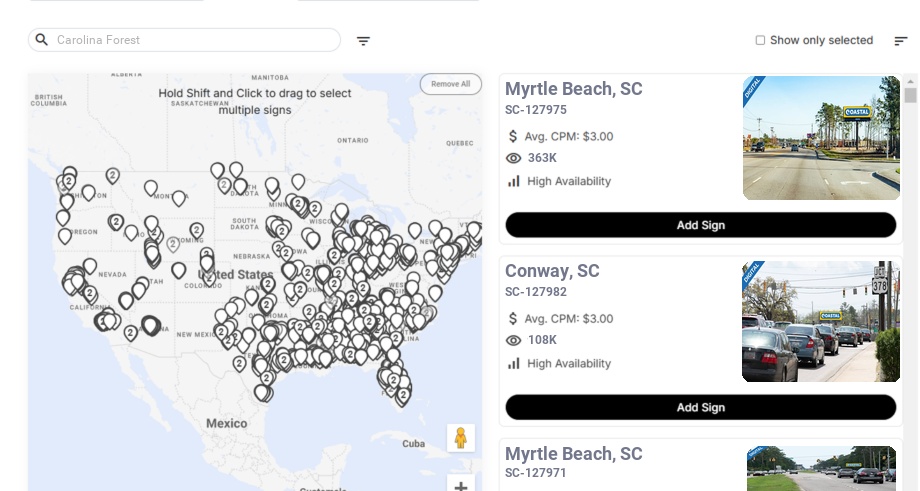



How much is a billboard near Carolina Forest?
Why Choose Blip for Billboard Advertising near Carolina Forest
-
Blip lets you launch Carolina Forest billboards fast, reaching SC-501 and SC-31 commuters without the old-school buying hassle.
-
In Carolina Forest, Blip's flexible budgets help you ramp up for summer beach traffic on US-17, then scale back when seasons slow.
-
Use dayparting on Carolina Forest to hit morning Myrtle Beach commuters, CCU students, and evening return traffic at the right time.
-
No contracts means you can test Carolina Forest billboard creative around local schools, River Oaks, and new subdivisions—then adjust anytime.
-
Track Carolina Forest campaigns in real time and shift spend toward peak weekends on SC-501 and tourist-heavy Myrtle Beach routes.
-
Blip's creative tools make it easy to tailor Carolina Forest ads for families, tourists, and golfers with quick, high-impact messages.
Frequently Asked Questions About Billboard Advertising near Carolina Forest
How much does a billboard cost near Carolina Forest, South Carolina with Blip?
With Blip, you control exactly how much you spend to appear on Carolina Forest billboards serving the Carolina Forest area. You set a daily budget that can be changed at any time, and Blip automatically keeps your campaign within that limit. Each blip is a 7.5–10 second ad display on digital billboards near Carolina Forest, South Carolina, and you only pay for the individual blips you receive.
Where can I advertise with Blip near Carolina Forest, South Carolina?
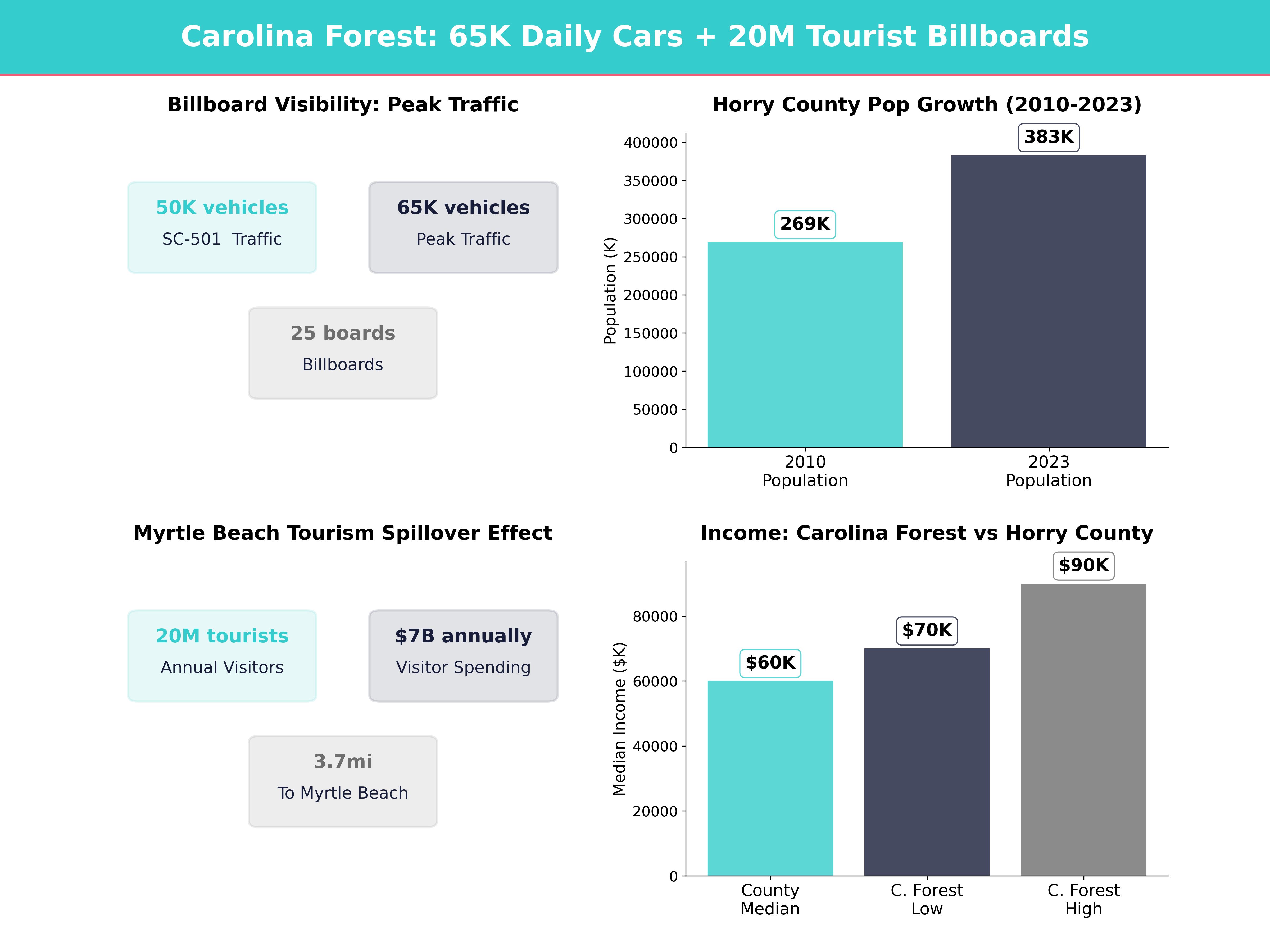
Blip’s 25 digital billboards near Carolina Forest are primarily along major routes in Myrtle Beach, about 3.7 miles away, and Conway, about 7.5 miles away. These strategically placed Carolina Forest billboards help advertisers reach both locals and visitors all day long. Key corridors include SC-501, SC-31, US-17, and local connectors like Carolina Forest Boulevard and River Oaks Drive.
Who do Carolina Forest, South Carolina billboards reach?
Carolina Forest billboards reach suburban families and commuters who live in the Carolina Forest area and travel daily toward Myrtle Beach, Conway, and beyond. They also reach coastal visitors and seasonal residents heading along SC-31, SC-501, and US-17 to reach Myrtle Beach and surrounding beaches. By combining boards near Myrtle Beach and Conway, the campaign intersects residents, students, and tourists as they pass around the Carolina Forest area.
When is the best time to run Blip billboards in Carolina Forest, South Carolina?
Blip’s scheduling flexibility can match your campaign with real-world traffic peaks near Carolina Forest. Morning peak is 6:30–9:30 a.m., afternoon/evening peak is 3:30–7:30 p.m., and late night can be cost-effective for younger, entertainment-focused audiences. Summer is the busiest season overall, while spring and fall still bring strong traffic and visitor activity.
What roads around Carolina Forest, South Carolina get the most billboard traffic?
SC-501 is a primary artery between Conway and Myrtle Beach, and South Carolina DOT traffic counts on segments near Carolina Forest often exceed 50,000 vehicles per day. SC-31 carries 30,000+ vehicles per day on certain segments, and US-17 near Myrtle Beach can see 60,000+ daily vehicles in peak season. Local connectors like Carolina Forest Boulevard and River Oaks Drive also funnel traffic toward the major corridors.
Do I need a contract to advertise with Blip near Carolina Forest?
No, Blip has no long-term contracts or minimum commitments. You can start, pause, or stop your campaign at any time.
How fast can I launch a billboard campaign with Blip near Carolina Forest?
You can have your campaign live in minutes. Create a free account, select your locations, set your budget, upload your design, and start running once approved.
Where can I advertise with Blip near Carolina Forest?
Blip has digital billboards near Carolina Forest. You can browse available locations on a map, choose the ones that fit your audience, and start advertising right away.
Still have questions? Launch a campaign in minutes — no contracts, no commitments.
Start Your CampaignCarolina Forest Billboard Advertising Guide
Carolina Forest is one of the fastest‑growing residential hubs along South Carolina’s Grand Strand, tucked between Myrtle Beach and Conway. With tens of thousands of year‑round residents, heavy commuter traffic, and steady inflows of tourists driving to and from the coast, the Carolina Forest area is perfectly positioned for high‑impact digital billboard advertising. By leveraging Blip’s 25 digital billboards near Carolina Forest—primarily along major routes in Myrtle Beach (about 3.7 miles away) and Conway (about 7.5 miles away)—we can help advertisers reach this valuable, rapidly expanding market with precision. These strategically placed Carolina Forest billboards give brands an efficient way to stay visible to both locals and visitors all day long.
Understanding the Carolina Forest Area Market
Carolina Forest is a large unincorporated community in Horry County that has transformed from pine forest to suburban powerhouse in just a couple of decades, making billboard advertising near Carolina Forest increasingly attractive for growing brands.
- Horry County’s population was estimated at about 383,100 people in 2023, up from roughly 269,300 in 2010—an increase of about 42% in just over a decade, making it one of the fastest‑growing counties on the East Coast. Horry County Government has reported annual growth in some recent years exceeding 3%, well above the South Carolina average.
- Local planning documents and regional estimates place the Carolina Forest area itself in the 30,000–40,000 resident range, with growth continuing as new subdivisions open along Carolina Forest Boulevard and River Oaks Drive. In some recent years, the Carolina Forest Planning Area has accounted for more than one‑quarter of all new housing permits issued in unincorporated Horry County.
- Nearby Myrtle Beach had an estimated 38,000+ residents in 2023, but its influence far exceeds that, with the City of Myrtle Beach reporting that the Myrtle Beach area attracts around 20 million visitors each year to the Grand Strand. Local tourism officials estimate annual visitor spending in the Myrtle Beach area at well over $7 billion across lodging, food, entertainment, and retail.
- Conway, home to Coastal Carolina University, had an estimated 27,000+ residents in 2023 and more than 10,600 university students enrolled for Fall 2023. CCU reports that more than 60% of its students live off campus, many in the Carolina Forest–Conway corridor.
- According to local real estate market reports referenced by Horry County, the median sale price for single‑family homes in the Myrtle Beach–Conway–North Myrtle Beach metro has climbed into the mid‑$300,000s, with some newer Carolina Forest subdivisions posting median prices 10–20% higher than older inland neighborhoods.
This means our 25 digital billboards serving the Carolina Forest area capture both:
- Suburban families and commuters who live in the Carolina Forest area and travel daily toward Myrtle Beach, Conway, and beyond. Local traffic studies show that more than 70% of employed Horry County residents commute by car alone, and average commute times often exceed 25 minutes, creating repeated daily billboard exposure and strong value for billboard rental near Carolina Forest.
- Coastal visitors and seasonal residents heading along SC‑31, SC‑501, and US‑17 to reach Myrtle Beach and surrounding beaches while passing just north and west of Carolina Forest. Tourism‑driven traffic can increase daily volumes on key corridors by 20–40% in peak summer months versus winter.
For advertisers, the Carolina Forest area is a classic “home base” market—people sleep in Carolina Forest, then work, shop, study, and play in nearby communities where our boards sit along their routes. Well‑planned Carolina Forest billboards can follow these audiences throughout their daily routines.
Where Traffic Flows: Key Corridors Around Carolina Forest
To design effective campaigns, we should think in terms of daily travel patterns and roadways that serve the Carolina Forest area. Several corridors stand out, with volumes documented in South Carolina Department of Transportation traffic count reports. Advertisers choosing billboards near Carolina Forest benefit from exposure along all of these high‑volume routes.
-
SC‑501 (Myrtle Beach Highway)
- A primary artery between Conway and Myrtle Beach, running just south of much of the Carolina Forest development.
- South Carolina DOT traffic counts on segments near Carolina Forest often exceed 50,000 vehicles per day, especially in peak tourism months, with summer weekend counts climbing toward 60,000–65,000 vehicles per day on some stretches.
- Congestion is especially pronounced on Fridays and Sundays in summer, when visitor arrivals and departures can push travel speeds down to under 30 mph during peak hours—ideal conditions for high billboard viewability.
- Our nearby Myrtle Beach and Conway digital billboards along this route can repeatedly reach commuters, students, and tourists who live or stay near Carolina Forest.
-
SC‑31 (Carolina Bays Parkway)
- A high‑speed bypass route that runs north‑south, parallel to the coast, serving the Carolina Forest area by connecting to SC‑501 and International Drive.
- Certain segments carry 30,000+ vehicles per day, acting as a bypass for tourists avoiding US‑17 congestion and for residents commuting between northern Horry County communities.
- Summer traffic volumes on SC‑31 have grown steadily since it opened; some segments have seen double‑digit percentage increases in annual average daily traffic over the last decade as Carolina Forest and nearby areas have built out, increasing the potential reach of billboard advertising near Carolina Forest.
-
US‑17 and US‑17 Bypass near Myrtle Beach
- Primary coastal corridors for beach access, attractions, and retail.
- Segments near Myrtle Beach can see 60,000+ daily vehicles in peak season, heavily weighted toward out‑of‑town visitors staying in oceanfront hotels and condo resorts.
- These roads serve major destinations such as Broadway at the Beach, Myrtle Beach Boardwalk, Market Common, and multiple outlet centers, concentrating high‑spending visitors with daily travel budgets that often exceed $150–$200 per party.
- Our Myrtle Beach boards on and near US‑17 capture Carolina Forest residents headed to the beach, shopping malls, and entertainment, plus tourists who stay in condos and resorts but shop and dine inland.
-
Local Connectors: Carolina Forest Boulevard, River Oaks Drive, International Drive
- These routes funnel residents and visitors from neighborhoods and golf communities toward SC‑31 and SC‑501.
- Local planning documents for the Carolina Forest area note that daily traffic volumes on Carolina Forest Boulevard and River Oaks Drive have climbed into the tens of thousands of vehicles per day, reflecting the area’s rapid residential growth.
- While our digital billboards are just outside the immediate neighborhood streets, they are placed where these feeder roads meet the region’s major corridors, catching traffic just before or after it passes the Carolina Forest area.
Because Blip allows us to choose specific board locations and dayparts, advertisers can tailor campaigns to target:
- Myrtle Beach‑facing commuters in the morning (toward the coast) and afternoon (back toward Carolina Forest).
- Conway‑facing student and worker traffic near Coastal Carolina University and downtown Conway, where daily traffic volumes on approach roads frequently top 20,000 vehicles.
- Beach and attraction traffic moving along US‑17 and SC‑501 to and from lodging areas and entertainment districts, which collectively host tens of thousands of occupied rooms per night in peak season, according to Visit Myrtle Beach
Who You Reach in the Carolina Forest Area
The Carolina Forest area is demographically distinct from traditional tourist‑centric coastal zones. Understanding who lives and travels there helps us craft more precise billboard messaging and choose the best mix of Carolina Forest billboards for your goals.
1. Year‑Round Residents & Families
- The median age in Horry County is about 44 years, but the Carolina Forest area skews younger with large numbers of families and working professionals; local school enrollment data suggest that more than one‑third of residents in some Carolina Forest neighborhoods are under 18.
- Horry County Schools reports that Carolina Forest‑area schools collectively serve thousands of K‑12 students, with Carolina Forest High School alone enrolling 2,500+ students in recent years, making it one of the larger high schools in the district.
- Carolina Forest High School and several elementary and middle schools in the area contribute to a strong K‑12 family presence, with morning and afternoon school‑related traffic spikes that directly intersect major corridors.
- Median household incomes in newer master‑planned communities trend higher than many older coastal neighborhoods, with some Carolina Forest subdivisions reporting median household incomes in the $70,000–$90,000 range, compared with countywide medians in the low‑$60,000s.
-
Homeownership rates in parts of the Carolina Forest area exceed 65–70%, reinforcing the appeal for:
- Home services (HVAC, roofing, landscaping, real estate)
- Financial services and insurance
- Healthcare providers and dental practices
- Childcare, tutoring, and extracurricular programs
2. Students and Young Adults
- Coastal Carolina University reported more than 10,600 students enrolled, many of whom live in or travel through the Carolina Forest and Conway areas.
- CCU’s economic impact reports estimate that university‑related spending (students, visitors, operations) injects hundreds of millions of dollars annually into the local economy, much of it concentrated within a 10–15‑mile radius of campus.
- Horry‑Georgetown Technical College, with a campus near Myrtle Beach and Conway, serves an additional 6,000+ students, many of them commuters who regularly use SC‑501 and US‑17.
- Young adults attending technical schools and working in tourism, hospitality, and retail also commute through this area daily; tourism employers in the Myrtle Beach area collectively support 80,000+ jobs in peak season, according to regional economic analyses.
-
They respond well to billboard messaging for:
- Quick‑service restaurants and bars
- Apartments and student housing
- Mobile apps, gyms, and entertainment venues
- Retail and seasonal employment opportunities
3. Tourists and Seasonal Residents
- The Myrtle Beach Area Chamber of Commerce & CVB 60 miles of coastline, and regional tourism generates billions of dollars in economic activity annually, with some estimates placing direct visitor spending in the $7–9 billion range.
- The area’s 20 million annual visitors translate to tens of millions of vehicle trips along SC‑501, US‑17, and connecting roads. During peak summer months, hotel occupancy rates along the Grand Strand often exceed 80–90%, and average daily room rates can climb into the $200+ range at major oceanfront properties.
- Myrtle Beach International Airport, operated by Horry County Department of Airports 3.5 million passengers annually in recent years, with many of those arrivals renting cars or being picked up on roadways that intersect our digital billboard network.
- Tourists staying on the coast frequently travel inland to shop at big‑box stores, visit attractions, and reach the airport or highways—routes that overlap with our Myrtle Beach and Conway boards serving the Carolina Forest area.
-
This segment is highly responsive to:
- Attractions, shows, and amusement parks
- Golf courses and resort packages (the Grand Strand features 80+ golf courses, several of them in or near Carolina Forest)
- Restaurants, nightlife, and live entertainment
- Retail outlets, malls, and local specialty shops
By combining boards near Myrtle Beach and Conway, we effectively intersect all three groups as they pass around the Carolina Forest area at different times of day and different days of the week, making billboard advertising near Carolina Forest a versatile tool for a wide range of objectives.
Seasonal Patterns and When to Run Your Campaigns
The Carolina Forest area experiences strong seasonality, but not just in summer. We can use Blip’s scheduling flexibility to match your campaign with real‑world traffic peaks and get the most from your billboard rental near Carolina Forest.
Hotel occupancy, airport arrivals, and traffic counts published by local agencies such as Visit Myrtle Beach Myrtle Beach International Airport
- Summer months can attract several million visitors across June–August alone.
- Spring and fall “shoulder seasons” have grown steadily, with some months now reaching 70–80% of peak summer occupancy levels.
- Winter remains quieter but still reflects steady activity from snowbirds and event‑driven travel.
Spring (March–May)
-
Visitor numbers begin to ramp up for spring break, golf trips, and events like:
- Myrtle Beach Marathon thousands of runners and spectators.
- Car shows and sports tournaments promoted on local event calendars, many of which can attract 10,000+ attendees over a weekend.
- Traffic grows significantly by Easter and stays elevated through late May; on some weekends, SC‑501 and US‑17 traffic volumes may rise 20–30% compared with February levels.
-
Ideal for:
- Tourism, attractions, and hospitality
- Spring home improvement (landscaping, roofing, remodeling) for local residents
- Seasonal hiring campaigns, especially in hospitality and retail, which may need to fill thousands of positions ahead of summer
Summer (June–August)
- Peak tourist season; the Grand Strand can see hundreds of thousands of visitors per week, with July often ranking as the busiest month.
- Weekend hotel occupancy at coastal properties frequently tops 90%, and Myrtle Beach International Airport
- Roads like SC‑501 and US‑17 become heavily congested on weekends as visitors arrive and depart. Average daily traffic on these highways can be 30–40% higher than in January.
-
Perfect for:
- Restaurants, entertainment, and retail that benefit directly from tourism spend
- Beach services, water sports, and family attractions
- Awareness campaigns that need broad regional reach (e.g., healthcare, banking, auto dealers)
With Blip, advertisers can increase bid amounts and display frequency on weekends and peak travel times, then scale back on slower weekdays to keep budgets efficient.
Fall (September–November)
- Tourist crowds thin, but “shoulder season” remains important. The weather is still mild, and events like bike weeks or festivals continue to draw tens of thousands of visitors.
- Many hotels now report September and October occupancy levels in the 60–75% range, signaling strong late‑season activity.
- Local life becomes dominant again—schools in full swing, college sports, and holiday shopping starting in late fall. Retail spending typically rises 20–30% over baseline in November and December thanks to holiday shopping.
-
Great window for:
- Back‑to‑school retail and services
- College‑oriented campaigns for Coastal Carolina University students
- Fall home projects and pre‑holiday promotions
Winter (December–February)
- Lowest overall visitor volume but steady year‑round resident traffic; Horry County’s permanent population base of 380,000+ ensures consistent daily mobility even when tourists are fewer.
- Snowbird visitors and holiday travelers still pass through, especially around Christmas and New Year’s. Some coastal condo communities report winter occupancy rates of 30–50% from long‑stay visitors.
-
Ideal for:
- Brand‑building for local professional services
- Off‑season deals for retailers, gyms, medical practices, and auto services
- Early‑booking campaigns for upcoming spring and summer tourism
Because Blip runs on a pay‑per‑display model, we can adapt to these seasonal variations—turning up visibility when tourists and locals are on the road in force, and sustaining cost‑efficient presence during quieter months.
Crafting Effective Creative for the Carolina Forest Area
The Carolina Forest area and its surrounding corridors have distinct visual and behavioral characteristics. Design decisions should reflect how people actually see your board so that every dollar spent on billboard rental near Carolina Forest works harder for your business.
1. Design for 55+ mph Traffic
Many of our boards near the Carolina Forest area sit along highways like SC‑501, SC‑31, and US‑17, where average speeds are 45–60 mph and, in some bypass segments, signed speeds are 65 mph:
- Keep messages to 7 words or fewer when possible; industry research shows that recall drops sharply when drivers must read more than 8–10 words at highway speeds.
- Use one clear call to action: “Exit 10 – Next Right” or “Order Online Today.”
- High‑contrast color combinations (dark text on light backgrounds or vice versa) stand out against greenery, sky, and beach‑area clutter.
- Use large fonts sized for readability at 500–700 feet; simple rules of thumb suggest at least 18–24 inches of letter height for highway‑speed boards.
2. Emphasize Local Relevance
Carolina Forest area residents are proud of their community identity, even without being an incorporated city. References that feel “local” perform better:
- Mention nearby landmarks: “Minutes from Carolina Forest Boulevard,” “Near River Oaks,” or “On 501 between Conway & Myrtle Beach.”
- Facility‑based businesses can reference key junctions: “On 501 across from Coastal Carolina University” or “Off 17 Bypass near Market Common.”
- Use imagery that reflects the local lifestyle: family neighborhoods, golf, coastal living, and outdoor recreation. With more than 60 miles of beaches, 80+ golf courses, and dozens of public parks managed by Horry County Parks & Recreation, local audiences strongly identify with outdoor themes.
3. Target Both Residents and Visitors with Different Creatives
Because we can rotate multiple creatives on the same boards, consider:
-
Resident‑focused creatives:
- “Carolina Forest Families Save on Auto Repair—Exit 10”
- “New Pediatric Dentist Serving the Carolina Forest Area”
- “Home Solar for Horry County—Free Estimate”
- “Urgent Care 5 Minutes From Carolina Forest Boulevard”
-
Visitor‑focused creatives:
- “Rainy Day? Visit Our Indoor Attraction – 15 Min from the Beach”
- “Tonight’s Live Music Near Myrtle Beach Boardwalk”
- “20% Off With Room Key – Show This Ad on Your Phone”
- “Free Parking – Just Off 501 Near Tanger Outlets”
By assigning dayparts and days of the week (for example, heavier visitor messaging Friday–Sunday and resident messaging Monday–Thursday), we make each impression more relevant. Studies of digital out‑of‑home campaigns show that using contextually tailored creatives can lift ad recall by 20–30% versus one‑size‑fits‑all messaging.
4. Use Clear, Simple Location Cues
Tourists may not know neighborhood names like “Carolina Forest,” but they do know highways, exits, and big landmarks:
- “Just off SC‑501 – 5 Minutes from the Myrtle Beach SkyWheel”
- “Next to Tanger Outlets on 501”
- “10 Minutes from Myrtle Beach International Airport
- “Off 17 Bypass Near Coastal Grand Mall”
Residents usually know both local and regional references, so including them helps your ad feel hyper‑local and makes it easy for drivers to connect the creative to specific billboards near Carolina Forest that they pass every day.
Strategic Timing: Dayparting for Commuters, Shoppers, and Tourists
Blip allows us to select specific hours and days for your campaign. Around the Carolina Forest area, that flexibility can be particularly powerful.
Traffic data and commuter patterns in Horry County indicate two clear weekday peaks and a slightly later, tourism‑heavy pattern on weekends:
Morning Peak (6:30–9:30 a.m.)
- Heavy outbound traffic toward Myrtle Beach, Conway, and university campuses. On key corridors like SC‑501, as much as 35–40% of weekday traffic may pass during morning and afternoon peaks combined.
-
Best for:
- Coffee shops, breakfast places, and quick‑service restaurants
- Professional services reminders (insurance, banking, healthcare)
- Public service announcements and local government messages from entities like Horry County Government or City of Myrtle Beach
Midday (10:00 a.m.–3:00 p.m.)
- Mix of tourists, retirees, shift workers, and stay‑at‑home parents; local transit usage from Coast RTA
-
Ideal for:
- Retail, attractions, golf, and daytime entertainment
- Medical appointments, salons, and personal services
- Lunch specials and “shop local” campaigns
Afternoon/Evening Peak (3:30–7:30 p.m.)
- Return commuting traffic toward the Carolina Forest area from Myrtle Beach, Conway, and further afield.
-
Strong for:
- Dinner and nightlife promotions
- After‑school programs, tutoring, and kids’ activities
- Grocery, big‑box retail, and last‑minute errands; local surveys show that a high share of households complete weekday shopping between 4:00 p.m. and 7:00 p.m.
Late Night (8:00 p.m.–Midnight)
- Smaller but often younger, entertainment‑focused audience. Traffic volumes fall, but cost per impression also tends to be lower.
-
Cost‑effective impressions for:
- Bars, clubs, bowling alleys, and theaters
- Food delivery apps and late‑night dining
- Streaming services, gaming, and digital products
We can pair these time windows with specific creatives so the message matches the mindset of drivers at that particular time of day and maximizes the effectiveness of your Carolina Forest billboards.
Campaign Ideas by Industry for the Carolina Forest Area
Different sectors can use the same boards serving the Carolina Forest area in very different ways. Here are some data‑informed ideas to guide your billboard advertising near Carolina Forest:
Home Services & Real Estate
Given the strong residential growth:
- Horry County has issued thousands of new residential building permits annually in recent years, with a large share in the Carolina Forest area—creating constant demand for home services.
- Promote new communities with “Now Selling” or “New Homes from the $300s Near Carolina Forest Boulevard.”
- Run seasonal campaigns: HVAC and roofing in summer storm season; insulation and window upgrades in winter, ahead of cold snaps that can push nighttime lows into the 30s.
- Real estate agents can feature a simple headshot, phone number, and area focus: “Buying in the Carolina Forest Area? Call [Name].” Short, memorable URLs and phone numbers help capture leads from fast‑moving traffic.
- Property management firms can advertise low‑vacancy, high‑demand rental communities, where occupancy often stays above 95% in peak seasons.
Healthcare & Wellness
With thousands of families and retirees:
- Highlight proximity: “Urgent Care 2 Miles Ahead – Open 7 Days.” Local healthcare providers report that convenient location is among the top three factors residents cite when choosing urgent care or primary care.
- Emphasize specialties not always obvious from a clinic sign (pediatrics, orthopedics, dental implants, mental health).
- Promote new patient offers or same‑day appointments, especially during flu season (fall–winter), when local clinics typically see double‑digit percentage increases in daily visits.
- Hospitals and health systems serving Horry County can use boards to promote screening campaigns (mammograms, heart checks) and community health events.
Education & Training
For K‑12, college, and workforce training:
- Private schools, preschools, and tutoring services can advertise enrollment windows and open houses; Horry County Schools serves 45,000+ students district‑wide, creating a large base for supplemental education.
- Coastal Carolina University and technical colleges can promote programs to commuters and parents: “Earn Your Degree While You Work.”
- Trade schools can reach students and career‑switchers living in the Carolina Forest area but working throughout the county; regional workforce studies show strong demand for skilled trades such as HVAC, electrical, and healthcare support, with projected growth rates in some fields above 15–20% over a decade.
Retail, Food, & Entertainment
For both locals and tourists:
- Run limited‑time promotions tied to events covered by local outlets such as The Sun News WBTW News13 WPDE ABC15.
- The Myrtle Beach retail market benefits from both tourists and locals; some major shopping centers report that 30–40% of summer sales come from out‑of‑town visitors, while locals provide steadier revenue in fall and winter.
- Promote happy hours and early‑bird specials targeting commuters heading home through the corridors serving the Carolina Forest area.
- Use simple, mouth‑watering imagery for restaurants—one main dish, price point, and exit direction. Clear offers (e.g., “$9.99 Lunch Special”) have been shown in industry studies to increase response rates by 10–20% over generic branding alone.
Government, Nonprofits, and Community Organizations
Local public agencies like Horry County Government, Horry County Emergency Management, and community groups can:
- Share emergency preparedness, storm evacuation, and hurricane information during relevant seasons. The Grand Strand sits in a hurricane‑prone zone, and evacuation orders can affect hundreds of thousands of residents and visitors.
- Promote community events, festivals, and public meetings affecting the Carolina Forest area, many of which draw hundreds or thousands of attendees.
- Run safety campaigns (seat belt use, impaired driving, school zone awareness) timed with holidays and school schedules; statewide crash data frequently show spikes around summer holidays and late‑night weekends.
- Nonprofits can highlight donation drives, volunteer needs, and awareness campaigns for local causes, using concise URLs and text codes for response.
Using Local Events and News to Stay Relevant
Because digital billboards with Blip can be updated quickly, we can tie your message to what people are hearing from local news and event sources:
- Monitor community calendars from Visit Myrtle Beach City of Myrtle Beach.
- Follow local coverage from The Sun News WBTW News13 WPDE ABC15 for breaking stories, new attraction openings, and seasonal happenings that may affect traffic patterns and consumer behavior.
- Align promotions with large regional events such as bike weeks, sports tournaments, concerts, and festivals; bike week events alone can attract tens of thousands of riders and spectators, significantly increasing traffic along US‑17 and SC‑501.
- React to major weather shifts—heat waves, storms, or cold snaps—with relevant offers (HVAC checks, tire checks, indoor activities). When heat indices rise above 100°F, for example, indoor attractions, waterparks, and cooling‑related services see noticeable spikes in demand.
This responsiveness helps keep your brand top‑of‑mind and makes your creative feel “live” rather than generic, especially when paired with flexible billboard rental near Carolina Forest that can quickly adjust to new opportunities.
Measuring and Refining Your Campaign
While roadside impressions themselves aren’t directly trackable, we can align your Blip campaigns near the Carolina Forest area with measurable actions:
- Use short vanity URLs, QR codes (for low‑speed locations), or unique promo codes to tie responses back to specific creatives. Even a small uplift—such as a 5–10% increase in tracked web sessions from Horry County during your campaign flight—can represent a strong return on investment given the low cost per thousand impressions (CPM) of digital billboards.
- Compare web traffic from the Horry County and Grand Strand region during flight dates versus prior periods using your analytics platform’s geographic reports.
- Track call volume, form fills, coupon redemptions, and in‑store traffic during campaign windows. Retailers can compare week‑over‑week sales; service businesses can monitor appointment bookings.
- Adjust board selection, dayparts, and creative based on performance—shifting more budget to boards and times that correlate with better results. Many advertisers find that reallocating 20–30% of impressions to top‑performing time windows significantly improves overall outcomes without increasing spend.
Because Blip allows you to start with modest budgets and scale up, we can treat your initial campaign as both marketing and market research—learning which messages resonate best with residents and visitors who move through the Carolina Forest area and which specific billboards near Carolina Forest deliver the strongest response.
By understanding who lives, works, studies, and vacations near Carolina Forest—and how they flow along the key corridors between Myrtle Beach and Conway—we can design smart, data‑driven digital billboard campaigns that maximize every impression. With 25 strategically positioned digital billboards serving the Carolina Forest area and Blip’s flexible scheduling and budgeting tools, advertisers of any size can tap into this growing, high‑value coastal market with confidence, using targeted Carolina Forest billboards and scalable billboard rental near Carolina Forest to reach the right audience at the right time.