Billboards near Socastee, SC
No Minimum Spend. No Long-Term Contracts. Just Results.
Trusted by Leading Brands


Billboard advertising
near Socastee has never been easier



How much is a billboard near Socastee?
Why Choose Blip for Billboard Advertising near Socastee
-
Blip lets Socastee advertisers launch fast on US-17 Bypass and US-501 corridors, reaching commuters and Grand Strand visitors without waiting on a traditional buy.
-
Set a flexible budget for Socastee billboards and lean in on peak summer tourism or weekend beach traffic, then scale back when demand softens.
-
No contracts means Socastee businesses can test messaging near Myrtle Beach and Conway, then shift spend toward the routes that drive calls.
-
Use Blip's real-time analytics to see what works in Socastee as traffic swings with school, airport, and tourist patterns along SC-707 and US-501.
-
Blip's creative tools make it easy to tailor Socastee ads for families, students, and snowbirds with clear offers that pop in 5-8 second drive-bys.
Frequently Asked Questions About Billboard Advertising near Socastee
How much does a billboard cost near Socastee, South Carolina with Blip?
With Blip, you choose your own daily budget for Socastee billboards, and the system automatically keeps your ads within that limit so you stay in control of your spend. Each ad is a short “blip,” and you only pay for the blips you receive, with prices varying based on time of day, location, and advertiser demand. That means you can start small, test what works, and increase your budget whenever you’re ready.
Where can I advertise with Blip near Socastee, South Carolina?
The digital billboards serving the Socastee area are located in Myrtle Beach and Conway, all within about 10 miles. Some of the most important corridors include US‑17 Bypass, US‑501, SC‑707 / Socastee Boulevard, and the area near Myrtle Beach International Airport. Choosing these boards can help you reach both residents and visitors moving through the Grand Strand.
Why are billboards near Socastee, South Carolina good for reaching customers?
Socastee sits in one of the fastest-growing coastal regions in the United States and is closely tied to Myrtle Beach and Conway. The area combines strong year-round local traffic with explosive seasonal tourism, so billboards can reach both residents and visitors when it matters most. For many brands, these billboards provide the first, most consistent touchpoint with Grand Strand consumers on the road.
When is the best time to run Blip billboards in Socastee, South Carolina?
Digital billboards near the Socastee area are especially powerful when campaigns align with the local calendar. Spring break, summer, and major event weekends can bring stronger tourism and higher hotel occupancy, while winter can be a cost-effective time to dominate share of voice. Blip can also intensify your schedule around key events and then scale back after peak demand passes.
What kind of traffic flows through the Socastee, South Carolina billboard area?
Key corridors serving the Socastee area include US‑17 Bypass and US‑501, which carry heavy commuter and tourist traffic. US‑17 Bypass near Myrtle Beach has key segments carrying 50,000–70,000 vehicles per day, and US‑501 often exceeds 40,000–50,000 vehicles per day on key segments. SC‑707 also serves as a critical connector from Socastee to Myrtle Beach and Conway.
Do I need a contract to advertise with Blip near Socastee?
No, Blip has no long-term contracts or minimum commitments. You can start, pause, or stop your campaign at any time.
How fast can I launch a billboard campaign with Blip near Socastee?
You can have your campaign live in minutes. Create a free account, select your locations, set your budget, upload your design, and start running once approved.
Where can I advertise with Blip near Socastee?
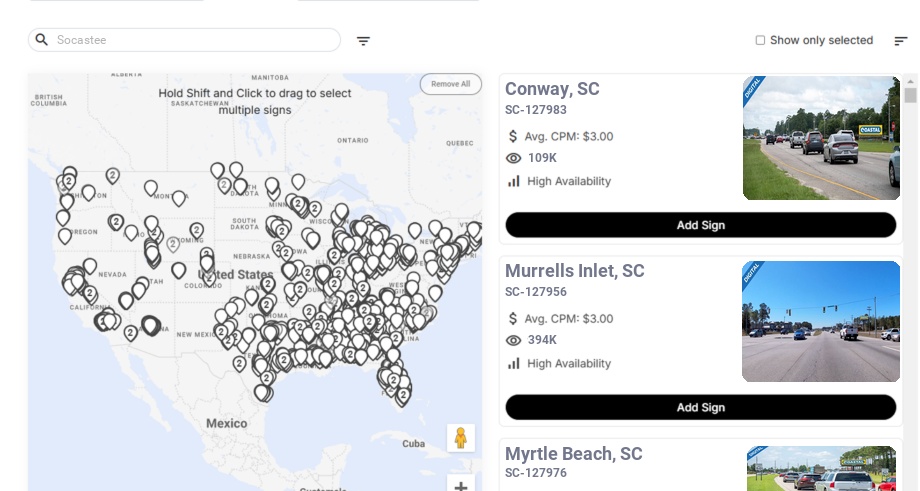
Blip has digital billboards near Socastee. You can browse available locations on a map, choose the ones that fit your audience, and start advertising right away.
Still have questions? Launch a campaign in minutes — no contracts, no commitments.
Start Your CampaignSocastee Billboard Advertising Guide
The Socastee area sits at the heart of one of the fastest‑growing coastal regions in the United States. With strong year‑round local traffic, explosive seasonal tourism, and major commuting corridors linking Socastee to Myrtle Beach and Conway, digital billboards near Socastee give us a powerful way to reach both residents and visitors exactly when and where it matters most. For many brands, these Socastee billboards provide the first, most consistent touchpoint with Grand Strand consumers on the road.
Understanding the Socastee Market
Socastee is an unincorporated community and census‑designated place in Horry County, immediately southwest of Myrtle Beach and southeast of Conway. It has grown rapidly over the past decade as a residential hub for people who work, shop, and play throughout the Grand Strand, making billboard advertising near Socastee increasingly valuable for local and regional businesses.
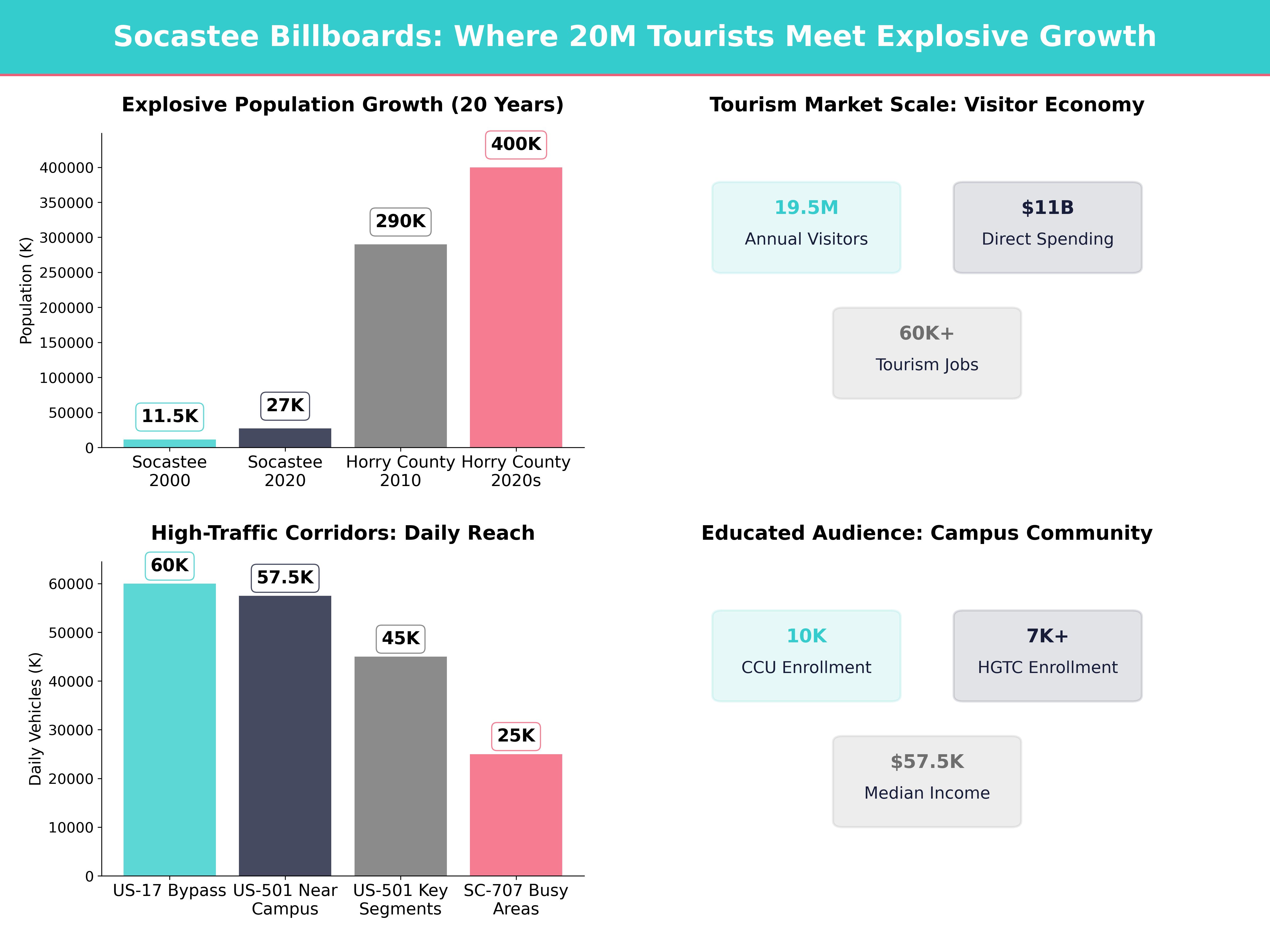
- The Socastee CDP counted roughly 27,000 residents in 2020, more than double its population in 2000 (around 11,000–12,000), reflecting well over 100% growth in about 20 years driven by new subdivisions and proximity to beaches and major employers.
- Horry County as a whole surpassed 400,000 residents by the early 2020s, according to Horry County Government, up from roughly 290,000 in 2010—an increase of about 35–40% in a decade. County planning documents routinely place Horry among the top 5 fastest‑growing counties in South Carolina.
- The broader Myrtle Beach–Conway–North Myrtle Beach metropolitan area has grown to well over 500,000 people, adding an estimated 15,000–20,000 residents every few years as retirees, families, and service‑industry workers move in.
- Recent federal estimates show Horry County’s median age in the low‑40s and a sizable 55+ population, while median household incomes have climbed into the $55,000–$60,000 range, supporting a broad mix of value‑oriented and higher‑end consumer spending.
Socastee residents are deeply tied into nearby economic centers:
- Many commute daily along SC‑707, US‑17 Bypass, and US‑501 toward Myrtle Beach, Coastal Carolina University, Horry‑Georgetown Technical College, and Conway.
- The area is also a gateway to the Myrtle Beach International Airport (MYR) 3.2 million passengers in 2022 and has grown air service by more than 40% in the past decade, according to the airport’s published statistics.
- Employment in Horry County is heavily concentrated in accommodation and food services, retail trade, and healthcare, together accounting for well over 40% of local jobs, based on county economic profiles.
With 21 digital billboards serving the Socastee area across nearby Myrtle Beach and Conway (all within about 10 miles), we can reach this audience at multiple touchpoints throughout their typical week—commuting, shopping, and recreating along the Grand Strand. For businesses exploring billboard rental near Socastee, this cluster of inventory makes it possible to build efficient coverage without needing a massive budget.
Tourism: The Multiplier for Your Reach
While Socastee is primarily residential, its proximity to Myrtle Beach dramatically amplifies advertising potential.
According to Visit Myrtle Beach Myrtle Beach Area Chamber of Commerce
- The Grand Strand attracts roughly 19–20 million visitors each year, with recent tourism reports pegging visitation at more than 20 million person‑trips in strong years.
- Direct visitor spending in the Myrtle Beach area reaches $10–12 billion annually, supporting an overall economic impact often cited above $20 billion when indirect and induced effects are included.
- Overnight visitors account for the majority of spending, with local tourism data showing average stays of 4–5 nights and party sizes of 3–4 people, which multiplies impressions as families and groups travel together.
- Tourism supports 60,000+ local jobs across hotels, restaurants, attractions, retail, and transportation, making visitor‑facing messaging especially powerful.
- Peak travel periods include March–August, with heavy spikes around spring break (March/April), Memorial Day, July 4th, and Labor Day. In many weeks during June and July, area hotels report occupancy over 80–90%.
Key implications for your billboard strategy near the Socastee area:
- Local + visitor mix: Depending on season, daily traffic can swing heavily toward visitors; during peak summer weeks, out‑of‑area license plates commonly account for half or more of visible vehicles along tourist corridors, based on local tourism and transportation observations. This favors simple, broadly relevant offers (dining, attractions, medical, auto, retail, real estate, financial services, etc.) on both Myrtle Beach– and Conway‑facing Socastee billboards.
- Multiple impressions: With an average vacation length of 4–7 days and typical visitors making 3–6 car trips per day (hotel–beach–shopping–dining), billboards in the Myrtle Beach and Conway corridors can easily generate dozens of impressions per visiting party in just a few days.
- Off‑season opportunity: Fall golf and festival season, winter snowbirds, and spring events keep a steady baseline of visitation—often 6–8 million trips outside of peak summer. Lower competition on billboards near the Socastee area in these periods can produce very efficient visibility and higher share of voice for local advertisers.
For event‑driven campaigns, check calendars from Visit Myrtle Beach City of Myrtle Beach City of Conway
Where Traffic Flows: Key Corridors Serving the Socastee Area
Although our digital billboards are located in Myrtle Beach and Conway, they sit directly on the routes Socastee residents and visitors use most. When planning your campaign, it helps to think in terms of traffic patterns rather than municipal borders so your billboard advertising near Socastee naturally intercepts the highest‑value trips.
Some of the most important corridors and nodes include:
-
US‑17 Bypass (near Myrtle Beach)
- Major north‑south artery connecting Socastee to Myrtle Beach, Surfside Beach, and North Myrtle Beach.
- Serves large retail centers like Coastal Grand Mall, restaurants, medical offices, and attractions.
- South Carolina Department of Transportation (SCDOT) traffic count data show key segments of US‑17 Bypass near Myrtle Beach carrying 50,000–70,000 vehicles per day in recent years, with peak summer volumes significantly higher on weekends.
- Carries a mix of daily commuters and heavy tourist traffic in peak months.
-
US‑501 (Conway–Coastal Carolina–Myrtle Beach corridor)
- Primary route from inland South Carolina to the Grand Strand, passing through Conway and toward Myrtle Beach.
- Heavy traffic volumes, often exceeding 40,000–50,000 vehicles per day on key segments according to South Carolina DOT, with some sections near Coastal Carolina University and Horry‑Georgetown Technical College trending closer to 55,000–60,000 vehicles per day.
- Captures tourists arriving from I‑95 and I‑20 as well as local students and workers commuting to colleges, hospitals, schools, and government offices in Conway.
-
SC‑707 / Socastee Boulevard corridor
- While digital billboards are concentrated near Myrtle Beach and Conway, SC‑707 is the critical connector from the Socastee area to those boards.
- Recently completed widening projects along portions of SC‑707 have increased capacity, and SCDOT traffic counts show 20,000–30,000 vehicles per day on busy sections, reflecting its role as a primary commuter route.
- Residents use this route to reach beaches, shopping centers, The Market Common
-
Near Myrtle Beach International Airport (MYR)
- Airport passengers exceeded 3 million annually, with MYR reporting growth of more than 25% in enplanements over the last several years as new low‑cost carriers and seasonal routes were added.
- A significant share of passengers rent cars or are picked up along Harrelson Boulevard and surrounding corridors, where nearby boards can capture attention.
- Ideal for campaigns targeting tourists at the start or end of their visit (hotels, attractions, restaurants, transportation services, beachwear, and grocery).
When selecting Blip locations, we recommend:
- Choosing US‑17 Bypass boards to target Socastee residents heading to Myrtle Beach for work, shopping, or entertainment, as well as beach‑bound tourists.
- Using US‑501/Conway boards to capture inland visitors and local commuters; this is especially effective for colleges, healthcare, automotive, and regional retail that draw from across Horry County and neighboring counties.
- Testing different combinations of boards to find the best performance relative to your budget and audience, using SCDOT’s traffic maps and local planning documents from Horry County Planning & Zoning
Local Audience Profiles and What They Mean for Messaging
The Socastee area and surrounding Horry County markets combine several valuable audience segments:
-
Growing family households
- Over the past two decades, Horry County has added tens of thousands of housing units, with much of the growth in single‑family neighborhoods around Socastee, Carolina Forest, and Conway.
- Horry County Schools reports enrollment of more than 45,000 students system‑wide, with several Socastee‑area schools operating near or above capacity—clear evidence of family‑driven growth.
- Strong fit for: pediatric and family healthcare, after‑school activities, youth sports, family dining, churches, and household services (HVAC, lawn care, home improvement, cleaning).
-
Young workforce and students
- Nearby Coastal Carolina University enrolls more than 10,000 students, including a significant number living off‑campus in nearby apartments and neighborhoods.
- Horry‑Georgetown Technical College adds 7,000+ students across its campuses, many of whom commute along US‑501 and US‑17.
- Combined, the local higher‑education community represents 15,000–20,000 students and staff who regularly travel the same billboard corridors.
- Good target for: quick‑service restaurants, nightlife, apartments, career programs, entry‑level jobs, mobile apps/services, and events.
-
Retirees and snowbirds
- The Myrtle Beach metro has a high share of residents aged 55+, with some local estimates indicating that one in four residents falls into the 55+ bracket, and an even higher share in coastal neighborhoods and golf communities.
- Seasonal “snowbird” visitors from the Northeast, Midwest, and Canada often stay one to three months during winter, providing stable off‑season traffic for healthcare, dining, and entertainment.
- Effective categories: healthcare, senior living, financial planning, insurance, golf communities, real estate, and home maintenance services.
-
Service and tourism workers
- Tourism accounts for roughly one in four jobs in the Myrtle Beach area economy, meaning tens of thousands of residents work irregular hours and commute multiple times per day.
- Many workers travel from more affordable inland areas (Conway, Socastee, Carolina Forest) toward oceanfront hotels, attractions, and restaurants.
- Relevant offerings: transportation, affordable dining, tax prep, check‑cashing/financial services, trade schools, staffing agencies, and uniform/gear providers.
For each of these segments, keep your message:
- Clear and benefit‑driven (e.g., “$49 New Patient Exam – 10 Minutes from Socastee Area”).
- Location‑anchored (e.g., “Next to Coastal Grand Mall” instead of only a street address).
- Time‑sensitive when relevant (e.g., “Kids Eat Free Tuesdays” or “Season Pass Sale Ends Sunday”).
Seasonality, Events, and Timing Your Blips
Digital billboards near the Socastee area are especially powerful when we align campaigns with the local calendar.
A few key seasonal patterns, supported by tourism and hotel performance data from Visit Myrtle Beach
-
Spring (March–May)
- Spring break travel drives sharp increases in young families and college‑age visitors; hotel occupancy typically climbs from winter lows into the 60–75% range by April.
- Major events (such as early bike weeks, marathons, and festivals) can spike weekend occupancy above 80%.
- Great for: attractions, restaurants, nightlife, events, and tourism‑based businesses.
- Use Blip’s scheduling tools to increase budgets on weekends and during evening drive times (roughly 4–8 p.m.) as traffic spikes.
-
Summer (June–August)
- Peak tourism: millions of visitors flood Myrtle Beach each summer, with hotel occupancy often surpassing 80–90% in prime weeks per Visit Myrtle Beach
- Average daily room rates and visitor spending are highest in July, making this the prime window for capturing high‑value tourist dollars.
- Strong for nearly all consumer categories, especially those serving visitors (dining, attractions, retail, entertainment, medical/urgent care, and transport).
- Consider running multiple creatives rotating by time of day (breakfast vs. dinner offers, daytime attractions vs. evening entertainment).
-
Fall (September–November)
- Back‑to‑school, college football, and golf season; visitor volume softens but remains significant, particularly for golf groups and event attendees.
- Many fall weekends still see 60–70% hotel occupancy, especially during special events and mild‑weather stretches.
- Focus on: locals, students, home services, healthcare, automotive, and longer decision‑cycle purchases (cars, real estate, elective medical).
-
Winter (December–February)
- Lower tourist traffic but stronger presence of snowbirds, locals, and holiday shoppers.
- Retailers around hubs like Coastal Grand Mall and The Market Common 20–25% of annual revenue in some categories.
- This is often the best time for local businesses to dominate share of voice on digital boards cost‑effectively due to reduced competition.
- Promote: tax prep, healthcare open enrollment, off‑season deals, golf packages, and brand‑building campaigns.
Additionally, keep an eye on:
-
Major local events, parades, bike weeks, and festivals highlighted by Visit Myrtle Beach Myrtle Beach Area Chamber of Commerce
- Sports tourism, such as youth baseball/softball tournaments and cheer/dance competitions at facilities in Myrtle Beach and Conway, which can bring thousands of athletes and families on select weekends.
- Weather‑driven demand (heat waves driving HVAC and ice cream sales, storms increasing demand for roofing, generators, and insurance). Horry County’s coastal climate averages over 50 inches of rain per year, with a defined hurricane season that often boosts interest in home‑protection services.
With Blip, we can intensify your schedule around these windows—ramping up impressions just before and during key events, then scaling back to preserve budget after peak demand passes.
Crafting High‑Impact Creative for Drivers Near Socastee
Traffic in the Socastee area and nearby Myrtle Beach/Conway corridors often includes out‑of‑towners and distracted vacation drivers, so artwork must be instantly understandable. On high‑speed corridors where vehicles travel 45–60 mph, drivers typically have 5–8 seconds of viewing time—so simplicity is critical for any billboard advertising near Socastee.
We recommend:
1. Ultra‑simple layout
- 7 words or fewer as your main headline.
- One dominant focal point (your logo or a product image).
- Large, high‑contrast fonts (avoid script or thin fonts).
- Limit color palette to 2–3 bold colors to preserve contrast in bright coastal sunlight.
Examples tailored to the area:
- “Beachwear 50% Off – Next Exit”
- “Emergency Dentist – 10 Minutes from Socastee Area”
- “New Homes from $300s – Socastee Area Community”
2. Location cues, not just addresses
Visitors and even locals may not know every street name. Use:
- Landmarks: “Near Myrtle Beach Airport,” “Across from Coastal Grand Mall,” or “By Coastal Carolina University.”
- Drive‑time: “5 Minutes from Socastee Area,” “Exit 10, Left 2 Miles.”
- Neighborhood identifiers: “In Market Common,” “Near Carolina Forest,” “Minutes from Surfside Beach.”
3. Time‑bound offers
Tie your creatives to when they run:
- Morning drive: coffee shops, breakfast, car repair, healthcare, daycare.
- Midday: lunch specials, attractions, shopping, auto services.
- Evening: restaurants, shows, bars, grocery, urgent care.
- Use clear urgency: “Tonight Only,” “This Weekend,” “Book by Sunday.”
Blip’s system allows us to upload multiple creatives and schedule them by time of day and day of week, so we can match the message to the audience and context.
4. Seasonal visuals
- Summer: bright colors, beach imagery, sun, water, outdoor dining, flip‑flops, and golf.
- Fall: football, back‑to‑school, festivals, and golf season themes.
- Winter: holiday themes, cozy interiors, off‑season golf or spa packages, snowbird specials.
- Spring: flowers, patios, grad season, spring break, and early beach days.
Using Blip’s Flexibility to Target the Socastee Area
Because our 21 digital billboards serving the Socastee area span Myrtle Beach and Conway, we can design a coverage pattern that mirrors how your ideal customers move through the region. Whether you are testing digital creative for the first time or scaling up an established campaign, this flexible network functions like an on‑demand billboard rental near Socastee.
Some effective approaches:
-
Socastee commuter coverage
- Prioritize boards on Myrtle Beach‑side corridors used by workers traveling to and from the Socastee area, particularly along US‑17 Bypass and near SC‑707 connections.
- Daypart around weekday morning and evening rush (e.g., 7–9 a.m., 4–7 p.m.), when commuter volumes are highest.
- Ideal for: professional services, healthcare, education, gyms, banking, and recurring services like childcare and tutoring.
-
Tourist funnel strategy
- Use Conway‑side US‑501 boards to catch visitors entering the Grand Strand, plus Myrtle Beach boards closer to the shore to reinforce your message once they arrive.
- Increase budget Friday–Sunday when weekend arrivals spike, as tourism reports show that a large share of drive‑market arrivals occur Thursdays and Fridays.
- Great for: hotels, attractions, restaurants, retail, shows, beachwear, and transportation (golf carts, ride services, shuttles).
-
Local dominance in the shoulder and off‑season
- In slower months, buy more frequent blips across more boards at lower overall cost as competition eases.
- Focus on building familiarity with Socastee‑based brands so you are top‑of‑mind when tourism returns; consistent exposure over 12–16 weeks is especially effective for categories like real estate, healthcare, and financial services.
- Consider creative specifically aimed at locals (“Socastee & Conway Locals Save 15%”) to differentiate from purely tourist‑oriented messages.
With Blip, you set your own daily or campaign budget, and you pay per “blip” (each display of your ad), which typically lasts 7–10 seconds. This lets us:
- Start small and test different boards and creatives, then scale winners.
- Shift spend away from underperforming placements, based on your website traffic, call volume, or in‑store results.
- Quickly ramp up in response to real‑time conditions (e.g., a sudden heat wave for HVAC or ice cream shops, or a new housing development announcement in Horry County for real estate and home services).
Tactics by Business Type in the Socastee Area
Here are some example playbooks tailored to common advertiser categories near the Socastee area:
Local restaurants and bars
- Focus on boards closest to Myrtle Beach retail zones and main gateways from Socastee, including corridors serving The Market Common
- Rotate creatives: lunch specials, happy hour, and late‑night menus at appropriate times. Many restaurants see 30–40% of daily sales during dinner, so prioritize evening dayparts.
- Use proximity messaging: “5 Minutes from Socastee Area,” “Near Market Common,” “Across from Coastal Grand Mall.”
- Boost impressions on weekends and during major events or holidays (bike weeks, July 4th, New Year’s Eve), when area visitor counts and local spending spike.
Home services and contractors
- Target commuting boards used daily by Socastee and Conway homeowners, especially those on US‑501 and US‑17 Bypass where local traffic is highest.
- Use simple benefit lines: “Roof Leaks? Call Before the Next Storm,” “$0 Service Call – Socastee Area,” “Free HVAC Check‑Up – Book Today.”
- Emphasize phone number and website; consider running heavier during hurricane and thunderstorm seasons, when local insurance and roofing claims historically rise.
- Layer in seasonal messages: spring landscaping, summer HVAC, fall roofing and gutters, winter remodeling.
Healthcare and dental
- Promote convenience: “Walk‑In Urgent Care – Open 8am–8pm,” “Same‑Day Dental Appointments,” “Telehealth Visits Available.”
- Align heavier scheduling in early mornings, evenings, and weekends when consumers think about care needs and have flexibility to book.
- Use reassuring imagery and local credibility (“Serving Grand Strand Families Since 2005,” “Near Socastee High School,” “Across from Conway Medical Center”).
- For specialists (orthopedics, cardiology, imaging), focus on boards with strong reach into both locals and visitors, as many seasonal residents seek care while in town.
Real estate and new developments
- Leverage growth in the Socastee area and across Horry County, where building permits and subdivision approvals have trended upward for years in county planning reports.
- Use directional wording: “New Homes – 3 Miles from Socastee Area Schools,” “Waterfront Living Near the Intracoastal,” “New Conway Community off US‑501.”
- Run consistently over several months to build recognition and trust—homebuyers typically spend several weeks to months in the consideration phase.
- Promote both primary residences and second‑home/condo investments, especially during high‑income visitor seasons (spring and summer).
Attractions, entertainment, and retail
- Concentrate on tourist‑rich corridors and boards near hotels, major shopping centers, and the airport.
- Run higher frequency in peak months, with special offers (“Show This Code for 10% Off”) to track impact.
- Time evening entertainment ads in afternoon and early evening, when families plan their nights; many attractions see 50%+ of daily attendance after 3 p.m. during summer.
- Coordinate messaging with event schedules from Visit Myrtle Beach
Measuring and Optimizing Your Campaign
While billboards are a top‑of‑funnel medium, we can still measure and improve performance using a mix of direct and indirect indicators:
-
Traffic and audience context
- Use public resources like South Carolina DOT for traffic count maps and Horry County Government for growth and planning documents.
- Focus on boards where Average Annual Daily Traffic (AADT) is 40,000+ vehicles for maximum reach, and pair those with more local, neighborhood‑oriented boards for depth.
-
Trackable calls to action
- Unique URLs or landing pages referenced only on billboards (e.g., yoursite.com/socastee).
- QR codes (large and simple) in low‑speed environments or near traffic lights; keep in mind that on 45–55 mph corridors, QR codes are less practical.
- Billboard‑specific promo codes or phone numbers; many local advertisers report that 10–20% of new customers mention “saw your sign” when asked.
-
Compare time windows
- Observe website traffic, Google Business Profile views, form fills, or call volume when your Blip campaign is active vs. paused.
- Track in‑store metrics such as walk‑ins, coupon redemptions, or event attendance for specific weekends when you increase your Blip budget.
- Listen for “How did you hear about us?” responses and track “saw your sign” mentions over at least 4–8 weeks to identify trends.
Local news outlets such as The Sun News / MyrtleBeachOnline.com WMBF News, and WPDE NewsChannel 15 can also help you stay up‑to‑date on development projects, traffic changes, and new events that may influence where and when to advertise. Monitoring these sources will alert you to:
- New road projects or detours that might change traffic patterns.
- Announcements of major employers, schools, or residential developments near your boards.
- New festivals, sports tournaments, and tourism initiatives that could warrant short‑term Blip budget increases.
Bringing It All Together
Digital billboards near the Socastee area offer a unique blend of:
- Consistent exposure to a rapidly growing local population of roughly 27,000 in Socastee and 400,000+ in Horry County.
- Massive seasonal reach to 19–20 million annual visitors whose trips generate billions of dollars in local spending.
- High‑traffic corridors such as US‑17 Bypass and US‑501, where daily vehicle counts frequently exceed 40,000–60,000 cars.
- Flexible, budget‑friendly scheduling and targeting options through Blip, letting you align your presence with peak traffic, key events, and seasonal demand.
By understanding Socastee’s role within the broader Grand Strand, focusing your creative on location clarity and simple offers, and aligning your schedule with traffic flows and seasonal patterns, we can build a campaign that delivers meaningful visibility and measurable results for your business using billboards near Socastee and the surrounding coastal market.