Billboards in Little River, SC
No Minimum Spend. No Long-Term Contracts. Just Results.
Trusted by Leading Brands


Billboard advertising
in Little River has never been easier



How much is a billboard in Little River?
Why Choose Blip for Billboard Advertising in Little River
-
Little River brands launch fast with Blip's self-serve tools, reaching US-17 commuters and Grand Strand visitors without a sales process.
-
Set flexible daily budgets in Little River and scale up for summer beach traffic or dial back in winter—no contracts needed.
-
Use dayparting in Little River to hit 6-9 a.m. commuters, midday tourists, and Friday check-ins on US-17 and bridge routes.
-
Blip's real-time analytics help Little River advertisers track what works as traffic surges near the Intracoastal Waterway and Ocean Isle Beach.
-
Create and swap Little River billboard creatives quickly for ShrimpFest, Blue Crab Festival, or rainy-day waterfront dining with Blip's tools.
Frequently Asked Questions About Billboard Advertising in Little River
How much does a billboard cost near Little River, South Carolina with Blip?
With Blip, you control exactly what you spend on Little River billboards by setting a daily budget that can be adjusted anytime, so your campaign always stays within your comfort zone. Each “blip” is a brief 7.5–10 second ad, and you only pay for the blips you receive, making it a flexible, pay-per-blip option for businesses serving the Little River area. The price of billboards near Little River, South Carolina depends on when your ad runs, where it shows, and real-time advertiser demand, so your total cost is simply the sum of each blip over time.
Where can I advertise with Blip near Little River, South Carolina?
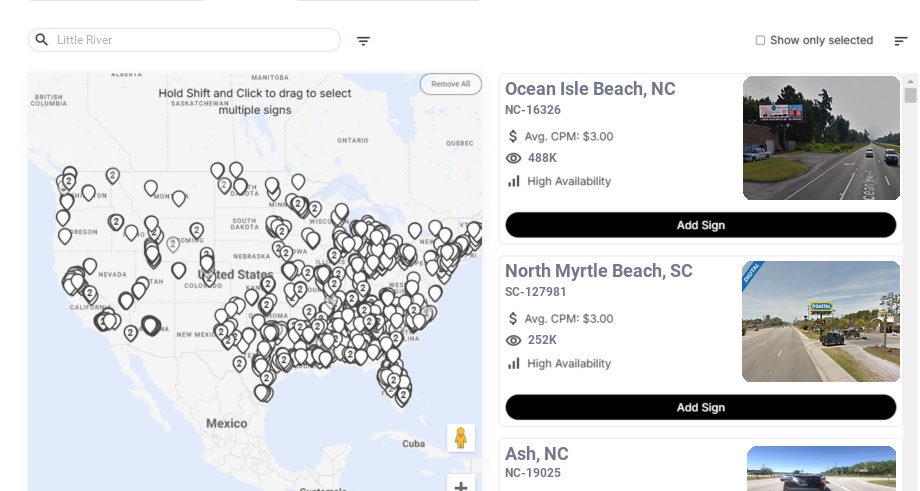
There are 7 nearby digital billboards in North Myrtle Beach and Ocean Isle Beach serving the Little River area, giving you reach across both local and visitor traffic. The boards in North Myrtle Beach can intercept Little River residents traveling south, while the Ocean Isle Beach boards can attract North Carolina visitors into the Little River area. These locations offer powerful visibility without having to place signs directly in residential zones.
Who sees Little River, South Carolina billboards most often?
Little River sits between high-volume tourist corridors and quiet residential neighborhoods, so ads can reach both locals and millions of visitors moving along the Grand Strand. The Little River area has a population of roughly 10,000–11,000 residents, while the broader Grand Strand attracts an estimated 19–20 million visitors annually. That mix makes the market useful for campaigns aimed at both recurring residents and seasonal tourists.
When is the best time to run Blip ads near Little River, South Carolina?
The Little River area is highly seasonal, with peak summer from June through August bringing the highest visitor counts and the most road congestion. Shoulder seasons like April–May and September–October still have strong traffic, while winter is ideal for campaigns focused on local services, healthcare, financial planning, education, and real estate. The page also recommends increasing your daily budget from Memorial Day to Labor Day for tourist-facing businesses.
What kinds of businesses work best on Little River, South Carolina billboards?
The page says the area’s older, stable resident base favors campaigns for healthcare, financial services, home improvement, real estate, and leisure activities that appeal to 50+ adults. It also highlights strong opportunities for restaurants, bars, waterfront dining, charters, cruises, watersports, vacation rentals, and local events. Because the market includes both locals and tourists, different industries can target different dayparts and seasons.
Do I need a contract to advertise with Blip in Little River?
No, Blip has no long-term contracts or minimum commitments. You can start, pause, or stop your campaign at any time.
How fast can I launch a billboard campaign with Blip in Little River?
You can have your campaign live in minutes. Create a free account, select your locations, set your budget, upload your design, and start running once approved.
Where can I advertise with Blip in Little River?
Blip has digital billboards in Little River. You can browse available locations on a map, choose the ones that fit your audience, and start advertising right away.
Still have questions? Launch a campaign in minutes — no contracts, no commitments.
Start Your CampaignLittle River Billboard Advertising Guide
Nestled where the Intracoastal Waterway meets the Atlantic, the Little River area sits between high-volume tourist corridors and quiet residential neighborhoods. With 7 nearby digital billboards in North Myrtle Beach and Ocean Isle Beach serving the Little River area, we can put messages in front of both locals and millions of visitors moving along the Grand Strand. For businesses searching for billboards near Little River or flexible billboard rental near Little River, these locations offer powerful visibility without having to place signs directly in residential zones. Below, we break down how to use Blip’s tools—timing, location, and creative strategy—to reach this market effectively.
Understanding the Little River Area Audience
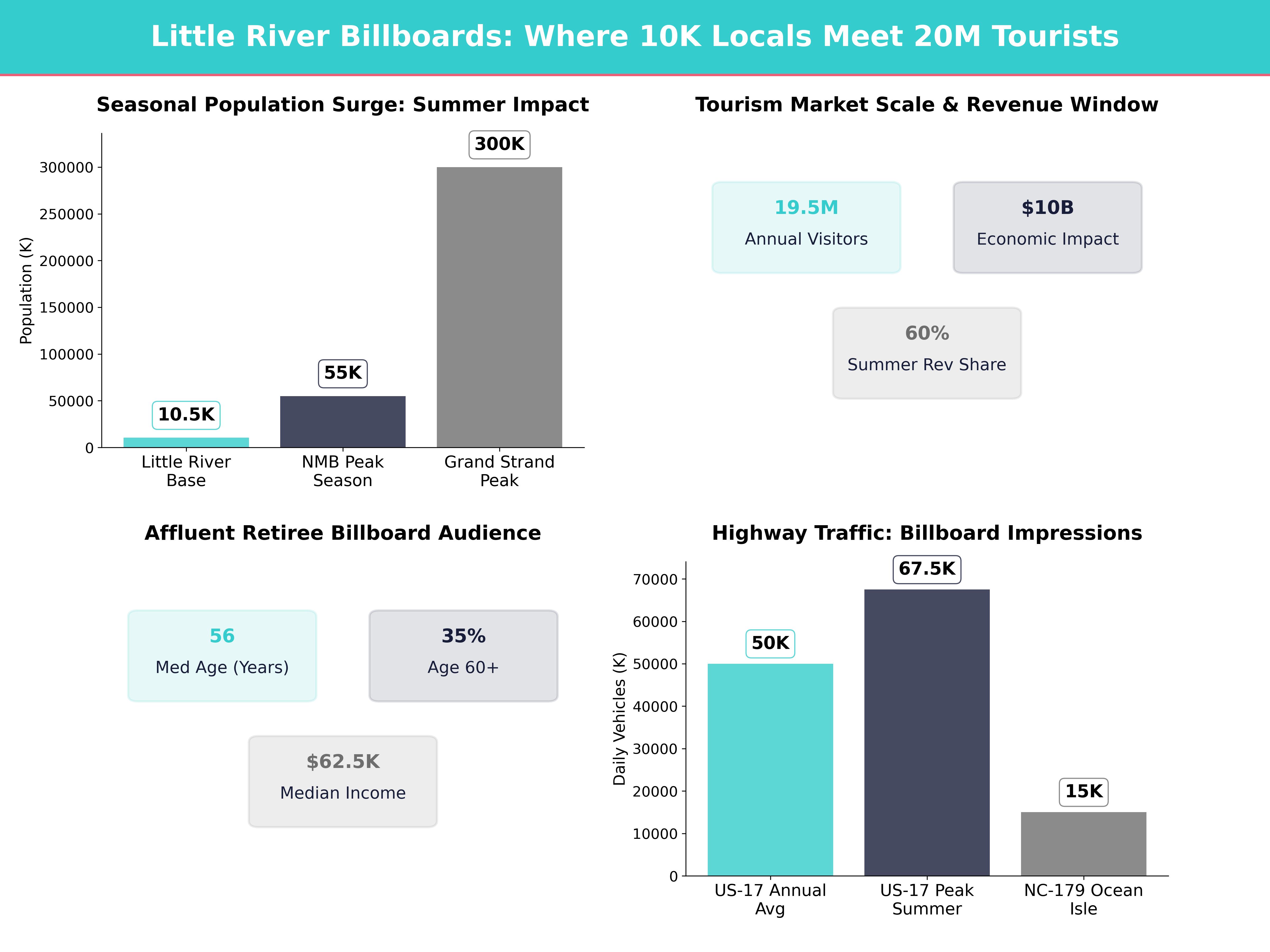
Little River itself is a small but fast-growing community. According to recent county and regional planning estimates, the Little River area has a population of roughly 10,000–11,000 residents, while Horry County as a whole has grown to 380,000+ people in the last few years, adding more than 90,000 residents since 2010. The Grand Strand region, from Little River down past Myrtle Beach, attracts an estimated 19–20 million visitors annually, according to Visit Myrtle Beach well over $10 billion per year into the local economy when you factor in lodging, food, retail, and entertainment spending reported by regional tourism and economic development agencies.
Key demographic and lifestyle characteristics to consider:
-
Older, stable base of residents
- The median age in the Little River area is in the mid–50s (around 55–57 years), significantly older than the U.S. median age in the low 40s.
- In many nearby coastal neighborhoods, 30–40% of residents are 60+, reflecting a high concentration of retirees and semi-retirees.
- Owner-occupied housing rates in the area are commonly 70–75%, and in some Little River neighborhoods, the share of seasonal or second homes can reach 20% or more, based on county property records.
- Household incomes skew moderate to upper-middle; many zip codes around Little River report median household incomes in the $55,000–$70,000 range, with a sizable share of households holding investment assets and retirement savings.
- This favors campaigns for healthcare, financial services, home improvement, real estate, and leisure activities that appeal to 50+ adults and respond well to ongoing billboard advertising near Little River.
-
Tourism-dominated regional economy
- Horry County identifies tourism as a multi-billion-dollar driver for the region, supporting tens of thousands of jobs in lodging, food service, retail, and recreation.
- Across the Grand Strand, there are 90,000+ accommodation units when you combine hotels, condos, and vacation rentals, and summer-season hotel occupancy frequently runs in the 80–90% range in core beach weeks, as reported by regional tourism and hospitality groups.
- North Myrtle Beach, just 3.3 miles from Little River, counts nearly 19,000 residents but swells to several times that in peak summer months, per City of North Myrtle Beach and North Myrtle Beach Chamber / CVB data. Many weeks, daily population in North Myrtle Beach can exceed 50,000–60,000 people when visitors are included.
- Ocean Isle Beach, about 9.2 miles away in Brunswick County, also draws large seasonal visitor volumes relative to its small year-round population of roughly 1,000 permanent residents, as highlighted by Brunswick County tourism and town information NC’s Brunswick Islands. During peak weeks, daily population on the island can multiply by 10x or more.
-
High car dependence and drive-time lifestyles
- Horry County and neighboring Brunswick County are heavily auto-oriented. Recent commuting profiles show that 80–85% of workers in the region drive to work alone, with minimal public transit usage.
- Average one-way commute times for Horry County residents are typically 21–24 minutes, and many Little River residents routinely travel to North Myrtle Beach or other parts of the Grand Strand for work, shopping, and services.
- Limited fixed-route transit options mean residents also drive for medical appointments, grocery trips, and entertainment across Horry County and into Brunswick County, NC.
- This makes roadside media and Little River billboards particularly strong for frequency and recall, with the average local resident passing key highway segments dozens of times per month.
For advertisers, this mix means we can speak both to recurring, higher-income locals and to waves of tourists with different needs—if we adjust messaging and scheduling by season using Blip’s flexible tools.
Traffic Patterns, Commuter Flows, and Where Billboards Fit
The Little River area’s road network channels people toward North Myrtle Beach and down the Grand Strand, as well as up the coast into North Carolina. Our digital billboards in North Myrtle Beach and Ocean Isle Beach are positioned along these key flows, serving the Little River area at high-traffic touchpoints. When you invest in billboard advertising near Little River, your message can ride along these everyday and seasonal traffic patterns.
Key corridors and estimated traffic volumes:
-
US-17 (Kings Highway / Ocean Highway)
- US-17 is the spine of the Grand Strand. South Carolina Department of Transportation (SCDOT) traffic count maps show average daily traffic (ADT) of roughly 45,000–55,000 vehicles per day along US-17 near North Myrtle Beach, with certain segments closer to Myrtle Beach exceeding 60,000 vehicles per day in annual averages.
- Seasonal peaks can run 10–25% higher than annual averages during June–August, pushing some days above 65,000–70,000 vehicles on core stretches.
-
This route captures:
- Little River residents heading south for shopping, dining, work, and entertainment.
- Tourists driving between resort areas, attractions, and golf courses.
- Through-travelers moving along the Carolina coast, including a portion of the tens of millions of annual vehicle trips between South Carolina and North Carolina beach destinations.
-
NC-179 / local connectors into Ocean Isle Beach
- North Carolina Department of Transportation (NCDOT) statistics for coastal Brunswick County show key segments near Ocean Isle Beach with 10,000–20,000 vehicles per day in annual averages, depending on the specific roadway.
- During peak summer weeks, counts on causeways and island access roads often rise 30–40% above annual averages, reflecting heavy visitor turnover in vacation rentals.
- Traffic near Ocean Isle Beach rises significantly from late spring through early fall as short-term rentals fill up and day-trip visitation from inland NC markets increases.
-
Intracoastal Waterway bridges and access routes
- Bridges into Cherry Grove, Ocean Drive, and Ocean Isle concentrate traffic at predictable choke points, where speeds often slow below 25–35 mph in peak times—ideal for legible billboard reads and high impression counts.
- On major check-in days (Fridays and Saturdays), some bridge approaches experience congestion spikes where backups can last 20–40 minutes, generating repeated exposures to the same motorists.
With Blip, we can buy exposure on these boards by the “blip,” adjusting budgets and timing to focus on:
- Morning and late-afternoon commuting patterns for Little River area residents, when weekday volumes on US-17 and nearby arterials are consistently high.
- Midday and early-evening travel when tourists are driving between beaches, restaurants, golf courses, and entertainment venues—periods when visitor-serving businesses see their highest conversion potential.
- Weekend surges, especially Friday inbound and Sunday outbound traffic in peak season, when vacationer turnover is highest and many corridors see 20–30% higher traffic than midweek.
Seasonality: When to Turn Up (or Down) Your Spend
The Little River area is highly seasonal, but its seasonality is not one-dimensional. We have year-round retirees, snowbirds, spring and fall festivals, and the massive summer vacation season. Data from Horry County, Visit Myrtle Beach local tourism organizations
-
Peak Summer (June–August)
- Visitor counts along the Grand Strand peak in this window; some local estimates suggest 35–45% of annual visitors arrive during these three months. That can mean 7–9 million visitors in summer alone.
- Many beachfront properties report hotel and rental occupancies regularly exceeding 85–90% in popular weeks, with average daily rates (ADR) often 20–40% higher than shoulder seasons.
- Road congestion is highest, increasing impressions per digital billboard spot. Some highway segments can see 15–25% more traffic than their annual daily averages.
- Restaurant, attraction, and retail sales often reach 2–3x their off-season monthly averages, based on regional hospitality and tax collections.
-
Shoulder Seasons (April–May, September–October)
- Golfers, festivals (like the Little River Blue Crab Festival), sports tournaments, and milder-weather vacationers fill in these periods.
- Occupancy levels commonly sit in the 55–75% range for many properties, and golf rounds across the Grand Strand spike in spring and fall.
- Traffic is still strong; many corridors run at 70–90% of summer volumes, but media competition is usually lower than peak summer, which can improve cost-efficiency and effective CPMs.
-
Winter (November–March)
- Visitor counts dip, but the local base becomes more prominent, along with long-term snowbirds staying 4–12 weeks.
- Lodging occupancy often drops into the 30–50% range outside major holidays, yet grocery, healthcare, and service-sector demand remains steady due to the older year-round population.
- This is ideal for campaigns focused on local services, healthcare, financial planning, education, and real estate, where competition for attention is lower and frequency is easier to achieve.
How to use Blip’s flexibility around this:
- Increase your daily budget and share of voice from Memorial Day to Labor Day if you sell anything tourist-facing: attractions, restaurants, entertainment, watersports, retail, or lodging. Many advertisers see 50–70% of their annual revenue within this period, and board inventory is at a premium.
- Run always-on, low-intensity campaigns during the rest of the year to stay top of mind among Little River area residents at a lower spend, maintaining presence while CPMs are often more favorable.
- Layer in tactical bursts around specific events listed by local outlets such as Visit Little River, City of North Myrtle Beach event calendars, and local news like WBTW News13 Little River ShrimpFest, the Blue Crab Festival, St. Patrick’s Day events in North Myrtle Beach, or North Myrtle Beach sports tournaments that can bring thousands of additional visitors on a single weekend.
Targeting Local vs. Tourist Audiences
Because the nearby boards serving the Little River area sit in heavily visited zones, we can tailor campaigns separately for locals and visitors, sometimes on the same screens at different times. This makes Little River billboards especially versatile for businesses that have both local and tourist customer bases.
Reaching local Little River area residents
Locals are most likely to travel repeatedly on:
- US-17 between Little River and North Myrtle Beach, where many residents drive 10–20 miles per day for work and errands.
- Routes to major shopping areas, medical centers, and service corridors in North Myrtle Beach and beyond, including large retail clusters that can attract several thousand vehicle trips per day.
- Everyday paths to grocery stores, schools, and churches, which generate consistent weekday and Sunday traffic even outside tourist peaks.
To target them effectively:
-
Daypart around commuter windows
- Weekday 6–9 a.m. and 3–7 p.m. blips will frequently hit working residents and active retirees running errands. Regionally, these windows account for 40–50% of daily commuter trips.
- Use clear, benefit-driven messaging: “Primary Care 10 Minutes North on 17,” “Trusted Tax Prep for Little River Families,” etc.
-
Lean on familiarity and place names
- Call out Little River, nearby neighborhoods (e.g., Cherry Grove, Barefoot area), and recognizable landmarks (e.g., “Near the Swing Bridge”).
- This reinforces that you are part of the community, not just a tourist-only brand, and can increase trust and recall, especially for higher-consideration purchases such as healthcare, real estate, and financial services.
-
Promote services locals need year-round
- Examples: HVAC and home services, real estate, insurance, auto repair, local banks and credit unions, healthcare practices, legal services, pet care, and senior living communities—all of which see steady demand from a base where over one-third of households include someone aged 60+.
Reaching tourists and vacationers near Little River
Tourists cluster heavily in lodging zones and along the main coastal corridors served by our North Myrtle Beach and Ocean Isle Beach boards. On a typical peak-season day, the combined population of visitors and residents in the Grand Strand can exceed 300,000 people, with a large share on the move by car.
To reach them:
-
Schedule heavier blips mid-day and early evening
- Many visitors drive around 10 a.m.–6 p.m. to and from beaches, attractions, and restaurants. Mobile location data for coastal markets like the Grand Strand commonly show tourist trip peaks late morning and late afternoon.
- Target weekend check-in/check-out patterns: Fridays 2–8 p.m. and Sundays 9 a.m.–2 p.m. often see the highest lodging-related traffic, as tens of thousands of visitors transition in and out of rentals.
-
Use fast, experience-focused messaging
- Emphasize unique experiences: “Fresh Local Seafood in Little River – 5 Miles North,” “Sunset Dolphin Cruises – Book Today,” “Best Waterfront Dining – Little River Waterfront.”
- Include clear directional cues and distance markers to capture impulse stops. Studies of highway advertising show that adding a distance marker such as “Next Right” or “2 Miles” can improve response and visitation rates by 15–30% compared to generic branding.
-
Align with weather and time-of-day behavior
- On very hot or rainy days, visitors look for indoor activities—ideal for cinemas, arcades, indoor attractions, and restaurants. Summer afternoons frequently see “feels like” temperatures above 95°F, which pushes more people to seek air-conditioned venues.
- Consider rotating creatives that highlight “Rainy Day Fun” or “Cool Off Here” during those conditions. Even switching creatives just a few times per season can significantly increase relevance and recall.
Creative Strategy for the Little River Area
Billboards serving the Little River area must grab attention quickly amid the visual noise of beach advertising, tourist attractions, and roadside retail. Our best-performing campaigns here tend to share several traits:
1. Bold, high-contrast designs
-
Use large fonts and 1–2 main colors against a contrasting background. Tests across multiple roadside campaigns routinely show that high-contrast designs can boost ad recall by 20–40% compared to low-contrast layouts.
- Avoid thin script fonts; they’re hard to read at 45–55 mph.
- Keep to 7 words or fewer on the main line whenever possible. The average driver has 3–5 seconds to process your message at highway speeds.
Examples:
- “Fresh Seafood – Little River Waterfront”
- “Family Golf – 5 Miles North on 17”
- “New Homes from the $300s – Little River”
2. Visuals that match coastal expectations
The Little River area is defined by water, marshes, boating, and golf:
- Use imagery of boats, marsh sunsets, piers, or golf fairways when relevant; coastal imagery aligns with visitor expectations and can increase engagement for tourist-facing offers.
- For local service providers, subtle coastal cues (colors, background imagery) can signal local roots without overloading the design, which is important given the limited viewing time.
3. Clear directional and geographic cues
Because our boards are in North Myrtle Beach and Ocean Isle Beach serving the Little River area, precise location cues help convert impressions into visits:
- Include distance (“5 Miles North,” “Exit in 2 Miles,” “Next Right at Swing Bridge”).
- Use simple map icons or arrows rather than full maps.
- Reference known place names like “Little River Waterfront,” “Harbour,” or “Casino Boat Dock” when appropriate; these are recognizable to both locals and repeat visitors and can reduce hesitation to try a new business.
4. Multiple creatives for different segments
Blip lets us upload multiple creatives and control when they run. In the Little River area, we can:
- Run one creative focused on locals during weekday rush hours (e.g., medical or financial services).
- Run another focused on tourists during midday and evening (e.g., waterfront dining or attractions).
- Use a third for event-specific promotions (festivals, live music nights, golf tournaments).
- Campaigns that rotate at least 2–3 creatives per season typically generate higher engagement than those that run a single static message all year.
Using Blip’s Tools to Maximize ROI
To make the most of the 7 nearby digital billboards serving the Little River area, we can combine location targeting, scheduling, and budget control. Blip’s platform effectively becomes a self-serve hub for billboard rental near Little River, allowing you to scale up or down without long-term contracts.
1. Start with a clear geographic strategy
-
Use boards in North Myrtle Beach (3.3 miles away) to intercept:
- Little River residents traveling south for work, retail, and healthcare.
- Tourists staying in North Myrtle Beach who may visit Little River for dining, boating, or events—this group alone can number tens of thousands of people per day in peak season.
- Visitors who may not recognize “Little River” by name yet, but will respond to “waterfront dining,” “casino cruise,” or “fishing charter” messages.
-
Use boards in Ocean Isle Beach (9.2 miles away) to:
- Attract North Carolina visitors into the Little River area for day trips, dining, or gaming cruises. Brunswick County’s population has grown more than 30% since 2010, adding to the pool of nearby repeat visitors.
- Support cross-border businesses (e.g., insurance, real estate, healthcare) that serve both SC and NC clients who routinely travel between Brunswick County and Horry County.
2. Budget by priority season and audience
-
For a tourist-centric business (restaurant, charter, attraction):
- Allocate 50–70% of your annual Blip budget to May–September, aligning with peak tourism and shoulder strength.
- Within that period, concentrate up to 60% of the seasonal spend on Fridays–Sundays, when visitor spending and traffic are highest.
- Maintain a 30–50% “baseline” of impressions Mon–Thu to reach extended-stay visitors and locals, smoothing demand across the week.
-
For a local service provider (medical, financial, trades):
- Distribute spend more evenly year-round, with perhaps 20–30% of your annual budget in peak summer (to stay visible among locals when roads are crowded) and the balance weighted to the rest of the year.
- Increase your daily budget by 20–30% during winter and early spring, when locals’ schedules are less dominated by visiting friends and family and when they are more likely to make decisions about healthcare appointments, home projects, and financial planning.
3. Use dayparting to match real local behavior
- Morning (6–9 a.m.): commuters, retirees heading to appointments, school traffic.
- Midday (11 a.m.–2 p.m.): tourists moving between beach and lunch, shoppers, and service visits.
- Evening (4–8 p.m.): diners, entertainment seekers, families heading out; in summer months, this block includes sunset times when restaurant and waterfront activity peaks.
With Blip, we can set different bid levels for each period. For example:
- Higher bids 11 a.m.–2 p.m. and 4–8 p.m. on weekends for restaurants and attractions that depend on mealtime and evening entertainment traffic.
- Higher bids 7–9 a.m. and 4–6 p.m. weekdays for local professional services and trades seeking repeat visibility with residents making everyday commutes.
Industry-Specific Tactics for the Little River Area
Different sectors can take advantage of the Little River area’s unique dynamics in specific ways. No matter the industry, billboards near Little River can be tuned to your exact demand cycle using Blip’s controls.
Restaurants, Bars, and Waterfront Dining
- Emphasize freshness, local seafood, and waterfront views—core to the area’s appeal. Coastal markets like the Grand Strand see 30–40% of visitor food spending go to seafood and waterfront venues, according to regional tourism surveys.
- Use short, urgent calls to action: “Turn Now for Fresh Local Shrimp,” “Sunset Drinks on the Waterfront Tonight.”
- Coordinate with live music schedules or specials; change creatives weekly or bi-weekly to stay relevant and build anticipation. Digital rotations can highlight daily or weekly specials without printing costs.
Charters, Cruises, and Watersports
- Little River is a launch point for fishing charters and casino boats, drawing both locals and visitors. Peak fishing and boating demand usually aligns with April–October, with highest volumes in May–September.
- Show boat or activity imagery, plus booking details: “Book Today – Morning & Sunset Cruises,” with a short URL or simple domain that’s easy to remember at speed.
- Peak advertising windows: late afternoon/early evening as visitors plan the next day’s activities; many families plan excursions between 4–8 p.m. after coming off the beach.
Real Estate and Vacation Rentals
- Horry County and Brunswick County have experienced substantial new construction and in-migration—each adding tens of thousands of residents over the last decade, with population growth rates in some nearby communities exceeding 3–4% per year.
- Use simple price and product cues: “New Homes – Little River from $350s,” “Waterway Condos – Boat Slips Available.”
-
Consider separate creatives for:
- Out-of-state buyers (“Retire on the Carolina Coast”) who may be part of the 20–30% of visitors coming from states like North Carolina, Virginia, Ohio, and Pennsylvania.
- Local move-up buyers or downsizers (“Stay in Little River, Right-size Your Home”) who already know the area and are more responsive to neighborhood names and HOA details.
Healthcare and Senior Services
- The older population base in the Little River area supports strong demand for primary care, specialists, urgent care, senior living, home health, and physical therapy. In some nearby zip codes, 25–30% of residents are 65+, significantly above national averages.
- Emphasize convenience and trust: “Primary Care 10 Minutes from Little River,” “Same-Day Appointments Available,” “Accepting New Medicare Patients.”
- Daypart heavily on weekday mornings and mid-afternoons when appointment-related traffic is strongest. Many healthcare appointments in the region cluster between 9 a.m. and 3 p.m., making these hours prime for awareness and last-minute decision-making.
Local Events, Festivals, and Entertainment
- Little River’s festivals draw large crowds from around the region. Events like the Blue Crab Festival or ShrimpFest can attract 10,000–20,000+ attendees over a weekend, according to organizers and coverage from outlets such as Visit Little River and local news outlets such as The Sun News
- Partner your timing with promotions by organizations like Visit Little River, Visit Myrtle Beach WMBF News and WPDE.
- Use countdown creatives: “Blue Crab Festival – This Weekend,” then “Today – Exit Now for Festival Parking.” Short-term countdown campaigns in other markets have shown double-digit percentage increases in event attendance compared with generic promotion alone.
Measuring and Refining Your Campaign
Digital billboard advertising near the Little River area becomes more powerful when we track what’s working and iterate. Whether your focus is ongoing brand awareness or short-term promotions, tying your Little River billboards to clear measurement points will help you optimize spend.
Ways to measure impact:
-
Use trackable URLs and promo codes
- Display a short, memorable URL (e.g., “BrandSC.com/river”) or code (“Mention ‘RIVER17’ for 10% Off”).
- Monitor website hits, online bookings, or redemptions tied to these elements. Many advertisers see 5–15% of weekly web sessions arrive via direct or vanity URLs promoted on out-of-home when properly tracked.
-
Align with Google Analytics time windows
- Compare site traffic and online inquiries during your Blip-active dayparts vs. other times.
- Look for lift patterns on days with higher impression counts; a consistent 10–20% uplift in sessions or calls during billboard-active periods is a good signal the campaign is contributing.
-
Watch local demand indicators
- For restaurants and attractions, track peaks in walk-in traffic matching your billboard schedule, particularly in the first 1–2 hours after your highest-frequency dayparts.
- For services, monitor call volume and new patient/customers by asking, “How did you hear about us?”—even a simple tracking question can reveal that 10–30% of new customers first encountered you through roadside visibility.
Then:
- Rotate underperforming creatives out and test new variations (different headlines, colors, or offers). Try to test only one major element at a time so you can attribute performance changes.
- Shift spend toward the boards and times that produce better results, gradually moving budget from low-ROI to high-ROI placements.
- Layer in new messages for each season—spring golf, summer beach, fall festivals, winter locals—so that returning visitors and residents see fresh, timely content rather than stale or out-of-season creative.
By understanding how residents and visitors move through the Little River area and surrounding destinations like North Myrtle Beach and Ocean Isle Beach, we can use Blip’s 7 nearby digital billboards to reach the right people at the right moments. With data-informed timing, focused geography, and clear, compelling creative, advertisers of any size can tap into the traffic and spending power of this unique coastal market, turning high vehicle volumes and strong tourism flows into measurable business results from billboard advertising near Little River.