Billboards near Clemson, SC
No Minimum Spend. No Long-Term Contracts. Just Results.
Trusted by Leading Brands


Billboard advertising
near Clemson has never been easier



How much is a billboard near Clemson?
Why Choose Blip for Billboard Advertising near Clemson
-
Blip lets you launch Clemson billboards in minutes and aim at US-123 and SC-28 traffic without traditional buying hurdles.
-
Set a flexible budget for Clemson, then scale around Clemson University move-in, game days, and graduation weekends as demand rises.
-
Daypart your Clemson ads for weekday commutes, late-afternoon shopping, or Thu-Sat nightlife near campus and Seneca.
-
No contracts mean you can test Clemson campaigns on Pendleton and Seneca corridors, then shift fast based on results.
-
Use Blip's real-time analytics and creative tools to track Clemson performance and tailor messages for students, families, and I-85 visitors.
Frequently Asked Questions About Billboard Advertising near Clemson
How much does a billboard cost near Clemson, South Carolina with Blip?
With Blip, you control exactly how much you spend on Clemson billboards by setting a daily budget that can be adjusted any time, so you can start small and scale as you see results. Each ad is a short “blip” on digital billboards near Clemson, South Carolina, and you only pay for the individual blips you receive, similar to pay-per-click ads online. Pricing for each blip changes based on when you run your ads, where they appear in the Clemson area, and current advertiser demand.
Where can I advertise with Blip near Clemson, South Carolina?
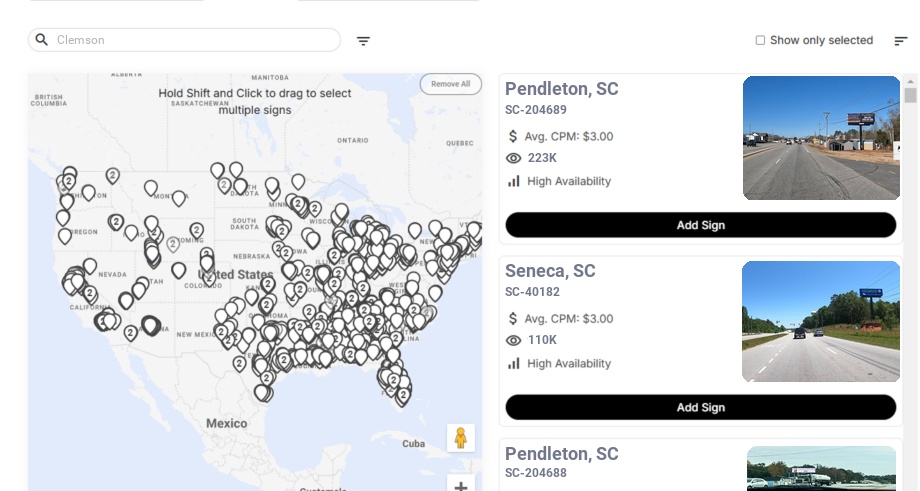
With five Blip digital billboards near Clemson within about 10 miles, centered in Seneca and Pendleton, you can reach locals, students, visiting families, and game-day crowds as they move through the Clemson area every day. Our five digital billboards in Seneca and Pendleton let you tap into these flows and “wrap” the Clemson area with your message without needing a structure inside city limits. For advertisers looking specifically for billboard advertising near Clemson, this cluster of locations functions like a flexible, high-impact Clemson billboard network.
Why is Clemson, South Carolina a strong market for Blip billboard advertising?
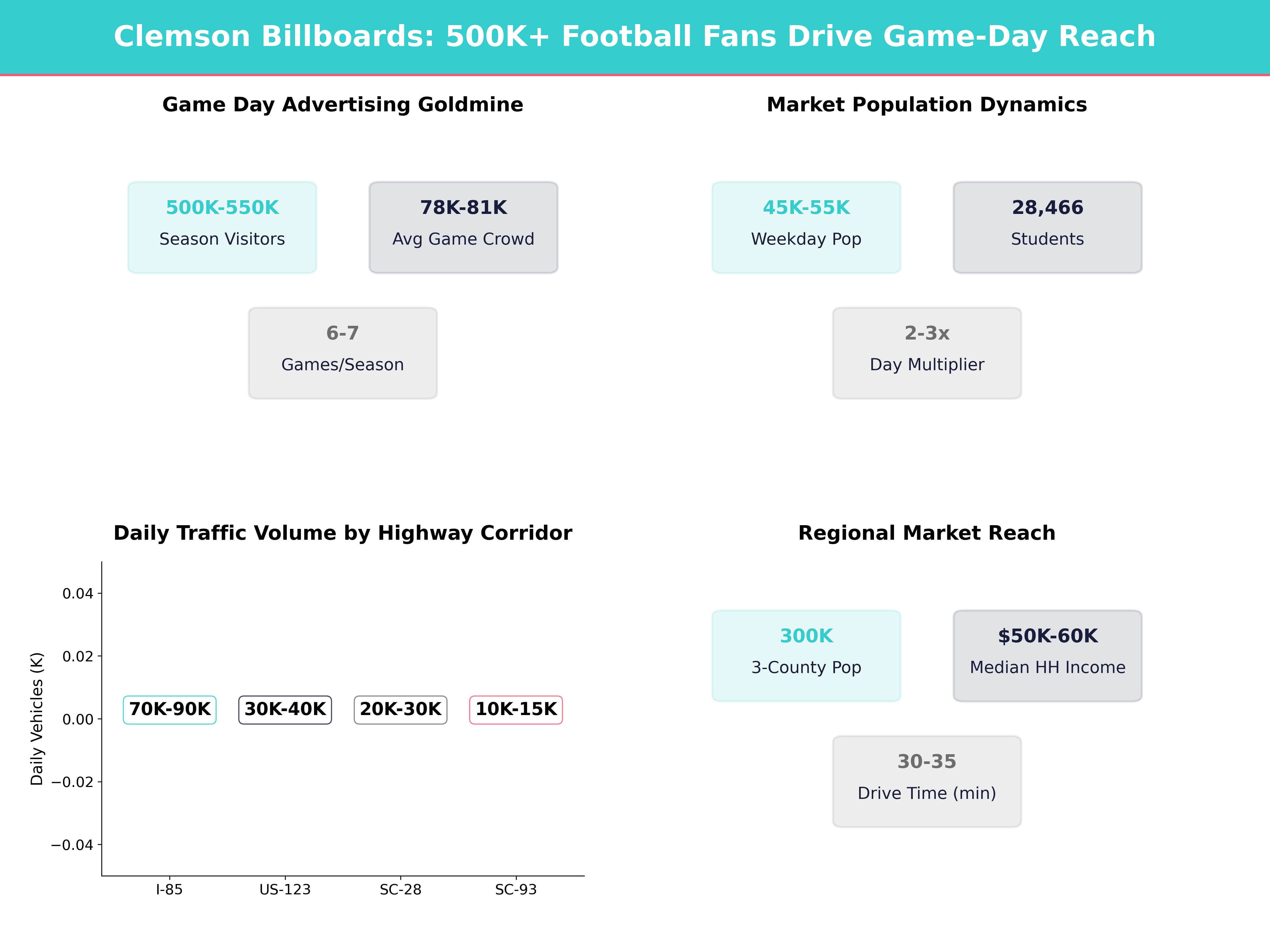
Clemson may be a small city on the map, but the Clemson area behaves like a dense, high-attention media market thanks to Clemson University, regional commuting, and year-round sports tourism. The City of Clemson has an estimated 18,000–19,000 permanent residents, but Clemson University alone enrolled 28,466 students in Fall 2023. When you add faculty, staff, service workers, and visitors, the effective daytime population can exceed 45,000–55,000 people.
When should I run Clemson billboards with Blip for the most impact?
Because Blip lets us buy individual “blips” instead of fixed 4-week contracts, we can match your spend closely to Clemson’s real rhythms and known high-traffic windows. August and September are strong for move-in and early football, October and November bring peak football attendance and fall tourism, and May through July is active with lake season and summer visitors. Weekday mornings, late afternoons, and Thu–Sat evenings are also highlighted as especially useful dayparts depending on your audience.
What roads around Clemson, South Carolina get the most billboard traffic?
Recent SCDOT counts on busy commercial segments of US-123 commonly fall in the 30,000–40,000 vehicles per day range, with some stretches near Seneca retail clusters edging toward the upper end of that band. SC-28 near Seneca often records 20,000–30,000 AADT, and SC-93 through the Clemson area is frequently in the 10,000–15,000 AADT range around campus and downtown. The boards are also positioned to intercept Clemson–Seneca traffic and Clemson–Pendleton traffic, including commuters and visitors connecting from I-85.
Do I need a contract to advertise with Blip near Clemson?
No, Blip has no long-term contracts or minimum commitments. You can start, pause, or stop your campaign at any time.
How fast can I launch a billboard campaign with Blip near Clemson?
You can have your campaign live in minutes. Create a free account, select your locations, set your budget, upload your design, and start running once approved.
Where can I advertise with Blip near Clemson?
Blip has digital billboards near Clemson. You can browse available locations on a map, choose the ones that fit your audience, and start advertising right away.
Still have questions? Launch a campaign in minutes — no contracts, no commitments.
Start Your CampaignClemson Billboard Advertising Guide
Clemson may be a small city on the map, but the Clemson area behaves like a dense, high‑attention media market thanks to Clemson University, regional commuting, and year‑round sports tourism. With five Blip digital billboards near Clemson within about 10 miles—centered in Seneca and Pendleton—we can help you reach locals, students, visiting families, and game‑day crowds as they move through the Clemson area every day. If you’re weighing options for Clemson billboards, this mix of nearby placements gives you market‑wide coverage without overpaying for a single static sign.
Why the Clemson Area Is a Powerful Billboard Market
Clemson sits at the intersection of education, tourism, and regional commerce, which combines to create outsized visibility for outdoor ads:
- Population + students: The City of Clemson has an estimated 18,000–19,000 permanent residents, but Clemson University alone enrolled 28,466 students in Fall 2023 according to Clemson University. When you add roughly 5,000–6,000 faculty and staff plus service workers and visitors on a typical weekday, the effective daytime population can exceed 45,000–55,000 people, several times the resident base.
- Regional hub: Clemson is part of the broader Upstate region that includes Greenville and Anderson. Discover South Carolina reports that South Carolina welcomed over 75 million visitors in a recent year, supporting more than $29 billion in total economic impact statewide. Upstate interstates and highways—especially the I‑85 corridor between Atlanta and Charlotte—carry a substantial share of those visitors, and Clemson is less than 15 miles from I‑85 via Pendleton and about 30–35 minutes from major centers like Anderson Greenville.
- Sports and event draw: Memorial Stadium (“Death Valley”) seats about 81,500 people. With 6–7 home football games per season and average announced crowds typically in the 78,000–81,000 range, you’re looking at roughly 500,000–550,000 in‑stadium visitors across a typical season—before you even account for tens of thousands of tailgaters and spectators who come to town without attending the game. Post‑season events, basketball at Littlejohn Coliseum (capacity 9,000+), baseball at Doug Kingsmore Stadium (capacity around 6,200), campus concerts, and graduation ceremonies add tens of thousands more annual visits to the area.
- Tourism and outdoor recreation: Oconee and Pickens counties—home to Clemson, Seneca, and nearby lakes—attract visitors for Lake Hartwell, Lake Keowee, and the Blue Ridge foothills. Tourism agencies like Visit Oconee SC highlight that outdoor recreation in the region supports hundreds of local jobs and generates tens of millions of dollars in direct visitor spending each year, bringing seasonal surges of boaters, anglers, hikers, and campers past your boards.
- Commuting and retail activity: Many students and workers live in Seneca, Pendleton, Central US‑123, SC‑28, and SC‑93. Oconee County, Pickens County, and Anderson County together account for more than 300,000 residents, and regional commuting patterns send thousands of vehicles per day toward Clemson for work, classes, medical appointments, and shopping.
Our five digital billboards in Seneca (approx. 6.3 miles from Clemson) and Pendleton (approx. 8 miles from Clemson) let you tap into these flows and “wrap” the Clemson area with your message—without needing a structure inside city limits. For advertisers looking specifically for billboard advertising near Clemson, this cluster of locations functions like a flexible, high‑impact Clemson billboard network that can be adjusted by time of day and season.
Understanding the Clemson Area Audience
To build effective creative and schedule your Blip campaign, it helps to understand who you’re talking to.
1. Students and Young Adults
- Clemson University’s 28k+ students skew heavily toward ages 18–24, with a smaller but important group of graduate students in their mid‑20s and 30s. Clemson reports strong enrollment in engineering, business, agriculture, health, and computing‑related majors, feeding a tech‑savvy and career‑focused audience.
- Student surveys and housing patterns in the Upstate indicate that well over half of students have access to a personal vehicle, and many live off‑campus in nearby communities like Central, Seneca, and Pendleton, driving the same corridors multiple times per day.
- National data on college media use show that over 95% of college‑age adults use smartphones daily and spend 3–4+ hours per day on social media platforms. In a campus‑centric market like Clemson, that makes billboards a strong bridge to digital channels.
Implications for your campaign:
- Use short, bold calls‑to‑action (“Text TIGER to…”, “Show this screen for 10% off”) that can be read in under 3 seconds.
- Lean into campus culture references—orange, tiger paws, game‑day language, move‑in/move‑out themes—without infringing trademarks.
- Promote late‑night food, entertainment, rideshare, and retail heavily in the evenings and weekends using Blip’s daypart controls, especially Thursday through Saturday when student nightlife peaks.
2. Local Families & Workers
Beyond the university, the Clemson area includes thousands of families and professionals:
- Clemson, Seneca, and Pendleton draw workers in healthcare, manufacturing, education, and small business. Major regional employers include Prisma Health, industries around Seneca, and educational institutions across Oconee, Pickens, and Anderson counties.
- Oconee County has a population of roughly 75,000–80,000 residents, Pickens County about 120,000–130,000, and Anderson County more than 200,000. A significant share of workers commute daily between these counties and the Clemson area, creating reliable weekday traffic on US‑123 and SC‑28.
- Household data for the Upstate region show homeownership rates above 65% and median household incomes in the mid‑$50,000s to low‑$60,000s, supporting demand for financial services, healthcare, home improvement, and family‑oriented retail.
Implications:
- Emphasize trust, convenience, and value: healthcare, banking, auto services, local retail, childcare, and home services.
- Use clear directional messages (“Next Right off US‑123”, “5 Minutes from Clemson Blvd”) to capture errand‑driven trips into Seneca or Pendleton.
- Consider weekday morning and late‑afternoon dayparts that line up with school drop‑off, work commutes, and after‑work shopping.
3. Visitors and Game‑Day Crowds
Game weekends and special events reshape the Clemson area:
- On peak football Saturdays, estimates from local agencies and campus police suggest that the effective population of Clemson and immediate surroundings can double or even approach 3x the usual level for several hours, as 80,000+ fans, support staff, and day‑trippers converge on the area.
- Visitors often drive in from Atlanta, Charlotte, Columbia, and Greenville, using I‑85 and then cutting through Pendleton or Seneca. I‑85 volumes in this stretch frequently exceed 70,000–90,000 vehicles per day, feeding steady flows toward Clemson on game and event days.
- Visit Oconee SC and Discover South Carolina promote the region’s lakes and outdoor recreation, bringing boaters, anglers, and hikers through Seneca and Pendleton spring through fall. Seasonal tourism reports show that spring and summer can account for 50%+ of annual leisure travel in lake and mountain regions of South Carolina.
Implications:
-
Plan event‑tied campaigns that peak on:
- Thursday–Saturday of home game weeks
- Spring graduation weekends promoted by Clemson University
- Fall and spring break travel periods listed on local tourism calendars such as Visit Clemson
- Feature hospitality, dining, lodging, and attractions with language like “Only 10 minutes from campus” or “Beat the post‑game traffic—dine in Seneca”.
- Consider creative variants for inbound vs. outbound directions (e.g., “Welcome to Tiger Town” on inbound traffic, “Make One Last Stop in Seneca” on outbound boards).
Key Travel Corridors Serving the Clemson Area
South Carolina Department of Transportation (SCDOT) traffic counts show steady growth across Upstate highways, with many segments gaining 1–3% in annual average daily traffic (AADT) over recent years. While specific volumes vary by segment and year, the Clemson area typically sees:
- US‑123 (Clemson–Seneca corridor): Recent SCDOT counts on busy commercial segments commonly fall in the 30,000–40,000 vehicles per day (AADT) range, with some stretches near Seneca retail clusters edging toward the upper end of that band.
- SC‑28 near Seneca: Commercial segments often record 20,000–30,000 AADT, capturing shoppers heading to big‑box centers, grocery stores, and services concentrated along the corridor.
- SC‑93 through the Clemson area: Volumes are lower than US‑123 but still substantial, frequently in the 10,000–15,000 AADT range around campus and downtown, with a particularly high percentage of students, university staff, and event‑related traffic.
Our five Blip billboards near Clemson are placed to intercept:
- Clemson ⇄ Seneca traffic: Capturing student runs to big‑box retail, groceries, and dining in Seneca, which serves as a primary shopping hub for much of Oconee and western Pickens counties.
- Clemson ⇄ Pendleton traffic: Reaching commuters and visitors connecting from I‑85 and Anderson, where daily traffic on the interstate exceeds 80,000 vehicles in several segments according to SCDOT.
- Regional shoppers and lake visitors: Travelers heading to Lake Keowee, Hartwell Lake, and surrounding recreation areas promoted by Visit Oconee SC and neighboring tourism offices.
Use these patterns to match boards and schedules to your target audience. For example:
- A Seneca‑facing board on US‑123 is ideal for weekend retail and restaurant promotions, when big‑box centers are busiest and weekend AADT can spike by several thousand vehicles compared to early‑week lows.
- A Pendleton‑side board is powerful for I‑85‑bound commuters or visitors arriving from Anderson and Greenville, especially during weekday rush hours and Friday afternoons when outbound weekend travel begins.
Timing Your Blip Campaign in the Clemson Area
Because Blip lets us buy individual “blips” (ad plays) instead of fixed 4‑week contracts, we can match your spend closely to Clemson’s real rhythms and known high‑traffic windows. This makes billboard rental near Clemson accessible for both small and large advertisers that want to ramp up only during peak periods.
Seasonal Timing
-
August–September (Move‑In & Early Football):
- Clemson typically welcomes thousands of new freshmen and transfer students plus their families in early August, pushing hotel occupancy in nearby cities like Clemson, Seneca, and Anderson close to capacity on peak weekends.
- Home opener and early‑season games pack the area; local reports often show near‑sellout crowds at Memorial Stadium for these matchups.
- Focus on: student housing, banking, phone providers, furniture, quick‑serve restaurants, school supplies, campus organizations, and back‑to‑school sales.
-
October–November (Mid‑Season & Fall Tourism):
- Peak football attendance continues, with rivalry and conference games often drawing 80,000+ fans.
- Fall foliage and comfortable temperatures (average highs in the 60s–70s°F) drive outdoor tourism around the lakes and foothills.
- Focus on: hospitality, bars and restaurants, local attractions, retail, fall sales, and seasonal events promoted by Visit Clemson and Visit Oconee SC.
-
December–January (Exams, Holidays, Winter Break):
- Student traffic dips significantly during winter break as many of the 28,000+ students leave town; traffic composition shifts toward permanent residents and regional shoppers.
- Holiday shopping creates spikes at Seneca and Anderson retail centers, while average highs in the 50s°F keep year‑round outdoor activity feasible.
- Focus on: holiday retail, auto sales, home services, healthcare, tax prep, and regional attractions targeting families.
-
February–April (Spring Semester & Graduation):
- Students return in January; by February, traffic stabilizes at full semester levels.
- Spring sports, campus events, and prospective‑student visits add visitor flows. May graduation ceremonies can bring thousands of visiting family members over several days.
- Focus on: graduation gifts, dining, lodging, professional services (relocation, job recruiters, grad programs), and spring sales.
-
May–July (Summer Sessions & Lake Season):
- Fewer students remain on campus for summer sessions, but high temperatures in the 80s–90s°F and long days drive lake and outdoor recreation.
- Lake Keowee and Hartwell Lake draw thousands of weekend visitors during holiday periods like Memorial Day, July 4, and Labor Day.
- Focus on: marine services, outdoor gear, tourism, summer camps, local events, and family‑friendly attractions across Oconee and Anderson counties.
Day‑of‑Week and Time‑of‑Day
-
Weekday Mornings (7–10 a.m.):
- Commuters from Seneca, Pendleton, Central, and Anderson into the Clemson area, plus school traffic.
- Promote: coffee, breakfast, commuting services, radio shows, traffic‑time messaging, and healthcare or banking with “before‑work” convenience.
-
Midday (11 a.m.–2 p.m.):
- Campus lunch rush and errands; local workers out for lunch. During the semester, thousands of students move between main campus, off‑campus housing, and Seneca.
- Promote: restaurants, quick services, medical clinics, banking, and same‑day service offers.
-
Late Afternoon / Evening (3–8 p.m.):
- Students and workers heading home; shopping and dining window. Retail sales data typically show late afternoon and early evening as peak in‑store hours for many categories.
- Promote: retail, entertainment, fitness, groceries, happy hour, and family activities.
-
Late Night (8 p.m.–2 a.m., select days):
- Strong student presence, especially Thu–Sat, with bar, restaurant, and late‑night delivery traffic.
- Promote: nightlife, delivery, rideshare, safety campaigns, and “open late” messaging.
With Blip’s scheduling tools, we can dial your budget into exactly the days and times that matter most to your audience, instead of paying for low‑value impressions on Clemson billboards that are running when your core customers aren’t on the road.
Crafting Creative That Resonates Near Clemson
Outdoor creative in the Clemson area needs to be instantly legible and culturally tuned.
Keep It Hyper‑Simple
Drivers typically have 3–6 seconds to absorb your message on a highway or arterial road:
- Limit to 7–10 words of main text and avoid crowded layouts.
- Use one primary image and one clear call‑to‑action.
- Ensure fonts are large and high‑contrast; orange and white on dark backgrounds work very well visually and echo local school colors.
Tap into Clemson Identity (Carefully)
- Use Clemson’s orange‑adjacent colors and tiger‑like motifs without copying official logos or trademarks.
- Phrases like “TIGER TOWN”, “GAME DAY READY”, or “BEAT THE RUSH” resonate strongly with both students and alumni.
-
For student‑focused campaigns, reference:
- “Welcome Back, Tigers”
- “Move‑In Special”
- “Finals Fuel”
- Coordinate with cultural moments highlighted by Clemson University and Clemson Area Chamber of Commerce, such as homecoming, family weekend, and major campus events.
Always avoid direct trademark use (official paw logo, wordmarks) unless you have formal permission.
Use Local Landmarks and Direction Cues
Tie your ad to mental maps that locals recognize:
- “5 Minutes from Clemson Blvd”
- “Across from the Seneca Walmart”
- “On the way to Death Valley”
- “Next Exit off I‑85 toward Clemson”
- “Near Downtown Pendleton Square”
Short directional cues dramatically increase response for restaurants, retail, and services, especially for visitors consulting roadside signage rather than mobile maps.
Make Offers and Deadlines Obvious
College‑town audiences respond well to urgency:
- “TODAY ONLY”, “THIS WEEKEND”, or “HOME GAME SPECIAL”
- Unique game‑day deals during home football Saturdays or marquee basketball games
- “Show this ad” or “Use code TIGER10” helps you measure billboard impact and tie lifts in sales, web visits, or app downloads to specific game days or time windows.
Because digital boards can be updated quickly through Blip, you can rotate:
- Early‑week teaser messaging
- Game‑day specials
- Post‑game or “Win/Lose” themed creative (without team trademarks)
- Weather‑responsive messages (e.g., “Rainy Day? Delivery Tonight”) that take advantage of Clemson’s 50+ inches of annual rainfall and frequent afternoon storms.
Local Strategy Ideas for Key Advertiser Types
Restaurants, Bars, and Coffee Shops
- Run heavy Thu–Sat evening blips on boards along US‑123 between Clemson and Seneca, when student and visitor volumes are highest.
- Promote “Beat the Post‑Game Traffic, Eat in Seneca” on home game weekends as 80,000+ fans filter out of Memorial Stadium and look for food options.
- For coffee shops, focus on weekday mornings and finals periods, when late‑night studying and early‑morning exams increase caffeine demand. Consider promos like “Finals Week Fuel – Open Late.”
- Coordinate with event calendars from Visit Clemson and Visit Oconee SC so your ads align with festivals, concerts, and tournaments.
Auto Dealers & Services
- Use Pendleton‑area boards to reach I‑85 commuters, many of whom drive 30–60 minutes daily between home and work and log heavy annual mileage.
- Schedule heavier rotation during tax refund season (Feb–Apr), when auto sales historically see a lift, and during back‑to‑school (Aug) when families and students reassess transportation needs.
- Rotate creative: financing offers, service specials, tire checks before long weekends, and “pre‑trip inspections” before holiday travel periods like Thanksgiving and spring break.
Local Retailers & Services
- Highlight “Locally Owned Near Clemson” positioning to tap into community pride and support‑local sentiment frequently echoed by the Clemson Area Chamber of Commerce and local media.
- In Seneca, align with peak shopping hours: late afternoon and weekends, when AADT and parking lot occupancy both rise.
- Use countdown campaigns: “3 Days Left – Spring Sale on Clemson Blvd” or “Ends Sunday – Lake Season Kickoff Sale,” particularly during high‑traffic seasonal weekends.
Real Estate, Housing, and Storage
- Intensify blips 4–6 weeks before each semester for student housing. Off‑campus leasing cycles often peak in late winter/early spring for the following academic year.
- Emphasize “Walk/Bike to Campus” or “10 minutes to Clemson” for off‑campus rentals, especially along SC‑93 and US‑123 corridors.
- For storage and moving services, time creative around move‑in (Aug), graduation (May), and winter break (Dec), when thousands of students change housing or leave town temporarily.
Healthcare and Education
- Promote quick‑care, dental, and mental health services during midday and early evening, when working adults and students are most likely to schedule appointments.
- For grad programs or continuing education, focus on March–April and Oct–Nov with graduation‑oriented messaging that syncs with academic calendars at Clemson University and regional institutions.
- Feature convenient locations (“5 minutes from campus”, “Across from Prisma Health Oconee Memorial Hospital”) and same‑day or walk‑in availability.
Using Blip’s Tools to Dominate the Clemson Area Efficiently
Because our five boards near Clemson operate on Blip’s open, pay‑per‑play platform, we can build very efficient strategies for billboard advertising near Clemson without the high upfront commitments of traditional contracts:
- Budget control: Set a daily cap as low as a few dollars, then scale up for key weekends (e.g., home football or graduation). This lets small businesses participate in high‑impact periods without committing to a full‑market buy.
- Dayparting: Turn ads on and off by hour, so you only pay when your audience is likely on the road—for example, skipping late‑night hours for a bank while leaning into them for a bar or pizza shop.
-
Location mixing: Allocate more budget to:
- Seneca boards on high‑traffic US‑123 for retail and dining.
- Pendleton boards for commuters and visitors coming from I‑85 and Anderson.
- Boards closest to lake routes during summer, when recreational traffic can rise sharply on Friday afternoons and weekends.
-
Creative rotation: Upload multiple designs and test:
- Different offers (percent‑off vs. dollar‑off)
- Student vs. family‑focused language
- Game‑day vs. everyday messaging
- Weather‑specific or event‑specific versions tied to forecasts and local calendars
We can review basic performance indicators—site visits, coupon redemptions, call volume, online orders, or foot‑traffic counts—around your run dates and refine your mix each month so your Clemson billboards work harder over time.
Leveraging Local Media and Events
Combining Blip billboards with local media amplifies your impact:
- Coordinate messaging with local outlets like The Greenville News, WYFF News 4, WSPA 7News Anderson Independent Mail in Anderson. Consistent headlines, taglines, and URLs across billboards and news ads improve recall.
- Mirror themes promoted by City of Clemson, Clemson University, City of Seneca, Town of Pendleton, and Clemson Area Chamber of Commerce—such as community events, business spotlights, and tourism pushes.
-
Time your campaigns to the events calendars on:
- Visit Oconee SC
- Visit Clemson
- Regional tourism and festival listings on Discover South Carolina
By aligning your billboard creative with what people are already hearing and seeing in local news and on campus, you increase recall and response, especially during high‑visibility events like homecoming, major concerts, or lake festivals.
Practical Tips: Regulations, Weather, and Readability
- Regulations: The boards we use in Seneca and Pendleton already comply with applicable local and state rules. Municipalities like City of Clemson, City of Seneca, and Town of Pendleton maintain sign and zoning ordinances that can affect permanent out‑of‑home structures; Blip’s existing digital locations are sited within these regulations. Brands with regulated products (healthcare, financial, legal, alcohol) should ensure creative meets professional standards and any South Carolina‑specific advertising rules.
-
Weather & visibility: The Clemson area experiences about 220+ sunny days per year along with 50–55 inches of annual rainfall and periods of fog, especially near lakes and low‑lying areas. Use:
- High contrast color combos (e.g., white or yellow on dark backgrounds).
- Large fonts (no small body copy) to stay readable in varied conditions.
- Minimal fine detail or thin lines that can be lost in glare, rain, or nighttime viewing.
- Emergency and community messaging: Organizations can use Blip to push timely community notices (safety messages, event changes, weather‑related updates) quickly—especially useful in a university‑driven town where information spreads fast through channels like Clemson University, local governments, and news outlets.
By understanding the Clemson area’s unique blend of students, families, commuters, and visitors—and by harnessing Blip’s flexible targeting across our five nearby boards in Seneca and Pendleton—we can build campaigns that punch far above their budget. Whether you want to own game day, capture everyday commuters, or hit key seasonal windows, digital billboards near Clemson give you a powerful, data‑informed way to be seen at exactly the right moments, with scalable billboard rental near Clemson that fits your goals and your budget.