Billboards near Seven Oaks, SC
No Minimum Spend. No Long-Term Contracts. Just Results.
Trusted by Leading Brands


Billboard advertising
near Seven Oaks has never been easier
How much is a billboard near Seven Oaks?
Why Choose Blip for Billboard Advertising near Seven Oaks
-
Blip lets you launch Seven Oaks billboards fast, reaching I-26 and I-126 commuters without buying a long-term package.
-
Set a daily budget for Seven Oaks and stay in control while targeting Broad River Road and Harbison shoppers on your terms.
-
Use dayparting in Seven Oaks to hit morning Columbia commuters, USC traffic, or evening return trips to Lexington.
-
No contracts with Blip means Seven Oaks brands can test Riverbanks Zoo weekend traffic, then scale what works.
-
Track Seven Oaks campaign results in real time and shift creative around USC games, Fort Jackson families, or holiday shopping peaks.
-
Blip's creative tools help Seven Oaks ads stay bold and local, with clear directions for drivers on I-26, US-176, and nearby corridors.
Frequently Asked Questions About Billboard Advertising near Seven Oaks
How much does a billboard cost near Seven Oaks, South Carolina with Blip?
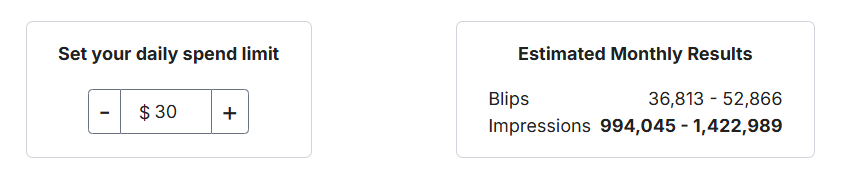
With Blip, you set your own daily budget for Seven Oaks billboards, and the system automatically keeps your campaign within that amount. Each blip is a short 7.5–10 second ad, and you only pay for the individual blips you receive, making it easy to start with even a small budget on billboards near Seven Oaks, South Carolina. The price of each blip varies based on when and where your ad runs and current advertiser demand, so your total cost is simply the sum of all your blips.
Where can I advertise with Blip near Seven Oaks, South Carolina?
We have 7 digital billboards serving the Seven Oaks area, located in Columbia and Lexington. These placements are about 3.1 miles away in Columbia and about 7.1 miles away in Lexington. Even though the structures are outside the Seven Oaks CDP boundaries, their positions on key corridors give you real reach into the Seven Oaks audience.
What kind of people can billboards near Seven Oaks, South Carolina reach?
Campaigns near the Seven Oaks area can effectively reach suburban families and homeowners, daily white-collar commuters into downtown Columbia and the medical/university district, students and young professionals, military-connected households, and regional visitors heading to attractions, games, and events. The area is also influenced by nearby anchors like the University of South Carolina, Riverbanks Zoo & Garden, and Fort Jackson. This mix creates steady traffic from both residents and visitors throughout the day.
Why are Blip billboards near Seven Oaks, South Carolina good for commuters?
Major roadways like I-26, I-20, I-126, US-1/US-378, and Broad River Road shape viewing patterns near Seven Oaks. I-26 commonly exceeds 100,000 vehicles per day on key segments, while I-20 routinely carries 70,000–90,000+ vehicles per day near Columbia. These corridors help intercept daily commuters traveling between Seven Oaks, Lexington, and downtown Columbia.
When should I run a billboard campaign near Seven Oaks, South Carolina with Blip?
Campaign timing in the Seven Oaks area should closely track Columbia’s event and seasonal calendar. Spring brings USC traffic and Riverbanks Zoo visitation, summer adds tourism and family travel, fall brings USC football and the South Carolina State Fair, and winter boosts holiday shopping and seasonal events. Using Blip, advertisers can ramp up impressions around these peaks while dialing back during lower-priority periods.
Do I need a contract to advertise with Blip near Seven Oaks?
No, Blip has no long-term contracts or minimum commitments. You can start, pause, or stop your campaign at any time.
How fast can I launch a billboard campaign with Blip near Seven Oaks?
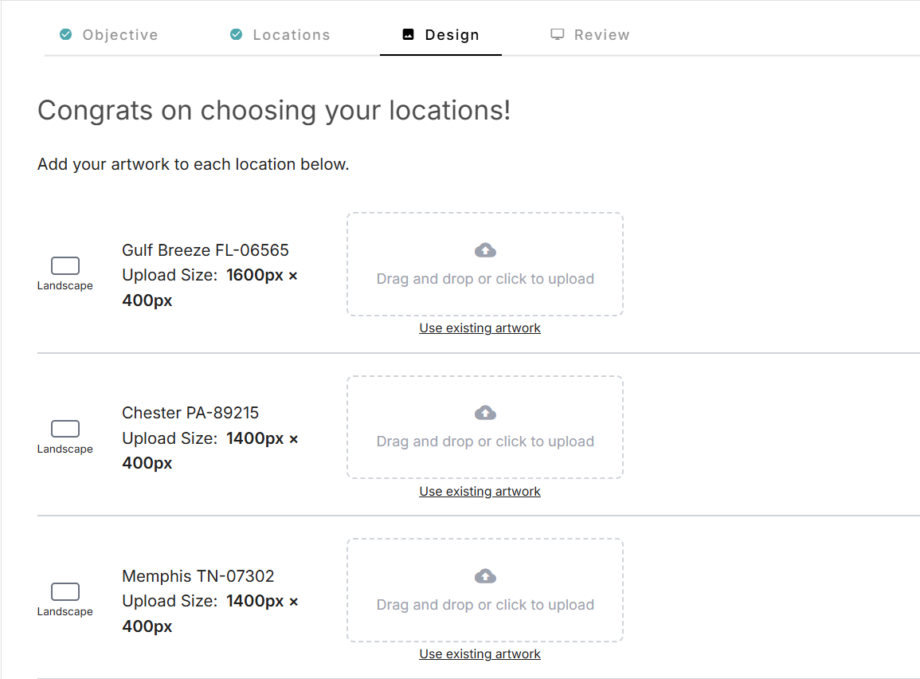
You can have your campaign live in minutes. Create a free account, select your locations, set your budget, upload your design, and start running once approved.
Where can I advertise with Blip near Seven Oaks?
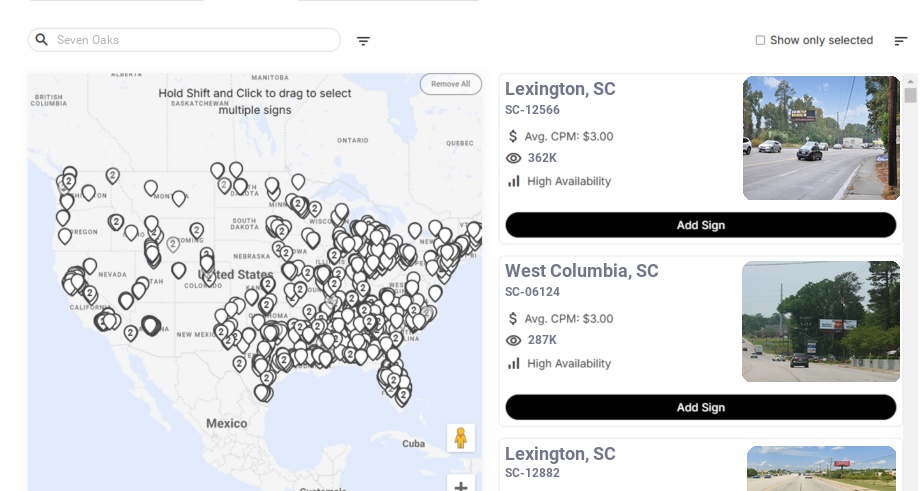
Blip has digital billboards near Seven Oaks. You can browse available locations on a map, choose the ones that fit your audience, and start advertising right away.
Still have questions? Launch a campaign in minutes — no contracts, no commitments.
Start Your CampaignSeven Oaks Billboard Advertising Guide
The Seven Oaks, South Carolina area sits at a strategic crossroads of suburban neighborhoods, commuter corridors, and major regional attractions just northwest of Columbia. With 7 nearby digital billboards in Columbia and Lexington within about 10 miles of Seven Oaks, we can cost‑effectively put your brand in front of daily commuters, families, students, and military-connected audiences who move through this area every single day. For local brands that need billboards near Seven Oaks specifically, this cluster of inventory functions like an always‑on digital ring around the neighborhood.
Understanding the Seven Oaks Area Market
Seven Oaks is a dense, established suburban community in Richland County, just outside the City of Columbia
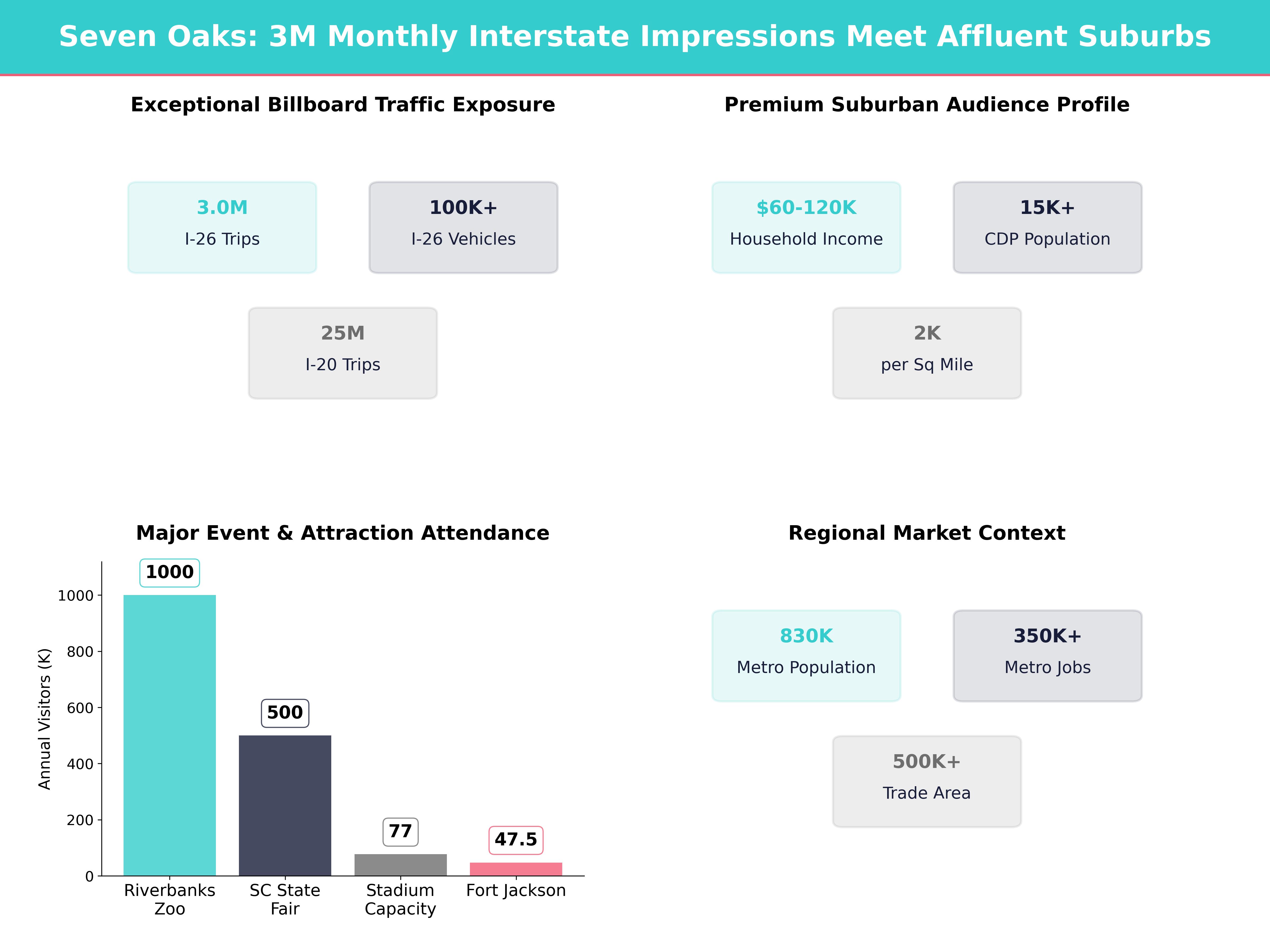
- Seven Oaks CDP population: roughly 15,000+ residents within a compact footprint of about 7 square miles, translating to more than 2,000 residents per square mile, which is significantly denser than many surrounding unincorporated areas in Richland and Lexington Counties.
-
Columbia city population: about 136,000 residents, with the broader Columbia metro area at roughly 830,000 people, accounting for around 16% of South Carolina’s total population. Seven Oaks benefits from its position between downtown Columbia and fast-growing Lexington County suburbs.
- Local profile: City of Columbia
-
Lexington town population: roughly 24,000 residents, but Lexington County has more than 300,000 residents and has consistently ranked among South Carolina’s top 5 fastest‑growing counties over the last decade, adding tens of thousands of new residents.
- County info: Lexington County government
-
Richland County population: over 420,000 residents, making it one of the top three most populous counties in the state.
- County info: Richland County government
Key local anchors drive steady traffic near the Seven Oaks area:
-
Riverbanks Zoo & Garden, one of the top attractions in the state, reports over 1 million guests annually and has repeatedly been listed among the most‑visited zoos in the Southeast. A large share of those visitors travel along I‑26 and I‑126 right by the Seven Oaks area.
- Website: Riverbanks Zoo & Garden
- Local tourism: Experience Columbia SC
-
The University of South Carolina in nearby Columbia enrolls around 36,000 students across undergraduate and graduate programs, plus several thousand faculty and staff. That creates a daily academic community of roughly 40,000+ people, many of whom live or commute through the western suburbs and the Seven Oaks/Irmo area.
- Website: University of South Carolina
-
Fort Jackson, on the eastern side of Columbia, is the U.S. Army’s largest basic training center, training roughly 45,000–50,000 soldiers per year and supporting tens of thousands of family members and civilian employees. Many off‑duty personnel and their families shop, dine, and visit attractions across the metro, including near Seven Oaks.
- Installation info: Fort Jackson
Layered on top of this are strong regional visitor flows:
-
The Columbia metropolitan area welcomes millions of visitors annually, with tourism generating hundreds of millions of dollars in direct visitor spending, much of it tied to attractions like Riverbanks Zoo, Lake Murray, and USC athletics.
- Regional tourism: Experience Columbia SC
- Lake Murray region: Capital City/Lake Murray Country
This mix means campaigns near the Seven Oaks area can effectively reach:
- Suburban families and homeowners
- Daily white‑collar commuters into downtown Columbia and the medical/university district
- Students and young professionals
- Military-connected households
- Regional visitors heading to attractions, games, and events
Why Digital Billboards Near Seven Oaks Work
We have 7 digital billboards serving the Seven Oaks area, located in Columbia (about 3.1 miles away) and Lexington (about 7.1 miles away). Even though structures are outside the Seven Oaks CDP boundaries, their positions on key corridors give you real reach into the Seven Oaks audience. For advertisers specifically searching for billboards near Seven Oaks, these placements function as practical Seven Oaks billboards because they intercept nearly all inbound and outbound traffic from the neighborhood.
Major roadways shaping viewing patterns include:
-
I‑26: A primary east‑west interstate linking Greenville–Spartanburg to Columbia and Charleston. Near Seven Oaks, Average Annual Daily Traffic (AADT) on I‑26 commonly exceeds 100,000 vehicles per day on key segments, generating well over 3 million vehicle trips per month past select billboard locations.
- Traffic data: South Carolina Department of Transportation
- I‑20: Runs east–west across the northern side of the metro; segments near Columbia routinely carry 70,000–90,000+ vehicles per day, or more than 25 million vehicle trips annually on heavily traveled stretches.
- I‑126 & US‑1/US‑378 corridors: Connect downtown Columbia to the western suburbs, channeling daily commuters from the Lexington and Seven Oaks areas. Peak periods can see hourly volumes in the thousands of vehicles in each direction.
- Broad River Road (US‑176): A high‑activity commercial corridor directly adjacent to the Seven Oaks area, with AADT counts frequently in the 20,000–30,000+ vehicles per day range in busier segments, driven by local retail, restaurant, and service traffic.
By tapping boards near these routes, advertisers can:
- Reach Seven Oaks residents during daily commutes to Columbia or Lexington
- Catch shoppers traveling to major retail clusters along Harbison Boulevard and in Lexington
- Influence visitors going to Riverbanks Zoo, downtown Columbia, or USC games
Digital billboards’ flexibility—especially with Blip’s pay‑per‑flip model—lets us focus your impressions on the specific times and directions that matter most for your audience. Industry studies of out‑of‑home advertising show:
- OOH can increase brand awareness by up to 40% when added to a digital mix.
- Around 70% of consumers say they often notice digital billboards during their regular drives.
- Locations with high weekly reach and frequency tend to drive stronger lifts in web search and in‑store visitation.
This makes billboard advertising near Seven Oaks a powerful complement to your existing digital and local media, giving you both broad reach and precise geographic focus.
Audience Insights: Who You Can Reach Near Seven Oaks
In the Seven Oaks area, we see several high‑value audience segments that respond especially well to out‑of‑home messaging:
1. Suburban families and homeowners
- The Seven Oaks area is dominated by single-family homes and townhomes, with many households in the middle to upper‑middle income ranges, often falling in the $60,000–$120,000+ household income bands.
- Nearby school zones in Richland and Lexington Counties serve tens of thousands of K‑12 students, fueling daily family traffic around schools, activities, and youth sports.
- These residents frequently travel along I‑26, Broad River Road, and Harbison Boulevard for shopping, dining, and school activities. Harbison alone houses dozens of national retailers, with certain centers drawing thousands of vehicles per day into their parking lots.
- Great fits: local home services (HVAC, roofing, landscaping), medical and dental practices, insurance, family attractions, churches, and private schools.
2. Retail and dining shoppers
The nearby Harbison/Irmo retail district—just a few miles from Seven Oaks—supports:
- Multiple shopping centers, big‑box stores, and restaurants, including regional draws in apparel, electronics, and big‑box home goods.
- A regional catchment from both Richland and Lexington Counties, encompassing a trade area of well over 500,000 residents within an easy drive.
- Weekends and holidays can see double‑digit percentage increases in traffic compared to weekdays, especially during back‑to‑school and year‑end shopping seasons.
Boards along the main corridors leading into this area let you:
- Announce new store openings or promos
- Promote “turn now” or “next exit” creative
- Steer evening and weekend dining decisions, when restaurant and QSR sales can account for 40–50% of weekly volume
3. Commuters into Columbia and Lexington
Thousands commute daily between Lexington County, Seven Oaks, and downtown Columbia:
- Regional labor data indicates that the Columbia metro hosts well over 350,000 jobs, many concentrated in government, healthcare, education, and professional services.
- A significant share of Lexington County residents commute into Richland County, with daily cross‑county commuter flows often in the tens of thousands of workers.
-
Peak flows:
- Morning inbound toward downtown (eastbound I‑26 and I‑126, southbound into Columbia)
- Afternoon and evening outbound toward Lexington and the northwestern suburbs
Professional services, healthcare networks, banks, and employers can all use time‑of‑day targeting to align with these patterns. OOH research shows that messages timed to commute windows can deliver 15–30% higher recall compared to all‑day generic rotations.
4. Students and young professionals
- USC’s enrollment of around 36,000 creates a steady student/young-professional shopper base, with a large proportion in the 18–34 age range.
- A meaningful share of students and staff live in the western metro, including Irmo, Harbison, and nearby apartment communities, and regularly use I‑26 and I‑126.
- Young adults are heavy users of dining, entertainment, fitness, and technology services, categories where OOH is often among the top three channels for driving awareness.
Brands targeting 18–34-year-olds—gyms, entertainment venues, QSRs, streaming or tech—can drive relevance with short, bold creative on boards that serve these commute patterns.
Seasonal & Event Timing in the Seven Oaks Area
Campaign timing in the Seven Oaks area should closely track Columbia’s event and seasonal calendar. A few key windows:
Spring (March–May)
- USC spring semester in full swing; Columbia’s student population of tens of thousands adds substantial weekday and weekend traffic, particularly around Five Points, the Vista, and downtown corridors connecting via I‑126.
- Outdoor activities spike as weather warms; families visit Riverbanks Zoo and nearby parks along the Saluda River. Riverbanks reports peak visitation months in spring and early summer, with some weekends attracting tens of thousands of guests.
- Local events, festivals, and 5Ks across Richland and Lexington Counties increase weekend travel along key corridors.
- Ideal for: attractions, outdoor recreation, home services, landscaping, spring sales events.
Summer (June–August)
- School’s out and family activities peak; many local schools in Richland and Lexington Counties release tens of thousands of students into summer schedules, shifting travel to daytime and evening leisure trips.
-
Tourism increases around Columbia’s attractions and nearby lakes. Lake Murray, just west of Seven Oaks, is a major draw for boating, fishing, and vacation rentals, with summer visitor volume surging particularly on weekends and holidays.
- Tourism info: Lake Murray Country
- Hotel stays, regional tournaments, and day trips add a significant lift to weekend traffic on I‑26 and major surface roads.
- Great timing for: family entertainment, summer camps, water parks, tourism, restaurants, and quick‑service dining.
Fall (September–November)
-
USC football at Williams-Brice Stadium creates major Saturday traffic surges and regional visitation. Stadium capacity exceeds 77,000 seats, and home games draw in‑market and out‑of‑market fans who drive along I‑26, I‑126, and I‑77.
- Local coverage: Gamecocks sports news – The State
-
The South Carolina State Fair in October typically attracts 400,000–500,000 visitors over its roughly 10–11‑day run, generating sustained daily surges in traffic around the State Fairgrounds near downtown Columbia.
- Fair info: South Carolina State Fair
- Back‑to‑school and university move‑in also spike shopping and transportation around late August, especially in the Harbison and Lexington retail areas.
- Ideal for: brand awareness, sports bars, apparel retailers, auto dealerships, and any business wanting to align with local pride and big-event energy.
Winter (December–February)
- Holiday shopping and end‑of‑year sales across Harbison, Lexington, and downtown Columbia can account for 20–30% of annual retail revenue for some categories.
- Riverbanks’ holiday lights and seasonal attractions continue to bring evening visitors; seasonal nighttime events can attract thousands of guests per night during peak weeks.
- Post‑holiday, local residents refocus on health, finances, and home projects, driving higher response to fitness, medical, and professional service messaging.
- Great timing for: retail, finance (tax and financial planning), healthcare enrollment messaging, and New Year’s resolution offers (gyms, wellness).
Using Blip, we can ramp up impressions around these peaks—targeting specific dates, times, or days of week—while dialing back during lower‑priority periods, protecting your budget while maximizing impact.
Locally Resonant Creative: What Works on Seven Oaks‑Area Billboards
To resonate with people in the Seven Oaks area, creative should feel local and immediately clear. A few principles:
1. Leverage familiar landmarks and directions
Use references that locals know:
- “Next exit for Harbison” or “5 minutes from the Seven Oaks area”
- “Just off I‑26 at [Exit #]”
- “Near Riverbanks Zoo / Broad River Road”
- “10 minutes from downtown Columbia” or “Short drive from Lexington”
When your business is in Columbia or Lexington, call that out with a directional hook:
“Lexington location – 10 minutes from the Seven Oaks area.”
Adding time or distance (e.g., “2 miles ahead,” “Exit 104”) can meaningfully increase response; OOH research often shows single‑digit percentage lifts in stopping or visitation when precise wayfinding is used.
2. Align with suburban, family‑focused values
Content that performs well often features:
- Family imagery, school‑age kids, and everyday life
- Emphasis on safety, convenience, savings, and trust (“Locally owned since 19XX”)
- Quick benefits: “Same‑day appointments,” “Walk‑ins welcome,” “Drive‑thru service”
- Clear value statements (“Save up to 25%,” “Free estimates,” “0% financing for 12 months”)
3. Keep designs bold and legible at highway speeds
For the I‑26/I‑20/I‑126 corridors especially:
- Limit text to 7–10 words total (around 3–6 seconds of reading time for 65–70 mph traffic).
- Use high‑contrast color pairs (e.g., dark text on light background or vice versa).
- Make your logo and call to action (CTA) large and uncluttered—ideally occupying at least one‑third of the sign’s visual weight.
-
Use one clear CTA:
- “Exit 104 – Turn Right on Harbison”
- “Book at ExampleClinic.com”
- “Text ‘OAKS’ to 555‑1234”
4. Tailor creative to time‑of‑day and day‑of‑week
With Blip, you can upload multiple creatives and schedule them differently:
- Morning commute (roughly 6–10 a.m.): Coffee shops, breakfast QSRs, traffic‑oriented messages, motivational themes (“Beat traffic—schedule online instead”).
- Midday (10 a.m.–3 p.m.): Medical appointments, home services, B2B services, errands, lunchtime specials.
- Evening & weekends (4–10 p.m., Fri–Sun): Restaurants, entertainment, retail, events, gyms—especially effective when paired with limited‑time offers (“Tonight only,” “Weekend sale”).
For example:
- One creative from 6–10 a.m. promoting a breakfast deal.
- Another after 4 p.m. highlighting dinner specials or happy hour in Lexington or downtown Columbia.
Advertisers who segment creative by daypart frequently see double‑digit percentage improvements in engagement metrics (web visits, calls, redemptions) versus one‑message‑fits‑all campaigns.
Geo & Directional Strategy: Placing Messages to Reach the Seven Oaks Area
Even though our structures are in Columbia and Lexington, we can design your campaign to directly intersect Seven Oaks’ traffic flows.
1. Focus on boards along I‑26 and I‑126
These routes:
- Carry Seven Oaks residents eastward into downtown Columbia and the USC/medical district.
- Carry Lexington residents eastward past the Seven Oaks area into Columbia (and vice versa), crossing county lines where tens of thousands of commuters travel daily.
Use:
- Eastbound creative to reach morning commuters heading into Columbia.
- Westbound creative to reach residents returning to Seven Oaks, Irmo, and Lexington.
If your business is:
- Near Harbison/Irmo or in the Seven Oaks trade area: emphasize westbound traffic with “On your way home” messages, as afternoon traffic volumes can rival or exceed morning peaks on these stretches.
- Downtown Columbia or USC‑adjacent: emphasize inbound morning and lunchtime traffic, tied to typical workday and class schedules.
2. Add Lexington‑side coverage
Boards near Lexington (about 7.1 miles from Seven Oaks) help you:
- Reach Seven Oaks‑area residents who also shop and dine in Lexington, where household incomes and homeownership rates are typically high.
- Build awareness for Lexington businesses looking to pull customers from the Seven Oaks/Irmo side of the metro.
- Tap into Lexington’s growing population base, which has expanded by tens of thousands of residents in recent years.
Messaging like “Worth the short drive from the Seven Oaks area” can work well for higher‑ticket services (furniture, auto dealers, medical specialists, private schools), where consumers are willing to travel 20–30 minutes for the right value or expertise.
3. Pair direction with intent
- Northbound / outbound patterns often correlate with “on the way home” decisions (picking up dinner, stopping at a retailer, booking services after work). Many consumers report making day‑of decisions on where to stop based on what they see along their route.
- Southbound / inbound patterns tie to morning planning, errands near workplaces, or lunchtime stops, when people are more open to planning appointments, banking, and shopping near downtown.
By mapping your store or service location relative to each board, we can prioritize directions and dayparts that align with the moments people are most likely to act, and then monitor for noticeable upticks in web traffic and store visits from the targeted zip codes. This is how we turn generic Seven Oaks billboards into a finely tuned local acquisition channel.
Budgeting and Using Blip’s Flexibility Near Seven Oaks
Because Blip allows you to buy individual “blips” (brief ad plays) instead of full‑time slots, we can stretch smaller budgets effectively in the Seven Oaks area. This makes billboard rental near Seven Oaks accessible even for single-location businesses and startups that might not otherwise consider out‑of‑home.
1. Start with a test budget
For many local advertisers, even a few dollars per day per board can establish a baseline presence. A common starting pattern:
- 2–4 boards on key routes (mix of Columbia and Lexington)
- Concentrated during a few high‑value dayparts (e.g., 7–9 a.m., 4–7 p.m.)
- Run for 4–8 weeks to gather directional performance insights relative to web traffic, search volume, or store visits
Over a 4‑week period, even a modest budget can generate thousands to tens of thousands of impressions, depending on competition and daypart targeting.
2. Use daypart and day‑of‑week optimization
Examples:
- Restaurants: heaviest blips Thu–Sun late afternoon and evening, when many restaurants see 40–60% of weekly revenue.
- Healthcare and professional services: primarily Mon–Fri, 7 a.m.–7 p.m., matching office hours and appointment windows.
- Event‑driven campaigns: heavy concentration in the 7–10 days before the event, with highest intensity in 48–72 hours prior, matching typical last‑minute decision and ticket‑buying behavior.
3. Layer creative testing
Rotate multiple creatives and monitor which messaging or offer aligns with spikes in:
- Website direct traffic and “brand name + Columbia” search queries
- Branded search volume in the Columbia and Lexington areas
- Call volume or appointment bookings
- In‑store customer feedback (“How did you hear about us?”)
Many advertisers find that 1–2 creatives outperform others by 20–50% on response metrics. Turn off underperforming creatives and reinvest impressions into the strongest performers, all without committing to new contracts.
Integrating Billboards With Other Local Channels
To get the most value from boards serving the Seven Oaks area, align your out‑of‑home strategy with other local and digital efforts:
- Feature your billboard design or slogan in social media ads targeting ZIP codes around Seven Oaks, Irmo, Columbia, and Lexington. Cross‑channel consistency can improve ad recall by 20–30%.
-
Sync campaign bursts with local news coverage or promotions from key outlets like:
- The State
- WIS News 10 and WLTX 19 (local TV stations)
- Free Times / Post and Courier Columbia for arts, food, and events
- Partner with local events and promote sponsorships on boards when possible (e.g., community festivals, school fundraisers, charity runs). Local events in the Columbia–Lexington region can attract anywhere from a few hundred to tens of thousands of attendees, amplifying your exposure.
When users see consistent visuals on billboards, social feeds, and local news or event promotions, recall and trust increase significantly, often leading to measurable lifts in store visits, web sessions, and brand searches in the weeks following a campaign.
Regulatory and Local Context to Keep in Mind
Billboards serving the Seven Oaks area fall under the jurisdiction of local and state regulations, including:
- Richland County and Lexington County sign and zoning rules, which govern placement, size, and illumination of outdoor advertising:
-
The City of Columbia municipal environment and planning context, which affects structures within city limits and along major corridors connecting to downtown:
- City of Columbia
- Proximity to interstates maintained by the South Carolina Department of Transportation (SCDOT), which regulates signage along state and federal highway rights‑of‑way:
While Blip and our sign partners manage compliance and operations, understanding this framework can reassure advertisers that digital boards are stable, long‑term fixtures in the market, not short‑lifecycle experiments. Many structures have been in place for a decade or longer, and digital conversions follow established permitting processes.
Putting It All Together: Crafting a Winning Seven Oaks‑Area Campaign
When we design a campaign to serve the Seven Oaks area using nearby Columbia and Lexington billboards, we typically:
-
Define the core audience
- Seven Oaks‑area families, Columbia commuters, USC students, Lexington shoppers, or some blend. Quantify who you’re targeting (for example, “households within 10 miles of Harbison with incomes over $60,000” or “USC‑adjacent 18–34‑year‑olds”).
-
Identify key corridors and directions
- I‑26/I‑126 into/out of Columbia, plus Lexington‑side coverage and surface streets like Broad River Road and Harbison Boulevard.
-
Pick high‑value dayparts
- Match to your sales patterns (commute, lunchtime, evenings, weekends), focusing on the 20–40 hours per week that matter most to your business.
-
Develop 2–4 simple, locally‑grounded creatives
- Clear offers, directional cues, local references, seasonal tie‑ins tied to major anchors like USC, Riverbanks Zoo, Lake Murray, and Williams‑Brice Stadium.
-
Launch with a clear timeframe and test mindset
- 4–8 weeks, with measurable goals (foot traffic lift, calls, site visits, coupon redemptions). Track at least one or two hard metrics (e.g., call volume) and one softer metric (e.g., brand search volume).
-
Optimize in real time
- Shift budget toward boards, times, and creatives that correlate with results, and adjust to event calendars (home games, fairs, holidays) where traffic surges can be 10–50% above typical levels.
By combining the reach of 7 digital billboards near Seven Oaks with precise scheduling and locally tuned messaging, we can help you connect with the people who live, work, and travel through the Seven Oaks area every day. Whether you’re exploring billboard advertising near Seven Oaks for the first time or looking to scale existing billboard rental near Seven Oaks, this approach turns visibility into measurable growth for your business.