Billboards in Roanoke, VA
No Minimum Spend. No Long-Term Contracts. Just Results.
Trusted by Leading Brands


Billboard advertising
in Roanoke has never been easier
How much is a billboard in Roanoke?
Why Choose Blip for Billboard Advertising in Roanoke
-
Blip lets you launch Roanoke billboards fast, reaching I-81 and I-581 commuters without the usual hassle.
-
Set a flexible budget for Roanoke and scale up around Blue Ridge Parkway weekends, festivals, or Virginia Tech travel days.
-
No contracts means you can test Roanoke's Valley View and downtown traffic, then shift spend when it performs.
-
Use Blip's real-time analytics to see what works on Roanoke's car-first corridors like US 220 and Williamson Road.
-
Blip's creative tools help tailor Roanoke ads with Blue Ridge visuals and quick exits for travelers on the move.
Frequently Asked Questions About Billboard Advertising in Roanoke
How much does a billboard cost in Roanoke, Virginia with Blip?
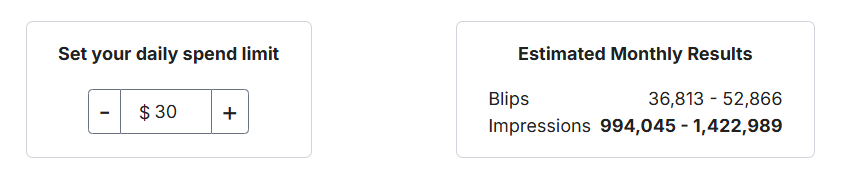
With Blip, you set your own daily budget for Roanoke billboards and only pay for the blips—those 7.5 to 10-second ad displays—you actually receive. Prices per blip change based on location, time, and advertiser demand, so your total cost over days or weeks is simply the sum of all the blips your ad runs. This makes advertising on billboards in Roanoke, Virginia flexible enough for nearly any marketing goal.
Where are the best places to advertise with Blip in Roanoke, Virginia?
Roanoke sits at the crossroads of the Blue Ridge Parkway, I‑81, and I‑581, making it a powerful location for digital billboard campaigns. Important corridors include I‑81 near Roanoke, I‑581 / US 220, US 460 / Orange Avenue, US 220 South (Franklin Road), Williamson Road and Peters Creek Road, and downtown approaches. These routes carry tens of thousands of vehicles per day and help reach both local residents and constant streams of travelers.
Why is Roanoke, Virginia a strong market for billboard advertising with Blip?
Roanoke is a compact but influential regional hub with about 100,000 city residents and roughly 315,000 people in the metro area. More than 75–80% of residents commute by car, which makes roadside media especially effective. The region also includes healthcare, education, manufacturing, logistics, and tourism drivers, giving advertisers a diverse audience with high daily vehicle usage.
When should I run billboards in Roanoke, Virginia to reach the most people?
Roanoke has clear traffic peaks in the morning from roughly 6:30–9:00 a.m., midday from 11:00 a.m.–2:00 p.m., and in the evening from 3:30–6:30 p.m. Tourism and outdoor activity are strongest from late March through early November, with the highest intensity from May to October. Fall, especially October, is often one of the busiest periods for scenic travel and college football weekends.
Do I need a contract to advertise with Blip in Roanoke?
No, Blip has no long-term contracts or minimum commitments. You can start, pause, or stop your campaign at any time.
How fast can I launch a billboard campaign with Blip in Roanoke?
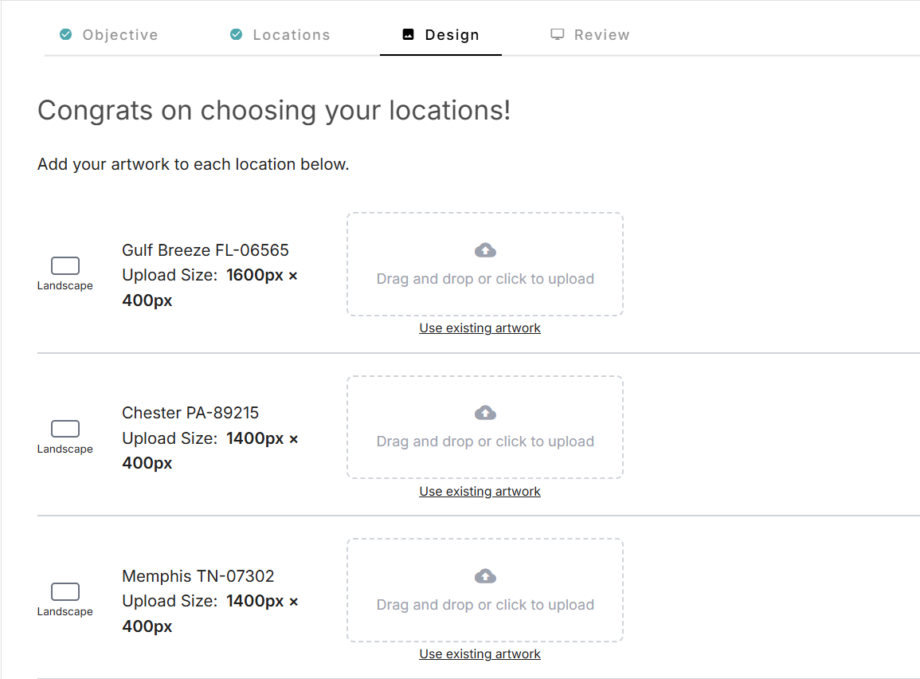
You can have your campaign live in minutes. Create a free account, select your locations, set your budget, upload your design, and start running once approved.
Where can I advertise with Blip in Roanoke?
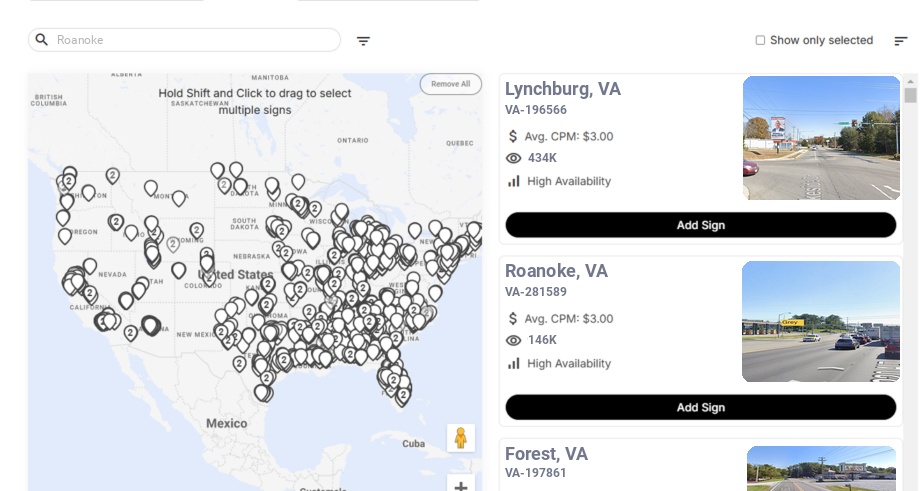
Blip has digital billboards in Roanoke. You can browse available locations on a map, choose the ones that fit your audience, and start advertising right away.
Still have questions? Launch a campaign in minutes — no contracts, no commitments.
Start Your CampaignRoanoke Billboard Advertising Guide
Roanoke, Virginia sits at the crossroads of the Blue Ridge Parkway, I‑81, and I‑581, making it a powerful location for digital billboard campaigns that reach both local residents and constant streams of travelers. When we understand who is on the road, where they are coming from, and what they care about, we can use Blip’s flexibility to build highly efficient, highly targeted campaigns in the Roanoke market and get maximum value from Roanoke billboards.
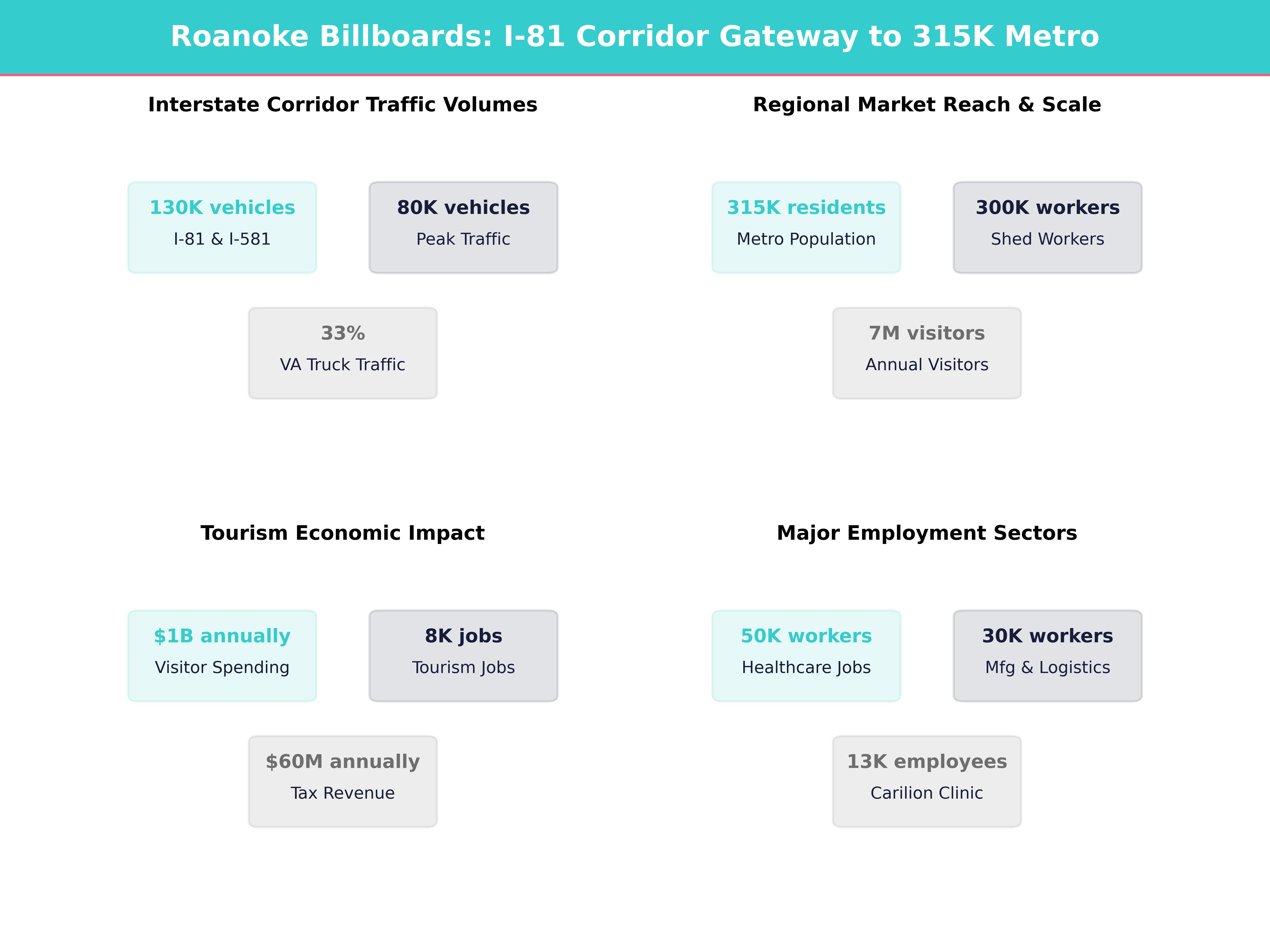
Roanoke Market Snapshot: Who We’re Reaching
Roanoke is a compact but influential regional hub that punches above its weight and offers excellent potential for Roanoke billboard advertising:
- The City of Roanoke has about 100,000 residents (around 100,000–101,000 in recent estimates), while the Roanoke metropolitan area (Roanoke–Salem–Botetourt) is home to roughly 315,000 people. Nearby Roanoke County adds about 96,000 residents and the City of Salem adds roughly 25,000, all feeding into the same road network.
- The broader Roanoke–Blacksburg region, often grouped together for economic development by the Roanoke Regional Partnership, totals over 450,000 residents when surrounding counties are included, with the Partnership citing a labor shed of more than 300,000 workers within a 45‑minute drive.
- According to local transportation and planning data referenced by the City of Roanoke, more than 75–80% of residents commute by car (drive alone or carpool), while less than 3–4% use public transit and about 2–3% walk or bike. That car-first pattern makes roadside media—especially digital billboards in Roanoke—especially effective.
- The region’s median age sits in the low 40s (Roanoke city just under 40, surrounding counties in the 42–44 range), with a balanced mix of young professionals, families, and older adults—ideal for a wide range of consumer offerings, from healthcare and home services to recreation and dining.
Key economic drivers in the Roanoke region include:
- Healthcare: Carilion Clinic is the region’s largest employer, with more than 13,000 employees across its system. Carilion and other health systems together account for a sizable share of the metro’s roughly 50,000 healthcare and social assistance jobs.
- Education and research: Virginia Tech, just down the road in Blacksburg, has around 38,000 students and employees on campus, and the Roanoke Innovation Corridor (including the Fralin Biomedical Research Institute and Virginia Tech Carilion School of Medicine) continues to grow high-skill traffic into the city. Hundreds of thousands of annual trips are generated by campus visits, sporting events, and academic conferences that pass along I‑81 and I‑581.
- Advanced manufacturing, transportation, and logistics: The Roanoke Regional Partnership notes that manufacturing and transportation/logistics together employ more than 30,000 workers regionally. Roanoke’s position on I‑81 makes it a vital freight and distribution corridor, with I‑81 moving roughly one‑third of Virginia’s interstate truck traffic by weight.
- Tourism and outdoor recreation: According to Visit Virginia’s Blue Ridge, tourism in Virginia’s Blue Ridge region generated more than $1 billion in direct visitor spending in a recent year, supporting well over 8,000 jobs and generating tens of millions of dollars in local and state tax revenue. Annual visitor counts to the region have topped 7 million in recent reporting.
This mix of commuters, regional workers, students, and visitors gives us a diverse audience with high daily vehicle usage. With more than 9 out of 10 households in the region having access to a vehicle, digital billboards are in front of people during the exact moments they are making decisions about where to eat, shop, stay, and explore, which is why thoughtful Roanoke billboard advertising can drive measurable business results.
Traffic Patterns and High-Value Corridors
Roanoke’s geography channels a large share of traffic through a few key arteries. That concentration means we can achieve meaningful frequency with well-placed Blip campaigns and carefully chosen Roanoke billboards.
Important corridors and typical daily traffic levels (AADT – average annual daily traffic) from the Virginia Department of Transportation include:
- I‑81 near Roanoke: Many segments around Roanoke carry 55,000–70,000 vehicles per day, with some stretches in Botetourt and Montgomery Counties exceeding 70,000. This is predominantly through‑traffic (freight, regional travelers, long-distance drivers) plus local commuters.
- I‑581 / US 220: The main connector from I‑81 into Roanoke, Valley View, and downtown. Segments commonly exceed 70,000–80,000 vehicles per day; near the interchange with Valley View Boulevard and the Roanoke–Blacksburg Regional Airport, volumes often climb above 80,000.
- US 460 / Orange Avenue: East–west traffic through Roanoke and toward Vinton and Botetourt County. Select segments often see 25,000–35,000 vehicles per day, with commercial nodes near Williamson Road and the I‑581 interchange at the upper end of that range.
- US 220 South (Franklin Road): Connects Roanoke to Smith Mountain Lake and Franklin County; segments can range from 20,000–30,000 vehicles per day, with summer and holiday peaks tied to lake traffic and second‑home owners.
- Williamson Road & Peters Creek Road: Busy commercial corridors with heavy local traffic, often 15,000–25,000 vehicles per day, serving shopping centers, restaurants, and service businesses.
- Downtown approaches (Jefferson Street, Franklin Road, Elm Avenue, and Campbell Avenue): Individual segments generally carry 10,000–20,000 vehicles per day but with high concentrations of office workers and event-goers.
VDOT’s public data confirms that the Roanoke Valley sees tens of thousands of daily trips concentrated on these few main flows. For example, combined traffic volumes on I‑81 and I‑581 within the region exceed 130,000 vehicles per day, while the broader Roanoke urbanized area supports more than 2 million vehicle miles traveled on a typical weekday. When we select boards on or near these routes, we can build strong reach and frequency even on modest budgets, making billboard rental in Roanoke a cost-efficient option.
How this should shape our strategy:
- For broad awareness (regional brands, healthcare, retail chains): prioritize I‑81, I‑581, and major US routes (220, 460). These corridors collectively touch well over 60–70% of daily commuters and visitors moving through the metro and offer some of the highest-impact billboards in Roanoke.
- For local foot-traffic and neighborhoods (small businesses, restaurants, services): favor arterials like Williamson Road, Peters Creek, Brandon Avenue, and routes leading toward specific districts (Grandin, Downtown, Valley View, Salem). These streets put your message in front of residents multiple times per week.
- For destination-based campaigns (Smith Mountain Lake, Blue Ridge Parkway, festivals): choose placements on approach routes (US 220 southbound, I‑581 toward downtown, US 460 toward the mountains) that capture drivers in the final 10–20 minutes before arrival, when decision‑making is highest.
Visitor & Tourism Dynamics: Leveraging the Blue Ridge
Roanoke is marketed as “Virginia’s Blue Ridge” and functions as the urban gateway to the Blue Ridge Parkway, Appalachian Trail, and Smith Mountain Lake. That role as a gateway city increases the value of Roanoke billboards for tourism, hospitality, and attraction campaigns.
Key visitor statistics:
- The Blue Ridge Parkway, which runs just outside Roanoke, sees roughly 14–16 million visitors annually along its entire length in recent years, consistently ranking among the most visited units in the National Park System. Roanoke serves as a lodging, dining, and supply hub for many of these visitors, with Parkway access points just 10–20 minutes from downtown.
- Visit Virginia’s Blue Ridge reports that visitor spending in the region surpasses $1 billion annually, with tourism supporting well over 8,000 jobs and generating more than $60 million in state and local tax revenue in a recent year. Local tourism officials have documented double‑digit percentage growth in visitor spending coming out of the pandemic recovery period.
- The Roanoke–Blacksburg Regional Airport has handled more than 600,000–700,000 passengers annually in recent years, with 2023 passenger counts climbing above 700,000 and trending upward. A large share of these travelers pass directly along I‑581 and near Valley View retail.
-
Outdoor recreation, craft beer, biking, and festivals draw significant crowds:
- Events like the Roanoke GO Outside Festival have reported attendance of 35,000–40,000+ over a weekend.
- The Local Colors Festival routinely draws 15,000–20,000 visitors to downtown.
- Signature running and cycling events, greenway races, and music festivals each bring thousands of participants and spectators throughout the year.
Implications for billboard messaging:
- Emphasize outdoor experiences, hospitality, and local flavor. Creative showing mountains, rivers, hiking, or skyline views tends to resonate strongly with both residents and visitors, especially since Visit Virginia’s Blue Ridge notes that more than half of visiting parties participate in outdoor activities during their stay.
- Use copy that speaks to short stays and day trips: with the average leisure trip to the region lasting 2–3 nights, clear “Tonight Only,” “Exit Now,” “10 Minutes Ahead,” or “This Weekend in Downtown Roanoke” messages on billboards in Roanoke help capture limited vacation time.
- Promote weekend events and offers via dayparting—heavier rotation Thursday–Sunday and during daytime/early evening, when travelers are planning and exploring and when hotel occupancy and restaurant covers peak.
Seasonality: When to Push Harder
Roanoke’s visitor and traffic patterns have distinct seasonal peaks that align with tourism data from Visit Virginia’s Blue Ridge and local lodging metrics. Matching your billboard rental in Roanoke to these peaks can significantly improve return on ad spend:
- Spring (March–May): Outdoor season kicks off; college events, graduations, and festivals start. Hotel occupancy and short‑term rentals begin to climb from winter lows toward the mid‑60% range on peak weekends. I‑81 and I‑581 see strong weekend surges as families visit students and outdoor travelers return.
- Summer (June–August): Prime tourism and lake season. Smith Mountain Lake, the Blue Ridge Parkway, and the Roanoke River Greenway are extremely active. Summer weekends often push hotel and short‑term rental occupancy above 70%, and lake-related traffic on US 220 and rural routes spikes, especially around holidays (Memorial Day, July 4, Labor Day).
- Fall (September–November): Often the region’s busiest period for scenic travel. Leaf‑peeping on the Blue Ridge Parkway and college football weekends (especially with Virginia Tech nearby) cause traffic spikes, particularly on Fridays and Sundays. October is frequently one of the highest-occupancy months of the year for area hotels, sometimes surpassing 75% occupancy on peak weekends.
- Winter (December–February): More commuter-heavy, though holidays and ski trips to nearby resorts still create pockets of visitor traffic. Average hotel occupancy typically dips into the 40–50% range outside of holiday periods, making this a cost‑efficient time for brands targeting locals and business travelers.
How we can align campaigns:
- Ramp up tourism, hospitality, attraction, and retail campaigns from late March through early November, with highest intensity from May–October when visitor spending and outdoor activity are at their peak.
- Use Blip’s flexibility to bid higher or run more blips around major weekends and events—such as fall foliage peaks, large festivals, and college football home games—rather than maintaining a flat spend all year.
- For local services (healthcare, auto, home services, education), maintain consistent year‑round presence but adjust messages seasonally—e.g., HVAC and plumbing in summer/winter, tax services in Q1, back‑to‑school and healthcare in late summer/early fall, and home improvement in spring.
Local Culture, Media, and Messaging Angles
Roanoke’s identity blends small-city warmth with regional importance. Understanding local culture helps us craft messages that feel authentic and ensures Roanoke billboard advertising complements other media rather than feeling out of place.
Key cultural and media anchors:
- The City of Roanoke emphasizes arts, outdoor recreation, and neighborhood development, allocating millions of dollars annually to parks, greenways, and cultural institutions. The city maintains over 100 parks and recreational facilities and more than 30 miles of greenways and trails.
- Local news outlets such as The Roanoke Times and TV stations like WDBJ7, WSLS 10, and WFXR
- Landmarks such as the Mill Mountain Star Center in the Square, Berglund Center, and the Taubman Museum of Art are widely recognized icons. Mill Mountain Star alone draws hundreds of thousands of visitors and locals annually to its overlook.
Messaging implications:
- Local pride works: references to the Star City, Blue Ridge, or Virginia’s Blue Ridge can help your creative feel native rather than generic, reinforcing the sense of community that local surveys repeatedly highlight as a top reason residents stay in the region.
- Simple references to recognizable places like “Downtown Roanoke,” “Valley View,” “Grandin Village,” or “Salem” orient viewers quickly and match how local media and the Roanoke Regional Partnership describe the market.
- Community-centric messaging—“Proud to Serve Roanoke Since 1995,” “Supporting Virginia’s Blue Ridge,” or “Locally Owned in the Star City”—builds trust, especially since nearly half of metro-area workers are employed by small and mid‑sized businesses.
Commuter Behavior and Dayparting Strategy
Most Roanoke-area workers commute by car, and traffic shows clear peaks shaped by the region’s roughly 150,000–160,000 daily workers. Effective Roanoke billboard advertising takes these patterns into account:
- Morning peak: roughly 6:30–9:00 a.m., as commuters travel inbound on I‑581, US 220, US 460, and city arterials.
- Midday activity: 11:00 a.m.–2:00 p.m. (errands, lunches, shopping trips), when retail and restaurant sectors see some of their highest transaction counts.
- Evening peak: 3:30–6:30 p.m., with extended flows around Valley View, downtown, and major retail corridors. Traffic volumes on I‑581 and Williamson Road in this window often run 20–30% higher than mid‑morning off‑peak periods.
Public transit, provided by Valley Metro, carries thousands of riders per weekday but still represents a small fraction (roughly 2–3%) of total commute trips, meaning most working-age adults are exposed to roadside signage daily.
How we can tailor Blip campaigns by time of day:
Morning (commute hours)
Best for: coffee shops, quick-service restaurants (breakfast), news & media, financial services, and B2B offers.
Messaging ideas:
- “Need Coffee? Exit 2N – 3 Minutes Ahead”
- “Beat the Rush – Schedule Your Appointment Online Today”
Midday
Best for: lunch promotions, medical/healthcare, shopping, errands, government or civic messages.
Messaging ideas:
- “Lunch Special 11–2 – Downtown Roanoke”
- “Walk-In Clinics Open Today – No Appointment Needed”
Evening
Best for: dining, entertainment, retail, fitness, and family activities.
Messaging ideas:
- “Dinner Near the Star – Free Parking After 5”
- “Tonight Only – Live Music in Downtown Roanoke”
Using Blip, we can allocate more budget to specific dayparts that match when our audience is most likely to act, rather than paying a flat rate for impressions at low‑action times. For example, concentrating 60–70% of your daily impressions into the two commute peaks and early evening can significantly increase response for time‑sensitive offers.
Creative Best Practices for the Roanoke Market
Digital billboards in Roanoke are typically viewed at highway speeds (55–70 mph) or on busy arterials (35–45 mph), which gives drivers only a few seconds to absorb your message. National research from the out‑of‑home industry shows that recall drops sharply when creatives exceed 7–8 words of headline copy or include more than one core idea.
We recommend:
-
Big, bold headlines (6–8 words max)
- “Kayak the Roanoke River This Weekend”
- “New Patients Welcome – Salem Dental”
-
High-contrast colors that stand up to daylight
Roanoke averages over 200 sunny or partly sunny days per year, and its mountainous backdrop can wash out low-contrast designs. Use strong contrasts (dark text on light background or vice versa) and avoid thin fonts that disappear at a distance. -
Local visuals
- Mill Mountain Star silhouette
- Blue Ridge ridgelines or the Roanoke River
- Downtown skyline at dusk
These elements help viewers instantly recognize that the ad is relevant to their location, and they align with imagery used by Visit Virginia’s Blue Ridge.
-
Directional and distance cues
- “Exit 4E – 2 Miles Ahead”
- “Next Right – Valley View Mall Area”
- “5 Minutes from Downtown Roanoke”
These short, specific cues consistently outperform vague “Across Town” messaging and help convert impressions on Roanoke billboards into immediate visits.
-
Urgent, time-bound offers
Roanoke’s blend of commuters and visitors responds well to urgency. Many visitors have itineraries of just 48–72 hours, so “now or never” language works:- “This Weekend Only – 20% Off Outdoor Gear”
- “Game Day Special – Today Only”
-
Multiple creatives for rotation
Blip lets us upload multiple creatives and rotate them. For Roanoke:- One design oriented toward locals (“Locally Owned, Serving Roanoke Families”).
- One geared to tourists (“Explore Virginia’s Blue Ridge – Stay With Us Tonight”).
- One pushing a seasonal offer (fall foliage, summer lake trips, holiday shopping).
Rotating 3–5 creatives can improve ad recall by 10–20% while letting you test which messages resonate most with different audience segments and which billboards in Roanoke produce the strongest response.
Location Strategy: Matching Boards to Business Goals
Because Roanoke is compact—roughly 43 square miles for the city and about 250 square miles for the urbanized valley—the “right” location matters as much as the number of locations when planning Roanoke billboard advertising.
Downtown Roanoke & Immediate Surroundings
Targets: office workers, event-goers, nightlife, arts & culture visitors. On weekdays, tens of thousands of workers and visitors move into and out of the downtown grid.
Use for: restaurants, bars, cultural events, entertainment, professional services.
Strategy: Aim for boards on approaches into downtown and near parking/retail zones. Tie scheduling to event calendars at venues like the Taubman Museum of Art, Center in the Square, and the Berglund Center, which together host hundreds of events and hundreds of thousands of attendees each year.
Valley View / I‑581 Corridor
Targets: regional shoppers, airport travelers, hotel guests, commuters. The Valley View area concentrates more than 1 million square feet of retail and restaurant space and is directly adjacent to the Roanoke–Blacksburg Regional Airport.
Use for: big-box retail, national and regional chains, auto, hotels, restaurants.
Strategy: Emphasize convenience and “exit now” style messaging; time heavier rotation around weekends and evenings when retail sales and flight arrivals/departures are highest.
I‑81 North/South of Roanoke
Targets: long-distance travelers, freight, regional commuters from Botetourt, Montgomery, and beyond. Average daily traffic often exceeds 60,000–70,000 vehicles, with trucks representing 20–30% of volume on some segments.
Use for: fuel & convenience, hotels, auto services, tourism attractions, universities, regional brands.
Strategy: Simple, high-impact creative with clear directions and quick value propositions (“Clean Rooms – Next 2 Exits”). Focus on capturing 1–2 key decisions per trip: where to stop for gas, food, and lodging.
US 220 South to Franklin County & Smith Mountain Lake
Targets: lake visitors, second-home owners, outdoor enthusiasts, commuters to/from Roanoke. Smith Mountain Lake has more than 500 miles of shoreline and thousands of vacation and second homes; summer and holiday weekends can see traffic volumes along US 220 jump 10–20% above non‑peak levels.
Use for: marinas, real estate, restaurants, outdoor gear, home services.
Strategy: Seasonal intensification (spring–fall), promote weekend and holiday offers, and tie messaging to the Smith Mountain Lake Regional Chamber of Commerce event calendar.
US 460 & Routes Toward Vinton, Salem, and Blacksburg
Targets: residents and students commuting to Roanoke, local shoppers, event attendees. More than 35,000 students between Virginia Tech, Radford University, and Roanoke-area colleges create consistent student and family travel along these routes.
Use for: education, healthcare, local retail, and dining.
Strategy: Consider message variations targeting “students & families” vs. “locals” during the year—e.g., move‑in and graduation messaging in August/May versus steady “everyday errands” messaging the rest of the year.
Using Blip’s Flexibility in Roanoke
Blip lets us buy digital billboard time one “blip” at a time, which is especially powerful in a mixed commuter/tourism market like Roanoke. This flexible approach to billboard rental in Roanoke means advertisers can test and scale quickly.
Ways to take advantage:
- Time-of-day optimization: Bid higher during commute hours or evenings while keeping a smaller presence at other times. For instance, dedicate 50–60% of your budget to 7–9 a.m. and 4–7 p.m. for commuter‑heavy campaigns, then assess lift in web traffic or store visits during those windows.
- Day-of-week focus: Push restaurant and entertainment creatives Thursday–Sunday—when visitor spending on food and beverage often hits 60–70% of weekly totals—while promoting home services Monday–Wednesday.
-
Event-based bursts: Increase bids and impressions during:
- Major events at the Berglund Center.
- Festivals promoted by Visit Virginia’s Blue Ridge.
- College move-in and graduation weekends impacting travel on I‑81 and I‑581, which can temporarily boost corridor traffic by several thousand vehicles per day.
- Seasonal switching: Maintain one base creative year‑round, then overlay seasonal creatives (spring outdoor, summer lake, fall foliage, holiday shopping) during peak periods. For example, shift 70–80% of impressions to fall foliage messaging in October, when Parkway and mountain travel is at its highest.
Because we’re not locked into long, inflexible contracts, we can adjust every few days or weeks based on performance, weather, and local happenings—such as responding quickly to a forecasted sunny weekend by increasing outdoor recreation messaging on key Roanoke billboards.
Example Campaign Approaches by Business Type
To make the Roanoke context concrete, here are sample strategies:
1. Local Restaurant in Downtown Roanoke
- Locations: Approaches into downtown from I‑581 and key arterials (Elm Avenue, Franklin Road, Williamson Road). These corridors collectively bring tens of thousands of drivers past downtown daily.
- Timing: Heavier blips 11 a.m.–2 p.m. and 4:30–7:30 p.m., Thursday–Sunday, when restaurant sales often peak and downtown foot traffic is highest.
-
Creative:
- “Downtown Lunch – 5 Minutes Ahead” with a clear arrow and logo.
- “Date Night Near the Star – Free Appetizer Tonight.”
- Seasonal: Promote patio dining in spring/summer; special menus for festivals and concert nights; holiday‑themed offers during December events like Dickens of a Christmas
2. Regional Healthcare Provider
- Locations: Throughout Roanoke Valley and on commuter routes from Salem, Vinton, and Botetourt (US 460, I‑581, Peters Creek, and Williamson Road). These routes reach a broad cross‑section of the roughly 300,000‑plus residents in the metro’s primary care catchment area.
- Timing: Steady, all-day presence; optional boosts during open enrollment, flu season (typically October–February), and back‑to‑school periods when healthcare demand spikes.
-
Creative:
- “Same-Day Appointments – Roanoke & Salem” with URL.
- “24/7 Emergency Care – Minutes from I‑581.”
- Messaging: Emphasize access, trust, and local roots (“Serving Virginia’s Blue Ridge for 30+ Years”), and consider including a simple metric such as “Trusted by 50,000+ Patients Each Year.”
3. Hotel Near I‑81 / I‑581
- Locations: Along I‑81 and I‑581 approaching Roanoke, especially near Valley View and airport exits. Combined traffic volumes on these segments often exceed 130,000 vehicles per day, with a high share of overnight trip decision-makers.
- Timing: Afternoons and evenings, especially Thursday–Sunday and during major events. Research on travel behavior shows that many drivers make final lodging decisions between 4–8 p.m. the day of stay.
-
Creative:
- “Clean, Comfortable Rooms – Next 2 Exits.”
- “Stay in Roanoke – Gateway to the Blue Ridge.”
- Seasonal: Highlight leaf season (September–November), lake/parkway travel (May–October), and holiday shopping packages (November–December). Tie in with event calendars from Visit Virginia’s Blue Ridge.
4. Outdoor Recreation or Attraction
- Locations: I‑581, US 220 South, and corridors linking downtown to greenways and trailheads. These roads feed into the Roanoke River Greenway, Mill Mountain Park Carvins Cove Natural Reserve, and other heavily used outdoor assets.
- Timing: Daylight hours, heavier on weekends and from March–November, when use of regional trails, rivers, and lakes peaks.
-
Creative:
- “Bike Virginia’s Blue Ridge – Rentals in Downtown Roanoke.”
- “Kayak the Roanoke River – Book Today.”
- Tie-ins: Sync messaging with outdoor-themed events promoted on local tourism calendars and with seasonal campaigns such as Virginia’s Blue Ridge outdoor passes or brewery trails.
Measuring and Refining Campaigns in Roanoke
To ensure our Roanoke campaigns are working, we recommend:
- Tracking web and call activity: Monitor website traffic and call volume by day and hour to correlate with Blip schedules. Look for 10–30% lifts in sessions or calls during and immediately after high‑impression windows.
- Using unique URLs or promo codes on billboard creative (“Use code STAR20” or “/roanoke”) to attribute response and estimate conversion rates. Even a 1–3% redemption rate from billboard‑driven traffic can be significant for high‑margin businesses.
- Aligning with store or office metrics: Compare foot traffic, sales, or appointment bookings before and after campaign launches or schedule changes. For example, track whether a 20% increase in weekend impressions yields a proportional rise in Saturday/Sunday sales.
- Testing multiple creatives: Run A/B tests—e.g., one design with a local landmark and one without—and compare engagement via digital metrics and business results. Advertisers often find that localized creatives outperform generic ones by 10–25% in response metrics.
Because Blip campaigns are easy to adjust, we can quickly shift impressions toward the best-performing messages, locations, and time windows. Over time, this data-driven refinement helps you capture a larger share of Roanoke’s more than $1 billion in annual visitor spending and the everyday purchasing power of its 300,000‑plus residents through well-placed Roanoke billboards.
Roanoke’s combination of heavy commuter flows, strong tourism, and a distinct local identity makes it an ideal market for agile digital billboard campaigns. By grounding our Blip strategy in the city’s traffic patterns, seasonal tourism dynamics, and cultural touchpoints, and by choosing the right billboards in Roanoke for your audience, we can reach the right people—residents, students, and visitors alike—at the exact moments they are most ready to take action.