Billboards in Virginia Beach, VA
No Minimum Spend. No Long-Term Contracts. Just Results.
Trusted by Leading Brands


Billboard advertising
in Virginia Beach has never been easier



How much is a billboard in Virginia Beach?
Why Choose Blip for Billboard Advertising in Virginia Beach
-
Blip lets you launch fast in Virginia Beach and target I-264 or I-64 commuters without contracts or minimums.
-
Set flexible daily budgets in Virginia Beach to catch summer Oceanfront visitors and 14M annual tourists when it matters most.
-
Use dayparting in Virginia Beach to reach Town Center lunch traffic or evening beachbound drivers on Virginia Beach Boulevard.
-
Track real-time results in Virginia Beach and shift spend as traffic spikes on Northampton Boulevard or around the Convention Center.
-
Blip’s creative tools make it easy to tailor Virginia Beach ads for military families, students, and Neptune Festival crowds.
Frequently Asked Questions About Billboard Advertising in Virginia Beach
How much does a billboard cost in Virginia Beach with Blip?
With Blip, the cost of billboard advertising in Virginia Beach is flexible and accessible because you only pay when your ad actually appears. Each “blip” is a 7.5-to-10-second display on a rotating digital billboard, with prices starting at $0.01 per display. Your daily budget guides Blip’s algorithm as it bids for open ad slots, and the cost per blip can change based on time of day, location, and advertiser demand.
Where are the best billboard corridors in Virginia Beach with Blip?
We can build frequency by showing up on the same routes during the same windows, especially on I-264, I-64, Virginia Beach Boulevard, Northampton Boulevard, Laskin Road, and Independence Boulevard. I-264 is the city’s main east-west advertising spine, while I-64 is the workhorse for regional reach. Virginia Beach Boulevard, Laskin Road, and Independence Boulevard are some of the best commercial corridors for local intent.
Why is Virginia Beach a strong market for Blip billboard advertising?
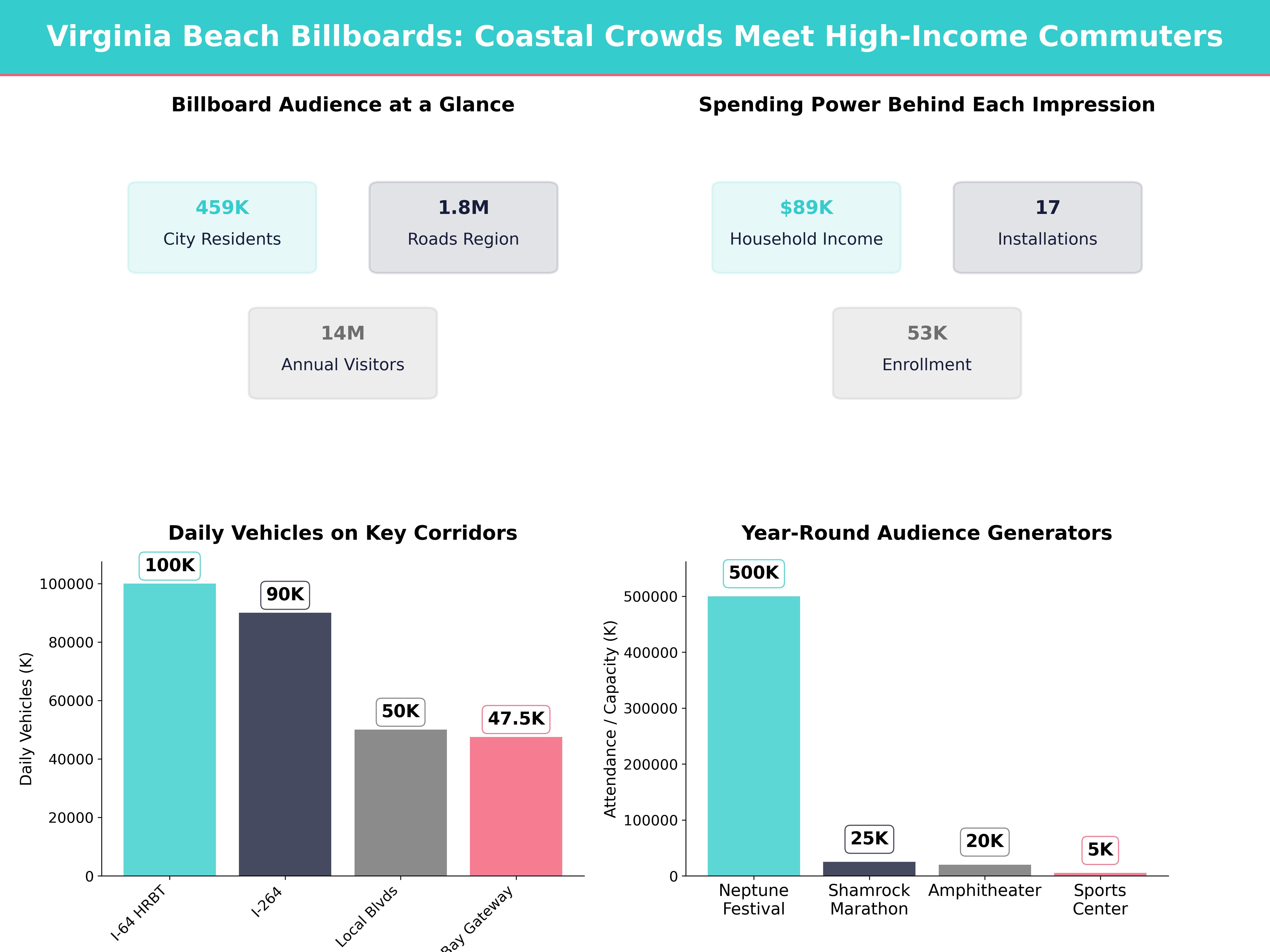
Virginia Beach gives us one of the strongest billboard markets on the Mid-Atlantic coast because it combines 459,470 local residents, about 1.8 million people across Hampton Roads, 17 military installations across the region, and more than 14 million visitors to the city each year. The city covers 497 square miles, so most daily movement happens by car along a relatively small set of major corridors. That mix gives campaigns both city-level depth and regional spillover.
When is the best time to run billboard ads in Virginia Beach?
Timing matters in Virginia Beach because the city’s traffic mix changes dramatically by season, by day of week, and even by time of day. Spring is one of the best times to start building visibility before summer rates and competition intensify, while summer is the obvious high-water mark for visitor traffic. Fall is ideal for back-to-school and event traffic, and winter can still work well for year-round commuter, convention, and sports traffic.
Do I need a contract to advertise with Blip in Virginia Beach?
No, Blip has no long-term contracts or minimum commitments. You can start, pause, or stop your campaign at any time.
How fast can I launch a billboard campaign with Blip in Virginia Beach?
You can have your campaign live in minutes. Create a free account, select your locations, set your budget, upload your design, and start running once approved.
Where can I advertise with Blip in Virginia Beach?
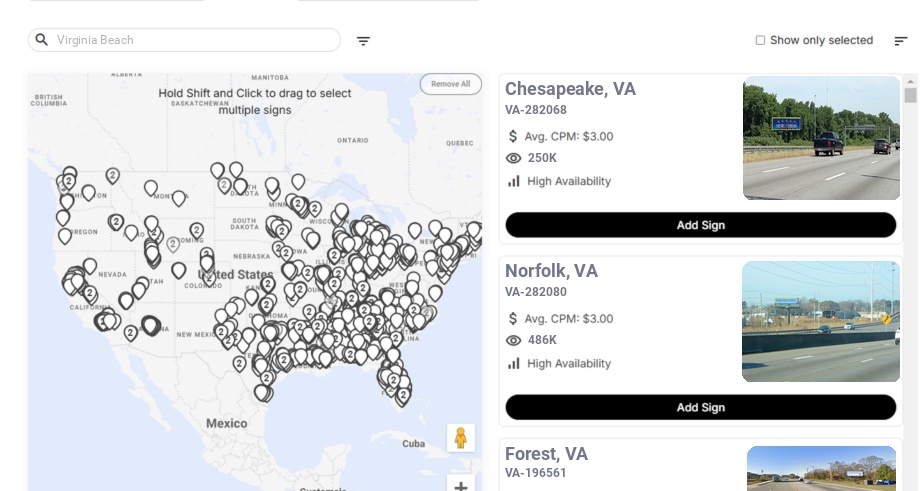
Blip has digital billboards in Virginia Beach. You can browse available locations on a map, choose the ones that fit your audience, and start advertising right away.
Still have questions? Launch a campaign in minutes — no contracts, no commitments.
Start Your CampaignVirginia Beach Billboard Advertising Guide
Virginia Beach gives us one of the strongest billboard markets on the Mid-Atlantic coast because it combines 459,470 local residents, about 1.8 million people across Hampton Roads, 17 military installations across the region, and more than 14 million visitors to the city each year in one geography. The city counted 459,470 residents in the 2020 Census, while the broader Hampton Roads region totals about 1.8 million people, which gives our campaigns both city-level depth and regional spillover. Because Virginia Beach covers 497 square miles, including roughly 249 square miles of land and 248 square miles of water, most daily movement happens by car along a relatively small set of major corridors. We also benefit from a tourism engine that brings more than 14 million visitors to the city each year, especially around the Oceanfront
Virginia Beach Market Overview for Billboard Advertisers
Virginia Beach Department of Economic Development positions the city as a large, affluent, and diversified market, and the fundamentals support that view. Virginia Beach grew from 437,994 residents in 2010 to 459,470 in 2020, which was a 4.9% increase over the decade. That is not explosive Sun Belt growth, but it is exactly the kind of steady base that rewards outdoor advertising with consistent reach and repeated exposure.
The local economy is broad enough that we do not have to rely on a single audience segment, with median household income around $89,000 and regional travel and freight throughput of more than 3.5 million TEUs through the Port of Virginia 4.8 million passengers at Norfolk International Airport in 2023. Tourism is powerful, but it sits alongside healthcare, education, defense, professional services, retail, and logistics. Regionally, the Port of Virginia 3.5 million TEUs in 2023, and Norfolk International Airport handled about 4.8 million passengers in 2023, which reinforces how much business, visitor, and freight traffic moves through the South Hampton Roads network.
Virginia Beach also has strong household buying power. Recent American Community Survey estimates put median household income at roughly $89,000, which is favorable for advertisers in healthcare, home improvement, financial services, automotive, retail, and higher education. Labor market conditions, tracked by the Virginia Employment Commission, have generally remained in the low-single-digit unemployment range in normal periods, which supports durable consumer demand.
For billboard strategy, the most important behavior is mobility. Roughly 85% of workers commute by car, whether driving alone or carpooling, and the average commute is about 24 minutes. In a city this spread out, that commute pattern matters more than density alone. We can build frequency by showing up on the same routes during the same windows, especially on I-264, I-64, Virginia Beach Boulevard, Northampton Boulevard, Laskin Road, and Independence Boulevard.
Key Traffic Corridors for Virginia Beach Billboards
Virginia Beach travel patterns are concentrated on a few highways and arterial spines, with key segments regularly carrying 90,000+, 100,000+, and 35,000 to 60,000 vehicles per day on major routes. When we understand those flows, we can align message, timing, and location with the people most likely to act.
I-264 Through Central Virginia Beach and the Oceanfront
I-264 is the city’s main east-west advertising spine. Recent Virginia Department of Transportation counts around central Virginia Beach commonly place I-264 in the 90,000-plus vehicles per day range near major interchanges, especially around the Independence Boulevard area. That volume reflects its role as the direct connector between Norfolk
This corridor works especially well for several advertiser categories.
- Restaurants, entertainment, and attractions: We can influence decisions before travelers reach the Oceanfront or Town Center.
- Healthcare, urgent care, and dental: We can reach residents on habitual weekday commutes and weekend errand trips.
- Hotels, vacation rentals, and tourism offers: We can capture beach-bound traffic while there is still time to choose a stop, a meal, or an add-on activity.
- Legal, insurance, and financial services: We can build repetition among residents who use the same route all year.
I-64 and the Southside Regional Commuter Loop
For regional reach, I-64 is the workhorse. The Hampton Roads Bridge-Tunnel Expansion Project notes that I-64 at the HRBT carries more than 100,000 vehicles per day, and about 8% of that traffic is trucks. Southside segments tied to Virginia Beach commutes also rank among the region’s heaviest-traveled roads, because I-64 links Virginia Beach with Norfolk, Chesapeake Suffolk, employment centers, airport traffic, and port-related logistics.
This is one of the best corridors for advertisers that need broad regional awareness.
- Universities and trade schools can reach prospective students across city lines.
- Automotive, tire, and repair brands can speak to long-distance commuters and commercial drivers.
- B2B services, staffing, logistics, and industrial suppliers can reach businesses tied to the port and defense economy.
- Healthcare systems and specialty care can build regional brand preference, especially for services that patients will travel for.
US 13, Northampton Boulevard, and the Bay Gateway
Northampton Boulevard is one of the most strategically important routes in the market because it ties together airport access, the northern part of Virginia Beach, Shore Drive, and the Chesapeake Bay Bridge-Tunnel 35,000 to 60,000 vehicles per day band. The Chesapeake Bay Bridge-Tunnel itself carries more than 4 million vehicles in a typical year, which makes this a crucial approach for visitors arriving from the Delmarva side and for regional travelers circulating near the bay.
This corridor is especially strong for:
- Hotels, seafood restaurants, and attractions, because we can intercept leisure travelers before they settle on a destination.
- Real estate, relocation, storage, and moving services, because military and transferee households often use this part of the regional network.
- Airport-adjacent services, because Norfolk International Airport traffic reinforces year-round exposure.
Virginia Beach Boulevard, Laskin Road, and Independence Boulevard
If we want local intent, these are some of the best commercial corridors in the city. High-volume stretches of Virginia Beach Boulevard, Laskin Road, and Independence Boulevard often run in the 30,000 to 50,000-plus daily vehicle range, depending on segment. These roads feed Town Center of Virginia Beach, dense shopping clusters, medical offices, neighborhoods, and the Virginia Beach Convention Center
These routes favor advertisers with shorter conversion windows.
- Retail, grocery, and quick-service dining can drive same-day visits.
- Home services can stay top of mind with homeowners in central and southern neighborhoods.
- Doctors, dentists, and elective care providers can target residents close to appointment locations.
- Event venues and ticketed entertainment can reach people who are already on the way to commercial districts.
Audience Segments We Can Reach in Virginia Beach
Virginia Beach is valuable because we are not talking to just one type of traveler. We can tailor campaigns to several distinct, high-value audiences.
Virginia Beach Commuters and Cross-City Households
The resident base is large enough to support always-on advertising. With 459,470 residents in the city and about 1.8 million across Hampton Roads, a Virginia Beach campaign often reaches both city residents and regional commuters. The city’s size, 497 square miles, reinforces dependence on vehicles, and the typical 24-minute commute creates repeated weekday impression opportunities.
For local brands, this means consistency matters. We do not need a giant one-week push to be effective. We often win by staying visible on the same routes during morning and late-afternoon commute windows.
Virginia Beach Tourists and Weekend Visitors
Tourism is the obvious headline audience, and the scale is real. Visit Virginia Beach 35 miles of beaches, a 3-mile boardwalk, and more than 14 million annual visitors. Those visitors are not confined to one zip code. They move between the Oceanfront, Shore Drive, Sandbridge, sports complexes, entertainment venues, and nearby cities.
Tourism-focused billboard campaigns perform best when we make decisions easy. Hotels, restaurants, attractions, parking services, nightlife, breakfast spots, surf shops, and family activities all benefit from simple route-based creative and dayparting that matches arrival times.
Military and Defense Audiences in Virginia Beach
Hampton Roads has one of the nation’s largest defense footprints, with 17 military installations across the region. In Virginia Beach, that audience is especially relevant around NAS Oceana Joint Expeditionary Base Little Creek-Fort Story
This audience is valuable because needs are predictable. We can market:
- Auto dealers, insurance agencies, and financial services that serve relocating households.
- Storage, moving, and apartment communities that benefit from PCS-related turnover.
- Healthcare, childcare, and education that appeal to military families seeking trusted local providers.
Virginia Beach Students, Parents, and Young Adults
The region’s student population is large enough to deserve its own strategy. Old Dominion University enrolls more than 23,000 students, Tidewater Community College 20,000 students, and Regent University enrolls more than 10,000 students. Virginia Wesleyan University also adds a residential student audience on the Virginia Beach side of the market.
Families are another major segment. Virginia Beach City Public Schools serves nearly 64,000 students across 86 schools, which creates strong cycles around back-to-school, athletics, tutoring, pediatric care, weekend entertainment, and family dining.
Virginia Beach Convention, Sports, and Entertainment Visitors
Virginia Beach has built a meaningful year-round visitor pipeline beyond the summer beach season. The Virginia Beach Convention Center offers 516,000 square feet of total space, including 150,000 square feet of exhibit space. The Virginia Beach Sports Center adds 285,000 square feet, up to 5,000 seats, and 12 basketball courts, which keeps team travel flowing through the market. The Veterans United Home Loans Amphitheater seats about 20,000, and venues such as the Sandler Center for the Performing Arts and The Dome extend entertainment traffic beyond peak summer weekends.
Seasonal and Timing Opportunities in Virginia Beach
Timing matters in Virginia Beach because the city’s traffic mix changes dramatically by season, by day of week, and even by time of day.
Spring Campaign Windows in Virginia Beach
Spring is one of the best times to start building visibility before summer rates and competition intensify. The Yuengling Shamrock Marathon Weekend brings about 25,000 participants to the Oceanfront each year, and that event creates a strong audience for hospitality, brunch, wellness, recovery services, retail, and local attractions.
Spring also works well for home services, landscaping, roofing, HVAC, education, and healthcare. Residents are back outside, local event calendars start filling up, and visitors begin testing beach weekends before school lets out.
Summer Peak Season in Virginia Beach
Summer is the obvious high-water mark. This is when the city’s 14 million-plus annual visitor base becomes most visible on roads feeding the Oceanfront, Shore Drive, Sandbridge, and central retail districts. Afternoon, early evening, and weekend placements tend to be especially valuable because that is when leisure travelers are making active choices about where to eat, park, shop, and spend the next few hours.
For summer creative, urgency matters. We should emphasize proximity, availability, hours, specials, reservations, and weather-proof alternatives. If we are advertising attractions, dining, or nightlife, “Tonight,” “Open Late,” “2 Miles Ahead,” and “Free Parking” style cues usually fit the market better than broad branding alone.
Fall Events and Back-to-School in Virginia Beach
Fall is one of the most underrated seasons for outdoor in this market. Neptune Festival 500,000 attendees, and the city still benefits from warm-weather weekends, sports tourism, conventions, and strong local traffic. At the same time, Virginia Beach City Public Schools, Old Dominion University, Tidewater Community College Regent University are back in session.
That makes fall ideal for:
- Family entertainment, tutoring, and pediatric care, because school-year routines return.
- Retail, grocery, and quick-service dining, because resident traffic becomes more dependable after summer.
- Colleges, career programs, and fitness brands, because enrollment and habit-formation campaigns perform well in late summer and early fall.
Winter and Shoulder-Season Opportunities in Virginia Beach
Winter is slower for leisure beach traffic, but it is not quiet, because the city still supports 459,470 residents and year-round commuter, convention, and sports traffic. The Virginia Beach Sports Center and Virginia Beach Convention Center help keep hotel and restaurant demand alive outside the beach peak.
Winter is also useful for service categories that want less-cluttered conditions. Healthcare, tax services, gyms, legal services, furniture, home improvement, and early-booking tourism offers can often stand out more easily. We should also remember that Atlantic hurricane season runs from June through November, so insurance, roofing, generators, flood mitigation, and emergency-prep advertisers have a clear late-summer and early-fall window.
Billboard Design Tips for the Virginia Beach Market
Virginia Beach responds best when creative looks like it belongs here. Generic billboard design can still function, but localized creative usually wins more attention and recall.
Use Virginia Beach Visual Cues That Feel Native
We should borrow from the city’s actual visual language. Ocean blues, teal, sunrise coral, sand neutrals, marina whites, and boardwalk-inspired contrast tend to feel more authentic than heavy industrial palettes or mountain imagery. When appropriate, we can reference beaches, surf, seafood, marinas, family recreation, and coastal sunsets without overloading the design.
For local relevance, place names matter. “Oceanfront,” “Town Center,” “Shore Drive,” “Kempsville,” “Red Mill,” and “Sandbridge” are more persuasive than generic “nearby” language because they map directly onto how residents and visitors think about the city.
Write for the Route, Not Just the Brand
Virginia Beach drivers are often moving with clear destination intent. That means location-based copy is powerful. “Next Exit for Brunch,” “5 Minutes to Free Parking,” and “Town Center Tonight” are stronger in this market than abstract slogans with no directional value.
This is especially true on:
- I-264, where beach-bound and homebound decisions happen quickly.
- Northampton Boulevard, where visitors may still be choosing among bay, airport, or resort-area options.
- Virginia Beach Boulevard and Independence Boulevard, where local shoppers can still redirect in real time.
Match Creative to Virginia Beach Audience Segments
Different parts of the market need different emotional tones.
- Tourism campaigns should feel immediate, easy, and upbeat. We should emphasize food, fun, distance, hours, and convenience.
- Military-family campaigns should feel dependable and practical. We should emphasize trust, savings, financing, relocation help, and straightforward next steps.
- Family and school-year campaigns should feel helpful and local. We should emphasize weekend plans, same-day care, after-school value, and neighborhood familiarity.
- Professional and B2B campaigns near Town Center and regional commuter routes should feel crisp and credible. We should emphasize expertise, outcomes, and brand stature.
Design for Bright Summer Light and Fast Traffic
Virginia Beach’s summer brightness is real, and digital creative needs to hold up in strong daylight. High contrast, larger type, and one dominant visual focal point usually perform better than intricate layouts. We should avoid thin script fonts, low-contrast pastel-on-pastel palettes, and copy-heavy slides that ask too much from a driver moving at speed.
Regional Strategies Across Virginia Beach
Not every part of the city behaves the same way. The best campaigns treat Virginia Beach as a set of connected submarkets rather than a single undifferentiated zone.
Virginia Beach Oceanfront and Resort Area
The Oceanfront is our most tourism-heavy submarket. Campaigns here should prioritize hotels, restaurants, nightlife, attractions, parking, events, surf retail, and family activities. Messaging should be short, immediate, and action-oriented because many viewers are already in spending mode.
This is also where dayparting matters most. Late morning through evening can outperform early commuting hours for leisure offers, especially on summer weekends.
Town Center and Central Virginia Beach
Town Center of Virginia Beach functions as a mixed-use urban core with offices, shopping, dining, entertainment, and civic activity. That makes central Virginia Beach ideal for healthcare, legal services, financial services, higher education, apartments, and event promotion tied to the Sandler Center for the Performing Arts.
Weekday business hours and evening social hours can require different messages. We should be willing to rotate creative between professional daytime branding and after-work dining or event calls to action.
Bayside, Shore Drive, and Northern Virginia Beach
The northern side of the city pulls together bay tourism, airport access, military-related households, and bridge-tunnel travelers. This area is especially useful for seafood, waterfront dining, hotels, real estate, self-storage, moving services, and regional attractions.
Because this zone serves both visitors and locals, mixed-message strategies can work well. We can run one creative set for weekday residents and another for weekend or evening visitors.
Princess Anne, Red Mill, and Southern Virginia Beach
Southern Virginia Beach skews more residential and family-oriented, though it also feeds Sandbridge travel and school traffic. Home services, healthcare, grocery, childcare, fitness, real estate, and community events fit well here. Repetition is the advantage in this part of the market because many trips are habitual rather than exploratory.
When we target this area, we should think in terms of trust and familiarity rather than novelty. Repeated exposure over several weeks often matters more than flashy one-off bursts.
Regional Crossover With Norfolk, Chesapeake, and Suffolk
Virginia Beach does not operate in isolation. Large numbers of residents and workers move among Norfolk Chesapeake Suffolk, and Portsmouth. For that reason, a Virginia Beach campaign often performs better when we pair local boards with one or two regional commuter screens.
This is especially important for hospitals, universities, dealerships, regional employers, and destination retailers. If our customer will travel across city lines, our billboard footprint should do the same.
Using Blip Tools in Virginia Beach
Blip’s tools are especially useful in Virginia Beach because the market changes by season, by audience, and by route.
We Can Daypart Around Virginia Beach Travel Behavior
Morning and late-afternoon commuter periods are ideal on I-64, I-264, and central commercial roads when we want resident reach. Midday, afternoon, and evening windows often make more sense for Oceanfront dining, attractions, and entertainment. Weekend targeting is valuable in resort-heavy areas, while weekday targeting can be more efficient around offices, schools, and medical corridors.
We Can Test Virginia Beach Creative by Submarket
Virginia Beach is an excellent place to run creative variations. We can test “Oceanfront” language against “Town Center” language, family-oriented copy against tourist copy, or military-friendly offers against general consumer messaging. Because Blip makes it easy to swap artwork and monitor results in real time, we can refine a coastal campaign much faster than we could with a fixed traditional buy.
The artwork tools are also useful here because local specificity matters. We can quickly build variants for spring events, summer tourism, fall school traffic, or holiday retail without starting from scratch each time.
We Can Scale Budgets With the Market’s Seasonality
Virginia Beach does not require an all-or-nothing approach. We can start with a focused commuter board, add an Oceanfront unit for summer, and then shift spend back toward local-service corridors in fall and winter. Because campaigns are flexible and pay-per-play pricing can start at $0.01 per display, we can match spend to demand instead of locking ourselves into the same footprint year-round.
Getting Started With Billboard Rental in Virginia Beach
Renting a billboard in Virginia Beach works best when we begin with strategy, not just availability.
We Should Define the Goal Before We Pick the Board
A Virginia Beach campaign can aim at at least four different outcomes: broad awareness, local store visits, tourist capture, or regional commuter reach. If we know which outcome matters most, location selection becomes much easier. An Oceanfront restaurant, a Town Center law firm, a Shore Drive hotel, and a regional university should not buy the same inventory for the same schedule.
We Should Evaluate Boards by Journey and Decision Point
In this market, the right question is not only “Where is the board?” The better question is “What decision is the driver about to make?” A board that appears 2 to 5 miles before an exit, retail cluster, or beach approach is often more useful than a board that is physically closer but too late to influence behavior.
When we evaluate Virginia Beach locations, we should look at:
- Direction of travel, because eastbound beach traffic behaves differently from westbound evening commuters.
- Distance to action, because restaurants and attractions need shorter conversion windows than hospitals or universities.
- Time sensitivity, because a nightlife offer at 8 p.m. is different from a breakfast offer at 7 a.m..
- Audience overlap, because a board near airport, military, and tourism flows can sometimes outperform a purely local location.
We Should Start Small, Learn, and Then Expand
One of the biggest advantages in Virginia Beach is that we can test intelligently. We can begin with 2 or 3 carefully chosen digital billboards, run for 2 to 4 weeks, and compare performance by route, daypart, and message. If one corridor clearly outperforms another, we can reallocate quickly rather than waiting out a long fixed contract.
That approach is especially useful in a market where July behavior is different from October behavior, and where an Oceanfront audience is very different from a Princess Anne audience.
We Can Simplify the Rental Process Compared With Traditional Buying
Traditional billboard buying often involves larger commitments, longer lead times, and less flexibility once a campaign is live. With Blip, we can review boards on a map, choose the locations that fit our real audience paths, set timing around Virginia Beach traffic rhythms, and adjust artwork or spend as local conditions change.
For Virginia Beach advertisers, that flexibility is practical, not just convenient. It lets us respond to summer peaks, school calendars, sports weekends, convention traffic, and local events without rebuilding an entire media plan. In a market shaped by driving, seasonality, and distinct sub-areas, that is exactly what makes billboard rental more effective.