Billboards near Staunton, VA
No Minimum Spend. No Long-Term Contracts. Just Results.
Trusted by Leading Brands


Billboard advertising
near Staunton has never been easier
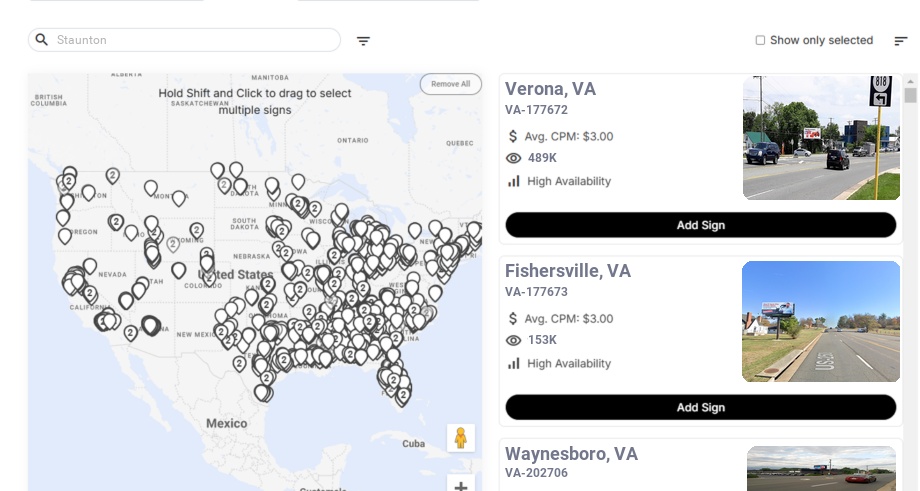



How much is a billboard near Staunton?
Why Choose Blip for Billboard Advertising near Staunton
-
Blip lets you launch fast in Staunton and reach I-81/I-64 commuters without contracts or long setups.
-
Use flexible budgets in Staunton to test ads near Augusta Health, then scale when weekday traffic proves out.
-
Daypart your Staunton campaign for rush hours or weekend Blue Ridge visitors on I-64 and U.S. 250.
-
Staunton businesses can track real-time performance and shift spend as tourism spikes around Shenandoah trips.
-
Blip's creative tools help Staunton ads stand out for Mary Baldwin families, downtown arts crowds, and commuters.
Frequently Asked Questions About Billboard Advertising near Staunton
How much does a billboard cost near Staunton, Virginia with Blip?
With Blip, you control exactly what you spend on Staunton billboards by setting a daily budget that can be changed at any time, so you can advertise in the Staunton area on virtually any budget. Each ad impression, or “blip,” is a 7.5 to 10-second display on digital billboards near Staunton, Virginia, and you only pay for the blips you receive. The price of each blip varies based on when and where your ad appears and current advertiser demand, and your total cost over time is simply the sum of those individual blips.
Where can I advertise with Blip near Staunton, Virginia?
We serve the Staunton area using 8 digital billboards in Fishersville, Waynesboro, and Stuarts Draft. These locations function as billboards near Staunton that cover the primary entry points into the city while also reaching major commuter flows across Augusta County. Combined, these corridors give our 8 digital faces exposure to well over 100,000 vehicle trips per day across the immediate radius.
What kind of traffic do Staunton, Virginia billboards reach?
The Staunton area sits along some of the highest-traffic corridors in the region, including I-81 near Staunton/Fishersville, I-64 near Waynesboro, and U.S. 250 and U.S. 340 around Waynesboro, Fishersville, and Stuarts Draft. Many segments see 15,000–25,000 vehicles per day, and I-81 near major interchanges is often in the 60,000–70,000 vehicles per day range. National out-of-home research shows that over 80% of U.S. adults notice OOH ads while driving, and around 50% notice digital billboards specifically each month.
When is the best time to run Blip billboard ads in Staunton, Virginia?
Morning peaks typically run 6:30–9:00 a.m., with evening peaks 4:00–6:30 p.m., when traffic volumes can be 40–60% higher than mid-day off-peaks on major routes. Tourist flows are heaviest from April–October, especially weekends, fall foliage season, and long holiday weekends. Blip’s scheduling tools allow us to increase bids and frequency during known high-volume windows—rush hours, weekends, and event days—while throttling back during lower-value periods.
What kind of audience does Staunton, Virginia have for billboard advertising?
The Staunton area offers a diverse mix attractive to many advertiser types, with families, retirees, and young adults all well-represented. Median ages in Staunton, Waynesboro, and Augusta County are generally in the 37–43 range, and median household incomes typically fall in the $55,000–$70,000 band. The area’s economy is anchored by healthcare, education, manufacturing and logistics, and tourism/hospitality.
Do I need a contract to advertise with Blip near Staunton?
No, Blip has no long-term contracts or minimum commitments. You can start, pause, or stop your campaign at any time.
How fast can I launch a billboard campaign with Blip near Staunton?
You can have your campaign live in minutes. Create a free account, select your locations, set your budget, upload your design, and start running once approved.
Where can I advertise with Blip near Staunton?
Blip has digital billboards near Staunton. You can browse available locations on a map, choose the ones that fit your audience, and start advertising right away.
Still have questions? Launch a campaign in minutes — no contracts, no commitments.
Start Your CampaignStaunton Billboard Advertising Guide
Nestled at the crossroads of I‑81 and I‑64, the Staunton area punches far above its size when it comes to visibility, tourism, and commuter traffic. With 8 digital billboards serving the Staunton area from nearby Fishersville, Waynesboro, and Stuarts Draft, we can tap into a high‑intent local audience plus a steady stream of regional travelers exploring the Shenandoah Valley and Blue Ridge Mountains. For brands specifically looking for billboards near Staunton or flexible billboard rental near Staunton, this inventory offers a cost‑efficient way to stay visible on the area’s busiest routes. Below, we’ll walk through how to build a smart, data‑driven digital billboard strategy tailored to the Staunton area using Blip’s flexibility.
Understanding the Staunton Area Market
The Staunton area is a compact but influential hub for the central Shenandoah Valley:
- Staunton city population: about 25,700–26,000 residents (mid‑2020s estimates from the City of Staunton
- Waynesboro population: about 23,500 residents, according to recent figures from the City of Waynesboro.
- Augusta County population: roughly 78,000–79,000 residents, per county‑level planning and economic development data from Augusta County
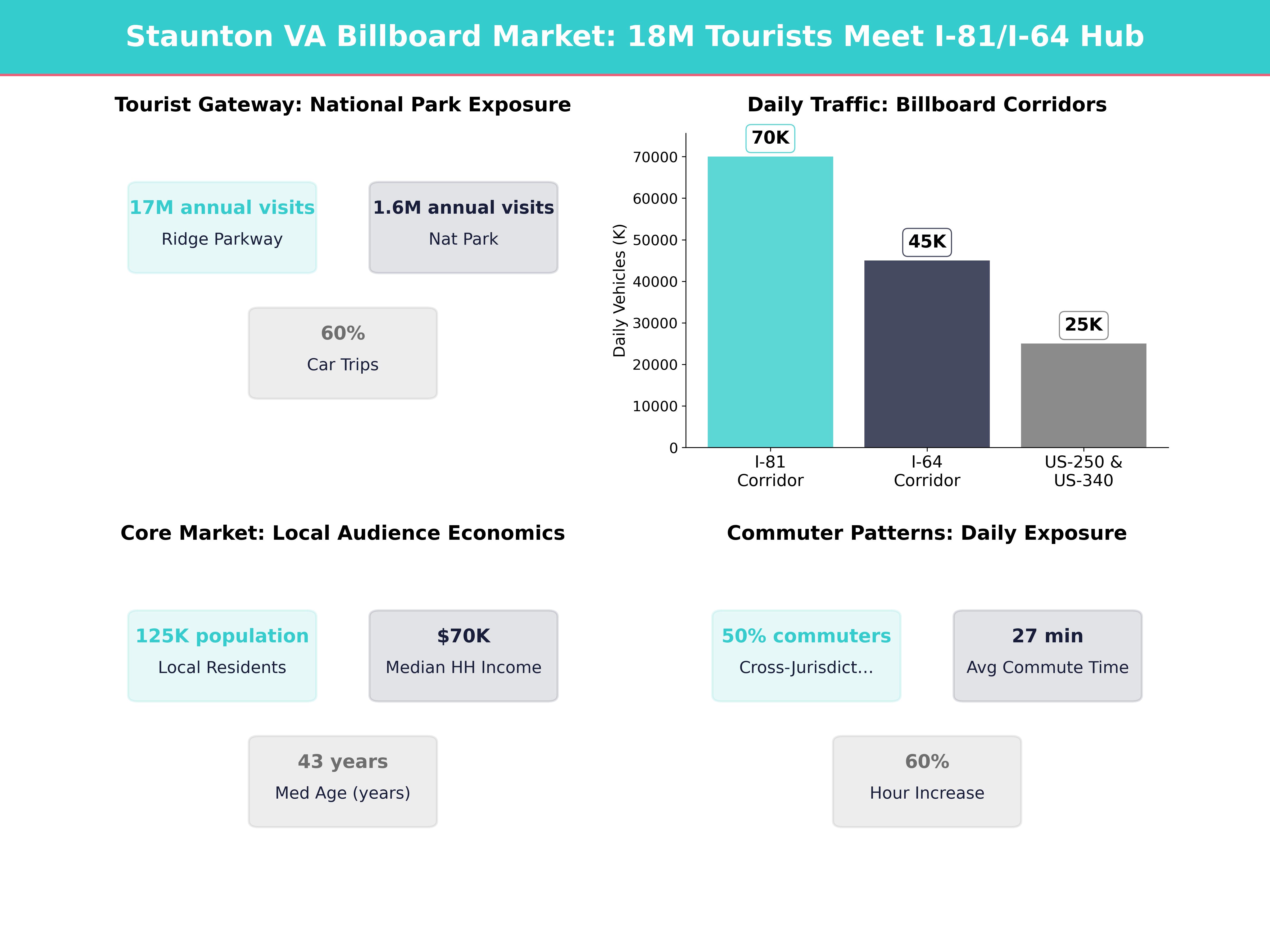
That puts the core market we can reach via nearby Fishersville, Waynesboro, and Stuarts Draft at well over 125,000 local residents, plus a large visitor base.
Key local anchors and institutions include:
- Mary Baldwin University (Staunton), with roughly 2,000 students across undergraduate and graduate programs and more than 10,000 alumni in Virginia, according to Mary Baldwin University. This drives a steady 18–34 audience segment and recurring family visit traffic for move‑ins, move‑outs, and events.
- Augusta Health in Fishersville, a major regional employer and healthcare hub noted by Augusta Health over 100,000 residents in its primary service area and employing 2,000+ team members. This creates dense weekday traffic from employees, patients, and visitors.
- A vibrant arts and tourism scene centered around downtown Staunton; see the city’s official site at staunton.va.us Visit Staunton. The historic downtown district hosts 100+ independent shops, restaurants, and galleries, according to Staunton Downtown Development Association.
- Cultural anchors like the American Shakespeare Center, which reports drawing tens of thousands of patrons annually to performances at the Blackfriars Playhouse in downtown Staunton (American Shakespeare Center).
Tourism is a major force:
- Shenandoah National Park, just east of the Staunton area, reported around 1.6 million recreational visits in 2023, per the National Park Service (Shenandoah National Park).
- The Blue Ridge Parkway, accessed via I‑64 east of Waynesboro, saw roughly 16–17 million recreation visits in 2023, consistently ranking among the top three most‑visited units in the National Park System (Blue Ridge Parkway).
- The broader Shenandoah Valley region, including Augusta County, generates hundreds of millions of dollars in visitor spending annually, with Virginia Tourism Corporation data indicating that visitor expenditures in the Staunton–Augusta–Waynesboro area climbed steadily through 2022–2023.
A meaningful slice of these visitors pass through or very near our digital billboards as they use I‑81, I‑64, and U.S. 250 to explore the Valley, visit ski and golf destinations like Wintergreen Resort Shenandoah Valley Travel Association
Where Our Billboards Are and Who They Reach
We serve the Staunton area using 8 digital billboards in:
- Fishersville (about 6.6 miles from Staunton)
- Waynesboro (about 8.0 miles from Staunton)
- Stuarts Draft (about 8.8 miles from Staunton)
These locations function as billboards near Staunton that cover the primary entry points into the city while also reaching major commuter flows across Augusta County.
These locations sit along some of the highest‑traffic corridors in the region:
- I‑81 near Staunton/Fishersville: A primary north–south artery with typical average daily traffic (ADT) often in the 60,000–70,000 vehicles/day range near major interchanges, per the Virginia Department of Transportation (VDOT) Staunton District
- I‑64 near Waynesboro: An east–west corridor carrying 35,000–45,000 vehicles/day in many segments, with peaks near interchanges that feed the Blue Ridge Parkway and U.S. 250.
- U.S. 250 and U.S. 340 around Waynesboro, Fishersville, and Stuarts Draft: Critical commuter and retail routes, with many segments seeing 15,000–25,000 vehicles/day, tying together bedroom communities, job centers, and shopping destinations.
Combined, these corridors give our 8 digital faces exposure to well over 100,000 vehicle trips per day across the immediate radius. National out‑of‑home research from the Out of Home Advertising Association of America (OAAA) shows that over 80% of U.S. adults notice OOH ads while driving, and around 50% notice digital billboards specifically each month, making these placements highly visible to both locals and travelers.
This pattern means our inventory is ideal for:
- Commuter reach: Thousands of daily commuters between Staunton, Waynesboro, Fishersville, Stuarts Draft, Harrisonburg, and Charlottesville. Regional planning data shows that 40–50% of workers in some Augusta County communities commute to a different jurisdiction, underscoring how much economic activity flows through these corridors and how consistently commuters encounter Staunton billboards on their daily drive.
- Tourist reach: Travelers heading to Shenandoah National Park, Blue Ridge Parkway, Wintergreen, and area wineries/breweries, plus visitors to major events highlighted by Visit Staunton and Visit Waynesboro.
- Local shopper reach: Residents frequenting big‑box retail, grocery, services, and medical appointments along U.S. 250, as well as the health‑care‑anchored activity node around Augusta Health.
Audience & Demographic Insights for the Staunton Area
The Staunton area offers a diverse mix attractive to many advertiser types:
- Age mix: Families, retirees, and young adults are all well‑represented. Median ages in Staunton, Waynesboro, and Augusta County are generally in the 37–43 range, indicating a balanced market of young families, mid‑career professionals, and older adults. Roughly 20–25% of residents in many localities are under 18, and 15–20% are 65+, giving advertisers strong youth and senior segments.
- Income profile: Median household incomes in the Staunton–Waynesboro–Augusta County region typically fall in the $55,000–$70,000 band. That supports discretionary spend on dining, travel, home improvement, and automotive, while price‑sensitive offers still perform well. In some commuter pockets closer to Charlottesville and Harrisonburg, typical household incomes edge toward $75,000+, making premium products and services viable.
- Employment mix: The area’s economy is anchored by healthcare (Augusta Health), education (Mary Baldwin University, area schools), manufacturing and logistics (industrial parks around Stuarts Draft and Weyers Cave), and tourism/hospitality. Local economic development data from Augusta County
- Education and culture: Downtown Staunton’s strong arts and culture scene—highlighted by venues like the American Shakespeare Center, the Frontier Culture Museum (Frontier Culture Museum), and a robust events calendar curated on Visit Staunton—creates a receptive audience for entertainment, cultural attractions, and dining. The presence of Mary Baldwin University and nearby colleges adds a steady student and faculty segment.
- Tourist psychographics: Outdoor‑oriented, road‑trip travelers and heritage tourists drawn to historic downtowns and scenic drives are common. Virginia tourism research shows that more than 60% of leisure trips in the state are by car, and Shenandoah Valley visitors heavily favor scenic byways, hiking, wineries, breweries, and small towns. They respond well to clear directional messaging (“Next Exit”, “5 Minutes Ahead”) and time‑sensitive offers, which aligns well with billboard advertising near Staunton that emphasizes exits, timing, and proximity.
When crafting campaigns, we can leverage this blend by:
- Targeting families and commuters on weekday morning and evening drives, when Nielsen OOH studies show that over 60% of drivers notice roadside ads.
- Targeting tourists and leisure seekers more heavily on weekends, holidays, and peak vacation months (late spring through fall), when traffic to parks and attractions can spike 30–50% over winter baselines.
- Segmenting messages by route (I‑81 vs I‑64 vs local arterials) to tailor to likely trip purpose—commuting, long‑distance travel, or local errands.
Key Travel Patterns and Hotspots
Understanding how people move through the Staunton area helps us choose which boards to emphasize and when:
-
Commuter flows:
- Many residents of Staunton, Stuarts Draft, and Waynesboro commute along I‑81, I‑64, and U.S. 250 to jobs at Augusta Health, local schools, manufacturing facilities in industrial parks, and retail centers. Regional commuting profiles suggest average one‑way commute times of 22–27 minutes, meaning repeated billboard exposures twice a day on key corridors.
- Morning peaks typically run 6:30–9:00 a.m., with evening peaks 4:00–6:30 p.m. During these windows, traffic volumes can be 40–60% higher than mid‑day off‑peaks on major routes.
-
Tourist flows:
- Heaviest from April–October, especially weekends, fall foliage season, and long holiday weekends (Memorial Day, July 4, Labor Day, and Columbus Day/Indigenous Peoples’ Day). Shenandoah National Park’s visitation during these months often accounts for 70%+ of its annual traffic.
- Many use I‑64 to access the Blue Ridge Parkway and Shenandoah National Park’s southern entrances, passing our Waynesboro‑area boards. When Skyline Drive and the Parkway are busy, local tourism offices in Staunton and Waynesboro report sold‑out or near‑capacity lodging on peak weekends.
- Weekend midday traffic (roughly 10:00 a.m.–3:00 p.m.) along I‑64 and major local routes offers prime exposure for attractions, restaurants, and lodging, with a higher share of out‑of‑area plates and leisure travelers.
-
Retail and service nodes:
- Shopping corridors along U.S. 250 near Waynesboro and Fishersville draw shoppers from throughout Augusta County and the Staunton area. Trade‑area studies from regional chambers such as the Greater Augusta Regional Chamber of Commerce indicate that these corridors serve tens of thousands of consumers weekly.
- Healthcare traffic to Augusta Health is steady throughout weekdays, ideal for healthcare, pharmacy, senior living, and professional services ads. Healthcare accounts for 10–15% of total employment in many Virginia localities, and that pattern holds in the Staunton–Augusta region, producing reliable weekday volumes.
Blip’s scheduling tools allow us to increase bids and frequency during known high‑volume windows—rush hours, weekends, and event days—while throttling back during lower‑value periods to maximize return on ad spend. Industry case studies show that campaigns which focus impressions into top traffic windows can improve recall by 20–40% compared with evenly spread schedules, making this a smart way to structure billboard advertising near Staunton for maximum impact.
Seasonal and Event‑Driven Opportunities
Seasonality in the Staunton area can dramatically boost campaign performance when we plan around it. Useful local calendars include:
- City of Staunton
- Visit Staunton events
- Visit Waynesboro tourism and events
- Community and county events via Augusta County Greater Augusta Regional Chamber of Commerce
Key patterns to build into your flighting:
-
Spring (March–May):
- Rising tourism and weekend trips as weather improves; Shenandoah and Blue Ridge Parkway visitation begins ramping up from winter lows and can double between March and May.
- Graduation season for Mary Baldwin University and local high schools, bringing in hundreds of visiting families over a concentrated period.
- Ideal for: attractions, restaurants, seasonal retail, graduation gifts, event venues, and local services (landscaping, home improvement, tax and financial services).
-
Summer (June–August):
- Peak national park and Blue Ridge Parkway visitation; in some years, July alone can account for 10–12% of total annual Parkway visits. Families on vacation fill I‑81 and I‑64, and hotel occupancy in the region typically reaches its annual highs.
- Local festivals, outdoor concerts, and farmers markets in Staunton and Waynesboro, regularly featured on Visit Staunton and Visit Waynesboro.
- Ideal for: lodging, dining, family activities, outdoor gear, ice cream/quick‑serve restaurants, fuel and convenience stores, and attractions such as the Frontier Culture Museum and American Shakespeare Center.
-
Fall (September–November):
- Leaf‑peeping drives through Shenandoah National Park and the Blue Ridge Parkway; tourism remains strong through October, with some overlooks and trailheads experiencing weekend parking capacity by mid‑morning.
- Back‑to‑school and college traffic in the Staunton area, including Mary Baldwin University move‑in and homecoming events.
- Ideal for: breweries/wineries, fall events, agritourism (pumpkin patches, corn mazes), home services, healthcare (flu shots, check‑ups), and retail gearing up for the holidays.
-
Winter (December–February):
- Holiday shopping and travel on I‑81/I‑64, including heavy traffic around Christmas and New Year’s. National travel data shows year‑end holidays can boost highway volumes by 20–30% over typical December weekdays.
- After-holiday lull in tourism but steady commuter and healthcare traffic; weather events can slightly reduce tourist flows but rarely affect local necessity trips.
- Ideal for: retail promotions, holiday events, end‑of‑year auto deals, tax preparers, gyms and wellness (January), and recruitment campaigns when employers ramp up hiring for the new year.
With Blip, we can launch short, high‑impact bursts timed to specific weekends or event days—such as local festivals or big performances covered by outlets like the Staunton News Leader (newsleader.com) and regional stations like WHSV and NBC29. Aligning billboard flights with these media spikes helps reinforce messaging; OAAA studies show that campaigns combining OOH with other media can boost overall reach and frequency by 10–20% compared with single‑channel efforts.
Crafting Effective Creative for the Staunton Area
To stand out on digital billboards serving the Staunton area, artwork must work at highway speeds and connect culturally with local viewers.
1. Keep it ultra‑simple
- Aim for 6–8 words max of headline text, reflecting industry best practice that drivers typically have 6–8 seconds to process a billboard at highway speeds.
- Use one main visual (product, person, or icon) and your logo.
- Ensure fonts are thick, high‑contrast, and at least 10–12 inches tall in final production terms (your designer or our templates can scale properly).
2. Use local cues and landmarks
People in the Staunton area are proud of their region. Tap into that by referencing:
- “Just past Exit XX on I‑64” or “Next exit for historic downtown” for tourist messaging, especially for destinations promoted by Visit Staunton and Visit Waynesboro.
- Mentions of Shenandoah Valley, Blue Ridge, or downtown Staunton’s arts district for relevance.
- Local directional cues like “5 minutes from Augusta Health” or “On U.S. 250 near Waynesboro,” anchoring your message to familiar waypoints.
3. Drive action with clear CTAs
Because people are often in motion, focus on easy next steps:
- “Order Now at [shortURL].com”
- “Exit 94 – Turn Right at U.S. 250”
- “Call Now: 540‑XXX‑XXXX”
- “Tonight Only – Tickets at [shortURL].com”
Use short, memorable URLs or QR codes sized large enough for slower local traffic corridors (they’re usually not ideal on high‑speed interstate boards but can work on slower arterials). Nielsen OOH research indicates that over 40% of viewers have visited a website or searched online after seeing an OOH ad, so simple, trackable CTAs can meaningfully drive digital engagement.
4. Match creative to audience segment and route
- On I‑81/I‑64 near the Staunton area: Think travelers and commuters. Use directional and benefit‑driven messaging: fuel, food, lodging, attractions, auto services, colleges, and hospitals. Emphasize exits and mileage (“Exit 225 – 2 Miles Ahead”) so drivers can quickly decide.
- On local roads in Fishersville, Waynesboro, and Stuarts Draft: Focus on daily‑life services like dentists, banks, grocery, retail, local events, churches, and schools. Here, you can use slightly more detail—such as hours or short offers—since speeds and viewing distances are lower.
5. Leverage digital flexibility
With Blip, we can rotate multiple creatives in a single campaign:
- Run tourist‑oriented artwork more heavily Friday–Sunday and during daytime hours (10 a.m.–6 p.m.) when leisure travel peaks.
- Run commuter‑oriented artwork Monday–Friday at rush hours (6:30–9:00 a.m., 4:00–7:00 p.m.).
- Test two or three versions of a headline at once and then focus budget on the better‑performing variants (based on web traffic, calls, and store visits during those flights). Case studies from Nielsen and OAAA show that optimizing creative based on performance can increase ad recall and response by 20–30%.
Smart Budgeting and Bidding Strategy with Blip
Digital billboards via Blip let us run campaigns in the Staunton area with any budget, from very small tests to full‑coverage efforts. This flexibility makes it easy to start billboard rental near Staunton without committing to long, expensive contracts.
Consider these tactics:
-
Start with a test burst:
- Pick 2–4 weeks as an initial test, long enough to hit multiple commute cycles and at least two weekends.
- Concentrate impressions on peak times (rush hours, weekends, or event days) rather than spreading too thin across all hours.
- Review impact on website sessions, calls, and in‑store visits. Many small businesses see noticeable directional traffic and awareness lift within the first 2–3 weeks of a concentrated digital billboard test.
-
Use dayparting:
- Morning: promotions for coffee, breakfast, traffic‑time radio shows, urgent care, and quick‑decision services.
- Midday: tourists, retirees, shoppers; ideal for attractions, lunch spots, and retail.
- Evening: restaurants, entertainment, family activities, next‑day reminders (“Schedule your appointment tonight”).
- For event‑driven campaigns (e.g., a Saturday festival downtown), consider front‑loading impressions Thursday–Saturday to build anticipation.
-
Adjust bids by sign and time:
- Raise bids on high‑traffic or highly competitive faces near key interchanges or retail centers (e.g., I‑64 near Waynesboro, U.S. 250 near major shopping areas).
- Lower bids in less competitive hours (late evenings, some mid‑day periods) to maintain presence cost‑effectively.
- For brands targeting tourists, prioritize Friday afternoon through Sunday evening on I‑64 and key parkway access routes.
-
Layer geographic coverage:
- Combine Fishersville, Waynesboro, and Stuarts Draft boards in one campaign to blanket major inflow/outflow routes for the Staunton area, including traffic to/from Charlottesville‑Albemarle Airport and I‑81 corridor cities.
- Emphasize boards closer to your physical location for directional campaigns (“Next Right”, “2 Miles Ahead”), which are especially effective for restaurants, gas, lodging, and urgent care.
Example Campaign Approaches by Industry
Here are concrete ways different advertisers can use our digital billboards serving the Staunton area:
Local Restaurants & Breweries
- Run lunch specials from 10 a.m.–2 p.m. and dinner/Happy Hour offers 4–8 p.m., aligned with peak dining windows.
- Use “Exit X off I‑64” or “2 miles on U.S. 250” copy to catch tourists and commuters who may be unfamiliar with local roads.
- Rotate creatives: one for locals midweek (e.g., “Kids Eat Free Tuesday in Staunton”), one for weekend travelers (“Craft Beer 5 Minutes Ahead – Exit 94”).
- Breweries and wineries along the Shenandoah Beerwerks Trail or Augusta County wine routes can tap into visitors already flagged by Visit Staunton and Visit Waynesboro.
Healthcare & Professional Services
- Promote Augusta County‑area clinics, dental offices, and urgent care with simple reliability messaging: “Walk‑In Care Near Augusta Health – Open 7 Days.”
- Time heavier frequency around commuting hours when people are thinking about to‑do lists; internal studies at many practices show that appointment calls often spike right before work, at lunch, and right after work.
- Run seasonal messages (flu shots in fall, sports physicals in late summer, Medicare enrollment and check‑ups in late fall).
- Use geo‑anchored language like “Across from Augusta Health in Fishersville” to leverage the strong awareness of Augusta Health
Tourism, Arts & Events
- For venues featured on Visit Staunton or Visit Waynesboro, highlight upcoming shows, festivals, and exhibits: “Shakespeare Tonight – 7 p.m. in Historic Downtown,” “Music Festival This Saturday – Riverfront in Waynesboro.”
- Use countdowns and limited‑time frames (“3 Days Until Queen City Mischief & Magic,” “Fall Foliage Festival This Weekend – Exit X”), which research shows can lift intent to attend by 15–25% compared with generic branding alone.
- Schedule heavier flights the week leading into events and on event days, especially Thursday–Sunday for weekend‑centric festivals.
Retail & Auto Dealers
- Promote limited‑time sales, clearance events, or new inventory. Auto buyers frequently research online but still visit multiple dealerships; OAAA data indicates that nearly 30% of drivers have visited a business after seeing its billboard.
- Combine a strong price/value hook with a big, legible call to action: “Trucks From $299/mo – Exit X, Waynesboro.”
- Increase bids around payday windows (e.g., 1st and 15th of the month) and weekends, when shopping and test‑drive activity typically peak.
- For large‑format retailers on U.S. 250 or near Staunton’s downtown, use simple location anchors (“Across from Walmart,” “Next to Downtown Parking Garage”) that locals instantly recognize.
Education & Recruitment
- For Mary Baldwin University, community colleges, private schools, or employers, run campaigns around application deadlines, job fairs, and open houses. Clear date‑driven CTAs drive urgency (“Apply by March 1,” “Job Fair Thursday 10–2”).
- Leverage directional messaging from I‑81/I‑64 and local corridors to position your campus or facility as close and accessible (“5 Minutes from I‑81 – Now Hiring,” “Downtown Staunton Campus – Apply Today”).
- Regional employers in manufacturing, logistics, and healthcare can target shift changes and commuting windows; many plants and hospitals rotate 3 main shifts per day, making time‑targeted recruitment billboards particularly effective.
Measuring Impact and Optimizing Over Time
Even though billboards are a “top‑of‑funnel” medium, we can still track effectiveness and improve performance:
-
Watch website analytics:
- Look for traffic spikes from the Staunton–Waynesboro–Augusta region during campaign periods.
- Use simple vanity URLs or dedicated landing pages for billboard visitors (e.g., yoursite.com/staunton). Campaigns that employ unique landing pages often see 10–30% of total web sessions to that page align closely with active billboard windows.
-
Monitor phone and store activity:
- Ask “How did you hear about us?” and track the share mentioning “billboard” or “sign.” Businesses that systematically ask this question often find 10–20% of new customers credit OOH as a discovery or reminder channel.
- Compare weeks with and without active Blip flights, especially across similar seasons (e.g., fall vs. fall). Look for sustained lifts in sales, foot traffic, or leads.
-
Align with media coverage:
- When your brand appears in local outlets like the Staunton News Leader (newsleader.com) or regional stations such as WHSV and NBC29, complement that awareness with heavier billboard presence to reinforce credibility. Studies on multi‑channel campaigns suggest that combining OOH with TV, radio, or online news can increase ad recall by up to 40% compared with using one medium alone.
-
Iterate creative and schedule:
- Test different headlines, images, or offers. Even simple A/B tests (e.g., “$10 Off” vs. “20% Off”) can reveal 5–15% differences in response.
- Shift spend to the days, times, and locations that drive the best downstream results—more calls, more web visits, more store traffic. Over time, this creates a tailored “Staunton playbook” for your brand and clarifies which billboard advertising near Staunton performs best for your goals.
Putting It All Together for the Staunton Area
The Staunton area offers a rare combination of:
- Strong local loyalty and community identity, reflected in active downtown districts and engaged civic organizations such as the Greater Augusta Regional Chamber of Commerce.
- Regional connectivity via I‑81 and I‑64 that deliver tens of thousands of daily vehicle trips past our boards.
- Robust tourism flows associated with the Shenandoah Valley, Shenandoah National Park, and the Blue Ridge Parkway, plus a growing slate of local events promoted by Visit Staunton and Visit Waynesboro.
By strategically using our 8 digital billboards in Fishersville, Waynesboro, and Stuarts Draft, we can efficiently reach residents, commuters, and visitors moving through the Staunton area every day. For advertisers comparing Staunton billboards with other local options, this cluster of signs delivers broad coverage without sacrificing the ability to target specific corridors and times of day.
When we combine:
- Clear, locally‑relevant creative,
- Smart timing around commuting patterns and seasonal tourism, and
- Data‑informed optimization using Blip’s flexible tools,
we create billboard campaigns that not only get noticed but also drive real, measurable business results for advertisers aiming to grow in the Staunton area and maximize the value of billboard rental near Staunton.