Billboards in Yorktown, VA
No Minimum Spend. No Long-Term Contracts. Just Results.
Trusted by Leading Brands


Billboard advertising
in Yorktown has never been easier



How much is a billboard in Yorktown?
Why Choose Blip for Billboard Advertising in Yorktown
-
Blip lets Yorktown advertisers launch fast and self-serve, reaching I-64 and Route 17 commuters without sales calls or delays.
-
Use Blip-optimized campaigns in Yorktown to auto-buy the best digital slots for tourism on Route 199 and commuter traffic on Victory Blvd.
-
Set a flexible budget in Yorktown and pay only when your ad plays, ideal for testing summer tourist surges or school-season demand.
-
Daypart your Yorktown ads for 6:30-9 a.m. commutes, 3:30-6:30 p.m. drives home, and weekend visitor traffic near Historic Yorktown.
-
No contracts means Yorktown brands can pause or shift anytime as storm season, festivals, or Peninsula traffic patterns change.
Frequently Asked Questions About Billboard Advertising in Yorktown
How much does a billboard cost in Yorktown, Virginia with Blip?
With Blip, the cost of billboard advertising in Yorktown is flexible and easy to control. You choose a daily budget, and Blip’s algorithm uses it to bid for open ad slots on rotating digital billboards, so you only pay when your ad actually displays. Each “blip” is a 7.5-to-10-second ad, starting at just $0.01 per display, and pricing can change based on time of day, location, and advertiser demand.
Where can I advertise with Blip in Yorktown, Virginia?
Historic Yorktown is not a giant standalone city market, but it is a strong billboard geography because it sits inside York County on the heavily traveled Virginia Peninsula. Key traffic corridors include I-64, Route 17, Victory Boulevard, Hampton Highway, and Route 199. The best digital opportunities are usually on approach roads rather than right on the riverfront.
What kind of audience can Blip reach in Yorktown, Virginia?
Yorktown is valuable because it layers several different audiences on top of one another. The market includes commuters, military households, industry workers, families and higher-income homeowners, tourists, and students, parents, and campus visitors. That mix makes Yorktown especially well suited for flexible digital billboard campaigns.
When is the best time to run a billboard campaign in Yorktown, Virginia with Blip?
The best Yorktown billboard campaigns usually follow the local calendar. Spring and summer are the most obvious tourism windows, especially from Memorial Day to Labor Day, while late August and September are excellent for back-to-school and fall routines. Holiday campaigns can also perform well, and coastal Virginia’s storm season from June through November creates short, timely opportunities for weather-driven messaging.
What roads get the most billboard traffic in Yorktown, Virginia?
According to recent traffic count maps from the Virginia Department of Transportation, key Interstate 64 segments serving the Yorktown area typically carry roughly 80,000 to 100,000 vehicles per day. Route 17 is the most important Yorktown-specific corridor, with major segments commonly in the 30,000 to 50,000 AADT range. Victory Boulevard and Hampton Highway generally carry about 20,000 to 35,000 vehicles per day on major local stretches.
Do I need a contract to advertise with Blip in Yorktown?
No, Blip has no long-term contracts or minimum commitments. You can start, pause, or stop your campaign at any time.
How fast can I launch a billboard campaign with Blip in Yorktown?
You can have your campaign live in minutes. Create a free account, select your locations, set your budget, upload your design, and start running once approved.
Where can I advertise with Blip in Yorktown?
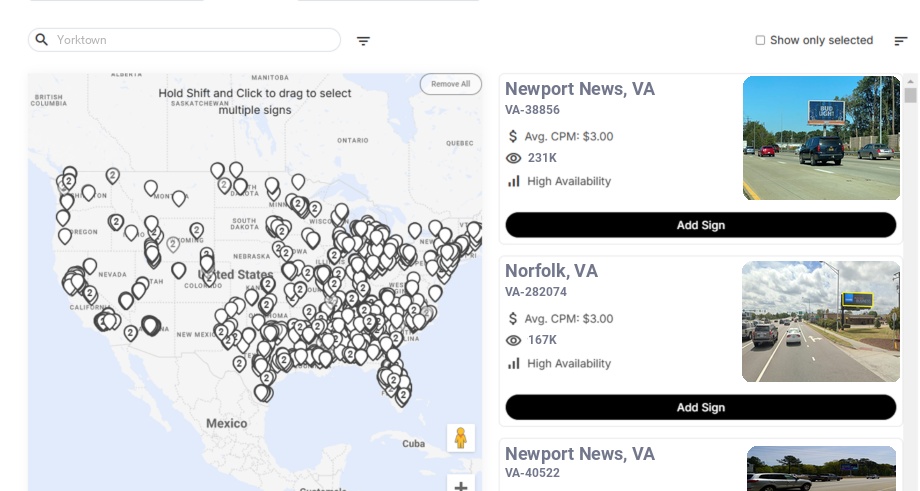
Blip has digital billboards in Yorktown. You can browse available locations on a map, choose the ones that fit your audience, and start advertising right away.
Still have questions? Launch a campaign in minutes — no contracts, no commitments.
Start Your CampaignYorktown Billboard Advertising Guide
Historic Yorktown is not a giant standalone city market, but it is a strong billboard geography because it sits inside York County on the heavily traveled Virginia Peninsula. Recent estimates from the Weldon Cooper Center for Public Service place York County at just over 70,000 residents, while the surrounding Peninsula communities of Williamsburg, James City County, York County, Newport News, and Hampton total roughly 500,000 people. We also benefit from a road network that funnels drivers onto a limited set of highways, including 4 major corridors—primarily I-64, Route 17, Route 199, and Route 134—which increases repeat exposure, and from a tourism economy that brings more than 4 million visitors a year to Greater Williamsburg, according to the Williamsburg Tourism Council. That mix of commuters, military households, students, families, and vacationers makes Yorktown especially well suited for flexible digital billboard campaigns.
Yorktown
Yorktown’s practical billboard market is much larger than the compact historic waterfront. When we plan media here, we should think in terms of York County plus the Lower Peninsula trade area, not just the few blocks around Main Street and the river.
Yorktown’s demographic and economic base
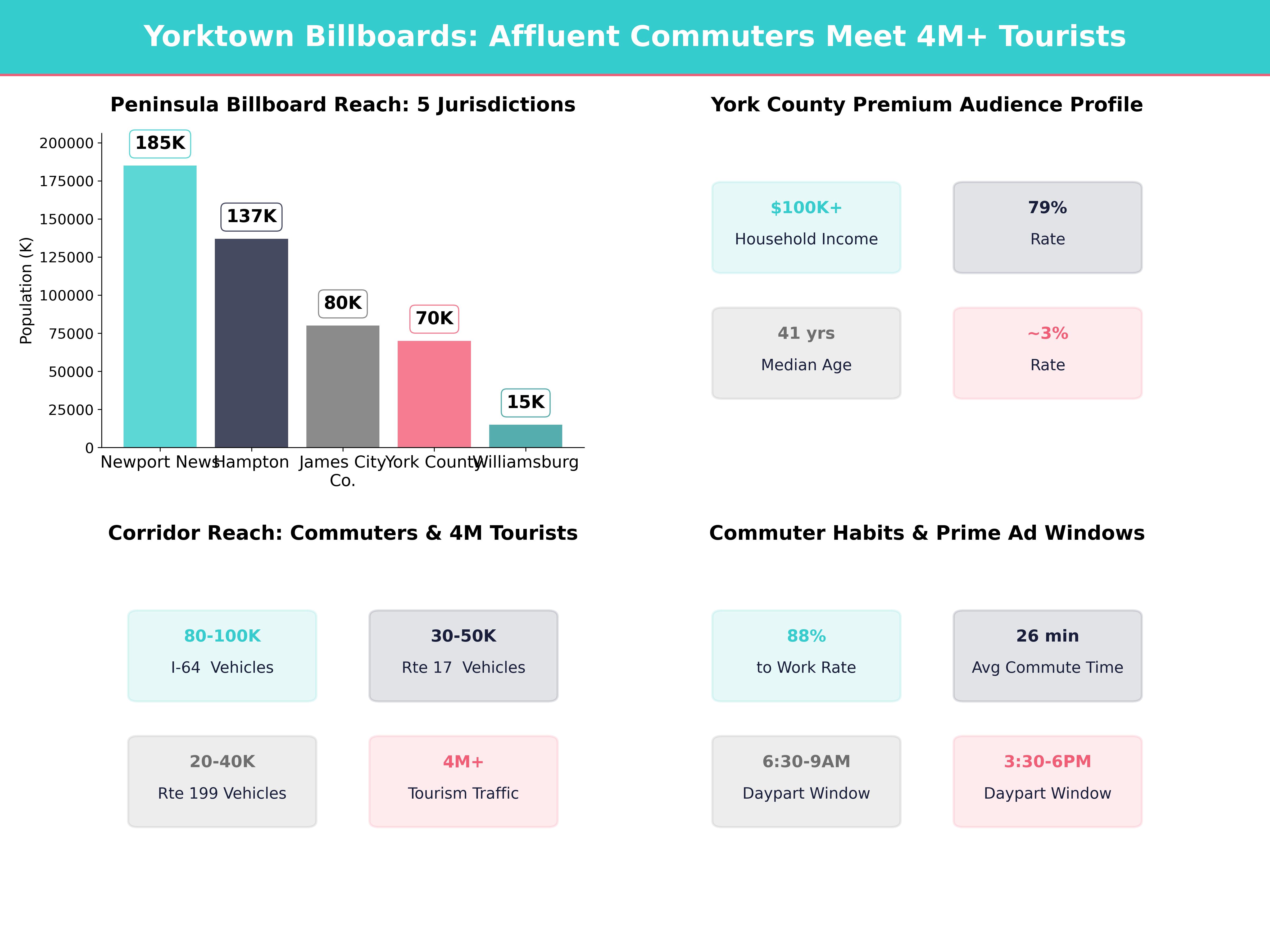
Recent Weldon Cooper Center estimates put York County a little above 70,000 residents, and the county grew by roughly 7% during the 2010s. Neighboring markets expand the available audience quickly, with Newport News at about 185,000 residents, Hampton at about 137,000, James City County near 80,000, and Williamsburg around 15,000. That concentration matters because many people who work, shop, study, or vacation near Yorktown cross city and county lines every day.
Recent community profiles from the Virginia Economic Development Partnership show York County as a relatively affluent suburban market, with median household income above $100,000, homeownership near 79%, and a median age around 41. Those numbers point to strong opportunities for advertisers in healthcare, financial services, real estate, home improvement, automotive, education, and family recreation. They also tell us that premium positioning can work here. We do not always need to compete on price alone in Yorktown.
The local economy is also broader than tourism. Large regional employers in education, healthcare, defense, and shipbuilding create steady year-round traffic. Newport News Shipbuilding alone employs about 26,000 people, which helps support a dependable commuter audience moving across the Peninsula.
What Yorktown travel patterns mean for billboard advertisers
Yorktown is a driving market first. Recent state and regional profiles indicate that roughly 88% of York County workers commute by car, whether alone or in carpools, and the average travel time to work is about 26 minutes. Transit from Hampton Roads Transit and the Williamsburg Area Transit Authority is useful in specific corridors, but it does not change the basic reality that most local trips still happen behind the wheel.
That car dependence is good news for outdoor advertisers because repeated daily exposure is easier to build here than in many transit-heavy metros. The road network is concentrated, and there are only so many practical routes between York County, Williamsburg, Newport News, and Hampton. When the same households use the same highways week after week, even modest billboard schedules can build familiarity quickly.
York County also tends to post low unemployment. Monthly data from the Virginia Employment Commission regularly place the county around 3% unemployment or below. For billboard advertisers, that usually means a relatively stable consumer base, steady commuting patterns, and durable demand for services rather than one-time impulse traffic alone.
Key Traffic Corridors Around Yorktown
York County and the surrounding Peninsula do not have dozens of interchangeable high-volume roads. They have a handful of dominant corridors, and that concentration is one reason billboard advertising works so well here.
Interstate 64 through the Yorktown-Williamsburg-Newport News corridor
According to recent traffic count maps from the Virginia Department of Transportation, key Interstate 64 segments serving the Yorktown area typically carry roughly 80,000 to 100,000 vehicles per day, depending on the exact segment. That makes I-64 the widest-reach corridor for advertisers who want regional visibility rather than neighborhood-only frequency.
This corridor is especially strong for:
- Regional healthcare systems, because it connects York County households to care options in Newport News, Williamsburg, and Hampton.
- Tourism and hospitality brands, because it carries visitors heading to Colonial Williamsburg, Busch Gardens Williamsburg, Water Country USA, and Yorktown attractions.
- Colleges and career programs, because it reaches students and families moving among William & Mary, Christopher Newport University, and other Peninsula destinations.
- Automotive, retail, and entertainment advertisers, because longer trips create more destination-based decision making.
If we want broad awareness across the Peninsula, I-64 should usually be on the short list.
Route 17, George Washington Memorial Highway, and the Yorktown gateway
Route 17 is the most important Yorktown-specific corridor. Recent VDOT counts commonly place major York County segments of Route 17 in roughly the 30,000 to 50,000 AADT range. The highway carries local suburban traffic, cross-river commuters from Gloucester County, and visitors heading toward Historic Yorktown.
This route is ideal for advertisers that rely on frequency and local relevance, including:
- Home services, because Route 17 reaches neighborhoods in Grafton, Tabb, and other York County residential areas.
- Healthcare, dental, and urgent care providers, because it is a routine path for family errands and weekday appointments.
- Banks, insurance agencies, and professional services, because repeated commuter exposure helps build trust.
- Restaurants, grocery, and convenience retail, because drivers often make quick decisions near familiar commercial nodes.
Route 17 is also a strong place to use directional language. Messages such as “Next Right,” “Minutes Ahead,” or “Near Riverwalk Landing” can work well when they are truthful and easy to process at speed.
Victory Boulevard, Hampton Highway, and employment access routes
Victory Boulevard and Hampton Highway, both tied into Route 134 segments in the Peninsula network, generally carry about 20,000 to 35,000 vehicles per day on major local stretches, based on recent VDOT count maps. These roads connect York County neighborhoods with employment zones near Newport News, Fort Eustis, and major retail clusters.
These routes are often best for:
- Recruitment advertising, especially for trades, healthcare support, retail management, and logistics.
- Quick-service restaurants and everyday retail, because drivers are often making practical stop decisions.
- Family entertainment, because the traffic includes parents running weekday and weekend errands.
- Auto repair, tire, and service brands, because the audience is heavily commuter-based.
When we want a slightly more local, utility-driven audience than I-64 delivers, these corridors are excellent complements.
Route 199 and the Williamsburg tourism loop
The VDOT network around Route 199 and nearby Williamsburg approach roads typically carries about 20,000 to 40,000 vehicles per day, depending on segment and season. That may sound smaller than I-64, but the audience quality can be outstanding for visitor-oriented campaigns.
This area is especially useful because the scenic Colonial Parkway does not function as a commercial billboard corridor. Visitors still need to enter the Historic Triangle through commercial feeder roads, and that is where our digital strategy becomes valuable. Route 199 placements can help us reach people heading toward Colonial Williamsburg, Jamestown Settlement, the American Revolution Museum at Yorktown, Busch Gardens Williamsburg, and Water Country USA.
For hotels, attractions, restaurants, museums, and retail centers, Route 199 can outperform larger roads simply because it intercepts people close to decision points.
Audience Segments We Can Reach in Yorktown
Yorktown is valuable because it layers several different audiences on top of one another. We are not buying one narrow commuter market. We are buying access to overlapping local and visitor segments.
Commuters, military households, and industry workers
The Peninsula’s workday economy is a major billboard asset. Newport News Shipbuilding employs about 26,000 people, and the broader region includes substantial military activity tied to Fort Eustis and Naval Weapons Station Yorktown. Those workers create dependable morning and afternoon traffic on I-64, Route 17, and nearby connectors.
This audience is strong for:
- Job recruitment.
- Healthcare and urgent care.
- Financial services.
- Automotive sales and service.
- Home services that people remember on the drive home.
Commuter campaigns should usually emphasize convenience, trust, and proximity. Drivers in this segment are often balancing work, family, and errands, so simple promises outperform vague brand language.
Families and higher-income homeowners in York County
York County is one of the stronger family markets on the Peninsula. Recent VEDP community profiles show homeownership near 79%, and roughly 1 in 5 residents is under age 18. The York County School Division serves about 13,000 students, which reinforces the family-oriented nature of the market.
That audience is especially attractive for:
- HVAC, roofing, plumbing, and remodeling.
- Pediatric, dental, orthodontic, and vision services.
- Insurance, legal, and financial planning.
- Youth sports, tutoring, camps, and enrichment programs.
- Grocery, warehouse clubs, and family dining.
In practice, this means Yorktown-area boards are often stronger for durable service categories than advertisers might expect from a place known mainly for history tourism.
Tourists and weekend visitors
Tourism is a major second layer on top of the resident market. The Williamsburg Tourism Council says Greater Williamsburg attracts more than 4 million visitors each year. Many of those visitors circulate through the full Historic Triangle, including Historic Yorktown, Colonial Williamsburg, Jamestown Settlement, and the American Revolution Museum at Yorktown.
This audience is excellent for:
- Hotels and short-stay lodging.
- Attractions and museums.
- Restaurants, breweries, and waterfront dining.
- Specialty retail and souvenirs.
- Event promotions and seasonal festivals.
Because many visitors arrive by car and are unfamiliar with the area, directional clarity matters even more than usual.
Students, parents, and campus visitors
Yorktown also benefits from nearby higher education traffic. William & Mary enrolls about 9,600 students, and Christopher Newport University enrolls about 4,700. Together, that gives the broader market more than 14,000 students before we even count parents, faculty, staff, prospective students, and visiting families.
This segment supports campaigns for:
- Apartments and student-oriented housing.
- Restaurants and coffee.
- Healthcare and urgent care.
- Retail, entertainment, and events.
- Graduate education and professional programs.
Student traffic is not the dominant Yorktown audience, but it is a meaningful layer, especially on routes connected to Williamsburg and Newport News.
Seasonal and Timing Opportunities in Yorktown
The best Yorktown billboard campaigns usually follow the local calendar. Tourism, school schedules, weather, and event activity all shift attention throughout the year.
Spring and summer in Yorktown
Spring and summer are the most obvious tourism windows. The period from Memorial Day to Labor Day is especially strong for hotels, attractions, restaurants, ice cream, family entertainment, and riverfront businesses. Busch Gardens Williamsburg, Water Country USA, Colonial Williamsburg, and Historic Yorktown all help expand leisure traffic.
Yorktown Market Days also add dependable seasonal activity. The market season typically runs April through December, with Saturday patterns that can justify heavier weekend and late-morning scheduling for food, retail, and destination businesses.
For spring and summer, we should often favor:
- Friday afternoon arrivals.
- Saturday late morning and afternoon traffic.
- Midday runs for tourist destinations.
- Family-oriented creative with clear wayfinding.
Back-to-school and fall in Yorktown
Late August and September are excellent for resetting campaigns around local routines. York County School Division families return to weekday schedules, and students come back to William & Mary and Christopher Newport University. That makes fall a strong season for healthcare, tutoring, after-school programs, home services, grocery, and commuter retail.
Fall also extends the tourism window rather than ending it. Historic attractions remain active, and Busch Gardens Williamsburg keeps regional travel alive with fall events. We should not assume that Yorktown outdoor demand disappears after summer. It simply shifts from family vacation messaging to weekend getaway, dining, festival, and local-service messaging.
Holiday and weather-driven opportunities in Yorktown
Holiday campaigns can perform well across the full Yorktown trade area. The Historic Triangle stays active thanks to heritage tourism, shopping, dining, and seasonal events. Winter can support campaigns for gift cards, special dining, local entertainment, healthcare enrollment, and service businesses.
Weather also creates practical opportunities. Coastal Virginia’s storm season peaks from June through November, and summer heat can be intense. That opens short, timely billboard windows for roofing, generators, flood mitigation, HVAC, urgent care, and insurance-related messaging. Because Blip lets us react quickly, Yorktown is a good market for event-driven or weather-responsive flights rather than only long, fixed campaigns.
Billboard Design Tips for the Yorktown Market
Yorktown responds best when creative feels like it belongs on the Peninsula. We should design for local culture, local speed, and local motivations.
Creative cues that fit Yorktown
The strongest Yorktown creative often borrows from three visual worlds at once: coastal, historic, and suburban. Water blues, navy, white, brick red, and sand tones all fit naturally here. So do images of the waterfront, colonial architecture, tree-lined roads, and family activities.
We should usually avoid generic resort-beach creative unless the offer is truly beach-oriented. Yorktown is not Virginia Beach. It is a history-rich, riverfront, family-centered market. Patriotic styling can work especially well here, but only when it feels polished rather than kitschy.
A few creative approaches that often match the market well include:
- A healthcare brand using calm navy and white with a simple convenience message.
- A home-services advertiser using storm-season imagery and a strong local promise.
- A restaurant using waterfront or historic-district cues instead of generic stock food photography alone.
- A museum, event, or attraction using patriotic color blocking near major travel weekends.
Messaging that works on Yorktown roads
Most Yorktown-area roadside traffic is moving at everyday commuter speed, often in the 45 to 65 mph range depending on corridor. That means concise copy matters. We should keep messages short, readable, and destination-focused.
Local specificity helps. A strong headline might mention York County by name, reference the next exit, or promise a short drive from Route 17 or I-64. Convenience language tends to perform well here because commuters and visitors both want clarity. Examples include same-day service, free estimate, military discount, family-friendly, waterfront dining, and next exit directions, as long as every claim is accurate.
The market’s relatively affluent profile also means we can lean into quality. In Yorktown, “trusted,” “award-winning,” “locally owned,” and “designed for families” often fit better than hard-discount messaging alone.
Regional Strategies Around Yorktown and the Peninsula
A smart Yorktown campaign usually works best when we tailor placements to sub-areas instead of treating the whole market as one blob.
Historic Yorktown and the riverfront approach
Historic Yorktown is a destination market. We should use nearby approach corridors to capture visitors before they arrive rather than expecting heavy billboard inventory in the waterfront core itself. Historic and scenic constraints mean the best digital opportunities are usually on approach roads, not right on the riverfront.
This zone is best for:
- Restaurants and waterfront dining.
- Museums and cultural attractions.
- Weddings and event venues.
- Boutique lodging.
- Seasonal festivals and special events.
Grafton, Tabb, and suburban York County
The Grafton and Tabb side of York County is a high-frequency residential strategy. Route 17 and adjacent connectors let us build repeated exposure with homeowners, parents, and commuters. This is where home services, healthcare, insurance, tutoring, fitness, and local retail can become very efficient.
If our business depends on local trust and repeated household exposure, this should usually be one of the first Yorktown sub-areas we test.
Williamsburg and James City County gateways
The Williamsburg side of the market adds tourism, student traffic, and upscale leisure spending. Corridors tied to I-64, Route 199, and visitor gateways can work well for attractions, hotels, dining, specialty retail, higher education, and healthcare systems serving the entire Historic Triangle.
This sub-area is especially useful when we want to reach visitors who may also spend time in Yorktown, even if they are sleeping or shopping closer to Williamsburg.
Newport News employment hubs and commuter spillover
The Newport News side of the market is more employment-heavy and utility-driven. That makes it strong for recruitment, apartments, healthcare, automotive, and practical retail. It also gives us access to shipyard traffic, Christopher Newport University, and travelers moving through the Newport News/Williamsburg International Airport area.
For many advertisers, the best “Yorktown” campaign will actually combine York County frequency with Newport News reach.
Using Blip Tools for Yorktown Campaigns
Blip works especially well in Yorktown because the market has distinct corridor audiences and strong seasonal swings. We can use that flexibility to fit how people actually move around the Peninsula.
Matching our Blip setup to Yorktown objectives
If we know we want Route 17 family traffic or I-64 tourism traffic, a manual campaign can make sense because we can target those boards directly. If our goal is broader Peninsula awareness across commuter and visitor patterns, a Blip-optimized campaign is often the faster path because it can distribute spend across the best available digital inventory.
Dayparting is valuable here. We should often emphasize 6:30 to 9:00 a.m. for morning commuters, 3:30 to 6:30 p.m. for drive-home frequency, and later morning through afternoon on Saturdays for tourism and retail traffic. Restaurants, attractions, and event campaigns can also benefit from heavier Friday afternoon and weekend weight.
Refreshing creative as Yorktown audiences change
Yorktown is a good market for creative rotation. We can run one version for summer visitors, another for back-to-school households, and another for holiday shoppers without rebuilding the whole campaign from scratch. Blip’s analytics also help us compare whether our message performs better on commuter-heavy boards, tourism gateways, or mixed-use suburban corridors.
The local creative tools are especially useful when we want to test small geographic changes, such as “York County Families,” “On the Way to Yorktown,” or “Near Williamsburg.” In a compact but layered market like this one, small wording changes can matter.
Getting Started with Billboard Rental in Yorktown
Renting a billboard around Yorktown is usually simpler when we start with the audience, not the map label. The most effective board for a Yorktown business may sit in Williamsburg, Newport News, or along a York County connector if that placement intercepts the right people.
What to expect when renting in Yorktown
We should expect the highest-value digital inventory to cluster on major commuter and tourism approaches rather than in the most historic parts of Yorktown itself. That is normal for this market. Scenic, heritage-focused areas are important to the brand of Yorktown, but commercial roadside reach usually happens on the roads feeding those destinations.
Traditional billboard buying can make smaller Peninsula campaigns feel rigid. Blip makes Yorktown easier because we can test, learn, and adjust without committing to a large fixed package. That matters in a market where the best mix may change between summer tourism, school season, and year-round commuter traffic.
How we should evaluate Yorktown billboard locations
When we compare Yorktown-area billboards, we should focus on a few practical questions. We should decide whether our main goal is broad awareness, repeated local frequency, or destination capture.
- We should check which direction traffic is moving and whether that direction matches our business hours and customer travel patterns.
- We should look at how close a board sits to a relevant exit, shopping node, school zone, or attraction turn.
- We should consider whether the audience is mainly commuters, residents, tourists, or a blend of all three.
- We should test at least 2 to 3 corridor strategies when possible so we can see whether York County frequency or regional Peninsula reach delivers better results.
For example, a home-services advertiser may do best with repeated Route 17 exposure near York County neighborhoods. A museum, hotel, or restaurant may do better on I-64 and Williamsburg gateways that intercept visitors before they choose where to stop. A healthcare system may want both.
Yorktown rewards advertisers who think regionally and execute locally. If we match the right roads to the right audience, keep creative specific to the Peninsula, and use Blip’s flexibility to follow seasonality, we can build a billboard campaign here that feels both efficient and highly targeted.