Billboards near Leeds, AL
No Minimum Spend. No Long-Term Contracts. Just Results.
Trusted by Leading Brands


Billboard advertising
near Leeds has never been easier
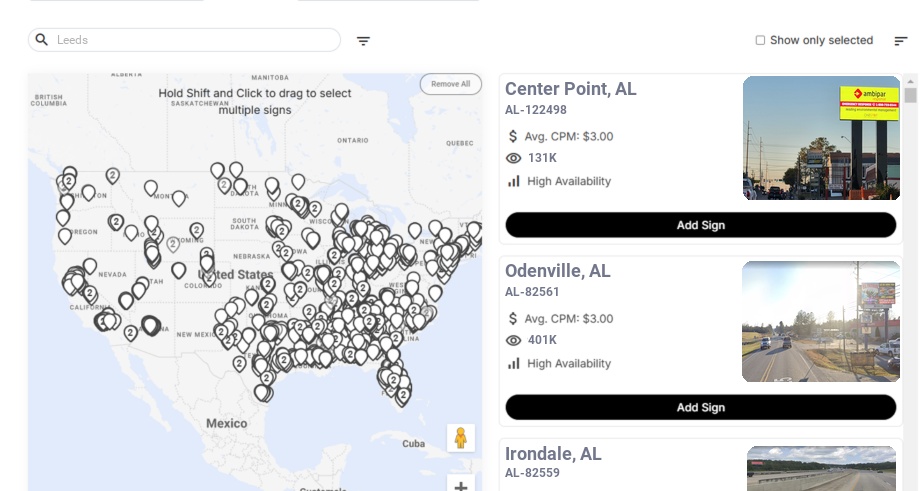



How much is a billboard near Leeds?
Why Choose Blip for Billboard Advertising near Leeds
Blip lets you launch on Leeds-area digital billboards in minutes, perfect for catching I-20 commuters and outlet shoppers near Grand River.
Set a flexible daily budget in Leeds, then scale up for Barber Motorsports Park weekends or holiday retail rushes without overspending.
Use dayparting in Leeds to hit morning commuters, lunchtime shoppers, or evening return traffic on I-20 and Hwy 78.
No contracts means Leeds businesses can test a message, pause after a race weekend, and restart when traffic spikes again.
Track real-time results with Blip in Leeds and shift spend fast when commuter, outlet, or Barber Museum traffic performs best.
Blip's creative tools make it easy to build bold Leeds ads with clear, local calls to action for drivers passing at highway speed.
Frequently Asked Questions About Billboard Advertising near Leeds
How much does a billboard cost near Leeds, Alabama with Blip?
With Blip, you choose a daily budget that works for you and only pay for each brief “blip” of your ad on Leeds billboards, so you’re always in control of your spend. Costs per blip change based on when you choose to advertise, where the billboards near Leeds, Alabama are located, and overall advertiser demand, but you can start with almost any budget and adjust it whenever you like. With Blip’s pay-per-blip model, the total cost of your campaign in the Leeds area is simply the sum of all the blips you receive.
Where can I advertise with Blip near Leeds, Alabama?
We currently have four digital billboards serving the Leeds area from Center Point, Alabama, about 9.6 miles away. While these billboards are not physically in Leeds, they sit within the daily travel shed for many Leeds-area residents and visitors. At typical Birmingham-area travel speeds, that 9–10 mile gap equates to roughly a 10–12 minute drive, meaning impressions near Center Point are still highly relevant for decisions made in or near Leeds.
What makes Leeds, Alabama a strong billboard market with Blip?
Leeds punches above its weight as an advertising market thanks to its location and visitor draw, making Leeds billboards an efficient way to tap into a much larger regional audience. The city sits at a powerful crossroads of interstate traffic, outlet shopping, motorsports tourism, and bedroom-community living. Together, this means campaigns on digital billboards serving the Leeds area don’t just reach a small town; they connect with a regional audience that lives, works, shops, and plays across the eastern Birmingham corridor.
When is the best time to run billboards in Leeds, Alabama with Blip?
Local traffic and mobility reports for the Birmingham area show clear congestion waves, with morning drive times from 6–9 a.m. and evening drive times from 4–7 p.m. being especially important for commuters. Weekends are strong for outlet shopping, dining, and tourist visits, and spring and fall are peak seasons for Barber Motorsports events and outdoor recreation. Holiday seasons from November through December also bring major retail surges in the Leeds area.
Who do Leeds, Alabama billboards reach?
Leeds-area billboards can reach local residents and families, commuters to and from Birmingham, and shoppers and visitors heading to places like the Outlet Shops of Grand River, Bass Pro Shops Leeds, and Barber Motorsports Park. Leeds has a strong family-oriented profile, and the surrounding counties include hundreds of thousands of working-age adults who move along area interstates and surface roads daily. This creates a broad halo of commuting and shopping patterns around the city.
Do I need a contract to advertise with Blip near Leeds?
No, Blip has no long-term contracts or minimum commitments. You can start, pause, or stop your campaign at any time.
How fast can I launch a billboard campaign with Blip near Leeds?
You can have your campaign live in minutes. Create a free account, select your locations, set your budget, upload your design, and start running once approved.
Where can I advertise with Blip near Leeds?
Blip has digital billboards near Leeds. You can browse available locations on a map, choose the ones that fit your audience, and start advertising right away.
Still have questions? Launch a campaign in minutes — no contracts, no commitments.
Start Your CampaignLeeds Billboard Advertising Guide
Leeds, Alabama sits at a powerful crossroads of interstate traffic, outlet shopping, motorsports tourism, and bedroom-community living. With four digital billboards serving the Leeds area from nearby Center Point (about 9.6 miles away), we can help you put your message in front of local residents, daily commuters, and visitors as they move through the eastern Birmingham metro. For advertisers comparing billboards near Leeds with other local media options, this combination of reach, flexibility, and proximity makes the area especially attractive.
Why the Leeds Area Is a Strategic Billboard Market
Leeds punches above its weight as an advertising market thanks to its location and visitor draw, making Leeds billboards an efficient way to tap into a much larger regional audience:
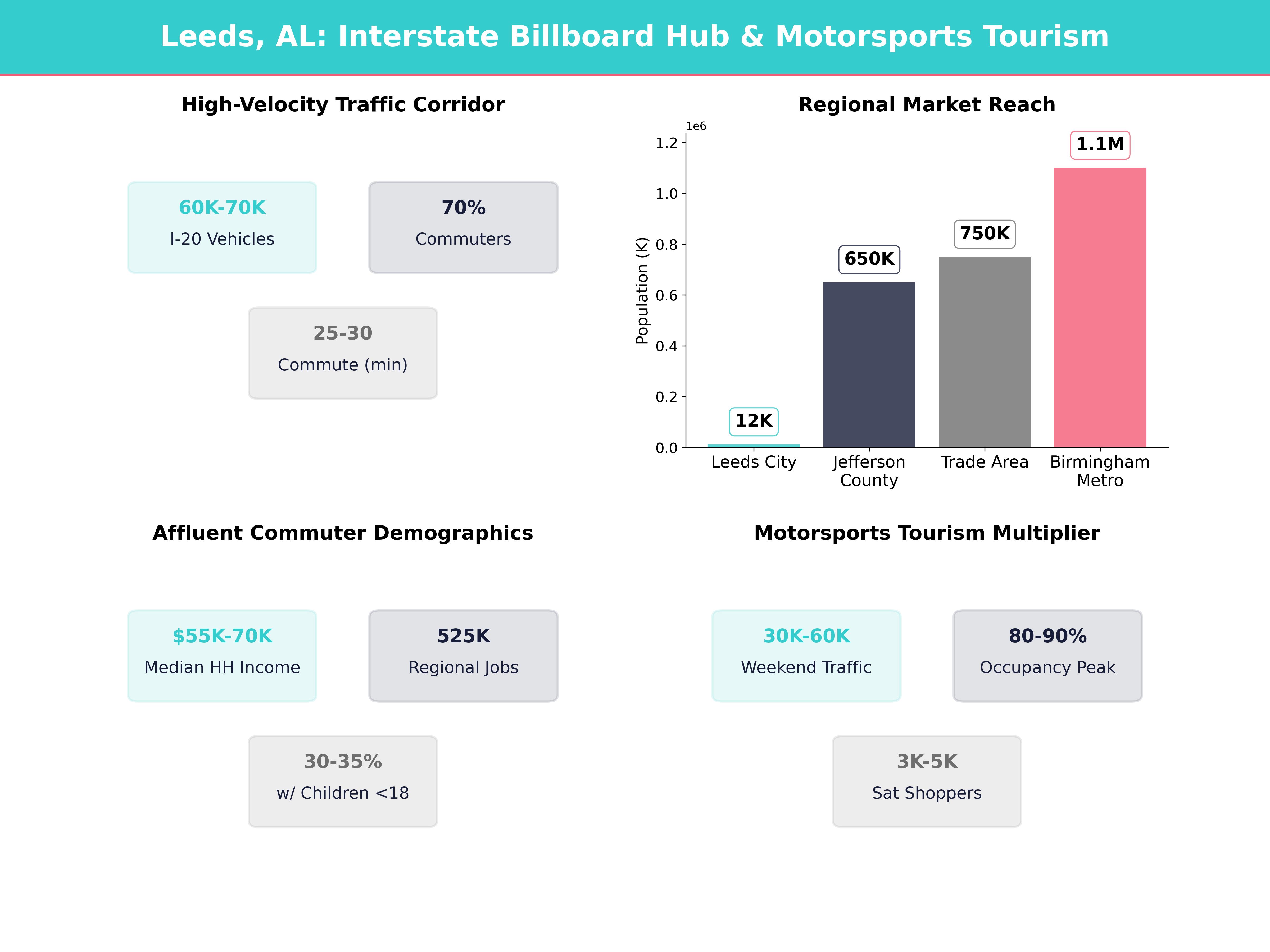
- The City of Leeds reports a population of roughly 12,000 residents within city limits, but the city pulls from a much larger trade area that includes eastern Jefferson County and western St. Clair County. Jefferson County as a whole has well over 650,000 residents, and neighboring St. Clair County adds another 90,000+ residents, creating a practical trade-area population of 750,000+ people within an easy drive of Leeds. Key civic and business information is available through City of Leeds, Jefferson County, and St. Clair County resources.
- Leeds is directly on I‑20, one of Alabama’s major east–west interstates, connecting the Birmingham metro with Atlanta. The Alabama Department of Transportation (ALDOT) corridor reports show annual average daily traffic (AADT) counts commonly in the 60,000–70,000 vehicles per day range on I‑20 segments near Leeds, with peak summer and event weekends often running higher. These volumes underscore why billboard advertising near Leeds can generate consistent, repeat exposure.
- The Outlet Shops of Grand River and Bass Pro Shops Leeds attract regional shoppers. The Outlet Shops promote more than 70 brand-name stores, and regional tourism data from the Greater Birmingham Convention & Visitors Bureau indicate that large outlet centers can draw several hundred thousand visits per year, with peak Saturdays often seeing 3,000–5,000 shopper visits spread across the day.
- Barber Motorsports Park & Barber Vintage Motorsports Museum just west of Leeds are nationally known venues; the park hosts major events like IndyCar, MotoAmerica, and large vintage racing events that can bring 30,000–60,000 visitors over a single race weekend. The museum itself typically reports 200,000+ annual visitors, many of whom travel through the Leeds retail and lodging corridors.
- Leeds is part of the greater Birmingham economic region, where the Birmingham–Hoover metro totals well over 1.1 million residents and supports more than 525,000 jobs across Jefferson, Shelby, St. Clair, Blount, Walker, and Chilton Counties, according to regional data from the Regional Planning Commission of Greater Birmingham. This creates a broad halo of commuting and shopping patterns around the city.
Together, this means campaigns on digital billboards serving the Leeds area don’t just reach a small town; they connect with a regional audience that lives, works, shops, and plays across the eastern Birmingham corridor. For advertisers, that translates into tens of thousands of daily impressions with the ability to concentrate messaging around the highest-value drive times and event periods. When you evaluate billboard rental near Leeds against other channels, this blend of regional scale and local relevance is a key advantage.
For basic background and community data, advertisers can review the City of Leeds official website and the Leeds Area Chamber of Commerce, which highlight local business activity and community events.
Understanding the Leeds-Area Audience
When we plan a Leeds-area billboard campaign, we want to understand who is actually seeing the message. Key audience characteristics:
Local Residents and Families
- Leeds has a strong family-oriented profile. Local school information from Leeds City Schools and community resources show a large share of households with children. In many eastern Jefferson County communities, roughly 30–35% of households include children under 18, and typical household sizes average around 2.6–2.8 people per household, signaling a strong “family market” for education, healthcare, food, and entertainment.
- The surrounding counties (Jefferson and St. Clair) together include hundreds of thousands of working-age adults who move along I‑20, I‑59, I‑459, and surface roads daily, many passing through corridors near our Center Point digital boards. Regional commuting statistics indicate that well over 70% of workers in this part of Alabama drive alone to work, and typical one-way commute times range from 25 to 30 minutes, keeping people on the road—and in front of digital billboards—twice a day.
- Local economic profiles show median household incomes in many Leeds-area neighborhoods in the $55,000–$70,000 range, with a significant share of households in the $50,000–100,000 band. This middle-income mix supports strong demand for value-oriented retail, automotive, and family services, which respond well to clear offers on billboards near Leeds.
Messaging implications:
- Family-focused language (“for your family,” “weekend fun,” “after-school,” “kid-approved”) performs well.
- Highlight value, safety, and convenience—themes that resonate with parents balancing budgets and time.
- Use clear, bold visuals that kids in the back seat can notice and talk about (e.g., recognizable mascots, bright colors).
- Promote offers that match local spending habits, such as $20–$40 family meal deals, “kids eat free,” and bundle offers.
Commuters to and from Birmingham
Many Leeds-area residents commute toward Birmingham and Trussville, while shoppers and workers from those areas head east toward Leeds.
- Commute data for the Birmingham metro consistently show tens of thousands of daily trips along I‑20 and I‑59 corridors. For example, ALDOT counts on major commuter segments closer to Birmingham often exceed 80,000–90,000 vehicles per day, feeding directly into the I‑20 corridor that serves Leeds and the outlet district.
- The northeast Birmingham suburbs around Center Point, Trussville, and Irondale collectively house tens of thousands of workers; local planning documents report that 40–60% of employed residents commute outside their home municipality daily, many using the same interstate routes where our digital boards are located.
- Our Center Point digital billboards, located about 9–10 miles from Leeds, reach drivers who live in or visit Leeds but work, shop, or travel through the northeast Birmingham suburbs. At average interstate speeds of 55–65 mph, drivers typically have 6–8 seconds of viewing time per digital display, making concise, high-contrast messaging especially important.
Messaging implications:
- For commuters, emphasize time-sensitive offers (“Tonight only,” “This weekend in the Leeds area,” “Exit at … after work”).
- Consider sequential storytelling: an awareness message during the early morning commute, then a direct call-to-action (“Stop by tonight”) in the late afternoon/evening.
- Use drive-time framing like “10 minutes off your route” or “right off Exit __” to reduce perceived friction for after-work stops and make Leeds billboards feel directly relevant to their daily drive.
Shoppers and Visitors
Leeds is a shopping and leisure magnet:
- The Outlet Shops of Grand River serve bargain hunters from across the Birmingham region and beyond. Outlet visitors typically travel farther than everyday local shoppers; regional tourism data suggest that a substantial share—often 30–40%—come from outside the immediate county, bringing fresh dollars into the market.
- Bass Pro Shops Leeds draws outdoor enthusiasts, often planning high-ticket purchases (boats, gear, firearms, etc.). National store analytics often show average basket values significantly higher than typical big-box retail, frequently in the $100+ range, with boating or ATV purchases reaching into the thousands of dollars.
- Barber Motorsports Park and the Barber Vintage Motorsports Museum bring motorsports fans and tourists, especially on event weekends. Large race events can push daily park attendance into the 10,000–20,000 visitors per day range, with visitors staying in area hotels, dining locally, and shopping before and after events. Nearby lodging reports regularly show occupancy spikes above 80–90% on major race weekends.
For these visitors, Leeds-area billboards are a great way to:
- Promote restaurants, hotels, attractions, and retail that benefit from weekend foot traffic. Even modest capture rates—such as engaging 1–3% of race or outlet visitors—can translate into hundreds of incremental customers across a busy weekend.
- Capture out-of-town dollars by positioning your business as the “must-stop” experience during their trip. Out-of-town visitors often spend 20–30% more per transaction on dining and entertainment than local residents, making them especially valuable targets for billboard campaigns.
Traffic Patterns and Where Billboards Fit
We currently have four digital billboards serving the Leeds area from Center Point, Alabama, about 9.6 miles away. While these billboards are not physically in Leeds, they sit within the daily travel shed for many Leeds-area residents and visitors. At typical Birmingham-area travel speeds, that 9–10 mile gap equates to roughly a 10–12 minute drive, meaning impressions near Center Point are still highly relevant for decisions made in or near Leeds. For businesses searching for practical options for billboard advertising near Leeds, these locations balance cost-efficiency with strong Leeds-area coverage.
Key Corridors That Matter for Leeds-Area Targeting
- I‑20 east–west: Main artery connecting Leeds with Birmingham and Atlanta. It handles a large proportion of through-traffic in the region, with ALDOT AADT counts frequently in the 60,000–70,000+ vehicles per day range near the Leeds exits, and higher closer to Birmingham.
- I‑59 and I‑459 near Center Point and northeast Jefferson County: Connect northern and eastern suburbs, feeding traffic to and from the Leeds area. On some stretches near major interchanges, AADT volumes exceed 70,000–90,000 vehicles per day, creating dense commuter flows that overlap with Leeds-area shopping and entertainment trips.
- U.S. Hwy 78 (Bankhead Highway): Local commercial corridor and an alternate route paralleling I‑20. While its traffic volumes are lower than interstate counts, typical segments often carry 10,000–20,000 vehicles per day, providing additional reach into neighborhood-level traffic and errand runs.
According to ALDOT traffic counts (which can be explored at ALDOT’s online traffic data resources), segments of I‑59 and nearby interchanges around Center Point routinely see traffic volumes in the tens of thousands of vehicles per day, ensuring strong impressions for campaigns targeting people who shop, commute, or recreate in the Leeds area. Even conservative impression models using 30,000–40,000 daily vehicles suggest hundreds of thousands of weekly impressions across a sustained campaign.
Implications for billboard strategy:
- Use our Center Point displays to catch Leeds-area commuters on the Birmingham side of their drive—ideal for “on your way home, stop in Leeds” or “this weekend in the Leeds area” messaging.
- Leverage directional cues: “Shop Grand River Outlets – Leeds area, 15 minutes east,” or “Next weekend at Barber Motorsports Park near Leeds – buy tickets now.”
- Consider using different creatives by corridor: more destination-focused language on I‑20 aimed at outlet and motorsports visitors, and more everyday-service language on routes feeding residential neighborhoods. This corridor-based approach is one of the simplest ways to get more from billboard rental near Leeds.
Seasonality and Best Times to Run Leeds-Area Campaigns
The Leeds area has predictable traffic and behavior peaks:
Daily Timing
Local traffic and mobility reports for the Birmingham area show clear congestion waves:
-
Morning drive (6–9 a.m.): Commuters heading toward Birmingham and surrounding employment centers. Vehicle volumes during this window can be 30–50% higher than off-peak periods on key commuter stretches. Ideal for:
- Service businesses (healthcare, insurance, banking)
- Recruitment campaigns
- Quick-service restaurants pushing breakfast
-
Midday (11 a.m.–2 p.m.): Errand and lunch traffic; great for:
- Restaurants in and near Leeds
- Retail promotions at Outlet Shops of Grand River or other centers
- Medical and personal services (walk‑in clinics, salons, oil changes)
-
Evening drive (4–7 p.m.): Workers returning toward Leeds and other eastern suburbs. PM peak volumes again rise to 30–50% above mid-afternoon baselines on major interstates. Perfect for:
- “Tonight only” or same-day restaurant specials
- Entertainment options (movies, sports bars, events)
- Fitness centers or after-work activities
With Blip’s scheduling controls, we can increase blip frequency during the time blocks that matter most: for example, allocating 70–80% of your impressions to weekday drive-times if commuter exposure is your priority, or shifting 50–60% of impressions to midday if you’re focused on lunch and shopping.
Weekly and Seasonal Patterns
- Weekends: Strong for outlet shopping, dining, and tourist visits. Many regional tourism dashboards show 15–25% higher retail foot traffic on Saturdays compared with typical weekdays in suburban shopping districts. We often recommend boosting weekend bids by 20–50% for retail, leisure, and attractions.
- Spring and Fall: Peak seasons for Barber Motorsports events and outdoor recreation. A single major event at Barber can add tens of thousands of vehicles passing through the broader corridor in a weekend, and Leeds-area hoteliers and restaurateurs frequently report near-capacity weekends during marquee events.
- Holiday seasons (November–December): Outlet and big-box shopping surges; Leeds benefits heavily as a regional retail hub. Many retailers see 20–30% or more of their annual sales in the November–December window, and outlet foot traffic can rise 40–60% above typical fall weekends.
- Summer: More family activities, camps, and regional tourism; a great time for family entertainment centers, water-based recreation, and travel services. School-district calendars show that families have 8–10 weeks of summer break, during which daytime traffic patterns shift from school-commute peaks to more mid-morning and mid-afternoon activity.
Blip allows you to dial campaigns up or down in real time, so you can concentrate spend around:
- A specific race weekend at Barber
- Tax refund season sales (often peaking late February through April)
- Back-to-school promotions aligning with Leeds City Schools calendars
- Major local events promoted by the Leeds Area Chamber of Commerce and Leeds Main Street
- Citywide events and festivals coordinated by the City of Leeds, such as holiday parades and downtown celebrations
Crafting Effective Creative for the Leeds Area
Digital billboards serving the Leeds area need to perform at highway speeds. Research on out-of-home (OOH) effectiveness frequently shows that ads with fewer than 10 words and one clear focal image deliver significantly higher recall—often 20–40% better than cluttered designs.
We recommend:
Keep It Simple and Regional
- Use 7 words or fewer when possible.
- Always think in terms of the “Leeds area” or “near Leeds” to match how drivers think about their destination and to ensure drivers immediately connect your offer with billboards near Leeds they see on their regular routes.
- Example: “Outlet Deals – Leeds Area, 15 Minutes Ahead” rather than a vague “Big Savings Here.”
- Include one primary call-to-action (e.g., “Exit 140 – Today Only”) rather than multiple offers competing for attention.
Highlight Landmarks and Time
Leeds-area drivers and visitors navigate by familiar markers:
- “Near Barber Motorsports Park – Leeds area”
- “Next to Bass Pro in the Leeds area”
- “Exit for Leeds Outlets – Lunch & Shopping”
Adding a time-distance cue (“10 minutes ahead,” “Next 2 exits”) increases response, especially for restaurants, gas, and attractions. OOH case studies often show that including a clear direction or distance can boost store-visit lift by 10–20%, because it reduces uncertainty about where to go.
Visuals That Match the Market
- For motorsports and outdoor audiences, dynamic imagery of cars, bikes, trails, or lakes stands out.
- For families, use bright, friendly visuals and clear calls like “Kids Eat Free” or “Family Fun This Weekend.”
- For professional commuters, opt for clean, modern design with strong branding and a single benefit (“Faster Checkups,” “Save on Insurance Today”).
- Aim for high-contrast color combinations—studies show that good contrast can increase legibility at distance by 30–50%, especially in bright sunlight.
Since our digital boards support full-color creative, avoid small text or clutter. A good test: if you can’t understand the message at a glance when standing back from your screen, it’s too busy. Try to design assuming drivers have 3–5 seconds to absorb your message at typical highway speeds.
Leeds-Area Industry Playbooks
Different sectors can use the Leeds-area boards in tailored ways.
Local Restaurants and Entertainment
Target: Residents, commuters, shoppers, and race-day visitors.
Ideas:
- Promote lunch and dinner specials timed to midday and evening schedules. Many QSR and casual dining brands see traffic increases of 5–15% when pairing timely billboard ads with in-store offers.
- Run countdowns to race weekends: “Race Weekend Special – Show This Ad Pic for 10% Off.” Even if only 2–3% of race attendees respond, that can mean hundreds of extra covers over a single weekend.
- Highlight proximity to outlets or I‑20 exits: “BBQ 1 Mile Off Leeds Exit” so that people who have seen Leeds billboards earlier in their trip can quickly act.
Strategy:
- Increase bids on Fridays and Saturdays, when outlet and event traffic spikes. In many retail corridors, Friday PM and Saturday account for 30–40% of weekly sales, so it makes sense to increase impression share during these windows.
- Use multiple creatives rotating through Blip to test which offer pulls better (e.g., “Kids Eat Free” vs. “Free Dessert”). After 2–4 weeks of data, shift budget toward the higher‑performing message.
- Cross-promote with events listed by Leeds Main Street and the Leeds Area Chamber of Commerce to tap into existing foot traffic.
Retailers in and near Leeds
Target: Outlet shoppers, regional bargain hunters, and families.
Ideas:
- For Outlet Shops of Grand River tenants, use billboard creative to extend in-mall marketing: “Find Us at Grand River – Suite 210, Leeds Area.” With more than 70 stores on site, clear location cues can help your storefront stand out.
- For independent retailers in Leeds and Moody, push limited-time discounts and new arrivals. Promos like “This Weekend Only – 25% Off” or “Buy One, Get One 50% Off” are easy to read quickly and have proven uplift in foot traffic.
- Add event tie-ins: sidewalk sales, back-to-school days, or holiday open houses.
Strategy:
- Focus spend on weekends and pre-holiday weeks, when the Leeds retail corridor is busiest and shoppers are more likely to travel 15–30 minutes specifically for deals.
- Use geographic references like “Leeds area, next to Bass Pro” to orient visitors unfamiliar with local streets and to reinforce the value of billboard advertising near Leeds as shoppers plan their trips.
- Monitor local retail trends through AL.com – Birmingham and WBRC FOX6 News to align promotions with broader shopping patterns and news.
Automotive, Powersports, and Motorsports-Related Businesses
Given Barber Motorsports Park’s influence, auto and motorsports-related brands have a natural edge.
Ideas:
- “Race-Day Ready – Performance Shop near Leeds”
- “Motorcycle Clearance – 15 Minutes from Barber Motorsports Park”
- “Detailing & Wraps – Get Show-Ready near Leeds”
Strategy:
- Ramp spend around major events listed on the Barber Motorsports events calendar. A single large race weekend can expose your brand to tens of thousands of highly qualified enthusiasts traveling through the area.
- Create event-specific creatives with dates, such as “This Weekend Only – Race Fans Save 15%.”
- Highlight financing or service packages; many auto and powersports purchases in this region are financed, making messages like “$0 Down” or “Payments from $199/month” effective at catching attention.
Professional Services and Healthcare
Leeds-area residents still choose providers across the Birmingham metro.
Ideas:
- “Family Dentist Serving the Leeds Area – Evening Appointments”
- “Urgent Care Near Leeds – Open 7 Days”
- “Accounting & Tax Services for Leeds-Area Families and Businesses”
Strategy:
- Maintain a steady, year-round presence with mid-level bidding for brand familiarity. Professional services often see results from sustained exposure over 3–6 months, rather than short bursts.
- Rotate creatives seasonally (tax season, back-to-school physicals, open enrollment). For example, emphasize “Same-Day Sick Visits” during peak flu months and “Sports Physicals” ahead of school athletic seasons listed on Leeds City Schools calendars.
- Consider including a phone number with fewer than 8 digits displayed (e.g., 555‑CARE) or a short URL to improve recall.
Recruitment and Education
With a broad commuting population, recruiters can reach both Leeds-area workers and those traveling through.
Ideas:
- “Now Hiring – Manufacturing Jobs near Leeds”
- “Nursing Positions – Short Commute from Leeds Area”
- “Community College Programs – 20 Minutes from Leeds”
Strategy:
- Focus on weekday drive times (5–9 a.m. and 4–7 p.m.), when workers are thinking about their jobs and future opportunities.
- Include a short, memorable URL or keyword; drivers may search on their phones later. Campaigns with concise URLs or text codes often see response-rate improvements of 10–30% compared with long, complex web addresses.
- Coordinate with local training and education providers highlighted by the City of Leeds and covered in local outlets like CBS 42 to align messaging with new program launches or career fairs.
Using Local Media and Data to Inform Your Campaign
We recommend pairing billboard insights with local information:
- City of Leeds and Leeds Area Chamber of Commerce for event calendars, business listings, and civic projects. City event calendars are especially useful for spotting weekends where downtown visitation may increase by 20–40%.
- Leeds Main Street for downtown events and local promotions. Main Street programs often track attendance and can provide rough estimates of expected visitors for marquee events.
- Local news outlets like AL.com – Birmingham, WBRC FOX6 News, and CBS 42 for coverage of traffic patterns, growth stories, and major happenings that may affect travel or interest. Traffic reports and growth articles can highlight new developments, road projects, or employer expansions that may shift commute routes or shopping patterns.
- Regional tourism and convention data via the Greater Birmingham Convention & Visitors Bureau for insights into visitor volumes and signature events that indirectly impact Leeds hotels, restaurants, and outlets.
Use these sources to:
- Identify peak weekends (festivals, parades, outlet events, race weekends). Align billboard campaigns to these peaks—often 10–20 high-impact dates per year can drive a disproportionate share of your annual revenue.
- Align your flight dates and creatives with what people are already thinking about in the Leeds area, such as major races, back-to-school, or holiday events.
- Adjust copy for emerging trends (for example, new housing developments or industrial projects near Leeds) that may add hundreds of new residents or jobs within a short time frame.
Maximizing Blip’s Capabilities for the Leeds Area
Our four digital billboards near Center Point give you flexible, data-driven options to reach the Leeds area:
- Bid-based scheduling: You choose how much you’re willing to pay per blip, allowing you to increase bids during crucial timeframes (race weekend, holiday sales) and lower them during off-peak periods. Many advertisers find that modest bid adjustments of 10–25% can significantly increase share-of-voice during competitive periods.
- Dayparting: Run ads only during selected hours—like morning and evening commutes, or weekend daytime hours for outlet-bound shoppers. This can dramatically improve efficiency, often delivering more relevant impressions per dollar compared with running 24/7.
- Creative rotation: Upload multiple designs and let them cycle, effectively A/B testing messages and visuals in the real world. After gathering a few thousand impressions per creative, you can begin to see which offers or visuals correlate with stronger web traffic, calls, or store visits.
- No long-term commitments: Adjust spend, pause, or restart your Leeds-area campaigns as your business cycles or promotions change. This is especially useful for businesses responding to weather-sensitive demand (e.g., HVAC, recreation) or short booking windows (e.g., events, ticket sales).
By combining strong local knowledge—traffic flows, visitor peaks, and community events—with Blip’s flexible tools, we can build a Leeds-area billboard strategy that is both cost-efficient and highly visible. Even small businesses can start with modest daily budgets and scale up once they see concrete results, making billboard rental near Leeds accessible even if you’ve never used out-of-home before.
Putting It All Together
To create a successful digital billboard campaign serving the Leeds area:
- Define your core audience: Local families, commuters, visitors, or a mix. Use local demographic and traffic data to estimate how much each group contributes to your revenue (e.g., families vs. race visitors).
- Map their routes: Consider where Leeds-area residents and visitors travel through Center Point and the northeast Birmingham corridor. Focus on interstates and arterials with tens of thousands of vehicles per day to maximize impressions, especially where drivers are most likely to encounter billboards near Leeds during their normal routines.
- Align with timing: Concentrate impressions around daily commute windows, weekends, and specific events important to the Leeds community. Plan for key seasonal peaks like race weekends, holidays, and back-to-school.
- Design simple, landmark-based creative: Use “Leeds area” language, time-distance cues, and recognizable local references. Keep text to 7–10 words, prioritize legibility, and test variations.
- Leverage Blip’s flexibility: Adjust bids, schedules, and creative in real time as you see what resonates. Shift budget to the dayparts and messages that deliver measurable lifts in calls, website visits, or foot traffic.
When we use data about how people move through and think about the Leeds area—and combine it with the agility of digital billboards—we can turn a set of four screens within 10 miles into a powerful, region-wide marketing engine for your business. For any brand exploring billboard advertising near Leeds, this approach delivers targeted visibility, measurable impact, and the ability to grow at your own pace.