Billboards in New Hope, AL
No Minimum Spend. No Long-Term Contracts. Just Results.
Trusted by Leading Brands


Billboard advertising
in New Hope has never been easier
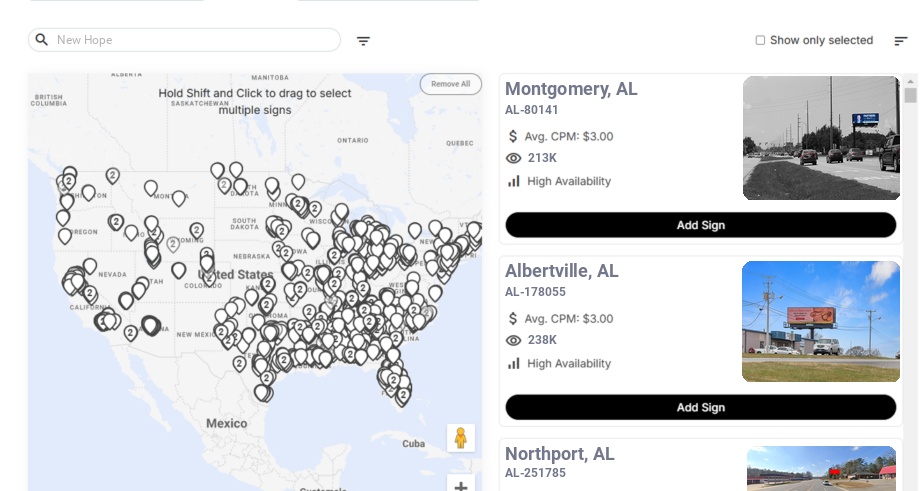



How much is a billboard in New Hope?
Why Choose Blip for Billboard Advertising in New Hope
Blip’s self-serve map lets you launch in New Hope fast and reach U.S. 431 commuters moving between Huntsville and Lake Guntersville.
No contracts or minimums in New Hope mean you can test weekday commuter traffic, then shift budget for Friday lake and weekend trips.
Use Blip dayparting in New Hope to hit 6-9 a.m. and 3:30-6:30 p.m. rushes on 431, then ease off when traffic slows.
Blip real-time analytics help New Hope advertisers track plays and optimize against the Huntsville, Madison County, and Guntersville travel flow.
Create and upload New Hope billboard art in minutes with Blip, tailoring messages for commuters, students, and lake-bound families.
Frequently Asked Questions About Billboard Advertising in New Hope
How much does billboard advertising in New Hope, Alabama cost with Blip?
With Blip, the cost of billboard advertising in New Hope is built to fit real budgets. You choose a daily budget, and Blip’s pay-per-play model means you only pay when your ad actually appears as a 7.5-to-10-second blip on a rotating digital billboard, starting at just $0.01 per display. Pricing can change based on time of day, location, and advertiser demand, while Blip’s algorithm works to get you the most reach for what you spend.
Where can I advertise with Blip in New Hope, Alabama?
The most important route for New Hope advertisers is U.S. 431, which carries traffic north toward Huntsville and south toward Guntersville. Based on Alabama Department of Transportation traffic count patterns, the stretch around New Hope generally carries roughly 15,000 to 20,000 vehicles per day, which is meaningful volume for a small-city market. Farther north, traffic intensifies as the corridor moves through Owens Cross Roads and toward Hampton Cove, where comparable U.S. 431 segments commonly exceed 30,000 vehicles per day.
Why is New Hope, Alabama a good market for billboard ads with Blip?
New Hope is a small city with an unusually strong billboard story because it sits on a major North Alabama travel path rather than at the end of one. We are not limited to New Hope’s roughly 2,900 residents when we advertise here; we are also reaching the much larger flow between Huntsville, south Madison County, Marshall County, and the recreation traffic headed toward Lake Guntersville. Because North Alabama remains heavily car-oriented, digital billboards can build frequency with weekday commuters and capture weekend destination travelers on the same corridor.
What kinds of businesses work best for New Hope, Alabama billboard advertising?
We usually recommend U.S. 431 for restaurants, convenience retail, and fuel stops, healthcare, dental, and urgent care brands, auto services, tire shops, and insurance agencies, and tourism, lodging, marinas, and attractions. New Hope also reaches commuters, students, families, and visitors, which makes it a fit for local services, recruiting, and destination-driven offers. The corridor also works well for businesses tied to lake life, hospitality, and discretionary spending.
When is the best time to run billboard ads in New Hope, Alabama with Blip?
Spring is one of the best times to advertise around New Hope because warmer weather increases traffic toward Lake Guntersville, Cathedral Caverns State Park, and Huntsville attractions. Summer stays strong because schools are out, baseball is active, and concert season builds. Late summer and fall bring back structured morning and afternoon traffic patterns, while holiday and winter periods reward practical, timely messaging for shopping, healthcare, and service offers.
Do I need a contract to advertise with Blip in New Hope?
No, Blip has no long-term contracts or minimum commitments. You can start, pause, or stop your campaign at any time.
How fast can I launch a billboard campaign with Blip in New Hope?
You can have your campaign live in minutes. Create a free account, select your locations, set your budget, upload your design, and start running once approved.
Where can I advertise with Blip in New Hope?
Blip has digital billboards in New Hope. You can browse available locations on a map, choose the ones that fit your audience, and start advertising right away.
Still have questions? Launch a campaign in minutes — no contracts, no commitments.
Start Your CampaignNew Hope Billboard Advertising Guide
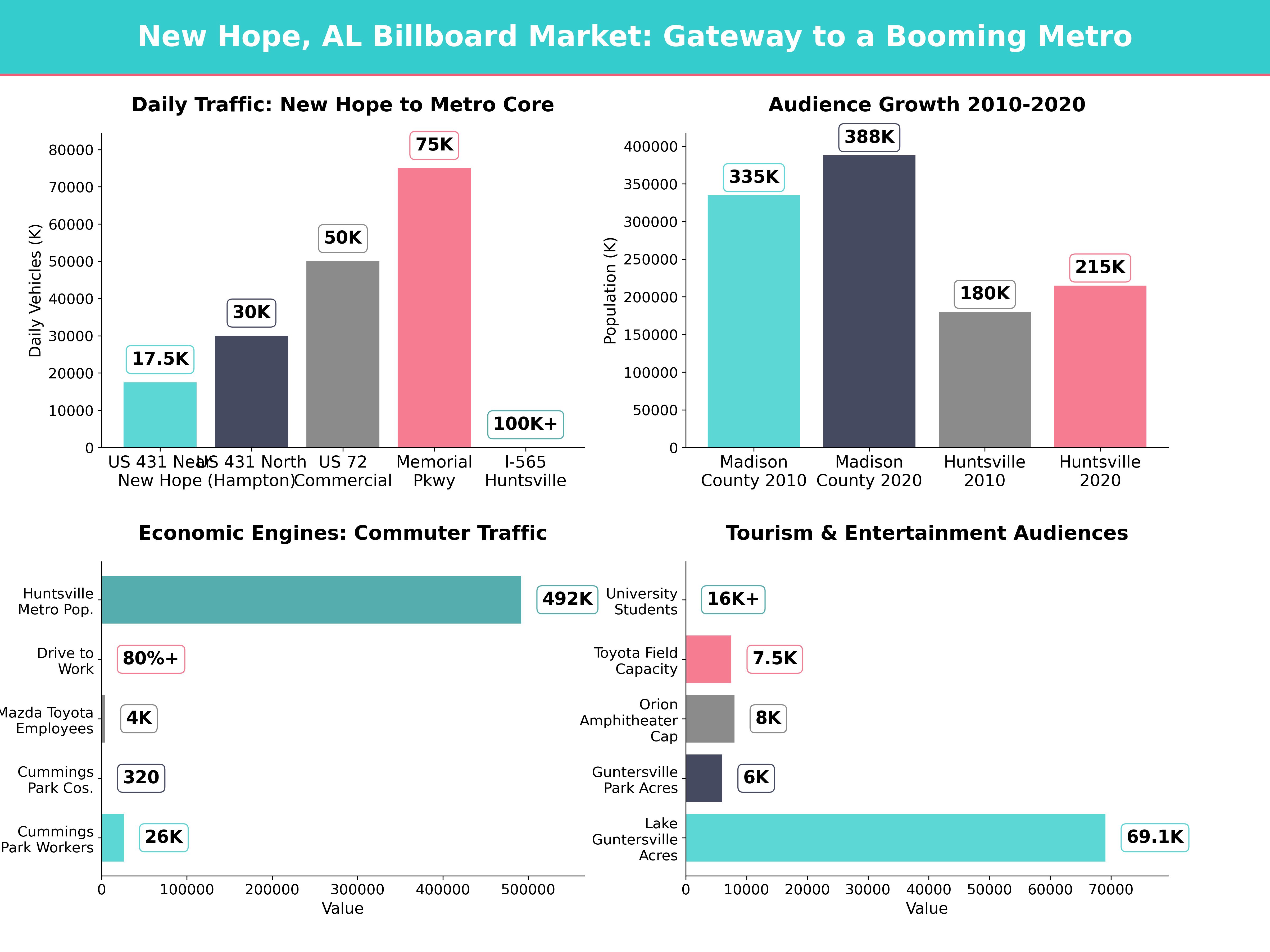
New Hope, Alabama 15,000 to 20,000 vehicles per day around New Hope and more than 30,000 farther north toward Huntsville. We are not limited to New Hope’s roughly 2,900 residents when we advertise here; we are also reaching the much larger flow between Huntsville, south Madison County, Marshall County, and the recreation traffic headed toward Lake Guntersville, which covers about 69,100 acres and roughly 949 miles of shoreline. Madison County 388,153 residents in 2020, and Huntsville reached 215,006, which gives New Hope advertisers access to a surrounding market many times larger than the city itself. Because North Alabama remains heavily car-oriented, digital billboards can build frequency with weekday commuters and capture weekend destination travelers on the same corridor.
Market Overview for New Hope
New Hope sits inside a much larger North Alabama trade area
When we plan billboard advertising in New Hope, we should think in corridor terms, not city-limit terms. New Hope is roughly 20 to 25 miles southeast of downtown Huntsville, and roughly 18 miles north of Guntersville, which places it in the middle of a practical consumer route rather than an isolated local market.
That matters because the surrounding population base is substantial. Madison County had 388,153 residents in 2020, and Huntsville had 215,006, making Huntsville Alabama’s largest city by population. The broader Huntsville metro was about 492,000 residents in 2020, and the Huntsville/Madison County Chamber
Growth has also been meaningful, not marginal. Madison County grew from 334,811 residents in 2010 to 388,153 in 2020, which is an increase of about 15.9%. Huntsville grew from 180,105 to 215,006 over the same decade, which is about 19.4% growth. For billboard advertisers, that kind of expansion usually means more rooftops, more shopping trips, more service demand, and more daily road volume.
The economy around New Hope supports recurring billboard demand
We also like New Hope because it benefits from the economic pull of the Huntsville region. Cummings Research Park 3,843 acres, hosts about 320 companies, and supports roughly 26,000 workers. Mazda Toyota Manufacturing in Limestone County is designed for up to 300,000 vehicles per year and up to 4,000 employees, which adds another major employment engine to the west side of the metro.
Education adds even more daily movement. The University of Alabama in Huntsville serves 10,000+ students, and Alabama A&M University serves 6,000+ students. Those students, faculty members, staff members, and visiting families contribute to year-round travel on Huntsville-area roads, especially at semester starts, graduation periods, and major campus event windows.
Most important for out-of-home advertising, this is still an overwhelmingly auto-dependent market. Local commute patterns consistently show that well over 80% of workers travel by car, truck, or van, which means the road network remains the clearest way to build broad awareness. For us, that translates into a practical billboard advantage: repeated exposure on habitual routes.
Key Traffic Corridors for New Hope Billboards
U.S. 431 is the defining corridor for New Hope advertising
The most important route for New Hope advertisers is U.S. 431 Alabama Department of Transportation 15,000 to 20,000 vehicles per day, which is meaningful volume for a small-city market.
Farther north, traffic intensifies as the corridor moves through Owens Cross Roads and toward Hampton Cove. Comparable U.S. 431 segments there commonly exceed 30,000 vehicles per day. That makes the route especially useful for advertisers that need both local familiarity and regional scale.
We usually recommend U.S. 431 for: Restaurants, convenience retail, and fuel stops, Healthcare, dental, and urgent care brands, Auto services, tire shops, and insurance agencies, and Tourism, lodging, marinas, and attractions. Direction matters on this road. Northbound traffic often behaves more like a work, school, and appointment audience. Southbound traffic often includes more leisure, dining, and destination intent, especially on Fridays, Saturdays, and lake-season weekends.
Memorial Parkway extends New Hope reach into Huntsville’s highest-volume traffic
As New Hope-oriented traffic feeds into Huntsville, the route effectively merges into the broader Memorial Parkway system, the region’s signature north-south urban artery. ALDOT count maps regularly place major Parkway segments in the 70,000 to 100,000+ vehicles per day range, with the busiest areas in and near the city core.
For advertisers based in New Hope, this corridor is valuable even when the business itself is not in Huntsville. A board on the Parkway can help us capture people who live, work, shop, or seek care in Huntsville, but who still travel south toward New Hope, Hampton Cove, or Marshall County.
Memorial Parkway tends to work well for: Large retail and multi-location service brands, Hospitals, specialty practices, and senior care providers, Higher education, training, and recruiting campaigns, and Entertainment venues and event promotions.
I-565 gives New Hope advertisers cross-metro visibility
I-565 100,000 AADT, and even less central portions commonly sit in the 60,000 to 90,000 range.
If our goal is broad regional awareness rather than immediate local turns, I-565 can amplify a New Hope campaign. This is especially useful when we want to reach people before they choose a dining destination, home-service provider, dealership, college, or event venue.
I-565 placements are often strong for: Regional healthcare systems, Dealerships and auto groups, Universities, workforce programs, and hiring campaigns, and Major events, festivals, and destination retail.
U.S. 72 broadens reach to western Huntsville and Madison shoppers
U.S. 72 40,000 to 60,000+ vehicles per day range.
We would not usually treat U.S. 72 as a “New Hope-only” road, but it becomes valuable when a New Hope business wants visibility across the wider Huntsville customer base. If we are promoting medical services, home improvement, furniture, legal services, education, or destination dining, U.S. 72 can help us reach households that will travel for the right offer.
Audience Segments We Can Reach Around New Hope
New Hope commuters are the foundational audience
The first audience is the daily commuter. New Hope’s location on U.S. 431 means we can repeatedly reach residents heading to work, school, shopping, and appointments in Huntsville and nearby communities. Because so much of local life happens by car, frequency matters here more than novelty.
This segment is ideal for: Banks, credit unions, and insurance providers, Quick-service restaurants and coffee stops, Home services, including HVAC, roofing, plumbing, and pest control, Medical appointments, especially primary care, dental, vision, and urgent care, and Hiring and recruiting, particularly for operations with shift-based labor needs.
New Hope also reaches a strong outdoor and tourism audience
One of the biggest advantages in this geography is the blend of resident traffic and visitor traffic. Lake Guntersville covers about 69,100 acres and has roughly 949 miles of shoreline, making it one of Alabama’s premier outdoor destinations. Lake Guntersville State Park alone spans 6,000 acres, which helps sustain boating, fishing, lodging, dining, and weekend travel demand.
Nearby attraction density strengthens the case. Monte Sano State Park covers 2,140 acres above Huntsville. Cathedral Caverns State Park features a cave entrance 126 feet wide and 25 feet high, which makes it a recognizable regional draw. The U.S. Space & Rocket Center, Huntsville Botanical Garden, and other North Alabama attractions promoted by the Alabama Mountain Lakes Tourist Association create even more trip layering.
This audience responds well to billboard campaigns for: Hotels, cabins, and vacation rentals, Boat dealers, marine services, and sporting goods, Restaurants, breweries, and family attractions, and Campgrounds, parks, and event venues.
Students, families, and event-goers expand reach well beyond New Hope’s size
We should also remember that New Hope sits within an active family and event market. UAH has 10,000+ students, and Alabama A&M has 6,000+ students. Madison County Schools and Huntsville City Schools create reliable school-year traffic rhythms, especially from early August through late May.
Entertainment adds another layer. Toyota Field Rocket City Trash Pandas, seats about 7,500 fans. The Orion Amphitheater has an 8,000-person capacity. Huntsville Botanical Garden spans 118 acres, and the Von Braun Center
These audiences are strong for: Family dining and entertainment, Retail promotions and seasonal shopping, Colleges, trade schools, and tutoring services, and Pediatric care, orthodontics, and youth programs.
Industry workers and skilled professionals are a high-value segment
The Huntsville area’s aerospace, engineering, defense, technology, and advanced manufacturing base creates a valuable professional audience. We can access some of that audience from New Hope because many employees commute from suburban and exurban communities rather than living in the urban core.
Campaigns that often perform well with this segment include: Professional services, including financial planning, legal help, and real estate; Healthcare and specialist care; High-consideration retail, such as furniture, appliances, and vehicles; and Recruiting for skilled labor, logistics, and plant operations.
Seasonal and Timing Opportunities in New Hope
Spring and summer in New Hope favor outdoor, tourism, and family campaigns
Spring is one of the best times to advertise around New Hope. Warmer weather increases traffic toward Lake Guntersville, Cathedral Caverns State Park, and Huntsville attractions. It also aligns with spring break travel, home improvement season, fishing trips, and sports attendance.
This is when we typically prioritize: Outdoor recreation, marinas, and lodging, Restaurants and dessert brands, Home services and lawn care, and Events and festivals, including downtown Huntsville spring programming such as Panoply Arts Festival
Summer stays strong because schools are out, baseball is active, and concert season builds. Campaigns tied to The Orion Amphitheater, Toyota Field
Late summer and fall in New Hope shift back toward routine and school calendars
The late-summer transition is important in this market. Madison County Schools and Huntsville City Schools typically begin in early August, which brings back structured morning and afternoon traffic patterns. College move-in periods at UAH and Alabama A&M also create valuable bursts for retail, telecom, furniture, food, and financial services.
Fall then brings a useful blend of everyday and leisure traffic. Football season, weekend day trips, and milder weather support strong messaging for: Restaurants and sports-viewing promotions, Auto service and tire replacement, Urgent care, pharmacies, and healthcare enrollment, and Retail and event campaigns.
Holiday and winter periods in New Hope reward relevance and timing
From November through December, we usually shift creative toward gifts, local shopping, family events, and year-end service reminders. Downtown Huntsville, the Von Braun Center
January through March is often better for practical categories than for leisure-heavy messaging. That is a strong window for: Tax services, Healthcare appointments, Fitness and wellness offers, and Home repair and storm-readiness services.
Shorter daylight hours and more winter gray can also make high-contrast billboard creative especially important in this region.
Billboard Design Tips for the New Hope Market
New Hope creative should match trip purpose and direction of travel
Because U.S. 431 carries different mindsets by direction, we should tailor creative accordingly. Northbound commuter traffic often responds best to utility-focused messaging, such as “Book Today,” “Hiring Now,” “Urgent Care Nearby,” or “Save on Insurance.” Southbound traffic often performs better with destination language, such as “Dinner on the Lake,” “Weekend Cabin Deals,” or “Your Next Stop on 431.”
For highway-speed readability, we generally treat 6 to 8 words as a practical ceiling for the main line. If the business is in New Hope, adding a precise distance, such as “2 Miles Ahead” or “On 431 in New Hope,” can outperform a vague location tag.
New Hope visuals should feel like North Alabama, not generic Anywhere-USA
The strongest local creative usually reflects what people actually see and value in this market. Lake imagery, mountain silhouettes, fishing and boating cues, family dining scenes, and clean suburban-home visuals often fit better than anonymous urban stock photography.
Color choice can also be local in a useful way. Blues and greens connect naturally with the lake-and-outdoors environment. Warm oranges and reds can work well for food, urgency, and seasonal promotions because they stand out against North Alabama tree cover and overcast skies. If we are advertising near leisure traffic, imagery that signals “weekend” can be more persuasive than imagery that signals “corporate.”
New Hope messaging should be plainspoken, value-forward, and specific
This market includes commuters, families, students, industrial workers, and visitors. That mix usually rewards clear offers over clever but vague headlines. We should lead with the category, the value, and the action.
Messages that often fit this geography include: Price-led offers, especially for fuel, food, and service; Convenience-led offers, such as same-day appointments or easy access from 431; and Local credibility cues, including “family owned,” “serving North Alabama,” or “in New Hope.”
We should also be specific about geography. Naming Huntsville, New Hope, Guntersville
Regional Strategies for New Hope and Nearby Communities
New Hope itself is best for local services and immediate-action campaigns
Boards closest to New Hope work best when we need quick relevance. This is where we should emphasize convenience, distance, and familiarity. If the goal is store visits, phone calls, or appointment bookings from nearby households, we should keep the message direct and local.
Best-fit categories include: Restaurants, grocery, and convenience retail, Medical, dental, vision, and pharmacy, Auto repair, towing, and tire service, and Church events, schools, and community campaigns.
North toward Hampton Cove and south Huntsville is ideal for higher-value household audiences
As we move north on the corridor, we reach more suburban households commuting into Huntsville. This area is often a smart choice for advertisers selling higher-ticket or planned-purchase services because the audience has both regular road exposure and strong household decision-making power.
We typically like this zone for: Home remodeling and home services, Real estate and new-home communities, Private education, childcare, and enrichment, and Specialty healthcare and elective procedures.
If our business is in New Hope but our customers work in Huntsville, this can be the sweet spot. We are reaching them on the route where they are most likely to notice a repeat message several times per week.
Huntsville’s core corridors let New Hope advertisers scale regionally
If we want mass awareness, we should extend beyond New Hope into Huntsville’s higher-volume inventory. Memorial Parkway, I-565
This strategy is especially strong when: The advertiser offers something destination-worthy, The average sale value is high enough to justify a longer drive, and The campaign supports a major event, seasonal promotion, or recruiting push.
For example, a restaurant, event venue, specialty medical practice, or outdoor retailer in New Hope can absolutely justify regional placements if the creative clearly explains why the trip is worth it.
South toward Guntersville
The southbound strategy is different. Here, we are often speaking to recreation-minded travelers, second-home owners, anglers, families, and weekend diners. That makes the corridor particularly attractive for businesses tied to lake life, hospitality, and discretionary spending.
We usually prioritize this area for: Lodging and vacation rentals, Marinas, docks, and marine repair, Boat, powersports, and outdoor gear retailers, and Casual dining, live music, and family attractions.
Using Blip Tools Effectively in New Hope
We can align budgets with New Hope’s real traffic rhythms
In a market like New Hope, we rarely need to treat every hour the same. We can focus budget on commuter-heavy windows, such as 6:00 to 9:00 a.m. and 3:30 to 6:30 p.m., when our goal is repeated weekday awareness. We can then shift emphasis toward Friday afternoons, Saturday daytime, and Sunday return traffic when we want to capture lake, dining, and recreation audiences.
That flexibility is especially helpful on U.S. 431 because trip purpose changes across the week. A healthcare brand might lean heavily into weekdays. A restaurant, campground, or attraction might allocate more aggressively from Thursday through Sunday.
We can test New Hope creative quickly and optimize from real performance
Blip’s workflow is useful here because New Hope campaigns often benefit from local experimentation. We can run one message for northbound commuters, another for southbound leisure traffic, and then compare what the analytics show. We can also test whether “In New Hope,” “On 431,” or “Near Guntersville” drives better response and recall.
We should use that flexibility to answer practical questions: Which corridor produces the most consistent plays within our budget, Which dayparts make the message most relevant, and Which local cue, such as lake imagery or commute utility, gets the strongest traction. If our first creative is too broad, we can revise quickly instead of waiting through a long static cycle.
Getting Started with Billboard Rental in New Hope
We should start by matching location to objective, not by choosing the cheapest board
The right New Hope billboard depends on what we want the campaign to do. If the goal is immediate local action, we should stay close to New Hope and prioritize boards that give drivers enough notice to act. If the goal is broad awareness, we should include approach routes in south Huntsville, Hampton Cove, or even farther into the metro.
When we evaluate boards, we should look at: Direction of travel, because northbound and southbound audiences behave differently; Traffic volume, using ALDOT and corridor patterns as a guide; Distance to the business, especially if we need same-trip conversion; Trip mindset, such as commuter, errand, or recreation travel; and Visual clutter, because a cleaner approach usually improves recall.
We should expect a faster, simpler rental process with Blip than with traditional billboard buying
Traditional billboard buying often means longer negotiations, less flexibility, and fewer opportunities to make quick local adjustments. With Blip, we can usually select boards on a map, launch with a practical test budget, monitor performance, and refine the campaign without locking ourselves into a rigid long-term package.
For many New Hope advertisers, the simplest path is to begin with a 2- to 4-week test across a few strategically different boards. We can include one closer to New Hope, one farther north toward Huntsville commuters, and, if relevant, one aimed at southbound leisure traffic. After that, we can narrow in on the placements and times that fit our real-world goals.
The biggest strategic point is this: renting a billboard for New Hope does not mean thinking small. New Hope works because it connects local business demand with one of North Alabama’s most useful movement patterns. When we combine that geography with smart timing, corridor-specific creative, and flexible digital execution, we can turn a small-city location into a very efficient regional advertising play.