Billboards in Sylacauga, AL
No Minimum Spend. No Long-Term Contracts. Just Results.
Trusted by Leading Brands


Billboard advertising
in Sylacauga has never been easier



How much is a billboard in Sylacauga?
Why Choose Blip for Billboard Advertising in Sylacauga
Blip's self-serve setup lets Sylacauga advertisers launch fast on U.S. 280 and Childersburg routes, reaching daily commuters without agency delays.
Use flexible budgets in Sylacauga to test small, then scale during Talladega Superspeedway weekends or back-to-school traffic spikes.
Daypart your Sylacauga ads for 6-9 a.m. and 3-7 p.m. commute peaks, or 9 a.m.-3 p.m. for retirees and errand runners.
No contracts means Sylacauga businesses can run short bursts for hiring, healthcare, or Marble City events, then pause anytime.
Track Sylacauga results in real time and shift spend toward U.S. 280 or SR 21/76 when local traffic and impressions climb.
Blip's creative tools help tailor bold, quick-read ads for Sylacauga drivers on the go, from Marble City branding to simple exit-now CTAs.
Frequently Asked Questions About Billboard Advertising in Sylacauga
How much does a billboard cost near Sylacauga, Alabama with Blip?
With Blip, advertising on Sylacauga billboards is flexible and budget-friendly because you choose a daily budget that works for you, and Blip automatically keeps your campaign within that amount. Each ad is a short, 7.5–10 second blip on digital billboards near Sylacauga, Alabama, and you only pay for the blips you receive. Prices per blip change based on when and where you advertise and on advertiser demand, giving you control over how often your message appears.
Where can I advertise with Blip in Sylacauga, Alabama?
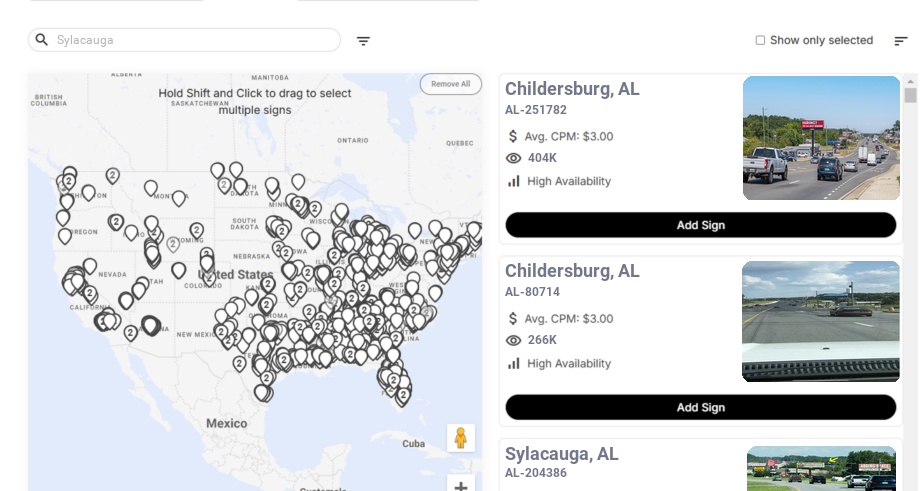
Digital billboards serving the Sylacauga area reach residents, commuters, and visitors moving along U.S. 280 and the key regional routes that tie Sylacauga to Childersburg and Talladega County. With three digital billboards near the Sylacauga area, located in nearby Childersburg within roughly 10 miles, advertisers can layer precise scheduling, flexible budgets, and targeted locations. These billboards give regional reach while still feeling local to everyday drivers.
What kind of traffic do Sylacauga billboards get on U.S. 280?
U.S. Highway 280 is the main east-west spine connecting Sylacauga, Childersburg, and Birmingham, and it is the single most important corridor for mass reach in the Sylacauga area. Traffic counts on U.S. 280 between Sylacauga and Childersburg commonly show 20,000–25,000 vehicles per day, with some segments closer to Birmingham rising above 40,000 vehicles per day. That makes it the backbone for digital billboards near Sylacauga.
When is the best time to run billboard ads in Sylacauga, Alabama with Blip?
If you want maximum reach, weekday commute windows from 6–9 a.m. and 3–7 p.m. are a strong choice, when traffic counts are often 30–40% higher than overnight lows. If you want a local, community feel, midday and early evening can work well when residents are running errands, shopping, or attending local events. Blip can also concentrate budgets during high-value seasonal windows like spring, summer, fall, and winter.
Who do Sylacauga billboards reach besides commuters?
Sylacauga billboards reach families, older adults, retirees, and visitors in addition to commuters. The area has a strong base of older adults, a family-oriented school population, and a steady stream of visitors headed to places like Majestic Caverns, Pursell Farms, and Talladega Superspeedway. That combination makes the market useful for healthcare, retail, restaurants, and tourism-related advertising.
Do I need a contract to advertise with Blip in Sylacauga?
No, Blip has no long-term contracts or minimum commitments. You can start, pause, or stop your campaign at any time.
How fast can I launch a billboard campaign with Blip in Sylacauga?
You can have your campaign live in minutes. Create a free account, select your locations, set your budget, upload your design, and start running once approved.
Where can I advertise with Blip in Sylacauga?
Blip has digital billboards in Sylacauga. You can browse available locations on a map, choose the ones that fit your audience, and start advertising right away.
Still have questions? Launch a campaign in minutes — no contracts, no commitments.
Start Your CampaignSylacauga Billboard Advertising Guide
Digital billboards serving the Sylacauga area give us a powerful way to get in front of residents, commuters, and visitors moving along U.S. 280 and the key regional routes that tie Sylacauga to Childersburg Talladega County. With three digital billboards near the Sylacauga area—located in nearby Childersburg within roughly 10 miles—we can layer precise scheduling, flexible budgets, and targeted locations to build campaigns that match the rhythms of this compact but highly mobile market. These billboards near Sylacauga give advertisers regional reach while still feeling local to everyday drivers. In a typical week, those three locations collectively deliver tens of thousands of impressions, with daily traffic counts in the immediate corridors commonly exceeding 20,000–30,000 vehicles per day when combined.
Understanding the Sylacauga Area Market
Sylacauga is a small city with an outsized regional role. Recent local estimates put the city’s population at around 12,500–12,600 residents, while Talladega County overall includes roughly 80,000–81,000 people spread across multiple communities and rural areas. That means many of the people we want to reach in the Sylacauga area are driving between towns for work, school, shopping, and recreation instead of staying in one dense urban core, making Sylacauga billboards especially effective for repeated exposure.
Key demographic characteristics for the Sylacauga area:
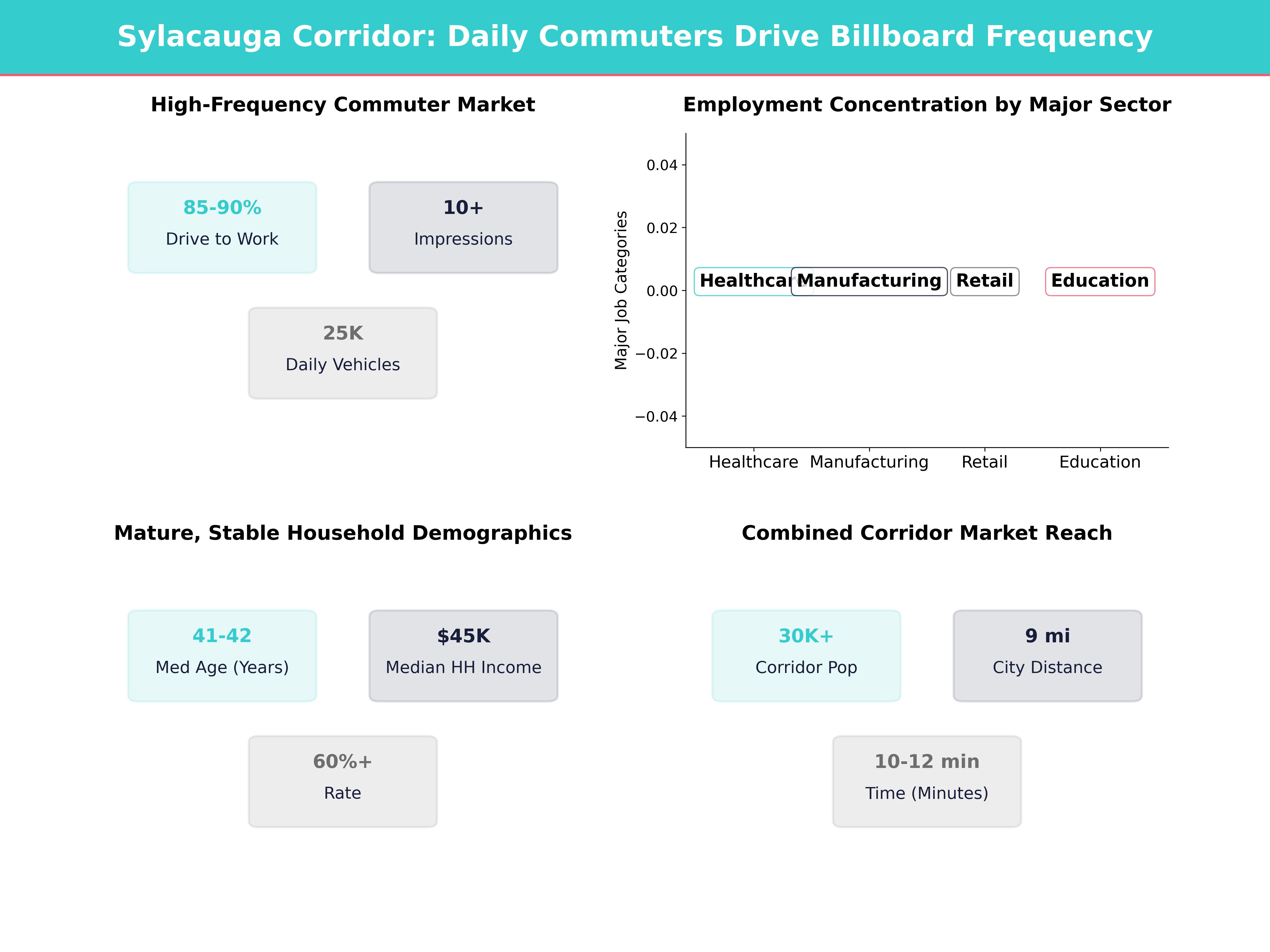
- Population: About 12,500 in the city, with a broader local trade area of 25,000–35,000 when we include nearby rural communities and Childersburg 5,000–5,500). Local planning and economic‑development groups often treat the Sylacauga–Childersburg corridor as a combined micromarket of 30,000+ people, which is exactly the audience reached by billboard advertising near Sylacauga along U.S. 280.
- Median age: Around 41–42 years, notably older than the U.S. median in the late 30s. In many Sylacauga‑area neighborhoods, more than 25% of residents are age 55+, which means a strong presence of families, mid‑career workers, and retirees.
- Households: Roughly 5,000–5,200 households in the city, with average household sizes around 2.4–2.5 people. Owner‑occupancy rates are typically above 60%, reflecting stable, long‑term residents with deep community ties.
- Income: Median household income in the area is in the mid‑$40,000s, and a sizable segment of residents—often 40–50% of households—fall into the $35,000–75,000 range. This band is prime for everyday retail, healthcare, auto, and home‑service marketing where value and convenience matter.
- Employment: Major local employers include healthcare, manufacturing, retail, and education—anchored by organizations like Coosa Valley Medical Center Blue Bell Creameries Sylacauga City Schools system. Healthcare and social assistance, manufacturing, retail trade, and education together often account for 50–60% of local jobs in similar Alabama micromarkets.
Local institutions and resources give us clues about who we’re reaching and what they care about:
- City of Sylacauga
- Sylacauga Chamber of Commerce
- Talladega County government
- Local news: Sylacauga News, The Daily Home (Talladega‑area coverage)
- Talladega County Schools (serving surrounding communities)
Local labor‑force data from state and county sources show labor‑force participation rates in the 55–60% range and unemployment generally hovering between 3–5% in recent years, which indicates an active working population that spends heavily on transportation, food, and healthcare.
A key takeaway: the Sylacauga area audience is hyper‑local, strongly community‑oriented, and highly dependent on cars. In small Alabama cities of this size, it’s common for 85–90% of workers to drive to work and for the dominant share of trips to be under 25 minutes. That makes roadside digital billboards extremely efficient for reaching people repeatedly in their daily routines and explains why demand for billboard rental near Sylacauga remains steady among local advertisers.
How People Move: Traffic Patterns Near Sylacauga
To use our three billboards serving the Sylacauga area effectively, we should think first in terms of traffic flows—where people drive and when.
Primary corridors influencing billboard reach:
- U.S. Highway 280: The main east‑west spine connecting Sylacauga, Childersburg ALDOT) traffic counts on U.S. 280 between Sylacauga and Childersburg commonly show 20,000–25,000 vehicles per day, with some segments closer to Birmingham rising above 40,000 vehicles per day. This is the single most important corridor for mass reach in the Sylacauga area and the backbone for digital billboards near Sylacauga.
- State Route 21 & 76: These routes link Sylacauga north toward Talladega and south toward smaller communities. Traffic is lighter—typically in the 7,000–12,000 vehicles per day range on key segments—but these routes carry very local, high‑intent drivers (workers, parents, local shoppers) whose trips are closely tied to daily life in the area.
- Childersburg local traffic: Childersburg 10,000–15,000 vehicles per day on busy stretches, giving our billboards frequent exposure to Sylacauga‑area commuters and workers headed to plants, quarries, and service jobs.
ALDOT’s traffic tools at aldottraffic.com
What this means for campaigns:
- If we want maximum reach, we prioritize U.S. 280‑facing faces during weekday commute windows (6–9 a.m., 3–7 p.m.), when traffic counts are often 30–40% higher than overnight lows.
- If we want a local, community feel, we can weight impressions toward midday and early evening when residents are running errands, shopping, or attending local events. Midday volumes on 280 and key city streets often still hold at 60–80% of peak commute traffic.
- Because Sylacauga and Childersburg 9 miles apart—a drive of roughly 10–12 minutes—many drivers see our boards multiple times per week. Daily commuters passing a location both morning and evening can accumulate 10+ impressions per week from a single advertiser, so frequency builds quickly, which is perfect for recall‑driven campaigns (healthcare, retail, churches, political) that rely on consistent Sylacauga billboards along the main corridor.
Key Audience Segments in the Sylacauga Area
By combining local data with what we know about regional travel, we can plan messages that speak directly to the people most likely to see our Childersburg‑area billboards near Sylacauga.
1. Local workers and commuters
- Many residents work in healthcare, manufacturing, retail, quarrying, and public services. In similar Alabama communities, these sectors together often represent 50% or more of non‑farm employment.
- Commute trips typically fall in the 6–9 a.m. and 3–6 p.m. windows on weekdays, with pronounced peaks around school and shift change times.
- A portion of residents commute up or down U.S. 280 toward Birmingham, Alexander City, or other jobs, passing our locations in the Childersburg area. In small cities along major corridors, it’s common for 20–30% of workers to commute outside their home city, which increases cross‑city exposure and makes billboard advertising near Sylacauga valuable for regional employers.
Best uses:
- Recruitment campaigns (“Now hiring,” sign‑on bonuses, shift work). In industrial recruiting, billboards can lift applicant volume by 10–30% when paired with digital and social ads.
- Service businesses that benefit from repeated exposure (insurance, banks, auto services); multiple weekly impressions support brand recall rates that can exceed 60–70% among exposed drivers.
- Safety and compliance messaging for industrial employers, where reaching the same workforce daily supports behavior change over time.
2. Families and parents
Sylacauga area schools (including Sylacauga City Schools and Talladega County Schools nearby) serve thousands of students across elementary, middle, and high schools. Within a 15–20‑mile radius, school enrollments can easily total 4,000–6,000 students when you include both city and county systems.
School‑related travel—drop‑offs, pick‑ups, and activities—heavily influences traffic between 7–9 a.m. and 2–5 p.m. Vehicles associated with school trips can account for 15–20% of traffic during peak hours in smaller markets, concentrating the attention of parents and caregivers along the same corridors where our boards are located.
Best uses:
- Pediatric practices, dentists, family medicine, and urgent care; healthcare spending for families often spikes in late summer and early fall, with back‑to‑school checks and sports physicals.
- After‑school programs, tutoring, sports leagues, and youth organizations; families of school‑age children frequently spend $500–$1,000+ per year per child on extracurriculars in many communities.
- Family restaurants, quick‑service chains, and local attractions, especially promoting kids‑eat‑free nights, team celebrations, and weekend specials.
3. Older adults and retirees
With a median age in the low 40s and a substantial 55+ population, the Sylacauga area has a strong base of older adults:
- In many similar Alabama communities, residents age 55+ make up 25–30% of the population, and those age 65+ can account for 15–18%.
- These residents drive throughout the day, with high activity between 9 a.m. and 3 p.m. on weekdays, when medical appointments, shopping, and social visits are concentrated.
- Many are managing healthcare needs, home services, and financial planning; healthcare expenditures per person in this age group are often 2–3 times higher than for younger adults.
Best uses:
- Clinics, pharmacies, specialty medical services, and senior care communities; digital billboards near medical hubs can drive measurable appointment increases, especially when combined with clear phone numbers or simple URLs.
- Home improvement and maintenance services (roofing, HVAC, lawn care), as older homeowners are more likely to hire out maintenance.
- Financial advisors and credit unions, emphasizing retirement planning, CDs, and savings products at local institutions such as area credit unions and community banks.
4. Visitors and regional tourists
The Sylacauga area benefits from a steady stream of visitors drawn to regional attractions:
- Majestic Caverns (formerly DeSoto Caverns) near Childersburg tens of thousands of visitors annually from across Alabama and the Southeast – majesticcaverns.com
- Pursell Farms (nearby resort and golf destination), which promotes luxury lodging, weddings, corporate retreats, and golf packages
- Talladega Superspeedway (about 35–40 miles away) hosts major NASCAR events, each pulling tens of thousands of fans—often 80,000+ spectators for marquee race weekends
- Access to Talladega National Forest and outdoor recreation across the county – tourism info via Visit Talladega Discover Shelby for nearby counties
According to state and regional tourism reports, outdoor and motorsports tourism can generate tens of millions of dollars in visitor spending annually across east‑central Alabama, much of it flowing through lodging, restaurants, fuel, and retail. When big race weekends or seasonal tourism peaks hit, U.S. 280 and nearby corridors see elevated traffic, often including out‑of‑town visitors unfamiliar with the area. Local hotels, restaurants, and attractions can time campaigns around these spikes to capture travelers who are actively looking for places to stay, eat, and shop, using Sylacauga billboards to guide them toward key exits and businesses.
Seasonal and Weekly Timing Strategies
Digital billboards serving the Sylacauga area are most effective when we match our schedules to local rhythms.
Weekly patterns
- Monday–Friday: Strong commute and work traffic. In many small metros, weekday volumes can be 10–20% higher than weekend volumes. Great for B2B, recruitment, healthcare reminders, and everyday retail.
- Friday afternoon/evening: People preparing for weekend shopping, dining out, and entertainment. Retail sales often jump 20–30% on Fridays and Saturdays versus midweek in many communities.
- Saturday: Heavier daytime errands and leisure trips, especially to big‑box retail and regional attractions. Midday Saturday traffic on retail corridors can rival weekday peaks.
- Sunday: Lower overall traffic but high relevance for churches, Sunday dining, and urgent‑care/health prompts. In highly church‑engaged communities, 40–60% of households may attend services at least occasionally, creating a consistent Sunday audience.
Seasonal patterns
-
Spring (March–May):
- High school sports, graduations, and outdoor events ramp up, with school calendars often packing 10–20 major events into this window.
- Tourism to outdoor attractions grows with warmer weather; regional parks often report double‑digit percentage increases in visitation from winter to spring.
- Ideal for: yard services, home improvement, auto dealers, seasonal events, and churches looking to promote Easter and spring programming.
-
Summer (June–August):
- Family travel to Majestic Caverns, lakes, and camps. State tourism agencies often report peak visitation to outdoor attractions in June and July.
- Students out of school—more daytime activity and flexible schedules, with teen/young adult traffic increasing in midday and evening.
- Ideal for: attractions, restaurants, summer programs, healthcare (sports physicals, back‑to‑school immunizations), and hiring campaigns for seasonal employers.
-
Fall (September–November):
- School and sports in full swing, plus major events at Talladega Superspeedway tens of thousands of additional vehicles on regional highways.
- Local football culture drives community engagement, with Friday night games and Saturday college football watch parties boosting restaurant and grocery traffic.
- Ideal for: political campaigns, retail promotions, events, auto sales, and sponsorship messaging tied to local teams.
-
Winter (December–February):
- Holiday shopping peaks late November through December; many retailers see 20–30% of annual sales in this period.
- Healthcare, financial planning, and tax prep messaging perform well in January–February, as people act on New Year resolutions and begin tax‑season planning.
- Ideal for: retail holiday pushes, year‑end giving campaigns, New Year health/fitness, and tax services.
With Blip’s flexible scheduling, we can concentrate budgets during these high‑value windows—without paying for low‑impact times that don’t match our goals. For example, a business might invest 60–70% of its annual billboard budget into just a few key months aligned with its busiest seasons, making cost‑effective use of billboard rental near Sylacauga during peak demand periods.
Creative Best Practices for the Sylacauga Area
Because our three boards serving the Sylacauga area are viewed primarily by drivers at highway speeds, creative has to be simple, bold, and locally resonant.
1. Design for quick reads at 55–65 mph
- Limit copy to 6–8 words or fewer. At 60 mph, a driver travels about 88 feet per second, leaving only 5–8 seconds of readable exposure.
- Use high‑contrast color combinations—dark text on light background or vice versa—to preserve legibility in sun and rain.
- Make a single focal point: one main photo or graphic, not a collage; cluttered layouts reduce recall by as much as 30–40% in billboard tests.
- Use very large fonts (think 18–24 inches tall in physical size; your designer or Blip templates can help approximate).
2. Lean into local identity
Sylacauga brands itself as the “Marble City” and has a distinct small‑town, community‑proud character. The city highlights its marble history and public art through resources on Sylacauga.net and local tourism features. Referencing that identity can dramatically increase attention:
- “Proud to serve the Marble City”
- “Sylacauga‑area families trust us with their health”
- “Your hometown bank on U.S. 280”
Use recognizable local imagery when appropriate: marble monuments, downtown Sylacauga scenes, or landmarks that residents know instantly. Campaigns that incorporate familiar landmarks often see higher recognition and favorability in post‑campaign surveys, especially when paired with prominent Sylacauga billboards on the main drive routes.
3. Highlight clear calls to action
Because drivers can’t click a billboard, the CTA must be simple:
- Phone numbers: use local area codes (e.g., 256/205) and no more than 7–10 easily readable digits. Shorter numbers can increase call rates by 10–20% versus longer, harder‑to‑read numbers.
- Web addresses: short URLs or memorable domains (avoid long slashes and complex paths). Vanity URLs can drive higher direct‑traffic spikes during campaigns.
- “Exit now,” “Next light,” or “10 minutes ahead on 280”–type directional cues for physical locations; clear distance cues help reduce friction and increase in‑the‑moment decisions.
- Time‑bound offers: “This weekend only,” “Now hiring,” “New patients today.” Urgency can improve response rates by 20–50% in many direct‑response contexts.
4. Use multiple creatives strategically
With digital, we’re not stuck with one static design:
- Run A/B variations: test different headlines or images targeting the Sylacauga area, then continue with the higher‑performing version. Even simple headline changes can shift response metrics by 10–30%.
- Rotate seasonal creatives: back‑to‑school, holiday, race‑weekend, summer, etc., so your message aligns with what people are already thinking about.
- Adjust promotions weekly if needed: “This week’s special,” “Game‑day deal,” “Race weekend rates.” Digital billboards often allow creative swaps in hours, not weeks, keeping campaigns agile.
Using Location and Scheduling Controls Effectively
Blip’s tools let us precisely target where and when our ads show on the billboards serving the Sylacauga area.
1. Focus on Childersburg for Sylacauga reach
Because our three digital billboards are located in nearby Childersburg 9 miles from Sylacauga):
- We can reach Sylacauga residents driving toward Birmingham, regional work sites, or Majestic Caverns. Many Sylacauga commuters travel this route daily, creating repeated exposure.
- We can also reach Childersburg residents who travel into the Sylacauga area to work, shop, or visit services. In small regional corridors, it’s common for 20–30% of working residents to cross city lines regularly.
Selecting these nearby locations in Blip ensures that your budget concentrates on the U.S. 280 corridor and surrounding routes that most Sylacauga‑area drivers use—capturing both local and through traffic with minimal waste and making your billboard advertising near Sylacauga highly targeted.
2. Dayparting for audience matching
We should schedule impressions when our desired audience is most likely on the road:
-
Recruiting & B2B:
- Weekdays, 6–9 a.m. and 3–6 p.m. commute windows, when worker volumes peak.
- Consider adding lunchtime (11 a.m.–1 p.m.) for workers out on break; midday reach can help with shift‑change hiring and drop‑in applications.
-
Healthcare & senior services:
- Weekdays, 9 a.m.–3 p.m. for older adults and parents running errands.
- Some evening hours (4–7 p.m.) for working families. Healthcare providers often see call and web‑visit spikes aligned with these windows when campaigns are active.
-
Retail, restaurants, and entertainment:
- Weekdays 4–8 p.m. for weeknight traffic and after‑work shopping.
- Fridays 3–9 p.m. plus Saturdays 10 a.m.–8 p.m. for weekend shoppers and diners, when discretionary spending is highest.
-
Events and churches:
- Focus the week leading up to the event; ramping impressions 3–7 days before can significantly lift attendance.
- Churches: emphasize Thursday–Sunday, with heavy weight Friday and Saturday when families are planning their weekends.
3. Budgeting for a small but active market
Because the Sylacauga area is smaller than major metros, even modest budgets can achieve strong frequency:
- Consider an always‑on baseline campaign (e.g., a small daily budget) to keep your brand visible. In markets of this size, a consistent presence can drive brand awareness in the 60–80% range among regular corridor users over time.
- Layer short, higher‑budget “bursts” for big promotions: grand openings, holiday sales, race weekends, back‑to‑school, or hiring pushes. A 1–2 week burst with higher share of voice can create noticeable upticks in store visits and calls.
- Leverage Blip’s ability to set maximum bids and daily caps to stay within budget while still capturing prime times along U.S. 280. In smaller markets, cost‑per‑thousand impressions (CPM) is typically lower than in large metros, improving ROI and making billboard rental near Sylacauga accessible even for smaller local businesses testing out-of-home for the first time.
Campaign Ideas by Business Type
Here are practical ways different advertisers can use the digital billboards serving the Sylacauga area.
Healthcare providers
Targets: families, older adults, and workers in the Sylacauga area.
- Show simple messages like “Same‑day appointments – Sylacauga area” or “ER wait times low – just 10 minutes ahead.” Local hospitals like Coosa Valley Medical Center
- Daypart around weekdays 7 a.m.–7 p.m., when 70–80% of routine appointments and urgent‑care visits occur.
- Emphasize local trust: “Serving Sylacauga‑area families for 20+ years.”
- Rotate messages for pediatrics, primary care, and urgent care depending on season (back‑to‑school, flu season, summer injuries), matching known seasonal spikes in patient volume.
Restaurants & QSR chains
Targets: commuters and families.
- Use countdown‑style messages: “Hungry? Turn right at next light,” “Exit now for burgers & shakes.” Adding distance cues (“2 miles ahead on 280”) helps capture spontaneous decisions.
- Focus on lunch and dinner dayparts; heavier on Friday and weekends. In many QSR chains, more than 50–60% of weekly sales occur between Friday and Sunday.
- Feature limited‑time offers and local tie‑ins: game days, race weekends, or community events promoted via Sylacauga News and local calendars.
- Highlight “drive‑thru open late” or “breakfast served all day” to capture specific daypart audiences.
Auto dealers & services
Targets: local drivers and commuters.
- Rotate ads for sales, service, and specific models; auto buyers typically research for 60–90 days, so consistent exposure builds familiarity.
- Promote easy access: “5 minutes ahead on 280,” “Free shuttle for Sylacauga‑area customers.”
- Schedule heavier impressions near month‑end, major holidays, and seasonal changeovers (tire promotions, winter/summer maintenance), when auto sales often spike 10–20%.
- For repair shops, pair billboard campaigns with clear offers like “Free brake check” or “Oil change specials this week.”
Retail & local shops
Targets: households and regional visitors.
- Use simple value statements: “New furniture showroom – Sylacauga area,” “Locally owned hardware – better prices, close to home.”
- Push pre‑holiday and back‑to‑school campaigns with short, strong bursts; local retailers often see 20–40% sales lifts during properly promoted events.
- For smaller retailers, use billboard campaigns in 1–2 week bursts around key sales events instead of year‑round, ensuring budgets line up with times of highest foot traffic.
- Tie messaging to local events promoted by the Sylacauga Chamber of Commerce Talladega County.
Education, churches & nonprofits
Targets: families and community‑minded residents.
- Promote enrollment periods, special series, or events: “Fall revival this week,” “Now enrolling 3K–12th.” Schools, churches, and nonprofits often rely on a narrow enrollment or campaign window where awareness is critical.
- Emphasize local connection: “Serving Sylacauga‑area families since 19XX.”
- Use specific dates and times; run heavier in the 7–9 a.m. and 4–8 p.m. windows when families are in the car together.
- Coordinate messaging with announcements in local media outlets such as Sylacauga News and The Daily Home.
Recruitment & workforce campaigns
Targets: workers in manufacturing, healthcare, logistics, and services.
- Showcase pay rates and benefits clearly: “$20/hr + benefits – Apply today.” Wage‑specific ads often drive higher application volumes than generic hiring messaging.
- Include short web address or “Text ‘JOBS’ to [short code].” Text‑to‑apply can reduce friction for workers who see the ad while commuting.
- Focus on weekday commute hours plus lunchtime. In tight labor markets, recruitment campaigns that run 4–6 weeks with frequent exposures can significantly increase applicant pools.
- Align campaigns with known hiring periods—plant expansions, seasonal tourism boosts, or new store openings announced by local governments and economic‑development groups.
Connecting Your Billboard Strategy with Local Media & Events
To maximize impact, we can align digital billboard buys with what people in the Sylacauga area are already seeing and talking about.
1. Coordinate with local news & sports
- Monitor local headlines via Sylacauga News and The Daily Home. These outlets cover city council decisions, school news, plant expansions, and sports.
- Tie messaging to high‑profile local sports matchups, school events, and community festivals listed on Sylacauga.net or the Sylacauga Chamber of Commerce
- When big stories break (like major plant expansions, healthcare announcements, or civic developments), supportive or relevant billboard messages can reinforce your brand’s presence and show community engagement.
2. Piggyback on major regional events
- For Talladega Superspeedway tens of thousands of extra vehicles through the region, boosting potential impressions.
- Highlight special offers for out‑of‑towners: “Race fans welcome,” “Show this ad on your phone for 10% off.” Even a small uptick in capture of race visitors can translate to significant revenue for hotels, restaurants, and retailers.
- For summertime tourism to Majestic Caverns or parks, promote activities, rentals, and family‑friendly services on weekends and holidays. Track park and attraction calendars via Majestic Caverns and Visit Talladega
3. Cross‑promote with digital & social
- Use similar designs on billboards, social media, and local digital ads so people recognize your brand across channels. Cross‑channel consistency can increase message recall by 20–30%.
- Encourage drivers to engage: “See our billboard? Tag us with a photo for a chance to win.” This creates measurable social signals tied to your out‑of‑home spend.
- Track spikes in direct traffic, branded search, and store visits during billboard flights to gauge impact; many advertisers see uplift in branded searches of 10–50% during heavy billboard campaigns, especially in smaller markets.
Measuring and Refining Your Sylacauga‑Area Campaign
Even though billboards are an offline medium, we can still measure performance and optimize.
Key measurement tactics
- Website analytics: Watch for increases in direct visits, brand‑name searches, and traffic from the Sylacauga/Childersburg area during active flights. Use geo‑filters in tools like Google Analytics to focus on Talladega County and surrounding ZIP codes.
- Call tracking: Use a dedicated phone number on your billboard creative and monitor calls during the campaign. Many businesses see measurable call volume increases of 10–30% during strong billboard pushes.
- Offer codes: Include a simple code like “Mention ‘Marble 10’ for 10% off” to attribute redemptions. Even a small redemption rate (e.g., 1–3% of customers) can provide strong evidence of billboard impact.
- Customer surveys: Ask new customers “How did you hear about us?” and log “billboard” responses. Over several weeks, a pattern of 15–25% of new customers citing billboards can justify ongoing investment.
Optimization approach
- Start with 2–3 creative variations and rotate them equally the first few weeks.
- Compare performance indicators (calls, web traffic, redemptions) by time period; look for days or times when metrics spike.
- Gradually allocate more budget to the best‑performing creative and dayparts. Shifting spend toward top performers can improve overall campaign efficiency by 20–40%.
- Adjust copy seasonally and around key community events, using the flexibility of digital to update artwork as often as needed—sometimes multiple times per month to stay aligned with news, holidays, and local happenings.
By understanding how people in the Sylacauga area live, drive, and make decisions—and by using Blip’s flexible tools on the three digital billboards located near Childersburg