Billboards in Morris, AL
No Minimum Spend. No Long-Term Contracts. Just Results.
Trusted by Leading Brands


Billboard advertising
in Morris has never been easier



How much is a billboard in Morris?
Why Choose Blip for Billboard Advertising in Morris
Blip lets you self-serve Morris campaigns fast, reaching I-65 commuters in North Jefferson without a rep or contract.
Use Blip to daypart Morris ads for southbound mornings and northbound evenings along I-65 and U.S. 31.
Blip-optimized bidding helps Morris budgets flex with traffic demand, so you can reach Birmingham-bound drivers without overspending.
Track Morris billboard results in real time and shift spend toward the corridors working best near Gardendale and Fultondale.
Blip's creative tools make it easy to tailor Morris ads for home services, school calendars, and seasonal demand across Jefferson County.
Frequently Asked Questions About Billboard Advertising in Morris
How much does a billboard cost in Morris, Alabama with Blip?
With Blip, billboard advertising in Morris can be surprisingly affordable because you only pay when your ad actually appears. Each “blip” is a 7.5-to-10-second display on a rotating digital billboard, and pricing starts at just $0.01 per display. The cost per blip changes based on time of day, location, and advertiser demand, so your total spend stays flexible and tied to actual impressions.
Where can I advertise with Blip in Morris, Alabama?
Morris sits inside a much larger North Jefferson market, and its value comes from its position near commuter routes and the larger Birmingham interstate network. I-65 through North Jefferson County is the backbone corridor, with traffic climbing into the 70,000s and 80,000s through the Gardendale area and reaching 90,000-plus closer to Fultondale and the Birmingham approach. U.S. 31, I-22, and local connectors such as AL-160 also offer useful placement options depending on whether you want reach, retail intent, or local repetition.
Why is Morris, Alabama a good market for Blip billboard ads?
Morris gives advertisers access to a small hometown audience inside a much larger Birmingham travel shed. The city is roughly 20 miles north of downtown Birmingham, sits in Jefferson County and the Birmingham metropolitan area, and the surrounding area is highly car-oriented. Because more than 90% of Jefferson County workers commute by car, truck, or van, billboard advertising can create fast, repeated visibility here.
When is the best time to run billboard ads in Morris, Alabama with Blip?
Spring is a high-opportunity season across North Jefferson, especially from March through May, when weather pushes demand for roofing, storm repair, insurance, tree service, gutter work, HVAC tune-ups, and urgent care. Summer runs especially well from Memorial Day through Labor Day, while fall is one of the strongest billboard seasons because school returns in late July or early August and football runs from August through November. Holiday retail ramps in November and December, and winter often works well for healthcare, tax preparation, gyms, and early-year promotions.
What kind of billboard messaging works best in Morris, Alabama with Blip?
North Jefferson drivers tend to respond best to messages that are useful and immediately relevant. In Morris, we should favor concrete offers, recognizable place names, and simple directional language such as “North Jefferson,” “Minutes from Gardendale,” “Off I-65,” or “Serving Morris, Kimberly, and Warrior.” Practical callouts like “Free estimate,” “Same-day care,” “Open 7 days,” and “Now hiring” also work well because many local trips are purpose-driven.
Do I need a contract to advertise with Blip in Morris?
No, Blip has no long-term contracts or minimum commitments. You can start, pause, or stop your campaign at any time.
How fast can I launch a billboard campaign with Blip in Morris?
You can have your campaign live in minutes. Create a free account, select your locations, set your budget, upload your design, and start running once approved.
Where can I advertise with Blip in Morris?
Blip has digital billboards in Morris. You can browse available locations on a map, choose the ones that fit your audience, and start advertising right away.
Still have questions? Launch a campaign in minutes — no contracts, no commitments.
Start Your CampaignMorris Billboard Advertising Guide
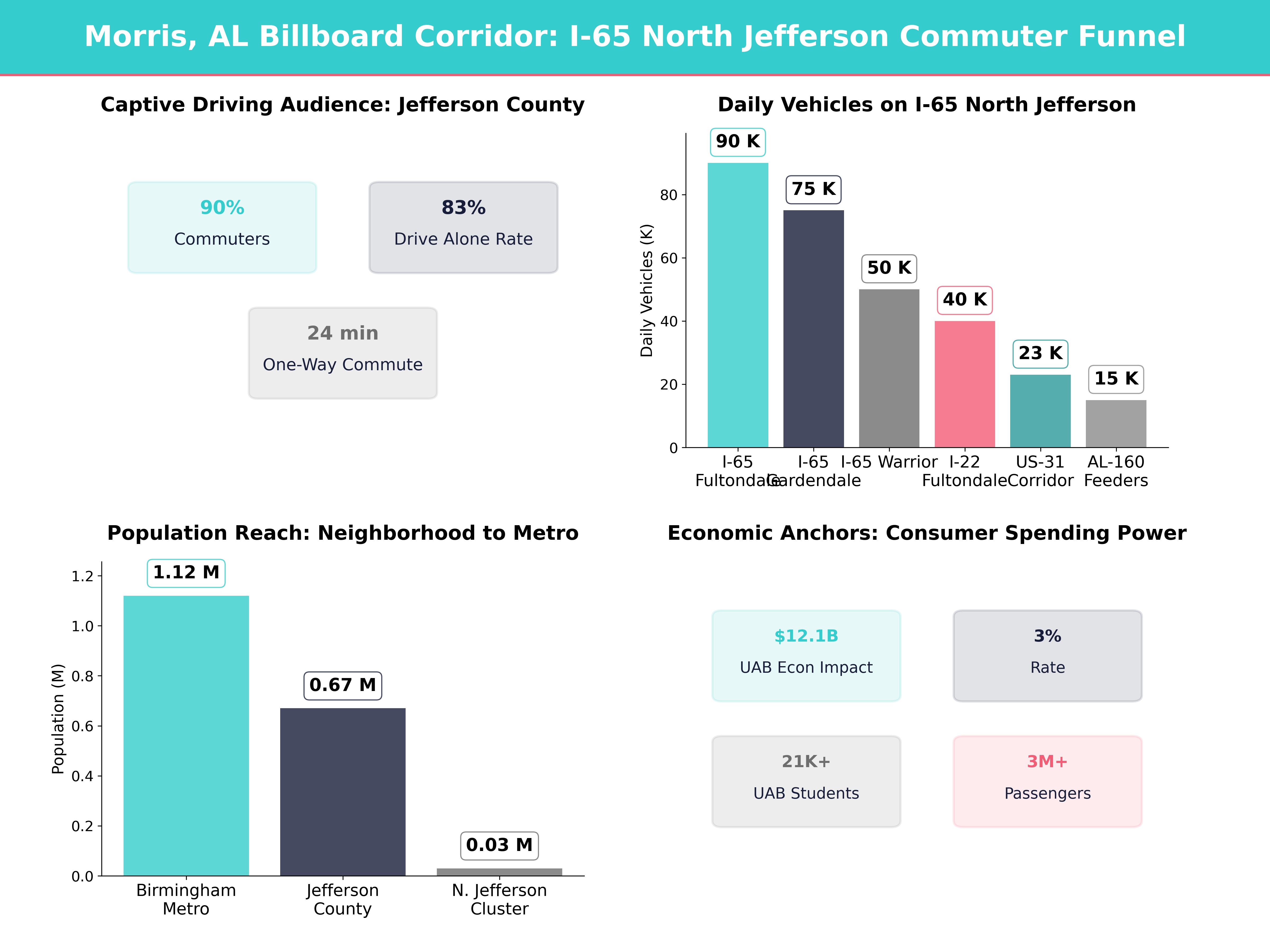
Morris 2,092 residents in Morris, but the city sits in Jefferson County, Alabama’s most populous county, with 674,721 residents, and within the Birmingham metropolitan area, which had 1,115,289 residents in 2020. Morris is roughly 20 miles north of downtown Birmingham, so one well-planned campaign can speak to local families, North Jefferson shoppers, and Birmingham-bound commuters. Because daily life in this part of Alabama is highly car-oriented, with more than 90% of Jefferson County workers commuting by car, truck, or van, and the I-65 corridor carries roughly 55,000 to 90,000+ vehicles per day through North Jefferson, billboard advertising can create fast, repeated visibility here.
Market Overview for Morris, Alabama
Morris sits inside a much larger North Jefferson market
Morris is not an isolated small town from an advertising perspective. It is part of a North Jefferson cluster that includes Gardendale Fultondale, and Warrior, and those nearby cities materially expand the reachable audience. Using 2020 Census counts, Gardendale had 16,044 residents, Fultondale had 9,269, Warrior had 3,176, and Morris had 2,092, for a combined nearby total of 30,581 residents before we even account for the rest of Jefferson County.
Morris itself also showed positive momentum over the last census cycle. The city grew from 1,859 residents in 2010 to 2,092 in 2020, which was an increase of about 12.5%. That matters because growth in small suburban cities often signals new rooftops, more family households, and more routine vehicle trips.
Jefferson County alone accounts for roughly 60% of the Birmingham-Hoover metro population. That means Morris advertisers are buying into a local market with regional spillover, not just a town-limits audience.
Morris benefits from a car-dependent regional economy
For billboard advertisers, mobility patterns matter as much as population. Recent American Community Survey estimates indicate that more than 90% of Jefferson County workers commute by car, truck, or van, about 83% drive alone, and the average one-way commute is about 24 minutes. Those numbers strongly support out-of-home advertising because they translate into repeated roadway exposure during the workweek.
The local economy is also broad enough to support many advertiser categories. The University of Alabama at Birmingham reports an annual statewide economic impact of $12.1 billion, and the greater Birmingham economy is anchored by healthcare, education, finance, manufacturing, logistics, and professional services. Recent reports from the Alabama Department of Labor have generally kept Jefferson County in the low-3% unemployment range, which is a useful signal for recruitment advertising, service businesses, and consumer spending.
For us as advertisers, the takeaway is straightforward:
- Local service brands can use Morris-area boards to build familiarity among households that drive the same routes every week.
- Regional brands can use North Jefferson inventory to intercept commuters before they reach Birmingham’s denser ad environment.
- Destination businesses can use Morris and nearby interstate boards to catch consumers while they still have time to change plans, choose an exit, or remember a brand later in the day.
Key Traffic Corridors for Morris, Alabama
Morris advertising works best when we think in corridors, not just municipal boundaries. The city’s value comes from its position near North Jefferson commuter routes and the larger Birmingham interstate network.
I-65 through North Jefferson County
I-65 ALDOT mid-50,000s AADT around the Warrior area, climbing into the 70,000s and 80,000s through the Gardendale area, and reaching 90,000-plus closer to Fultondale and the Birmingham approach. That is the corridor we use when we want scale.
This route is especially effective for several advertiser types:
- Healthcare advertisers benefit because North Jefferson residents frequently travel south toward major providers such as UAB Medicine, Children’s of Alabama, St. Vincent’s Birmingham Grandview Medical Center, and Brookwood Baptist Health.
- Home services brands benefit because homeowners see the same message repeatedly during weekday commuting and weekend errands.
- Auto dealers, financial services, and regional retail benefit because I-65 reaches consumers before they choose between Gardendale, Fultondale, downtown Birmingham, or continuing north.
Direction matters here. Southbound faces are strongest for weekday morning commuters heading toward Birmingham, while northbound faces gain strength in late afternoon and early evening as residents return to Morris and nearby communities.
U.S. 31 in the Gardendale-Fultondale retail corridor
U.S. 31 18,000 to 28,000 AADT, which is lower than I-65 but often better for retail intent because drivers are closer to storefronts, traffic signals, and decision points.
This corridor is a strong fit for:
- Restaurants, urgent care clinics, dental offices, and pharmacies because drivers can act quickly after seeing the message.
- Local retail and service businesses because the road serves everyday trips instead of only long-haul commuting.
- Churches, schools, and community events because nearby residents recognize place names and respond well to localized messaging.
If I-65 is our reach corridor, U.S. 31 is our action corridor.
I-22 and the western connection into Birmingham
I-22 30,000 to 50,000 AADT range. That corridor brings in commuters and shoppers from places such as Jasper
This route can work particularly well for:
- Recruitment campaigns that need a wider labor shed.
- Entertainment and event venues in Birmingham that want to pull visitors from west of the metro.
- Higher education and training providers that draw students from multiple counties.
For Morris-area brands, I-22 is often the “extra reach” corridor we add once I-65 and U.S. 31 are already covered.
AL-160 and local connectors near Morris
ALDOT counts on connectors such as AL-160 and nearby feeder roads typically run in the 11,000 to 18,000 vehicles per day range, depending on the segment. These numbers are much smaller than interstate traffic, but they are useful when we want local repetition rather than metro-wide reach.
These roads are strong for:
- Community banks, HVAC companies, plumbing companies, and pest control brands that depend on neighborhood trust.
- Schools, childcare providers, and family recreation businesses that want to stay top of mind close to home.
- Political, civic, and nonprofit campaigns that need local name recognition rather than broad regional awareness.
Audience Segments We Can Reach from Morris, Alabama
Morris and North Jefferson commuters
The first major audience is the daily commuter. With more than 90% of Jefferson County workers commuting by car, truck, or van, Morris-area billboards get repeated weekday exposure almost by default. We should expect the strongest commuter windows to cluster around roughly 6:00 to 9:00 a.m. southbound and 3:30 to 6:30 p.m. northbound.
This audience is ideal for:
- Banks, insurance agencies, and law firms because repeated commuting builds familiarity for considered purchases.
- Healthcare providers because appointment-based services benefit from reminder-style visibility.
- Employers and recruiters because workers are literally on the road to and from job centers when they see the message.
North Jefferson families and homeowners
Morris is also a family-oriented suburban market. The nearby North Jefferson cities of Morris, Gardendale, Fultondale, and Warrior total 30,581 residents, and the area is deeply shaped by school calendars, church life, youth sports, and household spending. Jefferson County Board of Education schedules and local routines create predictable peaks for back-to-school, home improvement, seasonal healthcare, and holiday shopping.
This audience is especially valuable for:
- Home services, including roofing, HVAC, remodeling, lawn care, pest control, and plumbing.
- Family healthcare, including pediatric, dental, vision, and urgent care services.
- Local retailers and restaurants that need consistent top-of-mind recall in nearby communities.
Students, healthcare users, and regional service consumers
Although Morris itself is small, it feeds into a much larger education and healthcare network. UAB enrolls more than 21,000 students, and Jefferson State Community College 4 campuses in the region. That gives us a meaningful audience of traditional students, adult learners, and workforce-training consumers.
Healthcare is equally important. North Jefferson residents routinely travel into Birmingham for specialists, hospitals, imaging, outpatient procedures, and pediatric care. That makes Morris-area and I-65 boards effective for hospitals, clinics, private practices, and ancillary healthcare services that want to be remembered before patients begin the trip south.
Visitors, eventgoers, and weekend travelers
Morris also participates in Birmingham’s visitor economy. Protective Stadium seats 47,100, Regions Field seats 8,500, and Birmingham-Shuttlesworth International Airport handles more than 3 million passengers annually. That creates rotating audiences of sports fans, concert attendees, conference visitors, and business travelers moving through Jefferson County.
Family and leisure attractions add even more audience variety:
- Birmingham Zoo features more than 550 animals representing about 180 species.
- McWane Science Center remains a strong family draw in downtown Birmingham.
- Barber Vintage Motorsports Museum houses more than 1,800 motorcycles and over 160 race cars.
- Rickwood Caverns State Park, just up the road from Morris, is built around a cave system estimated to be 260 million years old.
For advertisers, that means Morris is not only about local residents. It is also about intercepting people on the move.
Seasonal and Timing Opportunities in Morris, Alabama
Spring in Morris is prime time for home services and weather-driven messaging
Spring is a high-opportunity season across North Jefferson. From March through May, Alabama weather pushes demand for roofing, storm repair, insurance, tree service, gutter work, HVAC tune-ups, and urgent care. This is the season when practical, problem-solving creative tends to outperform image-only branding.
Tax refund season can also help categories such as auto dealers, furniture retailers, home improvement stores, and elective medical services. If we sell something that people often purchase after receiving a refund, spring billboard timing in Morris can be highly efficient.
Summer in Morris favors family fun, travel, and heat-related services
Summer runs especially well from Memorial Day through Labor Day. In the Birmingham area, July high temperatures commonly reach around 90°F, which makes cooling, convenience, and recreation messages feel timely. HVAC companies, cold beverages, pools, splash attractions, urgent care, family restaurants, and travel brands all have a natural summer angle.
This is also a good season for visitor-oriented messaging tied to Alabama Adventure & Splash Adventure, the Birmingham Zoo, McWane Science Center, and broader Alabama Tourism travel patterns. Weekend dayparting can be especially useful in summer because discretionary trips increase on Fridays, Saturdays, and Sundays.
Fall in Morris is built for football, school routines, and local retail
Fall is one of the strongest billboard seasons in the Morris area because multiple demand drivers stack together. School typically returns in late July or early August, football runs from August through November, and families settle back into consistent weekly routines. That is ideal for advertisers who want dependable impressions and sharper audience predictability.
This season supports:
- Sports-bar, restaurant, and retail promotions tied to game days.
- Medical and dental reminders as families get back on schedule.
- Colleges and training programs recruiting for fall and spring enrollment.
- Event promotion tied to Protective Stadium, the Birmingham-Jefferson Convention Complex, the Hoover Met Complex, and the Barber Vintage Festival.
Holiday and winter campaigns in Morris benefit from routine and visibility
Holiday retail ramps in November and December, and winter often works well for healthcare, tax preparation, gyms, family entertainment, and early-year promotions. Shorter daylight hours can also help digital boards stand out visually during evening commutes.
For Morris advertisers, winter is a good time to stay visible while competitors go quiet. That can be especially useful for local service businesses and regional brands that want lower-clutter share of voice.
Billboard Design Tips for Morris, Alabama
Morris creative should feel local, practical, and easy to act on
North Jefferson drivers tend to respond best to messages that are useful and immediately relevant. In Morris, we should favor concrete offers, recognizable place names, and simple directional language over abstract slogans. Phrases such as “North Jefferson,” “Minutes from Gardendale,” “Off I-65,” or “Serving Morris, Kimberly, and Warrior” usually fit the market better than vague brand copy.
This is a strong market for practical callouts such as:
- “Free estimate.”
- “Same-day care.”
- “Open 7 days.”
- “Now hiring.”
- “Family-owned.”
- “2 miles ahead.”
Those lines work because many local trips are purpose-driven. Drivers are commuting, running errands, taking kids to practice, or heading to a specific appointment.
Morris design should match a suburban, vehicle-heavy audience
Creative in this market should assume drivers are moving at suburban arterial or interstate speed and often sitting in trucks, SUVs, or family vehicles. We should use high-contrast color palettes, bold type, and one dominant idea per board. Local imagery that reflects home exteriors, family life, healthcare, outdoor recreation, and community trust usually lands better than highly stylized urban visuals.
If we are advertising a destination business, directional confidence matters. In the Morris area, people often decide in motion whether to stay on I-65, move to U.S. 31, or keep heading toward Birmingham. That means a billboard with a clear place cue often performs better than one that only states a brand name.
Morris campaigns should respect local sports culture without over-assuming
Football matters across greater Birmingham, but fan loyalty is split. Unless our audience is clearly defined, it is usually smarter to use broad game-day energy, tailgating imagery, or school-spirit themes than to assume one college affiliation. If a campaign is sports-driven, we can always test separate creative versions rather than betting everything on one visual identity.
Seasonal creative also works especially well here. Storm-related language in spring, cooling language in summer, football language in fall, and gift or wellness language in winter all align with how Morris-area households actually live.
Regional Strategies Around Morris, Alabama
Morris, Kimberly, and Warrior should emphasize frequency and trust
When we focus on Morris and nearby small communities, the goal is usually repetition rather than mass reach. This is where we should prioritize local service lines, testimonials, family messaging, and practical offers. Campaigns for dentists, HVAC companies, banks, pediatric care, churches, and community events can perform well with consistent local presence.
For these zones, we generally want messaging that says, in effect, “we are nearby, we understand this area, and we are easy to use.”
Gardendale and Fultondale should carry the scale load
If we want more volume, Gardendale Fultondale are the North Jefferson nodes that usually do the heavy lifting. With 16,044 residents in Gardendale and 9,269 in Fultondale, these communities concentrate more retail, more daily traffic, and more commuter interaction than Morris alone.
This is where we should lean into:
- Retail and restaurant campaigns that depend on active consumer intent.
- Regional healthcare campaigns that want frequency plus volume.
- Recruitment and education campaigns that need broader labor-market exposure.
Birmingham should be part of the strategy when the destination is the point
Because Morris is only about 20 miles from downtown Birmingham, we should not think of Birmingham inventory as separate from Morris strategy. If the advertiser’s offer is destination-based, such as specialty healthcare, legal services, major events, higher education, or downtown entertainment, it often makes sense to pair North Jefferson boards with boards nearer BJCC, Protective Stadium, Regions Field, or UAB.
That combination lets us build awareness on the approach and reinforce it near the destination.
Northbound extensions can help Morris advertisers grow beyond Jefferson County
For advertisers with a broader draw, northbound I-65 can extend a Morris campaign toward Cullman Wallace State Community College, and regional healthcare or automotive businesses that pull customers from multiple counties.
The main strategic point is that Morris can serve both as a local market and as a gateway market.
Blip Tools and Capabilities for Morris, Alabama Campaigns
We can match Morris buying patterns to actual traffic patterns
Morris is a strong use case for dayparting. We can weight weekday mornings toward southbound commuter exposure, shift weekday evenings toward northbound return traffic, and reserve weekend budgets for family travel and leisure trips. That helps us align the spend with how people really move through North Jefferson instead of paying for a flat schedule that ignores local behavior.
We can separate commuter, retail, and destination messaging
This market also rewards creative segmentation. We can run one message on I-65 for broad commuter awareness, a different message on U.S. 31 for store visits, and a third message near Birmingham destinations for conversion-oriented reminders. A manual campaign is especially useful if we already know the exact boards or corridors we want. A Blip-optimized campaign can be more efficient when we want the platform to distribute budget across North Jefferson and Birmingham based on performance.
We can test Morris ideas quickly and refine them with live data
Because Morris sits inside a larger metro network, testing matters. We can start with a focused corridor, compare weekday versus weekend performance, rotate seasonal creative, and watch the analytics to see whether commuter or event traffic is doing more work. We can also use Blip’s artwork tools to localize the same campaign into multiple versions without rebuilding everything from scratch.
Getting Started with Billboard Rental in Morris, Alabama
Start our Morris campaign with one clear objective
Before we choose a board, we should decide what success looks like. In Morris, most campaigns fall into one of four goals: Local awareness, such as a home service company or neighborhood clinic; Store visits, such as restaurants, retail, and urgent care; Recruiting, such as logistics, healthcare, trades, or education; and Regional destination traffic, such as downtown Birmingham entertainment or specialty medical services.
That objective will tell us whether to emphasize Morris-area frequency, Gardendale/Fultondale scale, or Birmingham reinforcement.
Evaluate Morris billboard locations by route function, not just map distance
Not every board near Morris does the same job. We should evaluate each location based on the roadway, travel direction, and driver mindset.
- If we want broad awareness, we should prioritize I-65 faces with interstate-scale traffic.
- If we want near-term action, we should prioritize U.S. 31 and other retail-adjacent roads where drivers can exit soon.
- If we want neighborhood trust, we should prioritize local connectors and repeated community exposure.
- If we want event or destination traffic, we should pair North Jefferson boards with Birmingham boards near the final destination.
We should also pay attention to whether the board is better for morning or evening traffic, how close it is to a key turn or exit, and whether the surrounding environment supports the message category.
Morris billboard rental is easier when we start small and optimize
Traditional billboard buying can be slow, rep-driven, and difficult to adjust once the plan is set. In Morris, that is unnecessary. We can start with a targeted set of digital boards, run during the hours that matter most, watch the data, and then expand into Gardendale, Fultondale, downtown Birmingham, or northbound I-65 if results justify it.
That flexibility is especially valuable in a market like Morris because local conditions change by season. A spring roofing campaign, a summer family-fun campaign, a fall football promotion, and a winter healthcare reminder do not need the same geography or timing. When we treat Morris as both a hometown market and a Birmingham gateway, we can build billboard campaigns that are more relevant, more efficient, and easier to scale.