Billboards in Weaver, AL
No Minimum Spend. No Long-Term Contracts. Just Results.
Trusted by Leading Brands


Billboard advertising
in Weaver has never been easier
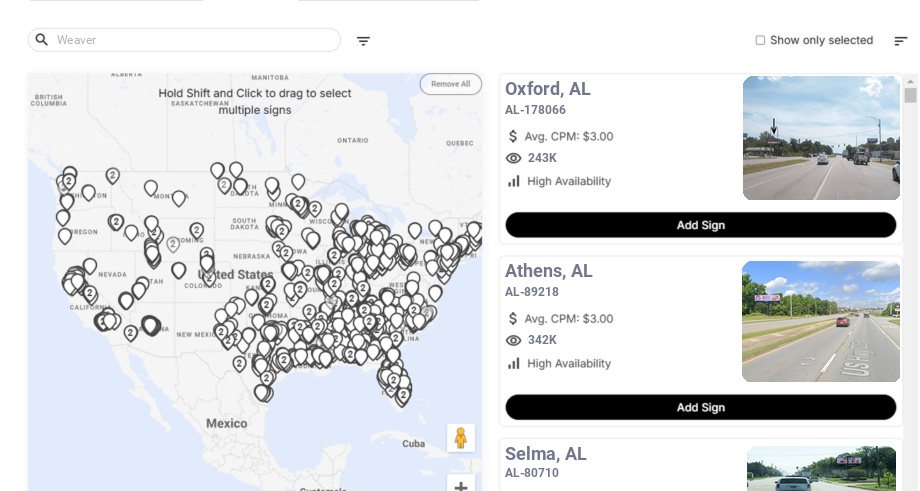



How much is a billboard in Weaver?
Why Choose Blip for Billboard Advertising in Weaver
Blip lets you launch in Weaver fast and self-serve, reaching I-20 drivers between Birmingham and Atlanta without calls or paperwork.
Set a flexible daily budget in Weaver and pay only when ads play, ideal for testing Alabama 21, U.S. 431, or Oxford retail traffic.
Use dayparting in Weaver to hit commuter peaks, JSU student traffic, or Talladega race-week weekends when the roads are busiest.
No contracts in Weaver means you can start small, pause anytime, and shift spend as traffic changes from Cheaha trips to holiday shopping.
Track Weaver campaigns in real time and optimize for I-20, Anniston, Oxford, or Jacksonville audiences as performance changes.
Blip's creative tools make it easy to tailor Weaver billboards for commuters, students, and tourists headed to Coldwater Mountain or Cheaha.
Frequently Asked Questions About Billboard Advertising in Weaver
How much does a billboard cost in Weaver, Alabama with Blip?
With Blip, billboard advertising in Weaver is flexible and budget-friendly. You set a daily budget that works for you, and Blip only charges when your ad actually appears as a 7.5-to-10-second “blip” on a rotating digital billboard, starting at just $0.01 per display. Because pricing is dynamic, the cost per blip can vary based on time of day, location, and advertiser demand.
Where can I advertise with Blip in Weaver, Alabama?
Weaver may be a small city, but it sits inside one of East Alabama’s most efficient billboard markets, with Interstate 20 corridors near Oxford often carrying 50,000 to 70,000 vehicles per day. Alabama 21 and U.S. 431 matter just as much for local frequency, and U.S. 78, Pelham Road, and Oxford retail approaches are strong for immediate-action campaigns. These routes connect Weaver to Anniston, Oxford, Jacksonville, and the broader East Alabama trade area.
Why is Weaver, Alabama a good place for Blip billboard ads?
Weaver benefits from geography because it sits roughly 60 miles east of Birmingham and about 90 miles west of Atlanta, placing it in a highly traveled stretch of Interstate 20. More than 90% of workers in Calhoun County travel by car, truck, or van, so roads are where attention concentrates. That makes billboard advertising effective for reaching both local households and pass-through travelers.
What kinds of people do Weaver, Alabama billboard ads reach with Blip?
A good Weaver billboard strategy can reach commuters and local households, students and parents in the Weaver-Jacksonville corridor, tourists and recreation travelers, and workers in healthcare, manufacturing, logistics, and the McClellan area. Jacksonville State University serves nearly 10,000 students, and Talladega Superspeedway, Cheaha State Park, and Coldwater Mountain all create additional traffic. This mix gives advertisers a broad audience across everyday drives and seasonal travel windows.
When is the best time to run Blip billboard ads in Weaver, Alabama?
Spring is one of the best times to advertise in this region because Talladega Superspeedway brings a major influx of race traffic, outdoor destinations become more active, and graduation season begins. Fall is another premium season with back-to-school activity, Jacksonville State University traffic, football weekends, and the second Talladega race window. Holiday and year-end timing also matters because Oxford’s retail concentration increases movement on key commercial routes.
Do I need a contract to advertise with Blip in Weaver?
No, Blip has no long-term contracts or minimum commitments. You can start, pause, or stop your campaign at any time.
How fast can I launch a billboard campaign with Blip in Weaver?
You can have your campaign live in minutes. Create a free account, select your locations, set your budget, upload your design, and start running once approved.
Where can I advertise with Blip in Weaver?
Blip has digital billboards in Weaver. You can browse available locations on a map, choose the ones that fit your audience, and start advertising right away.
Still have questions? Launch a campaign in minutes — no contracts, no commitments.
Start Your CampaignWeaver Billboard Advertising Guide
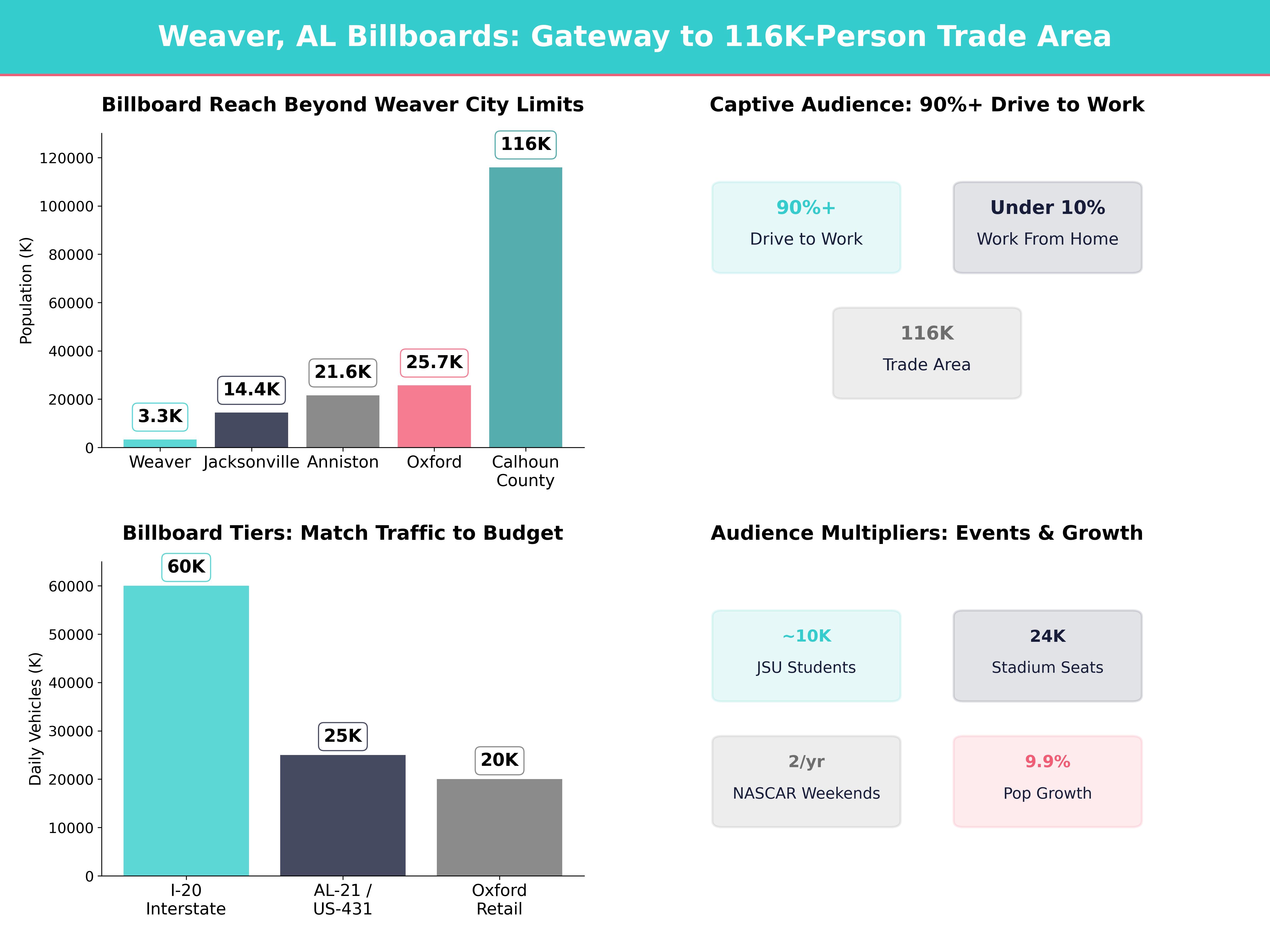
Weaver may be a small city, but it sits inside one of East Alabama’s most efficient billboard markets, with Interstate 20 corridors near Oxford often carrying 50,000 to 70,000 vehicles per day. The city had 3,339 residents in the 2020 Census, yet it is surrounded by the larger Calhoun County trade area of 116,441 people and quick connections to Anniston, Oxford, and Jacksonville Birmingham and Atlanta 10,000 Jacksonville State University students, Cheaha State Park’s 2,407-foot summit, Coldwater Mountain’s 35+ miles of trail, and Oxford’s 25,676 residents, and Weaver gives us more billboard leverage than its city limits alone suggest.
Weaver Market Overview for Billboard Advertising
When we advertise in Weaver, we are not buying a tiny standalone market. We are buying into a broader East Alabama movement pattern that ties together homes, jobs, schools, healthcare, shopping, and recreation across the county.
Weaver’s place inside the East Alabama trade area
Weaver’s 3,339 residents make it a small city by itself, but its value rises when we place it in context. The 2020 Census counted 21,564 residents in Anniston, 25,676 in Oxford, and 14,385 in Jacksonville 61,625 residents, or more than 18 times Weaver’s population.
The growth pattern is also useful for advertisers. Weaver grew from 3,038 residents in 2010 to 3,339 in 2020, which was a gain of about 9.9%. Oxford grew from 21,348 to 25,676, which was about 20.3% growth, and Jacksonville 12,548 to 14,385, or about 14.6%. Anniston declined from 23,106 to 21,564, or about 6.7%, which tells us regional growth has been shifting toward suburban, retail, and university-oriented nodes.
At the county level, the picture is stable rather than explosive. Calhoun County moved from 118,572 residents in 2010 to 116,441 in 2020, a modest change of about -1.8%. For billboard planning, that stability matters because it means we are advertising to a market with established routines, established commuter corridors, and well-defined commercial hubs.
Weaver also benefits from geography. The community sits roughly 60 miles east of Birmingham and about 90 miles west of Atlanta, placing it in a highly traveled stretch of Interstate 20 that regularly moves 50,000 to 70,000 vehicles per day in the Oxford area. That positioning gives our campaigns both local relevance and regional visibility.
What the numbers mean for advertisers in Weaver
Commuting patterns strongly favor outdoor advertising here. American Community Survey commuting tables show that more than 90% of workers in Calhoun County travel by car, truck, or van, while working from home remains under 10%. Public transportation plays only a minimal role in daily movement, so roads are where attention concentrates.
This is why billboard advertising works so well in the Weaver area. We can reach people repeatedly on the same routes they use to get to work in Anniston, shop in Oxford, attend class in Jacksonville RMC Health System. Repetition is especially valuable in a practical, drive-oriented market where people make many decisions while already in motion.
The economic base also supports a broad advertiser mix. The Calhoun County Area Chamber & Visitors Center, the Calhoun County Economic Development Council East Alabama Regional Planning and Development Commission consistently highlight manufacturing, logistics, healthcare, education, retail, and tourism as central parts of the local economy. That diversity gives us room to advertise everything from home services and restaurants to hiring campaigns, events, and healthcare providers.
Key Traffic Corridors for Digital Billboards in Weaver
The Weaver market is shaped by a few high-value roads. When we understand how each corridor functions, we can match message style, timing, and advertiser category much more precisely.
Interstate 20 through Oxford and Anniston
According to traffic count maps from the Alabama Department of Transportation 50,000 to 70,000 vehicles-per-day range, with the strongest sections often exceeding 60,000 AADT. That makes I-20 the highest-scale billboard corridor available to most Weaver-area advertisers.
This corridor is ideal when we want broad regional reach. Drivers on I-20 include daily commuters, Birmingham-bound business travelers, Atlanta-bound through traffic, race fans headed to Talladega Superspeedway Cheaha State Park, Coldwater Mountain, or Oxford’s retail district.
Advertisers that benefit most from I-20 exposure include the following groups: Regional retail, restaurants, and fuel brands benefit because drivers are often making stop decisions before they reach Oxford exits; Healthcare systems and urgent care clinics benefit because interstate traffic delivers scale and strong frequency across the county; and Auto dealers, legal services, colleges, and major employers benefit because these categories often need broad awareness rather than only neighborhood-level targeting.
Alabama 21 and U.S. 431 as the north-south spine
For local frequency, Alabama 21 and U.S. 431 matter just as much as the interstate. ALDOT 20,000 to 30,000 AADT range, depending on the exact segment. These roads tie together Weaver, Anniston, Oxford, Jacksonville, and Gadsden-bound travel.
This is where we reach people in the rhythm of everyday life. Commuters, parents, students, healthcare workers, and service technicians all rely on this corridor. If our goal is repeat exposure to local households rather than one-time regional reach, this corridor often performs better than a purely interstate buy.
Advertisers that fit this route especially well include the following groups. Home services benefit because people seeing the same message on repeated weekday drives are more likely to remember the brand when a need appears. Medical, dental, and family care providers benefit because these roads connect neighborhoods to appointment-based destinations. Schools, churches, and community events benefit because they need strong local recall more than statewide scale.
U.S. 78, Pelham Road, and Oxford retail approaches
The approaches into Oxford’s shopping and dining clusters are another strong layer. Traffic counts on key retail feeders such as U.S. 78, Pelham Road, and nearby commercial approaches commonly sit in the 15,000 to 25,000 vehicles-per-day range. That is less volume than I-20, but the purchase intent is often stronger.
These routes are excellent for campaigns tied to immediate action. If we want to drive restaurant visits, promote same-day retail offers, support entertainment venues, or push seasonal sales, these boards can be extremely efficient. They are also useful during weekends, holidays, and tournament-heavy travel periods around Choccolocco Park and the Oxford Performing Arts Center.
Audience Segments We Can Reach Around Weaver
A good Weaver billboard strategy starts with audience selection. The market is small enough that broad awareness still matters, but it is varied enough that we can target distinct groups with different timing and creative.
Commuters and local households in Weaver and Calhoun County
The most reliable audience is the everyday driver. With more than 90% of county workers commuting by car, truck, or van, we can count on regular weekday road exposure. This audience includes residents of Weaver, Anniston, Oxford, Jacksonville
This is the audience that responds best to practical offers. HVAC companies, roofing firms, injury attorneys, banks, auto repair shops, grocery stores, healthcare groups, and local restaurants all benefit from repeated impressions among people who pass the same boards multiple times per week.
Students, parents, and campus visitors in the Weaver-Jacksonville corridor
Jacksonville State University is one of the market’s most important audience engines. The university serves nearly 10,000 students, and its football venue, AmFirst Stadium, seats about 24,000 fans. That creates recurring traffic around move-in, move-out, home football weekends, family visits, graduation, and campus events.
This segment matters well beyond Jacksonville city limits. Parents traveling in from other Alabama communities, prospective students, alumni, and visiting fans all move through the same regional road network that serves Weaver and Oxford. Apartment communities, banks, restaurants, wireless providers, medical clinics, and part-time employers can all benefit from smart campus-season timing.
We can also think beyond the university itself. Gadsden State Community College has a presence in the broader region, and East Alabama’s education audience includes adult learners, workforce trainees, and certificate students moving between jobs and classrooms.
Tourists and recreation travelers near Weaver
Tourism is one of the market’s underrated strengths. Cheaha State Park includes Alabama’s highest point at 2,407 feet, and Coldwater Mountain offers more than 35 miles of trail. Talladega Superspeedway 2.66-mile NASCAR track just to the south, and it produces two especially important race-week windows each year, one in spring and one in fall.
Those visitors need food, fuel, lodging, attractions, outdoor gear, and route guidance. They also tend to arrive by car, which increases the value of highway-facing digital inventory. This audience is especially useful for hotels, campgrounds, quick-service restaurants, c-stores, tourism businesses, and event promoters.
Workers in healthcare, manufacturing, logistics, and the McClellan area
The local economy is not built on one employer type. The McClellan district, RMC Health System, county schools, distribution facilities, industrial employers, and retail centers all create daily worker movement. Shift-oriented employers also create nontraditional traffic patterns, which means early-morning, midday, and late-evening ad windows can all matter.
For hiring campaigns, boards near commuter routes can be especially effective. Many East Alabama workers are open to better wages, shorter commutes, and more stable schedules, and billboards can keep that message in front of them repeatedly without depending on social media algorithms or search behavior.
Seasonal and Timing Opportunities for Weaver Campaigns
Weaver is not a market where every month looks the same. Our timing should follow the local calendar.
Spring in Weaver: racing, graduation, and outdoor season
Spring is one of the best times to advertise in this region. Talladega Superspeedway Jacksonville State University.
This is a strong window for hotels, restaurants, entertainment venues, florists, photographers, formalwear, apartment communities, and family-oriented retailers. It is also a smart season for healthcare campaigns because people are out on the road more often and planning spring and summer appointments.
Summer in Weaver: family travel and tournament traffic
Summer expands the visitor mix. Families take road trips, outdoor recreation is in full swing, and Oxford sees additional activity around Choccolocco Park, shopping corridors, and entertainment venues such as the Oxford Performing Arts Center. Even when summer heat is intense, car travel remains the default transportation mode.
This is a strong period for cooling services, beverages, quick dining, retail promotions, hotel stays, and kid-focused businesses. Because travel is less strictly commuter-based in summer, we often do well by broadening exposure into midday and weekend hours.
Fall in Weaver: back-to-school, football, and second-wave tourism
Fall is another premium season. School resumes in August, Jacksonville State University returns to full activity, football weekends lift traffic, and the second big Talladega Superspeedway Cheaha State Park and Coldwater Mountain.
This is the right moment for game-day dining, tailgate supplies, sports bars, urgent care, retail apparel, apartment leasing, tutoring, and student banking offers. It is also a prime hiring season for employers preparing for year-end demand.
Holiday and year-end timing in Weaver
From November through December, Oxford’s retail concentration matters even more. Holiday shopping, family gatherings, event attendance, and end-of-year dining all increase movement on key commercial routes. January then shifts the message set toward tax services, health resolutions, legal services, and hiring.
We can refine these seasonal swings further by watching event calendars from Calhoun County Area Chamber & Visitors Center, The Anniston Star, Oxford Performing Arts Center, and Jacksonville State University. In a market this size, local calendars often outperform generic national planning.
Billboard Design Tips for the Weaver Market
Creative in Weaver should feel local, direct, and easy to process at driving speed. We do not need flashy complexity here. We need relevance.
Use route-aware messaging for Weaver drivers
Because much of the audience is moving on I-20, Alabama 21, U.S. 431, or retail approach roads, our copy should help drivers act quickly. Messages such as “Next Exit,” “Now Hiring in Oxford,” “Minutes Ahead,” or “Book Today in Anniston” work well because they fit the geography and the mindset of people already traveling.
On higher-speed routes, we should usually keep the headline to about 6 to 8 words. That is especially important on interstate placements where visual processing time is short. If we need more detail, it is usually better to split the message into multiple creative versions rather than crowding a single board.
Reflect East Alabama culture in the visuals
Weaver sits in a part of Alabama where local identity matters. Outdoor imagery, mountain skylines, football energy, checkered-race cues, and clean small-town service branding can all feel more natural than highly polished big-city visuals. Campaigns tied to Cheaha State Park, Coldwater Mountain, or race-week traffic can lean into green, blue, black, and high-contrast accent colors.
For student and game-day audiences, college-town energy works well, but we should keep it broad enough to avoid trademark misuse. For local services, a trustworthy tone often beats a clever one. East Alabama buyers respond well when the message looks useful, nearby, and real.
Lead with practical value for Weaver households
The strongest local creative often answers one of three questions immediately. What are we offering, where is it, and why should someone care now?
That means Weaver-area boards often perform well when they feature a clear offer, a strong category cue, and a simple call to action. Price-led messaging, “same-day service,” “free estimate,” “walk-ins welcome,” “family owned,” and “open late” are all more relevant here than abstract brand slogans.
Regional Strategies for Weaver and Nearby Communities
The smartest way to advertise in Weaver is to think regionally, then localize our message by sub-area.
Weaver and north Calhoun County
In Weaver itself, we should prioritize frequency and familiarity. This is the right zone for home services, local healthcare, banks, churches, schools, and everyday retail. Messaging should feel neighborhood-friendly and practical because the audience is mostly local residents repeating familiar routes.
Anniston and the McClellan employment base
Anniston gives us employment density, healthcare relevance, and civic visibility. Boards serving the city and the McClellan area are strong for hiring, medical specialists, continuing education, legal services, and community events. This zone is also valuable for nonprofits and public-interest campaigns that need broad local recognition.
Oxford’s I-20 retail district
Oxford is the county’s largest city at 25,676 residents, and it functions as the region’s retail gateway. If our goal is foot traffic, dining visits, shopping urgency, or hotel bookings, this is often the first zone we should test. Weekend-heavy scheduling is especially helpful here because intent rises when families and visitors are already on the move.
Jacksonville and the university corridor
Jacksonville
Recreation routes toward Talladega and Cheaha
When our product fits travelers, we should treat the broader region as a tourism funnel. Race traffic, mountain recreation, and scenic travel all support campaigns for fuel, lodging, food, attractions, and convenience retail. These campaigns often work best as short bursts tied to event windows rather than always-on schedules.
Using Blip’s Tools Effectively in Weaver
We do not need a huge-market strategy to win in Weaver. We need a nimble one.
Build Weaver campaigns around dayparts that match real traffic
Because the market is commute-heavy, we can start with weekday peaks such as 6 a.m. to 9 a.m. and 3 p.m. to 6 p.m. for services, healthcare, and hiring. For Oxford retail and entertainment, we can shift more weight into midday, evening, and weekends. For race weekends or tourism pushes, we can concentrate spend around the exact days when visitors are arriving.
That flexibility matters in a market with several distinct audiences. We do not have to run the same schedule for every board.
Use small-budget testing to compare Weaver-area zones
Because Blip allows pay-per-play buying that starts at $0.01 per display, we can test multiple sub-markets without overcommitting. In practical terms, that means we can compare an I-20 placement, an Oxford retail placement, and a local-frequency route near Anniston or Jacksonville before scaling the winner.
For Weaver advertisers, this is especially helpful because the city itself is small. We often learn more by testing the broader trade area than by assuming one hometown placement will do all the work.
Localize creative versions for different audiences
Blip’s creative tools make it easy for us to adapt the same campaign for multiple use cases. We can run one version built for commuters, another for college traffic, and another for race-week visitors. Since each digital ad appears as a short 7.5- to 10-second blip, clarity matters more than complexity, and versioning often beats trying to force every audience into one design.
Watch results and optimize fast
Real-time campaign data is especially useful in Weaver because the market is compact enough for pattern spotting. If Oxford boards outperform Anniston boards on weekend restaurant traffic, we can adjust. If hiring creative works best early in the morning, we can lean into that. If a seasonal message lifts during race week, we can intensify it while demand is present.
Getting Started with Billboard Rental in Weaver
Renting a billboard in Weaver should start with geography, not guesswork. The city is small enough that a strong campaign usually covers more than just Weaver itself.
Start with one goal, not every goal
We should first decide whether our campaign is meant to drive store visits, improve local awareness, support hiring, promote an event, or build regional brand recognition. A clear goal makes it much easier to choose the right corridor and the right schedule.
If we want scale, we should favor I-20. If we want local repetition, we should focus on Alabama 21, U.S. 431, or neighborhood-serving routes. If we want students, we should bias toward Jacksonville. If we want visitors, we should align with Talladega, Cheaha, or Oxford’s retail draw.
Expect the best Weaver campaigns to be regional
Because Weaver has 3,339 residents, the strongest billboard strategy is often a ring strategy rather than a single-point strategy. In many cases, 2 to 3 strategically different digital billboards will outperform one isolated location because they let us cover local commuters, retail traffic, and destination travelers together.
That is one of the biggest differences between a data-driven self-serve approach and a traditional billboard buy. Traditional billboard companies often sell in fixed 4-week periods and may limit flexibility once the board is reserved. With Blip, we can choose locations on a map, launch quickly, and change course as we learn what the Weaver trade area is actually doing.
Evaluate each billboard by audience fit
When we review possible boards, we should ask a few simple questions.
- Does this location reach the people we actually want? A board can have strong traffic and still miss our audience if it sits on the wrong side of the market.
- Is the message designed for the speed of that road? Interstate boards need simpler copy than local commuter boards.
- Does the timing match the audience’s routine? Hiring ads, restaurant ads, healthcare ads, and event ads all perform best in different windows.
- Does the location fit our service radius? For a local business, proximity still matters, even on a digital network.
Launch, learn, and scale in Weaver
The best way to begin is usually with a focused test. We can run a few boards, a few time windows, and a few creative versions, then let results guide the next move. In a market like Weaver, where everyday driving patterns are consistent and nearby sub-markets are distinct, that approach is often more efficient than locking into a large traditional buy from the start.
Weaver works well for billboard advertising because it gives us small-town trust, regional road exposure, and several nearby demand centers in one compact geography. When we combine that with thoughtful corridor selection, local creative, and flexible digital execution, we can build campaigns that feel highly relevant to East Alabama and still deliver real scale.