Billboards in Dayton, MN
No Minimum Spend. No Long-Term Contracts. Just Results.
Billboards in Dayton can bring your message to life with a bright, rotating digital spotlight. With Blip, you choose the billboard, set your budget, and launch fast—no contracts, no fuss, just playful ad power that pays only when your spot runs.
Trusted by Leading Brands


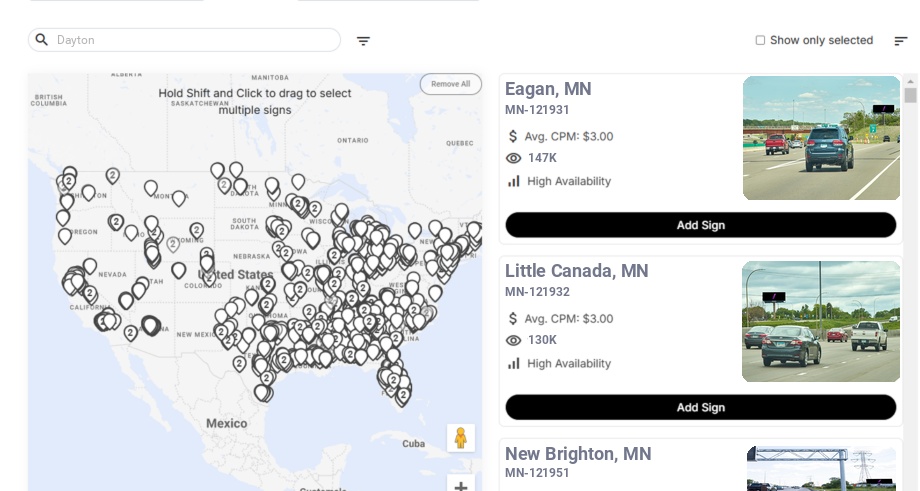
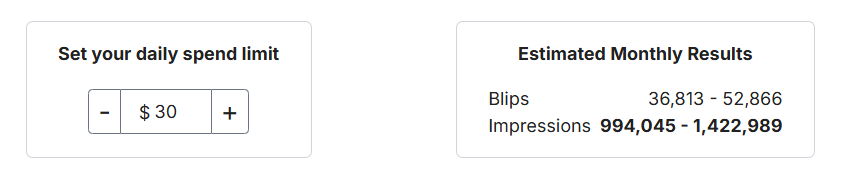
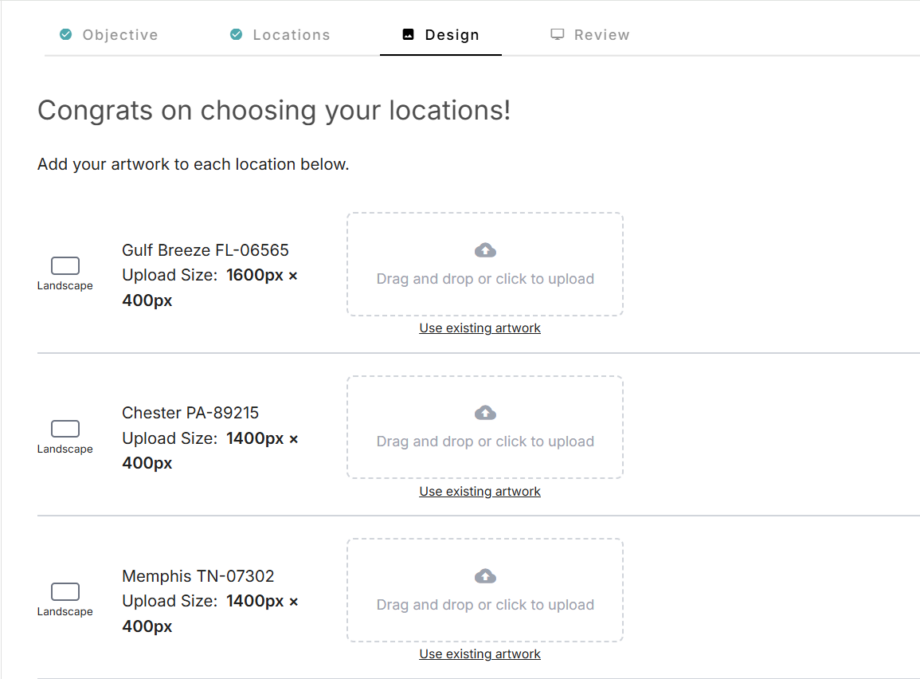
How much is a billboard in Dayton?
Why Choose Blip for Billboard Advertising in Dayton
Blip lets you launch fast in Dayton and reach repeat I-94 commuters without contracts or hassle.
In Dayton, Blip-optimized campaigns can auto-shift spend to Highway 610 and 101 for the best traffic fit.
Use flexible budgets in Dayton to test spring home-service ads or winter heating offers, then adjust anytime.
Dayton advertisers can daypart for 6-9am, school pickup, and 3-7pm drives to catch families on the road.
Track Dayton results in real time and use Blip creative tools to make bold ads for I-94, Rogers, and Maple Grove drivers.
Frequently Asked Questions About Billboard Advertising in Dayton
How much does a billboard cost in Dayton, Minnesota with Blip?
Where can I advertise with Blip in Dayton, Minnesota?
What kind of people see Dayton, Minnesota billboards with Blip?
Is Dayton, Minnesota a good market for family and home service ads on Blip?
What are the best times to run billboards in Dayton, Minnesota with Blip?
Do I need a contract to advertise with Blip in Dayton?
How fast can I launch a billboard campaign with Blip in Dayton?
Where can I advertise with Blip in Dayton?
Still have questions? Launch a campaign in minutes — no contracts, no commitments.
Start Your CampaignDayton Billboard Advertising Guide
Dayton, Minnesota gives us a strong billboard market because it combines fast suburban growth with steady regional traffic from the northwest side of the Twin Cities. The Minnesota State Demographic Center shows Dayton growing from 4,671 residents in 2010 to 7,262 in 2020, which is an increase of 2,591 people or 55.5% in just one decade.
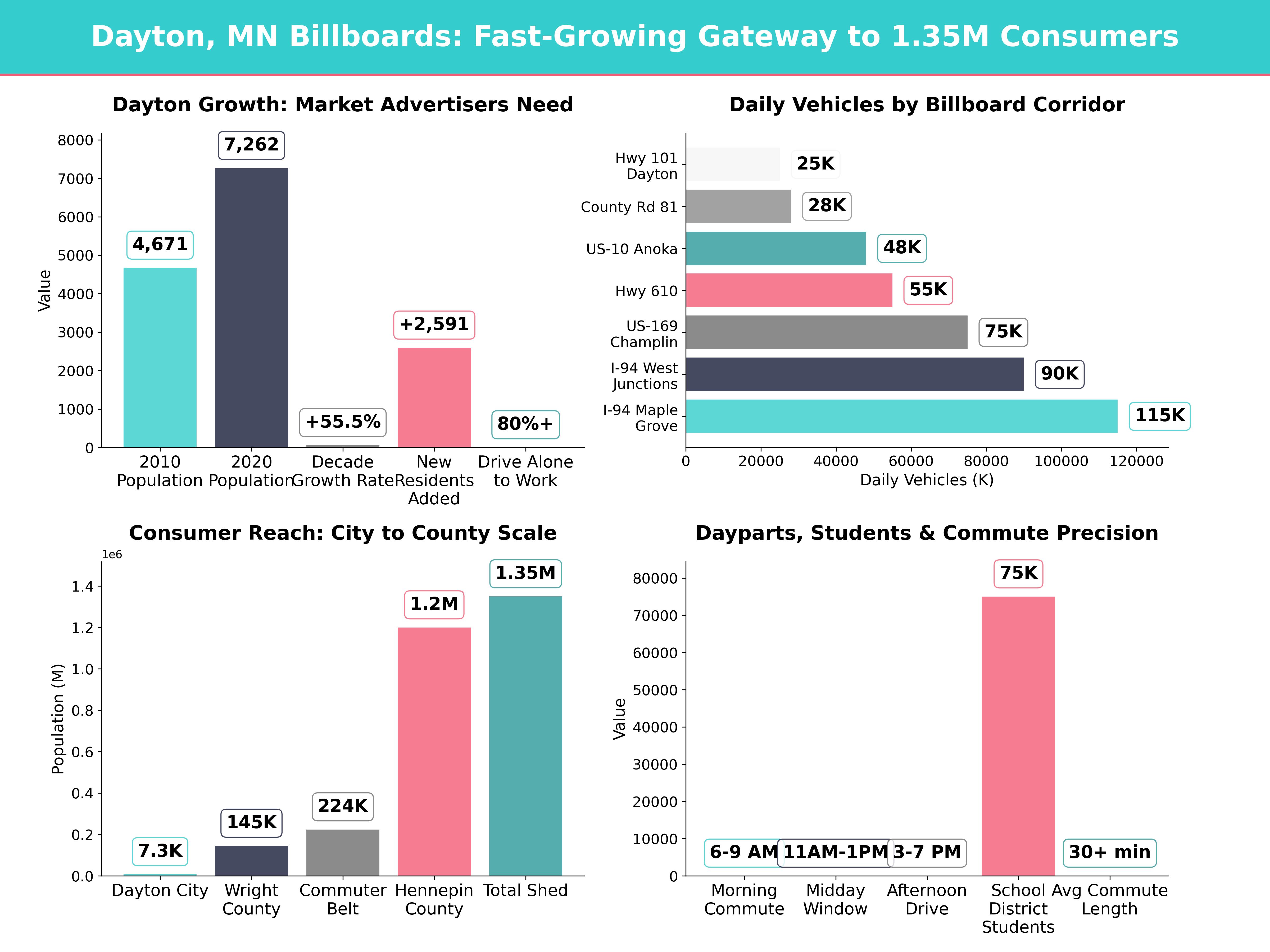
We also benefit from Dayton’s position inside the Metropolitan Council region of more than 3 million residents and next to major driving routes that connect Minneapolis, Maple Grove Rogers, Champlin Elk River 224,000 residents across those five cities. Because daily life here is highly car-oriented, with more than 80% of workers commuting alone by car, digital billboards can build awareness during work commutes, school trips, shopping runs, and weekend recreation drives.
Dayton, Minnesota Market Overview
Dayton sits across 2 counties, Hennepin County and Wright County 1.2 million residents, and Wright County has more than 145,000 residents, so even a city of Dayton’s size operates inside a much larger consumer shed of roughly 1.35 million county residents. We should think about Dayton not as an isolated small city, but as part of the broader northwest metro growth corridor.
Dayton’s growth and the surrounding trade area
Dayton’s own growth is the first reason the market matters. A 55.5% population gain in a single decade usually means new rooftops, new household formation, new schools, and rising demand for everyday services. That demand supports categories such as healthcare, home services, childcare, real estate, restaurants, auto services, and retail.
The nearby cities add even more scale. Maple Grove 70,253 residents in 2020, Brooklyn Park had more than 86,000, Champlin 23,919, Anoka 17,921, and Elk River 25,835 residents, for roughly 224,000 residents combined. Dayton sits close enough to all of these places that many billboard campaigns should be planned across the full commuter belt rather than only within city limits.
What Dayton’s commuting pattern means for advertisers
Dayton is a classic drive-first suburb. Community profile data used by local planners shows that more than 80% of workers commute alone by car, and commutes often run 30 minutes or more because many residents travel to jobs in Maple Grove, Brooklyn Park, Minneapolis, or other regional employment centers. That pattern is ideal for digital out-of-home because the same drivers repeat the same routes day after day.
For advertisers, that creates two advantages.
- We can build frequency quickly because many residents see the same roads every weekday.
- We can reach practical decision-makers because Dayton-area trips are often tied to work, errands, school pickup, home projects, and shopping.
Economic context around Dayton
The northwest metro economy is broad enough to support both consumer and business-to-business campaigns. Nearby Maple Grove 70,253 residents, is a major retail and healthcare center, Rogers, with roughly 13,000 residents, continues to grow as an industrial and logistics hub along I-94, and Brooklyn Park, with more than 86,000 residents, adds major employment density to the south and east. Organizations such as TwinWest Chamber of Commerce, Rogers Area Chamber of Commerce Minnesota Department of Employment and Economic Development all reflect the market’s mix of small business growth, construction activity, advanced manufacturing, warehousing, healthcare, and suburban retail.
For billboard advertisers, that mix means we are not limited to one audience. We can target homeowners, commuters, families, shift workers, and regional shoppers within the same geography.
Key Traffic Corridors for Dayton Billboards
Dayton’s strongest billboard value comes from the roads around it. According to recent Minnesota Department of Transportation traffic maps
Interstate 94 near Dayton, Maple Grove, and Rogers
I-94 is the dominant regional route for Dayton-area billboard strategy. MnDOT counts around the Maple Grove and Rogers sections commonly range from about 90,000 to more than 140,000 vehicles per day, depending on the segment. West of the densest junctions, volumes still often land in the 80,000 to 100,000 range.
This corridor connects Dayton-adjacent drivers to Maple Grove Rogers, St. Cloud
- Retail and restaurants benefit here because I-94 carries destination shoppers and meal-decision traffic near major exits.
- Healthcare providers benefit here because the route feeds large residential areas into regional care centers.
- Auto dealers and service businesses benefit here because drivers are already in a mobility mindset.
- B2B and recruiting advertisers benefit here because the corridor reaches warehouse, logistics, and construction workforces moving across the northwest metro.
Highway 610 for suburban commuter flow around Dayton
Highway 610 Brooklyn Park, Maple Grove 40,000 to 70,000 vehicles per day.
This route matters because it captures residents who may not be on the longest regional trip, but who are still highly valuable local consumers. These drivers are often headed to schools, clinics, shopping centers, youth sports, and home-service errands.
- Home improvement brands perform well here because suburban homeowners use this corridor for everyday local travel.
- Medical, dental, and family services perform well here because the route connects dense residential communities to neighborhood commercial nodes.
- Local retail and entertainment perform well here because Highway 610 supports short-trip frequency, not just long-haul reach.
Highway 101 and County Road 81 in Dayton
Highway 101 is one of Dayton’s most important local identity corridors because it ties the city directly to Champlin Rogers, and the surrounding river-crossing traffic. Recent counts in this area are commonly in the 20,000 to 30,000 vehicles per day range. Nearby County Road 81 also serves as a practical commuter and commercial route, with many segments in the broader Maple Grove and Rogers area typically around 20,000 to 35,000 vehicles per day.
These roads are usually better for local conversion than for broad metro reach. They help us reach residents who live, shop, and make decisions inside the northwest suburban belt.
- Real estate and new-home communities benefit here because the audience is already evaluating neighborhoods and local amenities.
- Churches, schools, and community events benefit here because these roads carry residents close to the point of action.
- HVAC, plumbing, landscaping, and remodeling businesses benefit here because homeowners on these routes are often just minutes from home.
U.S. 169 and U.S. 10 as Dayton spillover corridors
Even if a billboard is not physically in Dayton, it can still be highly relevant to Dayton advertisers. U.S. 169 through the Champlin and Brooklyn Park area frequently carries about 60,000 to 90,000 vehicles per day, while U.S. 10 through the Anoka corridor often runs around 35,000 to 60,000 vehicles per day.
These routes matter when we want to expand beyond Dayton’s immediate footprint and capture north metro circulation.
- Regional entertainment and tourism advertisers benefit because these roads pick up weekend movement.
- Higher education and workforce training advertisers benefit because they can reach students and working adults across the north metro.
- Insurance, legal, and financial services benefit because they can build wide-area familiarity among repeat suburban drivers.
Audience Segments We Can Reach in Dayton
Dayton works best when we define the audience by trip type. The city itself is growing, but the real power comes from the combination of local residents and surrounding regional movement.
Dayton commuters and suburban errand traffic
Our first audience is the everyday commuter. Dayton residents regularly move between home and nearby employment centers in Maple Grove Brooklyn Park, Minneapolis, and Rogers. Because these are repeating trips, billboard frequency adds up fast.
This audience is ideal for:
- Convenience-driven offers, such as urgent care, oil changes, banks, and quick-service restaurants.
- Brand reminders, such as healthcare systems, fitness clubs, hardware stores, and grocery chains.
- Recruiting campaigns, especially for employers trying to reach workers before or after the workday.
Dayton families and school communities
The Dayton market is heavily family-oriented, and that shows up in the school systems around it, which together serve about 75,000 students. Anoka-Hennepin School District serves about 38,000 students, Osseo Area Schools serves about 20,000 students, and ISD 728 serves roughly 17,000 students in communities such as Elk River, Rogers, and Otsego.
That concentration matters because school calendars shape traffic patterns, spending cycles, and decision windows. We can reach parents making decisions about:
- Childcare, tutoring, and enrichment programs.
- Orthodontics, pediatric care, and family healthcare.
- Youth sports, camps, and community events.
- Home services and household retail, especially during back-to-school and seasonal transition periods.
Dayton outdoor recreation and weekend visitors
Dayton also benefits from outdoor and destination traffic. Elm Creek Park Reserve, operated by the Three Rivers Park District, spans about 4,900 acres and draws visitors year-round for trails, mountain biking, swimming, skiing, tubing, and family outings. The nearby Mississippi River
This segment is a good fit for:
- Restaurants, breweries, and coffee shops that want to catch people before or after recreation.
- Sporting goods, outdoor retail, and automotive brands that align with active lifestyles.
- Local attractions and community events that depend on short-decision, same-day attendance.
Dayton’s industrial, logistics, and trades workforce
The I-94 corridor west and southwest of Dayton reaches a substantial workforce in warehousing, construction, distribution, manufacturing, and skilled trades. Rogers, Otsego Maple Grove
This audience responds best when we time messages around the workday.
- Early morning slots from 6:00 to 9:00 a.m. help us reach drivers on the way to job sites and shift starts.
- Midday slots from 11:00 a.m. to 1:00 p.m. help us reach lunch-break decision windows.
- Afternoon slots from 3:00 to 7:00 p.m. help us reach workers headed home and planning after-work errands.
Ready to reach your audience in Dayton?
Start Your Campaign →Seasonal and Timing Opportunities in Dayton
Dayton is not a flat, same-every-month market. Weather, school schedules, and regional events meaningfully change who is on the road and what they are ready to buy.
Spring and summer in Dayton
Spring is strong for home services, landscaping, decking, roofing, lawn care, and outdoor retail. The local audience is emerging from winter, evaluating projects, and spending more time on the road. Summer adds family recreation and destination traffic, especially near park and shopping routes.
We should pay extra attention to summer weekends, holiday-drive periods, and local events such as Maple Grove Days 4 days in July and increases movement around the broader northwest suburban area. If we sell food, entertainment, recreation, or short-notice events, late-week and weekend dayparting can become especially efficient in this season.
Back-to-school and fall around Dayton
Late August through October is one of the most productive windows in this market. Parents reestablish routines, youth activities restart, and households make practical purchases before winter. Healthcare, family services, tutoring, apparel, grocery, and household brands all benefit.
Fall also brings strong regional event traffic. Anoka Halloween traces its celebration history back to 1920, and the surrounding north metro sees increased seasonal visitation through October. That creates a useful moment for restaurants, entertainment venues, retail promotions, and community events.
Winter and holiday timing in Dayton
Winter changes the creative strategy, but it does not reduce the value of billboards. The Minnesota Climatology Office notes that the Twin Cities typically receives roughly 50 inches of snow in a normal year, and shorter daylight hours make illuminated digital creative stand out. Winter is especially effective for urgent care, auto repair, tires, heating services, retail, and restaurants.
Holiday retail messaging usually works best when we concentrate around evening commute periods and shopping corridors in Maple Grove
Billboard Design Tips for the Dayton Market
Creative in Dayton should feel practical, local, and easy to process at suburban driving speeds. The market is not looking for abstract branding alone. It responds well when we make the message feel immediately useful.
Design for a family-oriented, outdoor, suburban audience in Dayton
Dayton-area audiences often identify with home, family, convenience, and outdoor living. That means our creative can work harder when it shows relatable scenes such as a family heading to activities, a homeowner solving a seasonal problem, or a regional destination tied to weekends and recreation.
We usually see stronger local resonance when creative includes:
- Northwest metro place references, such as Dayton, Maple Grove, Rogers, Champlin, or Elk River.
- Practical time or distance cues, such as “Minutes off I-94” or “Near Highway 101,” when those claims are true.
- Seasonally relevant imagery, such as green lawns in May, sports signups in August, or snow-and-ice service visuals in January.
Make the message readable on Dayton-area roads
Because many placements in this market serve commuters moving at speed, we should simplify aggressively. One billboard should usually carry 1 main offer, 1 brand name, 1 call to action, and a very short supporting line if needed. This matters even more when our ad appears for a 7.5- to 10-second blip.
For Dayton-area creative, we should prioritize:
- Bold contrast in winter, because snow cover and gray skies can mute low-contrast designs.
- Clean directional language, because suburban drivers respond well to “next exit,” “off 610,” or “near 94” framing.
- Service-area clarity, because many businesses serve multiple communities and should say so directly.
Match the culture of the market
Dayton is not downtown Minneapolis. We should not lead with overly clever copy if it hides the offer. Straightforward messages usually outperform in this market, especially for healthcare, home services, local retail, and recruiting. Friendly confidence works better than edgy abstraction.
Regional Strategies for Dayton, Minnesota Campaigns
A strong Dayton campaign usually combines more than one sub-area. The right mix depends on whether we want local conversion, regional awareness, or both.
Dayton and Highway 101 for local trust
If our goal is to reach residents closest to the city, we should focus on Highway 101 and nearby local connectors. This approach is strongest for real estate, local government outreach, churches, youth programs, dental offices, and home services.
We should use this zone when we want:
- Neighborhood relevance over broad metro impressions.
- Repeat exposure among Dayton and Champlin households.
- Action-oriented messaging tied to a local destination.
Maple Grove and Highway 610 for family spending
The Maple Grove 70,253, strong shopping patterns, and major east-west commuter flow, Maple Grove offers the best blend of scale and suburban purchase intent for many Dayton advertisers.
This zone is especially useful for:
- Medical and dental practices seeking household decision-makers.
- Retailers and restaurants seeking frequent suburban shoppers.
- Entertainment and events seeking weekend family attendance.
Rogers and I-94 for reach, logistics, and recruiting
Rogers and the I-94 belt give us broader reach and more worker traffic. This is where we should lean in for recruiting, logistics, construction, dealership, and regional brand-awareness campaigns.
This zone works best when we need:
- High traffic volume, often in the 90,000-plus daily range on nearby interstate segments.
- Visibility to both local residents and through-travelers.
- A stronger B2B or workforce audience than purely residential corridors provide.
Champlin, Anoka, and north-metro connectors for added frequency
When we want to surround the market, we should add Champlin Anoka
We should use these boards when we want to reinforce messages seen elsewhere in the campaign and capture drivers moving between multiple suburbs in the same week.
Ready to reach your audience in Dayton?
Start Your Campaign →Using Blip Tools in Dayton, Minnesota
Dayton is a market where Blip’s flexibility becomes especially useful because the best strategy often combines local corridors and neighboring-city inventory.
How we can apply Blip in Dayton
If we want broad efficiency across Dayton, Maple Grove, Rogers, and adjacent commuter routes, we can let a Blip-optimized campaign spread spend toward the best opportunities as traffic patterns and availability change. If we have a very specific need, such as owning the Highway 101 conversation or concentrating on I-94 recruitment visibility, we can switch to a manual campaign and choose boards more selectively.
This matters because Dayton’s best billboard inventory is often distributed across a network rather than concentrated in one downtown district.
Dayparting for Dayton traffic behavior
Dayparting is especially powerful here. We should usually test:
- 6:00 to 9:00 a.m. for commuters and shift workers.
- 11:00 a.m. to 1:00 p.m. for lunch decisions and errands.
- 3:00 to 7:00 p.m. for after-work, school-pickup, and retail traffic.
- Friday afternoon through Sunday evening for recreation and destination traffic.
We can also shift budgets seasonally. A home-services advertiser may weight spring and early fall, while a recruiting campaign may stay heavier on weekday mornings year-round.
Creative testing and analytics in Dayton
Because the Dayton market mixes homeowners, commuters, families, and workers, we should test at least 2 creative angles when possible. One version might emphasize convenience and location, while another emphasizes price, urgency, or family relevance. We can then watch real-time analytics and move budget toward the boards, times, and messages that are producing the best momentum.
If we do not have finished creative, Blip’s artwork tools make it easier to produce market-specific variations without slowing down the launch.
Getting Started with Billboard Rental in Dayton
Renting a billboard around Dayton starts with a simple question: do we want local conversion or broader northwest metro awareness? Once we answer that, the market becomes much easier to navigate.
What to expect when renting in Dayton
Because Dayton is a smaller city inside a larger suburban network, the most effective billboard plan often includes nearby inventory in Maple Grove Rogers, Champlin
Traditional outdoor buying can be slow and commitment-heavy. Blip simplifies the process by letting us launch, adjust, pause, or expand without a long negotiation cycle. That is especially useful in Dayton, where the smartest campaign often starts with a test and then grows into the corridors that prove themselves.
How we should evaluate Dayton billboard locations
We recommend matching locations to campaign goals.
- Choose I-94 boards when we need reach, recruiting visibility, or broad awareness.
- Choose Highway 610 boards when we need family-oriented suburban frequency.
- Choose Highway 101 and County Road 81 boards when we need local relevance and action.
- Choose U.S. 169 or U.S. 10 boards when we want to widen the north-metro footprint.
A good first test often runs across 2 to 4 weeks so we can observe weekday versus weekend response, compare commute periods, and refine creative. From there, we can shift spend toward the locations and times that best match our actual customer behavior.
The simplest way to start in Dayton
We usually get the best results when we begin with a narrow objective, a focused geography, and concise creative. If we know whether we want homeowners, families, commuters, or workers, Dayton becomes a very manageable market. From there, we can use Blip to build a campaign that feels local in Dayton while still benefiting from the scale of the entire northwest Twin Cities corridor.