Billboards near Stillwater, MN
No Minimum Spend. No Long-Term Contracts. Just Results.
Trusted by Leading Brands


Billboard advertising
near Stillwater has never been easier
How much is a billboard near Stillwater?
Why Choose Blip for Billboard Advertising near Stillwater
Blip lets you self-serve Stillwater ads fast, reaching commuters on MN 36 and east-metro feeders without contracts or fuss.
Use Blip-optimized campaigns in Stillwater to auto-buy the right timing around weekday drives, weekend riverfront traffic, and St. Croix visitors.
Stillwater budgets stay flexible: start small, pause anytime, and only pay when your ad plays near the MN 36 and I-94 flow.
Blip gives Stillwater real-time analytics so you can shift spend as summer tourism, fall color trips, and holiday traffic change.
Create and launch Stillwater billboards with Blip's creative tools, built for clear messages that stand out to commuters and St. Croix River day-trippers.
Frequently Asked Questions About Billboard Advertising near Stillwater
How much does a billboard cost in Stillwater with Blip?
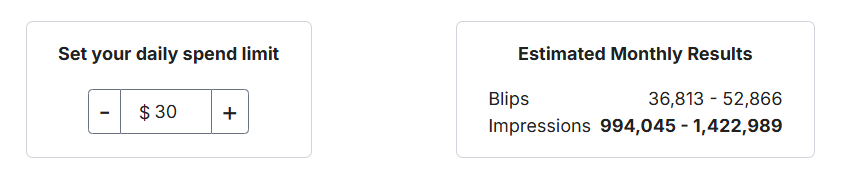
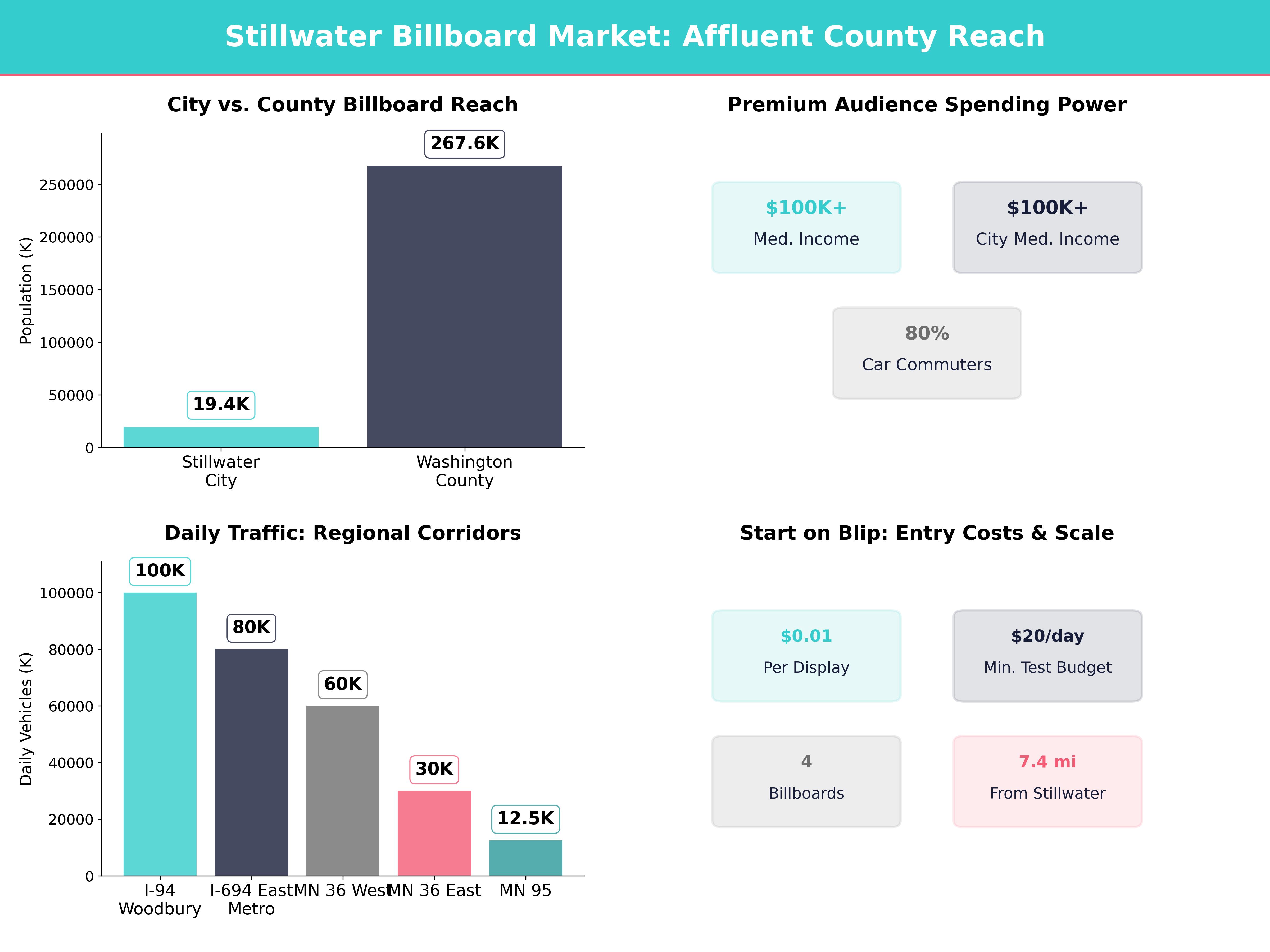
Each 7.5-to-10-second display, or “blip,” starts at just $0.01, and the cost can vary by time of day, location, and demand. Blip makes billboard advertising in the Stillwater area flexible and affordable. You set a daily budget, and Blip’s algorithm uses it to bid on open ad slots on rotating digital billboards serving the Stillwater area, so you only pay when your ad actually displays.
Where can I advertise with Blip in Stillwater?
Our 4 digital billboards serving the Stillwater area are in nearby Mahtomedi, about 7.4 miles away, which gives us access to drivers moving between Stillwater, the east metro, and the Saint Croix Valley. MN 36 is the main regional spine serving the Stillwater area, and I-94 and I-694 also feed a large share of east-metro trips into the market. That means advertisers can reach local households, east-metro commuters, weekend visitors, and Wisconsin-bound travelers.
Why is Stillwater a good market for billboard advertising?
Billboard advertising works especially well near Stillwater because the market blends affluent east-metro households, steady commuter flow, and a well-known visitor economy along the St. Croix River. Washington County median household income is above $100,000, and roughly 8 in 10 workers commute by car. The broader population base is roughly 14 times larger than the city name alone suggests.
What kinds of businesses work best for Blip billboards in Stillwater?
We typically see the strongest fit near Stillwater for home services, healthcare, retail and dining, tourism and events, and recruiting. The market has high homeownership and strong household income, which helps advertisers that depend on established households and repeat local spending. Families, commuters, and weekend visitors all make up meaningful shares of the audience.
When is the best time to run a Blip campaign in Stillwater?
The Stillwater area changes meaningfully by season, and our billboard timing should follow those shifts. Summer is the broadest season for the market, while fall is one of the most underrated billboard seasons near Stillwater. Winter also changes both messaging and daypart strategy, with shorter daylight hours making illuminated digital boards particularly useful.
Do I need a contract to advertise with Blip near Stillwater?
No, Blip has no long-term contracts or minimum commitments. You can start, pause, or stop your campaign at any time.
How fast can I launch a billboard campaign with Blip near Stillwater?
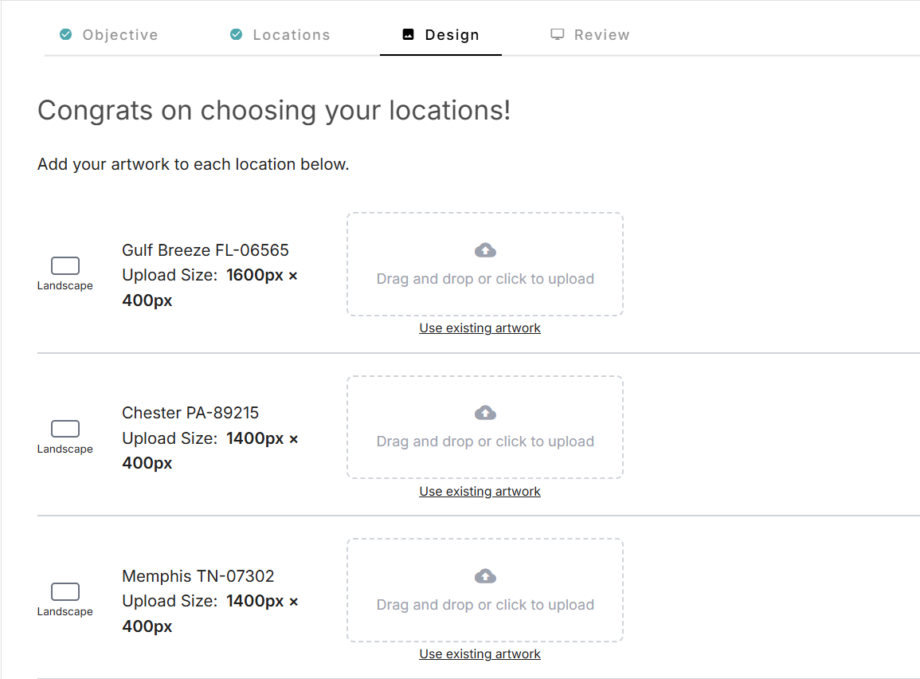
You can have your campaign live in minutes. Create a free account, select your locations, set your budget, upload your design, and start running once approved.
Where can I advertise with Blip near Stillwater?
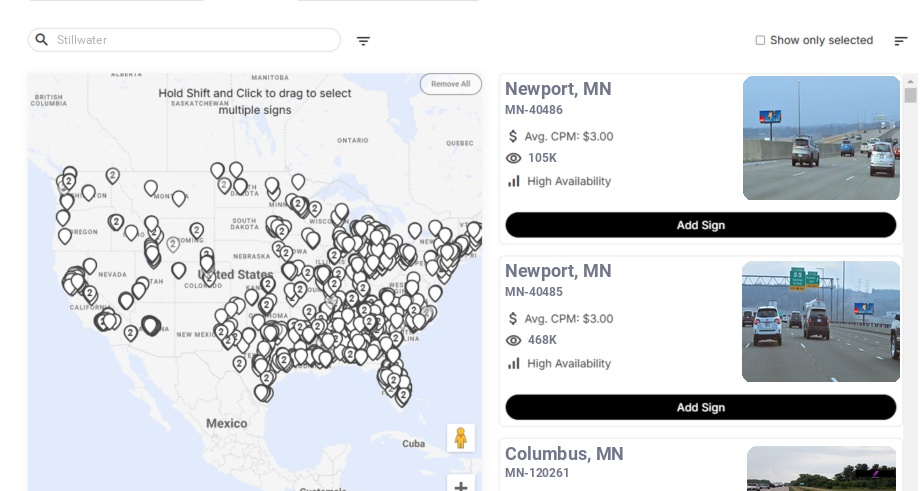
Blip has digital billboards near Stillwater. You can browse available locations on a map, choose the ones that fit your audience, and start advertising right away.
Still have questions? Launch a campaign in minutes — no contracts, no commitments.
Start Your CampaignStillwater Billboard Advertising Guide
Billboard advertising works especially well near Stillwater because the market blends affluent east-metro households, steady commuter flow, and a well-known visitor economy along the St. Croix River, with Washington County median household income above $100,000, roughly 8 in 10 workers commuting by car, and a broader population base that is roughly 14 times larger than the city name alone suggests. The City of Stillwater 19,394 residents at the 2020 Census, and broader Washington County 267,568 residents, so brands are speaking to a market that is much larger than the city name alone suggests. Our 4 digital billboards serving the Stillwater area are in nearby Mahtomedi 7.4 miles away, which gives us access to drivers moving between Stillwater, the east metro, and the Saint Croix Valley. For local businesses, regional brands, and destination-focused advertisers, that mix of everyday traffic and discretionary travel creates strong year-round opportunity.
Stillwater area market overview
The Stillwater area sits on Minnesota’s eastern edge, about 20 miles from Saint Paul, and functions as both a residential community and a regional destination. That dual role matters for outdoor advertising because we are not limited to one audience type. We can reach local households, east-metro commuters, weekend visitors, and Wisconsin-bound travelers with the same market strategy.
From a demographic standpoint, the Stillwater area is attractive because it combines a stable local base with the broader purchasing power of Washington County. According to Minnesota Compass, Washington County’s median household income is above $100,000, and Stillwater households are also around the $100,000 level. That matters for categories such as healthcare, financial services, home improvement, senior services, real estate, and specialty retail.
The housing profile is useful too. Stillwater is heavily owner-occupied, and Washington County as a whole is even more so, which helps advertisers that depend on established households and repeat local spending. For many brands, that means the Stillwater area is not just a place to build awareness. It is also a place where awareness can convert into store visits, appointment bookings, and seasonal household purchases.
Commuting behavior also supports billboards. Minnesota Compass profiles show that roughly 8 in 10 workers in Stillwater and Washington County commute by car, and average one-way commute times are around 25 minutes. That kind of drive-oriented pattern is exactly what digital billboard campaigns need. When most trips are made by vehicle, repeated exposure becomes easier to build across weekday routines and weekend errands.
Why the Stillwater area punches above its size
The Stillwater area benefits from belonging to the larger Metropolitan Council region while still feeling distinct from the core Twin Cities. We can market to residents who travel west toward Maplewood Woodbury, and Saint Paul for work, while also reaching people heading east or north for recreation, dining, and riverfront activities. That gives advertisers more flexibility than they often get in a market of roughly 19,000 residents alone.
Categories that fit the local economy
We typically see the strongest fit near Stillwater for:
- Home services, because the market has high homeownership and strong household income.
- Healthcare, because families, professionals, and older adults all make up meaningful shares of the audience.
- Retail and dining, because the area pulls both local spending and leisure traffic.
- Tourism and events, because the Stillwater area is a regular weekend destination.
- Recruiting, because employers can reach commuters who already travel across the east metro.
Key traffic corridors serving the Stillwater area
The roads that serve the Stillwater area are stronger than many advertisers assume. The key is to think regionally. We are not only chasing trips whose final destination is Stillwater. We are also reaching the approach routes people use before they arrive in the market.
MN 36 and the St. Croix Crossing approach
MnDOT traffic data make it clear that MN 36 is the main regional spine serving the Stillwater area. Farther west, near the east-metro interchanges, traffic volumes commonly reach 60,000-plus vehicles per day. Closer to the river crossing, the corridor still carries 30,000-plus vehicles per day, which is substantial for a market centered on a city of 19,394 residents.
That matters because MN 36 carries several different audiences at once:
- Stillwater-area residents heading toward Saint Paul and the east metro.
- Shoppers and diners coming toward the Stillwater area from Woodbury, Oakdale Maplewood
- Wisconsin-bound drivers using the modern St. Croix corridor.
- Weekend visitors traveling toward riverfront destinations.
The St. Croix Crossing 2017, and it changed how regional traffic moves around the Stillwater area. For billboard strategy, that means we should think less about old bottleneck patterns and more about steady cross-river flow.
I-94 and I-694 as feeder corridors
Even when our goal is the Stillwater area, I-94 and I-694 still matter because they feed a large share of east-metro trips into MN 36 and adjacent suburban routes. MnDOT counts on I-94 through the Woodbury area often exceed 100,000 vehicles per day, while I-694 through the east metro often exceeds 80,000 vehicles per day.
Those are not “Stillwater only” trips, but they absolutely help serve the Stillwater market. Many workers, households, and shoppers who spend money near Stillwater come through those corridors first. For awareness campaigns, those volumes tell us that east-metro traffic is a major asset, not just a background factor.
MN 95 and local destination traffic
MN 95 is a smaller-volume road than MN 36, but it is highly relevant because it carries local destination traffic tied to the Stillwater riverfront, Oak Park Heights, and nearby neighborhoods. Depending on the segment, MnDOT counts are often in the 10,000 to 15,000 vehicles-per-day range.
That lower volume can actually be useful. It tends to represent drivers who are deeper into the decision phase of their trip. For restaurants, clinics, entertainment venues, real estate firms, and local retailers, that kind of traffic can be more valuable than raw freeway scale.
Stillwater area audience segments
One reason billboard advertising performs well near Stillwater is that the market does not depend on just one type of person. We can build a campaign around commuter repetition, then layer in leisure traffic and family audiences without changing markets entirely.
Commuters and professionals
Commuters are the core weekday audience. Because roughly 80% of workers in the area drive to work, weekday scheduling can build frequency efficiently. Many of those trips move between Stillwater, the east metro, and Saint Paul, which is why nearby billboard inventory in Mahtomedi can still be highly relevant to the Stillwater area.
This is a strong segment for:
- Banks and credit unions.
- Healthcare systems and specialty clinics.
- Universities and certificate programs.
- Employers with recruiting needs.
- Auto dealers, insurance groups, and professional services.
If we want to reach professionals, we usually emphasize weekday morning and evening windows when route familiarity is high and repetition compounds over time.
Tourists, day-trippers, and weekend couples
The Stillwater area is also a destination market. Discover Stillwater Greater Stillwater Chamber of Commerce actively promote riverfront dining, lodging, shopping, and events. That makes the market especially attractive for hospitality, attractions, breweries, boutiques, spas, and wedding-related brands.
Several local assets help explain why tourism is so meaningful:
- The historic Stillwater Lift Bridge 1931.
- Brown’s Creek State Trail 5.9 miles.
- The Gateway State Trail spans about 18 miles.
- The St. Croix riverfront supports boating, walking, dining, and event traffic across much of the warm-weather season.
For this segment, Thursday afternoons, Fridays, Saturdays, and holiday weekends are often the best timing windows. The goal is less about daily utility and more about influencing leisure decisions when people are already in motion.
Families, homeowners, and school-connected households
Families are a major part of the Stillwater-area audience. Stillwater Area Public Schools serves more than 8,000 students, which creates a large network of parents, grandparents, staff, and activity-based trips. That makes billboards useful for:
- Pediatric, dental, and family healthcare.
- Tutoring, lessons, and youth activities.
- Home services, including roofing, remodeling, flooring, and landscaping.
- Grocery, financial, and insurance brands.
- Community events and nonprofit outreach.
Because family routines are so calendar-driven, this audience is particularly responsive around school starts, sports seasons, concerts, graduation periods, and back-to-school retail windows.
Winter recreation and regional leisure audiences
When snow arrives, the Stillwater area still draws motion. Afton Alps offers 300 skiable acres and 48 trails, giving us a real winter leisure audience within the broader east-metro orbit. That supports campaigns for cold-weather apparel, restaurants, lodging, urgent care, outdoor gear, and holiday events.
Seasonal and timing opportunities near Stillwater
The Stillwater area changes meaningfully by season, and our billboard timing should follow those shifts. This is one of the clearest advantages of digital inventory over static buys. We can adjust timing and creative as local behavior changes, rather than locking into one long message.
Spring in the Stillwater area
Spring is strong for home services, landscaping, allergy care, urgent care, patio dining, and real estate. As roads clear and day length improves, local travel picks up again. We often use spring to reach homeowners before summer projects begin and to capture families as school-year activities intensify.
This is also a good period for event promotion. The Stillwater area’s tourism season starts to build well before peak summer weekends, so awareness campaigns in April and May can help brands get ahead of heavier competition.
Summer near Stillwater
Summer is the broadest season for the market. The riverfront, trails, dining, weddings, and weekend traffic all peak during warm weather. If we are advertising lodging, attractions, restaurants, retailers, festivals, or recreation, summer near Stillwater is usually the highest-opportunity period.
This is when Thursday-through-Sunday scheduling often matters most. We generally want strong presence from late morning through evening, when leisure travelers and local residents are both on the road. Campaigns tied to boating, patios, river cruises, and special events tend to benefit from fresh creative rotations every 2 to 4 weeks.
Fall in the Stillwater area
Fall is one of the most underrated billboard seasons near Stillwater. The St. Croix Valley is a classic autumn drive market, and the back-to-school cycle adds local family traffic at the same time. For retailers, banks, colleges, home improvement companies, healthcare providers, and community events, September and October can deliver excellent audience quality.
We also like fall for campaigns that need a more affluent, intentional consumer mindset. Shoppers are planning holidays, homeowners are preparing properties for winter, and families are resetting routines after summer travel.
Winter and holiday timing
Winter changes both messaging and daypart strategy. Shorter daylight hours make illuminated digital boards particularly useful, and weather-driven needs become more urgent. Holiday retail, restaurants, entertainment, healthcare, auto service, fitness, and ski-related promotions can all work well.
The regional calendar also matters. Traffic patterns around the Minnesota State Fair in late August, which draws roughly 1.8 to 2.1 million visitors annually, holiday shopping in November and December, and winter recreation around Afton Alps all influence east-metro movement serving the Stillwater area.
Billboard design tips for the Stillwater area
Creative that works near Stillwater usually reflects the market’s mix of heritage, affluence, outdoor recreation, and practical suburban life. We should not design for a generic metro audience if the goal is to connect with people serving or visiting the Stillwater area.
Use a river-town visual language
The Stillwater area has a recognizable identity. Riverfront imagery, bridge silhouettes, wooded bluffs, boutique retail cues, and clean historic styling often feel more local than flashy big-city visuals. For hospitality, real estate, healthcare, and retail brands, that sense of place can improve relevance quickly.
We often recommend:
- Deep blue, forest green, charcoal, cream, and warm copper for timeless local tone.
- Crisp photography that feels seasonal and outdoors-oriented.
- Simple type layouts that match a premium, established market.
Design for highway reading, not brochure reading
The roads serving the Stillwater area include commuter corridors and approach routes, so clarity still rules. We usually keep copy to a single idea, one strong headline, and one action step. If the board is catching people on a faster route, we want bold contrast and immediate comprehension.
Good Stillwater-area creative often includes:
- A short headline of 6 words or fewer.
- One clear product, offer, or benefit.
- Large logo treatment.
- One memorable URL, phone number, or category cue.
Match the season visibly
Seasonality is unusually important here. Summer creative can use river views, patios, bikes, boats, and wedding imagery. Fall creative can lean into color, harvest, and weekend-drive energy. Winter creative should use high-contrast palettes that remain legible around snow, early darkness, and gray skies.
Because the market changes so much by season, we often see better performance when we rotate artwork at least 3 to 4 times per year instead of running one design indefinitely.
Speak to intent, not just awareness
Stillwater-area audiences often have purpose behind their trip. They are commuting, meeting friends, heading to an event, shopping, or planning a weekend. Creative that acknowledges that mindset usually works better than broad corporate branding.
Examples of locally resonant message angles include:
- “On the way home.”
- “Before the weekend starts.”
- “Make your riverfront stop count.”
- “Book now for fall color weekends.”
- “Upgrade your home before winter.”
Regional strategies around Stillwater
Because our inventory serving the Stillwater area is in nearby Mahtomedi, the smartest approach is to think in layers. We use those screens to intercept people before they finish their trip, not only after they arrive near the riverfront.
Suburban corridor strategy near Stillwater
Our 4 digital boards in Mahtomedi, just 7.4 miles from Stillwater, are well positioned for suburban movement between the Stillwater area and the east metro. This is ideal for brands that need broad household awareness, including healthcare groups, home service companies, schools, banks, insurance brands, and grocery-adjacent businesses.
We usually prioritize:
- Weekday morning delivery for westbound commuting behavior.
- Weekday evening delivery for return-home trips.
- Consistent weekly presence so repeated exposure builds memory.
This strategy is strongest when our objective is brand familiarity across a 5- to 10-mile service radius around Stillwater.
Highway interchange strategy serving the Stillwater area
If our goal is scale, we treat the Stillwater market as part of the broader east-metro traffic system. That means aligning creative and timing with the routes that feed MN 36, I-694, and I-94. Even when the billboards are not at the final destination, they can shape decision-making earlier in the trip.
This approach is especially effective for:
- Regional hospitals and specialty clinics.
- Multi-location retailers.
- Employment campaigns.
- Higher education and training programs.
- Entertainment, lodging, and destination dining.
Commercial district strategy for high-intent trips
For more conversion-focused campaigns, we think about where people are headed after they pass the board. The strongest local destinations include the retail and service clusters around Oak Park Heights, the riverfront-oriented leisure districts promoted by Discover Stillwater Woodbury and Maplewood
This is where offer-based creative tends to outperform generic branding. Dining specials, appointment prompts, event reminders, and short lead-time retail promotions are often a strong fit.
Blip tools for Stillwater-area campaigns
Blip’s platform is useful near Stillwater because the market has multiple rhythms. Some days are commuter-heavy. Some days are tourism-heavy. Some seasons tilt toward homeowners, while others favor visitors and recreation. A flexible system lets us respond to that variation without overcommitting.
If we want direct control, we can run a manual campaign and select the specific digital boards serving the Stillwater area. That is especially helpful when we want to focus only on the 4 nearby Mahtomedi boards and shape a campaign around precise timing windows.
If we want the platform to handle pacing, we can use a Blip-optimized campaign and let it allocate spend around our goals. That can be especially useful when traffic demand shifts between weekdays, weekends, and seasonal peaks.
A few capabilities matter most here:
- We can buy short digital ad appearances, or “blips,” that last about 7.5 to 10 seconds.
- Pricing starts at $0.01 per display, which makes testing practical.
- We can start, pause, or revise campaigns without long-term contracts.
- We can watch performance data in real time and adjust creative or timing based on what the Stillwater-area audience is actually doing.
For a market with both commuter repetition and seasonal spikes, that flexibility is a real advantage.
Getting started with billboard rental near Stillwater
The best way to start billboard rental near Stillwater is to define the audience before we define the artwork. Are we trying to reach weekday commuters, weekend visitors, homeowners, families, or a broader east-metro mix? Once we answer that, location and daypart decisions become much easier.
Step 1: Start with the goal
We usually begin with one primary objective:
- Awareness for a local or regional brand.
- Store traffic.
- Appointment generation.
- Event attendance.
- Recruiting.
- Seasonal promotion.
A campaign built for one clear goal will usually outperform a campaign trying to say everything at once.
Step 2: Match the billboard position to the trip type
Because the boards serving the Stillwater area are in nearby Mahtomedi, they are often best for interception and awareness rather than last-second navigation. That is not a weakness. It simply means we should use them to shape preference early, especially for businesses that serve customers across the whole Stillwater area.
When we evaluate fit, we usually ask:
- Is the target audience likely to pass through east-metro approach routes?
- Is the message better for commuters, or for leisure traffic?
- Does the offer need immediate action, or repeated exposure?
- Is the destination local enough that a 7.4-mile approach still feels relevant?
Step 3: Test with a manageable budget
Traditional billboard companies often push longer commitments, fixed inventory periods, and slower approval processes. With Blip, we can start smaller, move faster, and learn before scaling. Many advertisers begin with a modest test, such as $20 to $50 per day for 7 to 14 days, then expand after they see how timing and creative perform.
That testing mindset is especially valuable near Stillwater because audience mix changes by season. A summer tourism message may need different timing than a fall home-services campaign or a winter healthcare campaign.
Step 4: Measure and refine
Once the campaign is running, we should look for practical signals:
- Which times of day deliver the strongest engagement lift?
- Does commuter-focused creative outperform weekend creative?
- Do seasonal visuals improve performance?
- Does a direct offer outperform a branding-only message?
The easier it is to adjust, the easier it is to improve. That is why self-serve digital rental works so well for a market like Stillwater. We can align our spend with real local behavior instead of locking into a static plan and hoping it fits all year.