Billboards in Minnetonka, MN
No Minimum Spend. No Long-Term Contracts. Just Results.
Trusted by Leading Brands


Billboard advertising
in Minnetonka has never been easier
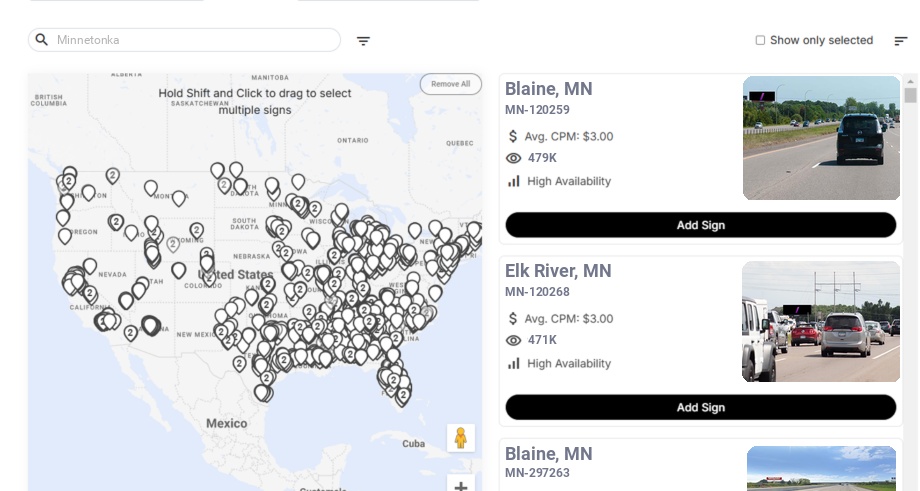



How much is a billboard in Minnetonka?
Why Choose Blip for Billboard Advertising in Minnetonka
Blip lets you launch fast in Minnetonka and target I-494 and I-394 commuters without contracts or minimums.
In Minnetonka, Blip-optimized campaigns can auto-place ads near Ridgedale, Highway 7, and U.S. 169 to fit your goals.
Set a flexible daily budget in Minnetonka, and Blip will stretch spend across busy west-metro drives only when ads play.
Use Minnetonka dayparting to hit 6-9 a.m. commuters or 3-7 p.m. family traffic on Highway 7 and I-494.
Track Minnetonka performance in real time and shift fast as Lake Minnetonka summer traffic or winter commute patterns change.
Blip's creative tools make it easy to tailor Minnetonka billboards for Ridgedale shoppers, office parks, and school families.
Frequently Asked Questions About Billboard Advertising in Minnetonka
How much does a billboard cost in Minnetonka with Blip?
With Blip, the cost of billboard advertising in Minnetonka is flexible and easy to control. You set a daily budget, and Blip’s algorithm uses it to bid for available ad slots on rotating digital billboards. You only pay when your ad actually displays, with each 7.5-to-10-second display called a “blip,” starting at just $0.01 per blip.
Where can I advertise with Blip in Minnetonka?
Minnetonka’s billboard value is concentrated along a handful of corridors that carry both local intent and regional pass-through traffic. I-494 is the strongest pure-reach corridor, while I-394 gives a premium weekday audience into Minneapolis. Highway 7, U.S. 169, and local routes near Ridgedale Center and Carlson Parkway are also important for reaching commuters, shoppers, and local decision-makers.
What kind of audience does Blip reach in Minnetonka?
Minnetonka combines affluent suburban households with median household income above $100,000, major employment centers, and heavy west-metro driving. More than 70% of workers still commute by driving alone, and the city has a balanced audience of established professionals, school-age families, and older adults. This makes it a strong market for healthcare, financial services, education, home improvement, automotive, legal services, and higher-end retail.
When is the best time to run billboard ads in Minnetonka with Blip?
Winter is a strong window for digital billboards because early darkness makes them especially visible during morning and evening commutes. Spring and summer are good for lake traffic, outdoor projects, and leisure travel around Lake Minnetonka. Late July through September is also one of the best family-planning windows because of back-to-school demand.
Why is Minnetonka a good market for Blip billboard advertising?
Minnetonka is a dependable digital billboard market because it combines affluent suburban households, major employment centers, and heavy west-metro driving. The city sits inside Hennepin County and the broader Twin Cities region, so the practical advertising footprint is much larger than the city limits alone. Daily travel on I-494, I-394, Highway 7, and U.S. 169 gives repeated exposure among commuters who still make many of their buying decisions from the car.
Do I need a contract to advertise with Blip in Minnetonka?
No, Blip has no long-term contracts or minimum commitments. You can start, pause, or stop your campaign at any time.
How fast can I launch a billboard campaign with Blip in Minnetonka?
You can have your campaign live in minutes. Create a free account, select your locations, set your budget, upload your design, and start running once approved.
Where can I advertise with Blip in Minnetonka?
Blip has digital billboards in Minnetonka. You can browse available locations on a map, choose the ones that fit your audience, and start advertising right away.
Still have questions? Launch a campaign in minutes — no contracts, no commitments.
Start Your CampaignMinnetonka Billboard Advertising Guide
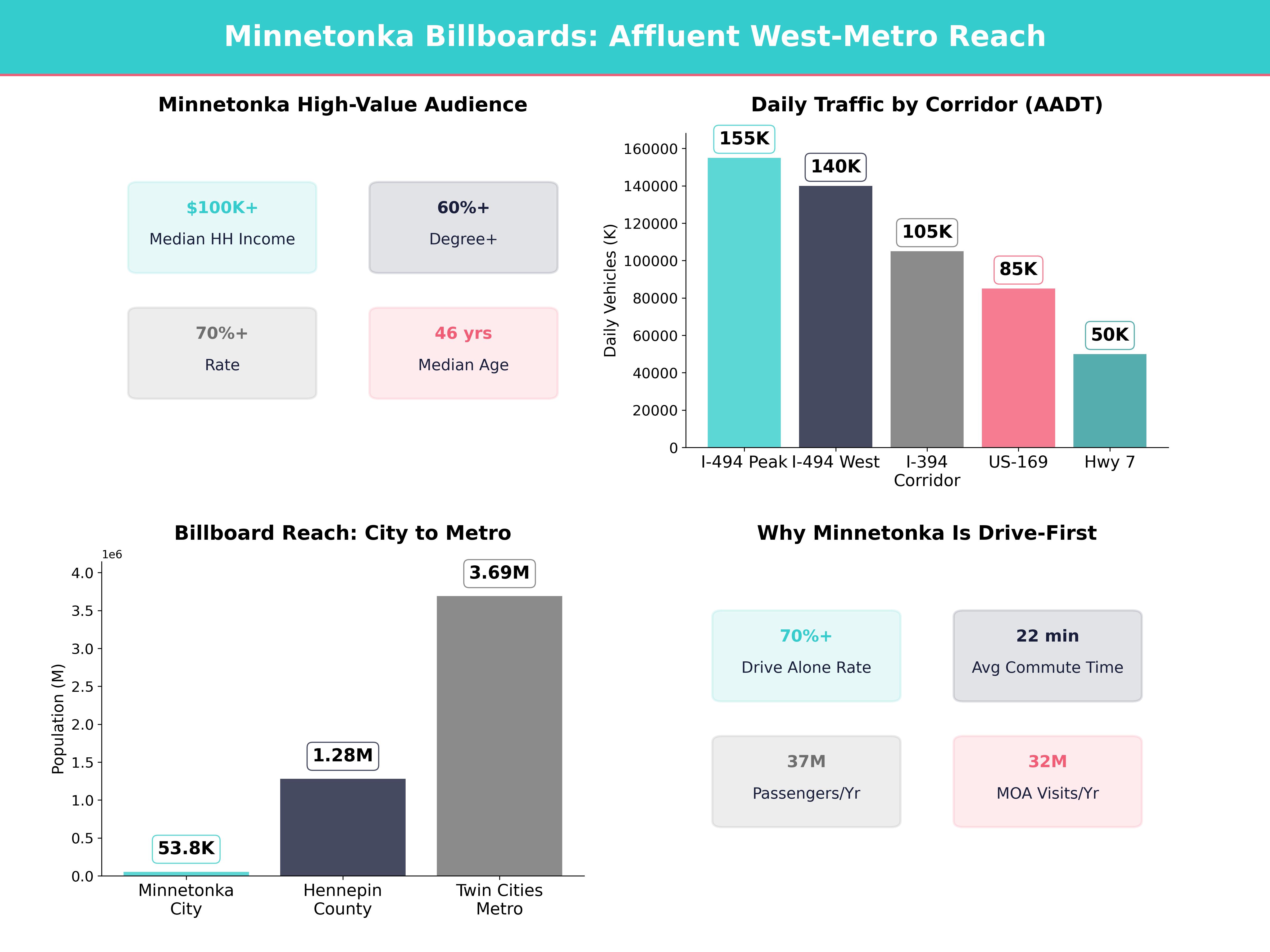
Minnetonka $100,000, major employment centers, and heavy west-metro driving, including I-494 segments above 140,000 vehicles per day and I-394 segments around 90,000 to 130,000. The City of Minnetonka 53,781 residents in 2020, but the practical advertising footprint is much larger because the city sits inside Hennepin County's 1.28 million residents and the Metropolitan Council's 3.69 million-person Twin Cities region. Daily travel on I-494, I-394, Highway 7, and U.S. 169 gives us repeated exposure among commuters who still make many of their buying decisions from the car. We also benefit from west-metro shopping and leisure traffic that moves between Ridgedale Center, Lake Minnetonka Hopkins Wayzata Eden Prairie
Minnetonka Market Overview
Minnetonka is not just a suburb with good traffic. It is a mature, high-value west-metro market where household spending power, professional employment, and strong car dependence work together in our favor.
Minnetonka demographics and economic fundamentals
Between 2010 and 2020, Minnetonka grew from 49,734 residents to 53,781, which was an 8.1% increase. That growth rate was meaningful for an already established suburb, and it reinforces the city's long-term stability for local and regional advertisers.
Community profiles assembled by local and regional planning sources consistently place Minnetonka's median household income above $100,000, bachelor's-degree attainment above 60%, and homeownership above 70%. That combination matters because it supports strong demand for healthcare, financial services, education, home improvement, automotive, legal services, and higher-end retail.
Minnetonka's median age is around 46, which is older than the U.S. median of about 39 and gives us a balanced audience of established professionals, school-age families, and older adults with growing healthcare and financial-planning needs. We are not advertising into a transient market. We are advertising into a market where many households have both purchasing power and predictable routines.
The local economy is also strengthened by major employers and office concentrations in and around Minnetonka. Companies such as UnitedHealth Group, Medica Plymouth Hopkins Eden Prairie Minnesota DEED remains anchored by professional services, healthcare, technology, logistics, and retail.
Why Minnetonka remains a drive-first billboard market
Even after hybrid work changed commute patterns, Minnetonka remains overwhelmingly auto-oriented. More than 70% of workers still commute by driving alone, and average commute times are about 22 minutes.
That is long enough for billboard exposure to build memory, but short enough that route familiarity stays high. Transit options from Metro Transit and SouthWest Transit add some regional mobility, but Minnetonka's land use still favors the car.
Office parks, schools, medical campuses, shopping centers, and lake-area leisure destinations all depend heavily on road access. For us, that means digital billboards are not a supplemental medium here. They are often one of the most direct ways to reach people during habitual daily travel.
Key Traffic Corridors for Minnetonka Billboards
Minnetonka's billboard value is concentrated along a handful of corridors that carry both local intent and regional pass-through traffic. When we understand the purpose of each route, we can match the right creative to the right traveler.
Interstate 494 in Minnetonka
According to traffic count maps from the Minnesota Department of Transportation, west-metro segments of I-494 touching or immediately adjacent to Minnetonka regularly carry more than 140,000 vehicles per day. The busiest sections near the I-394 system interchange rise into roughly the 150,000 to 160,000 AADT range.
I-494 is our strongest pure-reach corridor in Minnetonka. It connects Bloomington, Eden Prairie Minnetonka Plymouth MSP Airport, major shopping districts, and the south metro. We should favor this corridor when we want broad awareness for hospitals, universities, legal groups, home-improvement chains, insurance brands, event venues, and large retailers.
I-494 also works especially well for campaigns that need both frequency and geographic diversity. Many drivers on this route are not just Minnetonka residents. They are cross-metro travelers moving between jobs, errands, and family obligations.
Interstate 394 and Minnetonka's downtown connection
I-394 is Minnetonka's direct commuter line into Minneapolis. MnDOT counts around Carlson Parkway, Hopkins Crossroad, and the Ridgedale area generally run about 90,000 to 120,000 vehicles per day, and some eastbound segments closer to St. Louis Park 130,000.
This corridor gives us a premium weekday audience. It is especially attractive for financial services, business software, recruiting, live entertainment, healthcare specialists, and restaurants that benefit from reaching office workers and higher-income suburban households. Because I-394 is a familiar, repeated route for many commuters, frequency compounds quickly here.
We should also remember that I-394 is not only about downtown jobs. It serves the office, hotel, and retail concentration around Ridgedale and Carlson Parkway, which keeps the corridor useful throughout the day.
Highway 7 through south Minnetonka
Highway 7 is more local, more practical, and often more conversion-oriented than the interstates. Through Hopkins St. Louis Park 40,000 to 60,000 range.
That profile makes Highway 7 ideal for businesses that depend on immediate action. We can use it effectively for urgent care, dental offices, grocery-anchored retail, childcare, fitness centers, auto service, quick-service restaurants, local colleges, and neighborhood events.
Drivers on Highway 7 are often closer to a practical turn, a same-day appointment, or an evening family decision. Highway 7 also helps us speak to a different mindset than I-394. The interstate commuter may still be in work mode. The Highway 7 traveler is often thinking about errands, dinner, healthcare, or school pickup.
U.S. 169 and Minnetonka's north-south movement
U.S. 169 supplies valuable north-south connectivity for Minnetonka and adjacent suburbs. Near Excelsior Boulevard, Bren Road, and nearby interchanges, MnDOT counts often fall in the 80,000 to 90,000 daily-vehicle range.
We can use U.S. 169 to reach households moving among Edina, Hopkins Minnetonka Plymouth Eden Prairie
Because U.S. 169 links several suburban trade areas, it is a smart bridge corridor when we want to stretch a Minnetonka campaign into a larger west-southwest footprint.
Ridgedale, Carlson Parkway, and last-mile local routes
Not every valuable Minnetonka impression happens on a freeway. Local arterials such as Carlson Parkway, County Road 62, Baker Road, and roads feeding Ridgedale Center matter because they finish the trip.
When our goal is foot traffic, proximity to office campuses, hotels, clinics, or shopping centers can outperform a higher-volume board that sits farther away from the purchase point. This is where local context becomes decisive. A board that reaches fewer vehicles can still be the better buy if it catches drivers just before a retail stop, a healthcare appointment, or an office lunch decision.
Audience Segments We Can Reach in Minnetonka
Minnetonka works best when we think in audiences instead of municipal boundaries. The city sits at the overlap of commuter traffic, affluent households, school communities, and west-metro leisure movement.
Minnetonka commuters and office professionals
Because drive-alone commuting remains above 70%, billboard frequency still builds quickly among professionals moving between west-metro homes and offices. This audience includes executives, healthcare administrators, analysts, sales teams, and service professionals who are on predictable weekly routes.
For this group, billboard advertising works well for financial advisors, law firms, private schools, colleges, healthcare specialists, business software, recruiting, upscale dining, and business events. The strongest placements are usually on I-394, I-494, and the office-serving roads around Ridgedale and Carlson Parkway.
Minnetonka families, homeowners, and school communities
Families are one of Minnetonka's most valuable audience segments. Homeownership is above 70%, the median age is around 46, and the area is served by large, high-performing school systems.
Minnetonka Public Schools serves more than 11,000 students. Hopkins Public Schools serves about 7,000 students, and Wayzata Public Schools serves more than 13,000 students.
Together, those districts account for more than 31,000 students and a large parent audience that makes recurring decisions about healthcare, tutoring, youth activities, orthodontics, dining, family entertainment, and home services. This audience responds especially well to messaging that emphasizes trust, convenience, expertise, and local relevance.
In Minnetonka, a well-placed billboard can influence not only an individual commuter, but an entire household's next purchase.
Minnetonka shoppers, visitors, and leisure travelers
Retail and leisure traffic expands the audience beyond residents. Ridgedale Center is one of the west metro's major shopping anchors, and Lake Minnetonka 125 miles of shoreline.
Nearby destinations such as Paisley Park in Chanhassen Minnesota Landscape Arboretum, and trails managed by Three Rivers Park District add more discretionary travel through the area. Regional travel patterns widen the opportunity even further.
Mall of America reports roughly 32 million visits annually, and MSP Airport handled more than 37 million passengers in 2023. Even when the final destination is outside Minnetonka, west-metro routes still carry a meaningful share of the regional hotel, dining, attraction, and airport-traveler audience.
Minnetonka consumers with high-consideration purchases
Minnetonka's combination of income, education, and age also makes it a strong market for high-consideration categories. We can effectively advertise elective healthcare, hearing and vision services, wealth management, remodeling, real estate, and premium automotive services here because the audience is both decision-oriented and comparatively established.
This matters for billboard strategy because high-consideration purchases rarely happen after one impression. Minnetonka's repeated commute patterns give us the frequency needed to stay present while the customer compares options.
Seasonal and Timing Opportunities in Minnetonka
The best Minnetonka billboard campaigns align with how the west metro changes over the year. Traffic is steady, but intent shifts noticeably by season.
Minnetonka winter campaigns
The Twin Cities average about 54 inches of snow each year, and winter darkness arrives early. Those conditions make digital billboards especially visible during morning and evening commutes from November through March.
Winter is a strong window for snow removal, HVAC, auto repair, tire sales, tax services, healthcare, fitness memberships, and indoor entertainment. We should also take advantage of shorter daylight because illuminated creative stands out more when roads are dark, snowy, and familiar.
Minnetonka spring and summer campaigns
Spring and summer create a different emotional context. Households start thinking about outdoor projects, patios, deck work, landscaping, roofing, lake recreation, and weddings.
Lake Minnetonka's 125 miles of shoreline turn the west metro into a warmer-weather leisure corridor, especially around Wayzata Chanhassen
Destinations such as Paisley Park, the Minnesota Landscape Arboretum, and parks from Three Rivers Park District keep weekend traffic active and help us broaden reach beyond weekday commuters.
Minnetonka back-to-school, fall, and holiday timing
Late July through September is one of the best family-planning windows in Minnetonka. The combined 31,000+ students in the Minnetonka, Hopkins, and Wayzata school systems create clear demand spikes for tutoring, pediatric care, orthodontics, youth sports, music lessons, after-school programs, and family dining.
Fall also benefits from broader Twin Cities event traffic. The Minnesota State Fair drew 1.8 million attendees in 2023, and many west-metro residents travel across the regional freeway network during fair season, football weekends, and autumn event calendars. We can use that period to promote entertainment, retail, healthcare, and destination dining.
Holiday campaigns should emphasize convenience, gifting, and proximity. Shoppers moving toward Ridgedale Center, Mall of America, and west-metro dining districts respond especially well to timely creative from November through December.
Billboard Design Tips for the Minnetonka Market
Minnetonka responds best to billboard creative that feels polished, credible, and locally aware. We should design for a well-educated suburban audience that values both quality and practicality.
Creative tone that fits Minnetonka
Clean layouts, confident typography, and polished photography usually outperform chaotic discount-style creative in Minnetonka. Deep blues, greens, charcoal, and white often work well because they align naturally with lake imagery, healthcare trust, professional services, and upscale retail.
We can still use bright accents, but the overall feel should be intentional rather than noisy. This market is especially good for messages built around credibility.
Claims such as local expertise, award-winning service, certified staff, same-day availability, or a clear premium benefit fit the Minnetonka mindset better than generic hype.
Local cues that make Minnetonka billboards feel relevant
Minnetonka creative should sound geographically useful. Phrases such as “Near Ridgedale,” “Off I-494,” “Minutes from Highway 7,” or “Serving the west metro” can do a lot of work.
Local relevance matters here because many trips are practical and route-based. Imagery should reflect the audience we actually see in Minnetonka.
That usually means office-casual professionals, modern homes, family activities, lake and trail lifestyles, healthcare settings, and retail convenience. A billboard that visually feels like Minnetonka will generally outperform one that feels generic.
Designing for Minnetonka speed, weather, and visibility
Many freeway drivers in this market are moving at 55 to 65 mph. Because of that, we should present one idea, one offer, and one location cue on each board.
Minnetonka commuters do not need complexity. They need clarity they can absorb instantly on a familiar route.
Seasonal adaptation also matters. In winter, high-contrast text against darker or snow-bright backgrounds reads best, and in summer, lake-inspired blues, greens, and warm sunset tones often feel more natural and inviting for west-metro leisure traffic.
Regional Strategies for Different Parts of Minnetonka
Minnetonka is not one uniform billboard market. Different sub-areas carry different audiences, and we should adjust our approach accordingly.
East Minnetonka and the Ridgedale-I-494-I-394 district
East Minnetonka is our strongest zone for broad reach and premium commuter traffic. The mix of Ridgedale Center, office space, hotels, and direct interstate access makes this area ideal for healthcare systems, B2B services, recruiting, entertainment, and regional retail.
If our goal is scale, this is usually the first part of Minnetonka we should evaluate. It gives us a dense overlap of local residents, office workers, and pass-through regional traffic.
South Minnetonka and the Highway 7 corridor
South Minnetonka is more neighborhood-driven and more conversion-focused. Highway 7 and its surrounding streets are excellent for advertisers that need parents, homeowners, and practical evening decision-makers.
This is where we should prioritize dentists, urgent care, tutoring, childcare, quick-service restaurants, gyms, grocery-anchored retail, and local events. The audience is often closer to an actual purchase than the audience on a faster commuter freeway.
North and west Minnetonka toward lake communities
As we move north and west toward Wayzata
This is also where seasonal creative becomes more important. A lake-oriented summer message or a winter comfort-and-home message can feel highly relevant in these areas.
Expanding beyond Minnetonka into the west metro
One of Minnetonka's biggest strengths is how easily we can scale outward. A placement change that adds only 10 to 15 minutes of drive time can shift the audience from office commuters to family neighborhoods or leisure travelers.
That makes it easy for us to extend a Minnetonka campaign into Hopkins Plymouth Eden Prairie Chanhassen St. Louis Park
Using Blip Tools in Minnetonka
Blip works especially well in Minnetonka because the market has clear commuting patterns, distinct sub-areas, and seasonal creative opportunities. We can use the platform's flexibility to match those local behaviors instead of locking ourselves into one static plan.
Dayparting for Minnetonka travel behavior
We can weight morning delivery from 6-9 a.m. on I-394 and I-494 when we want office commuters, healthcare appointments, or professional-service audiences. We can emphasize midday delivery from 11 a.m.-2 p.m. around Ridgedale and office clusters for lunch traffic, retail visits, and same-day services.
We can push harder from 3-7 p.m. on Highway 7 and U.S. 169 for restaurants, childcare, family entertainment, and home services. That kind of timing matters in Minnetonka because traveler intent changes over the course of the day even when the roads stay busy.
Testing Minnetonka creative and locations efficiently
A manual campaign is useful when we already know we want boards near Ridgedale, Highway 7, or a specific trade area. A Blip-optimized campaign is useful when we want the system to spread budget across Minnetonka and adjacent west-metro inventory, then learn which pockets deliver the best mix of reach and frequency.
Real-time analytics are especially helpful here because Minnetonka is seasonal. We can rotate from winter services to lake-season offers, or from back-to-school messaging to holiday retail, without rebuilding a traditional long-term buy.
If we need to localize creative quickly, the artwork tools make it easier to build multiple west-metro versions without slowing down launch time.
Getting Started with Billboard Rental in Minnetonka
Renting a billboard in Minnetonka becomes much easier when we define the goal before we choose the board. The right placement for a regional hospital is not the right placement for a local dentist, and the right placement for a holiday retailer is not the right placement for a summer marina.
How we should choose Minnetonka billboard locations
For most local businesses, we should start with a 5- to 10-mile planning radius around the storefront or service area. Then we should match corridors to intent.
- We should prioritize I-494 and I-394 when our goal is broad west-metro awareness.
- We should prioritize Highway 7 and U.S. 169 when our goal is immediate local action.
- We should prioritize Ridgedale-area placements when our goal is retail traffic, office exposure, or all-day relevance.
- We should prioritize lake-adjacent west-metro routes when our goal is premium household reach or seasonal leisure demand.
We should also evaluate every billboard by asking a few practical questions. Is the board on the inbound or homebound side of traffic? Is it before the exit we need, or after it? Does the nearby demand come from offices, homes, schools, or leisure destinations? Does the time of day match the action we want people to take?
What to expect from the Minnetonka rental process
Traditional billboard companies often require fixed inventory, slower revisions, and longer commitments than many local advertisers want. Blip simplifies that process. We can start smaller, test faster, and adjust based on what the market is actually doing instead of guessing months in advance.
A smart first campaign in Minnetonka often uses 2 to 4 key corridors and a learning window of 2 to 4 weeks. That gives us enough time to compare commuter-heavy placements, neighborhood-facing boards, and seasonal creative.
Once we see where our message fits best, we can scale with much more confidence. Minnetonka rewards advertisers who stay local, stay clear, and stay flexible.
If we align our boards with west-metro traffic patterns, family calendars, and seasonal demand, billboard rental in Minnetonka can become one of the most efficient awareness plays in the Twin Cities.