Billboards in Saint Paul, MN
No Minimum Spend. No Long-Term Contracts. Just Results.
Turn heads in Saint Paul with digital billboard ads that fit your pace and your budget. Blip makes it easy to pick placements, set timing, and launch fast—no contracts, no minimums, just pay when your ad plays and let your message pop.
Trusted by Leading Brands


Billboard advertising
in Saint Paul has
never been easier
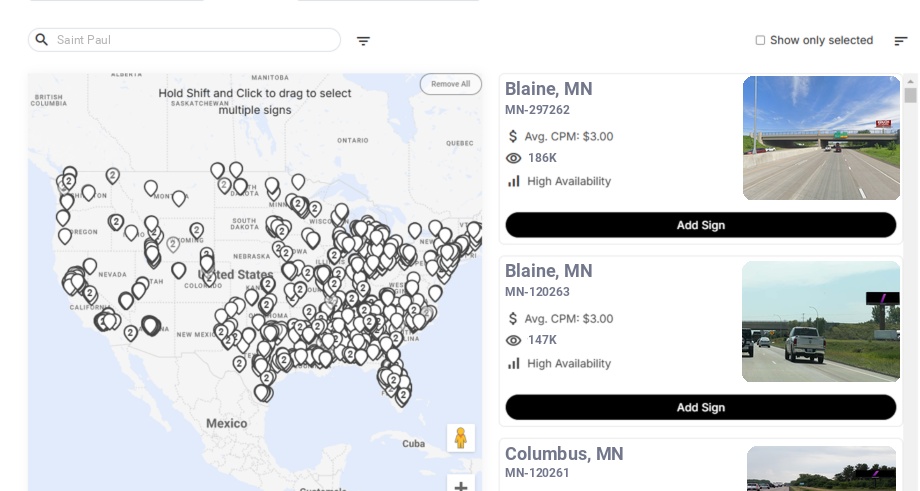
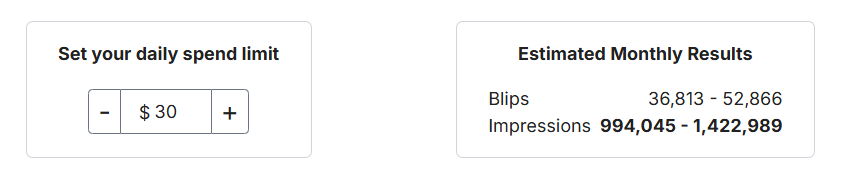
How much is a billboard in Saint Paul?
Why Choose Blip for Billboard Advertising in Saint Paul
Blip lets you self-serve Saint Paul billboards fast on I-94 and I-35E, reaching daily commuters and downtown workers without the usual buying hassle.
Use Blip-optimized campaigns in Saint Paul to auto-pick boards around Xcel Energy Center, Allianz Field, and the State Fair route based on your goals.
In Saint Paul, flexible budgets mean you can start small and scale for winter rush, fair season, or Wild game nights—no contracts needed.
Daypart your Saint Paul ads for 3-7 p.m. commuter peaks or event windows near Lowertown and West Seventh, so Blip spends when traffic is hottest.
Track Saint Paul performance in real time and shift spend fast as traffic changes on University Avenue, I-94, or MSP-bound corridors.
Blip creative tools help Saint Paul ads stand out in snowy skies with bold, local copy like "Near Allianz" or "Downtown Lowertown".
Frequently Asked Questions About Billboard Advertising in Saint Paul
How much does a billboard cost in Saint Paul with Blip?
Where are the best billboard locations in Saint Paul for Blip ads?
Why is Saint Paul a strong billboard market for Blip?
When is the best time to run billboard ads in Saint Paul with Blip?
Who can Blip help reach with Saint Paul billboard advertising?
Do I need a contract to advertise with Blip in Saint Paul?
How fast can I launch a billboard campaign with Blip in Saint Paul?
Where can I advertise with Blip in Saint Paul?
Still have questions? Launch a campaign in minutes — no contracts, no commitments.
Start Your CampaignSaint Paul Billboard Advertising Guide
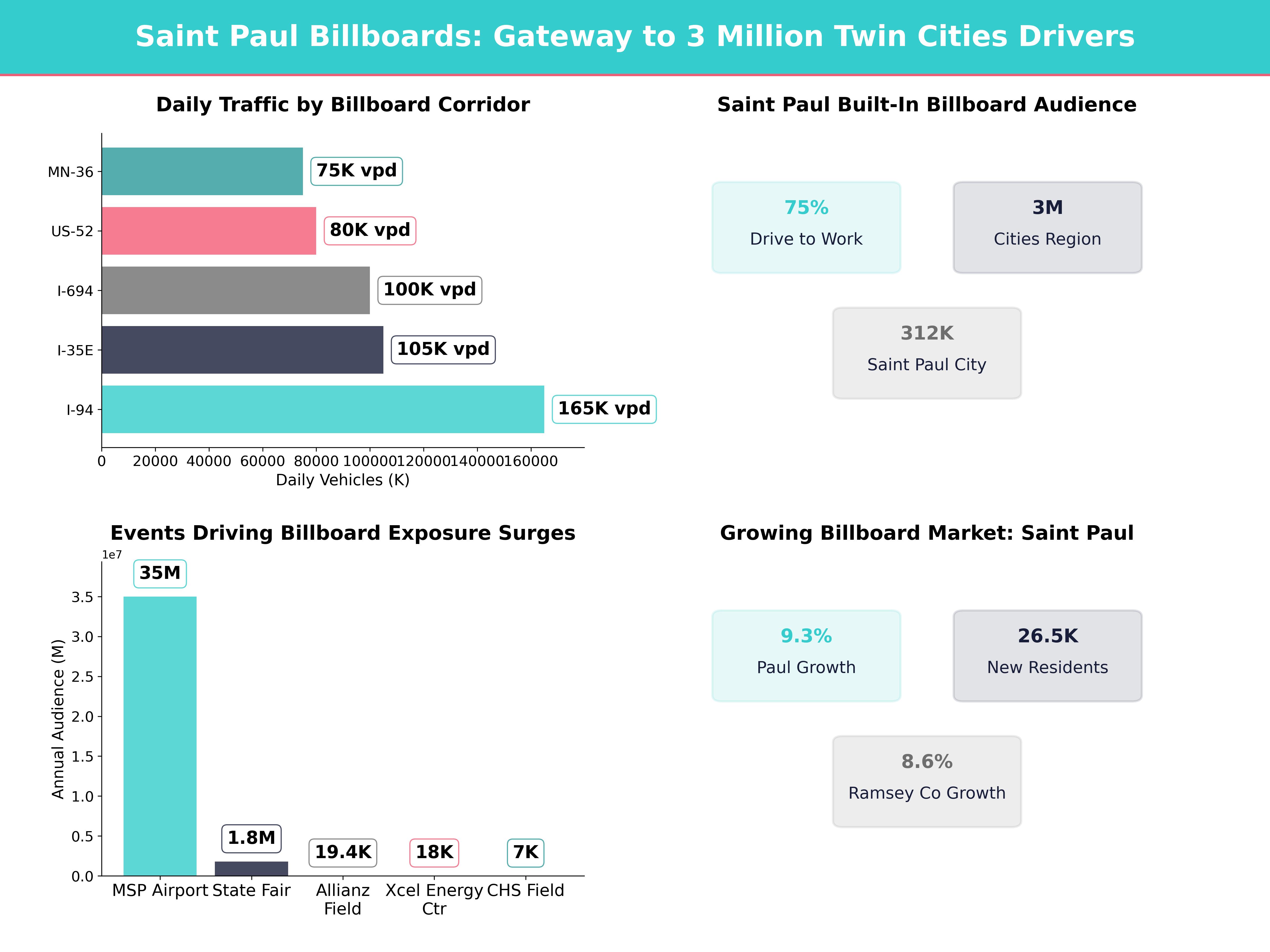
Saint Paul is one of the strongest billboard markets in the Upper Midwest because it combines capital-city employment, dense commuter traffic on corridors that can run roughly 90,000 to 180,000 AADT, and year-round event activity. The City of Saint Paul had 311,527 residents in 2020, and it sits inside a Twin Cities region of roughly 3 million people served by the Metropolitan Council. Even with strong transit options, roughly 75% of Ramsey County workers still commute by car, truck, or van, which keeps roadside visibility valuable for repeated reach. We also benefit from tourism and event surges driven by places like Xcel Energy Center (17,954 seats), Allianz Field 19,400 seats), the Minnesota State Fair (12 days and more than 1.8 million attendees), and MSP Airport (nearly 35 million travelers in 2023).
Saint Paul Market Overview
Saint Paul gives us city density and regional scale
Saint Paul is Minnesota’s second-largest city, and it anchors the east side of the Twin Cities with a built-in mix of residents, office workers, students, and visitors. Ramsey County had 552,352 residents in 2020, so even a campaign focused tightly on Saint Paul still taps into a countywide audience larger than many full metro areas.
Growth matters here. Saint Paul added 26,459 residents between 2010 and 2020, which equals 9.3% growth over the decade. Ramsey County grew 8.6% during the same period. For billboard advertisers, that means we are not working in a stagnant market. We are advertising in a city that keeps adding households, renters, and daily trips.
Saint Paul also benefits from being paired with Minneapolis. The two downtowns are only about 10 miles apart via I-94, so many boards in Saint Paul reach people whose daily routines span both cities.
The local economy creates multiple billboard audiences
Saint Paul’s economy is broad enough that we do not need to rely on only one audience segment. Government activity around the Minnesota State Capitol, headquarters such as Ecolab Securian Financial, healthcare anchors like Regions Hospital, and industrial development supported by the Saint Paul Port Authority all add weekday travel demand.
Education is another major demand driver. Saint Paul Public Schools serves more than 33,000 students. The University of St. Thomas enrolls more than 9,000 students, Macalester College has more than 2,000 students, and Hamline University, Concordia University, St. Paul, Saint Paul College, and the nearby University of Minnesota Twin Cities add even more student traffic to the local mix.
Saint Paul is still a strong drive-by market
Saint Paul is more transit-oriented than many Midwestern cities, but it is still highly useful for billboard advertising because driving remains the dominant travel mode. Minnesota Compass 75% of Ramsey County workers commute by car, truck, or van.
Transit still matters because it shapes where traffic concentrates. The METRO Green Line runs 11 miles with 23 stations between downtown Saint Paul, the University of Minnesota area, and downtown Minneapolis. That corridor helps us identify dense urban locations where slower traffic, repeated commuting, and neighborhood retail exposure can all work together.
The takeaway is simple. Saint Paul gives us both frequency and diversity. We can reach weekday commuters, state workers, students, sports fans, convention attendees, and families without leaving one compact geography.
Key Traffic Corridors for Digital Billboards in Saint Paul
Saint Paul’s billboard performance is driven by a handful of high-value corridors. The best placements depend on whether we want broad commuter reach, neighborhood relevance, or event-based timing. According to Minnesota Department of Transportation traffic volume maps
Interstate 94 through Saint Paul and Midway
I-94 is the backbone of Saint Paul billboard strategy. Central segments through downtown Saint Paul, Snelling Avenue, and the Midway area commonly carry about 150,000 to 180,000 vehicles per day.
This corridor is powerful because it links downtown Saint Paul, downtown Minneapolis, the Midway retail district, Allianz Field Minnesota State Fairgrounds. We use I-94 when we want repeated exposure among:
- Retail and restaurant advertisers, because weekday commuters see the same boards over and over.
- Healthcare and higher education brands, because the route touches dense neighborhoods and major campuses.
- Entertainment and event campaigns, because it reaches Wild fans, soccer fans, concertgoers, and fair attendees.
- Recruiting campaigns, because it captures workers moving between Minneapolis, Saint Paul, and inner-ring suburbs.
Interstate 35E in Saint Paul
I-35E is the city’s main north-south commuter spine. Through and near Saint Paul, many segments run around 90,000 to 120,000 AADT. It connects downtown Saint Paul with northern communities such as Roseville Little Canada White Bear Lake Mendota Heights
We like I-35E for advertisers that need a broad cross-section of professional, suburban, and government-adjacent audiences. It is especially effective for:
- Legal, financial, and B2B services, because it feeds directly into downtown office and government activity.
- Hospitals and specialty care, because healthcare choices often involve deliberate, repeated consideration.
- Home services and consumer brands, because the route reaches commuters headed to and from residential areas.
Interstate 694, Minnesota 36, and Saint Paul’s northern gateway
Saint Paul’s northern and northeastern approaches matter because they bring in suburban households with high shopping mobility. On nearby segments, I-694 often carries roughly 80,000 to 120,000 vehicles per day, while MN-36 typically lands around 60,000 to 90,000 AADT, depending on the exact location.
These routes connect Saint Paul with Maplewood North Saint Paul Oakdale White Bear Lake
- Regional retail, because shoppers often use these routes for errands and weekend trips.
- Automotive advertisers, because vehicle buyers and service customers are already in drive mode.
- Family destinations and healthcare, because these corridors bring in household decision-makers.
US 52, Lafayette, and the southeast approach to Saint Paul
US-52 is one of Saint Paul’s most practical corridors for inbound commuting from the southeast. Many segments near the Saint Paul approach operate around 70,000 to 90,000 vehicles per day. It also serves the connection toward Rochester and the broader southeast Minnesota travel shed.
This corridor works especially well for:
- Healthcare systems and clinics, because people traveling longer distances often plan care and specialty visits.
- Workforce recruiting, because industrial, logistics, and construction audiences are common on this route.
- Downtown services and event promotions, because it feeds directly into the city core.
University Avenue and the Green Line spine
Not every effective Saint Paul billboard sits on a high-speed freeway. University Avenue parallels the 11-mile Green Line and connects downtown Saint Paul, the Midway district, Allianz Field University of Minnesota Twin Cities, and downtown Minneapolis.
This corridor gives us longer read time because traffic moves more slowly than on I-94. It is one of our best options for:
- Restaurants and neighborhood retail, because nearby action matters more than metro-wide awareness.
- Colleges, training programs, and apartments, because students and young adults move through this spine regularly.
- Multicultural campaigns, because Saint Paul’s diverse communities are highly visible along University Avenue.
Audience Segments for Saint Paul Billboards
Saint Paul commuters, office workers, and state employees
Saint Paul’s weekday audience is anchored by commuters, public-sector employees, and downtown visitors. The city’s role as state capital keeps government traffic steady around the Minnesota State Capitol, downtown courthouses, and office districts. Because roughly 3 in 4 Ramsey County workers still commute by car, truck, or van, commuter-facing boards remain foundational for local campaigns.
This audience is ideal for banks, insurance, healthcare, legal services, workforce recruiting, and consumer services that benefit from repeated exposure over several weeks.
Saint Paul students and young adults
Saint Paul has an unusually strong education audience for its size. We can reach more than 33,000 Saint Paul Public Schools students and their families, plus college populations at University of St. Thomas, Macalester College, Hamline University, Concordia University, St. Paul, and Saint Paul College. We also benefit from the Green Line connection to the University of Minnesota Twin Cities, which enrolls more than 50,000 students.
This audience responds well to apartments, food delivery, telecom, career training, entertainment, apparel, and healthcare brands with urgent or mobile-friendly offers.
Sports fans, concertgoers, and event attendees in Saint Paul
Saint Paul delivers event audiences far beyond its resident base. Xcel Energy Center seats 17,954 for hockey, and the Minnesota Wild bring 41 regular-season home games every year before we even count preseason, playoffs, concerts, and other arena events. Allianz Field 19,400, and Minnesota United FC plays 17 regular-season MLS home matches, plus additional cup and friendly dates.
Lowertown adds another strong sports cluster. CHS Field 7,000 people, and the St. Paul Saints bring roughly 75 home dates in a typical Triple-A season.
For advertisers, that makes Saint Paul excellent for restaurants, bars, parking apps, apparel, live entertainment, hospitality, and last-minute promotions tied to game nights.
Families, tourists, and regional visitors around Saint Paul
Saint Paul also performs well with destination audiences. MSP Airport handled nearly 35 million travelers in 2023, and many of those visitors pass through the Saint Paul side of the metro for events, hotels, meetings, and attractions. The Minnesota State Fair in nearby Falcon Heights 12 days and typically draws more than 1.8 million attendees to its 322-acre fairgrounds.
Additional year-round draws include Como Park Zoo & Conservatory Minnesota History Center, the Ordway Center for the Performing Arts, and the Saint Paul RiverCentre. This audience is valuable for hotels, attractions, medical travel, colleges, and consumer brands that want to extend beyond local residents.
Ready to reach your audience in Saint Paul?
Start Your Campaign →Seasonal and Timing Opportunities in Saint Paul
Winter advertising opportunities in Saint Paul
Winter is not a slow season in Saint Paul. It is a visibility season. The Saint Paul Winter Carnival has been running since 1886, and the Minnesota Wild keep downtown active through much of the cold-weather calendar. In late December, sunset arrives before 4:40 p.m., so evening commute boards begin working earlier than many advertisers expect.
That makes winter especially strong for:
- Healthcare, urgent care, and pharmacy campaigns, because winter illness and injury demand rises.
- Home services, because heating, insulation, plumbing, and emergency repair messages feel timely.
- Restaurants and indoor entertainment, because people look for convenient evening plans during dark commutes.
We usually like heavier weekday afternoon and early evening dayparting from roughly 3:00 p.m. to 7:00 p.m. in winter because the roads are full and the sky is dark.
Spring and summer timing in Saint Paul
Summer opens Saint Paul’s event machine. Minnesota United FC plays through the warmer months, the St. Paul Saints bring dozens of game nights to Lowertown, patios fill along West Seventh, and road construction changes travel patterns. In June, daylight stretches past 9:00 p.m., which gives evening campaigns more useful visibility than in many markets.
This is the season when we like to:
- Increase weekend and evening budgets for dining, beverages, retail, and entertainment.
- Use route-specific boards near event venues because traffic concentrates around arrival windows.
- Rotate creatives more often because summer audiences respond well to freshness and urgency.
Late summer and fall in Saint Paul
Late summer and fall may be the city’s best billboard window. The Minnesota State Fair alone creates a massive surge, and back-to-school movement ramps up at Saint Paul Public Schools, local colleges, and the University corridor. Early fall also brings the Twin Cities Marathon, which covers 26.2 miles and drives regional travel around Saint Paul neighborhoods.
This is the time to push:
- Retail and entertainment before and during fair season.
- Education, childcare, and healthcare in August and September.
- Recruiting and B2B campaigns in September and October, when routines normalize after summer travel.
Billboard Design Tips for the Saint Paul Market
Use creative that stands out in Saint Paul’s weather and roadway conditions
Saint Paul has long winters, frequent overcast skies, and a streetscape full of gray pavement, concrete, and snow for part of the year. We usually avoid pale gray, white-heavy, or low-contrast layouts unless the brand identity absolutely requires them. Deep blue, black, red, gold, and other saturated colors tend to separate better from winter backgrounds.
Traffic speed matters too. Freeway creative on I-94 or I-35E should stay extremely lean. We aim for one idea, one brand cue, and one action. On slower urban routes like University Avenue, we can afford a little more nuance, but clarity still wins.
Reference Saint Paul places instead of generic Twin Cities language
Saint Paul audiences respond well when we sound local. Copy such as “Next exit,” “Near Allianz,” “Downtown Lowertown,” “West Seventh,” “Midway,” “Highland,” or “East Side” often feels more useful than generic metro wording.
Local visual cues can help too. Depending on the brand, we may use imagery connected to the Minnesota State Capitol, the Mississippi riverfront, hockey, soccer, neighborhood main streets, or fair-season culture. We do not need every ad to feel hyperlocal, but a light Saint Paul touch can improve relevance.
Match the message to Saint Paul’s audience mix
Different Saint Paul submarkets reward different tones.
- In downtown and Capitol-adjacent zones, we usually favor clean, credible, straightforward messaging for legal, healthcare, finance, and B2B campaigns.
- Around University Avenue and the Midway area, we often see stronger results from community-aware, multicultural, and value-forward messaging.
- Near venues like Xcel Energy Center, Allianz Field CHS Field
- For neighborhood family audiences, convenience cues such as same day, close by, easy parking, or minutes away are often more persuasive than abstract brand claims.
If we are targeting neighborhoods with strong multilingual communities, especially along University Avenue or on the East Side, localized language versions can be worth testing. Even one well-executed English/Hmong or English/Spanish variant can signal relevance in a way that generic creative cannot.
Regional Strategies Across Saint Paul
Downtown Saint Paul, Lowertown, and West Seventh
Downtown Saint Paul is our best zone for government, legal, finance, conventions, and event-driven campaigns. The area ties together the Minnesota State Capitol, Saint Paul RiverCentre, Xcel Energy Center, the Ordway, and Lowertown entertainment.
We usually divide this area into time-based audiences. Morning boards reach workers and public-sector traffic. Midday boards reach appointments, lunch traffic, and downtown errands. Evening boards are ideal for games, concerts, and dining.
Midway, Snelling, and University Avenue in Saint Paul
The Midway district is one of the most versatile billboard zones in the market. It combines I-94 reach, Allianz Field
Because this area connects both downtowns, it also works well when we want Saint Paul relevance without giving up metro-scale exposure.
East Side, Maplewood, and Saint Paul’s eastern gateways
The East Side and nearby suburban edges around Maplewood North Saint Paul Oakdale
We usually favor this zone for clinics, grocery, home improvement, trades, auto services, community colleges, and local retail with practical offers.
Highland Park, airport access, and southwest Saint Paul
Highland Park and the southwest side connect Saint Paul to MSP Airport, Mendota Heights
When we want business travelers, airport-adjacent audiences, and residents with high mobility, this area often deserves its own creative and schedule.
Ready to reach your audience in Saint Paul?
Start Your Campaign →Using Blip Tools for Saint Paul Billboard Strategy
We can let Blip optimize across Saint Paul’s mixed audience patterns
Saint Paul is exactly the kind of market where Blip’s optimization tools are useful. Our audience is not concentrated in one downtown core alone. It spreads across commuter freeways, event districts, university corridors, and neighborhood retail zones. A Blip-optimized campaign can help us cover that mix without forcing us to guess the perfect split on day one.
This works especially well when we want broad awareness across I-94, I-35E, downtown Saint Paul, and nearby venue zones at the same time.
We can use manual controls for Saint Paul’s high-value moments
Manual selection becomes valuable when timing is the strategy. We can choose boards near Xcel Energy Center on Wild game nights, concentrate on I-94 during morning and evening rush, or add fair-season weight near Falcon Heights
We also like to use Blip’s creative tools and analytics to test Saint Paul-specific variations. A strong practical workflow is to launch 2 to 3 creative versions, review performance after 7 to 14 days, and then shift budget toward the best-performing boards, time blocks, and messages. Saint Paul is local enough that those differences often show up quickly.
Getting Started with Billboard Rental in Saint Paul
We should choose Saint Paul locations based on movement, not just map boundaries
The best Saint Paul billboard is the one that matches our goal. If we want broad commuter frequency, we usually start with I-94 and I-35E. If we want event demand, we focus on the downtown Saint Paul, Lowertown, Midway, and venue clusters. If we want households and service decisions, we lean toward the East Side, Maplewood gateways, and northern connectors.
When we evaluate specific boards, we should ask five practical questions:
- Who is moving past this location most often, and why?
- Is traffic fast, slow, inbound, or outbound?
- How close is the board to our store, venue, or service area?
- Does the audience need awareness, urgency, or a directional cue?
- Would this board be better on weekdays, weekends, or event dates?
Blip simplifies Saint Paul billboard rental compared with traditional buying
Traditional billboard buying often means availability checks, negotiated packages, fixed commitments, and limited flexibility once the campaign starts. Blip changes that. We can test Saint Paul inventory without a long contract, adjust pacing as we learn, and swap artwork when seasons, offers, or events change.
That matters in a market like Saint Paul because performance can shift with fair season, hockey season, weather, construction, and school calendars. Flexibility is not just convenient here. It is strategic.
Our best starting plan in Saint Paul is to test, learn, and expand
We usually recommend starting with one clear goal, one primary audience, and a manageable board set. A 2- to 4-week test is often enough to learn whether Saint Paul commuters, event audiences, or neighborhood shoppers respond best to our message. From there, we can expand into nearby zones like Roseville Maplewood Woodbury, or airport-adjacent routes.
Saint Paul rewards advertisers who think locally. If we match our boards to the city’s commuter routes, seasonal rhythms, and neighborhood identities, we can build campaigns that feel both efficient and unmistakably relevant.