Billboards in Sleepy Eye, MN
No Minimum Spend. No Long-Term Contracts. Just Results.
Trusted by Leading Brands


Billboard advertising
in Sleepy Eye has never been easier
How much is a billboard in Sleepy Eye?
Why Choose Blip for Billboard Advertising in Sleepy Eye
Blip lets you self-serve Sleepy Eye ads in minutes, reaching drivers on U.S. Highway 14 and Minnesota Highway 4 without broker delays.
Use Blip-optimized campaigns in Sleepy Eye to let the platform place your ads around local commutes, school runs, and New Ulm trips.
No contracts in Sleepy Eye mean you can start small, adjust anytime, and fit budgets around ag, healthcare, or hiring pushes.
Daypart with Blip in Sleepy Eye to hit 6-9 a.m., lunch errands, and 3-6 p.m. traffic when Brown County drivers are on the move.
Track Sleepy Eye performance in real time and shift spend if U.S. 14 or Hwy 4 is driving better results.
Blip's creative tools make it easy to refresh Sleepy Eye ads for planting, harvest, or winter with clear, local messages.
Frequently Asked Questions About Billboard Advertising in Sleepy Eye
How much does a billboard cost in Sleepy Eye with Blip?
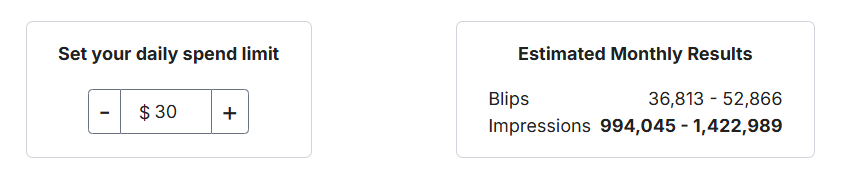
With Blip, billboard advertising in Sleepy Eye is built to fit your budget. You choose a daily amount you’re comfortable with, and Blip’s algorithm uses it to bid for open ad slots on rotating digital billboards. Each 7.5-to-10-second display, or “blip,” starts at just $0.01 per display.
Where can I advertise with Blip in Sleepy Eye?
Sleepy Eye sits at the junction of U.S. Highway 14 and Minnesota Highway 4 in Brown County, which gives it strong billboard fundamentals. U.S. 14 is the backbone of Sleepy Eye’s regional movement, while Highway 4 provides north-south connectivity through town. These routes reach commuters, local households, ag workers, and regional travelers moving between Sleepy Eye, New Ulm, and Mankato.
When is the best time to run a Blip billboard campaign in Sleepy Eye?
The strongest windows are usually 6 a.m. to 9 a.m., 11 a.m. to 1 p.m., and 3 p.m. to 6 p.m. Those blocks align with work commutes, school runs, lunch errands, and after-work shopping. Fall from September through November is also one of the strongest billboard periods because harvest traffic increases and school sports are back.
Why is Sleepy Eye a good market for Blip billboard advertising?
Sleepy Eye is a small southern Minnesota market with unusually strong billboard fundamentals because it has repeat local travel and a wider rural trade area. Most trips here happen by car, and many households regularly drive to New Ulm, Mankato, schools, medical appointments, work sites, and farm-service destinations. That combination makes Sleepy Eye a strong place for smart, well-timed digital billboard advertising.
What kind of businesses work well for billboard advertising in Sleepy Eye with Blip?
The local economy is anchored by agriculture, food processing, healthcare, education, and regional services. That creates good conditions for recruitment, training, trade services, healthcare outreach, lending, insurance, and everyday consumer offers. Highway 4 is especially effective for farm and ag-service advertisers, local clinics, repair businesses, and community banking offers.
Do I need a contract to advertise with Blip in Sleepy Eye?
No, Blip has no long-term contracts or minimum commitments. You can start, pause, or stop your campaign at any time.
How fast can I launch a billboard campaign with Blip in Sleepy Eye?
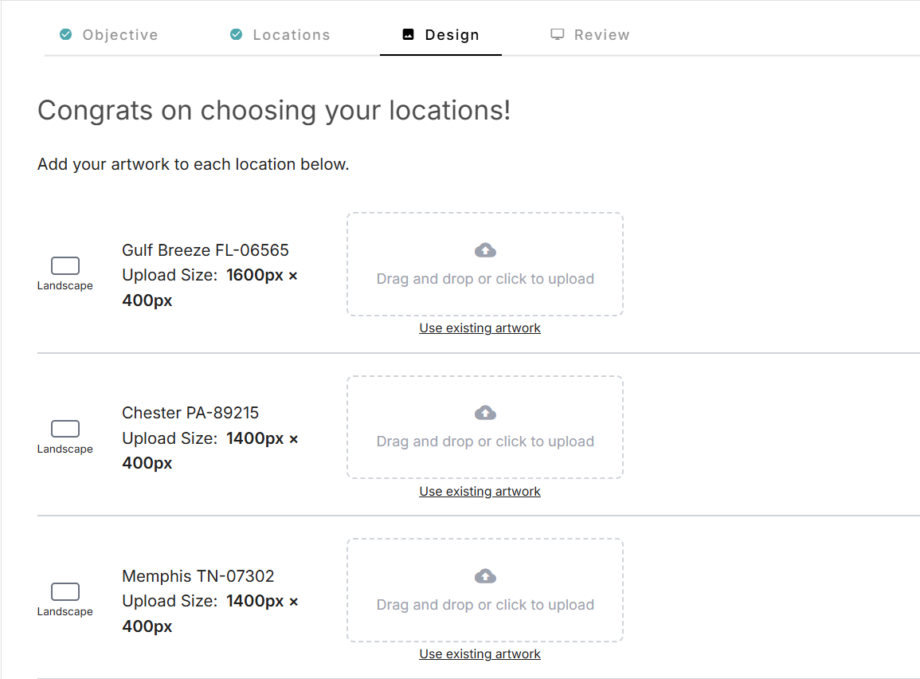
You can have your campaign live in minutes. Create a free account, select your locations, set your budget, upload your design, and start running once approved.
Where can I advertise with Blip in Sleepy Eye?
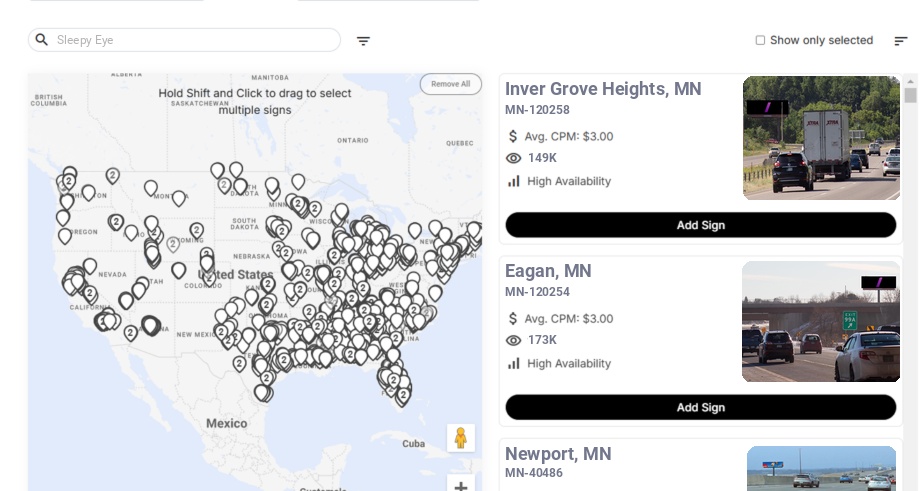
Blip has digital billboards in Sleepy Eye. You can browse available locations on a map, choose the ones that fit your audience, and start advertising right away.
Still have questions? Launch a campaign in minutes — no contracts, no commitments.
Start Your CampaignSleepy Eye Billboard Advertising Guide
Sleepy Eye U.S. Highway 14 and Minnesota Highway 4 in Brown County Minnesota State Demographic Center places the city at roughly 3,400 residents (3,464 in the 2020 Census), while Brown County is home to about 25,900 people, which gives us a compact local audience plus a wider rural trade area. Most trips here happen by car, and many households regularly drive to New Ulm, Mankato
Market Overview for Sleepy Eye
Sleepy Eye is a small city with a regional role
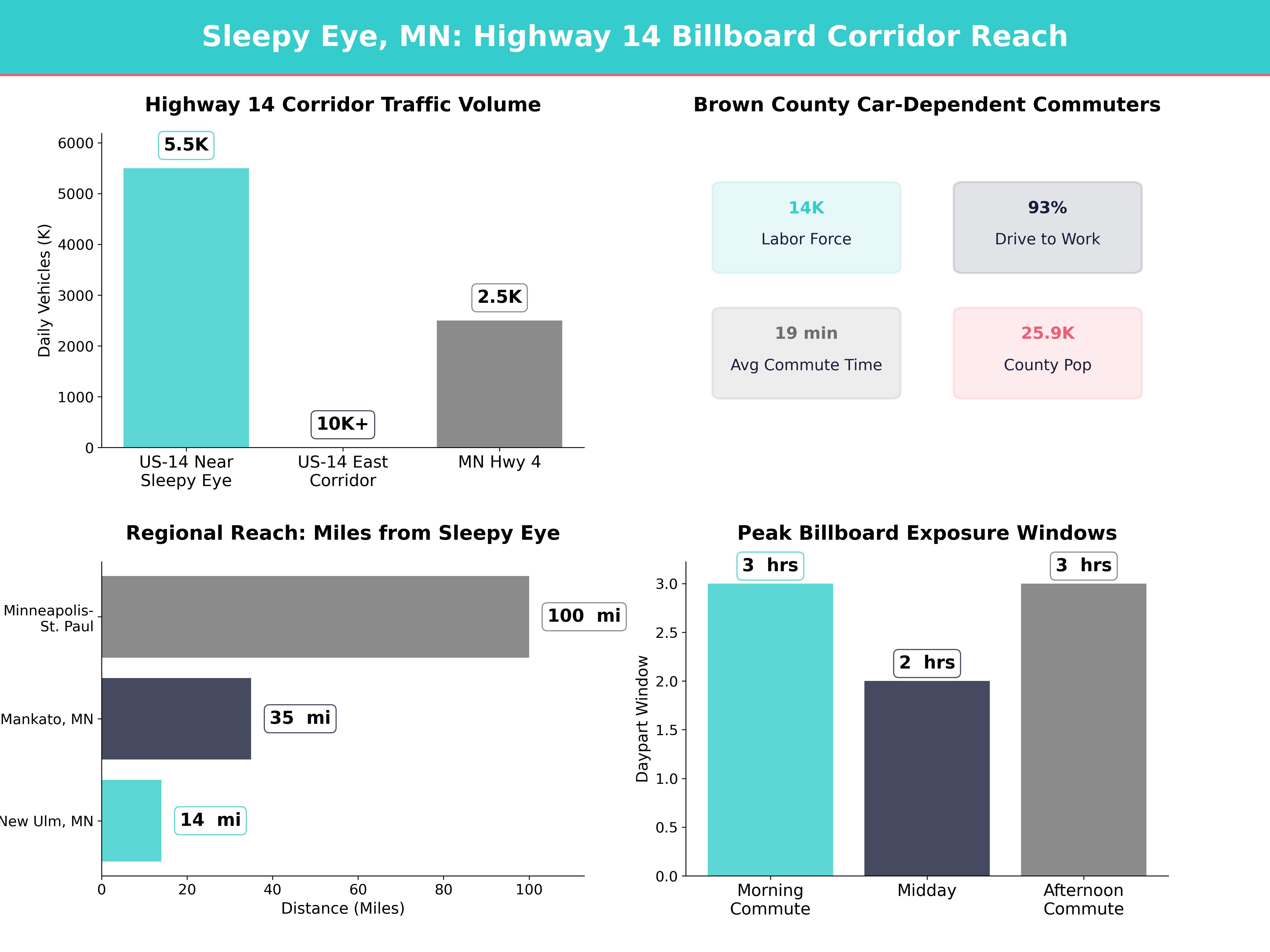
Sleepy Eye works best when we think of it as more than one town. It is a local community, but it also functions as a service hub for nearby rural households, ag operations, industrial workers, and families moving around south-central Minnesota. New Ulm is only about 14 miles to the east, Mankato 35 miles to the northeast, and the Minneapolis-Saint Paul 100 miles away, so even a modest campaign can influence both everyday local trips and longer regional drives.
Population growth in this part of Minnesota has been relatively flat rather than explosive, according to the Minnesota State Demographic Center. That matters for billboard strategy because stable markets reward repetition. When the same drivers use the same routes week after week, frequency often matters more than broad but shallow reach.
Sleepy Eye’s economy supports practical, intent-driven advertising
The local economy is anchored by agriculture, food processing, healthcare, education, and regional services. Employers and institutions such as Christensen Farms, Del Monte Foods Sleepy Eye Medical Center Sleepy Eye Public School District Mayo Clinic Health System in New Ulm
From a labor standpoint, Minnesota Department of Employment and Economic Development data consistently show rural south-central Minnesota operating with a relatively tight labor market, and Brown County unemployment has often been in the 3% to 4% range outside unusual downturns. Brown County’s labor force is roughly 14,000 people, which is meaningful in a county of its size. That creates good conditions for recruitment, training, trade services, healthcare outreach, lending, insurance, and everyday consumer offers.
What commute behavior means for Sleepy Eye advertisers
Commute and errand habits are especially billboard-friendly here. Minnesota Compass shows that more than 9 in 10 workers — roughly 93% — in counties like Brown typically get to work by car, truck, or van when we combine solo driving and carpooling. Average travel times are still short by metro standards, at roughly 19 minutes, but those trips are highly predictable. For us, that means a billboard does not need huge urban traffic to be effective. It needs to be on the right route, in front of the right drivers, at the right time of day.
Key Traffic Corridors for Sleepy Eye Billboard Campaigns
Sleepy Eye’s travel pattern is organized around a few high-value roads. That makes location planning simpler than in a large metro, but it also means each corridor carries a distinct audience and purchase intent.
U.S. Highway 14
U.S. Highway 14 is the backbone of Sleepy Eye’s regional movement. Recent Minnesota Department of Transportation traffic maps generally show segments near Sleepy Eye in the neighborhood of 4,500 to 6,500 AADT, depending on the exact location and year of count. Eastward toward New Ulm and the larger regional corridor, counts rise further, and parts of the broader U.S. 14 corridor move into 10,000-plus daily vehicles.
This route is ideal for advertisers that benefit from repeated regional visibility, including:
- Retailers and restaurants that want to capture routine east-west traffic.
- Healthcare providers that draw patients from multiple towns.
- Auto dealers, lenders, and home-improvement brands that depend on planned purchases.
- Employers that need to reach drivers traveling between communities for work.
Because U.S. 14 connects Sleepy Eye with New Ulm and the larger Mankato
Minnesota Highway 4
Minnesota Highway 4 gives Sleepy Eye its north-south connectivity. MnDOT counts on similar rural trunk highways in this area generally place traffic through town in the 2,000 to 3,000 AADT range. Those volumes are smaller than U.S. 14, but they are still valuable because the audience is highly local and highly relevant.
Highway 4 is especially effective for:
- Farm and ag-service advertisers.
- Tire, parts, repair, and equipment businesses.
- Local clinics, dental offices, and service professionals.
- Grocery, telecom, insurance, and community banking offers.
On a route like Highway 4, the same customer may pass a board multiple times in a week. That kind of repetition is powerful in a market where trust and familiarity strongly influence purchase decisions.
The Sleepy Eye to New Ulm to Mankato path
For many advertisers, the right strategy is not only “in Sleepy Eye,” but “from Sleepy Eye outward.” Residents routinely travel east for shopping, medical care, higher education, and larger events. A campaign that starts around Sleepy Eye and extends toward New Ulm and Mankato
This extended corridor is useful when we want to target:
- Higher-education audiences near Minnesota State University, Mankato, which serves 10,000-plus students.
- Healthcare seekers traveling to larger regional providers.
- Shoppers making planned trips rather than spontaneous stops.
- Employers willing to recruit from a 35- to 45-mile radius.
Audience Segments We Can Reach in Sleepy Eye
Commuters and errand traffic
Sleepy Eye is a car-first market, so commuters remain the core billboard audience. The strongest windows are usually 6 a.m. to 9 a.m., 11 a.m. to 1 p.m., and 3 p.m. to 6 p.m. Those blocks align with work commutes, school runs, lunch errands, and after-work shopping.
This audience is ideal for banks, healthcare, restaurants, pharmacies, grocery stores, and service businesses because the message reaches people while they are already moving toward a purchase or appointment.
Agricultural and industrial workers
This is one of the most important segments in the Sleepy Eye area. Brown County’s economy is closely tied to farming, animal agriculture, food production, trucking, and support services. Brands connected to Christensen Farms, Del Monte Foods
For this audience, billboard messaging should emphasize utility and immediacy. Hiring, service availability, financing terms, parts inventory, and location cues generally outperform abstract branding.
Families, students, and school communities
Sleepy Eye’s family audience is more important than raw population totals may suggest. The city has strong school-related travel generated by Sleepy Eye Public School District August through May. Athletic events, concerts, and school functions also add weeknight traffic from about 5 p.m. to 9 p.m.
This segment is a natural fit for:
- Healthcare and dental practices.
- Family restaurants and grocery stores.
- Wireless, internet, and financial services.
- School-year recruitment for childcare, after-school programs, and youth activities.
Visitors, recreation users, and regional travelers
Even though Sleepy Eye is not a major tourism market on the scale of the North Shore or Brainerd Lakes, it still benefits from warm-weather recreation, local festivals, road trips, and nearby destination traffic promoted by Explore Minnesota New Ulm and the Minnesota River Valley.
For advertisers, this audience is especially valuable from Memorial Day to Labor Day, when leisure trips increase and local spending broadens beyond basic errands.
Seasonal and Timing Opportunities in Sleepy Eye
Spring in Sleepy Eye: planting, hiring, and home projects
From April through June, we usually see stronger relevance for ag services, seed and crop inputs, equipment support, home improvement, tax services, outdoor recreation, and spring healthcare messaging. This is also a good time for recruitment campaigns tied to seasonal labor and summer production.
If we are advertising services that solve urgent problems, spring is a strong window because customers are actively planning purchases and schedules rather than casually browsing.
Summer in Sleepy Eye: travel, festivals, and regional events
Summer is Sleepy Eye’s broadest lifestyle advertising season. Local recreation demand rises, family schedules become more mobile, and nearby events create extra traffic. Bavarian Blast in New Ulm typically lands in July, and Farmfest, held near Morgan, is usually in early August and within about 30 miles of Sleepy Eye. Those events can boost regional awareness campaigns for ag brands, hospitality, entertainment, healthcare, and retail.
Summer timing works especially well for:
- Campgrounds, resorts, and recreation.
- Quick-service restaurants and c-stores.
- Farm and equipment brands around event-driven travel.
- Tourism, real estate, and home services.
Fall in Sleepy Eye: harvest, canning, sports, and healthcare
From September through November, Sleepy Eye moves into one of its strongest billboard periods. Harvest traffic increases, school sports are back, and food-processing demand often intensifies. Employers can use 6- to 10-week hiring bursts during this season, especially if they need plant, logistics, maintenance, or shift-based labor.
This is also a smart time for:
- Orthopedic, urgent care, and primary care messaging.
- Heating, HVAC, and winterization services.
- Farm lenders, insurance agencies, and equipment dealers.
- Hunting, outdoor, and sporting-goods promotions tied to the early-November deer opener.
Winter in Sleepy Eye: early darkness and high-frequency messaging
From November through February, the market becomes more repetitive and more routine-driven. Sunset arrives before 5 p.m. in December, road conditions can be challenging, and many consumers default to familiar businesses. That makes winter a strong season for high-contrast creative and consistency.
We often like winter campaigns for:
- Healthcare providers.
- Tax preparation and financial services.
- Indoor retail, furniture, and mattresses.
- Restaurants and convenience-driven offers.
- Post-holiday recruitment and training programs.
Billboard Design Tips for Sleepy Eye
Lead with practical value, not vague brand language
Sleepy Eye audiences tend to respond best to direct, useful messaging. In a market shaped by work, family, agriculture, and routine travel, people want to know what we offer, where we are, and why it matters now. Simple headlines such as “Now Hiring on Hwy 14,” “Appointments This Week,” or “Feed, Seed, and Service off Hwy 4” usually fit the market better than clever but unclear taglines.
We generally recommend keeping the main line to 6 to 8 words, using 1 clear offer, and giving 1 location cue.
Use visuals that feel native to south-central Minnesota
Creative should feel like it belongs here. Field imagery, trucks, family scenes, small-town storefronts, medical care, local food, seasonal color, and outdoor recreation can all work when they are authentic. Blue-and-white lake imagery can be effective in summer, while harvest gold, safety orange, deep green, and high-contrast winter palettes often feel right in fall and winter.
If the campaign serves local households broadly, we should avoid looking too polished or too metro. Sleepy Eye advertising often performs better when it feels grounded, trustworthy, and useful.
Consider bilingual creative where it fits the offer
Sleepy Eye has a meaningful Latino presence, and bilingual English-Spanish creative can improve relevance for hiring, grocery, telecom, healthcare, finance, and community-service campaigns. We do not need to overload one board with two full messages. A better approach is often to rotate language versions, or keep the primary headline in one language and the supporting line in the other.
That approach keeps the design readable while still signaling inclusion and familiarity.
Build around route logic
Because local traffic is shaped by 2 main highways, directional language matters more here than in some larger cities. Messages like “East on 14,” “Next turn off 4,” or “14 miles to New Ulm” can be powerful if they match the customer journey. When people are already driving with a destination in mind, route-based relevance can outperform broad awareness messaging.
Regional Strategies Around Sleepy Eye
Focus on frequency inside Sleepy Eye and the immediate trade area
If our goal is local awareness, we should prioritize repeated exposure within a 5- to 10-mile radius. This is the right approach for clinics, local retail, restaurants, schools, service providers, churches, and community events. In a smaller market, one well-placed board can do a lot of work when the audience passes it several times each week.
Extend east when we need more scale
If we want broader reach, we should expand toward New Ulm and the Mankato 15- to 40-mile regional strategy can help us reach bigger shopping flows, healthcare seekers, students, and job candidates. This is often the best plan for larger employers, specialty healthcare, colleges, and destination retail.
Use north-south placements for ag and service categories
For ag suppliers, co-ops, repair shops, lenders, equipment brands, and rural services, a north-south strategy along Minnesota Highway 4 can be more efficient than chasing only the biggest traffic counts. The audience may be smaller, but the fit is stronger, and the buying intent is often higher.
Time regional campaigns around events and seasonal peaks
Event-led targeting can work well in this geography. We can start with Sleepy Eye inventory, then add boards near Farmfest, Bavarian Blast, back-to-school periods, or harvest windows. That approach keeps the campaign grounded locally while widening the audience when demand rises.
Using Blip Tools in Sleepy Eye Campaigns
Match the buying approach to the market size
In Sleepy Eye, a manual campaign works well when location is everything, such as a board on U.S. 14 for a restaurant, clinic, or local employer. A Blip-optimized campaign can be a better fit when we want the platform to distribute budget across Sleepy Eye, New Ulm, and Mankato
Daypart around actual local movement
Because travel rhythms are consistent, dayparting is especially useful here. We can weight spend toward 6 a.m. to 9 a.m. for work traffic, 11 a.m. to 1 p.m. for lunch and errands, 3 p.m. to 6 p.m. for school and commute traffic, and even Friday 2 p.m. to 7 p.m. for weekend movement. That lets us put budget where Sleepy Eye drivers are most active without paying for low-value overnight hours.
Refresh creative with the season
Sleepy Eye is a good market for quick creative changes because the local calendar shifts clearly. We can move from spring planting to summer recreation to fall hiring to winter healthcare with small artwork updates every 2 to 3 weeks if needed. Blip’s artwork tools make that much easier than waiting on a traditional billboard production cycle.
Use analytics to compare local and regional performance
One of the smartest Sleepy Eye tactics is comparing board groups by corridor. We can monitor whether U.S. 14 boards drive stronger reach than Highway 4 boards, or whether eastbound regional placements outperform local frequency. That makes it easier to shift budget based on what the market is actually doing, not what we assumed in advance.
Getting Started with Billboard Rental in Sleepy Eye
Start with the real trading radius
Before we rent anything, we should define how far customers truly travel for the offer. A local restaurant, dental office, or school may only need a 5- to 10-mile radius. A healthcare provider, ag brand, or employer may need 15 to 40 miles. A specialty service or college recruitment campaign may need a 35- to 45-mile draw.
The better we define that radius up front, the easier it is to choose the right boards.
Evaluate each Sleepy Eye billboard by route, direction, and intent
In this market, a billboard is not just a screen. It is a point on a customer journey. We should ask:
- Is the board on U.S. 14 or Highway 4, and does that match our audience?
- Is the message aimed at local frequency, or at regional destination traffic?
- Does the board face the direction people are traveling when they can act on the message?
- Is the nearby destination a school, employer, clinic, retail area, or event route?
Those questions matter more than raw traffic alone in a market of this scale.
Expect a simpler process than traditional billboard buying
Traditional billboard companies often work through fixed inventory packages, longer lead times, and 4-week buying blocks. With Blip, we can usually move much faster. We can select boards on a map, upload creative, adjust timing, and refine spending without turning a simple Sleepy Eye campaign into a long negotiation.
Launch with a test mindset
We like starting Sleepy Eye campaigns with at least 2 creative variations and a clear hypothesis about audience and timing. Then we can watch performance, tune dayparts, and decide whether to stay concentrated in Sleepy Eye or expand into New Ulm and Mankato 7.5- to 10-second blip, clarity matters from day one.
In practical terms, Sleepy Eye billboard rental works best when we stay focused on route relevance, repetition, and seasonality. If we choose boards that match how people actually move through Brown County