Billboards in Magna, UT
No Minimum Spend. No Long-Term Contracts. Just Results.
Trusted by Leading Brands


Billboard advertising
in Magna has never been easier



How much is a billboard in Magna?
Why Choose Blip for Billboard Advertising in Magna
Blip lets Magna advertisers launch fast and self-serve on SR-201 commuter traffic without traditional buying hassles.
Set flexible budgets in Magna and reach west-side drivers by I-80, I-215, and Bangerter without contracts or minimums.
Use dayparting in Magna to hit 85% car commuters at rush hour, then shift to ski-weekend and event-night traffic.
Track Magna billboard results in real time and move spend toward the corridors that work best for airport and industrial audiences.
Build and upload creative in minutes with Blip, so Magna campaigns can swap winter, back-to-school, or hiring messages fast.
Frequently Asked Questions About Billboard Advertising in Magna
How much does a billboard cost in Magna with Blip?
With Blip, billboard advertising in Magna can be surprisingly affordable because you control what you spend. You set a daily budget, and Blip’s algorithm uses it to bid for open ad slots; you only pay when your ad actually appears. Pricing is dynamic, so the cost per blip can change based on time of day, location, and advertiser demand.
Where can I advertise with Blip in Magna?
SR-201 is Magna’s signature advertising corridor, and UDOT traffic counts show that SR-201 segments east of Magna commonly run in the 70,000 to 100,000+ AADT range. Interstate 80, Interstate 215 on the west side, Bangerter Highway, and Magna’s local arterials such as 3500 South, 5400 South, 5600 West, 7200 West, and 8400 West are also important routes. These roads help reach local shoppers, commuters, airport traffic, and regional travelers.
Why is Magna a strong billboard market with Blip?
Magna is a strong billboard market because we are advertising inside the orbit of one of the Intermountain West’s biggest population centers while still benefiting from a distinctly road-driven local audience. The 2020 Census counted 28,333 residents in Magna, and the township sits within Salt Lake County's 1,185,238-person market. Most workers on Magna’s west side commute by private vehicle, so a relatively small group of highways and arterials concentrates daily impressions in ways advertisers can use efficiently.
What kind of audience can Blip reach in Magna?
Magna works because it gives us more than one audience. We can use the same geography to reach workers, families, shoppers, visitors, and students, depending on which corridors and dayparts we choose. Magna is also a family market, and Granite School District serves roughly 67,000 students across 93 schools.
When is the best time to advertise in Magna with Blip?
Magna campaigns work best when we respect the local calendar. From December through April, winter weather changes driver behavior and purchase priorities, while from May through August Magna becomes more event-oriented. August and September are especially valuable for family-oriented advertisers, and November and December bring heavier shopping, airport trips, gift spending, and event attendance.
Do I need a contract to advertise with Blip in Magna?
No, Blip has no long-term contracts or minimum commitments. You can start, pause, or stop your campaign at any time.
How fast can I launch a billboard campaign with Blip in Magna?
You can have your campaign live in minutes. Create a free account, select your locations, set your budget, upload your design, and start running once approved.
Where can I advertise with Blip in Magna?
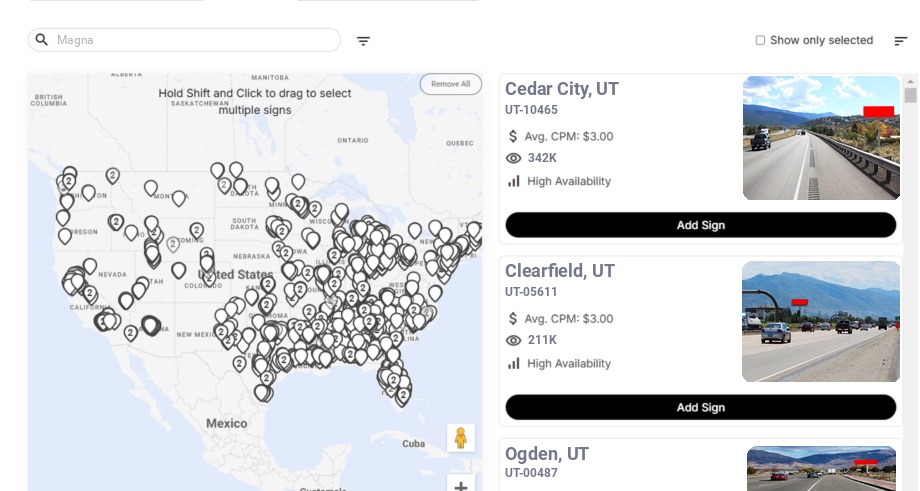
Blip has digital billboards in Magna. You can browse available locations on a map, choose the ones that fit your audience, and start advertising right away.
Still have questions? Launch a campaign in minutes — no contracts, no commitments.
Start Your CampaignMagna Billboard Advertising Guide
Magna 2020 Census counted 28,333 residents in Magna, and the township sits within Salt Lake County's 1,185,238-person market, which gives our campaigns local relevance and regional scale at the same time. Most workers on Magna’s west side commute by private vehicle, with roughly 85% driving alone or carpooling, so a relatively small group of highways and arterials concentrates daily impressions in ways advertisers can use efficiently. We also benefit from nearby industrial employment, airport traffic, Great Salt Lake recreation, and regional event travel, which helps Magna billboards reach far beyond the township line.
Magna Market Overview
Magna Metro Township Salt Lake County economy.
Magna’s population base and growth
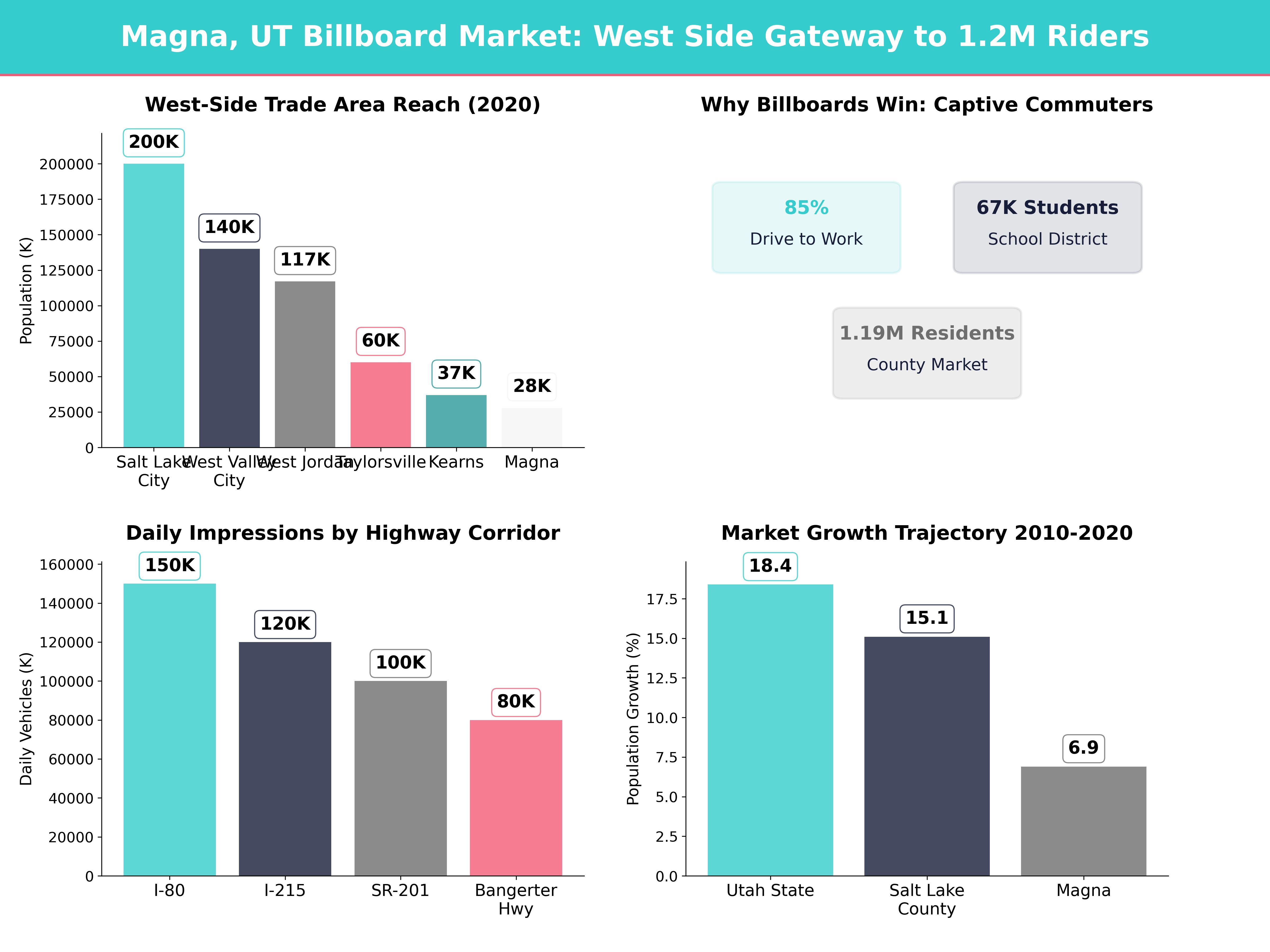
Magna grew from 26,505 residents in 2010 to 28,333 residents in 2020, which was an increase of 1,828 people, or about 6.9% over the decade. That growth was slower than the county and the state, but it still matters because it added households without changing Magna’s core identity as a stable, commuter-oriented community.
The surrounding market is much larger. Salt Lake County grew from 1,029,655 residents in 2010 to 1,185,238 in 2020, adding 155,583 people for 15.1% growth. Utah as a whole grew from 2,763,885 residents in 2010 to 3,271,616 in 2020, which was an increase of 507,731 people, or 18.4%.
For advertisers, that means Magna works best when we think beyond the township boundary. We are reaching Magna residents, but we are also speaking to western Salt Lake Valley households and pass-through traffic from the larger metro.
The west-side population around Magna
The neighboring communities around Magna create a much larger practical trade area than the township population alone suggests. The 2020 Census counted 140,230 residents in West Valley City, 116,961 in West Jordan, 60,448 in Taylorsville, 36,723 in Kearns, and 200,133 in Salt Lake City, for a combined 554,495 residents.
When we add those nearby markets together, we can see why Magna billboard placements punch above their weight. They serve local shoppers and workers, but they also reach regional residents moving between the west side, downtown, the airport, and the southwest valley.
Why car dependence matters in Magna
Magna is a car-first market. American Community Survey commuting patterns for Magna and the west side consistently show that roughly 85% of workers get to work by private vehicle when we combine driving alone and carpooling, and that matters because repeated roadside exposure is exactly what billboards do best.
That road orientation is reinforced by geography. Magna sits west of Salt Lake City Tooele County, near Rio Tinto Kennecott Salt Lake City International Airport. A business that needs broad awareness, such as healthcare, legal services, retail, food service, automotive, home services, or hiring, can use Magna-area boards to build frequency with commuters who drive the same routes every week.
Key Traffic Corridors Around Magna
Utah Department of Transportation traffic maps make Magna’s billboard logic clear. A few corridors carry a large share of the area’s daily movement, and those corridors let us match message, audience, and budget with unusual precision.
State Route 201
SR-201 is Magna’s signature advertising corridor. UDOT traffic counts show that SR-201 segments east of Magna commonly run in the 70,000 to 100,000+ AADT range, and the busiest eastern segments push above 100,000 vehicles per day.
That matters because SR-201 connects Magna to West Valley City, I-80, and the urban core. It is ideal for:
- Automotive advertisers, because drivers are already in a car-dependent decision environment.
- Quick-service restaurants and convenience brands, because commuters often make impulse stops on routine trips.
- Healthcare, dental, legal, and insurance services, because frequency and repetition support consideration-based purchases.
- Employers and recruiters, because the route reaches both local workers and regional labor moving through the west side.
Interstate 80
I-80 is Magna’s regional amplifier. On Salt Lake County segments near the airport and the central valley, UDOT counts often exceed 150,000 AADT, making it one of the strongest broad-reach corridors available to advertisers targeting the metro.
We should use I-80 when we want Magna-area campaigns to stretch beyond neighborhood awareness. This corridor is especially effective for:
- Airport-oriented hospitality and parking, because it serves travelers heading to and from Salt Lake City International Airport.
- Tourism and entertainment, because it captures visitors moving between downtown, the airport, and the mountain access routes.
- Large healthcare systems, colleges, and events, because it reaches a genuinely regional audience.
Interstate 215 on the west side
I-215 complements SR-201 and I-80 by capturing north-south movement on the west side. UDOT traffic maps show west-belt segments regularly in the 100,000 to 120,000+ AADT range, particularly where the freeway handles airport, commuter, and cross-valley traffic.
We should lean into I-215 when we want broader metro household reach. It is a strong fit for:
- Retail chains and big-box stores, because it connects multiple residential zones.
- Event venues, because it captures pre-event and post-event traffic.
- Higher education and healthcare, because those categories benefit from recurring, metro-scale exposure.
Bangerter Highway and Magna’s arterial grid
Bangerter Highway is especially important for campaigns that need western and southwestern Salt Lake Valley households. Depending on the segment, Bangerter often carries roughly 50,000 to 80,000 AADT, and it links growth areas that advertisers cannot ignore.
Magna’s local arterials matter too. Roads such as 3500 South, 5400 South, 5600 West, 7200 West, and 8400 West are where neighborhood frequency happens. These are the routes we should favor for:
- Local clinics, dentists, and urgent care providers.
- Home improvement, HVAC, plumbing, and electrical services.
- Family entertainment and after-school services.
- Restaurants and retailers that depend on repeat local trips.
Audience Segments We Can Reach in Magna
Magna works because it gives us more than one audience. We can use the same geography to reach workers, families, shoppers, visitors, and students, depending on which corridors and dayparts we choose.
Magna and west-side commuters
The first audience is the daily commuter base. Magna’s 28,333 residents sit near a ring of west-side communities that includes 140,230 people in West Valley City, 60,448 in Taylorsville, and 36,723 in Kearns.
These are high-frequency audiences because they repeat routes. For many categories, that repetition is more valuable than a single premium impression. If we are promoting legal services, injury care, car dealerships, job openings, storage, banks, or local retail, Magna’s commuter flow is exactly the kind of audience we want.
Families and school-driven households
Magna is also a family market. Granite School District serves roughly 67,000 students across 93 schools, and much of the west side follows the district’s school-year rhythm for shopping, childcare, activities, and healthcare decisions.
That family orientation makes Magna especially useful for:
- Pediatric, dental, and family healthcare brands.
- Grocery, telecom, and discount retail.
- Tutoring, childcare, and youth recreation.
- Home services that rely on household decision-makers.
Industrial, logistics, and shift-based workers
The west side’s economic identity is deeply tied to industry and logistics. Rio Tinto Kennecott Bingham Canyon Mine 2.5 miles wide and roughly 0.75 mile deep.
That industrial backbone supports billboard categories that perform well with shift-based and trade-oriented audiences, including:
- Recruiting and staffing.
- Pickup trucks, tires, tools, and workwear.
- Quick meals and convenience offers.
- Banks, credit unions, and tax services.
- Workers’ comp, injury, and legal services.
Visitors, eventgoers, and regional leisure traffic
Magna is not a pure tourism market, but it sits inside a much larger visitor ecosystem. Visit Salt Lake promotes a region with 4 major Salt Lake County ski resorts, namely Alta Ski Area, Snowbird, Brighton Resort, and Solitude Mountain Resort.
The area also benefits from events and attractions that draw regional movement, including The Great Saltair, Utah State Fairpark, Maverik Center, Delta Center Salt Palace Convention Center, which offers about 515,000 square feet of exhibit space. Even sports-related leisure adds to the mix, because the Utah Olympic Oval is anchored by a 400-meter speed skating oval.
These audiences are ideal for hospitality, entertainment, dining, and event-driven retail.
Seasonal and Timing Opportunities in Magna
Magna campaigns work best when we respect the local calendar. The market is steady year-round, but certain windows produce sharper intent and stronger relevance.
Winter in Magna and the Salt Lake region
From December through April, winter weather changes driver behavior and purchase priorities. Ski travel increases, snow and ice create urgency around tire shops and auto care, and cold snaps raise demand for HVAC, plumbing, and home services.
This is also the season when regional leisure travel spikes toward Alta Ski Area, Snowbird, Brighton Resort, and Solitude Mountain Resort. We should favor I-80, I-215, and SR-201 during this window if we want to capture skiers, airport arrivals, and residents making weather-driven purchases.
Spring and summer for events, concerts, and home services
From May through August, Magna becomes more event-oriented. The Great Saltair and the west-side concert circuit can create useful nighttime and weekend demand, while warmer weather makes home improvement, lawn care, pest control, and exterior services much more relevant.
Summer also increases family recreation trips to the Great Salt Lake State Park, downtown festivals, and sports venues. This is a good time for restaurants, local attractions, retail promotions, and seasonal service providers.
Back-to-school and fall buying cycles
August and September are especially valuable for family-oriented advertisers. School resumes, schedules tighten, and households make fresh decisions about childcare, healthcare, after-school activities, restaurants, and retail.
September also matters because the Utah State Fairpark calendar and fall event season add extra regional movement. If we are advertising family services, youth programs, apparel, wireless plans, or routine care, early fall is one of the smartest times to increase frequency.
Holiday travel and year-end retail
November and December bring heavier shopping, airport trips, gift spending, and event attendance. That creates a strong case for evening-commute targeting, airport-adjacent placements, and bold promotional creative.
In Magna, holiday advertising works especially well for:
- Retail and gift offers.
- Dining and catering.
- Entertainment and live events.
- Healthcare enrollment and year-end financial services.
Billboard Design Tips for the Magna Market
Magna audiences respond best when our creative feels practical, local, and easy to process at speed. This is not a market that rewards vague branding alone.
Use clear value language for Magna’s working households
Magna’s west-side audience includes many working families and shift-based commuters, so our best creative usually leads with the offer, not the backstory. Price, speed, availability, financing, and convenience are often stronger hooks than abstract brand statements.
Messages such as “Open Late,” “Free Estimate,” “Now Hiring,” “Same-Day Care,” and “2 Miles Ahead” fit the market well because they match real roadside decisions.
Consider bilingual or culturally inclusive creative
Magna and the west side have a substantial Hispanic and Latino presence, so bilingual or Spanish-forward creative can be a smart local choice when it reflects the advertiser’s real customer base. Even when we stay in English, simple wording, familiar visuals, and plain-language offers tend to outperform overly polished corporate copy.
Show visuals that feel locally credible
In Magna, credibility matters. Imagery tied to family life, home ownership, trucks, tools, food, sports, local recreation, and west-side pride often feels more authentic than stock imagery that could belong anywhere.
We can also use subtle regional cues, such as mountain silhouettes, the lake horizon, winter gear, or industrial textures, to make a campaign feel grounded in Salt Lake County rather than generic.
Design for fast road environments
Magna-area boards often face fast traffic on SR-201, I-80, and I-215, so concise design matters even more than usual. In a 7.5-to-10-second digital slot, we should favor one message, one visual focal point, and one action.
That usually means:
- A short headline.
- A large brand mark.
- A simple directional cue or offer.
- Strong contrast for snow, glare, and nighttime driving.
Regional Strategies for Magna and Nearby Submarkets
A Magna campaign gets better when we stop treating every board as interchangeable. The most effective plans usually mix local frequency with regional reach.
Magna proper and neighborhood service coverage
When our goal is store traffic, service calls, or neighborhood awareness, we should start with boards closest to Magna’s own retail and residential movement. Placements near 3500 South, 8400 West, and SR-201 access points help us stay close to the community itself.
This is where local brands often win. Dentists, HVAC companies, local restaurants, auto repair shops, churches, youth programs, and nearby clinics should usually begin here.
West Valley City, Taylorsville, and the broader west valley
If we need more household scale, we should widen into West Valley City, Taylorsville ChamberWest. This move expands reach quickly without leaving Magna’s natural consumer orbit.
This strategy works well for regional healthcare groups, furniture stores, wireless carriers, supermarkets, and entertainment brands that need broad household awareness.
Airport, downtown, and event-facing corridors
For campaigns that depend on visitors or regionwide brand lift, we should push east toward Salt Lake City International Airport, Salt Lake City Salt Palace Convention Center, Delta Center Utah State Fairpark.
This approach is especially strong for hotels, attractions, restaurants, tourism brands, higher education, and event-driven advertisers.
Westbound strategy toward Tooele County
Magna also sits on the path toward Tooele County, which had 72,698 residents in 2020. That makes westbound and interchange-oriented placements useful for advertisers that want to reach commuters moving between Salt Lake County and the communities farther west.
If our customer base includes contractors, trade workers, logistics employees, or regional families making shopping trips, this westbound strategy can add meaningful incremental reach.
Using Blip Tools for Magna Billboard Campaigns
Blip is especially useful in Magna because the market rewards testing. Traffic patterns are strong, but audience intent changes by route, by time of day, and by season.
Build a corridor-based campaign mix
We can use Blip’s map-based planning to mix SR-201 frequency with I-80 or I-215 reach instead of committing our entire budget to one board. That lets us learn whether our customer is more likely to respond on a neighborhood commuter route or on a larger regional freeway.
Daypart around how Magna actually moves
Magna is a great place to use dayparting. Morning and evening commute windows can work well for professional services, urgent care, and food offers, while late afternoon and early evening can be stronger for family retail and restaurants.
Concert nights, fair dates, and ski weekends are also good opportunities to tighten timing.
Rotate creative by audience and season
We should not use the same message for every screen. A recruiting ad on a west-side commuter route can emphasize pay, shifts, or hiring speed, while an airport-facing board can focus on convenience, directions, or booking.
In winter, we can switch to weather-relevant creative. In back-to-school season, we can pivot toward family offers.
Use analytics to refine Magna placements
Blip’s real-time reporting helps us compare which corridors actually deliver the best response for our goal. After a short test, we can move budget toward the boards, hours, and creative versions that fit Magna’s audience best, rather than guessing based on market stereotypes.
Getting Started with Billboard Rental in Magna
Renting a billboard in Magna is much easier when we begin with the geography, not the format. The right board is the one that matches our audience’s route and our customer’s decision moment.
Start with a practical campaign goal
We should first decide whether we need:
- Local store traffic in Magna.
- Regional awareness across the west valley.
- Recruiting reach for industrial or service jobs.
- Event, tourism, or airport-facing visibility.
That choice determines whether we should favor neighborhood arterials, SR-201, I-80, I-215, or a mix of all four.
Evaluate boards the way Magna drivers experience them
In Magna, we should judge a board by the travel environment around it. Direction of travel, vehicle speed, proximity to exits, nearby retail, and whether the audience is commuting, shopping, or heading to an event all matter.
A board that is perfect for a local restaurant may be wrong for a legal brand or a regional healthcare system. We should always ask what the driver is doing at that exact point on the road.
Expect more flexibility than traditional billboard buying
Traditional billboard buying often pushes long commitments, limited change windows, and a slower planning cycle. Blip simplifies that process by letting us launch, adjust, pause, and test locations without turning Magna into a high-risk media buy.
That flexibility is especially useful in a market like Magna because local conditions change quickly. School periods, weather, concerts, hiring pushes, and weekend travel can all affect which message makes sense.
Begin small, learn quickly, and expand what works
A smart Magna campaign often starts with a focused test on a few west-side and regional boards. Once we see which route, message, and daypart are producing the right kind of response, we can scale into additional screens near West Valley City, Salt Lake City West Jordan, or Tooele County.
If we stay disciplined about matching audience, corridor, and timing, Magna can deliver the two things billboard advertisers want most: efficient frequency and broad regional spillover.