Billboards in Provo, UT
No Minimum Spend. No Long-Term Contracts. Just Results.
Trusted by Leading Brands


Billboard advertising
in Provo has never been easier



How much is a billboard in Provo?
Why Choose Blip for Billboard Advertising in Provo
Blip lets you launch Provo billboards in minutes, reaching I-15 commuters and BYU traffic without buying a long-term package.
Set a Provo daily budget that fits your goals, then scale up for BYU games, graduation, or Stadium of Fire surges.
Use Blip dayparting in Provo to hit morning commuters on I-15 and midday student traffic on University Parkway when they’re most likely to act.
No contracts means you can test Provo routes like State Street and Geneva Road, then shift spend to what drives results.
Track Provo billboard performance in real time and adjust fast as Utah County traffic changes between campus, Silicon Slopes, and weekend canyon trips.
Blip's creative tools help you build bold Provo ads for students, families, and tech workers with clean, high-contrast messaging.
Frequently Asked Questions About Billboard Advertising in Provo
How much does a billboard cost in Provo, Utah with Blip?
With Blip, you control exactly what you spend on Provo billboards by setting your own daily budget, whether that’s a few dollars a day or more. Each “blip” is a brief 7.5 to 10-second ad on digital billboards in Provo, Utah, and you only pay for the blips you actually receive. Costs vary based on when and where your ad appears and current advertiser demand, but Blip automatically keeps your campaign within the budget you choose and lets you adjust it anytime.
Where can I advertise with Blip in Provo, Utah?
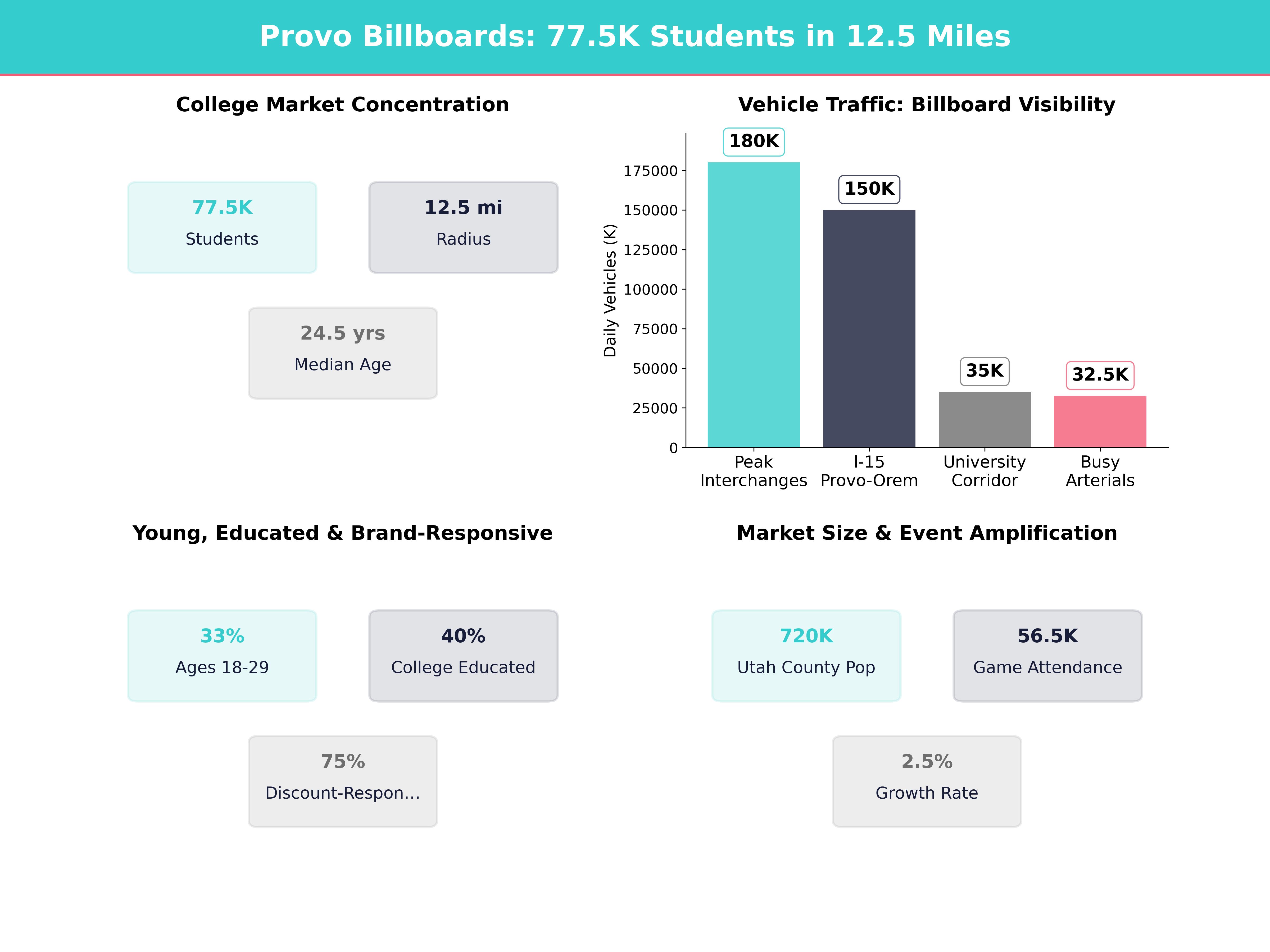
High-impact corridors in Provo include Interstate 15, University Parkway, University Avenue, State Street, and Geneva Road. I‑15 carries over 150,000 vehicles per day in the Provo–Orem stretch, while routes near BYU and UVU routinely see 30,000–40,000 vehicles per day. These roads connect students, commuters, shoppers, and event traffic, making them strong options for billboard placement.
Why are Provo, Utah billboards effective for reaching students and young adults?
Between BYU and UVU, the Provo–Orem area influences an audience of 70,000+ students within a roughly 10–15 mile radius. Provo’s median age is around 24–25, and student-age adults make up roughly one-third of the Provo–Orem population. Students also commute daily between campus, housing, jobs, and social hubs, creating repeated exposure to billboards.
When is the best time to run Blip billboards in Provo, Utah?
Provo’s calendar creates powerful peaks around BYU semesters, move-in and back-to-school season, graduation, and major sports events. BYU home football games and the annual Stadium of Fire event bring large surges in traffic and visitors, while summer and fall tourism also create strong opportunities. Blip’s scheduling can ramp up impressions 1–2 weeks before move-in or during major campus events.
How should I target commuters with billboards in Provo, Utah?
Many residents commute between Provo, Orem, Lehi, and Salt Lake County, making rush-hour messaging especially effective. Morning commute windows are 7:00–9:00 a.m. and evening windows are 4:00–6:30 p.m., when I‑15 speeds drop and drivers spend more minutes in view of each board. The page recommends commuter-specific messaging for time-saving services, B2B offerings, and professional services.
Do I need a contract to advertise with Blip in Provo?
No, Blip has no long-term contracts or minimum commitments. You can start, pause, or stop your campaign at any time.
How fast can I launch a billboard campaign with Blip in Provo?
You can have your campaign live in minutes. Create a free account, select your locations, set your budget, upload your design, and start running once approved.
Where can I advertise with Blip in Provo?
Blip has digital billboards in Provo. You can browse available locations on a map, choose the ones that fit your audience, and start advertising right away.
Still have questions? Launch a campaign in minutes — no contracts, no commitments.
Start Your CampaignProvo Billboard Advertising Guide
Provo, Utah sits at the heart of Utah County Silicon Slopes
Provo Market Snapshot: Why This Area Works So Well for Billboards
Provo is both a college town and a major employment hub, which creates dense, repetitive daily traffic—perfect for digital billboards and traditional billboards in Provo that drivers pass every day on their commute.
Key stats that shape campaign strategy:
-
Population concentration
- Provo’s population is around 115,000 residents, while Utah County as a whole has climbed past 720,000 residents in recent estimates from Utah County 2–3%.
- The median age in Provo is around 24–25, compared with a Utah statewide median in the low 30s, giving the city one of the youngest age profiles of any metro in the U.S. Local data from Provo City also shows average household sizes above 3.0 people per household, reflecting large family and student households.
- More than 40% of residents in the Provo–Orem area have some college or a bachelor’s degree or higher, creating a highly educated audience that responds well to informational and professional‑services messaging.
-
University presence
- Brigham Young University (BYU) in Provo enrolls about 34,000+ students on campus each year, plus thousands of staff and faculty. BYU reports that LaVell Edwards Stadium seating capacity of 63,470, and regular home attendance frequently exceeds 50,000 fans per game, causing intense surges in traffic on game days and boosting the visibility of nearby Provo billboards.
- Just up the road in Orem, Utah Valley University (UVU) enrolls around 43,000+ students, according to UVU fact sheets. That makes UVU one of the largest public universities in the state.
- Combined, the Provo–Orem corridor regularly hosts 75,000–80,000 university students during the academic year, all within a roughly 10–15 mile radius.
-
Economic engine
- Utah County is a core part of “Silicon Slopes,” with thousands of tech and startup jobs clustered along I‑15 and in nearby Lehi, Orem, and Provo. The Silicon Slopes 100,000 workers statewide, with a substantial share in Utah County.
- Provo’s official economic development pages from Provo City highlight an unemployment rate that often runs 1–2 percentage points below the national average, a diverse base of 1,000+ local businesses, and key sectors in software, education, healthcare, and tourism.
- Median household incomes in many Provo‑area neighborhoods fall in the $60,000–$80,000 range, with tech‑corridor zip codes trending higher, which supports both value‑oriented and premium offers.
-
Commuting & traffic
- I‑15 carries well over 150,000 vehicles per day through the Provo–Orem section, according to counts published by UDOT. Some interchanges in neighboring Orem and Lehi now see 170,000–190,000 vehicles per day, giving advertisers repeated exposures to regional commuters.
- North–south arterial roads like University Avenue (US‑189), State Street (US‑89), and Geneva Road serve dense local and campus traffic, often handling 25,000–40,000 vehicles per day on the busiest segments.
- The Utah Transit Authority reports strong use of the FrontRunner commuter rail and bus routes connecting Provo with Salt Lake County, adding another layer of daily movement past key billboard locations and making billboard rental in Provo effective for both residents and regional visitors.
For billboard advertisers, this means we’re dealing with a large, young, educated, and highly mobile audience, with predictable traffic flows and heavy repeat exposure.
Understanding Provo’s Core Audiences
To get the most from digital billboards and other billboards in Provo, we should design campaigns around how people in Provo actually live, move, and make decisions.
1. Students and Young Adults
- Size & density: Between BYU and UVU, we’re influencing an audience of 70,000+ students within a roughly 10–15 mile radius. Student‑age adults (18–29) make up roughly one‑third of the Provo–Orem population, far above the national share.
- Housing & lifestyle: Local housing summaries from Provo City and Orem City 60–80% of units are renter‑occupied, with high turnover each academic year. That creates recurring demand for housing, furnishings, food, and services.
-
Behavior: Students typically:
- Commute between campus, off‑campus housing, jobs, and social hubs via I‑15, University Parkway, University Avenue, and State Street. Peak student routes can see tens of thousands of daily trips when school is in session.
- Are highly price‑sensitive and responsive to limited‑time offers and promotions; surveys of college‑age consumers routinely show 70–80% report choosing brands based on discounts and loyalty rewards.
- Engage heavily with mobile and social platforms: Utah ranks near the top nationally for smartphone ownership and social media use among 18–29 year‑olds, making billboard‑to‑digital crossovers powerful.
Creative implications:
-
Use bold, minimal designs with:
- 5–7 words max
- Strong contrast (e.g., dark background + light type)
- A single, standout offer (e.g., “$5 Lunch Near Campus – Exit 269”)
- Highlight student discounts, promo codes, or time-bound offers tied to class schedules (lunch hours, evening outings), and reinforce them on channels like Instagram, TikTok, and campus media such as BYU’s The Daily Universe.
2. Families & Long-Term Residents
Provo and surrounding cities ( Orem Springville Spanish Fork) have large family households, high birth rates, and strong community ties.
- Utah is consistently ranked among the states with the highest birth rate and largest average household size; Utah County mirrors this pattern, with many neighborhoods averaging 4+ people per household according to local planning departments.
- Local school districts such as Provo City School District and Alpine School District serve tens of thousands of K‑12 students, driving predictable traffic around school start and end times.
-
Families frequent:
- Retail plazas along University Parkway and State Street
- Big-box and grocery nodes near freeway interchanges (e.g., Provo Towne Centre, major warehouse clubs, and grocery anchors)
- Parks, churches, and schools scattered through neighborhoods; Provo Parks & Recreation 50+ parks and facilities, many near major arterials
-
They’re heavily influenced by:
- Value (multi‑purchase deals, memberships, family discounts)
- Safety, education, and community reputation—local surveys regularly show schools, safety, and affordability among the top decision factors for Utah County families.
Creative implications:
- Emphasize trust, savings, and convenience.
-
Use family-centric imagery (without clutter) and clear calls like:
- “Family Eye Exams – 5 Minutes from This Exit”
- “Save 20% on Weekly Groceries – Provo Location Only”
- Consider including signals like “locally owned since [year]” or “trusted by X Utah families” if you can back it with real customer counts.
3. Tech, Healthcare, and Office Workers
Many residents commute between Provo, Orem, Lehi, and Salt Lake County.
-
Major employment nodes:
- Downtown Provo business district and civic center, supported by Downtown Provo Inc., which highlights hundreds of local businesses, offices, and restaurants.
- Tech and office parks along I‑15 in Provo, Orem, and Lehi; the broader Silicon Slopes corridor is home to dozens of large employers and thousands of small tech firms.
- Healthcare facilities including Intermountain Utah Valley Hospital thousands of staff and serves hundreds of thousands of patient visits per year.
-
Commute windows:
- Morning: 7:00–9:00 a.m.
- Evening: 4:00–6:30 p.m.
- UDOT peak‑period data shows I‑15 speeds dropping significantly in these windows, meaning drivers spend more minutes in view of each board.
Creative implications:
-
Target time‑saving services, B2B offerings, or professional services:
- Managed IT, coworking, corporate housing, financial services, legal, healthcare, and recruiting.
-
Use commuter-specific messaging:
- “IT Support for Growing Teams – Book in 60 Seconds”
- “Exit 265: Coffee That Beats I‑15 Traffic”
- Consider including recruitment stats (“Hiring 50+ roles in Provo”) to stand out in a competitive labor market.
Traffic Patterns and Placement Strategy in Provo
Digital billboard success in Provo depends on aligning message, location, and time with how people move, and selecting billboard rental in Provo that covers both highway and surface-street corridors.
High-Impact Corridors
-
Interstate 15 (I‑15) – Backbone of the Market
- Over 150,000 vehicles per day in the Provo–Orem stretch, with some segments approaching 170,000+ according to UDOT traffic volumes.
-
Serves:
- Regional commuters (Lehi/SLC ↔ Provo/Spanish Fork)
- Gametime and event traffic (BYU, UVU, concerts, sports)
- Weekend outdoor and shopping trips to destinations promoted by Explore Utah Valley
-
Strategy:
- Use I‑15 placements for brand awareness campaigns (healthcare, banks, real estate, auto, insurance, universities).
-
Pair brand awareness with simple directional cues:
- “Next 2 Exits”
- “Provo River Activities – Exit 275”
- “New Apartments – 3 Minutes Off This Exit”
- Consider upper‑funnel KPIs: a brand seen by 150,000+ daily vehicles, even at conservative occupancy and viewability assumptions, can generate hundreds of thousands of weekly impressions.
-
University Parkway & University Avenue
- These routes link BYU, UVU, and major retail hubs. Segments near the universities routinely see 30,000–40,000 vehicles per day, plus heavy pedestrian activity.
- Very high concentration of student + shopper traffic: two large campuses, multiple grocery chains, big‑box retailers, and dining clusters.
-
Strategy:
- Perfect for offer-based ads (fast casual, gyms, tutors, retail, salons).
-
Rotate messages by daypart:
- Morning: test prep, tutoring, breakfast, coffee.
- Afternoon: quick lunches, student services, auto repair.
- Evening: entertainment, restaurants, group activities.
- During back‑to‑school weeks, traffic counts and retail sales along these corridors can spike by 10–20% compared to summer baselines.
-
State Street & Geneva Road
- Heavy local traffic with more price-sensitive shoppers; many stretches report 20,000–30,000 vehicles per day.
- These roads connect Provo to Orem, Lindon, and Pleasant Grove, making them ideal for multi‑city catchment.
-
Strategy:
- Focus on value messaging (discount retailers, used auto, family dining, local services).
- Emphasize proximity and savings: “Oil Change Under $40 – 1 Mile Ahead.”
- Test A/B creative like “Save $10 Today” vs “Oil Change Under $40” to see which drives more calls or web traffic from local zip codes.
Seasonality and Event-Driven Opportunities
Provo’s calendar creates powerful peaks where digital billboards can deliver outsized results, and well-timed Provo billboard advertising can capture visitor spending during those peaks.
BYU Academic Year & Campus Events
- BYU semesters (roughly late August–April) bring tens of thousands of students back to town, plus an influx of visiting families several times per year.
-
Key windows:
-
Move‑in / back‑to‑school (Aug–Sep):
- BYU and UVU combined welcome thousands of new freshmen and returning students each fall.
- High demand for housing, furniture, banking, cell plans, groceries, and student jobs; local retailers often report double‑digit percentage increases in sales during the first two weeks of fall semester.
-
Midterms & finals:
- Increased interest in tutoring, mental health services, caffeine, and food delivery. Late‑night concepts and study‑friendly venues can see noticeable spikes; campus reports routinely highlight extended library and lab hours.
-
Graduation (April):
- Graduation ceremonies at BYU and UVU bring in thousands of visiting family members over a few days, driving up hotel occupancy, restaurant reservations, and photography bookings.
-
Move‑in / back‑to‑school (Aug–Sep):
- Check the BYU events calendar and UVU’s events pages to align your flights with high‑traffic academic and cultural events.
Tactics:
-
Use Blip’s scheduling to ramp up impressions:
- 1–2 weeks before move‑in
- During major campus events (club fairs, orientation, graduation)
-
Rotate creative:
- Early semester: “Now Hiring Students – Start This Week.”
- Mid-semester: “Late-Night Study Fuel – Open Until Midnight.”
- Graduation: “Celebrate Grads Tonight – Reserve Your Table in Provo.”
Sports & Stadium of Fire
- BYU home football games at LaVell Edwards Stadium can draw 50,000–63,000+ attendees per game, in a city of only about 115,000 residents—effectively doubling the city’s active population in the immediate area on game days.
-
The annual Stadium of Fire Independence Day event typically attracts 40,000–50,000 attendees, plus significant related traffic on I‑15, University Parkway, and University Avenue.
- Learn more via America’s Freedom Festival in Provo
- Local news outlets such as Daily Herald and KSL.com regularly cover these events, amplifying awareness before and after.
Tactics:
- Increase bids and frequency on game days and holidays along I‑15 and main arteries leading to the stadium.
-
Time creatives:
- Pre‑event (weekdays before): parking solutions, restaurants, pre‑party venues, retail sales.
- Day-of: quick meals, parking, last-minute tickets, ridesharing, branded awareness.
- Post‑event: recovery offers (breakfast spots, chiropractic/massage, auto repair).
- Consider geo‑matching your digital ads to zip codes and device locations that cluster near the stadium during events for retargeting.
Outdoor & Tourism Seasons
The Provo area is a gateway to major outdoor attractions:
- Provo Canyon & Sundance Mountain Resort (skiing, hiking, festivals). Sundance Mountain Resort offers winter skiing with hundreds of skiable acres and year‑round events that draw local and out‑of‑state visitors.
- Utah Lake and nearby canyons and trailheads, heavily promoted for boating, fishing, and bird‑watching.
- Regional tourism promoted via Explore Utah Valley, which reports millions of annual visitors across Utah Valley attractions, events, and conferences.
Seasonal patterns:
- Winter: ski traffic to/from Sundance, holiday shopping, winter sports retailers. Lodging in nearby mountain areas can see occupancy rates jumping to 70–90% on peak weekends.
- Spring: hiking, biking, graduation tourism, and increasing national park traffic passing through Utah County.
- Summer: lake activities, youth sports tournaments, summer camps, and large events like the Freedom Festival; many local restaurants and attractions report their highest monthly sales during June–August.
- Fall: leaf peeping in Provo Canyon, football, back‑to‑school, Halloween events; scenic drives become a key leisure activity.
Tactics:
-
Align creatives to activities:
- “Rental Cars for Ski Weekends – Exit 263.”
- “Boat Rentals on Utah Lake – Reserve Today.”
- “Fall Family Photos – Book While Colors Last.”
- Coordinate with the Explore Utah Valley event calendar to sync offers with festivals, races, and conferences.
Creative Best Practices for Provo’s Audience
With digital billboards, simple and targeted design wins, especially in a fast‑moving market like Provo where billboards in Provo may only have seconds to make an impression on passing drivers.
Message & Tone
-
Reflect Provo’s young, family‑oriented, and faith‑influenced culture:
- A majority of Utah County residents identify with a faith‑based community, and local surveys highlight family, education, and service as core values.
- Positive, clean, and upbeat messaging generally outperforms edgy or provocative themes here.
-
Focus on:
- Value (discounts, savings, bundles)
- Community & trust (local, family-owned, long-standing; “Serving Utah County since 2005”)
- Convenience (nearby, fast, easy; “Just Off Exit 265”)
-
Reinforce any hard numbers you have:
- “Trusted by 5,000+ Utah County patients”
- “Rated 4.8★ by 1,200+ local reviews”
Examples tailored for local context:
- “New Family Dentist in Provo – Same‑Day Appointments.”
- “Tech Bootcamp in Utah County – Launch Your Career in 12 Weeks.”
- “Local Meal Prep for Busy BYU & UVU Students – Order Online.”
Visuals and Layout
- Use high contrast and large fonts that can be read in 2–3 seconds; drivers on I‑15 typically have only 6–10 seconds to view a board at highway speeds.
-
Include:
- One core visual (e.g., product image or key person).
- One short headline.
- One simple next step (exit, website, short URL, or promo code).
-
For student and commuter audiences, test:
- Vanity URLs: “MyGymProvo.com”
- Short codes: “Text PROVO to 12345”
- Keep character counts low: the Outdoor Advertising Association of America often recommends no more than 7–10 words total; in a quick‑view market like Provo, staying on the low end of that spectrum is even more critical.
Localization
-
Reference local landmarks and routes:
- “Off University Parkway.”
- “Near BYU Campus, 5 Minutes East.”
- “Across from Provo Towne Centre.”
-
Use seasonal tie‑ins that locals immediately recognize:
- “Pre‑Game Burgers – Just South of LaVell Edwards Stadium.”
- “Beat Canyon Traffic – Reserve Your Rental Online.”
- “Fuel Up Before Stadium of Fire – Exit 265.”
- Consider using local news and weather cues (e.g., “Snow Day? We Deliver – Provo & Orem”) alongside coverage from outlets like Daily Herald.
Using Blip’s Tools Strategically in Provo
Blip’s flexibility—pay‑per‑blip bidding, dayparting, and location selection—lets us tailor campaigns tightly to the Provo market and get more from every dollar spent on Provo billboard advertising.
1. Hyper-Local Location Targeting
-
Focus on corridors that match your audience:
- Students and young adults: boards near BYU, UVU, University Parkway, University Avenue, and student housing clusters highlighted on Provo City and Orem City
- Families: east‑side neighborhoods, State Street retail, near grocery and big-box areas, and around major schools and parks.
- Commuters and B2B: I‑15 facing rush-hour flows between Provo, Orem, Lehi, and Salt Lake.
-
Approach:
- Start with 2–4 locations, then expand based on performance metrics (web traffic, coupon redemptions, store visits).
-
Track basic metrics like:
- Changes in local organic search (e.g., “dentist Provo”)
- New customer zip codes
- Promo code usage tied to specific boards (“Code: UNIVERSITY” vs “Code: STATEST”)
- Consider directional creatives on boards closest to your location: “Next Exit – Turn Right on University Ave.”
2. Dayparting for Maximum Relevance
Provo’s life rhythm is highly predictable:
-
Early Morning (6–9 a.m.):
- Commuters, early classes, parents on school runs; local schools generally start between 7:30–9:00 a.m.
- Promote: coffee, breakfast, fitness, B2B services, commuter offers.
-
Midday (11 a.m.–2 p.m.):
- Student lunch, errands, retail, quick services.
- Promote: QSR, fast casual, medical/dental, auto services, same‑day appointments.
-
Afternoon (2–5 p.m.):
- Students finishing classes, after‑school, family errands.
- Promote: tutoring, extracurriculars, family entertainment, youth programs advertised by local parks and recreation departments.
-
Evening (5–9 p.m.):
- Dining, shopping, sports, entertainment; BYU and UVU events frequently begin in this window.
- Promote: restaurants, movies, escape rooms, date‑night activities, faith‑friendly and family events.
With Blip, we can:
- Increase bids during our key dayparts and lower them during less relevant times, smoothing out cost‑per‑impression.
-
Run different creatives by time of day:
- Morning: “Stop Before Work.”
- Afternoon: “After‑School Snacks – 2 Miles Ahead.”
- Evening: “Tonight Only – Kids Eat Free.”
3. Budgeting and Testing
-
Start with a daily budget sized to your goals and scale:
- A small local business might start as low as $5–$15 per day focused on key hours and 2–3 nearby boards.
- Larger regional brands may invest hundreds of dollars per day for broad I‑15 saturation through Utah County.
-
Use short test flights:
- 2–4 weeks with multiple creatives and locations.
- Compare performance data from your own channels (web analytics, in‑store feedback, promo code usage).
-
Simple testing framework:
- Run 2–3 creative variations at the same time.
- Assign unique URLs or offer codes by creative (“/provo1”, “/provo2”).
- After at least 10,000–20,000 impressions per creative, keep the one delivering the most leads or sales.
Iterate:
- Pause underperforming creatives or locations.
- Double down on specific times, routes, or messages that drive measurable results.
- Consider coordinating with coverage from Daily Herald or KSL.com when you have newsworthy milestones (expansions, awards, or community events).
Integrating Billboards with Local Media and Digital Channels
Provo’s audiences are highly online and strongly connected via local information sources, which makes it easy to connect offline impressions from billboards in Provo with online search and social activity.
Pairing with Local News and Community Outlets
Local news and information hubs include:
- Provo City announcements and city channels
- Daily Herald (Utah County’s major newspaper)
- KSL.com (regional news with strong Utah County reach)
- Campus media such as BYU’s The Daily Universe
- Local radio and TV such as KBYU and other Utah County broadcasters
How to integrate:
-
Time your billboard campaign with:
- Local news coverage of your brand, events, or initiatives.
- Sponsored content or digital ads on these sites.
- Community events listed on Provo City Explore Utah Valley.
- Use consistent visuals and taglines across billboards and online, so commuters recognize your brand when they see it again on their phones or laptops.
- Track referral traffic from these outlets; when news‑site impressions and billboard flights overlap, you should see noticeable lifts in direct and branded search traffic.
Driving Online Action
Because Provo’s median age is low and digital adoption is high, many billboard views turn into immediate online searches.
Best practices:
- Use searchable brand names and simple URLs.
-
Align your billboard campaign with:
- Search ads targeting “near me” terms (e.g., “dentist in Provo,” “student housing near BYU”).
- Social media campaigns targeting Provo, BYU, and UVU audiences, especially on Instagram, TikTok, and Facebook.
- Design your landing pages for quick conversion: many Utah County users access sites on mobile; local analytics often show 60–70% of sessions coming from smartphones.
Example:
- Billboard: “New BYU Housing – Walk to Campus – WillowCourtApts.com”
- Digital: Instagram and TikTok ads with tours and move‑in specials targeting 18–25‑year‑olds within 10 miles of Provo.
-
Measure success:
- Track spikes in direct URL visits during your billboard flight.
- Use short URLs or UTM tags to tie traffic back to specific campaigns.
Example Campaign Concepts for Provo
To illustrate how everything ties together, here are a few sample approaches that show how to use Provo billboards in real-world scenarios.
Student Housing Launch
- Objective: Fill a new apartment complex near BYU.
- Timing: July–September (pre‑semester / move‑in), when tens of thousands of students are finalizing housing.
-
Blip Strategy:
- Locations: Boards on University Parkway, University Avenue, and I‑15 near Provo.
- Dayparts: Heavy focus 7 a.m.–10 p.m., with added emphasis on evenings when students and parents tour properties.
-
Creatives:
- “Walk to BYU – Now Leasing for Fall.”
- “$300 Off First Month – Provo Student Housing.”
- “Private Rooms • Free Wi‑Fi • 3-Min Walk to Campus.”
- Integration: Coordinate with BYU events calendar to ramp impressions before new-student events and orientations; run parallel social ads targeting BYU and UVU students.
Family Dental Practice Growth
- Objective: Attract families within a 5–10 mile radius.
- Timing: Year‑round with push during back‑to‑school (July–September) and early summer.
-
Blip Strategy:
- Locations: Boards along State Street, neighborhood‑adjacent routes, and near retail centers frequented by families.
- Dayparts: Morning and late afternoon (school runs) plus early evening.
-
Creatives:
- “Family Dental Care in Provo – New Patients Welcome.”
- “Checkups Before School Starts – Book Today.”
- “Kids’ Cleanings in Under 45 Minutes – Exit 265.”
- Integration: Promote a dedicated landing page and offer (“Free Whitening with Exam”) and track new‑patient signups from Provo, Orem, and Springville zip codes. Consider sponsoring a local school or youth sports team, with mentions on Provo City School District or league pages.
Tech Employer Recruiting
- Objective: Hire software engineers and support staff from the Provo–Orem–Lehi corridor.
- Timing: Ongoing, with spikes before BYU and UVU graduation dates.
-
Blip Strategy:
- Locations: I‑15 commuter boards plus roads near BYU and UVU.
- Dayparts: Morning and evening commute peaks; mid‑day bursts during campus career fairs.
-
Creatives:
- “Build What’s Next in Provo – We’re Hiring Engineers.”
- “Local Tech, Global Impact – Apply at [YourURL].”
- “$120K+ Engineer Roles in Utah County – Apply Today.”
- Integration: Align with campus career fairs and ads on local job boards and LinkedIn; look for editorial opportunities in Daily Herald or Silicon Slopes
By aligning our targeting, timing, and creative with Provo’s unique mix of students, families, commuters, and outdoor enthusiasts, we can use Blip’s digital Provo billboards to punch far above our budget. The combination of high traffic volumes, a young and tech-savvy population, and flexible pay‑per‑blip buying makes billboard rental in Provo an especially powerful option for thoughtful, data‑driven outdoor campaigns.