Billboards in West Jordan, UT
No Minimum Spend. No Long-Term Contracts. Just Results.
Trusted by Leading Brands


Billboard advertising
in West Jordan has never been easier



How much is a billboard in West Jordan?
Why Choose Blip for Billboard Advertising in West Jordan
Blip lets you launch West Jordan billboards fast, reaching Bangerter Hwy and Redwood Rd commuters without a long-term commitment.
Set a flexible budget in West Jordan and scale up for Jordan Landing weekends, school seasons, or holiday shopping rushes.
Daypart your West Jordan ads for 6:30-9 a.m. and 3:30-6:30 p.m. to catch repeat daily commuters on east-west routes.
No contracts means you can test West Jordan billboards on family-focused campaigns, then shift spend to what drives calls.
Track West Jordan performance in real time and refine by corridor, traffic peaks, and local audience response.
Use Blip's creative rotation tools to run bilingual or family-first West Jordan messages for the city's young, diverse households.
Frequently Asked Questions About Billboard Advertising in West Jordan
How much does a billboard cost in West Jordan, Utah with Blip?
With Blip, you control exactly what you spend on West Jordan billboards by setting a daily budget that can be increased or decreased whenever you like. Every “blip” is a 7.5 to 10-second ad on rotating digital billboards in West Jordan, Utah, and you only pay for the blips you receive. Pricing for each blip changes based on when and where your ad shows and current advertiser demand, so even small budgets can access premium exposure.
Where can I advertise with Blip in West Jordan, Utah?
Blip campaigns can capture attention along Bangerter Highway, Redwood Road, and the east–west commuter corridors that define daily life in West Jordan. Key corridors in and around West Jordan include Bangerter Highway, Redwood Road, 7000 South, 7800 South, 9000 South, and the Mountain View Corridor. Boards in the West Jordan core, around Jordan Landing, and along southwest commuter routes are all strong options for reaching local drivers.
What kind of audience will West Jordan, Utah billboards reach?
West Jordan, Utah sits in the fast-growing southwest corner of the Salt Lake Valley and gives us a powerful mix of suburban families, commuters, and retail shoppers to reach with digital billboards. The city has a median age of about 30 to 31 years, with more than 50% of residents under age 35, creating a strong base of young families and early-career professionals. Homeownership rates are high and median household income is in the mid-$80,000s, supporting campaigns around home services, remodeling, and durable goods.
When is the best time to run Blip ads in West Jordan, Utah?
Typical traffic peaks in West Jordan are roughly 6:30–9:00 a.m. and 3:30–6:30 p.m., with a strong spike in 4:30–5:30 p.m. homebound traffic. Midday bump traffic from 11 a.m.–2 p.m. is especially strong around retail hubs and food corridors such as Jordan Landing. Saturday midday traffic on commercial corridors often rivals or exceeds weekday midday volumes, making weekends attractive for retail, dining, and entertainment campaigns.
Do I need a contract to advertise with Blip in West Jordan?
No, Blip has no long-term contracts or minimum commitments. You can start, pause, or stop your campaign at any time.
How fast can I launch a billboard campaign with Blip in West Jordan?
You can have your campaign live in minutes. Create a free account, select your locations, set your budget, upload your design, and start running once approved.
Where can I advertise with Blip in West Jordan?
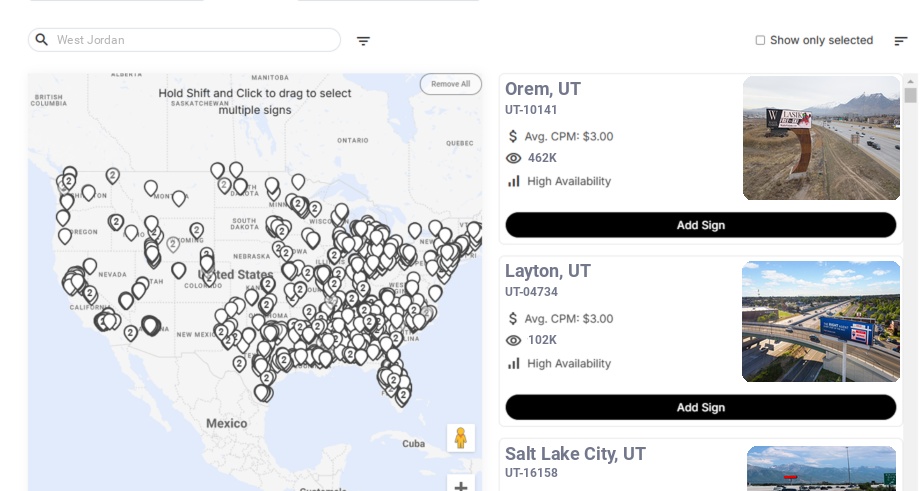
Blip has digital billboards in West Jordan. You can browse available locations on a map, choose the ones that fit your audience, and start advertising right away.
Still have questions? Launch a campaign in minutes — no contracts, no commitments.
Start Your CampaignWest Jordan Billboard Advertising Guide
West Jordan, Utah sits in the fast-growing southwest corner of the Salt Lake Valley and gives us a powerful mix of suburban families, commuters, and retail shoppers to reach with digital billboards. With a 2020 population of 116,961 and continued growth since then (local estimates place the city in the 120,000+ range by mid‑decade), West Jordan is now one of Utah’s largest cities and part of a metro area of over 1.2 million people. By pairing that growth with Blip’s flexible scheduling, budgeting, and creative rotation tools, we can build highly targeted campaigns that capture attention along Bangerter Highway, Redwood Road, and the east–west commuter corridors that define daily life in this city, and turn West Jordan billboards into reliable, always‑on visibility for local brands.
Understanding the West Jordan Audience
To design effective campaigns, we should start with who lives and works in West Jordan and who will actually see billboards in West Jordan on their daily routes.
- Population growth: 116,961 residents in the 2020 Census, up from 103,712 in 2010—a growth of about 12.7% over the decade, outpacing the overall U.S. growth of 7.4%. Salt Lake County as a whole has added more than 150,000 residents since 2010, reinforcing West Jordan’s role in a rapidly expanding metro that supports sustained demand for West Jordan billboard advertising.
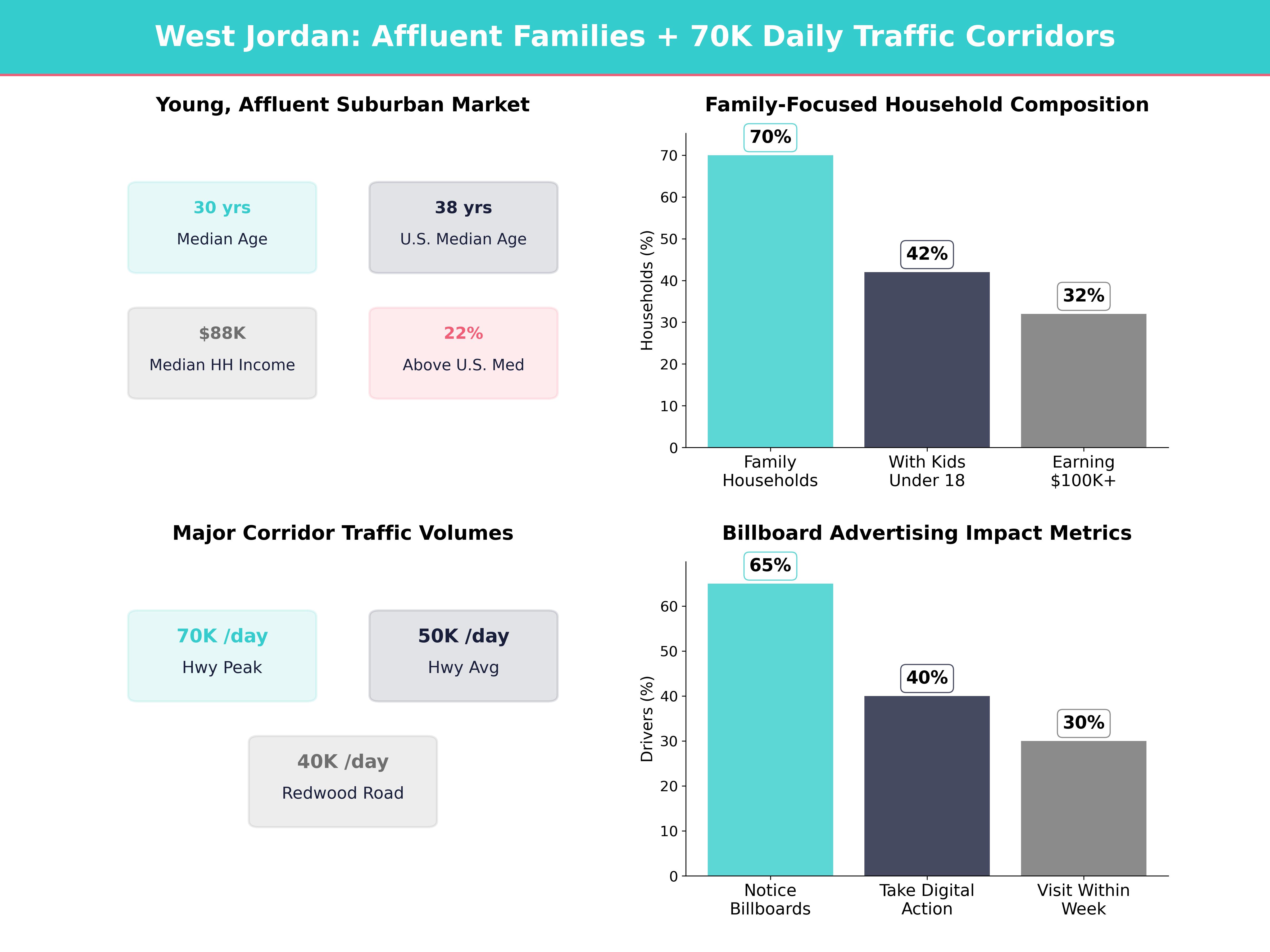
- Age: The median age in West Jordan is about 30–31 years, compared with roughly 38 years nationally. About 30–33% of residents are under age 20, and more than 50% are under age 35, creating a strong base of young families and early‑career professionals.
-
Households and families:
- Roughly 32,000–33,000 households in the city.
- Over 70% are family households, and about 40–45% of households include children under 18.
- Average household size is around 3.3–3.4 people vs. about 2.6 nationally, and average family size is close to 3.7–3.8 people.
- Homeownership rates are high, generally in the low‑70% range, which supports campaigns around home services, remodeling, and durable goods.
-
Income and spending power:
- Median household income in West Jordan is in the mid‑$80,000s (recent estimates around $87,000–$90,000), roughly 20–25% higher than the U.S. median and comparable to the Salt Lake County median.
- Around 30–35% of households earn $100,000 or more annually, supporting mid‑ to higher‑priced goods and services, from home improvement and autos to healthcare and financial services.
- Consumer spending data for Salt Lake County show that local households spend above the national average on categories like recreation, dining out, and personal services—areas where billboard calls-to-action perform well.
-
Diversity and language:
- West Jordan has a sizable Hispanic/Latino community, typically reported around 20–23% of the population.
- More than 15% of residents speak a language other than English at home, with Spanish the most common; this supports bilingual or Spanish‑inclusive creative.
-
Employment:
- Unemployment in Salt Lake County often runs 1–2 percentage points below the national rate (frequently in the 2–3% range in recent years), signaling a stable job market.
- Major sectors include healthcare, tech, retail, construction, logistics, and public education.
- A large share of residents commute to employment centers in West Jordan itself, nearby South Jordan, Riverton, West Valley City, and downtown Salt Lake City, creating predictable, high-frequency exposure patterns for billboards.
Local context, demographic summaries, and economic development updates are available from the City of West Jordan, Salt Lake County, and the West Jordan Chamber of Commerce
Implications for campaigns:
- Emphasize family benefits, value, and convenience (e.g., “Save 2 hours this week,” “Family passes,” “Kid‑approved”) so your West Jordan billboard advertising speaks directly to daily needs.
- Offer clear calls-to-action (CTAs) that appeal to busy working parents: easy online ordering, quick scheduling, or nearby locations.
- Consider bilingual or Spanish‑inclusive creative if appropriate; the city’s 20%+ Hispanic/Latino share means inclusive messaging can expand reach and differentiate your brand.
- Use financing, membership, or subscription offers that align with $80,000+ median household incomes (“from $99/month,” “family memberships under $50”).
Nationwide out‑of‑home (OOH) research from industry groups such as the Out of Home Advertising Association of America (OAAA) shows that:
- Over 40% of U.S. adults report noticing a digital billboard in the past week.
- Roughly 60–70% of drivers say they sometimes or frequently notice billboards during their regular commutes.
- Around 35–45% of recent OOH viewers report taking a digital action (searching online, visiting a website, or using a map app) after seeing an OOH ad.
Those national benchmarks, combined with West Jordan’s high car‑commute reliance, support using digital billboards in West Jordan as a core awareness and response channel.
Traffic Patterns and the Best Times to Run Blips
West Jordan’s layout and commuting patterns drive how and when we should schedule our Blip campaigns so that West Jordan billboards appear when local drivers are most attentive.
Key corridors in and around West Jordan include:
- Bangerter Highway (SR‑154): A major north–south expressway crossing West Jordan; Utah Department of Transportation (UDOT) reports several segments in southwestern Salt Lake County carrying on the order of 40,000–60,000 vehicles per day, with some peak segments in the corridor exceeding 70,000 vehicles per day.
- Redwood Road (SR‑68): A principal arterial on the east side of West Jordan with heavy commercial frontage; many segments in Salt Lake County see daily traffic in the 30,000–50,000 vehicle range, with especially strong flows near major intersections and retail centers.
- 7000 South, 7800 South, and 9000 South: Primary east–west connectors that funnel traffic toward I‑15, with daily volumes often in the tens of thousands of vehicles—commonly 20,000–35,000 vehicles per day where these roads connect to major arterials.
- Mountain View Corridor (SR‑85): Just west of West Jordan, carrying fast‑growing commuter traffic connecting the southwest valley to the broader region. Some completed segments report annual average daily traffic (AADT) in the 30,000–45,000 range and climbing year over year.
Commute and driving behavior (Salt Lake County and West Jordan–area patterns):
- Around 75–80% of workers commute by car alone, with another 10–12% carpooling; fewer than 5% use public transit for daily commuting.
- Average commute times are about 24–26 minutes—long enough that drivers see the same boards repeatedly on routine routes, often 10+ times per workweek.
-
Typical traffic peaks:
- Morning: roughly 6:30–9:00 a.m., with many corridors seeing traffic volumes at or near capacity.
- Evening: roughly 3:30–6:30 p.m., with a strong spike in 4:30–5:30 p.m. homebound traffic.
- Midday bump: lunchtime shopping and school errand traffic (11 a.m.–2 p.m.), especially around retail hubs and food corridors such as Jordan Landing.
-
Weekend traffic:
- Saturday midday traffic on commercial corridors (Redwood Rd, Bangerter Hwy near retail, and roads feeding Jordan Landing) often rivals or exceeds weekday midday volumes, making weekends attractive for retail, dining, and entertainment campaigns.
Local transportation information, road construction updates, and corridor plans from UDOT and Salt Lake County
How we can use Blip’s tools:
-
Dayparting:
- B2B or professional services: Emphasize morning (6–9 a.m.) and lunch (11 a.m.–1 p.m.) when decision‑makers commute or step out; many office workers in the valley follow standard 8–5 schedules.
- Retail and dining: Heavier rotation from 11 a.m.–2 p.m. and 4–8 p.m. to catch lunch, after‑school, and dinner decisions when traffic volumes, especially on retail corridors, rise 20–40% above late‑evening lows.
- Family activities, gyms, and weekend events: Boost impressions on Friday afternoons/evenings and weekend daylight hours when family leisure trips spike.
-
Directional targeting:
- Use morning‑focused messaging on eastbound roads (toward I‑15 and downtown job centers) and afternoon‑focused messaging on westbound legs (back to neighborhoods and retail).
- For example, “Before Work: Stop at [Brand] on 7000 S & Redwood” for eastbound drivers, and “On Your Way Home: Pick Up Dinner at [Brand]” for westbound traffic.
-
Frequency vs. reach:
- Given commute repetition, even a moderate schedule can deliver 20–40 weekly impressions per commuter on key routes if your creative appears several times per hour during peak periods.
Local Anchors, Events, and Seasonality
West Jordan’s civic and cultural calendar creates predictable spikes in local attention that we can tap into.
Key local anchors:
- City government and community events shared via the City of West Jordan events page, including city festivals, safety fairs, and neighborhood nights that can draw thousands of attendees per event.
- County‑wide events, leagues, and races promoted by Salt Lake County Parks & Recreation, which operates dozens of parks, recreation centers, and trails that attract heavy weekend and evening use.
- Regional tourism activities highlighted by Visit Salt Lake, which reports millions of annual visitors to the county for conventions, skiing, and events.
- Local schools and athletics through the Jordan School District, serving tens of thousands of K‑12 students in the southwest valley—back‑to‑school periods and sports seasons create strong, repeatable promotion windows.
- Community and cultural listings from local media such as KSL, Deseret News, and The Salt Lake Tribune, which highlight large‑scale events, concerts, and new developments that influence traffic and shopping behavior and can benefit from timely West Jordan billboard advertising.
Seasonal patterns to consider:
-
Winter (December–February):
- Shorter daylight hours (often under 10 hours per day from December into January) mean more night‑time visibility; bright, high‑contrast creatives perform especially well.
- Holiday shopping and year‑end promotions are strong: in many markets, November–December retail sales account for 20–30% of annual revenue—local West Jordan and Salt Lake County retailers follow similar patterns.
- Ski and snow recreation across the county drive tourist traffic up and down the valley; Utah hosts millions of skier days per season, with many visitors lodging or shopping in the valley and passing through West Jordan’s main routes.
- Healthcare and urgent care visits often spike with flu season, creating strong performance windows for clinics and pharmacies.
-
Spring (March–May):
- As temperatures rise into the 50s and 60s, home improvement, landscaping, yard services, car dealerships, and recreation businesses see demand surge.
- Tax and financial services campaigns often peak February–April, with national data showing that more than 50% of filers complete their returns between March and mid‑April.
- Youth sports, camps, and activities fill quickly; billboard reminders 4–6 weeks before registration deadlines help capture last‑minute sign‑ups.
-
Summer (June–August):
- Family entertainment, festivals, outdoor dining, and attractions dominate; Jordan Landing and local parks see heavy daily use.
- Utah’s population skews younger, and summer break puts more teens and kids in vehicles during non‑commute hours. Daytime and early evening traffic near pools, parks, and shopping centers can rise 20–30% compared with the school year on those specific corridors.
- Independence Day, Pioneer Day (July 24), and local city celebrations draw large crowds; some West Jordan and county events attract thousands to tens of thousands of attendees.
-
Fall (September–November):
- Back‑to‑school, healthcare open enrollment (often October–December), and pre‑holiday shopping windows open.
- Many families make large purchases (furniture, electronics, cars) in this window to be “ready for the holidays;” national retail data show notable spending bumps around Labor Day and late‑November sales events.
- Youth sports, school activities, and fall festivals provide good tie‑in opportunities for localized creative.
Local media like KSL, Deseret News, and The Salt Lake Tribune provide useful context on community events, new developments, and trending issues we can reflect in copy (“Now open in the new shopping center on 7800 S,” “Serving West Jordan for 20 years”), reinforcing the local feel of billboards in West Jordan.
How to use this in Blip:
- Run “evergreen” brand creative year‑round but create seasonal flights with increased budgets and tailored messages for 4–8 week bursts aligned to these patterns.
- Use Blip’s scheduling to launch event‑specific creative 7–14 days before key dates (open houses, grand openings, concerts, school events) and then a last‑48‑hours urgency push (“This Saturday,” “Last day today”).
- Align creative with pay cycles: many households are paid biweekly or semi‑monthly; heavier spend around the 1st and 15th can support promotions that require discretionary income.
Crafting Creative That Resonates in West Jordan
To stand out in a corridor where thousands of drivers pass daily, we need art that’s optimized for both the local audience and the digital billboard format.
Messaging principles:
-
Family‑first framing
- Use copy like “for your family,” “kids love,” “stress‑free for parents,” “save your Saturday,” which speaks to West Jordan’s large family households and above‑average share of children.
-
Examples:
- “Braces They’ll Love. Payments You Can Afford.”
- “Family Pass: 4 Tickets for $39 – 10 Minutes from West Jordan.”
- Given that 40–45% of households include children, explicitly mentioning “kids” or “family” can resonate with nearly half of viewers and makes West Jordan billboard advertising feel tailored to everyday family life.
-
Time and convenience
-
With 24–26 minute average commute times and busy two‑earner households, commuters value anything that saves time:
- “Book in 60 seconds at [short URL]”
- “Same‑day urgent care on Redwood Road”
- Emphasize location proximity: “5 minutes from Bangerter & 7800 S,” “Under 2 miles from Jordan Landing.”
- National OOH surveys indicate that more than 30% of drivers visit a business they saw advertised on a billboard within a week—clear directions increase that conversion potential.
-
With 24–26 minute average commute times and busy two‑earner households, commuters value anything that saves time:
-
Community and local pride
-
West Jordan residents respond well to “local business” positioning:
- “West Jordan–owned since 2005”
- “Proud to serve the southwest valley”
- Tie artwork to recognizable local landmarks or directions: “Just west of Jordan Landing,” “Across from West Jordan High,” “Near the TRAX station.”
- Hyper‑local cues can increase message relevance; research in OOH effectiveness frequently shows higher response rates when ads reference nearby intersections or neighborhoods.
-
West Jordan residents respond well to “local business” positioning:
Design best practices for this market:
-
High contrast and legibility
- Use 6–10 words maximum per frame; at 55 mph, drivers often have 6–8 seconds or less to read your message.
- Large, bold fonts; white or bright text on dark backgrounds or vice versa.
- One main image or icon; avoid clutter and fine detail that can’t be seen from 400–600 feet away.
-
Mobile‑friendly URLs and CTAs
- Use short URLs or QR codes that can be remembered or scanned in traffic (but don’t rely only on QR codes at high speeds).
- Clear single CTA per creative: “Text ‘QUOTE’ to 55555,” “Visit [Brand].com,” or “Exit at Redwood Rd.”
- Industry surveys show that 40–50% of smartphone users have performed a mobile search after seeing an OOH ad; simple CTAs capitalize on this behavior.
-
Localization in visuals
- Include imagery that reflects local demographics: young families, outdoor lifestyles, local sports, and school spirit aligned with Jordan School District high schools and middle schools.
- Subtle use of Utah or local color palettes (mountain silhouettes, desert skies) connects with regional identity without overwhelming the core message.
Since Blip allows rotating multiple creatives, we can:
- Run one “brand” creative plus 2–3 “offer” or “event” creatives simultaneously.
-
A/B test different headlines or images:
- Example: Version A “Save On Braces” vs. Version B “Braces for $99/Month” and compare performance against your internal metrics (web traffic, calls, walk‑ins) synced to campaign schedules.
- Based on industry benchmarks, creative refreshes every 30–60 days help prevent “ad fatigue,” especially for daily commuters who may pass the same board more than 200 times in a year.
Geo‑Targeting Within the Salt Lake Valley
West Jordan doesn’t exist in isolation; most residents travel across the valley for work, shopping, and recreation. With Blip, we can take advantage of this by strategically choosing boards in and near the city to extend the impact of billboards in West Jordan.
Key sub‑zones and strategies:
-
West Jordan core (Redwood Rd and east–west corridors)
- Focus: everyday errands, local services, dining, education, healthcare, auto repair.
- Messaging: “Minutes from home,” “near [major intersection],” “your neighborhood [service].”
- These boards reach both residents and nearby workers, ideal for services with a 3–5 mile trade area.
-
Jordan Landing and nearby retail areas
- Jordan Landing, one of the valley’s largest shopping centers, spans more than 500 acres of retail, entertainment, and residential uses and pulls traffic from across West Jordan and nearby cities.
- Daily visitor counts can easily reach tens of thousands on weekends or around holidays.
- Advertisers with stores in or near such hubs benefit from “You’re almost here” or “Turn at Jordan Landing” creatives and can geo‑target messaging within a 1–2 mile radius.
-
Southwest commuter routes (Bangerter, Mountain View Corridor)
- Ideal for brands drawing from Herriman, Riverton, South Jordan, and West Jordan.
- Messaging: brand awareness plus clear exit/direction cues; consider separate creatives for northbound vs. southbound.
- Because many commuters use these routes 10 times per week (twice daily, five days a week), even moderate frequency can quickly build brand recall.
-
Eastbound toward I‑15 and downtown
- A significant share of West Jordan residents commute toward major employment centers in Murray, Midvale, Sandy, and downtown Salt Lake City.
-
Good for:
- Healthcare and services based in central valley hubs.
- Education (universities, trade schools, training centers).
- Larger regional attractions and events in downtown Salt Lake, South Town, or at county venues.
- Boards on these approaches can extend your catchment area 10–20 miles beyond West Jordan.
Transit ridership and park‑and‑ride usage data from the Utah Transit Authority can also inform whether you want to complement highway boards with messaging near major TRAX or bus hubs, especially for campaigns targeting workers who split their trips between driving and transit.
Blip lets us selectively fund Blips on boards aligned with each of these patterns. For example:
-
A local dental office in central West Jordan might:
- Allocate 70% of spend to boards within or adjacent to West Jordan.
- Allocate 30% to high‑traffic connectors where potential patients from nearby cities pass.
- Focus on a 5–7 mile radius, which aligns with typical patient travel distances for routine dental care.
-
A regional brand (e.g., a Salt Lake–based entertainment venue) might:
- Place boards concentrated on the eastbound morning commute and westbound afternoon commute to frame the trip (“After work, head to…”).
- Add boards near regional attraction clusters promoted by Visit Salt Lake to reach both visitors and locals.
Budgeting and Bidding Strategy with Blip
Because Blip is auction‑based and pay‑per‑“blip” (each display), we can adapt budgets to West Jordan’s traffic realities and our goals, making billboard rental in West Jordan accessible for both small businesses and larger regional advertisers.
Guidelines for this market:
-
Start with a reachable daily budget:
- Many local businesses begin with $10–$30 per day per key corridor and then scale up as they see results.
- For a citywide presence across multiple boards, budgets of $30–75 per day can generate substantial frequency over 2–4 weeks, often yielding hundreds to thousands of plays (blips) per day, depending on bids and competition.
-
Set bid caps sensibly:
- Higher‑demand slots (weekday rush hours) may cost more per blip than off‑peak times because more advertisers compete for them.
- To dominate a specific commute window, raise your max bid for those hours and reduce or pause off‑peak rotations.
- For efficiency, consider slightly lower bids in shoulder times (e.g., 9–11 a.m., 2–4 p.m.) where traffic remains strong but competition is lighter.
-
Balance reach and frequency:
- For brand awareness: distribute budget across several boards and a broader time window, aiming for multiple daily exposures per typical commuter.
- For direct response or event promotion: focus budget on fewer boards with higher frequency and tightly controlled schedules (for example, just morning and evening rush for 10–14 days).
- Industry rule‑of‑thumb: achieving 15–20 impressions per target viewer over a 2–4 week period can significantly lift brand recall.
Example campaign structure:
-
Local home services company:
- Budget: $1,000 over 4 weeks (~$35/day).
- Geo: Priority boards along Bangerter Hwy and Redwood Rd that intersect West Jordan neighborhoods.
- Timing: 70% budget to 7–9 a.m. and 4–7 p.m. on weekdays; 30% to daytime weekend hours when homeowners are more likely to book services.
-
Creatives:
- “Free Same‑Day Estimates – Call Today”
- “West Jordan’s Trusted Plumbers Since 2008”
- KPI ideas: track call volume and quote requests per day; look for 10–30% lifts during the campaign window compared with your baseline.
-
Regional retail or restaurant chain:
- Budget: $1,500–$3,000 over 4–6 weeks across multiple valley cities.
- Geo: Mix of West Jordan, South Jordan, West Valley City, and downtown‑feeder boards.
- Timing: Lunch and dinner dayparts plus weekends.
- Creatives: “New in West Jordan – Now Open at Jordan Landing” plus offer‑based frames (“$5 Off This Week Only”).
Thoughtful budgeting in this way allows advertisers to test and scale West Jordan billboard advertising based on real performance without overcommitting up front.
Sample Campaign Playbooks for West Jordan
To make these ideas concrete, here are sample strategies tailored to common advertiser types in West Jordan.
-
Family Entertainment Center or Trampoline Park
- Objective: Fill weekday evenings and weekend slots.
-
Timing:
- Weekdays: 3–7 p.m. (after school, early evening).
- Weekends: 10 a.m.–8 p.m.
-
Geo:
- Boards around key collector roads feeding neighborhoods (7000 S, 7800 S, 9000 S).
- Boards near Jordan Landing and major commercial zones.
-
Creative:
- “Family Night Special – 4 Jump Passes for $39”
- “5 Minutes from Bangerter & 7800 S”
-
Strategy:
- Run a steady base campaign for 8 weeks, with higher budget for the first 2 weeks and around holidays or school breaks.
- Rotate at least one evergreen “Family Fun Any Day” ad plus limited‑time offers tied to school calendars from Jordan School District (e.g., “Fall Break Special,” “Summer Kickoff Deal”).
-
Healthcare Clinic or Urgent Care
- Objective: Increase patient volume and brand recognition.
-
Timing:
- Heavy weekday presence 7–10 a.m. and 3–8 p.m.
- Some weekend morning coverage.
-
Geo:
- Boards closest to the clinic plus main commuting corridors (people will travel 10–20 minutes for care).
-
Creative:
- “Open 7 Days – Walk‑In Urgent Care on Redwood Rd”
- “Short Wait Times. Check In Online at [short URL].”
-
Strategy:
-
Rotate 2–3 creatives:
- One general brand ad.
- One “Open Late / Open 7 Days.”
- One seasonal (allergy, flu, sports physicals).
- Track visit volume by ZIP code and time of day; shift budget toward boards and dayparts that correlate with higher check‑ins.
-
Rotate 2–3 creatives:
-
Local Restaurant or Quick‑Service Chain
- Objective: Drive incremental visits during key meal periods.
-
Timing:
- Breakfast: 6–9 a.m. (if applicable).
- Lunch: 11 a.m.–2 p.m.
- Dinner: 4–8 p.m.
-
Geo:
- Within 5–10 minutes of the location—use simple, clear directions.
-
Creative:
- “Tonight Only: Kids Eat Free After 5”
- “Exit at 7000 S – Left on Redwood Rd”
-
Strategy:
- Use time‑triggered offers (“Today,” “This Week”) to create urgency, but also maintain at least one evergreen ad for consistent brand presence.
- Many restaurants see 20–40% of daily sales concentrated in a 2–3 hour dinner window; focus Blips there for maximum impact.
-
Education and Training Programs
- Objective: Enroll students in K–12, trade programs, or higher ed.
-
Timing:
- Heaviest 6–10 weeks before enrollment deadlines or semester starts.
- Daytime and evening slots to reach both parents and adult learners.
-
Geo:
- Boards along commuter routes from bedroom communities into employment centers, and near major intersections serving multiple schools in the Jordan School District.
-
Creative:
- “Finish Your Degree from West Jordan”
- “Classes Starting Sept 5 – Apply Now”
-
Strategy:
- Increase spend for 2–3 peak weeks before application deadlines; reduce to an awareness‑only presence afterward.
- Use unique URLs for each enrollment period (e.g., /spring, /fall) to track responses.
-
Local Government, Civic, or Nonprofit Campaigns
- Objective: Promote city events, public health messages, or civic initiatives.
-
Timing:
- 2–4 weeks leading up to key events or deadlines (e.g., city open houses, election information, utility programs).
-
Geo:
- Citywide coverage across West Jordan plus select countywide boards for regional initiatives.
-
Creative:
- “West Jordan Summer Fest – June 10–15 – Details at WestJordan.Utah.Gov”
- “Water‑Wise Yard? Get Rebates from Salt Lake County”
-
Strategy:
- Coordinate with communications teams at the City of West Jordan and Salt Lake County to align billboard messages with mailers, social media, and local news coverage.
These playbooks show how different organizations can use West Jordan billboards to reach specific audiences at the right times and places.
Measuring, Learning, and Optimizing
To get the most from West Jordan billboard campaigns, we should build a feedback loop between Blip schedules and our business metrics.
Practical steps:
-
Use trackable CTAs:
- Dedicated URLs (e.g., brand.com/wj) or discount codes (“Show this code: WJ20”).
- Track call volume or web sessions by time of day and day of week, and compare to your Blip schedule.
- Consider unique phone numbers per campaign (using call tracking services) to tie calls directly to billboard exposure windows.
-
Align with analytics:
- Look at changes in Google Analytics traffic from West Jordan–area ZIP codes during your campaign periods.
- Watch store traffic and POS data by dayparts corresponding to your biggest ad pushes; for example, compare sales or visits during 4–7 p.m. on weeks with campaigns vs. baseline weeks.
-
Iterate creatives:
- Swap out underperforming creatives every 2–4 weeks; even small improvements in click‑through or call rates compound over time.
- Test one variable at a time (headline, offer, or image) so you understand what drove improvement.
-
Adjust geo and timing:
- If you see more conversions from certain ZIP codes or times, bias your budget toward boards and dayparts aligned with those audiences.
- Use local insights from the City of West Jordan, Salt Lake County, and regional news outlets such as KSL, Deseret News, and The Salt Lake Tribune to stay on top of new developments—like road expansions, new shopping centers, or population shifts—that might suggest new board locations or fresh angles for your messaging.
By combining West Jordan’s strong demographic fundamentals—rapid population growth, young and family‑oriented households, and above‑average incomes—with Blip’s flexibility, we can build campaigns that reach people where they actually drive, speak to what they value (family, convenience, and community), and continuously improve results with data‑driven adjustments grounded in both local and industry statistics. Over time, this approach turns billboards in West Jordan into a predictable, scalable engine for awareness and response for businesses of all sizes.