Billboards in Syracuse, UT
No Minimum Spend. No Long-Term Contracts. Just Results.
Trusted by Leading Brands


Billboard advertising
in Syracuse has never been easier
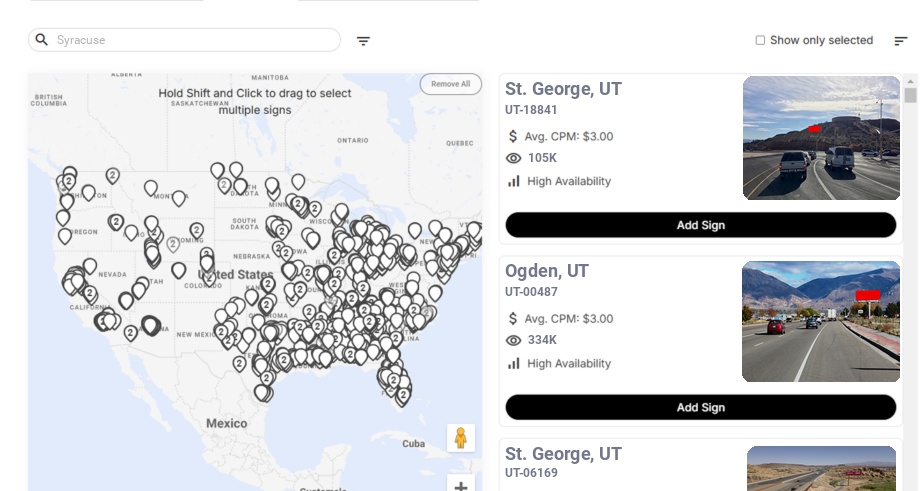



How much is a billboard in Syracuse?
Why Choose Blip for Billboard Advertising in Syracuse
Blip lets you launch Syracuse billboards in minutes—perfect for SR-193, Antelope Drive, and I-15 commuters heading to Hill AFB.
Set a budget that fits Syracuse and adjust anytime; no contracts mean you can test ads during homebuilding and family-shopping seasons.
Use dayparting in Syracuse to hit 6:30–9 a.m. and 3:30–6:30 p.m. traffic, when Davis County commuters are on the road.
Track Syracuse campaign results in real time and shift spend fast as traffic patterns change near Layton, Clearfield, and Clinton.
Blip's creative tools make it easy to build clean, family-focused Syracuse ads for young households, schools, and local events.
Frequently Asked Questions About Billboard Advertising in Syracuse
How much does a billboard cost in Syracuse, Utah with Blip?
With Blip, you’re in control of your budget from the start: you simply set a daily amount you’re comfortable with, and Blip automatically keeps your Syracuse billboards campaign within that limit. Each blip is a short 7.5 to 10-second ad on rotating digital billboards in Syracuse, Utah, and you only pay for the individual blips you receive, similar to pay-per-click ads online. Costs per blip vary based on when and where your ad appears and current advertiser demand, so you can tailor your spend to busy times or stretch it over longer periods.
Where can I advertise with Blip in Syracuse, Utah to reach local commuters?
State Route 193 and Antelope Drive are primary east–west routes linking Syracuse to Hill Air Force Base and Layton, with daily traffic volumes often in the 15,000–25,000 vehicles per day range. State Route 108 (2000 W) connects Syracuse with West Point, Clinton, and Layton, and several segments carry 20,000+ VPD. Proximity to I-15 interchanges in Layton and Clearfield also gives Syracuse billboards access to six-figure daily vehicle counts along the Wasatch Front corridor.
Who does Syracuse, Utah billboard advertising reach?
Syracuse has a young, family-heavy population with a median age around 29, and over 60% of households have children under 18. The city also has high homeownership and median household income above $105,000, which supports spending on home improvement, vehicles, recreation, financial services, and healthcare. Because Syracuse sits inside the Ogden–Clearfield–Salt Lake commuting ecosystem, billboards can influence buying decisions far beyond the city limits.
When is the best time to run Blip billboards in Syracuse, Utah?
Morning peaks typically occur from about 6:30–9:00 a.m., with evening peaks from about 3:30–6:30 p.m., influenced by both standard office hours and base shifts. On Hill AFB-adjacent routes like SR-193, morning surge traffic can be 30–40% higher than mid-day volumes. Blip’s scheduling tools can focus spend on those commuter windows instead of low-value overnight impressions.
What kind of Syracuse, Utah billboard messages work best for families and homeowners?
The page recommends emphasizing family, highlighting long-term value, and staying community-oriented. Messages like “For Syracuse Families,” “Davis County’s Home Experts,” and “Serving Syracuse & Davis County Since 2005” are suggested as clear local approaches. It also notes that simple, positive, family-friendly creative tends to work well in a culturally conservative market.
Do I need a contract to advertise with Blip in Syracuse?
No, Blip has no long-term contracts or minimum commitments. You can start, pause, or stop your campaign at any time.
How fast can I launch a billboard campaign with Blip in Syracuse?
You can have your campaign live in minutes. Create a free account, select your locations, set your budget, upload your design, and start running once approved.
Where can I advertise with Blip in Syracuse?
Blip has digital billboards in Syracuse. You can browse available locations on a map, choose the ones that fit your audience, and start advertising right away.
Still have questions? Launch a campaign in minutes — no contracts, no commitments.
Start Your CampaignSyracuse Billboard Advertising Guide
Syracuse, Utah sits at the heart of northern Davis County's growth corridor, sandwiched between Hill Air Force Base
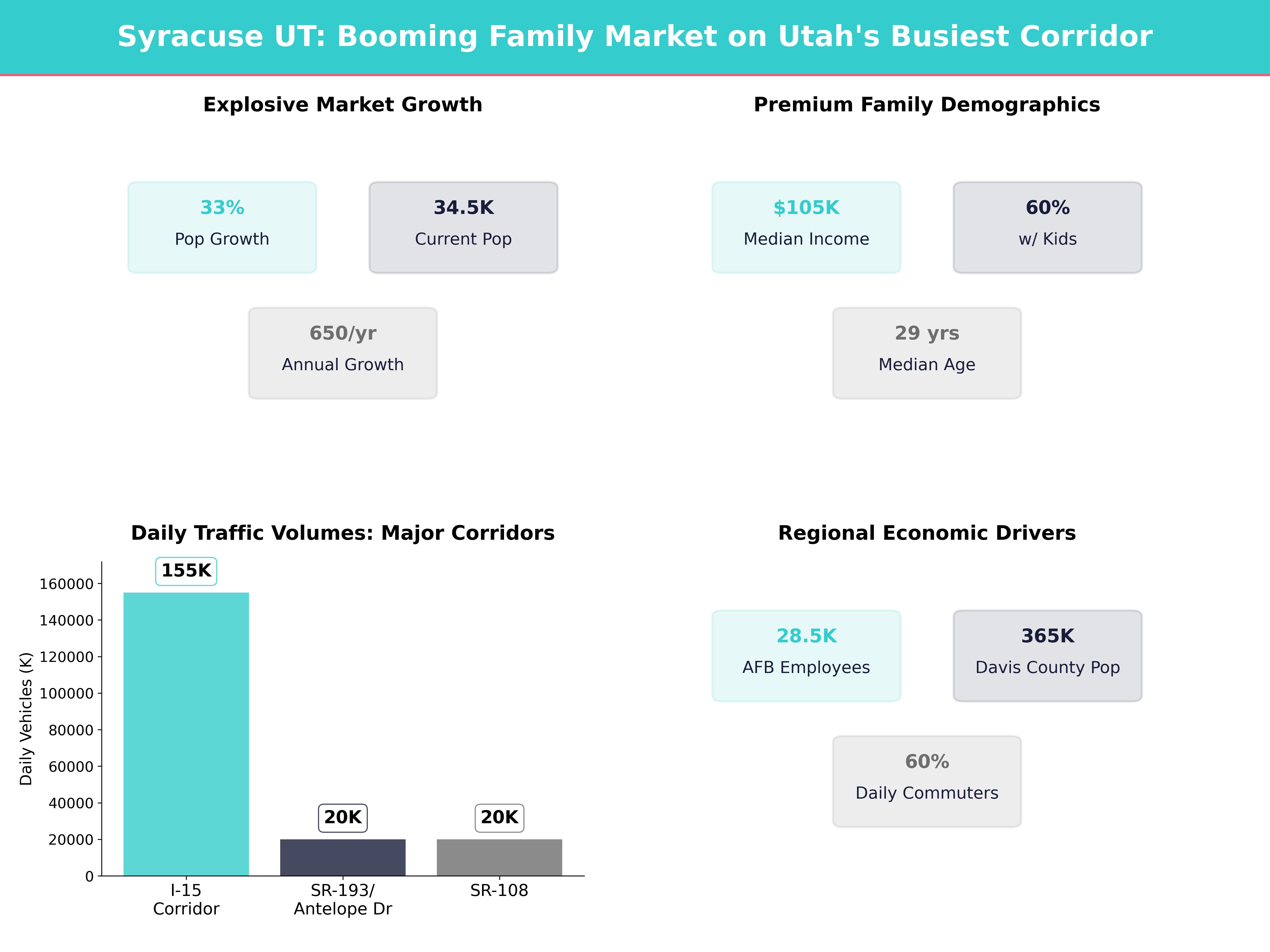
Syracuse Market Snapshot: Why This Small City Punches Above Its Weight
Syracuse has transformed from a quiet agricultural town into a booming suburban hub:
- The population grew from 24,331 in 2010 to 32,420 in 2020—an increase of about 33% in a single decade—and local estimates now place the city at roughly 34,000–35,000 residents, adding 500–800 people per year.
- Syracuse is part of Davis County, which counts over 365,000 residents. The county added more than 45,000 people between 2010 and 2020 (about 14% growth), and state projections anticipate it will surpass 400,000 residents before 2030.
- The median household income in Syracuse tops $105,000, while Davis County overall sits in the low‑$90,000s; both figures are roughly 25–40% higher than national household income levels, indicating strong spending power for local and regional businesses.
- Local housing data show that new home construction in Syracuse and adjacent West Point/Clinton has delivered hundreds of new units annually, with several master‑planned communities adding thousands of rooftops within a 10–15 minute drive.
For context and local insight, advertisers can reference:
- City government: City of Syracuse
- County government: Davis County
- Tourism and visitor insights: Discover Davis (Davis County Tourism)
- Regional news: Standard-Examiner and KSL.com Northern Utah
- Additional local coverage: Davis Journal and Gephardt Daily Northern Utah
For advertisers, this means:
- We’re speaking to rapidly growing neighborhoods filled with young families—more than half of Davis County’s residents are under age 35.
- There is substantial disposable income to support premium products and services; in many Syracuse subdivisions, average home values now exceed $500,000, and new‑build prices commonly run higher.
- Even though Syracuse itself is small, its position inside the Ogden–Clearfield–Salt Lake commuting ecosystem gives billboards a much wider effective reach, tapping into a Wasatch Front region of more than 2.6 million people. Well‑placed billboards in Syracuse can therefore influence buying decisions far beyond the city limits.
Who Lives and Drives in Syracuse?
Understanding the audience lets us craft artwork and schedules that feel truly local, which is essential for effective Syracuse billboard advertising.
Demographics and lifestyle
Recent data for Syracuse and northern Davis County show:
- A young population: The median age in Syracuse is around 29, several years younger than the U.S. median (about 38). In practical terms, roughly 30–35% of residents are under 18, and another 20–25% are in their 20s and early 30s.
- Family‑heavy households: Over 60% of households in Syracuse have children under 18, one of the highest proportions in Utah and well above the state average (about 40–45%). In some new subdivisions, it’s common to see average household sizes of 3.5–4.0 people.
- High homeownership: Roughly 80–85% of occupied housing units in Syracuse are owner‑occupied, compared with about 70–75% in Davis County and around 65% statewide. This reinforces a stable, community‑oriented customer base.
- Higher incomes: Median household income of $105,000+ is roughly 20–25% higher than the Utah median and 30–40% higher than national figures, indicating the ability to spend on home improvement, vehicles, recreation, financial services, and healthcare.
- Education and occupations: A substantial share of adults have some college or a bachelor’s degree or higher, and many work in professional, technical, government, and defense‑related roles connected to Hill Air Force Base and the broader Wasatch Front economy.
For neighborhood‑level context, advertisers can track development and demographics via:
- Syracuse Community Development
- Davis County Community & Economic Development
Implications for messaging
Given these traits, we generally see the best results when we:
- Emphasize family: Use phrases and imagery that reference kids, school schedules, sports, and family time. With 3‑ and 4‑child households common, family‑sized offers and bundles resonate strongly.
- Highlight long‑term value: Homeownership and higher incomes support campaigns around mortgages, remodels, insurance, and big‑ticket items. Financing messages (e.g., “$0 down,” “low monthly payment”) can appeal to growing families balancing budgets.
- Stay community‑oriented: Syracuse residents are tightly connected to local schools, churches, youth sports, and civic events. “Local,” “neighbor,” “supporting our community,” and “Syracuse/Layton/Clearfield families” perform well as concepts, especially when paired with specific local references (e.g., “near Syracuse High”). For district‑wide context, advertisers can reference Davis School District.
- Keep it clean and positive: Northern Davis County skews culturally conservative; simple, uplifting messages are typically more effective than edgy or controversial creative. Avoiding clutter and keeping a friendly tone aligns with the expectations of a community where more than 60% of adults participate in religious congregations and civic groups.
Traffic Patterns: Where Syracuse Billboards Work Hardest
While Syracuse does not sit directly on I‑15, it is threaded with key commuter routes that feed onto the interstate and into major job centers, making Syracuse billboards on these corridors especially valuable.
Key traffic flows include:
- State Route 193 and Antelope Drive (2000 W / 1700 S area): Primary east–west routes linking Syracuse to Hill Air Force Base and Layton. Recent Utah Department of Transportation (UDOT) counts show daily traffic volumes on SR‑193 and Antelope Drive segments in the Syracuse–Layton area often in the 15,000–25,000 vehicles per day (VPD) range, with higher peaks near commercial nodes.
- State Route 108 (2000 W): A north–south spine connecting Syracuse with West Point, Clinton, and Layton. UDOT data indicate several segments of SR‑108 carry 20,000+ VPD, making it one of the most important local commuter corridors.
- Proximity to I‑15 interchanges in Layton and Clearfield, which carry six‑figure daily vehicle counts along the Wasatch Front corridor. Key stretches of I‑15 between Layton and Clearfield routinely see average annual daily traffic (AADT) in the 140,000–170,000 VPD range.
For up‑to‑date traffic planning and construction insights, we recommend using:
- Utah Department of Transportation (UDOT) Traffic & Construction for commute patterns in and around Syracuse.
- City of Syracuse Transportation/Engineering pages for road projects and growth areas that can shift traffic volumes.
- Regional planning context from the Wasatch Front Regional Council
How this shapes Blip strategy
Because Blip lets us select specific boards and adjust bids by location, we can:
- Target commuter corridors that serve Syracuse residents even when boards sit in neighboring Layton, Clearfield, or Clinton, capturing 10,000s of daily impressions at relatively low cost compared to central‑city inventory.
- Concentrate spend on I‑15 boards just outside the city that capture Syracuse commuters heading to and from Ogden, Salt Lake City
- Use boards closest to major retail nodes (e.g., along Antelope Drive and near big‑box and grocery centers) for last‑mile “shop here now” messaging, reaching shoppers in the final 5–10 minutes of their trip and making Syracuse billboard advertising particularly effective for impulse visits.
Commuter Behavior: Reaching Hill AFB and Wasatch Front Workers
Hill Air Force Base, immediately east of Syracuse, is one of Utah’s major employers:
- The base employs roughly 27,000–30,000 military, civilian, and contractor personnel, making it one of the largest single‑site employers in the state.
- Economic impact studies have estimated Hill AFB’s annual contribution to Utah’s economy at over $4–5 billion, much of it flowing into Davis and Weber counties.
- Many Hill AFB workers live in Syracuse, Layton, Clearfield, Clinton, and other Davis County suburbs; local housing surveys in base‑adjacent communities consistently show a sizable share of households with at least one defense‑related worker.
For more background, see:
- Hill Air Force Base
- Military Affairs Committee – Davis Chamber of Commerce
Additionally:
- A large share of working Syracuse residents commute outside the city to jobs in Layton, Clearfield, Ogden, and the Salt Lake metro. Regional planning data suggest that more than 60% of Davis County workers leave their home city for work each day, and Syracuse fits this pattern.
- Typical one‑way commute times for Syracuse residents fall in the 20–30 minute range, which aligns well with billboard exposure windows on arterials and freeways.
- Morning peaks typically occur from about 6:30–9:00 a.m., with evening peaks from about 3:30–6:30 p.m., influenced by both standard office hours and base shifts. On Hill AFB‑adjacent routes like SR‑193, morning surge traffic can be 30–40% higher than mid‑day volumes.
How to use Blip’s scheduling tools
We can use dayparting to:
- Focus on early morning (6–9 a.m.) and late afternoon (3–7 p.m.) along I‑15 and SR‑193 for commuter‑focused offerings (auto, quick‑serve restaurants, coffee, banking, childcare, fitness). Targeting these windows aligns with when tens of thousands of vehicles are on the road.
- Emphasize midday and early afternoon around retail corridors for campaigns aimed at stay‑at‑home parents, retirees, or flexible workers (healthcare, grocery, local services), when traffic on local arterials remains steady but competition for attention may be lower.
- Run special evening and weekend bursts to promote events, restaurants, entertainment, and church or community gatherings, capitalizing on Friday–Saturday traffic spikes near shopping areas and event venues.
Because Blip is pay‑per‑“blip” rather than fixed‑rent, we can move budget into exactly those time windows instead of paying for low‑value overnight impressions that may represent less than 5–10% of daily traffic. This flexible approach functions like dynamic billboard rental in Syracuse, keeping spend aligned with the moments that matter most.
Seasonality and Local Events: When Syracuse is Paying Attention
Syracuse’s calendar and climate create distinct advertising windows.
Seasonal traffic and behaviors
- Winter (Dec–Feb): Shorter daylight hours and snowy conditions encourage local shopping and services closer to home. Northern Utah freeways can see crash and delay rates rise 20–40% during major storms, nudging residents to favor nearby grocery, healthcare, and service options in Syracuse and adjacent cities.
- Spring (Mar–May): Construction, home improvement, landscaping, car buying, and sports registrations surge. Utah home improvement and garden retailers often report double‑digit sales increases between March and May, and local contractors frequently book several weeks out once temperatures warm.
- Summer (Jun–Aug): Outdoor and recreation season peaks. Antelope Island State Park, accessible via Syracuse, often attracts 700,000–800,000 visitors annually in recent years, with summer and early fall weekends drawing several thousand visitors per day. This injects a significant volume of non‑resident traffic along the Syracuse–Antelope Island corridor.
- Fall (Sep–Nov): Back‑to‑school, fall sports, and holiday prep drive spending in clothing, electronics, food, and home décor. Retail sales often trend upward from late October through December, with many local businesses generating 25–30% of annual revenue in the final quarter.
Local touchpoints to monitor:
- City events and updates: Syracuse City Calendar & News
- Regional tourism: Discover Davis Events
- Antelope Island info: Antelope Island State Park
- Statewide tourism trends: Visit Utah and Utah Office of Tourism Industry Resources
Campaign timing ideas
- Launch back‑to‑school campaigns in late July/early August along routes near schools and major shopping areas, matching the period when local school districts finalize registration and families purchase supplies and clothing.
- Boost home services and remodeling in March–June when homeowners plan projects; many contractors in Davis County see inquiry volumes rise 30–50% from winter lows during this window.
- Promote summer festivals, youth sports sign‑ups, and church activities in late spring and early summer, when parks, sports complexes, and church buildings host hundreds of youth per week.
- Use November and December for holiday retail, charitable giving, and year‑end financial planning, keeping creative warm and family‑centered. Many nonprofits and financial advisors see as much as 40% of annual donations or new account openings during this period.
Creative Strategy: Designing Artwork for Syracuse Drivers
To maximize impact on digital billboards in and around Syracuse, we recommend:
1. Speak to young families clearly and directly
- Headlines like “For Syracuse Families,” “Ready for School Season?” or “Davis County’s Home Experts” establish immediate local relevance and contrast with generic regional advertising.
- Feature relatable visuals: kids in sports uniforms, families at the park, young couples in front of a new home, or recognizable Wasatch Front landscapes such as Antelope Island, the Great Salt Lake shoreline, or the Wasatch Range.
- Consider nods to local schools and mascots (e.g., Syracuse Titans, Clearfield Falcons) where appropriate and compliant with school branding guidelines; these schools collectively enroll thousands of teens and families in the Syracuse–Clearfield area.
2. Keep it simple and legible at speed
Given typical drive speeds on Antelope Drive, SR‑193, and I‑15, aim for:
- 6–8 words in the main message; studies of roadside advertising often show significant drops in comprehension once copy exceeds 10–12 words at 45–65 mph.
- Large, high‑contrast fonts (avoid script or thin typefaces).
- 1 main image or simple graphic element.
- A single clear call‑to‑action: “Exit at Antelope Drive,” “Call Today,” “Book Online,” or a very short URL. QR codes can work on slower arterials (35–45 mph), but are less effective on high‑speed freeway boards.
3. Emphasize local proof and trust
Syracuse residents respond well to credibility and community connection:
- “Serving Syracuse & Davis County Since 2005”
- “Trusted by 3,000+ Northern Utah Families”
- “Proud supporter of Syracuse High / Clearfield Falcons / local youth leagues”
With homeownership rates above 80% and a high share of families with children, references to long‑term presence, sponsorships, and local roots help differentiate you from out‑of‑area competitors.
4. Align tone with community norms
- Family‑friendly, positive, and respectful messaging will go further than aggressive or provocative ads in a market where community surveys frequently show high emphasis on safety, schools, and family activities.
- Recognize key Utah and local observances such as Pioneer Day (July 24), local high school graduation seasons, and religious holidays where appropriate.
- Tie creative into major community events promoted on the Syracuse City Calendar or Discover Davis Events
5. Use Blip’s flexibility to rotate messages
Because artwork can be swapped easily:
- Run different creatives by time of day: breakfast offers in the morning, dinner or entertainment in the evening. For example, promote a 7–9 a.m. coffee special near commuter routes and a 4–7 p.m. family‑meal offer on the same board later in the day.
- Test value vs. prestige messages: e.g., “Save $50 on HVAC Tune‑Up” vs. “Keep Your Syracuse Home Comfortable All Year.” Track which theme drives more calls or web visits.
- Localize variations for boards closer to Syracuse vs. deeper in the Wasatch Front (e.g., “5 minutes from this exit” vs. “Worth the short drive from Syracuse”).
Geographic Targeting: Building a Syracuse‑Centric Footprint
Most campaigns serving Syracuse should think in concentric circles to get the most from billboard rental in Syracuse and nearby cities.
Inner circle: Syracuse and immediate neighbors
- Syracuse, West Point, Clinton, and parts of Clearfield and Layton make up the daily living sphere for most residents. Combined, these communities represent well over 100,000 residents within about a 10‑minute drive.
-
Use boards in this ring for:
- Grocery, healthcare, schools, childcare, local services, and restaurants.
- “We’re your neighbors” and “Right in Syracuse” messaging.
- Calls‑to‑action such as “Next Right,” “On Antelope Drive,” or “5 Minutes from Here.”
Middle circle: Commuting and shopping orbit
- Hill Air Force Base, Layton Hills Mall area, Clearfield, and Ogden‑area retail nodes are regular destinations. The Layton–Clearfield–Ogden segment of I‑15 alone captures 100,000+ vehicles per day, many of them Davis County commuters.
-
Use boards on I‑15 and major arterials to:
- Capture morning and evening commuters to Hill AFB and Ogden/Salt Lake.
- Promote regional shopping centers, auto dealers, big‑ticket home services, and entertainment.
- Build frequency among commuters who may pass the same board 400–500 times per year.
Outer circle: Greater Wasatch Front reach
- For brands drawing customers from across northern Utah, layer Syracuse‑area boards with placements further north (Ogden) or south (Bountiful, Salt Lake).
- Tailor creatives to mention “Short drive from Syracuse” on boards outside Davis County while using “Right here in Syracuse” on local placements.
- Regional context and growth projections are available from the Utah Governor’s Office of Planning and Budget Kem C. Gardner Policy Institute
Blip’s location tools allow us to choose exactly which boards to include in each ring and allocate budget proportionally—for example, 50–60% of spend on the inner circle, 30–40% on commuter corridors, and 10–20% on broader awareness.
Using Data to Optimize: Test, Measure, Refine
Even in a smaller market, we can build data‑driven campaigns:
1. Coordinate with your own data
-
Use Google Analytics, point‑of‑sale reports, or call tracking to monitor:
- Store visits or online orders by day and time.
- Spikes in traffic after launching or adjusting Blip schedules.
- Changes in key metrics (conversion rate, average ticket size) during heavy vs. light billboard periods.
-
Line these up with:
- Dayparts and days of the week you’re blipping.
- Different creatives you’re running at different boards.
- Any local events or weather patterns noted on UDOT Traffic or the Syracuse City News page that might shift behavior.
2. Run structured creative tests
-
Create 2–3 variations:
- Version A: price‑driven (“$19.99 Oil Change in Syracuse”).
- Version B: benefit‑driven (“Keep Your Car Winter‑Ready in Davis County”).
- Version C: community‑driven (“Family‑Owned in Syracuse Since 1995”).
-
Rotate them evenly using Blip and track:
- Which version correlates with more calls, site visits, coupon redemptions, or online form fills.
- Any difference in day‑of‑week or time‑of‑day performance—for instance, price‑driven messages might perform 10–20% better on weekdays, while community messages may resonate more on weekends.
3. Adjust budgets by performance
Once you see patterns:
-
Increase your bids on:
- Boards closer to your best‑performing zip codes (for example, if 84075 and 84015 generate most of your sales).
- Time slots that produce more leads or sales—if 4–7 p.m. drives 40% of daily revenue, shift spend toward that window.
-
Reduce spend on:
- Underperforming dayparts such as late‑night hours that may account for less than 5% of conversions.
- Boards that don’t match where your customers actually come from, based on your CRM or POS data.
Vertical‑Specific Ideas for Syracuse Advertisers
Below are practical ways Syracuse’s specific characteristics can inform campaigns and how Syracuse billboard advertising can support each vertical.
Home services (HVAC, lawn care, remodeling, solar)
- Audience: High‑income homeowners, many with newer but rapidly aging homes needing upgrades. Syracuse and nearby communities have seen thousands of homes built since 2000, meaning many systems are now 15–25 years old—prime for replacement.
-
Strategy:
- Focus spring and fall campaigns on energy efficiency, comfort, and family safety. Utah’s climate swings—from winter lows often below 20°F to summer highs in the 90s—make HVAC reliability a high‑salience issue.
- Use hyperlocal language: “Serving Syracuse, West Point, and Clearfield.”
- Run weather‑responsive creatives (swap in “Beat the Heat” or “Prepare for Winter” messages as seasons shift).
- Consider financing callouts (“As low as $99/month”) for big‑ticket installs to match the area’s higher incomes and larger homes.
Healthcare and dental
- Audience: Young families with children and teens, plus commuters who prefer providers close to home.
-
Strategy:
- Emphasize convenience: “Evening & Saturday Appointments in Syracuse.” In commuter communities, extended hours can capture patients who otherwise delay care.
- Promote new‑patient offers timed to back‑to‑school and January benefit resets; many benefits plans reset on January 1, creating a strong window for dental, vision, and preventive care messaging.
- Use boards near schools and family retail clusters for orthodontics, pediatric care, and urgent care. Syracuse‑area schools enroll thousands of K–12 students, translating directly into pediatric and teen‑oriented demand.
- Link to or reference local health resources such as Davis County Health Department for community health context.
Education, childcare, and youth activities
- Audience: Households with children, which make up 60%+ of Syracuse homes.
-
Strategy:
- Run campaigns around registration periods: spring/summer for youth sports and camps; late summer for preschools and private schools. Many programs fill 70–100% of available slots within a few weeks of registration opening.
- Use countdown messaging: “2 Weeks Left to Register for Fall Soccer.”
- Highlight safety, character building, and community—values that resonate strongly locally.
- Position near schools and parks referenced on the Syracuse Parks & Recreation page to match daily parent driving routes.
Retail and restaurants
- Audience: Local residents plus visitors heading to or from Antelope Island and Hill AFB.
-
Strategy:
- Use “exit now” and “just ahead on Antelope Drive” language near key junctions.
- Promote lunch specials during daytime blips targeting base and office workers; Hill AFB alone has tens of thousands of personnel on site most weekdays, many leaving base for meals or errands.
- Emphasize family‑friendly dining and group deals in the early evening; with average household sizes near four people, “family meal” bundles and kids‑eat‑free messaging can boost ticket size.
- Run limited‑time promotions around city events and holidays listed on the Syracuse City Calendar and Discover Davis Events
Financial services and real estate
- Audience: High‑income, home‑owning households; military families; upgraders and relocators.
-
Strategy:
- Highlight low‑down‑payment programs, VA loans, and refinance options for Hill AFB–connected families. Davis County has one of the state’s highest concentrations of military‑affiliated households.
- Feature “Move up in Syracuse” or “Build Your Dream Home in Davis County” messaging, tapping into a market where many households move from starter homes into larger properties as families grow.
- Intensify campaigns during peak homebuying seasons (spring and early summer), when statewide transaction volumes commonly rise 20–40% over winter levels.
- Coordinate messaging with regional market updates from sources like the Northern Wasatch Association of Realtors or Utah Association of Realtors
Respecting Local Norms and Regulations
To stay aligned with the community and local rules:
- Review Syracuse City’s codes and updates via the official city website, particularly if you’re also using on‑premise signage or coordinating with events. Land use, sign, and zoning ordinances can be accessed through the Syracuse City Code.
- Check regional regulations and development patterns through Davis County Community & Economic Development if your campaign spans multiple jurisdictions.
- Keep creative content appropriate for a family‑oriented, largely conservative audience; local surveys and election participation rates point to strong community engagement and expectations of respectful public messaging.
- Avoid overly cluttered or visually noisy designs that can be distracting for drivers and less effective. UDOT safety guidance emphasizes minimizing driver distraction on high‑speed roadways, which aligns with clean, focused billboard creative.
Blip works within the legal and technical limits of each sign location, but matching community expectations in Syracuse is just as important as complying with regulations.
Bringing It All Together
Syracuse, Utah may be modest in size, but its rapid growth, high household incomes, and strong family orientation make it an exceptionally attractive market for digital billboard advertising. With a city of roughly 34,000–35,000 residents plugged into a county of more than 365,000 people—and a broader Wasatch Front region exceeding 2.6 million—we can:
- Reach Syracuse residents not only inside city limits but across their broader commuting and shopping patterns, including the 100,000+ vehicles traveling daily on nearby I‑15 segments, by strategically using Syracuse billboards and nearby inventory.
- Focus spend precisely on the days, times, and locations where local families are actually on the road, concentrating on the peak morning and evening windows that account for the majority of daily vehicle miles traveled.
- Tailor creative that reflects Syracuse’s values—family, community, stability, and outdoor living—while testing and refining for measurable results using your own sales, web, and call‑tracking data.
By combining a deep understanding of Syracuse’s people, traffic, and seasonal rhythms with the flexibility of Blip’s digital platform, we can build Syracuse billboard advertising campaigns that feel personal, relevant, and timely—turning everyday drives into powerful opportunities for your brand and making billboard rental in Syracuse a high‑impact part of your local marketing mix.