Billboards in Millcreek, UT
No Minimum Spend. No Long-Term Contracts. Just Results.
Trusted by Leading Brands


Billboard advertising
in Millcreek has never been easier
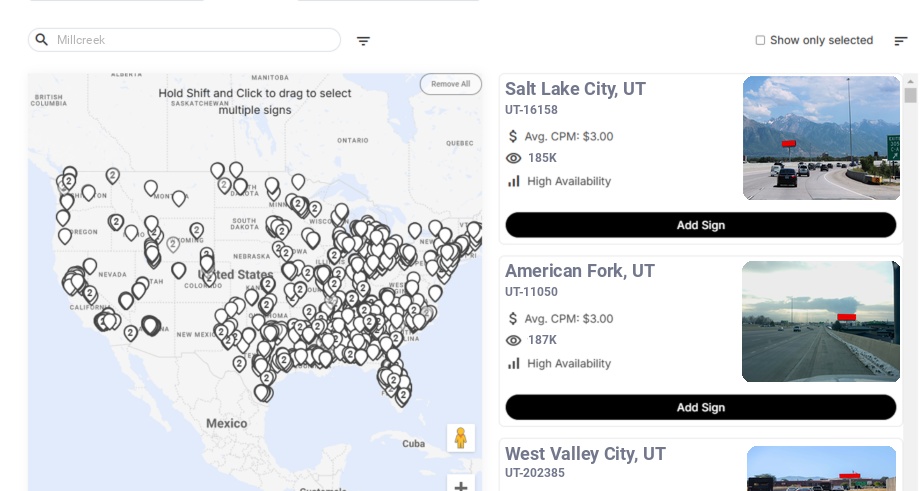



How much is a billboard in Millcreek?
Why Choose Blip for Billboard Advertising in Millcreek
Launch Blip ads in Millcreek in minutes and reach I-215 commuters, State Street shoppers, and 3300 S drivers without traditional buying hurdles.
Millcreek budgets stay flexible with Blip—start small, then scale for ski weekends, canyon traffic, or weekday peaks on 3900 S and Highland Drive.
Daypart Millcreek billboards for 7-9 a.m. and 4-7 p.m. commuters, or 2:30-6:30 p.m. school pickup traffic near Granite School District routes.
No contracts means Millcreek advertisers can test spring home services, fall back-to-school, or winter ski promos and shift fast as demand changes.
Track Millcreek results in real time and optimize by corridor—use Blip to see what works on I-215, State Street, or neighborhood feeders.
Use Blip creative tools to build bold Millcreek ads fast, with simple, high-contrast messaging that stands out on fast-moving canyon and freeway traffic.
Frequently Asked Questions About Billboard Advertising in Millcreek
How much does a billboard cost in Millcreek, Utah with Blip?
With Blip, you control exactly what you spend on Millcreek billboards by setting a daily budget that can be as small or as large as you’d like, and Blip automatically keeps your campaign within that limit. Each “blip” is a brief 7.5–10 second ad on digital billboards in Millcreek, Utah, and you only pay for the individual blips you receive. Pricing is flexible because the cost per blip varies based on when and where your ad runs, as well as advertiser demand.
Where can I advertise with Blip in Millcreek, Utah?
Millcreek’s best billboard corridors include I-215, State Street, 3300 South, 3900 South, Highland Drive, and 900 East. I-215 near Millcreek reaches 80,000–95,000 vehicles per day, while State Street carries roughly 30,000–40,000 vehicles per day. The east–west corridors also connect neighborhoods to local shopping, Millcreek Common, and canyon approaches.
When is the best time to run Blip billboards in Millcreek, Utah?
Commute windows are concentrated around 7:00–9:00 a.m. and 4:00–6:30 p.m. on weekdays, with I-215 and State Street seeing particularly strong peak flows. For family and errands campaigns, 10 a.m.–1 p.m. and 3–6 p.m. weekdays are recommended. Weekend and evening schedules also work well for recreation, dining, and event traffic.
What kind of people see billboards in Millcreek, Utah?
Millcreek has a median age around 35 and a population of approximately 63,000 residents, with a strong mix of young professionals, families, and students commuting through the area. More than 70% of workers in the Salt Lake metro area commute by car, and the city also draws students, healthcare workers, and outdoor recreation audiences. The area’s household income, education levels, and family presence make it a strong market for many types of advertisers.
Why does Blip work well for Millcreek, Utah billboard advertising?
Millcreek’s compact shape and concentration of key roads amplify each impression, making local boards work harder than their footprint might suggest. Major corridors like I-215, State Street, 3300 South, and 3900 South funnel commuters, shoppers, and recreation traffic through the area every day. Blip’s flexible budgeting also lets advertisers test multiple corridors at low cost and shift spend toward the locations and times that perform best.
Do I need a contract to advertise with Blip in Millcreek?
No, Blip has no long-term contracts or minimum commitments. You can start, pause, or stop your campaign at any time.
How fast can I launch a billboard campaign with Blip in Millcreek?
You can have your campaign live in minutes. Create a free account, select your locations, set your budget, upload your design, and start running once approved.
Where can I advertise with Blip in Millcreek?
Blip has digital billboards in Millcreek. You can browse available locations on a map, choose the ones that fit your audience, and start advertising right away.
Still have questions? Launch a campaign in minutes — no contracts, no commitments.
Start Your CampaignMillcreek Billboard Advertising Guide
Millcreek, Utah, sits at the crossroads of suburban life, outdoor recreation, and the Salt Lake City
Millcreek Market Snapshot: Why This Suburb Punches Above Its Weight
Millcreek may be smaller than neighboring Salt Lake City, but it functions as both a bedroom community and a commercial corridor, which makes billboards in Millcreek work much harder than their footprint might suggest.
Key local stats to anchor our strategy:
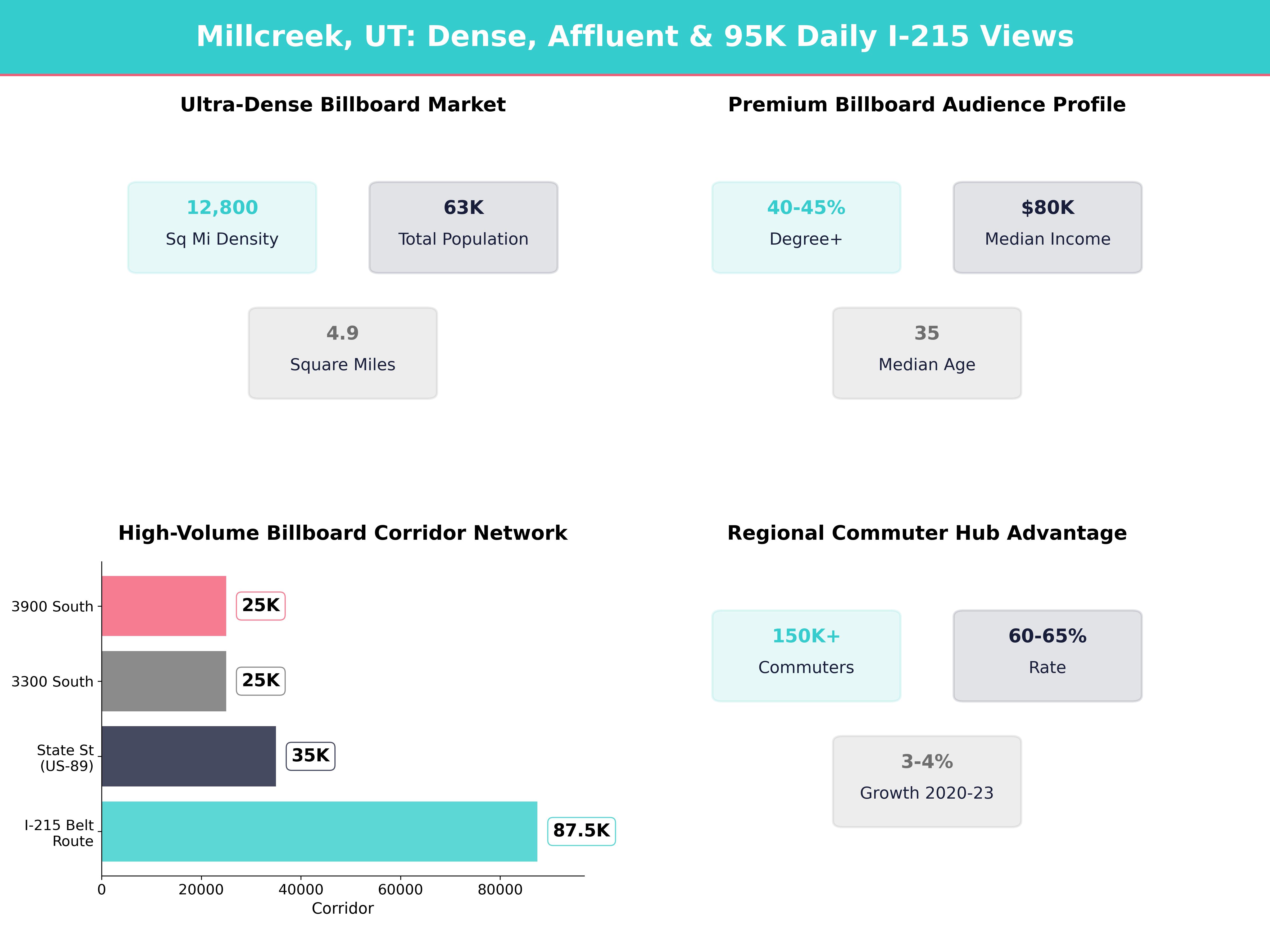
- Population: Approximately 63,000 residents as of 2023 estimates, up from about 61,000 in 2020—a growth of roughly 3–4% in just a few years, outpacing many mature suburbs in Salt Lake County.
- Density: Over 12,800 residents per square mile, which is more than double the overall density of Salt Lake County and dramatically higher than many nearby communities like Cottonwood Heights Holladay. That concentration translates into more impressions per board in a compact area.
- Median age: Around 35 years—slightly younger than the national median of about 38—indicating a strong mix of young professionals, families with children, and students commuting through the area.
- Education: In the broader east-bench area that includes Millcreek and adjacent neighborhoods, more than 40–45% of adults hold a bachelor’s degree or higher, reflecting a highly educated, information-driven consumer base that responds well to expertise-based messaging.
- Income: Household median income hovers in the low– to mid–$80,000s, with a meaningful share of households earning over $100,000 annually and a high proportion of dual-income families, supporting robust discretionary spending on dining, recreation, and home improvement.
- Housing: Owner-occupancy in surrounding Salt Lake County neighborhoods is roughly 60–65%, with Millcreek offering a balanced mix of long-term homeowners and renters—useful for both big-ticket home services and more transient, lifestyle-oriented campaigns.
As a first-ring suburb, Millcreek also imports a large daytime audience:
- Salt Lake County’s job base exceeds 550,000 jobs, and thousands of Millcreek residents commute daily to downtown Salt Lake City, Murray, and the University of Utah, as well as the rapidly growing tech cluster stretching toward Lehi
- Major east–west arteries (3300 S, 3900 S) and north–south routes (State Street, Highland Drive) funnel both local and regional traffic. Segments of these corridors see 20,000–40,000 vehicles per day, giving even neighborhood-facing boards sizable reach.
- Nearby mountain access points and canyons pull in recreation traffic from across the Wasatch Front. Utah logs more than 23 million annual visits to ski resorts statewide, and nearby areas like Big and Little Cottonwood Canyons see intense seasonal weekend traffic that flows past Millcreek approaches.
We can leverage this by targeting commuter-heavy hours, weekend recreation peaks, and school/college transitions to match messages to real, observable behavior on the roads and make Millcreek billboard advertising more efficient and performance-driven.
For local context and community initiatives, the city’s site at millcreek.us is a great reference, including resources such as Millcreek Common event listings, and broader regional visitor trends can be tracked via Visit Salt Lake.
Understanding Who Sees Your Billboards in Millcreek
Millcreek’s audiences are diverse but follow a few clear patterns that should shape our creative and scheduling choices for any billboard rental in Millcreek.
1. Commuters and professionals
- More than 70% of workers in the Salt Lake metro area commute by car, and key routes through Millcreek carry much of that volume between the Salt Lake City core, Murray, and east-bench neighborhoods.
- Many residents work in professional, scientific, tech, healthcare, and education sectors—industries that dominate the county’s job mix, with professional and business services alone representing roughly 15–20% of jobs.
- Commute windows are concentrated around 7:00–9:00 a.m. and 4:00–6:30 p.m. on weekdays, with I‑215 and State Street seeing particularly strong peak flows.
- The Utah Transit Authority (UTA) also runs multiple bus routes and nearby TRAX lines, adding transit riders and park‑and‑ride users to the impressions mix.
Implication: We should schedule B2B, high-ticket consumer services (financial, healthcare, home improvement, automotive) and professional training/education ads in these peak drive times, when decision-makers and working professionals dominate the roadways.
2. Young families and mid-career households
- With a median age in the mid-30s and strong family presence, demand is high for schools, kids’ activities, home services, healthcare, and family dining.
- In similar first-ring east-bench communities, roughly 30–35% of households include children under 18, creating strong cycles around school calendars and youth sports seasons.
- Nearby school systems such as Granite School District serve tens of thousands of students, and a significant share of those daily drop-off and pick-up trips pass along Millcreek corridors like 3300 S and 3900 S.
Implication: We should run school, childcare, tutoring, and youth sports promotions in August–September and January (new semesters) and emphasize convenience, safety, and family value in messaging.
3. Outdoor and recreation enthusiasts
Millcreek is a gateway to the Wasatch Front outdoors:
- Millcreek Canyon, Big Cottonwood Canyon, and Little Cottonwood Canyon, highlighted by state tourism resources like Visit Utah, help drive Utah’s reputation as an outdoor capital; the state’s outdoor recreation economy generates roughly $6+ billion in consumer spending annually.
- Ski areas in the Cottonwood Canyons, highlighted by organizations such as Ski Utah, collectively attract several million skier visits each winter, and much of that traffic moves along I‑215 and key Millcreek surface streets to reach canyon entrances.
- Salt Lake County operates more than 100 parks and open spaces, and neighborhood destinations like Sugar House Park
Implication: We should highlight outdoor gear, ski shops, bike shops, breweries, and experiential activities Thursday–Sunday and during key recreation seasons (ski season: roughly November–April; hiking/biking: late March–October), using Millcreek billboards positioned along these outdoor routes.
4. Students and education-focused audiences
- Proximity to the University of Utah, which enrolls over 34,000 students, and Salt Lake Community College (SLCC) 30,000 students across campuses, means Millcreek roads attract substantial student and staff traffic.
- Students often drive or rideshare through Millcreek between housing, work, and campus. Off-campus housing clusters and part-time jobs are spread along key commuting routes and commercial corridors.
Implication: We should emphasize short, bold, mobile-friendly offers for food, entertainment, off-campus housing, and skills programs during August–September, January, and May–June, when enrollments, moves, and job changes peak.
For ongoing demographic and neighborhood-level insights, local news outlets like The Salt Lake Tribune and KSL offer data-driven coverage on housing, commuting, and lifestyle trends, often breaking down conditions by neighborhood and corridor.
Traffic Patterns and Best Corridors for Blip Campaigns
Millcreek’s compact shape and concentration of key roads amplify each impression. Data from the Utah Department of Transportation (UDOT) and regional planning organizations like the Wasatch Front Regional Council
- I-215 (Belt Route) near Millcreek reaches 80,000–95,000 vehicles per day (Average Annual Daily Traffic), depending on the segment, making it one of the highest-volume freeways in the Salt Lake Valley.
- State Street (US-89) through the Millcreek area carries roughly 30,000–40,000 vehicles per day, a mix of local shoppers, commuters, and service traffic.
- 3300 South and 3900 South typically see in the 20,000–30,000 vehicles per day range, linking neighborhoods to employment centers and retail hubs.
- Highland Drive and 900 East support steady, higher-income neighborhood and shopping traffic, generally 15,000–25,000 vehicles per day, with strong repeat exposure among local residents.
How we translate this into a smarter billboard strategy:
1. I-215 for regional reach and brand building
- Use this corridor when we need to reach audiences beyond Millcreek: commuters from Cottonwood Heights West Valley City. Combined, these nearby cities account for well over 150,000 residents, many of whom use I‑215 daily.
- Ideal for hospitals, universities, regional retailers, and attractions (ski resorts, major events). For example, major healthcare systems like Intermountain Healthcare and University of Utah Health rely heavily on I‑215 visibility for systemwide branding.
- Because speeds are higher, creatives must be extremely simple: 6–8 words max, large logos, and clear URLs/QR codes.
2. State Street for retail and service calls-to-action
- State Street is lined with auto dealers, quick-serve restaurants, and service businesses for a reason: lots of mixed-intent traffic with tens of thousands of daily passersby who are often in “errand” mode.
- Use location-driven CTAs: “2 blocks north on State,” “Just off 3900 S,” or “Exit I-215 on 3300 S.”
- Daypart around lunch (11:00 a.m.–2:00 p.m.) and early evening (4:00–7:00 p.m.) to push food, fitness, and same-day services when trip-making for these purposes peaks.
3. East–west corridors (3300 S, 3900 S) for local dominance
- These roads connect neighborhoods to I-215, State Street, Millcreek Common, and local shopping centers. They also serve as feeders to popular canyon approaches.
- Perfect for hyper-local businesses wanting to “own” the Millcreek audience—dentists, HVAC, landscaping, real estate agents, youth programs—because the same residents pass repeatedly, often twice daily.
- Because travel speeds are moderate, we can support slightly more detailed creative (e.g., one short line of supporting copy plus a main headline).
4. Neighborhood feeders (Highland Dr, 900 E) for affluent and loyal customers
- Traffic volume is lower than I‑215, but audience quality is high—homeowners, established families, and boutique shoppers who frequent local nodes in Millcreek, Sugar House, and Holladay.
- Best for higher-margin services: home renovation, boutique fitness, specialty healthcare, real estate, and local restaurants where long-term brand recall and repeat visits matter more than sheer reach.
We can use Blip’s flexible budgeting to test multiple corridors at low cost, then shift spend toward locations that produce the strongest engagement (more web traffic, calls, or store visits during specific flight windows), turning Millcreek billboard advertising into a continuously optimized channel.
Seasonality and Timing: When Millcreek Billboards Work Hardest
Millcreek’s annual calendar follows both Utah’s four-season pattern and the rhythms of nearby Salt Lake City. We can unlock more value by aligning campaigns with these time-bound behaviors.
Local events and seasonal programming highlighted by Millcreek City and Millcreek Common
Winter (November–March)
- Utah ski resorts collectively record 4–5 million skier visits in strong seasons, and canyon-bound vehicles regularly back up to I‑215 on powder days and weekends, funneling thousands of recreation-minded drivers past Millcreek boards.
- Shorter daylight hours mean more impressions in dawn/dusk and evening darkness—ideal for bright, high-contrast digital creatives that stand out when commuters are driving in low light.
- Inversions and winter storms, tracked by the Utah Department of Environmental Quality
- Strong categories: ski/snowboard gear, winter clothing, auto service (tires, brakes, 4x4 checks), healthcare/urgent care, and indoor entertainment.
Blip strategy: Concentrate weekend and evening blips Thursday–Sunday, and use dynamic messaging like “Storm coming? Get your snow tires today” during major snow forecasts, timed to morning commute.
Spring (April–June)
- Housing activity picks up: in Salt Lake County, home listings and pending sales often rise 20–40% from winter lows into late spring, which in turn boosts demand for remodeling, landscaping, and moving services.
- Outdoor recreation quickly ramps up, with trail usage in foothill areas rising significantly as snowlines retreat—trailheads near Millcreek Canyon and Big Cottonwood Canyon fill early on weekends.
- Families focus on graduations, summer camps, and kids’ programs, with local schools promoting registration windows via channels like Granite School District and community newsletters.
Blip strategy: Run home services, real estate, and outdoor categories heavily in April/May. Use time-of-day scheduling to push “after-school” activities 2:30–6:30 p.m., when parents are on pickup runs and making plans for the evening.
Summer (June–August)
- School is out, and family movement increases—camps, sports, vacations, and local events. Many day camps and recreation programs in the county report filling 70–90% of capacity by early summer.
- Tourism peaks across Salt Lake County; Visit Salt Lake reports millions of annual convention and leisure visitors, and summer months routinely show the highest hotel occupancy and visitor spending.
- Evening traffic stays stronger later due to longer daylight and outdoor dining/events, especially around hubs like downtown Salt Lake, Sugar House, and Millcreek Common’s ice ribbon and plaza.
Blip strategy: Emphasize food, events, attractions, and tourism services. Schedule heavier blipping from late afternoon through 9:00–10:00 p.m. on Thursdays–Saturdays, when families and visitors are choosing where to eat and what to do.
Fall (September–October)
- Back-to-school and university reopenings reshape traffic—predictable daily flows around drop-off and commute times. Combined enrollment at the University of Utah and SLCC alone exceeds 60,000 students, many of whom adjust commuting routes at semester start.
- Home projects, healthcare checkups, and financial planning campaigns pick up ahead of year-end. Many families schedule physicals, dental visits, and insurance reviews before benefits reset.
- Leaf-peeping and fall hikes push weekend canyon traffic; Utah’s fall foliage brings surges in Saturday/Sunday travel to nearby canyons and scenic byways.
Blip strategy: Run back-to-school and education-focused creatives late July–September. Use canyon-oriented corridors and weekend schedules to reach recreation traffic with outdoor gear and hospitality messages.
Creative Strategy: What Works on Millcreek Billboards
High-performing Millcreek creatives share a few traits: clarity, local relevance, and emotional resonance with outdoor- and family-focused audiences. When planning Millcreek billboard advertising, creative choices can be the difference between a fleeting impression and a remembered brand.
1. Match visuals to the Wasatch lifestyle
- Use imagery of the Wasatch Front skyline, Millcreek Canyon, local neighborhoods, and family-friendly scenes. Boards that feel “of this place” tend to outperform generic stock visuals in brand recall studies.
- Outdoor themes test well: hiking, skiing, biking, dogs, and kids in local parks, echoing the strong participation rates in outdoor recreation reported across Salt Lake County.
- For regional campaigns, reference “Minutes from Millcreek,” “5 minutes off I‑215,” or similar messaging to create a sense of proximity and reduce perceived travel friction.
2. Respect commuter attention spans
On I‑215 and fast-moving corridors:
- 6–8 words total, plus a big logo and one clear CTA.
- High-contrast color palettes (dark backgrounds with bright fonts or vice versa).
- Avoid complex product shots; use one bold visual focus. At 65–70 mph, drivers have only a few seconds to absorb your message.
On 3300 S, 3900 S, and neighborhood streets:
- We can add one short line of detail: “Same-day appointments,” “Free estimates,” “Now enrolling K–8.”
- Short URLs or brand names that are easy to remember or search, recognizing that over 85% of U.S. adults now own smartphones and frequently search businesses they just saw advertised.
3. Use local proof and credibility
Millcreek residents value trust and community:
- Add “Serving Millcreek since 2005,” “Neighbors in Holladay & Millcreek,” or “Voted Best in Salt Lake County.”
- If featured in The Salt Lake Tribune or KSL, call it out concisely: “As seen on KSL.”
- For medical, legal, or financial services, highlight key credentials or simple outcomes (“Board-certified dermatology,” “Flat-fee estate planning”). Healthcare systems across Salt Lake County routinely feature such qualifications in campaigns because they significantly improve trust.
4. Time-sensitive and dynamic messages
Digital billboards let us align with live conditions:
- Weather triggers: “Powder day? 20% off rentals today only.” Ideal on mornings when UDOT and local news outlets are reporting fresh snow totals.
- Event tie-ins: “Heading downtown? Park free with our app.” Effective on days with major games or concerts at venues featured on Visit Salt Lake.
- Limited-time offers: “This week only,” “Ends Sunday,” synced with short Blip bursts that coincide with your promotion windows.
We should keep multiple creatives ready—one evergreen, one seasonal, and one promotional—and rotate them based on day, time, or campaign phase so billboards in Millcreek stay fresh and relevant.
Vertical-Specific Tips for Millcreek Advertisers
Different industries can tap unique Millcreek strengths. Here are practical tactics for some of the most active local categories using billboard rental in Millcreek.
Local restaurants and food services
- Focus on corridors with dense dining clusters: State Street, 3300 S, 3900 S, and Highland, where combined daily traffic often exceeds 80,000 vehicles across segments.
-
Daypart around meals:
- 7:00–10:00 a.m.: breakfast/coffee.
- 11:00 a.m.–2:00 p.m.: lunch specials.
- 4:00–8:00 p.m.: dinner, takeout, and delivery.
- Use simple offers: “Kids eat free Tuesday,” “15 minutes from Millcreek Canyon trailheads,” or “Show this ad on your phone for 10% off.” Redemption-based offers help you directly measure billboard impact.
- Consider aligning with local events at Millcreek Common Visit Salt Lake, when dining demand spikes.
Home services and real estate
- Target east–west corridors feeding residential neighborhoods, where owner-occupancy rates in surrounding communities often sit in the 60–70% range.
- Spring and fall are top seasons for home improvement; schedule heavier frequency in March–June and September–October, mirroring local real estate listing cycles.
- Use before/after visuals and local framing: “Roofing Millcreek & Holladay,” “We live where we work.”
- Open houses and new developments can be promoted with very short, concentrated Blip bursts (48–72 hours) timed to weekend showings.
Healthcare and wellness
- Promote urgent care, dentistry, eye care, and specialty clinics on high-traffic commuter routes for quick brand recall. Healthcare represents one of the largest employment sectors in Salt Lake County, and patients often choose providers based on convenience and visibility.
- Healthcare decisions are often made by parents; align with school calendars and family routines, especially August–October and January–March.
- Message ideas: “Same-day appointments near 3900 S & State,” “Open evenings and Saturdays,” “Millcreek’s pediatric specialists.”
- For mental health, physical therapy, and wellness studios, neighborhood corridors like Highland and 900 E work well for repeated exposure to local residents.
Education and youth programs
-
Align flights with registration timelines:
- Private schools and preschools: January–March and July–September.
- Camps and after-school programs: March–June.
- Target afternoon and early evening for parents on pickup routes—roughly 2:30–6:30 p.m.—on 3300 S, 3900 S, and near major school clusters highlighted on Granite School District.
- Use validation-based messaging: “Trusted by 500+ Millcreek families,” “STEM camps ages 8–14.”
- Consider adding QR codes that point to short registration pages; with high smartphone penetration, many Millcreek parents will respond from the car or shortly after seeing the board.
Outdoor, fitness, and recreation
- Emphasize proximity to canyons, trailheads, and ski resorts. Driving times of “10 minutes to Millcreek Canyon” or “15 minutes to Big Cottonwood” resonate with residents accustomed to quick access to the outdoors.
- Weekend-heavy schedules and late-afternoon/early-evening weekday runs capture recreation planners, especially Thursdays and Fridays when people set weekend plans.
- Messaging ideas: “Gear up before the canyon,” “Rent skis 10 minutes from Millcreek Canyon,” “Join Millcreek’s 6 a.m. fitness tribe.”
- Tie into air-quality-conscious habits promoted by local agencies like the Utah Department of Environmental Quality
Using Blip’s Flexibility to Win in Millcreek
Because Millcreek’s audiences shift dramatically by time and corridor, we can unlock more value by using Blip’s flexible tools strategically, ensuring every dollar spent on Millcreek billboard advertising is accountable.
1. Hyper-local testing and scaling
- Start with a small daily budget on 2–3 boards: one I‑215, one State Street, one neighborhood corridor.
-
Run A/B tests:
- Creative A: brand-led message.
- Creative B: offer or urgency-led message.
-
After 1–2 weeks, correlate impression windows with:
- Web analytics (traffic spikes during specific hours/days).
- Call logs or form fills.
- POS data (for restaurants and retail).
- Shift more budget to the locations and times that line up with measurable lifts. In many local campaigns, reallocating just 20–30% of spend from underperforming boards to top performers yields noticeable ROI gains.
2. Dayparting for precision
- Commuter campaigns (B2B, services): 7–9 a.m., 4–7 p.m. weekdays, aligning with UDOT’s observed peak-period congestion.
- Family and errands (grocery, kids’ services): 10 a.m.–1 p.m. and 3–6 p.m. weekdays.
- Nightlife and entertainment: 5–10 p.m. Thursdays–Saturdays, especially when events appear on calendars from Visit Salt Lake or Millcreek Common.
- Outdoor and seasonal: weekends and the day before major weather or event days, mirroring powder days and trail traffic.
3. Responsive budgeting for events and news
Millcreek and the broader Salt Lake area host frequent events, festivals, and civic initiatives publicized on Millcreek City’s site and outlets like KSL.
- Increase Blip frequency one or two days before big local events that drive traffic past your boards—concerts, outdoor movies, food truck nights, farmer’s markets, or seasonal festivals.
- Tie promotions to relevant news cycles (e.g., real estate, healthcare, air quality days, winter storm advisories). When local stations report a storm, for example, tire shops and urgent care centers can deploy storm-specific creatives within hours.
Measuring Success and Refining Campaigns
To keep improving our Millcreek campaigns, we need to connect impressions to behavior so your investment in billboards in Millcreek stays accountable and scalable.
1. Align campaign windows with internal metrics
- Track website sessions, calls, online bookings, and in-store visits by date and time. Even simple hourly or daily breakdowns can reveal clear patterns around your Blip schedule.
- Tag your billboard campaigns internally: “Millcreek Spring 2025,” “I‑215 Branding,” etc., so your team can compare performance by season and corridor.
- Compare performance during flight dates vs. control periods, looking for percentage lifts (for example, 10–20% increases in website sessions or calls during heavily advertised weeks).
2. Use simple but focused landing experiences
- Drive traffic to short, Millcreek-specific landing pages (e.g.,
/millcreek-dentist,/millcreek-camp). - Offer a clear call to action: “Book now,” “Get a quote,” “Claim offer.”
- Mention the local context on the page: “Serving Millcreek and surrounding neighborhoods,” which reinforces relevance and can improve conversion rates.
- For location-based offers, include maps or driving directions from key corridors (I‑215, State Street, 3300 S) using embeddable tools from providers like Google Maps.
3. Survey and ask “How did you hear about us?”
- Add “billboard” as an explicit option on forms and intake calls.
- In high-touch businesses (healthcare, services, real estate), train staff to ask and record responses. Over a few months, even 30–50 recorded responses tied to “billboard” can validate your investment.
- After a few months, you’ll see patterns by board type (commuter vs. neighborhood) and time of year, helping you decide where to double down next season.
Millcreek’s combination of dense neighborhoods, heavy commuter flows, and gateway-to-the-mountains location makes it an ideal market for highly targeted digital billboard campaigns. By understanding the local data—where people drive, when they move, and what they value—and by tying campaigns into trusted local resources like millcreek.us, Visit Salt Lake, and leading news outlets, we can use Blip to place the right message on the right board at the right moment, turning everyday traffic into measurable growth for Millcreek-area businesses and maximizing the return from any billboard rental in Millcreek.