Billboards in Murray, UT
No Minimum Spend. No Long-Term Contracts. Just Results.
Trusted by Leading Brands


Billboard advertising
in Murray has never been easier



How much is a billboard in Murray?
Why Choose Blip for Billboard Advertising in Murray
Blip lets you launch Murray billboards on I-15 and I-215 fast, reaching the county’s commuter hub without a long buy-in.
Set a flexible daily budget for Murray and focus spend on busy State Street, Fashion Place, and 5300 South traffic.
Use Blip dayparting to hit Murray’s morning commute, lunch rush, or weekend mall shoppers when they’re most likely to act.
No contracts means you can test Murray campaigns near IMC or Fashion Place, then shift based on what works.
Track Murray billboard results in real time and adjust for seasonal spikes like back-to-school, flu season, and holiday shopping.
Blip’s creative tools make it easy to tailor bold Murray ads for families, healthcare, and retail audiences on the fly.
Frequently Asked Questions About Billboard Advertising in Murray
How much does a billboard cost in Murray, Utah with Blip?
With Blip, you control exactly what you spend on Murray billboards by setting a daily budget that can be as small or as large as you’d like, and Blip automatically keeps your campaign within that limit. Each “blip” is a brief 7.5 to 10-second ad display, and you only pay for the blips you receive. Costs for billboards in Murray, Utah vary based on when and where your ad appears and on local advertiser demand, so you get flexible pricing instead of a large, fixed contract.
Where should I advertise with Blip in Murray, Utah to reach the most commuters?
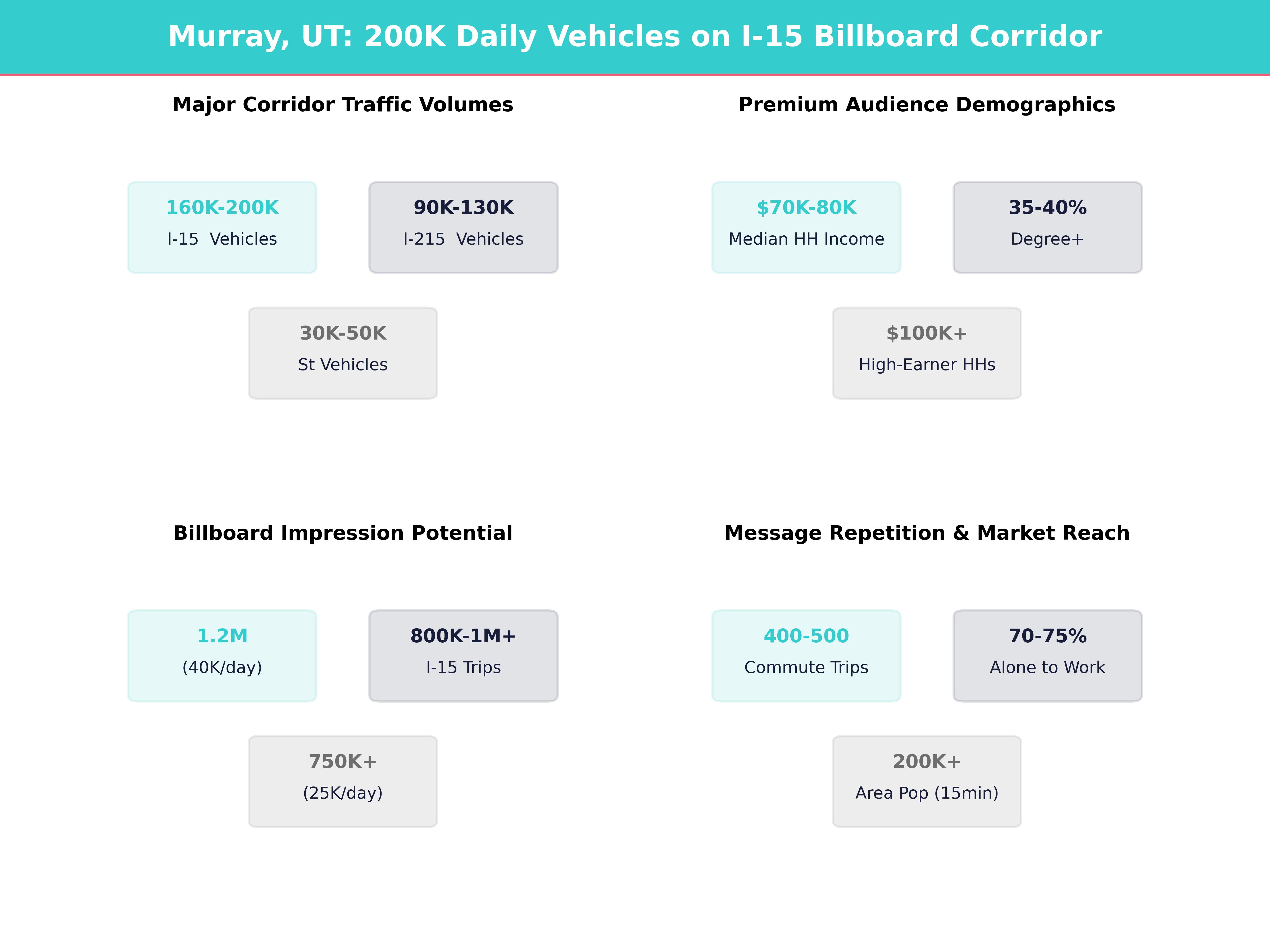
Murray is defined by a handful of high-volume routes, and the primary freeway to prioritize is I‑15, which carries roughly 160,000–200,000 vehicles per day on busy segments in the Murray stretch. I‑215 segments through and near Murray carry roughly 90,000–130,000 vehicles per day, while State Street typically handles 30,000–50,000 vehicles per day. Use I‑15 and I‑215 boards to reach broader, regional audiences and commuters from across the Wasatch Front.
What kind of audience do Murray, Utah billboards with Blip reach?
Murray is both central and well connected, so each impression reaches more than just Murray residents. In Salt Lake County, roughly 70–75% of workers typically drive alone to work, and many of those commutes pass through or near Murray via I‑15, I‑215, or State Street. That makes Murray billboard advertising uniquely efficient for reaching multiple neighboring cities with one cluster of signs.
What makes Murray, Utah a strong market for Blip billboard advertising?
Murray sits at the heart of Salt Lake County, with dense commuter traffic, major medical and retail centers, and easy access from every direction along the Wasatch Front. Murray is a city of about 50,000–51,000 residents, but its daytime population is much higher because of commuters and visitors. The city positions itself as the “Hub of Salt Lake County,” which translates into concentrated, repeat exposure to the same commuters every day.
When is the best time to run billboards in Murray, Utah with Blip?
The morning commute from 6:30–9:00 a.m. is a peak window on I‑15, I‑215, and key arterials, and the evening commute from 3:30–6:30 p.m. is another strong period. Midday is ideal for restaurants, clinics, and retail, while weekends remain strong on retail corridors and around Fashion Place. With Blip, you can daypart your campaigns to focus budget on these high-value windows instead of paying for 24/7 exposure you might not need.
Do I need a contract to advertise with Blip in Murray?
No, Blip has no long-term contracts or minimum commitments. You can start, pause, or stop your campaign at any time.
How fast can I launch a billboard campaign with Blip in Murray?
You can have your campaign live in minutes. Create a free account, select your locations, set your budget, upload your design, and start running once approved.
Where can I advertise with Blip in Murray?
Blip has digital billboards in Murray. You can browse available locations on a map, choose the ones that fit your audience, and start advertising right away.
Still have questions? Launch a campaign in minutes — no contracts, no commitments.
Start Your CampaignMurray Billboard Advertising Guide
Murray, Utah sits at the heart of Salt Lake County, with dense commuter traffic, major medical and retail centers, and easy access from every direction along the Wasatch Front. When we use digital Murray billboards through Blip, we’re tapping into a compact but high-impact market that punches above its size for daily impressions and regional influence. For advertisers considering billboard rental in Murray, this combination of centrality and volume makes the city a powerful anchor in any Wasatch Front campaign.
Understanding the Murray Market
Murray is a city of about 50,000–51,000 residents, but its daytime population is much higher because of commuters and visitors. Recent estimates place Murray’s population at roughly 50,000–51,000 people, while Salt Lake County as a whole is home to around 1.2 million residents. Murray sits almost exactly in the geographic middle of Salt Lake County, and multiple freeways intersect near its borders. That means many people who never live or shop in Murray still drive through it every day and see billboards in Murray multiple times per week.
Key context:
- Population: Approximately 50,000–51,000 residents in Murray City, with the metro trade area (including nearby Midvale, Holladay, and Taylorsville 200,000 people within a 10–15 minute drive.
- Age profile: Median age in Murray is in the mid‑30s, in line with Salt Lake County’s median of about 33–34 years. Roughly 25–30% of residents are under 18, and close to 13–15% are 65 or older, giving advertisers a strong mix of young professionals, families with kids, and established homeowners.
- Education: In the broader Salt Lake County region, roughly 35–40% of adults hold a bachelor’s degree or higher, and Murray’s central, employment-heavy character tends to skew toward that educated profile—valuable for professional services, healthcare, and financial products.
- Income: Median household income in the Murray area is generally in the $70,000–$80,000 range, with Salt Lake County as a whole in the low‑ to mid‑$80,000s. A significant share of households earn $100,000+, creating healthy demand for mid‑ and high‑ticket offers (auto, home improvement, elective medical, travel) that can be efficiently promoted with Murray billboard advertising.
- Housing and stability: Owner-occupancy in nearby central valley communities often runs around 60–65%, meaning a large base of stable homeowners who invest in their properties, vehicles, and local services.
- Regional role: Murray is a key employment and retail hub within the county, anchored by Intermountain Medical Center Fashion Place
The City of Murray positions itself as the “Hub of Salt Lake County,” which is echoed on the official city site at murray.utah.gov. For advertisers, that “hub” status translates into concentrated, repeat exposure to the same commuters every day and access to a county-wide audience passing through a tight geography, which is exactly what we want when investing in billboard rental in Murray.
For additional city context, development updates, and community data, see Murray City and county-level information at Salt Lake County.
Traffic Patterns and Where People Are Driving
Murray is defined by a handful of high-volume routes. When we plan Blip campaigns and decide which Murray billboards to prioritize, we should start with these corridors and then fine-tune by time of day.
Major arteries:
-
I‑15: The primary north–south freeway along the Wasatch Front, cutting right through Murray’s western side.
- In the Murray stretch, recent counts from the Utah Department of Transportation (UDOT) show annual average daily traffic (AADT) commonly in the 160,000–200,000 vehicles per day range on busy segments.
- A typical workweek can easily mean 800,000–1,000,000+ vehicle trips past Murray on I‑15 alone.
- Commuters use it to travel between Utah County (to the south), Salt Lake City (to the north), and Davis/Weber counties.
-
I‑215 (Belt Route): Forms a loop around the Salt Lake Valley and intersects near Murray’s southern/eastern edge.
- UDOT data show segments through and near Murray carrying roughly 90,000–130,000 vehicles per day.
- Connects residents from Holladay, Cottonwood Heights, West Valley, and other suburbs to major job and retail nodes.
-
State Street (US‑89): Historic main artery running straight through Murray’s commercial core.
- Key stretches in Murray typically handle 30,000–50,000 vehicles per day, with a high density of local retail, auto dealers, hotels, and services.
- For context, a board on a 40,000‑vehicle‑per‑day corridor can generate over 1.2 million vehicle impressions per month (assuming 30 days), before you even account for multiple occupants per vehicle.
-
East–west connectors: 4500 South, 5300 South, 5900 South, 6200 South, and 7200 South move traffic between I‑15, State Street, and neighborhoods.
- These routes capture more localized audiences and shoppers, often with daily traffic in the 20,000–40,000 vehicles per day range on key segments.
- Even at a “modest” 25,000 vehicles per day, that’s 750,000+ vehicle trips per month passing a well-placed board.
For more detailed, location-specific traffic counts, advertisers can reference the Utah Department of Transportation’s interactive mapping tools at udot.utah.gov, which provide segment-level AADT and construction updates that can help you choose the best billboards in Murray for your campaign.
Implication for Blip campaigns:
- Use I‑15 and I‑215 boards to reach broader, regional audiences and commuters from across the Wasatch Front. A single Murray-area I‑15 board can realistically deliver millions of monthly impressions when factoring in vehicle occupants.
- Use State Street and east–west corridor boards when we need hyperlocal reach (for example, promoting a nearby restaurant, clinic, or retailer within a 2–3 mile radius).
- Schedule heavier frequency during weekday commuting hours to capture repeat impressions among the same drivers; many commuters make 400–500 round trips per year, creating powerful repetition when you daypart correctly.
Who We Reach: Demographics and Commuter Flows
Because Murray is both central and well connected, we reach more than just Murray residents with each impression.
Key audience characteristics in and around Murray:
- Commuters: In Salt Lake County, roughly 70–75% of workers typically drive alone to work, with another 10–12% carpooling and 5–7% using public transit. Average one-way commute times are in the 22–25 minute range. Many of those commutes pass through or near Murray via I‑15, I‑215, or State Street, turning Murray into a daily touchpoint for residents of Sandy, West Jordan, West Valley City, Holladay, and beyond. That makes Murray billboard advertising uniquely efficient for reaching multiple neighboring cities with one cluster of signs.
-
Workers in Murray:
- Intermountain Medical Center 500 inpatient beds and often cited as employing 5,000+ staff (physicians, nurses, and support teams).
- Murray’s commercial and office parks add thousands more jobs in healthcare support, finance, call centers, and professional services.
- Many of these employees commute from 10–20 miles away, so your message near IMC can reach both local residents and higher-income professionals from across the valley.
-
Shoppers:
- Fashion Place 100+ stores and restaurants and is one of the region’s premier fashion and dining destinations; see tenant and visitor info at fashionplacemall.com
- Regional malls of this size typically attract millions of shopper visits per year, heavily concentrated on evenings and weekends—perfect timing for digital billboard messaging along I‑15, 5300 South, and State Street.
-
Transit riders: Murray is one of the best-served cities in the valley for TRAX light rail and commuter rail operated by the Utah Transit Authority:
- Murray Central (TRAX Blue Line + FrontRunner commuter rail),
- Murray North (Blue Line),
- Fashion Place West (Blue and Red Lines).
UTA’s light rail system moves tens of thousands of riders on a typical weekday across the valley, with Murray as a key transfer and park‑and‑ride node. Even transit riders are often in view of nearby arterial or freeway boards while transferring, waiting at intersections, or using adjacent park‑and‑ride lots.
Implication for messaging:
We’re speaking to a mixed but relatively affluent, education-oriented audience who values convenience, health, and family life. Ads that highlight:
- Time savings and convenience (“In & out in 30 minutes,” “Same-day appointments”),
- Family-friendly offers (kids’ menus, youth programs, family passes),
- Health and wellness (clinics, gyms, healthy dining, mental health services),
- Outdoor and lifestyle experiences (skiing, hiking, local events and festivals),
tend to resonate in this market, especially when paired with clear directional cues to nearby Murray locations and reinforced consistently across multiple Murray billboards.
Seasonality: When to Turn Up Your Blips
Because Murray is centrally located, its traffic ebbs and flows mirror broader county trends but with some local twists driven by retail, healthcare, and recreation.
Daily and Weekly Patterns
-
Morning commute (6:30–9:00 a.m.):
- Peak volumes on I‑15, I‑215, and key arterials. In many metro areas, the heaviest hour can carry 15–20% of daily traffic.
- Great for coffee shops, fitness studios, healthcare reminders, B2B services, and “on your way to work” messaging.
-
Midday (11:00 a.m.–2:00 p.m.):
- Increased movement for lunch, errands, and medical appointments. Retail and dining corridors can see midday volumes that are 60–70% of peak commute traffic.
- Ideal for restaurants, quick-service food, clinics, dental offices, and retail promotions.
-
Evening commute (3:30–6:30 p.m.):
- Another peak, especially northbound I‑15 and east–west connectors near Fashion Place and major big-box clusters.
- Perfect for after-work activities, family dining, shopping, entertainment, and home services.
-
Weekends:
- Saturday volumes remain strong on retail corridors (State Street, Fashion Place area, big-box clusters), and mid-day traffic can rival weekday peaks.
- Promote shopping events, weekend specials, real estate open houses, car dealerships, and recreation-based offers.
With Blip, we can daypart our campaigns to focus budget on these high-value windows instead of paying for 24/7 exposure we might not need. This is especially helpful if your billboard rental in Murray budget is limited and you need every impression to count.
Annual Seasonality
-
Winter (Dec–Feb):
- Holiday shopping spikes around Fashion Place and big-box corridors. Nationally, retailers often see 20–25% of annual sales in November–December, and Murray’s regional mall status concentrates a big share of that spend locally.
- Healthcare and urgent care visits typically rise due to flu, cold, and respiratory illnesses, with many clinics reporting their highest patient volumes of the year in this window.
- Utah ski resorts collectively log millions of skier visits per season, and a large portion of Wasatch Front residents and visitors pass near Murray en route to Cottonwood Canyon access points. Snow sports and winter recreation offers from across the Wasatch Front can perform well with commuters heading to and from ski areas.
- Consider “New Year, new you” creative for gyms, clinics, and wellness providers in January, when fitness-related signups often spike 20–30% versus fall.
-
Spring (Mar–May):
- Home improvement, landscaping, tax services, and car dealers see strong activity. In many markets, home services and garden categories jump 30–50% in advertising activity from winter to spring.
- Warmer weather increases traffic to parks and local events listed by the city at murray.utah.gov.
- Emphasize remodeling, cleaning, yard care, pest control, and vehicle upgrades.
-
Summer (Jun–Aug):
- School is out; families travel more within the valley. Murray Park and local splash pads, pools, and sports facilities attract consistent daily traffic.
- Murray Park and the city’s arts programs draw visitors; check programming via Murray City Cultural Arts hundreds to thousands of attendees per event.
- Promote events, attractions, summer camps, and family activities, as well as HVAC services (AC tune‑ups, system replacements) during heat waves when calls can spike 50–100%.
-
Fall (Sep–Nov):
- Back-to-school, college semesters, and sports seasons increase regular patterns on I‑15 and I‑215 as routines normalize after summer.
- Strong season for healthcare (flu shots, checkups), education services (tutoring, test prep), and retail sales events (Labor Day, pre-holiday promotions).
- Real estate and home services often see a final push before winter, especially roofing, insulation, and heating services.
With Blip, we can pre-plan seasonal shifts and ramp budgets up or down in real time to align with our highest-conversion months, rather than committing to static boards for long fixed terms.
Local Landmarks and Context for Targeting
When we place digital billboards in and around Murray, we should mentally connect each board to the nearby destination drivers are heading toward and to the audience profile using that corridor.
Important local anchors:
-
Intermountain Medical Center (IMC):
- One of the largest hospitals in the Intermountain West, with 500+ beds and a campus visible from I‑15 and key arterials. Learn more at Intermountain Medical Center – Murray
- High traffic from patients, visitors, and healthcare workers every day; hospitals of this scale regularly see hundreds of inpatient admissions per week and thousands of outpatient visits.
- Ideal for healthcare, senior living, pharmacies, insurance, and wellness brands looking to align with a trusted medical hub.
-
Fashion Place Mall:
- Regional mall carrying national anchors, luxury and mid-tier brands, and restaurants, with 100+ tenants listed on fashionplacemall.com
- Draws shoppers from multiple counties—Salt Lake, Utah, and Davis in particular—making it a natural “magnet” that your billboard creative can reference (“Next to Fashion Place,” “Across from Fashion Place”).
- Perfect anchor for fashion, dining, entertainment, tech, and financial services ads targeting higher-spend consumers.
-
Murray Park & Recreation Centers:
- A large, centrally located park with the Murray Park Center, ballfields, swimming pool, and amphitheater.
- Hosts sports leagues, festivals, and concerts, which you can track via Murray Parks & Recreation and the city’s events calendar.
- Many youth sports seasons bring hundreds of families per week to the complex, especially in spring and summer.
- Great for local businesses targeting families, youth programs, and event-based offers.
-
Automotive and big-box corridors:
- Clusters of dealerships and big-box retailers along State Street, 5400 S, and near I‑15 interchanges.
- Auto dealerships in the central valley collectively sell thousands of vehicles per year, and service departments handle dozens to hundreds of service appointments per day.
- Supportive environment for auto, finance, insurance, and related services that rely on visible, offer-driven advertising.
-
Regional connections:
- Murray’s quick access to downtown Salt Lake City 10–20 minute drive in normal conditions) means valley-wide brands can centralize part of their campaign here while also extending coverage via additional Blip boards in adjacent cities.
Tactical tip:
If we’re advertising a local destination, use map-based targeting to concentrate Blips on boards along the main approach routes to that destination during peak times. For example:
- A restaurant near Fashion Place should focus on southbound and northbound I‑15 approaching 5300 S, plus east–west arterials like 5300 S and 5900 S, during weekday evenings and weekends.
- A clinic near IMC can concentrate on morning and midday impressions on I‑15 and State Street and use copy like “Next to IMC in Murray” to leverage the hospital’s name recognition.
- A youth program using Murray Park facilities can focus on early evening and Saturday Blips on State Street and nearby connectors, when families are already heading to the park.
Strategic placement like this turns individual Murray billboards into a coordinated local network that moves people directly toward your doors.
Creative Strategy for Murray’s Audience
Drivers in Murray are exposed to a high density of messages. To stand out, our creative should be:
-
Ultra-clear at a glance.
- Use 7 words or fewer for main headlines—drivers at freeway speeds often have 3–5 seconds to process your message.
- One dominant visual; strong contrast; large, legible fonts.
- Include only one call to action (e.g., “Exit 5300 S,” “Schedule Today,” “Visit This Weekend”).
-
Location-anchored.
- Use clear directional cues: “Next Exit,” “2 Lights Ahead,” “Left on State Street,” “Across from Fashion Place.”
- Mention “Murray” explicitly when it reinforces proximity and trust: “Murray Family Dentistry,” “Your Murray Auto Experts,” “Serving Murray for 20+ Years.”
-
Time- and event-sensitive.
- Rotate creative for key holidays, sales events, or community happenings, e.g., “This Weekend Only – Murray Park,” or “Flu Shots Today Near IMC.”
- Use Blip’s ability to upload multiple creatives and schedule them (e.g., weekday commute messages vs. weekend family-focused messages).
-
Value-driven for a practical audience.
- Murray-area commuters often weigh convenience and value: show real numbers and offers.
- Use specific promos such as “$0 Down,” “$29 Exam,” “20% Off This Weekend,” or “Free Appraisal,” and consider short, trackable URLs or promo codes so you can attribute response to your boards.
-
Aligned with local lifestyle.
- Highlight outdoor lifestyle (Wasatch mountain views, skiing, hiking), family, health, and community engagement.
- References to the Wasatch mountains, local high school sports, and family activities feel natural for this audience and can increase recall.
When you apply these principles consistently across multiple billboards in Murray, you build a cohesive, recognizable presence that compounds with every commute.
Using Blip’s Flexibility: Dayparting, Budgeting, and Geo-Targeting
Blip lets us buy digital billboard space in small increments (“blips”) instead of locking into a single static board 24/7. In a market like Murray, that flexibility is a major advantage for maximizing impressions per dollar and testing different Murray billboard advertising strategies before scaling.
Dayparting: Spend when it matters most
- Focus 6:30–9:00 a.m. for commuter-focused offers, quick-service food, and healthcare reminders. You’re reaching workers during one of the highest-traffic 2–3 hour windows of the day.
- Emphasize 11:00 a.m.–2:00 p.m. for retail, dining, and appointment-based services, especially near Fashion Place and healthcare clusters.
- Push 3:30–7:00 p.m. for events, family activities, shopping, and home services when people are planning their evening.
- For nightlife or entertainment in nearby Salt Lake City or Sandy, schedule evening and weekend night Blips, especially Thursdays–Saturdays, when entertainment spending typically peaks.
Micro-geography: Reach your real trade area
- Select boards along I‑15 for regional reach (multiple cities). Ideal for brands serving a 15–30 mile trade area (hospitals, universities, regional retailers, auto groups).
- Choose State Street and cross-street boards for tight local campaigns within 3–5 miles of your business (clinics, restaurants, gyms, neighborhood services).
- Combine Murray boards with nearby boards in Salt Lake City, Midvale, Holladay, West Jordan, or Sandy for a valley-wide presence that can reach hundreds of thousands of unique drivers per week.
Budget control
- Start with a modest daily budget to test (for example, $10–$20/day) focused on a single corridor and daypart. This level can still generate dozens to hundreds of daily playings depending on competition and board pricing.
- Monitor performance signals—web traffic, calls, coupon redemptions, and walk-in volume—and then scale spend on the best-performing times and locations.
- Use short “bursts” for short-lived events (sales weekends, concerts, clinics) instead of continuous always-on spending. For example, invest 3–5x your normal daily budget during the 3 days leading up to a major event for maximum impact.
This approach turns billboard rental in Murray into a flexible, test-and-learn channel instead of a fixed overhead line item.
Industry-Specific Opportunities in Murray
While almost any business can benefit from billboard advertising, some categories fit particularly well with Murray’s patterns and assets.
Healthcare and Wellness
With Intermountain Medical Center and many smaller clinics:
- Promote urgent care, specialty clinics, dental, vision, physical therapy, and behavioral health within a 3–5 mile radius of Murray.
- Use benefit-driven copy: “Same-Day Appointments,” “Open 7 Days,” “Walk-Ins Welcome,” “Results in 24 Hours.”
-
Time campaigns around:
- Open enrollment (Oct–Dec): health plans and clinics can capture interest when tens of thousands of county residents are reviewing coverage.
- Back-to-school physicals (Aug–Sep): pediatric clinics and urgent cares often see a noticeable volume spike in these months.
- Flu season (Oct–Feb): pharmacies and clinics can promote flu shots and vaccinations as visits rise.
Healthcare advertisers are especially well positioned to benefit from Murray billboard advertising because so many daily trips already revolve around medical services in this hub.
Retail and Restaurants
Fashion Place, State Street, and nearby plazas make Murray a shopping and dining destination.
- Run storewide sale and grand opening campaigns with countdown or date-based creative: “Sale Ends Sunday,” “Grand Opening This Saturday,” “3 Days Only – Murray Location.”
- For restaurants, emphasize quick decisions: “Lunch in 10 Minutes,” “Kids Eat Free Tonight,” “Exit 5300 S – 2 Minutes Away,” or “Open Late Near Fashion Place.”
- Heavier presence on weekends and paydays (1st and 15th of the month) captures discretionary spending, when many households see cash flow peaks and are more likely to dine out or make impulse purchases.
- Consider pairing your boards with listings on local directories and reviews; for tourism and visitor traffic, see Visit Salt Lake.
Because many shoppers visit from across the valley, a handful of well-chosen Murray billboards can act as your primary regional retail awareness channel.
Auto Dealers and Services
Murray has a strong automotive corridor.
- Use digital boards to rotate multiple offers: one creative for financing, one for service specials, one for featured vehicles. In a single campaign, you can test which offer (e.g., “0.9% APR” vs. “$500 Trade‑In Bonus”) drives more web or call response.
- Highlight clear numbers: “0.9% APR,” “Oil Change $39,” “Brakes from $199,” “$500 Trade-In Bonus.”
- Time service-oriented creative to mornings and early evenings when people plan errands, and feature sales-oriented creative on weekends when dealer traffic is typically highest.
For dealerships and repair shops, targeted billboard rental in Murray near these auto clusters can consistently intercept in-market buyers as they comparison shop along State Street.
Home Services and Real Estate
A large share of Murray and nearby residents are homeowners or aspiring buyers.
- Promote HVAC, plumbing, roofing, landscaping, and remodeling with seasonal hooks: “Beat the Heat,” “Winterize Now,” “Spring Refresh,” “Storm Damage? Call Today.”
- Real estate agents and mortgage lenders can feature neighborhoods and price points: “Move-In Ready in Murray,” “Homes Under $500k Near Fashion Place,” “Low-Down-Payment Options in Central Valley.”
- Target boards near residential arteries and school routes; families often make dozens of weekly trips along the same corridors for school, shopping, and sports, which amplifies repetition.
Entertainment, Events, and Arts
Murray has a strong local arts and recreation program and serves as an easy jumping-off point to events across the valley.
- Promote concerts, theater, festivals, and sports events happening in Murray or downtown Salt Lake.
- Use date + venue callouts: “This Friday – Murray Park Amphitheater,” “Tonight, 7 PM, Downtown SLC,” “Saturday 10 AM – Murray City Park.”
- Intensify impressions 3–5 days before the event and on the day of; many events see 50–70% of ticket sales in the final week.
- For local arts and events calendars, refer to Murray City’s event listings, county-level cultural listings via Salt Lake County, and visitor information via Visit Salt Lake.
Murray billboard advertising is particularly effective for time-sensitive entertainment and events because creatives can be swapped quickly and precisely timed to peak interest.
Leveraging Local Media and Data Sources
To refine and measure campaigns, we can pair our Blip strategy with local data and coverage:
-
City and county:
- Murray City for development plans, event calendars, and community services that shape traffic and interest (new facilities, road projects, major events).
- Salt Lake County for broader regional planning, economic development news, and statistics shaping where growth and new housing are going.
-
Transportation:
- UDOT for traffic counts by segment, seasonal patterns, and construction updates impacting travel patterns near your chosen boards.
- Utah Transit Authority for TRAX and FrontRunner route maps and park‑and‑ride locations that intersect with billboard visibility.
-
News outlets:
- Murray Journal for neighborhood-level news, school stories, and community priorities.
- Regional coverage from The Salt Lake Tribune and KSL.com to understand broader economic trends (job growth, housing, consumer confidence) that influence buying behavior.
To assess impact, track:
- Brand or location-based search volume before, during, and after your Blip flights.
- Website analytics (sessions, direct traffic, and location-based traffic from Murray and surrounding ZIP codes).
- Coupon or promo code redemptions tied to billboard-specific offers.
- Call tracking numbers used only in your billboard creative.
Compare these metrics against your schedule of Blip impressions (by corridor and daypart) to identify which combinations deliver the strongest lifts. Over time, this allows you to refine exactly which Murray billboards, messages, and time frames produce the best return.
Putting It All Together
A strong digital billboard strategy in Murray typically includes:
- Clear objective: Brand awareness, store visits, lead generation, event attendance, or hiring, with corresponding metrics (e.g., 10–20% lift in branded search, specific ticket or call goals).
- Right corridors: I‑15/I‑215 for regional reach; State Street and key cross streets for local impact within a 3–5 mile trade area.
- Smart timing: Focus on commute windows, weekday vs. weekend, and major seasonal peaks that align with your industry.
- Tightly crafted creative: Simple, location-anchored messaging that reflects Murray’s commuter, family, and health-conscious culture, staying under 7 key words and one main call to action.
- Flexible budget: Start focused at around $10–20/day, measure impact, and scale successful placements and time slots while trimming underperformers.
- Continuous optimization: Use local data, event calendars, and your own business metrics to fine-tune your schedule and artwork monthly or even weekly.
By combining Murray’s unique position as the center of Salt Lake County with Blip’s flexible, data-informed buying tools, we can build Murray billboard advertising campaigns that deliver efficient, targeted reach and measurable value—whether we’re attracting shoppers to Fashion Place, patients to a nearby clinic, families to a Murray Park event, or commuters to a new service right off the freeway. Thoughtful billboard rental in Murray becomes a scalable, testable part of your marketing mix rather than a one-off experiment.