A good billboard does more than look good.
It helps people remember your business, understand why they should care, and feel something positive when they see your name again.
That starts before you choose a font, photo, or color.
Michael Lieberman, Chief Strategy Officer at Adkom and Blip, has spent his career thinking about what makes advertising work. His advice comes down to three jobs every ad needs to do.
Get these right, and your creative has a much better foundation to work from.
Key Takeaways
- Make your business easy to remember. Your name or brand should be one of the first things people take away.
- Give customers one clear reason to care. Focus on what matters most to them, not everything you want to say.
- Leave the right impression. Familiarity and positive associations can help your business come to mind when customers are ready to choose.
Start With the Message, Not the Billboard
It is easy to start with the board.
Where is it? How much traffic passes it? How big will the ad look?
Those questions matter. But before you decide where your billboard should go, decide what you need customers to take away from it.
A great location cannot make up for a message people do not understand or remember.
And for a local business putting real marketing dollars behind a campaign, getting that message right matters even more.
So before you build your next ad, make sure it can do these three things.
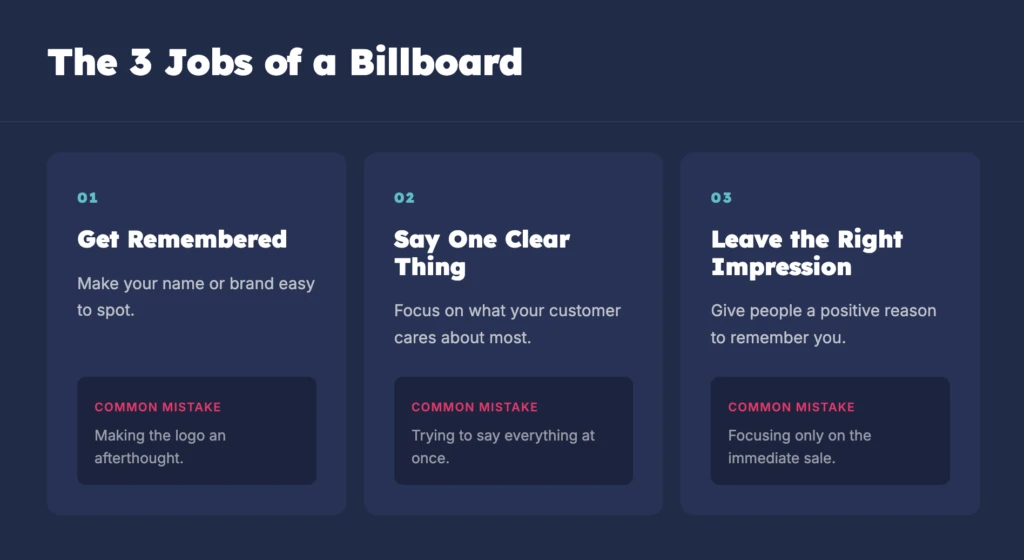
1. Make Your Business Easy to Remember
The first job is simple: people need to know who the ad is for.
That sounds obvious, but plenty of ads make the brand name, logo, or identifying element compete with everything else on the board.
Michael points to insurance advertising as an example. The jingles may be repetitive, but that repetition is exactly why people remember them.
Your billboard does not need a jingle. It does need something customers can quickly connect back to you.
Ask yourself:
If someone passed this billboard a few times this week, would they remember my business name?
If the answer is unclear, make your brand easier to find.
Your logo should not be an afterthought. Your name should not disappear behind the offer. The most important identifying element should be easy to take in at a glance.
2. Say One Thing Your Customer Cares About
Once someone knows who you are, give them one clear reason to care.
The biggest temptation is trying to fit everything onto the board:
Your services.
Your awards.
Your phone number.
Your website.
Your sale.
Your tagline.
Your years in business.
The result is usually more information and less impact.
Instead, think about the customer you want to reach and the question they are trying to answer.
A customer looking for a plumber may care most about getting help quickly.
Someone choosing a dentist may care about feeling comfortable.
Someone deciding where to eat may simply want to know whether your restaurant is worth stopping for.
Your billboard should meet that customer where they are.
Michael puts it this way: when what you want to say and what your audience wants to hear do not match, the problem goes deeper than the creative.
A useful test: If customers remember only one thing from this billboard, what should it be?
Build around that.
3. Leave the Right Feeling Behind
Not every billboard needs someone to act immediately. Sometimes the bigger win is becoming the business they already know when the need finally arrives.
Think about a personal injury attorney advertising along a busy highway. Most drivers do not need an attorney at that exact moment.
The billboard is doing something earlier.
It is building familiarity.
If that person eventually does need help, the name they have seen repeatedly may be easier to remember than one they are encountering for the first time.
That is why the feeling your ad leaves behind matters.
Does your business feel trustworthy? Approachable? Local? Fun? Premium? Dependable?
Your design, message, and tone should reinforce the impression you want customers to carry with them.
You are not just asking people to notice you. You are giving them a reason to remember you positively.
There Is No One Formula for a Great Billboard
Good advertising is not about following every creative rule. It is about knowing who you are talking to and what will connect with them.
When MINI Cooper launched in the U.S., some of its billboard ads used close to 100 words of copy. That breaks nearly every conventional billboard guideline. But the approach fit the brand: unconventional, playful, and made for drivers who wanted something different.
Apple’s Shot on iPhone campaign went in the opposite direction.
A strong image. Minimal copy. Nothing fighting for attention.
The execution worked because it matched what people already understood about Apple.
One of the campaigns Michael remembers most was even simpler: a serialized comic called Julio and Marisol that ran on static subway cards in New York in the 1990s.
No video. No elaborate technology. Just a story built specifically for the teenagers seeing it.
Different formats. Different audiences. Different creative choices.
But each campaign did the same three things:
It was memorable.
It communicated something specific.
It created the right feeling for the audience.
That is the part worth copying.
Not the number of words. Not the layout. Not the creative trick.
The thinking behind it.
Before Your Next Billboard Goes Live
You do not need an award-winning idea or a massive creative budget.
You need a message built around the customer you want to reach.
Before you launch, ask:
- Will people remember who this is from?
- Is there one clear thing I want them to know?
- What impression will they walk away with?
If you can answer all three, you are starting from a much stronger place.
Then you can focus on finding the right boards, reaching the right customers, and giving that message enough opportunities to stick.
Frequently Asked Questions
Does my billboard really need to be simple?
For most businesses, simpler is easier to understand quickly. Drivers may only have a few seconds with your message, so every element should earn its place.
That does not mean every billboard needs to follow a strict word count. MINI Cooper showed that longer copy can work when the execution is intentional and fits the brand.
The better question is: Can the person I am trying to reach quickly understand what matters?
If yes, the creative is doing its job.
What if my billboard looks great but I am not seeing results?
Start with the three jobs:
- Can people easily tell who the ad is for?
- Is there one clear message customers care about?
- Does the ad leave the impression you want?
If one is missing, start there.
Then look beyond the creative. Location, frequency, timing, and how the billboard works with the rest of your marketing can all influence campaign performance.
Billboards are especially useful for building recognition over time, so judging the campaign only on immediate sales can miss part of the value.
Ready to Put the Framework to Work?
With Blip, you can find digital billboards in the places your customers already travel, launch with the message you want to test, and make changes as you learn.