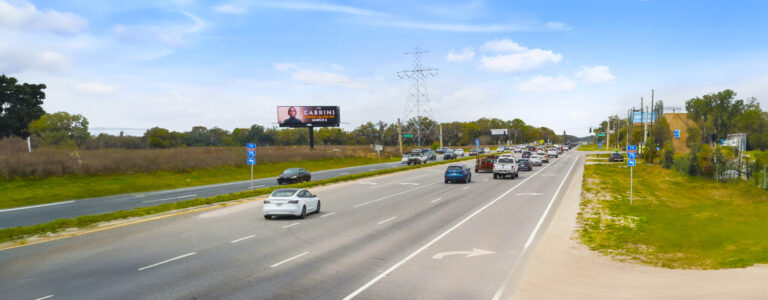
Quick Answer: OOH stands for out-of-home advertising. It covers every ad format designed to reach people when they are outside their homes, from billboards and bus shelters to transit wraps and digital screens.
If you are looking to grow your brand beyond search and social, OOH is one of the most proven ways to do it.
If you are looking to grow beyond search and social, OOH helps your brand get seen and remembered in the real world. As AI changes how people search, compare, and choose businesses, real-world visibility can help your brand feel more familiar and credible.
A billboard is a strong trust signal. It puts your business in front of local audiences again and again, helping people recognize your name, remember what you do, and feel more confident choosing you.
Billboards are the most recognized OOH format, and the data backs up why. Nearly two-thirds of consumers took at least one action after seeing a digital billboard. Whether you have worked with outdoor advertising agencies before or you are brand new to the space, this guide breaks down everything you need to know.
Key Takeaways
- OOH (out-of-home) advertising refers to any ad placed in a public space outside the home, including billboards, transit ads, street furniture and place-based signage.
- According to the OAAA, billboards deliver a 497% return on investment, and nearly 88% of adults notice OOH ads.
- Digital out-of-home (DOOH) advertising, particularly digital billboards, adds flexibility, real-time updates and cost control that static formats cannot match.
- OOH is a form of paid media that works alongside your digital campaigns to build brand recall and drive online engagement.
- Self-serve platforms like Blip let any business launch digital billboard campaigns without contracts, large budgets, or working through an outdoor advertising agency.
What is OOH Advertising?

OOH advertising is a broad term for any advertising placed in public spaces outside the home. OOH ads are designed to reach large audiences in high-traffic areas where people walk, drive and commute. They are built to be seen repeatedly by the same people, which makes them effective at building brand recall.
Common OOH formats include billboards, bus shelter ads, transit wraps, airport signage, and retail displays. Each serves a different purpose, but they all share one thing: they reach your audience in the physical spaces where they already spend time.
OOH helps businesses build awareness where people already spend time in the real world. Billboards keep your brand visible during daily drives, commutes, errands, and local routines. Online ads and OOH do different jobs, and they can work well together. Billboards help people recognize and remember your business, so your brand feels familiar when they see you online later.
Is OOH Advertising Paid Media?
Yes. OOH advertising is paid media because you pay to place your ad on outdoor spaces like billboards, bus shelters, and digital screens.
In the past, that usually meant working with a billboard advertising agency, signing contracts, and committing to bigger spends. With Blip, you can buy digital billboard space directly, set your own daily budget, and only pay when your ad runs. Agencies can also use Blip to manage digital billboard campaigns for their clients at scale, without the usual back-and-forth of traditional billboard buying.
OOH is also great for brand recall. It helps people see your name again and again, so they are more likely to remember you when it is time to choose.
Why is OOH Advertising Important and Beneficial
This kind of advertising represents one of the amplest opportunities for advertisers to connect with their audiences. As marketers, advertisers or business owners, you have much to gain when you implement OOH in your advertising stack.
Data on the Benefits of OOH Advertising
Let’s first jump right into the data that proves the efficiency of using the OOH route.
- Research cited by the Out of Home Advertising Association of America (OAAA) has found that out-of-home advertising can deliver strong returns, with some studies reporting up to 497% return on investment.
- This roughly translates to a return of $6 for every $1 spent on advertising.
- Another OAAA study reveals that nearly a whopping nine in ten adults (88%) notice OOH ads and nearly 80% of those viewers are inspired to take action.
- OOH clearly affects those who see its messages.
- The most effective OOH ads are capable of triggering a 38% increase in mobile engagements between customers and brands. Customers are also 17% more likely to interact with a brand after being exposed to an OOH ad.
- This shows that OOH is never a standalone operation. It helps customers throughout their customer journey with your brand, as it makes them more likely to engage with it. This includes partaking in engagements with your brand on their mobile devices. Thus, OOOH stimulates your customers’ mobile UX.
Why OOH Advertising is Important for Your Brand
Out-of-home advertising reaches and engages a wide range of people, many of whom are within your target market.
Although many customers spend their time online, they still leave the home, either regularly for work and errands or occasionally to meet with friends and family. You wouldn’t want to miss an opportunity to reach your customers when they’re out and about.
OOH ads are usually large and hard to miss. They also allow brands to showcase their creative side. Thus, when their size and creative content are coupled, they are easy to notice and pay attention to. (As aforementioned above, almost 9 in 10 adults notice outdoor signage).

Many of the same people pass by out-of-home ads on a daily basis, thereby seeing messages from the same brand repeatedly. This is incredibly invaluable to brand marketing, as it ingrains your brand and its messages into the minds of your customers. As such, OOH ads trigger brand recall and recognition.
In this way, OOH fosters qualified buyers, i.e., the ad viewers most likely to buy from you. When your potential customers have qualified impressions or QI, this denotes that they have seen your ad at least 6 times or more. When customers hit the 6-impression mark, they are then ready to make a purchase decision, as they know enough about your brand.
After all, no one will buy from you after seeing your ad just once. This is because there is a psychology to advertising, which requires potential customers to know enough and feel something toward your brand – typically a sense of credibility and self-identification before they buy.
Enhancing Customer Experiences instead of intruding on them
Outdoor advertising is a non-intrusive form of advertising. Most people are tired of ads, as no matter how much customers love a brand, ads are usually unwanted and intrusive.
Digital ads especially are notorious for negatively impacting your customers’ UX. No one wants an ad interrupting their activity online, whether it involves looking at a webpage, reading content, watching a video or playing an online game. When an ad pops up during these engagements, it is intrusive and irritating.
This is not the case with out-of-home ads.
OOH ads don’t intrude or invade any experience. They simply exist. When a customer sees outdoor signage, they’re doing so voluntarily, not because such ads are foisted upon them in a way that prevents them from continuing their activities. Instead, outdoor ads enhance customers’ experience.
They are created as visually appealing images and words that capture attention without impeding people from going on about their day. Thus, OOH ads create positive customer experiences and shape positive associations with your brand.
Best of all, you can’t click out of or scroll away from an outdoor advertisement.
The Types of OOH Ad Channels
Now that you understand the importance and advantages of OOH advertising, let’s discover the specific types of OOH advertising. Consider the following types when you’re deliberating on the right outdoor ad channel for your brand. Here are a few examples of prominent OOH channels:
- Street furniture
- Ads on bus shelters
- Booths
- Benches
- Bike stations
- Electric vehicle charging stations
- Transit
- In-station train and subway ads
- Ads along the sides of buses and cars
- Ads in airports
- Taxis
- Place-based
- Wallscapes
- These are painted on the side of a building or made of an extraordinarily large billboard.
- Ads in restaurants, pubs and bars
- Shopping areas
- Special events
- Handouts of flyers
- Wallscapes
- Retail
- Ads in supermarkets
- Posters on storefronts
- Shopping areas and malls
- Billboards
- Digital billboards, a kind of DOOH (digital out-of-home advertising)
- Bulletins
- Junior posters
Why Digital Billboards Are the Best OOH Advertising Channel
Out-of-home advertising is filled with variety, both in terms of the types of advertisements it encompasses, along with the types of benefits it offers.
When it comes to choosing the best OOH method, we suggest taking the DOOH route, particularly digital billboards. Digital billboards offer you the best of what billboards offer, and take it a few steps further.
Given that billboards can be beautifully designed to command and retain attention, digital billboards take this to the next level. They are bright, flashy and rotating, making them nearly impossible to ignore.
Their inclusion of light makes them stand out far more than an analog billboard. They will make any space your customers are traveling that much more special, which in turn,forms positive associations with your brand.
Additionally, DOOH advertising tends to show ads in rotation, which is proven to be a strong method of brand recall. This is especially powerful when you feature your blips (8-15 second ad slots) for an extended time period.
Because these billboards are digital, you can regularly change and update your ad to your liking, without the need to invest too much time and energy. This kind of dynamic and changeable nature is not found in regular billboards. Because they’re dynamic, you can supercharge your ad campaigns with various messages.
With the right DOOH platform, digital billboards are also highly cost-effective, allowing you to uphold your advertising budget. There is no need to spend tens of thousands of dollars on DOOH ads. The right platform will enable you to create and post ads without overspending.
How an OOH Advertising Company Like Blip Makes It Easy
Running OOH campaigns does not have to be complicated. Blip is a self-serve DOOH platform that gives you everything you need to launch and manage billboard campaigns on your own terms.
With Blip, you get access to thousands of digital billboard locations across the country. You can schedule your ads, pick specific times of day, set your own daily budget and bid on 8-second ad slots called Blips. There are no contracts and no minimum spend.
Unlike working through a traditional out of home advertising agency, Blip puts you in full control. You can launch a campaign in minutes, pause it whenever you need to, and make changes on the fly.
Need help along the way? The Blip support team is available to assist, whether you are a first-time advertiser or managing campaigns for multiple locations.
Frequently Asked Questions About OOH Advertising
What is OOH in advertising?
OOH in advertising means paid ads shown in public spaces, outside someone’s home. It is built for visibility, repeated exposure, and local brand awareness.
What are out-of-home ads?
Out-of-home ads are ads people see while commuting, shopping, travelling, or moving through public spaces. Examples include billboards, bus shelter ads, transit wraps, and digital screens.
What is out-of-home media?
Out-of-home media is the group of physical ad placements brands buy to reach people offline. It gives businesses a way to stay visible beyond search, social, and email.
What is an example of OOH advertising?
A local restaurant running an 8-second digital billboard ad near a busy intersection is a clear OOH example. The ad reaches nearby drivers at the exact moment they are close enough to visit.