Billboards near Kirkwood, MO
No Minimum Spend. No Long-Term Contracts. Just Results.
Trusted by Leading Brands


Billboard advertising
near Kirkwood has never been easier



How much is a billboard near Kirkwood?
Why Choose Blip for Billboard Advertising near Kirkwood
-
Blip lets you launch Kirkwood billboards fast along I-44 and I-270, reaching daily commuters without sales calls or delays.
-
Set a flexible daily budget for Kirkwood, then scale up for Downtown Kirkwood festivals or back-to-school season when traffic peaks.
-
Daypart your Kirkwood campaign to hit school drop-off, commute, and Manchester Road shopping hours when families are most on the move.
-
No contracts means Kirkwood businesses can test campaigns, then shift spend to the St. Louis, Ballwin, or Valley Park boards that perform best.
-
Track results in real time on Blip and adjust creative as Kirkwood traffic changes between weekday commutes and weekend downtown events.
-
Use Blip's creative tools to build simple, local ads for Kirkwood—great for quick reads on I-44, Lindbergh, and busy West County routes.
Frequently Asked Questions About Billboard Advertising near Kirkwood
How much does a billboard cost near Kirkwood, Missouri with Blip?
With Blip, you control exactly what you spend on Kirkwood billboards by setting a daily budget that can be as small or as large as you like. Each ad showing, or “blip,” is a brief 7.5–10 second spot on digital billboards near Kirkwood, Missouri, and you only pay for the blips you receive. Prices per blip vary based on time of day, location, and advertiser demand, so your total cost is simply the sum of all those individual blips over time.
Where can I advertise with Blip in Kirkwood, Missouri?
We have 29 digital billboards serving the Kirkwood area within roughly 10 miles. These are located in St. Louis, Missouri, Ballwin, Missouri, and Valley Park, Missouri. These placements function as a network of Kirkwood billboards, giving coverage along major corridors that Kirkwood-area residents use daily.
What kind of people live in the Kirkwood, Missouri area for billboard advertising?
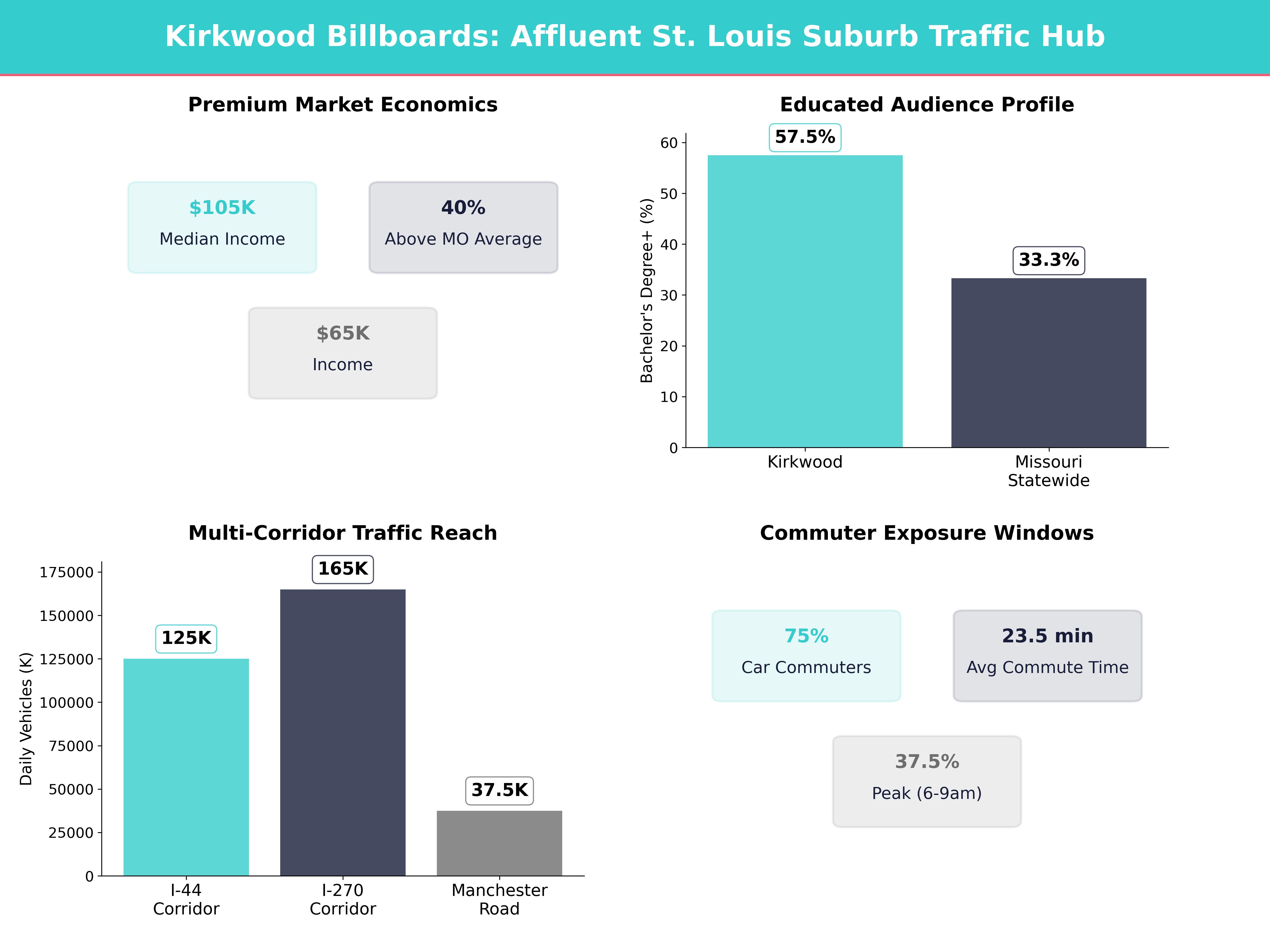
Kirkwood is an established, affluent suburb with deep community roots and a strong local brand identity. The area has a population of roughly 29,000 residents, with a median household income around $100,000–$110,000, which is roughly 35–45% higher than the statewide median for Missouri households. Local estimates indicate that around 55–60% of adults in the Kirkwood area have a bachelor’s degree or higher.
When is the best time to run billboards in Kirkwood, Missouri with Blip?
The Kirkwood area’s lifestyle and commuting patterns should guide when we schedule campaigns. In most suburban St. Louis traffic studies, roughly 60–65% of weekday vehicle trips occur between 6:00 a.m. and 7:00 p.m., with clear peaks in the morning and late afternoon. With Blip, we can shift budget toward peak times for your audience.
What roads have the most traffic for billboards near Kirkwood, Missouri?
Interstate 44 near the Kirkwood area carries on the order of 110,000–140,000 vehicles per day on nearby segments, depending on the exact stretch. Interstate 270 is one of the busiest loops in the region, with nearby stretches often exceeding 150,000–180,000 vehicles per day and some peak locations approaching 190,000. Manchester Road through Ballwin, Des Peres, and west St. Louis County frequently sees 30,000–45,000 vehicles per day.
Do I need a contract to advertise with Blip near Kirkwood?
No, Blip has no long-term contracts or minimum commitments. You can start, pause, or stop your campaign at any time.
How fast can I launch a billboard campaign with Blip near Kirkwood?
You can have your campaign live in minutes. Create a free account, select your locations, set your budget, upload your design, and start running once approved.
Where can I advertise with Blip near Kirkwood?
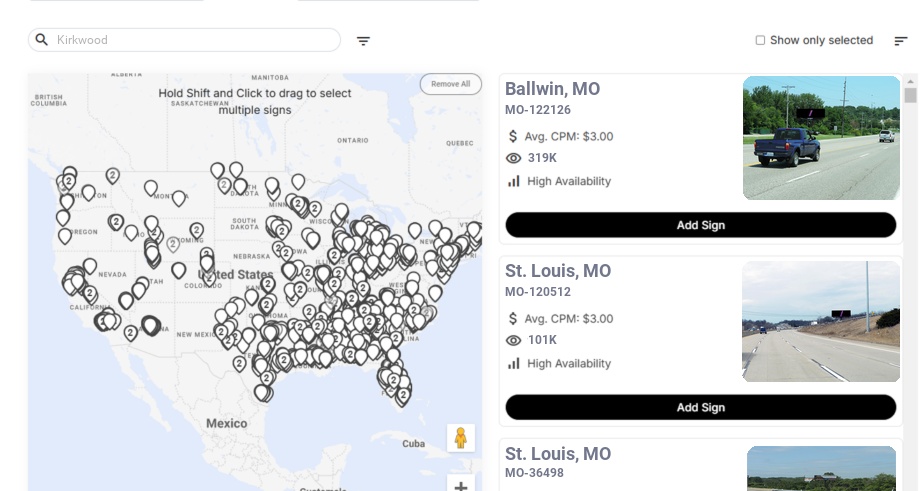
Blip has digital billboards near Kirkwood. You can browse available locations on a map, choose the ones that fit your audience, and start advertising right away.
Still have questions? Launch a campaign in minutes — no contracts, no commitments.
Start Your CampaignKirkwood Billboard Advertising Guide
Understanding the Kirkwood Area Audience
Kirkwood is an established, affluent suburb with deep community roots and a strong local brand identity.
- The Kirkwood area has a population of roughly 29,000 residents, with a median household income around $100,000–$110,000, which is roughly 35–45% higher than the statewide median for Missouri households.
- Homeownership is high, with about 70% of occupied housing units owner‑occupied, and more than half of those owner households having lived in the same home for 10 years or longer, reflecting stable, long-term residents who tend to support local businesses.
- Local estimates indicate that around 55–60% of adults in the Kirkwood area have a bachelor’s degree or higher, compared with roughly one‑third statewide, supporting demand for professional services, healthcare, and enrichment activities.
- The City of Kirkwood
- The Kirkwood School District serves about 6,000 students across multiple elementary schools, two middle schools, and Kirkwood High School, drawing families that often prioritize education and community activities. Graduation rates in the district typically exceed 95%, and district communications highlight that more than 80% of graduates continue to post‑secondary education or training.
These factors matter for billboard advertisers:
- Spending power: With typical disposable income per household estimated in the $60,000–$70,000 range, higher household income supports premium products and services: home improvement, professional services, healthcare, financial services, automotive, and discretionary retail. Households in this income band spend, on average, 20–30% more on dining out and entertainment than middle‑income households.
- Family focus: Roughly 30–35% of households in the Kirkwood area include children under 18, and families often participate in multiple weekly activities—sports, lessons, faith communities, and school events—creating frequent exposure to roadside media. Youth activities, family attractions, education services, and healthcare can resonate strongly with parents in the Kirkwood area and are natural fits for billboard advertising near Kirkwood.
- Local loyalty: Surveys conducted in similar St. Louis County
Commuting is also central to the Kirkwood area’s daily rhythm:
- In typical St. Louis County downtown St. Louis
- Average one‑way commute times for Kirkwood‑area workers are roughly 22–25 minutes, with 20–25% of commuters traveling 30 minutes or more. This frames when drivers are most receptive to commute-related messaging (coffee, quick-service restaurants, traffic-related services, auto care).
- Regional transit options such as Metro Transit buses and nearby rail stations carry tens of thousands of daily riders across the St. Louis area; park‑and‑ride and feeder traffic generates additional vehicle trips near major highway access points.
Digital billboards serving the Kirkwood area from nearby St. Louis, Ballwin, and Valley Park allow us to intercept this commuting and shopping flow at key points and build effective billboard advertising near Kirkwood without overspending.
Where Our Digital Billboards Reach the Kirkwood Area
We have 29 digital billboards serving the Kirkwood area within roughly 10 miles, located in:
- St. Louis, Missouri (about 0.8 miles from Kirkwood)
- Ballwin, Missouri (about 3.7 miles from Kirkwood)
- Valley Park, Missouri
These placements function as a network of Kirkwood billboards, giving coverage along major corridors that Kirkwood-area residents use daily. Western St. Louis County as a whole has more than 250,000 residents within roughly a 15–20 minute drive of Kirkwood, meaning these 29 boards can touch a large, high‑value regional audience.
Key traffic patterns and corridors to consider:
-
Interstate 44 near the Kirkwood area
According to Missouri Department of Transportation (MoDOT) traffic data, I‑44 segments running just east and west of the Kirkwood area carry on the order of 110,000–140,000 vehicles per day, depending on the exact segment, with truck traffic often representing 8–12% of total volume. That translates to roughly 40–50 million vehicle impressions per year on the heaviest segments.- Ideal for: broad-reach campaigns (health systems, banks, major retail, events) and any advertiser wanting consistent visibility across western St. Louis County using billboards near Kirkwood.
-
Interstate 270 near the Kirkwood area
I‑270 is one of the busiest loops in the region. MoDOT counts on nearby stretches often exceed 150,000–180,000 vehicles per day, with some peak locations approaching 190,000. Morning and evening peaks can see hourly flows above 8,000 vehicles per lane.- Ideal for: regional brands targeting both Kirkwood-area residents and shoppers from neighboring suburbs (Ballwin, Des Peres, Town & Country, Fenton). A single well‑positioned I‑270 board can deliver millions of weekly impressions to higher‑income commuters and serves as a high-impact Kirkwood billboard for regional visibility.
-
Manchester Road corridor (Ballwin / West County)
Manchester Road (Route 100) through Ballwin, Des Peres, and west St. Louis County is a dense retail and service corridor. Local segments frequently see 30,000–45,000 vehicles per day, and the corridor connects multiple major shopping destinations, including West County Center in Des Peres, which reports millions of shopper visits annually.- Ideal for: retail, restaurants, automotive dealers, fitness, and personal services that draw Kirkwood-area residents to shop or dine nearby. For example, capturing even 1% of daily Manchester Road traffic at 35,000 vehicles per day equates to about 350 potential customers viewing your ad each day at that location alone.
-
Highways 141 and 61/67 (Lindbergh Boulevard) near Valley Park and St. Louis
These routes funnel traffic north–south between the Kirkwood area, Fenton, and South County, with typical daily volumes in the tens of thousands of vehicles per segment—often 35,000–55,000 vehicles per day on busy stretches.- Ideal for: destination businesses south or west of the Kirkwood area that still rely heavily on Kirkwood-area customers, such as big‑box retail, auto dealers, and regional medical centers.
Because Blip lets us choose specific boards and times, we can stitch together coverage that mirrors how Kirkwood-area residents actually move: from neighborhoods to schools, retail centers, workplaces, and entertainment districts. For many campaigns, combining 5–10 of the highest‑traffic boards can provide access to 200,000–300,000 daily vehicle impressions across the broader Kirkwood trade area, creating a cost-effective, on‑demand billboard rental near Kirkwood.
Daily Rhythms: When to Run Your Blips
The Kirkwood area’s lifestyle and commuting patterns should guide when we schedule campaigns. In most suburban St. Louis traffic studies, roughly 60–65% of weekday vehicle trips occur between 6:00 a.m. and 7:00 p.m., with clear peaks in the morning and late afternoon.
Morning (6:00–9:00 a.m.)
- Parents driving children to schools across the Kirkwood School District. With approximately 6,000 students and hundreds of staff, school‑related traffic alone accounts for several thousand vehicle trips each school day.
- Commuters heading toward employment centers in downtown St. Louis, Clayton, and the I‑270 corridor. Regional data show that 35–40% of workers start their commute between 6:00 and 9:00 a.m.
- Traffic is heaviest on I‑44, I‑270, and Lindbergh Boulevard approaching these routes, with MoDOT morning peak volumes often at 85–95% of evening-peak levels.
Best use cases:
- Coffee shops, bakeries, quick breakfasts—especially those within 5–10 minutes of major interchanges.
- Auto services (“Get that noise checked before your next commute.”).
- Health and wellness reminders (flu shots, urgent care, dental) that can capture the 15–20% of commuters who schedule appointments before or right after work.
- Education, tutoring, and after‑school programs that parents research later in the day after seeing the morning message on Kirkwood billboards along their route.
Midday (10:00 a.m.–3:00 p.m.)
- Errand and shopping trips to Manchester Road, local business districts, and major retail centers in Ballwin, Des Peres, and West County. Retail trade areas like West County Center and downtown Kirkwood can see thousands of midday visitors on weekdays and significantly more on weekends.
- Seniors and flexible workers on the road; in many suburbs, adults aged 55+ represent 20–25% of the population, and this group is more likely to schedule daytime appointments.
Best use cases:
- Retail sales, boutiques, home improvement, and garden centers that rely on spontaneous weekday visits.
- Medical and professional services that accept weekday appointments (chiropractic, physical therapy, dentistry, financial advisors).
- Restaurants emphasizing lunch specials; national quick‑service brands often see 15–25% of daily transactions during the lunch window.
Afternoon School / Work Return (3:00–6:30 p.m.)
- Parents picking up students from schools and activities. Extracurricular participation rates in strong suburban districts commonly reach 60–70% of middle and high school students, increasing late‑afternoon traffic near schools and activity centers.
- Workers returning to Kirkwood-area neighborhoods via I‑44 and I‑270. Across the region, more than 40% of commuters leave work between 3:00 and 6:30 p.m.
- Afternoon peak volumes on MoDOT counts typically rival or slightly exceed morning rush hour; on some corridors, the 4:00–5:00 p.m. hour is the single busiest of the day.
Best use cases:
- Restaurants and takeout (“Dinner solved in 15 minutes.”) targeting households where 50–60% of weeknight dinners involve at least some prepared or restaurant food.
- Youth sports and enrichment programs.
- Local events and entertainment (movie theaters, family attractions, community events) that depend on spur‑of‑the‑moment decisions sparked by billboard advertising near Kirkwood during the drive home.
Evening and Weekend
The Kirkwood area has a strong dining and leisure culture:
- Downtown Kirkwood, promoted by the Downtown Kirkwood Special Business District, features restaurants, boutiques, and events that draw visitors from across the region. Local business district reports note thousands of visitors for major seasonal events and consistent evening foot traffic during fair‑weather months.
- Attractions like The Magic House, St. Louis Children’s Museum
Best use cases:
- Family attractions, entertainment venues, and seasonal events.
- Retail promotions for weekend shopping; regional malls and lifestyle centers often see 30–40% of weekly traffic on Saturdays and Sundays.
- Faith communities and nonprofits promoting programs or fundraisers, as weekend service attendance and events concentrate exposure.
With Blip, we can shift budget toward peak times for your audience. For example, a kids’ activity center might weight 70–80% of impressions to after‑school and weekend slots, while a B2B service may focus heavily on weekday commute hours and allocate 60–70% of spend to 7:00–10:00 a.m. and 3:00–6:00 p.m., maximizing the impact of billboard rental near Kirkwood during high‑value windows.
Tailoring Creative for the Kirkwood Area
The Kirkwood area responds especially well to messaging that feels local, family-friendly, and community-minded.
1. Emphasize Local Identity
Kirkwood-area residents are proud of their city’s history and feel distinct from “generic” West County:
- Reference local touchpoints: “Near Downtown Kirkwood,” “Minutes from Kirkwood Road,” or “Proud to serve the Kirkwood area.”
- Visuals that echo local landmarks (train station silhouette, tree‑lined neighborhoods, classic brick storefronts) create instant recognition.
- Consider nods to popular local amenities like Kirkwood Farmers’ Market or nearby greenways developed by Great Rivers Greenway
Avoid implying your boards are physically inside the city when they are actually near the Kirkwood area; instead, phrase your message around serving the community and use Kirkwood billboards as gateways directing traffic to your nearby location.
2. Make It Family-Focused (When Applicable)
With roughly 30–35% of households including children, family-oriented messaging resonates:
-
Use quick, benefit-driven lines:
- “After‑school smiles in the Kirkwood area.”
- “Weekend fun, 10 minutes from Kirkwood.”
- Promote specific outcomes: improved grades, easier weeknight dinners, fun family time, reliable healthcare. Research on outdoor advertising shows that simple, benefit‑oriented copy can increase recall by 15–20% compared with purely descriptive messages.
3. Design for Fast Commuter Read Time
On busy routes like I‑44 and I‑270, drivers may only have 5–7 seconds to absorb a message:
- Keep to 7 words or fewer when possible; industry studies indicate that boards with fewer than 7 words can have 80–90% higher recall than cluttered designs.
- Use one dominant visual and a single call to action.
- Rely on strong contrast: bold typography, light text on dark backgrounds or vice versa.
- Feature a simple, memorable URL or short phrase instead of long web addresses (e.g., “VisitSmithDental.com” or “Search ‘Kirkwood Storage’”). Short domains can improve type‑in accuracy by 20–30% compared with complex URLs.
4. Use Numbers and Offers
Data and specific offers stand out:
- “$49 New Patient Special” for dental.
- “Save 20% This Weekend Only” for retail.
- “Open 7 Days on Manchester Rd” for urgent care or convenience retail.
- Including a clear numeric offer can improve response rates by 10–20% versus generic branding alone, according to industry case studies.
5. Rotate Messages with Blip
Because you pay per blip (each display) and can upload multiple creatives, we can:
- Run brand awareness creatives most of the time.
- Layer in time-sensitive creatives — flash sales, events, deadlines — during specific days or hours.
- Test variations in headlines or visuals and watch which correlates with better response.
For example, a local home services company could rotate:
- A “brand” ad: “Trusted Repairs for the Kirkwood Area Since 1995.”
- A “seasonal” ad: “Furnace Tune‑Up Before the First Freeze – Call Today.”
- A “promotion” ad: “$79 A/C Check – Limited Time.”
Tracking call volume or web sessions while rotating 2–3 creatives per board over 4–6 weeks can reveal which message drives 20–30% more engagement, allowing you to favor the top performer and squeeze more value from each billboard rental near Kirkwood.
Leveraging Local Events and Seasonality
The Kirkwood area has a robust calendar of events and seasonal rhythms that we can align with.
Community Events and Festivals
The City of Kirkwood Downtown Kirkwood Special Business District highlight recurring events such as:
- Seasonal festivals and street fairs that can draw thousands of visitors over a single weekend.
- Holiday lighting events that pack downtown streets and lots.
- Farmers markets and local vendor fairs; the Kirkwood Farmers’ Market alone can attract tens of thousands of shopper visits over a full season.
These are prime times to:
- Promote local retail and restaurants to capture event-driven foot traffic. Even capturing 2–3% of a 5,000‑person event audience can translate into 100–150 incremental customers.
- Sponsor or support events and use billboards to showcase your role (“Proud sponsor of [Event Name] in the Kirkwood area”), reinforcing community ties and increasing brand favorability.
Sports and School Calendars
With the Kirkwood School District and local youth sports leagues active nearly year-round:
- Run sports‑related promotions around start-of-season periods (late summer/early fall and late winter/early spring). In many suburban districts, 60–70% of middle and high school students participate in at least one sport or club activity annually.
- Target parents with back-to-school campaigns in July–September, when families are purchasing apparel, supplies, technology, and services; national spending data indicate that households with school‑age children often spend $800–$1,200 per child on back‑to‑school and back‑to‑college needs.
- Promote tutoring, enrichment, and college prep heavily before major exam seasons, when search interest for these services can spike 20–40%.
Weather and Seasonal Opportunities
Missouri’s four seasons create context for timely messages:
- Winter: Heating, home services, auto repair, healthcare (flu, urgent care), holiday retail, and indoor activities (gyms, museums, play centers like The Magic House
- Spring: Landscaping, home improvement, gardening, real estate, and outdoor recreation. Home listings and showings typically rise 30–50% from winter lows, and demand for landscaping and lawn services increases sharply once temperatures consistently climb above 60°F.
- Summer: Camps, pools, family attractions, ice cream and quick-service restaurants, and travel services. Families often spend 20–25% more on leisure and entertainment in peak summer months.
- Fall: Back-to-school, fall festivals, Halloween events, and pre‑holiday shopping. Many retailers see September–November accounting for 35–45% of annual revenue.
Blip’s flexibility allows us to increase spending only during weeks when these seasonal themes are most relevant, then scale back after the seasonal peak passes, keeping your effective cost per impression aligned with actual demand and making your billboard advertising near Kirkwood feel timely instead of generic.
Choosing Billboard Locations Strategically
Within the 29 digital billboards serving the Kirkwood area, we can choose boards based on your audience’s most likely travel paths. Well‑planned campaigns often concentrate 60–80% of their budget on the top‑performing 30–40% of locations.
For Downtown Kirkwood and Neighborhood-Focused Businesses
- Prioritize boards in nearby St. Louis and Valley Park oriented toward drivers heading toward the Kirkwood area via I‑44 and Lindbergh.
- Focus on commute windows and weekend midday slots when locals are heading to dining, shopping, and events. Downtown events promoted by the Downtown Kirkwood Special Business District can temporarily increase traffic on approach routes by several hundred vehicles per hour.
For Regional Shopping and Service Destinations
- Use Ballwin boards along Manchester Road to capture Kirkwood-area residents who regularly shop and dine in West County. Retail corridors like this often serve a primary trade area of 100,000–150,000 residents within a 15‑minute drive.
- Blend in St. Louis boards that catch both Kirkwood-area residents heading east and city residents who might visit your store near the Kirkwood area. Highlight easy access from major junctions like I‑44 and I‑270 and leverage billboards near Kirkwood to reinforce that your location is a short, convenient drive.
For Healthcare, Finance, and Professional Services
- Combine I‑44 and I‑270–adjacent boards for wide coverage of professionals living in the Kirkwood area but working across the metro. St. Louis County employment centers host tens of thousands of jobs in healthcare, finance, and professional services.
- Use consistent, reassuring branding with clear location cues (“Kirkwood‑area offices in Des Peres and Ballwin,” for example) and simple directions (“5 minutes from I‑270 & Manchester”).
For Employers Recruiting in the Kirkwood Area
- Target morning and evening commute periods on boards near major employment clusters and along routes used by residents of the Kirkwood area.
- Highlight short commute times from Kirkwood-area neighborhoods (“15‑minute commute from the Kirkwood area”) and benefits attractive to families (flexible schedules, healthcare, paid time off).
- In a tight labor market—where local unemployment may sit in the 3–4% range—outdoor messaging can help reach the 60–70% of workers who are not actively job‑hunting online but are open to better opportunities.
Using Blip’s Tools to Optimize Your Campaign
Blip’s platform lets us design a campaign that matches both your budget and your goals for the Kirkwood area.
Key capabilities to use:
- Set your own budget: Start with a modest daily spend and scale as you see results. Many local advertisers successfully begin in the $10–$30 per day range and increase to $50–$100+ per day once they see measurable impact from their billboard advertising near Kirkwood.
- Choose specific boards: Select boards in St. Louis, Ballwin, and Valley Park that best align with your customer flows and that collectively reach tens of thousands to hundreds of thousands of daily vehicles.
- Daypart targeting: Run heavier during school and work commute windows, or concentrate on weekends for retail and entertainment. Shifting even 20–30% of impressions from low‑traffic to high‑traffic hours can materially increase effective reach.
- Date and event targeting: Set campaigns to run only for a festival weekend, a two-week sale, or a seasonal push, aligning with local calendars from the City of Kirkwood St. Louis County
- Creative rotation: Upload multiple creatives and use A/B testing by monitoring which messages drive more web visits, calls, or in‑store traffic. Testing 2–3 variations and favoring the top performer can improve campaign efficiency by 15–30%.
We recommend:
-
Phase 1 – Awareness (4–6 weeks):
- Focus on broad coverage across the 29 boards serving the Kirkwood area.
- Run simple, brand-forward creatives at moderate frequency. Aim to deliver several hundred to a few thousand impressions per day, depending on budget, so that typical Kirkwood‑area commuters see your ad multiple times per week.
-
Phase 2 – Focused Optimization (4–8 weeks):
- Analyze when you see lifts in website traffic, search volume (e.g., Google searches for your brand), and store visits. Even a 10–20% lift sustained over several weeks can be meaningful.
- Reallocate budget to the best-performing boards and time windows, potentially concentrating 60–70% of spend on the top half of your initial locations.
-
Phase 3 – Always-On + Bursts:
- Maintain a baseline awareness presence on a subset of high-performing boards (for example, 3–5 locations with the highest daily traffic counts).
- Layer short, intensive bursts for promotions, new product launches, or event tie‑ins—such as a 7–10 day push before a major downtown festival or store anniversary sale, using flexible billboard rental near Kirkwood to scale up and down quickly.
Measuring Impact in the Kirkwood Area
Even without direct “clicks,” we can track meaningful indicators to evaluate your campaign:
-
Website Analytics
- Watch for lifts in direct traffic and branded search traffic from ZIP codes covering the Kirkwood area (for example, 63122 and nearby). An increase of 15–30% during your billboard flight compared to your prior baseline is a strong signal of impact.
- Track daypart effects: do page views spike during or immediately after your scheduled times? If you see consistent 5–10% bumps around your Blip windows, that helps validate your schedule.
- Use tools like Google Analytics to segment traffic by location and device; mobile sessions often account for 60–70% of local consumer traffic.
-
Store Traffic and Sales
- Compare store traffic and revenue in the Kirkwood area during campaign periods vs. similar periods without billboards (same weekday mix, similar season). Even a 5–10% sustained lift can justify ongoing investment.
- Use promo codes or “mention this ad” offers unique to your Blip creative. If 2–3% of in‑store shoppers reference the offer, you can extrapolate broader brand‑awareness impact.
-
Call Volume and Form Fills
- Track call counts and online inquiries, ideally tagged by “how did you hear about us?” questions referencing billboards near the Kirkwood area. When 10–20% of respondents cite outdoor or “saw your sign,” you know the message is breaking through.
- For service businesses, even a handful of additional high‑value calls per week can create significant return on a modest Blip budget.
-
Brand Lift
- Local news sites like the St. Louis Post‑Dispatch and KSDK News often influence community conversation; if your brand appears there or on social media more frequently during campaigns, that can signal increased awareness.
- Monitor branded search trends, social mentions, and reviews. Increases of 10–25% in branded search volume or review activity over a 2–3 month stretch often coincide with well‑executed outdoor campaigns.
By aligning your targeting, creative, and scheduling with how people in the Kirkwood area actually live, commute, and spend, digital billboards near the Kirkwood area become a powerful, flexible tool. With 29 strategically located boards across St. Louis, Ballwin, and Valley Park, and daily traffic counts on key corridors reaching well into the hundreds of thousands of vehicles, we can build a campaign that keeps your message top‑of‑mind for the people who matter most to your business and makes the most of every dollar you invest in Kirkwood billboards.