Billboards near Clayton, MO
No Minimum Spend. No Long-Term Contracts. Just Results.
Trusted by Leading Brands


Billboard advertising
near Clayton has never been easier
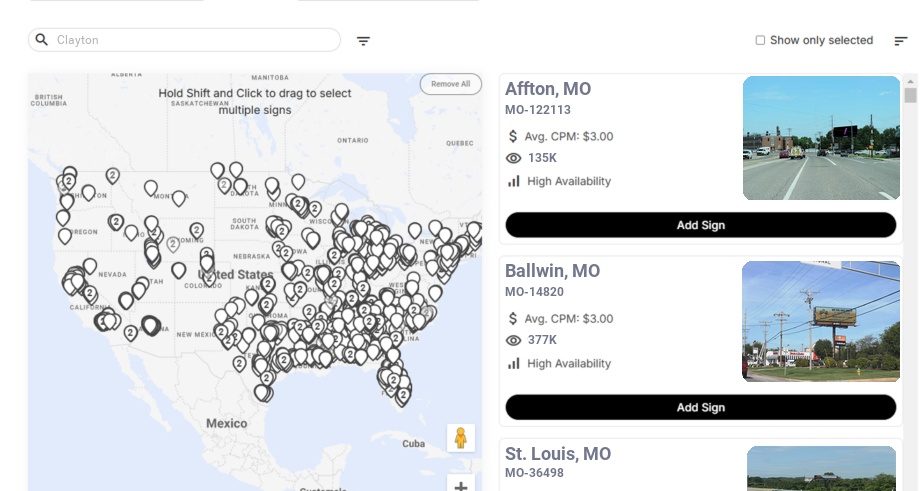



How much is a billboard near Clayton?
Why Choose Blip for Billboard Advertising near Clayton
Blip lets you launch Clayton billboards in minutes and tap I-64/US-40 commuter traffic without the usual buying hurdles.
Set a daily budget for Clayton and stay in control as your ads reach daytime professionals, students, and visitors in the county seat.
Daypart with Blip for Clayton rush hours—6:30-9:30 a.m. and 3:30-6:30 p.m.—to catch the heaviest I-170 and Forest Park Parkway flows.
No contracts means you can test Clayton against nearby St. Louis, Ballwin, and Maryland Heights, then shift spend to what works.
Use real-time analytics to see how Clayton campaigns respond to lunch-rush and event traffic, then adjust fast for better ROI.
Blip's creative tools help you tailor clean, executive-ready ads for Clayton's high-income professionals and WashU-connected audiences.
Frequently Asked Questions About Billboard Advertising near Clayton
How much does a billboard cost near Clayton, Missouri with Blip?
With Blip, you choose your own daily budget for Clayton billboards, and our system automatically keeps your campaign within that limit, making it easy to test digital billboard advertising in the Clayton area without overspending. Each “blip” is a brief 7.5 to 10-second ad display, and you only pay for the blips you receive, similar to pay-per-click online ads. The price of each blip on billboards near Clayton, Missouri depends on the time of day, location, and advertiser demand, so you stay in control by adjusting your budget or schedule at any time.
Where can I advertise with Blip near Clayton, Missouri?
Blip’s 39 digital billboards serving the Clayton area are positioned in nearby cities within about 10 miles, strategically aligned with commuter and visitor flows. The page highlights nearby boards in St. Louis, Berkeley & Hazelwood, Maryland Heights, Ballwin, and East St. Louis. For marketers searching for billboards near Clayton or cost-effective billboard rental near Clayton, these locations provide flexible coverage without needing a sign inside the city limits itself.
Who are the main people seeing billboards in Clayton, Missouri?
Clayton sits at the economic and governmental heart of St. Louis County, with a small residential base but a huge daytime influx of professionals, students, and visitors. Clayton’s daytime population swells to 45,000–50,000+ as workers, students, and visitors stream into the downtown core on a typical weekday. The area is ideal for premium products, B2B services, education, healthcare, financial services, and luxury retail.
When should I run Blip billboard ads in Clayton, Missouri?
For B2B and professional services, the page recommends concentrating impressions on weekdays during peak commute windows, typically 6:30–9:30 a.m. and 3:30–6:30 p.m. It also says advertisers can reach workers earlier in their trips by targeting daytime slots from 11 a.m. to 2 p.m. For weekend and event traffic, targeting weekend afternoons and evenings helps capture people traveling to and from events.
Why are Clayton, Missouri billboards valuable for advertisers with Blip?
Clayton has a median household income of roughly $120,000–$125,000, and more than 75–80% of adults hold at least a bachelor’s degree. Professional and management occupations account for well over 60% of local jobs, and the area includes major employers in law, finance, healthcare administration, and technology. These conditions make Clayton-area billboards especially useful for reaching high-value decision-makers and affluent consumers.
Do I need a contract to advertise with Blip near Clayton?
No, Blip has no long-term contracts or minimum commitments. You can start, pause, or stop your campaign at any time.
How fast can I launch a billboard campaign with Blip near Clayton?
You can have your campaign live in minutes. Create a free account, select your locations, set your budget, upload your design, and start running once approved.
Where can I advertise with Blip near Clayton?
Blip has digital billboards near Clayton. You can browse available locations on a map, choose the ones that fit your audience, and start advertising right away.
Still have questions? Launch a campaign in minutes — no contracts, no commitments.
Start Your CampaignClayton Billboard Advertising Guide
Clayton sits at the economic and governmental heart of St. Louis County, with a small residential base but a huge daytime influx of professionals, students, and visitors. With 39 nearby digital billboards serving the Clayton area through Blip, we can reach this high-value audience as they commute, work, shop, and fly in and out of the region. For brands specifically looking for billboards near Clayton without paying downtown St. Louis prices, these placements offer a powerful balance of reach and efficiency.
Understanding the Clayton Area Market
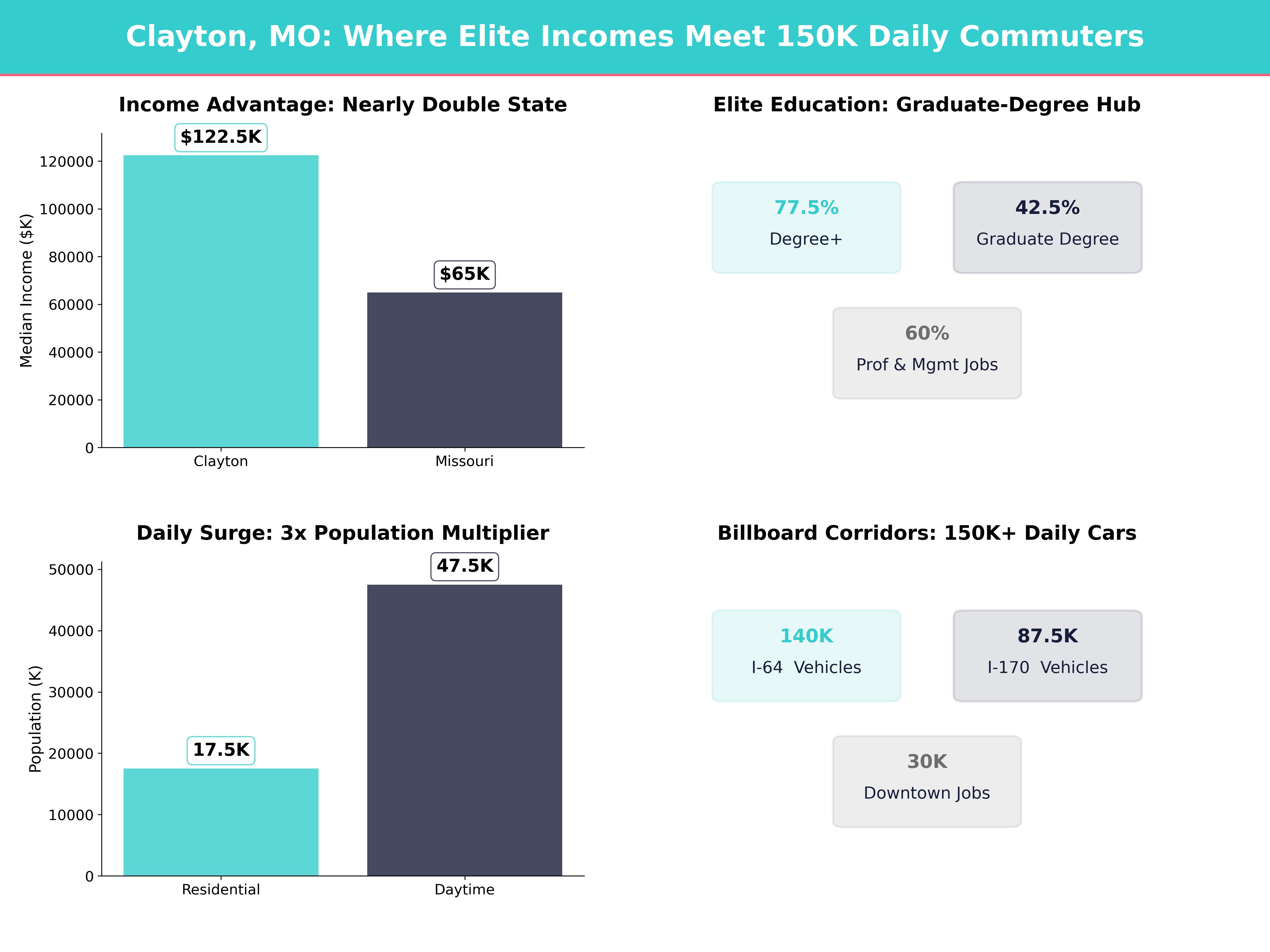
Clayton is the county seat of St. Louis County City of Clayton 17,000–18,000 residents according to recent estimates from the City of Clayton and regional planning agencies, but its daytime population swells to 45,000–50,000+ as workers, students, and visitors stream into the downtown core on a typical weekday.
Key data points that matter for advertisers considering Clayton billboards:
-
Affluence
- Recent American Community Survey estimates show Clayton’s median household income at roughly $120,000–$125,000, close to 85–90% higher than Missouri’s statewide median (about $65,000).
- Per capita income exceeds $75,000, placing Clayton among the top-earning communities in the St. Louis region.
- In many nearby ZIP codes (63105, 63124, 63141), more than 40–50% of households report annual incomes above $100,000, supporting demand for premium services, luxury retail, and professional offerings.
-
Education and Professional Profile
- Over 75–80% of Clayton adults hold at least a bachelor’s degree, and roughly 40–45% have a graduate or professional degree—several times higher than state and national averages.
- Professional and management occupations account for well over 60% of local jobs, with concentrations in law, finance, accounting, consulting, healthcare administration, and technology.
- Corporate and professional employers within a short radius include the Clayton business district Washington University in St. Louis, and the BJC HealthCare medical complex, creating a dense ecosystem of decision-makers who are frequently exposed to billboard advertising near Clayton along their daily routes.
-
Employment Hub
- Clayton’s central business district contains an estimated 7–8 million square feet of office space, with Class A office occupancy consistently in the 80–90% range according to regional real estate reports.
- St. Louis County government, major banks, Am Law 100 law firms, and Fortune 1000 companies together support 30,000+ jobs in and around downtown Clayton, pulling commuters from across St. Louis County and the Illinois suburbs.
- Major employers highlighted by the Clayton Chamber of Commerce and STL Partnership include financial services, wealth management, and business services firms that are prime B2B advertising targets.
-
Regional Context
-
Clayton borders the City of St. Louis and sits at the center of key corridors: I‑64/US‑40, I‑170, and Forest Park Parkway. Recent Missouri Department of Transportation
- I‑64 near Clayton carrying roughly 130,000–150,000 vehicles per day.
- I‑170 north–south volumes in the 80,000–95,000 vehicles per day range.
- Nearby communities such as Ladue, Brentwood, Richmond Heights, and University City feature some of the metro’s most affluent neighborhoods; in Ladue (ZIP 63124), median home values regularly exceed $800,000, and median household incomes often top $200,000.
-
Clayton borders the City of St. Louis and sits at the center of key corridors: I‑64/US‑40, I‑170, and Forest Park Parkway. Recent Missouri Department of Transportation
For advertisers, this means campaigns serving the Clayton area are ideal for premium products, B2B services, education, healthcare, financial services, and luxury retail—while still reaching a broad cross-section of commuters and travelers across the St. Louis region through well-placed Clayton billboards.
Where Our 39 Billboards Reach the Clayton Area
Blip’s 39 digital billboards serving the Clayton area are positioned in nearby cities within about 10 miles, strategically aligned with commuter and visitor flows. For marketers searching for billboards near Clayton or cost-effective billboard rental near Clayton, these locations provide flexible coverage without needing a sign inside the city limits itself. The St. Louis metro has a population of roughly 2.8 million across Missouri and Illinois, and more than 1.4 million workers according to regional planners like the East‑West Gateway Council of Governments
-
St. Louis, Missouri (≈6.6 miles from Clayton)
Boards here can reach drivers along key urban arteries connecting downtown St. Louis to the west county suburbs and the Clayton area. Major routes like I‑64, I‑44, and I‑55 together move well over 300,000 vehicles per weekday near the central corridor, according to MoDOT’s St. Louis District Washington University in St. Louis campuses and the BJC HealthCare medical complex, which alone employs more than 30,000 people across the region. For many advertisers, these St. Louis locations function as primary Clayton billboards because of the heavy overlap in commuter traffic. -
Berkeley & Hazelwood, Missouri (≈6.0–9.8 miles)
These boards are near St. Louis Lambert International Airport, I‑70, and major industrial and logistics zones. Lambert handled more than 13 million passengers in 2023, with total enplanements up over 10% year‑over‑year as travel rebounded. Pre‑pandemic volumes exceeded 15 million passengers, and the airport remains a key gateway for business travelers and convention attendees promoted by Explore St. Louis- Targeting airport users and visitors who may stay or do business in Clayton and central county.
- Reaching the 20,000+ workers employed in and around the airport corridor in aviation, freight, and advanced manufacturing.
- Capturing inbound traffic before it disperses into west and central St. Louis County via I‑70, I‑170, and I‑270.
For brands that want billboard advertising near Clayton to influence business travelers and executives, this airport-focused cluster is especially valuable.
-
Maryland Heights, Missouri (≈9.2 miles)
Maryland Heights is a major entertainment and employment center highlighted by Visit Maryland Heights, with:- The Hollywood Casino Amphitheatre (capacity 20,000+), hosting dozens of concerts each season.
- The Centene Community Ice Center and nearby hospitality cluster supporting sports tourism.
- Large office parks along I‑270 and I‑70, where thousands of tech, logistics, and professional workers are based.
Boards here can reach a mix of: - Office and tech corridor workers commuting toward Clayton or other central-county destinations.
- Concert and event traffic during evenings and weekends.
- Residents from outer suburbs using I‑270 and I‑70 to reach the Clayton area.
For many suburban commuters, these Maryland Heights locations are the first billboards near Clayton they encounter on their drive.
-
Ballwin, Missouri (≈9.0 miles)
Located along major suburban commuter routes (such as Manchester Road) that funnel residents from west St. Louis County toward the Clayton area and St. Louis. According to MoDOT 35,000–45,000 vehicles per day in key segments. Ballwin itself, highlighted by the City of Ballwin, has:- A population of roughly 30,000 residents.
- Median household income in the $110,000–120,000 range.
- Homeownership rates near 80%, indicating stable, higher-income households.
This corridor is ideal for higher-end consumer products and services aimed at professionals commuting toward Clayton, and it is one of the strongest choices for billboard rental near Clayton when targeting affluent west-county households.
-
East St. Louis, Illinois (≈9.7 miles)
Boards along I‑55/I‑64 reach heavy interstate traffic entering the St. Louis urban core from Illinois. East‑west river crossings like the Poplar Street Bridge and Stan Musial Veterans Memorial Bridge together carry roughly 120,000–150,000 vehicles per day according to Illinois and Missouri DOT counts Illinois Department of Transportation. These locations are effective for:- Capturing cross-river commuters heading toward Clayton and central/west county.
- Building broad regional awareness for brands that serve both Missouri and Illinois sides of the metro.
By selectively activating boards in these nearby cities, we can construct a coverage “ring” that follows the real-world movement of Clayton-area workers, residents, students, and visitors, giving you billboard advertising near Clayton that tracks how people actually travel.
Key Audience Segments in the Clayton Area
Because of its role as a county seat and business center, the Clayton area draws diverse high-value audiences that are larger than its residential base alone would suggest. Matching the right Clayton billboards to the right audience segment is key.
-
Professionals & Executives
- Thousands of lawyers, financial professionals, consultants, and executives work in downtown Clayton office towers every weekday; local business directories and the Clayton Chamber of Commerce list hundreds of professional services firms headquartered or with major offices here.
- Many commute from affluent suburbs like Ladue, Town and Country, and Chesterfield—communities where median household incomes often exceed $130,000–$200,000, and professional/management occupations account for more than 50–60% of local employment.
- Messaging emphasizing efficiency, ROI, reputation, and quality tends to align with the expectations of these highly educated, time-constrained decision-makers.
-
Government & Civic Workers
- St. Louis County employs more than 3,000–4,000 people across departments, with a large concentration at its Clayton government campus
- Additional public-sector workers commute into Clayton from agencies such as the courts, county police, school districts, and regional entities like East‑West Gateway
- These workers are key targets for public notices, union communications, continuing education, retirement planning, and local services like credit unions and healthcare providers.
-
Students & University-Connected Audiences
- The nearby Washington University in St. Louis enrolls more than 17,000 students and employs roughly 17,000 faculty and staff region‑wide, according to university data.
- The Washington University Medical Campus and BJC HealthCare complex collectively attract tens of thousands of daily visitors, patients, and employees—many of whom travel through or near Clayton via Forest Park Parkway and I‑64.
- Student-focused messaging—education, housing, banking, food, and entertainment—can perform especially well when scheduled around semester start dates, move-in weeks, homecoming, and major sports events highlighted by WashU Athletics
-
Affluent Residents & Shoppers
- Clayton is home to upscale dining, galleries, and boutiques, with the City of Clayton
- Nearby destinations like the Saint Louis Galleria in Richmond Heights, featured by Richmond Heights, draw regional shoppers; the Galleria alone has over 1 million square feet of retail space and hundreds of tenants.
- High-income residents in Clayton and adjacent ZIP codes often devote above-average spending to categories like dining out, travel, home services, financial planning, and private healthcare, making them attractive targets for luxury and premium offerings.
-
Travelers & Visitors
- The St. Louis region welcomed roughly 25–28 million visitors annually in the years immediately before the pandemic, and more than 22–24 million in recent recovery years, according to Explore St. Louis
- Convention and meeting business at facilities in downtown St. Louis, west county, and near the airport feeds hotel and restaurant activity around Clayton, which sits roughly equidistant between the airport and downtown.
- Boards near the airport and along interstate corridors reaching Clayton are effective for hotels, attractions, events, and transportation services that serve both business travelers and leisure visitors.
Understanding which of these groups you most want to reach will guide which nearby billboards to prioritize, how to structure billboard rental near Clayton, and how to time your Blip campaigns.
Commuter Patterns and Traffic Flows to Leverage
To maximize impact, we want to align impressions with how people actually move in and out of the Clayton area. Regional data from MoDOT East‑West Gateway Metro Transit show strong commuter flows converging on central St. Louis County.
-
Morning & Evening Commutes
- Major commuter inflows to the Clayton area come from west and south St. Louis County (via I‑64, I‑270, Manchester Road, Clayton Road, and Ladue Road) and from the Illinois side via bridges into downtown St. Louis and then west on I‑64 or Forest Park Parkway.
- MoDOT counts indicate that key commuter routes feeding Clayton—like I‑64 between I‑270 and Kingshighway—see 120,000–150,000 vehicles per weekday, with peak hours typically 6:30–9:30 a.m. and 3:30–6:30 p.m.
- For B2B and professional services, we recommend concentrating impressions on weekdays during these peak windows on boards near Ballwin, Maryland Heights, St. Louis, and East St. Louis, when executive and office-worker traffic is heaviest and your billboard advertising near Clayton will be seen most frequently by decision-makers.
-
Midday & Lunchtime Traffic
- Office density and government offices mean Clayton experiences a significant lunch and errand rush. Local business groups such as the Clayton Chamber of Commerce regularly spotlight strong weekday restaurant and retail activity.
- Metro-area travel surveys indicate that 20–25% of weekday trips region‑wide are for shopping, dining, and personal business, much of it between 11 a.m. and 2 p.m.
- Advertisers can reach these workers earlier in their trips by targeting daytime slots (11 a.m.–2 p.m.) on boards in St. Louis and Maryland Heights, especially if they promote restaurants, delivery, retail, or healthcare services that can be visited during lunch breaks.
-
Weekend and Event Traffic
- Events like the Saint Louis Art Fair in Clayton 100,000+ visitors over a single weekend, according to organizers, dramatically increasing traffic in and around Clayton.
- Downtown St. Louis and Maryland Heights host Cardinals games at Busch Stadium (3.4 million+ annual attendees in strong seasons), Blues games at Enterprise Center, and large concerts and festivals. Visit Explore St. Louis Visit Maryland Heights
- Targeting weekend afternoons and evenings on boards serving the Clayton area helps event organizers, hospitality businesses, and entertainment venues capture this discretionary traffic as people travel to and from events.
-
Transit Integration
- The Clayton area is served by Metro Transit with MetroLink light-rail stations (Clayton, Forsyth) and multiple bus routes that connect to the airport, downtown, and suburban job centers.
- MetroLink system ridership averages around 30,000 weekday boardings, with the Blue Line—which serves Clayton—carrying a substantial share of that volume. Park‑and‑ride lots near key stations create mixed driving/transit trips.
- Campaigns that reference proximity to MetroLink (“2‑minute walk from Clayton Station”) or last‑mile services can resonate with commuters who split their trips between driving and transit.
Blip’s scheduling tools let you “daypart” campaigns so you spend more when traffic and your target audience are heaviest, and scale back during lower-value hours, giving you more control over how your Clayton billboards perform throughout the day.
Crafting Creative That Resonates in the Clayton Area
Audiences near the Clayton area are time-poor, information-rich, and used to high-quality design. Many work in industries—law, finance, consulting, healthcare—where clarity and professionalism are non‑negotiable.
-
Keep It Executive-Ready
- Use clean layouts, plenty of negative space, and no more than 7–9 words of main copy to stay legible at freeway speeds (typically 55–65 mph on major corridors).
- Emphasize strong, professional typefaces and restrained color palettes for B2B, finance, and legal campaigns, reflecting the visual language common in Clayton’s corporate offices and county government materials.
- Lead with a specific benefit or outcome: “Cut Payroll Time by 50%” or “Reduce Tax Risk for Clayton Businesses” provides clearer value than generic innovation language.
-
Highlight Local Relevance
-
Reference the Clayton area explicitly when appropriate:
- “Now serving the Clayton area”
- “Just 5 minutes from Clayton’s business district”
- Show recognizable visual cues: Clayton’s skyline, county government buildings, Forest Park, or well-known intersections. Localized creative can increase recall; outdoor industry research often finds 10–20% higher ad recognition when people see references to locations they know well.
- Reinforcing that your offer is “near Clayton billboards on I‑64” or “right off Manchester Road on the way to Clayton” can make your creative feel even more relevant.
-
Reference the Clayton area explicitly when appropriate:
-
Design for High-Income Consumers
- For luxury goods and services, use lifestyle imagery featuring professional environments, sophisticated dining, or modern interiors that mirror the high-end experiences available in downtown Clayton and nearby Ladue.
- Avoid clutter and “price shouting”; affluent audiences tend to respond better to cues of quality, exclusivity, and trust—such as “Serving Clayton professionals since 1998” or “Top‑rated in St. Louis County.”
-
Serve Students & Young Professionals
-
For campaigns targeting Washington University and nearby students and residents in University City and Richmond Heights:
- Use bolder colors and slightly more playful copy, while keeping the total text count low.
- Feature clear calls to action: “Text CLAYTON to 55555 for 20% Off” or “2 Stops from Clayton MetroLink.”
- Promote time-limited offers around semester start, finals week, move‑in days, and big events promoted on WashU’s campus calendar
-
For campaigns targeting Washington University and nearby students and residents in University City and Richmond Heights:
-
Make Calls-to-Action Device-Friendly
-
Because most drivers cannot respond instantly, focus on actions they can remember or search later:
- Short URLs (e.g., brand.com/Clayton)
- Trackable promo codes (“CLAYTON20”)
- Simple search prompts: “Search ‘[Brand] Clayton’”
- Phone numbers only if short and easy; otherwise prioritize URL/search.
-
Because most drivers cannot respond instantly, focus on actions they can remember or search later:
We recommend testing 2–4 creative variations per campaign and using Blip’s rotation to compare performance metrics like website traffic surges, increases in branded search volume, or promo‑code redemptions in key ZIP codes.
Using Blip’s Flexibility to Target the Clayton Area
Blip’s platform allows you to buy digital billboard impressions near the Clayton area one “blip” at a time, giving you granular control over budget, timing, and location. This makes it easy to experiment with billboard rental near Clayton without committing to a long-term static contract.
-
Smart Geographical Selection
-
Prioritize boards in:
- Berkeley/Hazelwood to hit airport users and north‑county commuters who pass through the Lambert area and onto I‑170 or I‑70.
- Ballwin to reach affluent west‑county households heading toward Clayton or downtown St. Louis via Manchester Road and I‑64.
- Maryland Heights to catch workers in tech corridors, logistics hubs, and entertainment districts using I‑270, I‑70, and Page Avenue.
- St. Louis & East St. Louis to intercept cross-river commuters and long‑distance interstate travelers entering the core of the metro.
- With these locations, you can build concentric coverage patterns that align with real commuting patterns documented by East‑West Gateway’s travel studies
-
Prioritize boards in:
-
Dayparting and Budget Control
- Increase bids during peak hours relevant to your audience (e.g., weekday rush hours for B2B and healthcare; weekend afternoons and evenings for retail, dining, and entertainment).
- Lower or pause spending late nights and midday weekdays if your target is primarily office workers and county staff, whose core hours cluster around 8 a.m.–5 p.m.
- Many advertisers find success starting with a focused window (for example, 7–9 a.m. & 4–6 p.m. on weekdays) and then expanding to additional hours once early data shows where conversions and inquiries are coming from.
-
Event-Driven Blasts
-
Schedule short, high-frequency bursts around:
- Major Clayton events like the Saint Louis Art Fair or seasonal festivals highlighted by the City of Clayton
- Cardinals or Blues home games and downtown concerts, using schedules from Cardinals.com, St. Louis Blues, and Enterprise Center.
- Conferences and trade shows at regional venues promoted by Explore St. Louis
- Because you’re not locked into long-term static buys, you can ramp up for a few high-impact days, then scale down when event demand subsides.
-
Schedule short, high-frequency bursts around:
-
Always-On Branding + Tactical Layers
- Many brands benefit from a low-level “always-on” presence near the Clayton area—perhaps a smaller daily budget covering off-peak hours to maintain brand familiarity among frequent commuters.
- Layer on tactical bursts for key seasonal moments: product launches, enrollment periods, fiscal year-end pushes, open enrollment for benefits, holiday shopping, or tax season.
Sample Campaign Strategies for the Clayton Area
To make these ideas concrete, here are a few example approaches, grounded in the traffic and audience patterns described by local agencies and business groups. Each one shows how billboard advertising near Clayton can be tailored to different goals.
1. Regional Law Firm Targeting Corporate & High-Net-Worth Clients
- Goal: Generate awareness among executives, business owners, and professionals working near the Clayton area.
- Board Focus: St. Louis (urban commuters), Ballwin (west‑county executives), Maryland Heights (office corridors).
- Timing: Weekdays, 7–10 a.m. and 4–7 p.m., plus a lighter schedule 11 a.m.–2 p.m. for lunch break viewing, aligned with peak flows on I‑64, I‑270, and Manchester Road.
-
Creative:
- Main line: “Top-Ranked Business Law for the Clayton Area.”
- Sub-line: “Offices Minutes from the Clayton Business District.”
- Visual: Professional team portrait or elegant skyline; firm logo and URL (e.g., firm.com/Clayton).
- Optional variation: Highlight metrics like “Serving 500+ St. Louis businesses” or “Average client tenure 10+ years.”
2. Restaurant Group Driving Lunchtime Traffic
- Goal: Increase weekday lunch visits from office workers and government employees in Clayton’s CBD.
- Board Focus: St. Louis and Maryland Heights boards serving the Clayton area, where pre‑lunch outbound and inbound traffic is strong.
- Timing: 10:30 a.m.–1:30 p.m. on weekdays, which coincides with the 11 a.m.–2 p.m. regional lunch peak shown in travel surveys.
-
Creative:
- Rotating copy tied to specific days (“Taco Tuesday near the Clayton Courthouse,” “Pasta Thursday 3 minutes from Clayton Station”).
- Simple call-to-action: “Show this ad on your phone for a free drink” or “Search ‘[Brand] Clayton Lunch.’”
- Short URL or QR code for menu previews and online ordering (optimized for mobile).
3. University or Private School Enrollment Campaign
- Goal: Boost inquiries from parents and prospective students across central and west St. Louis County.
- Board Focus: Ballwin, Maryland Heights, Berkeley/Hazelwood boards serving the Clayton area, reflecting where many families live and commute.
- Timing: Heaviest presence during key enrollment windows (January–March and July–August), morning and evening commute times when parents are driving children or commuting from home to work.
-
Creative:
- Highlight data points: “98% college acceptance,” “$5M+ in annual scholarships,” or “Top‑ranked in St. Louis County.”
- Message variations for “Early Childhood,” “STEM Programs,” and “College Prep,” each targeted on different boards or dayparts.
- URL structured for tracking: school.edu/Clayton, plus unique phone numbers or codes to identify billboard-driven inquiries.
4. Healthcare System Promoting a Clayton-Area Clinic or Service Line
- Goal: Increase appointments at a specialty clinic or urgent care close to the Clayton area.
- Board Focus: St. Louis, Ballwin, and Berkeley boards along routes commuters use to reach Clayton and nearby employment centers.
- Timing: All weekdays, with heavier spending earlier in the week (Monday–Wednesday), when appointment scheduling and online search activity for health services tend to be highest.
-
Creative:
- Clear benefit: “Same-Day Appointments near the Clayton Business District.”
- Convenience hook: “Open 7 a.m.–7 p.m.” or “Free parking—5 minutes from I‑64.”
- Strong call-to-action: “Book in 60 Seconds at [short URL]” and, if applicable, “Most major insurance accepted.”
Measuring and Refining Your Clayton-Area Campaign
To get the most from campaigns serving the Clayton area, use both Blip’s tools and your own analytics, and tap into local information sources.
-
Align with Your Own Data
- Track website traffic, form fills, appointment bookings, and promo-code usage by ZIP code. ZIPs like 63105 (Clayton), 63124 (Ladue), 63117 (Richmond Heights), 63144 (Brentwood), and 63011/63021 (Ballwin) help validate whether Clayton‑area audiences are responding.
- Compare periods when your Blip campaigns are active to prior weeks or months, looking for 5–20% lifts in key metrics from target ZIPs.
-
Use Local News & Events as Context
- Follow outlets like the St. Louis Post-Dispatch, St. Louis Public Radio, and the Clayton Chamber of Commerce to time campaigns around local happenings—new corporate relocations, major civic projects, infrastructure work, or community celebrations.
- Check calendars from Explore St. Louis City of Clayton Richmond Heights and Maryland Heights) for event-driven opportunities.
-
Test, Then Optimize
- Start with at least 2 creative variants and 2–3 focus corridors (e.g., Ballwin + St. Louis + Berkeley). Give each a minimum of 2–4 weeks of consistent activity so you can collect enough impressions and downstream results to compare.
- Shift budget toward the locations and messages correlated with the strongest lifts in inquiries or sales from Clayton‑related ZIP codes. If one corridor delivers a 30–40% higher response rate, lean into that cluster while still maintaining some presence on secondary routes.
- Refresh creative at least every 8–12 weeks to avoid message fatigue among frequent commuters who see your boards multiple times per week.
By using data-driven planning, thoughtful creative tailored to the Clayton area’s high-value audiences, and Blip’s flexible buying model, you can build campaigns that punch far above their budget—connecting your brand with some of the most influential and affluent consumers in the St. Louis region through well-planned billboard advertising near Clayton.