Billboards near Ferguson, MO
No Minimum Spend. No Long-Term Contracts. Just Results.
Trusted by Leading Brands


Billboard advertising
near Ferguson has never been easier



How much is a billboard near Ferguson?
Why Choose Blip for Billboard Advertising near Ferguson
Blip lets Ferguson businesses launch fast on I-70, I-270, and Lindbergh without contracts—perfect for reaching daily commuters and airport traffic.
Set a flexible budget for Ferguson billboards and pay only for each blip, so local shops and one-time events can scale with demand.
Daypart Ferguson campaigns for 6–9 a.m. commutes, school pickup, or 4–9 p.m. dining traffic to catch people when they act.
See real-time analytics on Ferguson ads and shift spend toward Hazelwood, Berkeley, or Florissant routes that drive the best response.
Use Blip's creative tools to build bold Ferguson messages for North County families, airport workers, and I-270 corridor shoppers.
Frequently Asked Questions About Billboard Advertising near Ferguson
How much does a billboard cost near Ferguson, Missouri with Blip?
With Blip, you control exactly what you spend on Ferguson billboards by setting a daily budget that fits your goals, whether you’re a small business or promoting a one-time event. Each blip is a brief digital ad display on billboards near Ferguson, Missouri, and you only pay for the blips you receive, so every dollar goes directly toward real exposure. Costs vary based on time of day, location, and advertiser demand, but you can raise, lower, or pause your budget at any time.
Where can I advertise with Blip near Ferguson, Missouri?
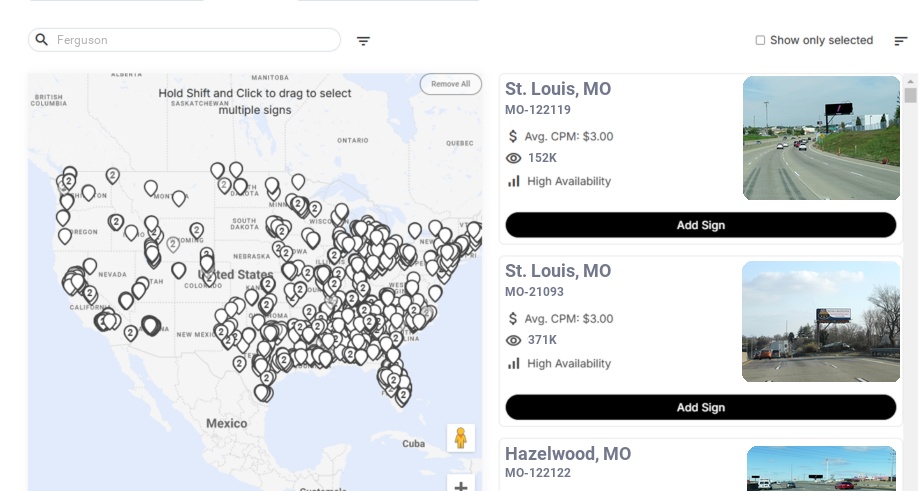
There are 26 digital billboards serving the Ferguson area from nearby Berkeley, Florissant, Hazelwood, and Maryland Heights. These corridors touch tens of thousands of drivers per day and millions of impressions per month, forming a flexible billboard rental near Ferguson that can be tailored to different goals. The boards are positioned to reach residents, workers, and visitors moving through north St. Louis County.
What kind of traffic and commute patterns do Ferguson, Missouri billboards reach?
Across the St. Louis region, about 80–82% of workers commute by driving alone, and more than 9 in 10 trips in the county are made by car. In north St. Louis County, many Ferguson-area residents work in nearby employment centers like Hazelwood, Berkeley, Maryland Heights, and central St. Louis. Major roads such as I-70, I-270, and I-170 carry heavy daily traffic and create strong exposure for billboards near Ferguson.
When is the best time to run Blip ads near Ferguson, Missouri?
Daily rhythms matter just as much as seasons, and typical work shifts concentrate commuting in the 6–9 a.m. and 3–7 p.m. windows. School traffic further intensifies 7–8:30 a.m. and 2:30–4 p.m. Concentrating impressions into the 10–12 hours each day that matter most often delivers higher recall per dollar than always-on flights.
What types of businesses work well on Ferguson, Missouri billboards with Blip?
The Ferguson area supports both value-focused messaging and aspirational offers because the surrounding households include a mix of residents, commuters, and workers. Retail, restaurants, healthcare, education, home services, financial services, and logistics recruiting are all called out as strong fits. Boards near the right corridors can reach shoppers, families, and commuters with straightforward local messaging.
Do I need a contract to advertise with Blip near Ferguson?
No, Blip has no long-term contracts or minimum commitments. You can start, pause, or stop your campaign at any time.
How fast can I launch a billboard campaign with Blip near Ferguson?
You can have your campaign live in minutes. Create a free account, select your locations, set your budget, upload your design, and start running once approved.
Where can I advertise with Blip near Ferguson?
Blip has digital billboards near Ferguson. You can browse available locations on a map, choose the ones that fit your audience, and start advertising right away.
Still have questions? Launch a campaign in minutes — no contracts, no commitments.
Start Your CampaignFerguson Billboard Advertising Guide
The Ferguson, Missouri area sits at a powerful crossroads of neighborhood life, airport traffic, and regional commuting patterns. With 26 digital billboards serving the Ferguson area from nearby Berkeley, Florissant, Hazelwood, and Maryland Heights, we can reach residents, workers, and visitors moving through some of north St. Louis County
Understanding the Ferguson Area Market
Ferguson is a tight-knit, largely residential community embedded in a large regional economy. Knowing who we’re talking to helps us design better campaigns and choose the right Ferguson billboards for the job.
-
Population & density
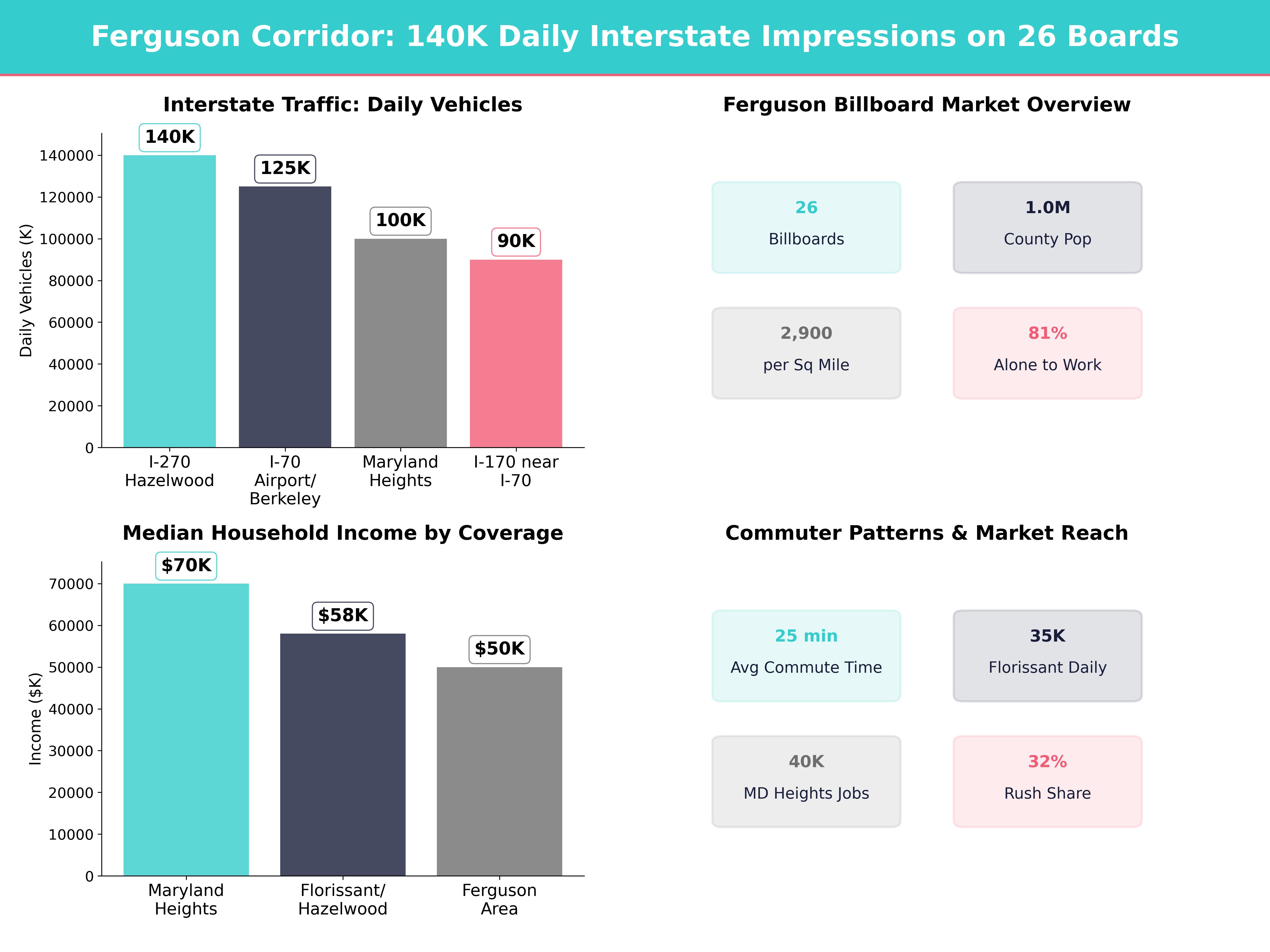
- The City of Ferguson has roughly 17,000–18,000 residents packed into about 6 square miles, or nearly 2,900 people per square mile—denser than many outer-ring suburbs but more residential than the City of St. Louis. More about the community is available on the official city site at fergusoncity.com.
-
Surrounding north St. Louis County adds substantial scale:
- St. Louis County overall has close to 1,000,000 residents, according to recent county demographic estimates published through stlouiscountymo.gov
- Nearby cities include Florissant (~50,000–51,000 residents, see florissantmo.com), Hazelwood (~25,000 residents, hazelwoodmo.org), Maryland Heights (~28,000 residents, marylandheights.com), and Berkeley (~8,000 residents, cityofberkeley.us).
- Ferguson’s residential neighborhoods are relatively dense for a suburban setting, which means many short, frequent trips across major arterials like Florissant Road and Chambers Road, generating repeated daily exposure for billboard advertising near Ferguson.
-
Demographics & households
- The Ferguson area skews relatively young-adult and family-oriented. Regional estimates show that nearly 55–60% of residents in the wider Ferguson–Florissant corridor are under age 45, with a strong concentration of adults in their 20s–40s and children under 18.
-
Household incomes vary widely across north St. Louis County:
- Many tracts in and around Ferguson show median household incomes in the $35,000–$65,000 range.
- Some nearby suburbs trend higher: Florissant and Hazelwood often fall around $55,000–$60,000, while Maryland Heights and parts of west county climb into the $70,000+ range.
- Roughly 55–60% of occupied housing units in the broader north county area are owner-occupied, with the balance renter-occupied, supporting a mix of long-term residents and more mobile households.
- This mix supports both value-focused messaging (discounts, financing, seasonal deals) and aspirational offers (travel, education, home improvements, automotive upgrades).
-
Commuting behavior
- Across the St. Louis region, about 80–82% of workers commute by driving alone, another 8–10% carpool, and only a small share (roughly 3–4%) use public transit via MetroBus or MetroLink (Metro Transit – St. Louis). Average one-way commute times hover around 24–26 minutes.
-
In north St. Louis County, many Ferguson-area residents work in nearby employment centers:
- Industrial and logistics areas near Hazelwood and Berkeley, including business parks along I‑270 and near St. Louis Lambert International Airport (STL) ( flystl.com
- Healthcare, education, and professional services near Maryland Heights, Creve Coeur, and the I‑270 corridor
- Offices and institutions closer to central and downtown St. Louis via I‑70 and I‑170
- With more than 9 in 10 trips in the county made by car, according to regional transportation studies referenced by the Missouri Department of Transportation (MoDOT) St. Louis District
-
Community & local identity
- The City of Ferguson emphasizes community engagement, local business, and neighborhood events, with regular updates on city services, festivals, and council meetings at fergusoncity.com.
- The wider north county area is represented by organizations like North County Inc. (northstlouiscounty.com), which highlights economic development, employers, and regional initiatives.
- Local news and conversation are shaped by outlets such as the St. Louis Post-Dispatch, St. Louis Public Radio, and TV stations like FOX 2 (KTVI), KMOV 4, and KSDK 5 On Your Side. Referencing known landmarks or local storylines (sports, schools, neighborhood events) can quickly increase relevance.
- Area schools, including the Ferguson-Florissant School District (fergflor.org), enroll tens of thousands of students regionwide, making school calendars and sports seasons reliable hooks for timing and creative.
Implication for advertisers: Campaigns near the Ferguson area work best when they balance everyday practicality (price, convenience, proximity) with clear community awareness and respect. We can speak to commuters, parents, service workers, and small business owners with straightforward, locally grounded messages backed by data about how they live and travel, and then deliver those messages through highly visible Ferguson billboards on their daily routes.
Where Our Billboards Are and Who They Reach
The 26 digital billboards serving the Ferguson area sit in nearby hubs that capture daily traffic flow. Together, these corridors touch tens of thousands of drivers per day and millions of impressions per month, forming a flexible billboard rental near Ferguson that can be tailored to different goals.
-
Berkeley (about 2.7 miles from Ferguson)
- Berkeley, profiled at cityofberkeley.us, sits immediately south of Ferguson and borders St. Louis Lambert International Airport (STL).
- STL handled approximately 13–15 million passengers per year in recent years as traffic recovered from the pandemic, with over 270 daily departures and arrivals in peak seasons ( flystl.com
- Major roads: I‑70, Airport Road, Natural Bridge Road, and airport access roads that funnel tens of thousands of vehicles daily.
-
Our boards near Berkeley are ideal for reaching:
- Airport employees and airline staff—STL supports an on‑site workforce of 15,000+ across airlines, concessions, and support services.
- Travelers and those picking up/dropping off passengers, many of whom arrive from across Missouri and Illinois.
- Workers in nearby logistics and industrial parks that support the airport and I‑70 corridor.
-
Florissant (about 3.7 miles from Ferguson)
- Florissant, highlighted at florissantmo.com, is one of Missouri’s larger suburban cities with around 50,000–51,000 residents and more than 20,000 households.
- Key roadways: Lindbergh Boulevard (US‑67), New Halls Ferry Road, and local commercial strips that often carry 25,000–35,000 vehicles per day on busier segments, according to MoDOT traffic count maps from the Missouri Department of Transportation.
- With an extensive mix of shopping centers, medical offices, schools, and restaurants, Florissant boards are great for retail, dining, healthcare, and local services that draw from the broader Ferguson–Florissant–Hazelwood area and benefit from billboard advertising near Ferguson.
-
Hazelwood (about 5.5 miles from Ferguson)
- Hazelwood, detailed at hazelwoodmo.org, is a major industrial and distribution hub in St. Louis County, hosting multiple business parks and logistics centers.
- City economic profiles show thousands of daily commuters into Hazelwood’s industrial areas, with employment counts in some parks topping 10,000 workers across manufacturing, warehousing, and distribution.
- Located along I‑270 and near I‑170/I‑370 links, Hazelwood boards capture cross‑county commuters and heavy truck traffic, with I‑270 segments frequently seeing 120,000–140,000 vehicles per day.
- Strong opportunity for B2B services, workforce recruiting, blue‑collar consumer offers (automotive, equipment, training), and logistics-dependent businesses.
-
Maryland Heights (about 8.3 miles from Ferguson)
- Maryland Heights, at marylandheights.com, is a significant employment and entertainment center with 2,000+ businesses and major regional draws like Hollywood Casino, hotels, and the amphitheater complex.
- The city’s commercial and industrial areas support an estimated 35,000–40,000 jobs, meaning daily inflows of workers from north, west, and south county.
- Sitting along I‑270 and Page Avenue (MO‑364), Maryland Heights corridors routinely reach 100,000+ vehicles per day on their busiest stretches.
- Billboards here reach both daily commuters and event-goers from across the metro, including visitors drawn by attractions promoted through Explore St. Louis at explorestlouis.com
Implication for advertisers: Even though the boards are positioned in nearby cities, they reach substantial portions of the Ferguson area audience as people move for work, shopping, and travel. With tens of thousands of daily vehicles on these corridors, we can choose boards that match the specific flows we care about—airport-bound visitors, industrial workers, suburban families, or I‑270 corridor professionals—and treat the entire group as an interconnected set of billboards near Ferguson.
Key Roadways and Traffic Patterns Near Ferguson
To maximize impressions, we want to align campaigns with the heaviest traffic corridors feeding the Ferguson area. MoDOT’s St. Louis District ( modot.org/st-louis-district
-
Interstate 70 (I‑70)
- Connects the Ferguson area to downtown St. Louis to the east and to St. Charles County and central Missouri to the west.
- MoDOT reports that I‑70 segments near STL airport and Berkeley often carry 110,000–125,000 vehicles per day, producing millions of monthly impressions for well-positioned boards.
- Ideal for high‑reach campaigns: brand awareness, regional promotions, sports/event tie‑ins, and offers aimed at both Missouri and Illinois travelers.
-
Interstate 270 (I‑270)
- The northern beltway around the St. Louis region.
- On the north county arc between Hazelwood, Florissant, and Maryland Heights, daily traffic volumes commonly reach 120,000–140,000 vehicles, including a high proportion of freight and commuting trips.
- Drives citywide or countywide visibility for businesses that draw from multiple suburbs, particularly those with customers across St. Louis County and St. Charles County.
-
Interstate 170 (I‑170)
- Runs south from I‑270 toward inner-ring suburbs and central St. Louis, including University City, Clayton
- I‑170 segments near I‑70 carry 80,000–90,000 vehicles per day, capturing Ferguson-area residents commuting to professional, healthcare, and educational jobs further south.
- Particularly useful for campaigns that want to reach Ferguson-area residents who commute to higher-income employment nodes.
-
Lindbergh Boulevard (US‑67) and other arterials
- US‑67 through Florissant and Hazelwood is lined with retail, automotive, and dining destinations, with many segments registering 25,000–40,000 vehicles per day.
- Other key arterials like New Halls Ferry Road, West Florissant Avenue, and Natural Bridge Road often range from 15,000–30,000 vehicles per day, depending on the segment.
- Excellent for localized, “I’m just up the road” messages that can convert directly into store visits.
Implication for advertisers: By choosing billboards near these specific roadways, we can decide whether to prioritize broad reach (I‑70, I‑270) or hyper-local targeting (US‑67, airport approaches and neighborhood arterials). With Blip’s board-level controls, we can fine‑tune our mix and test which corridors deliver the best response in terms of website visits, calls, or in‑store traffic, making every billboard rental near Ferguson work harder for your budget.
Seasonality and Timing in the Ferguson Area
The Ferguson area sits within a four‑season Midwestern climate, and behavior shifts throughout the year. St. Louis typically experiences about 200–210 sunny or partly sunny days per year, around 42 inches of rain, and 15–18 inches of snow, all of which influence driving and consumer patterns.
-
Winter (Dec–Feb)
- Shorter daylight hours mean that in December and January, both morning (7–8 a.m.) and evening (5–6 p.m.) commutes are often in the dark. Illuminated digital boards stand out especially well during this period.
- STL airport and local highways see a spike in holiday travel, with national travel data indicating December air passenger volumes can run 20–30% higher than shoulder months for major airports like STL.
- Heating, plumbing, and auto repair demand typically rises during cold snaps; regional utilities report peak winter load days when temperatures drop below 25°F, prompting more home-service emergencies.
- Strong fits: auto repair and tires, heating and plumbing services, retail promotions, holiday events, tax prep awareness, and travel offers.
-
Spring (Mar–May)
- Home improvement, landscaping, tax season financial services, and graduation‑related spending grow. Hardware and garden retailers often see double‑digit percentage increases in sales versus winter months.
- Local calendars fill with school sports, festivals, and community events; many of these are promoted through channels such as stlouisco.com fergusoncity.com and florissantmo.com.
- Great time for contractors, realtors, lawn care, education, and seasonal hiring as businesses ramp up staffing for summer.
-
Summer (Jun–Aug)
- Peak for festivals, outdoor recreation, and family activities. Explore St. Louis reports that the region attracts over 25–26 million annual visitors and billions of dollars in visitor spending, with many trips peaking during summer travel season ( explorestlouis.com
- Cardinals baseball, concerts, and casino visits increase cross‑county evening and weekend traffic, especially along I‑70, I‑270, and MO‑364.
- Many residents travel or host out‑of‑town guests, increasing trips to the airport, event venues, and attractions like the zoo, museums, and riverfront.
- Excellent for entertainment, restaurants, attractions, quick‑serve concepts, tourism offers, and back‑to‑school teasers in late July and August.
-
Fall (Sep–Nov)
- Back‑to‑school purchasing drives late August and early September; families in districts like Ferguson-Florissant (fergflor.org) and neighboring systems spend heavily on clothes, electronics, and extracurricular activities.
- High school, college, and professional sports seasons create steady weekend and evening traffic to games, watch parties, and sports bars.
- Healthcare and insurance enrollment campaigns are common, especially October–December, when open enrollment drives a spike in health plan shopping and preventative care appointments.
- Strong window for education, healthcare, financial services, home services (roofing before winter), and early holiday promotion.
Implication for advertisers: With Blip’s flexible budgeting and scheduling, we can increase spend during relevant seasonal spikes (e.g., more impressions on boards near the airport during holiday travel; more on neighborhood‑oriented boards during back‑to‑school). Seasonal planning tied to local event calendars and climate patterns helps advertisers align campaigns with real-world behavior and get more from their billboard advertising near Ferguson.
Using Dayparting to Match Local Routines
Daily rhythms matter just as much as seasons. In the Ferguson area, we can take advantage of Blip’s dayparting capabilities to match the times when roads are busiest and people are making key decisions.
Regional traffic data and employer surveys show that typical work shifts concentrate commuting in the 6–9 a.m. and 3–7 p.m. windows, with school traffic further intensifying 7–8:30 a.m. and 2:30–4 p.m.:
-
Morning commute (6–9 a.m.)
- Residents heading from the Ferguson area toward Hazelwood, Berkeley, and Maryland Heights business districts, as well as downtown and central corridor jobs via I‑70 and I‑170.
- This window can account for 30–35% of weekday daily traffic on major routes.
- Best for time‑sensitive CTAs: “Today Only,” breakfast promotions, daily specials, recruitment messages (“Now Hiring – Apply After Work”), and service reminders people can act on at lunch or after work.
-
Midday (10 a.m.–3 p.m.)
- Errands, shift workers, retirees, and parents with flexible schedules.
- Many local retailers report that 40–50% of weekday in‑store transactions happen between late morning and mid‑afternoon.
- Ideal for medical/dental appointments, grocery and discount retail, local government notices, and B2B services targeting daytime traffic.
-
Evening commute (3–7 p.m.)
- Return trips to the Ferguson area; school pickups, after‑work shopping, and dining decisions.
- Restaurant industry benchmarks show that over half of daily sales for many sit‑down and quick‑serve restaurants occur after 4 p.m., aligning closely with this window.
- Great for restaurants, entertainment, fitness centers, family‑oriented services, and same‑day or next‑day appointment reminders.
-
Late evening & overnight (7 p.m.–2 a.m.)
- Night-shift workers, dining and nightlife, airport travelers, and logistics traffic.
- Regional freight studies show that truck volumes as a share of total traffic rise significantly after 8 p.m. on I‑70 and I‑270, which benefits logistics hiring and truck‑stop/convenience offers.
- Efficient for bars, casinos, late‑night restaurants, convenience stores, and warehousing jobs seeking off‑shift staff.
Implication for advertisers: Instead of running 24/7, we can focus our Blips on the hours when the Ferguson-area audience is most likely to act—stretching budgets further without sacrificing impact. Concentrating impressions into the 10–12 hours each day that matter most often delivers higher recall per dollar than always‑on flights and ensures your billboards near Ferguson are visible in the moments that count.
Creative Strategies That Work Near Ferguson
To stand out on digital billboards serving the Ferguson area, we should build creatives specifically for fast‑moving drivers and the traffic conditions described above:
-
Lead with bold, high-contrast design
- Most drivers have only 5–7 seconds to process a message at highway speeds. Use simple color palettes that punch through varying light conditions: dark text on a very light background or vice versa.
- Avoid small fonts or cluttered logos; aim for 6–8 words max, plus logo and a single CTA. Testing by outdoor advertising associations consistently shows recall drops sharply beyond about 8–10 words.
-
Reference recognizable anchors
-
Mention directions based on landmarks people know, backed by real travel times:
- “5 minutes north of the airport” (for locations near I‑70 in north county)
- “Just off I‑270 at Lindbergh” (for businesses in Florissant or Hazelwood)
- Use plain, accurate distance cues like “2 miles ahead at [Exit #]” to convert impressions into visits. Drivers are far more likely to exit when they know the turnoff is within 1–3 miles.
-
Mention directions based on landmarks people know, backed by real travel times:
-
Reflect local values and events
- Incorporate references to local schools, sports, or seasons (“Back‑to‑school checkups near the Ferguson area,” “Proudly serving north county families”).
- Align with regional storylines—Cardinals or Blues game days, local festivals, or civic initiatives promoted by outlets such as stltoday.com, news.stlpublicradio.org, and neighborhood events calendars on fergusoncity.com.
- Community surveys regularly show that 70%+ of consumers prefer to support local businesses when given a clear choice; explicitly stating “Locally owned in north county” can tap into that preference.
-
Prioritize clarity over cleverness
-
Example structures:
- “$29 Oil Change • 10 Minutes from the Ferguson Area • [Brand]”
- “Same‑Day Dental Appointments • Florissant • Call Today”
- Simple price + benefit + location consistently outperforms complex wordplay in driver recall studies, especially when drivers have less than 10 seconds of viewing time.
-
Example structures:
-
Use multiple creatives strategically
-
With Blip, we can rotate several designs:
- One focused on price (“From $XX/month”)
- One on urgency (“Sale Ends Sunday”)
- One on credibility (“Serving North County for 25 Years”)
- Running A/B tests for 2–4 weeks and tracking differences in calls, web visits, or code redemptions by creative gives concrete insight into what resonates with the Ferguson-area audience and which Ferguson billboards are best suited to each message type.
-
With Blip, we can rotate several designs:
Aligning Board Selection with Business Goals
Because our 26 boards are spread across Berkeley, Florissant, Hazelwood, and Maryland Heights, we can design campaigns around specific objectives and use local travel data to back our choices.
-
Goal: Attract Ferguson-area residents to a local storefront
- Choose boards in Florissant and Hazelwood on routes that Ferguson residents commonly use for shopping (Lindbergh, I‑270 interchanges, New Halls Ferry Road). These corridors can deliver tens of thousands of impressions per day from nearby households.
- Messaging: “2 miles from the Ferguson area,” “Next to [well-known shopping center],” or “Off Lindbergh by [anchor store].”
- Consider adding a short URL or code specific to these boards to track visits from nearby ZIP codes and compare the effectiveness of different billboards near Ferguson.
-
Goal: Recruit workers for industrial or logistics jobs
- Prioritize boards near Hazelwood and Berkeley, close to industrial parks and the airport where thousands of workers already commute daily.
- Daypart heavily around shift changes (5–8 a.m., 2–5 p.m., 10 p.m.–1 a.m.), mirroring employer schedules in logistics and manufacturing.
- Messaging: strong wage call‑out (“Earn up to $XX/hr”), benefits, and “Apply Today at [short URL].” Employers often see 20–30% higher response when pay rates and bonuses are clearly listed.
-
Goal: Build regional brand awareness
- Use a spread across I‑70 and I‑270 corridors near Berkeley, Florissant, Hazelwood, and Maryland Heights to capture north‑south and east‑west commuting patterns. This can expose your brand to hundreds of thousands of unique drivers and passengers over a month.
- Rotate city‑specific lines: “Trusted Across North County,” “Serving the Ferguson Area and Beyond,” or “Now Open in [City Name].”
- Coordinate timing with media coverage or sponsorships from outlets like St. Louis Post-Dispatch or local TV sports broadcasts to create cross‑channel reinforcement and amplify your billboard advertising near Ferguson.
-
Goal: Drive event attendance
- For concerts, church events, festivals, or school functions accessible from the Ferguson area, schedule heavy impressions in the 7–10 days leading up to the event, when most ticket decisions are made.
- Focus on time, place, and simple RSVP/website mention; consider evening-heavy dayparting (4–9 p.m.) when people are planning their nights and weekends.
- Tie in to local venue traffic, such as casinos and amphitheaters in Maryland Heights, or community spaces listed on fergusoncity.com and florissantmo.com.
Budgeting and Optimization with Blip
Blip’s pay‑per‑Blip model gives us fine control over how, where, and when we spend, which is especially valuable in a market with clear traffic and seasonal patterns.
-
Start small, then scale
- Many advertisers start with a modest daily budget (for example, $10–$30 per day) spread over 3–5 highly relevant boards (two near Hazelwood, two in Florissant, one near the airport in Berkeley).
- After 2–4 weeks, compare any uplift in website traffic, calls, foot traffic, or promo code usage from Ferguson and nearby ZIPs (such as 63135, 63031, 63033, 63042) to refine board selection and messaging. This approach turns even a small billboard rental near Ferguson into a data-driven experiment.
-
Use geographic experiments
- Run one creative set primarily on boards near Florissant and another near Maryland Heights.
- If one cluster drives more measurable response—say, 30% more calls or form fills per impression—shift budget toward that area while still maintaining a presence on other key routes for brand continuity.
-
Sync with other campaigns
- Coordinate billboard flights with digital or print coverage from local outlets like the St. Louis Post-Dispatch, St. Louis Public Radio, or TV campaigns on FOX 2, KMOV, or KSDK.
- Marketing studies consistently find that cross‑channel frequency drives stronger results: seeing a brand 3–5 times across multiple media in a short window can dramatically increase recall and purchase intent versus a single‑channel approach.
Vertical-Specific Tips for the Ferguson Area
Different industries can leverage the Ferguson area’s geography and demographics in distinct, data-informed ways:
-
Local retail & restaurants
- Emphasize proximity and convenience: “Next to [grocery store/anchor] off Lindbergh,” “3 minutes from I‑270 at [exit].” Surveys of north county shoppers show that convenience and travel time rank among the top decision factors for where to buy everyday goods and meals.
- Use lunchtime and evening dayparts to capture decision windows, reflecting that many restaurants see 60–70% of sales during 11 a.m.–2 p.m. and 5–8 p.m.
- Boards on US‑67 and New Halls Ferry Road are ideal for impulse dining and retail decisions, especially when tied to clear, simple billboard advertising near Ferguson neighborhoods and shopping corridors.
-
Healthcare & wellness
- Focus on access and trust: “Same‑day appointments near the Ferguson area,” “Accepting new patients,” “Walk‑ins Welcome.”
- Place creatives on boards near key commuting routes between residential neighborhoods and medical offices in Florissant, Hazelwood, and Maryland Heights. Healthcare providers commonly draw patients from a 5–10 mile radius, making these cross‑suburb corridors crucial.
- Open enrollment and back‑to‑school seasons often produce 10–20% surges in appointment requests; align heavier schedules with those windows.
-
Education & training (colleges, trade schools, certifications)
- Many potential students commute and work; highlight flexible schedules (“Evening Classes,” “Weekend Programs,” “Online + In‑Person”).
- Use I‑70 and I‑270 boards to reach commuters across north county, St. Charles County, and the city core. Trade schools and community colleges often report that half or more of enrollees are part‑time workers balancing jobs and classes, making commute‑friendly locations and hours a key selling point.
-
Home services (HVAC, roofing, plumbing, landscaping)
- Weather‑linked messaging is powerful in the Midwest: “Storm damage? Call us today,” “Beat the summer heat with a new A/C,” “Furnace check‑up before first freeze.”
- Severe storms and hail events can spike call volume by 50–100% within a few days; having flexible Blip budgets lets advertisers quickly increase impressions after major weather events reported by local media.
- Use wide‑area boards on I‑270 and I‑70 because service areas often extend 20–30 miles beyond individual cities, making regional Ferguson billboards valuable for reaching many ZIP codes at once.
-
Financial services & credit unions
- Local trust is crucial; emphasize community roots (“Proudly serving north St. Louis County since [year],” “Member‑owned, not Wall Street‑owned”).
- Coordinate timing around tax season (Jan–Apr), back‑to‑school (Aug–Sep), and holiday spending (Nov–Dec), when demand for loans, credit cards, and budgeting services rises. Some financial institutions see 25–40% of annual new accounts opened in these windows.
- Place boards near employment hubs (Hazelwood industrial parks, Maryland Heights office clusters) and near residential corridors to reach both workers and households.
Measuring Success in the Ferguson Area
To ensure campaigns serving the Ferguson area are working as hard as possible, we should define and monitor clear indicators and tie them back to specific boards and schedules.
-
Website & search behavior
- Track changes in direct traffic and branded search queries from ZIP codes covering the Ferguson area and adjacent suburbs (e.g., 63135, 63031, 63033, 63042, 63043).
- Use simple landing pages or unique URLs featured on the billboard (e.g., yourbrand.com/north or /ferguson) to attribute interest. Even a 10–15% uptick in traffic from target ZIPs during the flight can indicate strong impact.
-
Call and walk‑in volume
- Train staff to ask, “How did you hear about us?” and specifically track “billboard near [city/road].”
- Compare week‑over‑week trends during on vs. off periods; if calls or visits from north county ZIPs rise 15–30% while boards are running and then soften when paused, that’s a strong signal your placements and creatives are working.
-
Offer-based codes
- Use short, memorable promo codes unique to the billboard campaign (e.g., “NORTH20,” “FERGUSON15”).
- Review redemption by date and location to see which boards and time windows perform best. If one corridor yields 2–3x more redemptions per impression, shift budget accordingly.
- For events, compare ticket sales before and after boards go live; even a 5–10% boost in last‑week sales can more than cover campaign costs.
By combining a clear understanding of the Ferguson area’s people, roads, and routines with Blip’s flexible scheduling and precise board selection, we can build campaigns that genuinely move the needle—meeting residents where they are, when they travel, and with messages tailored to how they live and work every day. Whether you’re testing a single billboard rental near Ferguson or orchestrating a larger network of Ferguson billboards, this locally tuned approach helps turn impressions into measurable results.