Billboards near Jennings, MO
No Minimum Spend. No Long-Term Contracts. Just Results.
Trusted by Leading Brands


Billboard advertising
near Jennings has never been easier
How much is a billboard near Jennings?
Why Choose Blip for Billboard Advertising near Jennings
Blip lets you launch fast near Jennings on I-70 and I-270, reaching north St. Louis County commuters without sales calls or delays.
Set a flexible budget for Jennings and scale up during rush hour, school pickup, or weekend shopping in Florissant and Hazelwood.
No contracts with Blip mean you can test Jennings billboards for tax season, back-to-school, or holiday spikes and pivot anytime.
Use real-time analytics to see what works on Jennings routes like Lewis & Clark, Natural Bridge, and Halls Ferry, then optimize fast.
Blip's creative tools make it easy to build clear, local ads for Jennings families, airport workers, and cross-river traffic near East St. Louis.
Frequently Asked Questions About Billboard Advertising near Jennings
How much does a billboard cost near Jennings, Missouri with Blip?
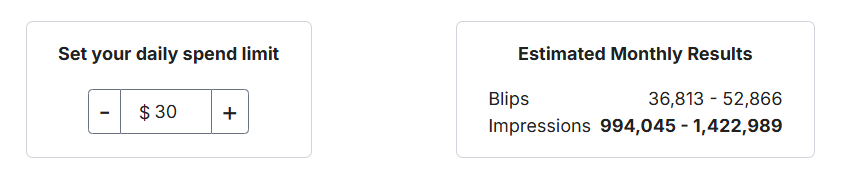
With Blip, you control exactly what you spend on Jennings billboards by setting a daily budget that works for you, whether you’re a local shop or a growing brand serving the Jennings area. Because Blip uses pay-per-blip advertising, you only pay each time your 7.5–10 second ad appears on billboards near Jennings, Missouri, and Blip automatically keeps your campaign within the budget you choose. The total cost depends on when and where your blips run and current advertiser demand, but you’re always in charge of the total cost.
Where can I advertise with Blip near Jennings, Missouri?
We have 27 digital billboards serving the Jennings area, positioned in nearby cities within roughly 10 miles. These locations include Berkeley, Florissant, Hazelwood, and East St. Louis, and they can generate hundreds of thousands of daily impressions depending on time of day and route. This coverage effectively provides billboard rental near Jennings without requiring boards inside the city limits themselves.
What kind of people do Jennings billboards reach in north St. Louis County?
Jennings and neighboring north county communities have a large share of Black/African American residents, with many neighborhoods 70–90% Black. Median household income in the Jennings area is lower than the county average, around $30,000–$35,000, and many households are highly sensitive to value, deals, and savings. Many residents work in healthcare, retail, transportation, manufacturing, logistics, education, and service sectors, often on non-traditional schedules.
When is the best time to run Blip ads near Jennings, Missouri?
Morning drive is roughly 6:30–9:00 a.m., afternoon school traffic is 2:30–4:00 p.m., and evening rush is 4:00–6:30 p.m. Digital boards serving the Jennings area become more powerful when messages are timed around residents’ real movements and habits, and a north county commuter can pass the same billboard location 10–20 times in a typical week. Weekends also shift toward shopping in Florissant and Hazelwood and events downtown.
What routes near Jennings get the most traffic for billboard advertising?
Major travel routes near the Jennings area include I-70, I-270, I-170, and Route 367 / Lewis & Clark Boulevard. Nearby arterial roads such as Lindbergh Boulevard, Natural Bridge Road, and Halls Ferry Road add tens of thousands more daily vehicles and serve as key connectors from Jennings into surrounding commercial corridors. These roads connect Jennings-area residents with shopping, work, schools, and entertainment in neighboring cities where the boards are located.
Do I need a contract to advertise with Blip near Jennings?
No, Blip has no long-term contracts or minimum commitments. You can start, pause, or stop your campaign at any time.
How fast can I launch a billboard campaign with Blip near Jennings?
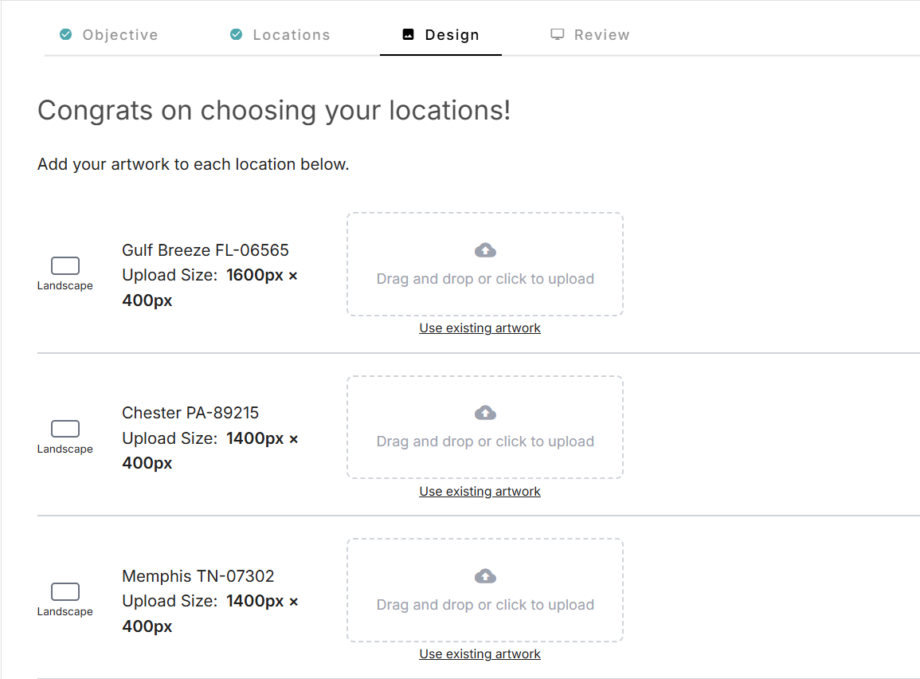
You can have your campaign live in minutes. Create a free account, select your locations, set your budget, upload your design, and start running once approved.
Where can I advertise with Blip near Jennings?
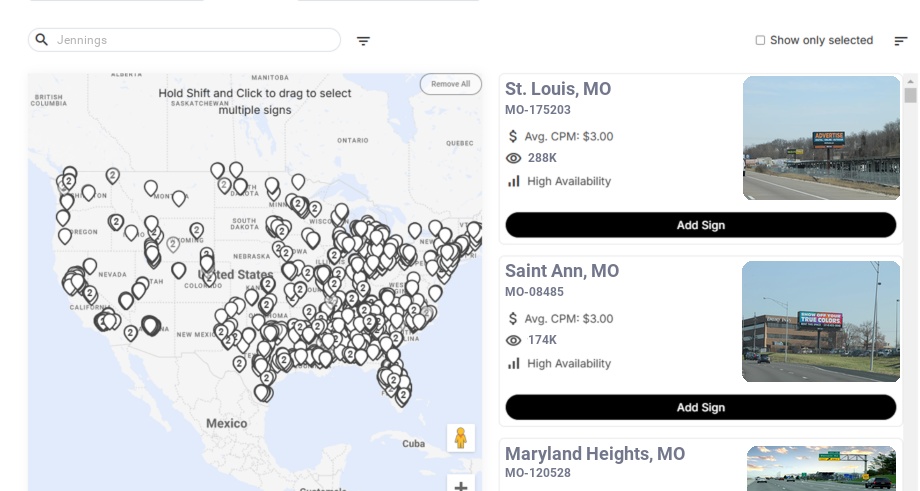
Blip has digital billboards near Jennings. You can browse available locations on a map, choose the ones that fit your audience, and start advertising right away.
Still have questions? Launch a campaign in minutes — no contracts, no commitments.
Start Your CampaignJennings Billboard Advertising Guide
The Jennings, Missouri area sits at a high-traffic crossroads of north St. Louis County, surrounded by major interstates, busy commuter routes, and regional retail centers. With 27 digital billboards serving the Jennings area from nearby Berkeley, Florissant, Hazelwood, and East St. Louis, we can help you reach residents, commuters, and shoppers moving between downtown St. Louis, Lambert–St. Louis International Airport
Understanding the Jennings Area Market
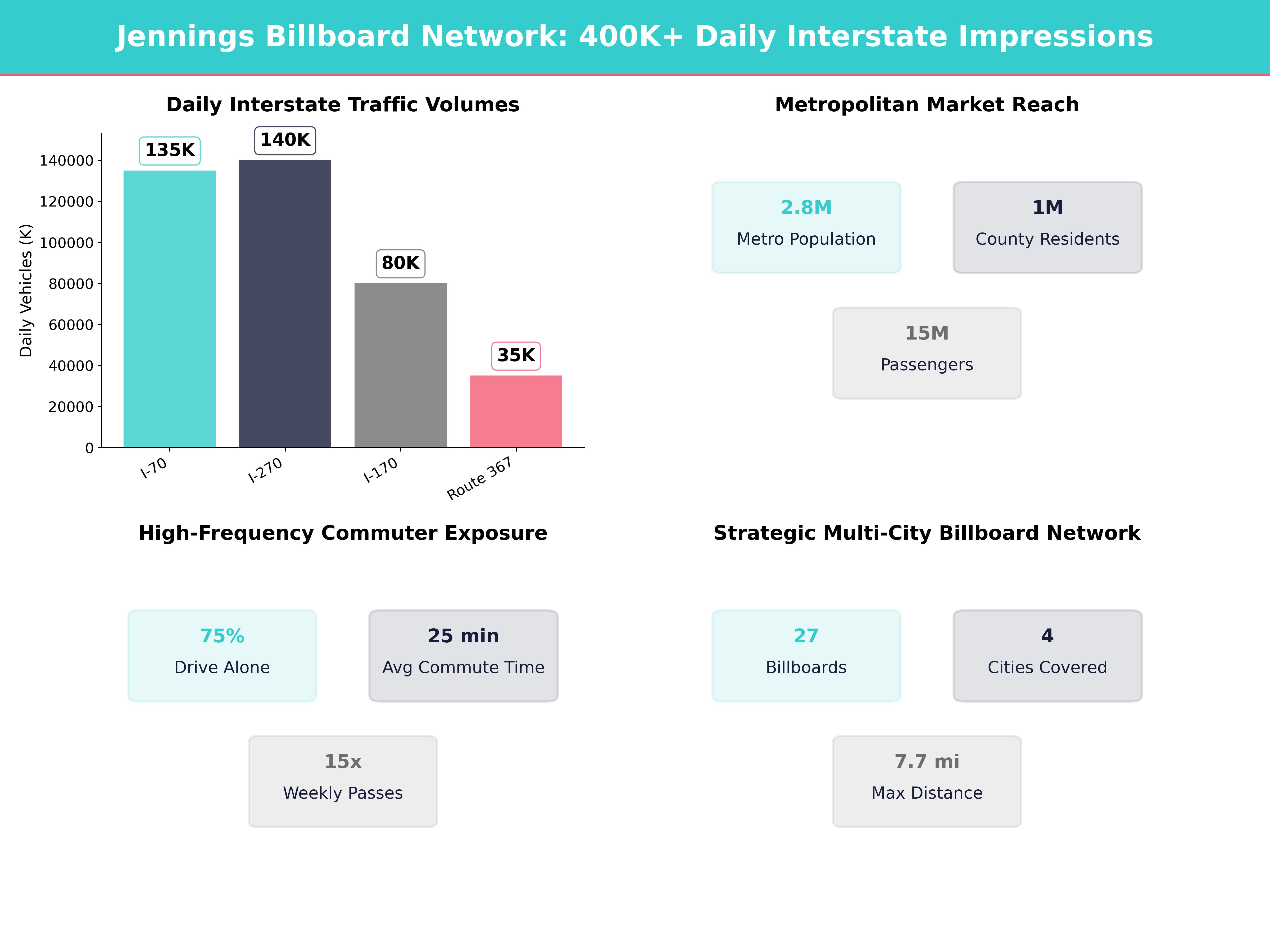
The Jennings area is tightly woven into the fabric of the greater St. Louis region. The City of Jennings itself has roughly 12,500–13,000 residents (about 12,900 as of the most recent census count), with a median age around 35–37 years old and a high share of multigenerational households where grandparents, parents, and children often live together. The city is part of north St. Louis County, which is embedded in St. Louis County’s roughly 1 million residents, while the full St. Louis metro exceeds 2.8 million people across Missouri and Illinois.
Key context for advertisers:
-
Commuter profile
- The average commute time in St. Louis County is about 24–26 minutes, with more than 75% of workers driving alone and another 8–10% carpooling. This indicates frequent cross‑suburb and city‑to‑suburb travel that repeatedly passes key billboard locations, making Jennings billboards especially effective for reaching working families.
- Jennings-area residents commonly travel toward downtown St. Louis, the office and government hub in Clayton Lambert airport, and retail corridors in Florissant and Hazelwood. Regional job centers in these areas support tens of thousands of daily workers, reinforcing two-way traffic throughout the day and increasing frequency for billboard advertising near Jennings along these main routes.
-
Regional connectivity
-
Major travel routes near the Jennings area include:
- I‑70 (serving roughly 120,000–150,000 vehicles per day through north St. Louis County, per MoDOT)
- I‑270 (commonly 130,000–150,000 vehicles per day across north county segments)
- I‑170 (about 70,000–90,000 vehicles per day)
- Route 367 / Lewis & Clark Boulevard (around 30,000–40,000 vehicles per day, depending on the segment)
- Nearby arterial roads such as Lindbergh Boulevard, Natural Bridge Road, and Halls Ferry Road add tens of thousands more daily vehicles and serve as key connectors from Jennings into surrounding commercial corridors tracked by St. Louis County.
- These roads connect Jennings-area residents with shopping, work, schools, and entertainment in neighboring cities where our boards are located, generating millions of monthly impressions across our 27 digital faces and giving your billboard advertising near Jennings substantial regional spillover.
-
Major travel routes near the Jennings area include:
-
Local character
- Jennings has a strong neighborhood identity, local schools in the Jennings School District, and community programs coordinated by the City of Jennings, which regularly promotes youth programs, senior services, and city events.
- North county residents often pay close attention to local issues covered by outlets like the St. Louis Post‑Dispatch and St. Louis American, as well as community-focused partners such as North County, Inc.. This creates an audience that is highly engaged with community-focused messages and regional developments.
- Regional surveys have shown that over 70% of St. Louis-area residents follow local news weekly, and more than half say they prefer to support businesses that visibly invest in their community—an ideal match for local billboard messaging.
For advertisers, this means your digital billboards near Jennings should speak to a community-oriented, locally proud audience that moves frequently across the north St. Louis County road network and is highly receptive to messages that reference neighborhood issues, local jobs, and family value.
Where Our Billboards Reach Near Jennings
We have 27 digital billboards serving the Jennings area, positioned in nearby cities within roughly 10 miles. Combined, these locations can generate hundreds of thousands of daily impressions, depending on time of day and route. This coverage effectively provides billboard rental near Jennings without requiring boards inside the city limits themselves:
-
Berkeley (about 4.1 miles from Jennings)
- Close to Lambert–St. Louis International Airport, which handled over 15 million passengers in 2023 according to FlySTL 5,000 on-site jobs and thousands more in related transportation and hospitality services.
- Captures airport workers, travelers, and traffic along I‑70, Natural Bridge Road, and airport access roads, where daily traffic volumes routinely exceed 80,000 vehicles near major interchanges.
- Ideal for businesses targeting visitors arriving from other states, ride‑share and taxi drivers, and airport‑adjacent workers who frequently see Jennings billboards on their way to and from north county neighborhoods.
-
Florissant (about 6.0 miles from Jennings)
- One of Missouri’s largest cities, with over 50,000 residents, and a strong retail tax base supported by corridors along Lindbergh Blvd and N Hwy 67. Local commercial centers draw shoppers from not only Florissant but also Jennings, Ferguson, and other north county communities.
- Estimated daily traffic on N Hwy 67 and Lindbergh routinely hits 35,000–50,000 vehicles per day, supporting grocery, dining, and big-box retail trips tracked by city and Florissant economic development.
- Strong reach into north county shoppers and families spending significant portions of their budgets on food, apparel, healthcare, and auto services, making these placements some of the most valuable billboards near Jennings for retail and restaurant campaigns.
-
Hazelwood (about 7.7 miles from Jennings)
- Home to distribution centers, industrial parks, and the St. Louis Outlet Mall area, with logistics and industrial employers that draw workers from all over north St. Louis County.
- I‑270 near Hazelwood sees around 140,000–150,000 vehicles per day, including a large volume of trucks and commercial vehicles, according to MoDOT.
- This makes Hazelwood boards especially effective for B2B messages (industrial suppliers, staffing firms) as well as consumer brands targeting shift workers and commuters, particularly those who live in or pass through the Jennings area.
-
East St. Louis, Illinois (about 9.2 miles from Jennings)
- Sits at the junction of I‑55, I‑64, and I‑70 at the Mississippi River, just across from downtown St. Louis.
- The Poplar Street Bridge and nearby river crossings carry roughly 100,000–120,000 vehicles per day, many of them commuters and event-goers heading to downtown venues.
- Ideal for catching cross‑river traffic heading to or from downtown St. Louis, including visitors to sports games, concerts, and conventions promoted by Explore St. Louis
Strategically using these locations lets us blanket the main paths used by Jennings-area residents and people traveling through the north county corridor. A well-structured rotation can expose a single commuter to your message multiple times per week across different boards, reinforcing recall and response.
Who You Can Reach in the Jennings Area
Understanding who you’re talking to will shape your messages and scheduling:
-
Demographics (north St. Louis County / Jennings area)
- Jennings and neighboring north county communities have a large share of Black/African American residents, with many neighborhoods 70–90% Black. This creates strong opportunities for culturally relevant, community-conscious creative.
- Median household income in the Jennings area is lower than the county average; around $30,000–$35,000, compared with St. Louis County’s roughly $70,000–75,000. Roughly 1 in 4 residents in parts of north county live below the federal poverty line, making clear value propositions particularly important.
- Household sizes are often larger, with many homes including children or extended family. In many nearby ZIP codes, 35–40% of households have children under 18, and multigenerational households are significantly above the national average.
-
Lifestyle and purchasing behavior
- High sensitivity to value, deals, and savings, especially for groceries, utilities, auto repair, and big-ticket purchases. Regional consumer surveys in St. Louis have found that residents in moderate-income suburbs are 20–30% more likely than higher-income residents to switch brands for discounts and promotions.
- Strong support for local businesses, churches, schools, and nonprofits. North county organizations often see strong attendance at local events, with church congregations regularly drawing hundreds of attendees per weekend service.
- Many residents work in healthcare, retail, transportation, manufacturing, logistics, education, and service sectors, often on non‑traditional schedules. Shift work for hospitals, warehouses, and airport support services in and around Jennings and Berkeley boosts late-night and early-morning traffic.
-
Traffic patterns
- Morning drive: roughly 6:30–9:00 a.m., fueled by work and school commutes. In many metro areas, including St. Louis, more than 40% of daily weekday traffic occurs during the combined morning and evening rush windows.
- Afternoon school traffic: 2:30–4:00 p.m. around school routes and local streets, particularly near Jennings School District campuses and neighboring districts highlighted by St. Louis County.
- Evening rush: 4:00–6:30 p.m., especially along I‑70, I‑170, I‑270, and Lindbergh Blvd, as workers return from downtown, Clayton, and airport-area jobs.
- Weekend peaks centered on shopping areas in Florissant and Hazelwood and on routes to downtown events promoted by Explore St. Louis tens of thousands of extra trips through downtown and across river bridges on a single day.
-
Media and out-of-home behavior
- Industry studies of out-of-home (OOH) in metro areas like St. Louis show that 70–80% of drivers notice roadside billboards in a typical week, and over half report that OOH ads sometimes prompt them to visit a website, search online, or visit a store.
- Because digital billboards can rotate multiple messages, campaigns in comparable markets have delivered 20–35% higher recall than static boards when using multiple creatives and time‑based targeting.
We can use Blip’s flexible dayparting and bidding tools to line up your ads precisely with these traffic flows and audience characteristics, maximizing the impact of any billboard rental near Jennings and surrounding communities.
Timing Your Campaigns for Maximum Impact
Digital boards serving the Jennings area become more powerful when we time your messages around residents’ real movements and habits. In a typical week, a north county commuter can pass the same billboard location 10–20 times, creating a strong frequency effect when schedules are carefully planned.
Weekday vs. Weekend
-
Weekdays (Mon–Fri)
-
Focus on:
- Work commuters heading toward downtown, Clayton, and the airport. Regional employment centers in downtown and Clayton together host 100,000+ jobs, driving heavy morning and evening flows.
- Parents driving to school, after‑school programs, and youth sports at facilities promoted through the City of Jennings and neighboring municipalities such as Florissant and Hazelwood.
-
Recommended dayparts:
- 6–9 a.m.: “Don’t forget” messages, breakfast offers, quick-service restaurants, reminders for appointments, and top-of-mind branding. Morning OOH exposure is associated with higher same‑day search and store visits.
- 3–7 p.m.: Retail offers, local services (auto repair, healthcare, tax prep), job recruitment, and dinner promotions—hours when many working families make purchase decisions on the way home.
-
Focus on:
-
Weekends (Sat–Sun)
-
Traffic shifts toward:
- Shopping in Florissant and Hazelwood, where weekend retail sales can account for 35–45% of weekly in-store revenue for many merchants.
- Church, community events, and sports, including youth leagues and high school games promoted by local school districts and community groups highlighted by St. Louis American.
-
Recommended dayparts:
- 9 a.m.–2 p.m.: Family activities, brunch, local churches, and community events.
- 2–8 p.m.: Entertainment, dining, nightlife in downtown St. Louis and the central corridor, including visitors to venues covered by Explore St. Louis.
-
Traffic shifts toward:
Seasonal Opportunities
-
Back‑to‑school (July–September)
- Jennings-area families are preparing for the new year at local schools and nearby colleges such as St. Louis Community College – Florissant Valley, where enrollment numbers often reach into the thousands of students.
- Back‑to‑school spending in the U.S. often exceeds $800 per household on average for K‑12, and families in value-conscious areas like north county are highly responsive to promotions on clothing, supplies, and technology.
- Promote school supplies, clothing, youth programs, tutoring, and healthcare checkups, including sports physicals and immunizations recommended by health departments like the St. Louis County Department of Public Health
-
Tax season (January–April)
- With many households in value-conscious income brackets, tax preparation, refund-advance, and financial services resonate strongly. Nationally, more than 70% of filers receive a refund, and neighborhoods with median incomes around $30,000–$40,000 often see high use of storefront tax preparers and refund-advance products.
- Billboards can remind drivers in key windows—especially late January through mid‑February and again in early April—when filing and last‑minute demand peak.
-
Holiday shopping (November–December)
- Direct traffic to local retailers and e‑commerce offers; emphasize savings and layaway options. Holiday sales can represent 20–30% of annual retail revenue for many categories, making even modest lifts from billboards highly valuable.
- Tie messaging to local tree‑lightings, parades, and seasonal markets promoted by City of Jennings, St. Louis County, and St. Louis Post‑Dispatch event listings.
-
Sports seasons
- Messages tied to St. Louis Cardinals baseball and St. Louis Blues hockey resonate strongly; many home games draw 30,000–45,000 attendees downtown.
- Local high school football and basketball seasons also attract strong regional interest, with some rivalry games drawing 1,000+ fans.
- Aligning billboard messaging along I‑70 and cross‑river routes near East St. Louis before and after games can capture both dedicated fans and casual event-goers.
By adjusting bids and budgets across these periods, we can intensify your presence exactly when Jennings-area audiences are most likely to respond and allocate spend to the weeks where seasonal demand spikes.
Crafting Effective Creative for the Jennings Area
Because digital billboards near Jennings are primarily viewed at 45–65 mph, your creative must be instantly clear and culturally relevant. Industry research shows that drivers typically have 6–8 seconds to absorb a billboard message; designs that respect this window significantly outperform cluttered layouts.
Message Strategy
-
Lean into community identity
- Reference “North County,” “Jennings area,” or local landmarks and routes (e.g., “Just off I‑270,” “Near Halls Ferry,” or “Minutes from Jennings”).
- Feature real local images when appropriate—north county neighborhoods, local storefronts, or recognizable St. Louis skyline shots including the Gateway Arch featured by Explore St. Louis.
-
Lead with value and clarity
-
Use bold, direct offers:
- “$29 oil change – 10 minutes from Jennings”
- “New patients: $0 exam with insurance”
- “Save up to 40% this weekend only”
- Limit to 7–10 words of main copy plus your logo/URL/QR code. OOH design studies indicate that messages under 10 words see significantly higher recall.
- Use numerals (“$29,” “3‑minute signup”) to anchor value visually.
-
Use bold, direct offers:
-
Build trust
-
Include simple credibility markers:
- “Serving North County for 25+ years”
- “Rated #1 in St. Louis by local customers”
- If your organization is featured in outlets like St. Louis Post‑Dispatch or supports community groups showcased by City of Jennings, reference that briefly (“Proud supporter of Jennings youth programs”).
- Local trust is key: surveys consistently show that 60–70% of consumers feel more comfortable buying from businesses that highlight community involvement.
-
Include simple credibility markers:
Visual Design
-
Contrast is critical
- High-contrast color pairings (dark background with bright text or vice versa) work well under varied weather conditions common to the St. Louis region, which can see over 100 days per year with precipitation or low‑visibility conditions.
-
Font size
- Use large sans-serif fonts; test readability from a distance. If it wouldn’t be legible across a wide St. Louis County arterial, it’s too small. Best practice suggests a minimum of 18–24 inches of letter height on the physical board for primary text, which translates to bold, simple type on your digital file.
-
One focal point
-
Choose either:
- A bold offer, or
- A powerful image—not both crowded together.
- Studies of digital OOH show that simple, single-focus layouts can improve recall by 20–30% compared to cluttered designs.
-
Choose either:
-
Local cues
- Colors associated with local sports teams (red for Cardinals, blue for Blues) or north county high school colors can create immediate familiarity—just avoid trademarked logos unless you have rights.
- When promoting events, include a clear date or short countdown (“This Saturday,” “3 days only”) to trigger urgency.
We encourage advertisers to prepare multiple creative variations, then use Blip’s platform to A/B test them across different boards and times of day. Campaigns that rotate 3–5 creative variations often see stronger engagement than those with a single static design, especially when those creatives explicitly call out the Jennings area to connect your message to nearby drivers.
Using Blip’s Tools Strategically Near Jennings
Blip’s platform allows precise control over where, when, and how often your ads play on digital billboards serving the Jennings area. This flexibility is especially useful in a market like north St. Louis County, where traffic levels and audience composition can shift significantly by time of day and day of week.
Location Targeting
With 27 boards in Berkeley, Florissant, Hazelwood, and East St. Louis, we can:
-
Concentrate impressions close to:
- Retail corridors used by Jennings-area shoppers in Florissant and Hazelwood, where weekend traffic can be 20–30% higher than weekday mid‑day volumes.
- Airport-access routes through Berkeley, capturing a mix of employees and the 40,000+ average daily passengers and visitors moving through Lambert–St. Louis International Airport.
- Cross‑river routes into downtown via East St. Louis, especially during major events publicized by Explore St. Louis.
-
Layer coverage:
- For example, run weekday commuter messaging on I‑70/Hazelwood boards and weekend shopping messages on Florissant boards, while using East St. Louis boards for event‑oriented creative.
- Use boards near key transit nodes—such as park‑and‑ride lots and MetroLink stations promoted by Metro Transit – St. Louis—to reach multimodal commuters.
This kind of location targeting ensures your Jennings billboards act as part of a unified, regionally optimized network rather than isolated placements.
Budget and Bidding
- Set your daily or total campaign budget, then let Blip automatically bid for ad slots (“blips”) based on your max price and competition.
-
To stretch smaller budgets:
- Focus on off‑peak dayparts (e.g., mid‑day or later evenings) where price per blip is often lower but still sees strong circulation. In many markets, off‑peak CPMs can be 20–40% lower than prime rush-hour periods.
- Rotate your ads across multiple boards at lower frequency to maximize geographic reach, then ramp up frequency on the highest-performing boards as results become clear.
- Use shorter flight windows (e.g., 2–4 weeks) around key events or promotions, rather than always-on campaigns, to create noticeable bursts of visibility.
-
For larger budgets:
- Consider maintaining a baseline presence on key commuter boards (I‑70, I‑270) and layering on high-intensity bursts around product launches, holiday periods, or major regional events featured by St. Louis Post‑Dispatch and St. Louis American.
This approach to budgeting and bidding makes billboard rental near Jennings accessible for both small and large advertisers, with room to scale as results come in.
Dayparting and Scheduling
-
Use dayparting to:
- Hit school commute times if you target parents and students, especially around Jennings and neighboring districts listed by St. Louis County.
- Align restaurant and grocery ads with meal windows (e.g., 3–7 p.m.) and payday cycles—particularly the 1st and 15th of each month, when spending often spikes in value-conscious communities.
- Time church, event, or nonprofit messages around weekends and evenings, when attendance is highest.
-
Schedule different messages by day:
- Example: job recruitment messages Monday–Thursday; promotion-heavy messaging Friday–Sunday.
- Use event calendars from City of Jennings and Explore St. Louis to anticipate local peaks and adjust your schedule in advance.
Fine-tuning your schedule in this way helps transform generic billboard advertising near Jennings into a highly targeted, time-sensitive campaign that mirrors how local residents actually move through the area.
Local Events and Community Calendars to Leverage
Aligning your campaign with happenings covered by local organizations and media can significantly boost relevance and response. Event-driven campaigns often see noticeable short-term lifts in web traffic, calls, or in-store visits compared to baseline weeks.
-
City and County resources
- City of Jennings – community meetings, festivals, and citywide events such as seasonal celebrations, job fairs, and youth programs.
- St. Louis County – county fairs, public health initiatives, and park events across more than 70 county parks and facilities.
-
Regional attractions
- Explore St. Louis – lists major concerts, sports games, conventions, and seasonal attractions. The St. Louis region hosts millions of visitors annually, with major attractions like the Gateway Arch and Forest Park consistently ranking among top regional draws.
- Downtown venues, including sports stadia and arenas, frequently host events with 10,000–45,000 attendees, creating spikes in cross‑river and interstate traffic.
-
Local news
- St. Louis Post‑Dispatch and St. Louis American frequently highlight local festivals, school events, neighborhood initiatives, and small business stories that resonate in Jennings and north St. Louis County.
- Community and neighborhood news can influence turnout for local events, making coordinated billboard messaging particularly effective in the 7–10 days leading up to an event.
Effective event‑tied strategies:
- Promote pre‑event offers (e.g., “Game day specials 10 minutes from Jennings” or “Stop by before the concert downtown”) during the 2–3 days before major events.
- Run countdowns (“3 days left to enroll,” “Final weekend of our sale”), which have been shown in marketing studies to increase urgency and response rates.
- Highlight community support (“Proud sponsor of North County schools,” “Supporting Jennings families since 1995”) to build long-term goodwill.
- Coordinate with local organizations, such as North County, Inc., to align campaigns with broader community initiatives.
We can help you adjust creative in near‑real time to respond to breaking news, weather shifts, or newly announced events, leveraging the flexibility of digital boards versus traditional print or static OOH.
Sample Campaign Playbooks for the Jennings Area
To make this concrete, here are some proven patterns tailored to the Jennings area. These patterns draw on typical performance in comparable metro markets, where localized digital billboard campaigns have driven double-digit percentage lifts in branded search and store visits.
Local Retailer or Restaurant
Goal: Increase foot traffic from Jennings-area residents.
- Boards: Focus on Florissant and Hazelwood locations along main shopping routes where daily vehicle counts are in the tens of thousands.
-
Schedule:
- Weekdays: 4–7 p.m. (after‑work stops)
- Weekends: 11 a.m.–7 p.m. (peak shopping and dining windows)
-
Creative:
- Ad 1: “Family meals under $25 – 8 min from Jennings”
- Ad 2: “Buy 1, get 1 50% off – This weekend only”
- Ad 3: “Kids eat free Sunday – North County favorite since 2005”
-
Tactic:
- Use a short, memorable URL or trackable promo code (“Show this code: JENNINGS10”) and monitor redemption rates.
- Restaurants and retailers in similar campaigns have seen 5–15% increases in weekend traffic during promotional flights when combining billboards with in‑store offers, especially when the creative clearly signals these are billboards near Jennings and intended for local families.
Healthcare or Dental Practice
Goal: Build ongoing patient base from north county families.
- Boards: Mix Berkeley (for commuters to airport/downtown), Florissant (for families), and East St. Louis (cross‑river commuters).
-
Schedule:
- Heavy rotation 6–9 a.m. and 3–7 p.m. on weekdays when families are commuting and planning appointments.
- Lighter reminder schedule on Saturdays for walk‑in clinics and urgent care.
-
Creative:
- “New patients: $0 exam w/ insurance – Near the Jennings area”
- “Evening & Saturday appointments – Call [phone number]”
- “Back‑to‑school checkups – Same‑week appointments available”
-
Tactic:
- Run a specific “Back‑to‑School Checkups” flight July–September, when pediatric and sports physical demand peaks.
- Use a dedicated phone line or landing page to measure appointment requests generated during the campaign; healthcare providers in similar markets often report 10–20% more new-patient calls during focused billboard periods.
Education, Nonprofit, or Faith Organization
Goal: Drive awareness and participation among Jennings-area residents.
- Boards: Emphasize Florissant and Berkeley for regional reach; supplement with East St. Louis for cross‑river viewers who may attend or support programs in north county.
-
Schedule:
- Wed–Sun, 6–9 a.m. and 4–9 p.m., to reach both work commuters and evening attendees.
-
Creative:
- “Free youth programs for North County families – Learn more at [short URL]”
- “Join us this Sunday – Welcoming the Jennings area”
- “Volunteer in your community – Sign up in 3 minutes”
-
Tactic:
- Use multiple creatives to speak to parents, teens, and volunteers separately.
- Tie campaigns to specific drives (e.g., “Fall enrollment ends Oct. 15”) or events featured on City of Jennings and St. Louis American.
- Nonprofits in comparable digital OOH campaigns often see significant spikes (20–30%+) in web visits and sign‑ups during targeted flight periods.
Measuring and Optimizing Your Jennings-Area Campaign
While billboards are inherently a mass‑reach medium, we can still measure and refine performance for campaigns near the Jennings area using both digital and offline signals.
Ways to track impact:
-
Web and search activity
- Watch for spikes in website visits and branded search from north St. Louis County ZIP codes when your campaign is running.
- Studies of integrated campaigns show that adding OOH can increase search activity by 20–40% in the markets where boards are present.
-
Promo codes and landing pages
- Use unique promo codes, phone numbers, or landing URLs on your billboard creative to attribute leads or sales.
- Even modest redemption rates (e.g., 1–3% of in-store customers) can demonstrate a strong return when scaled across thousands of daily impressions.
-
Foot traffic
- Retailers can compare store traffic from Jennings-area ZIPs during campaign and non‑campaign periods.
- If you use foot‑traffic analytics tools, look for increases in visits within 0–3 days after high‑frequency billboard exposure.
-
Call volume
- Service businesses can monitor call logs during specific billboard dayparts for noticeable increases and track how many callers mention “seeing your sign.”
- In many local service categories, 5–10 additional calls per week can translate into meaningful revenue, especially in recurring-service models.
After 2–4 weeks of running, we recommend:
- Identifying which locations and dayparts generated the best response, using web analytics, call tracking, or in‑store feedback.
- Shifting budget toward those higher‑performing segments, often concentrating 60–70% of spend on the top‑producing boards and times while leaving the rest for testing.
- Refreshing creative with new offers while maintaining recognizable brand elements (colors, logo, core headline) to preserve continuity and recognition.
- Aligning ongoing flights with upcoming events and initiatives promoted by City of Jennings, St. Louis County, and Explore St. Louis.
This ongoing optimization ensures that your billboard advertising near Jennings continues to improve over time rather than remaining static.
Putting It All Together
By combining a deep understanding of the Jennings area with the flexibility of digital billboards, we can:
- Reach residents and commuters across 27 strategically located boards in Berkeley, Florissant, Hazelwood, and East St. Louis, generating consistent exposure along routes that see well over 100,000 vehicles per day in aggregate.
- Align your messaging with local traffic patterns, community identity, and economic realities, ensuring that value-driven offers and community-focused themes resonate with north county audiences.
- Use Blip’s tools to target, test, and optimize without committing to inflexible long‑term contracts, allowing you to scale up or pivot as performance data and local conditions evolve.
Whether you’re a small local business, a regional brand, or a nonprofit serving north St. Louis County, a well‑planned digital billboard strategy near Jennings can become a powerful driver of awareness, trust, and action—backed by real traffic data, clear audience insights, and measurable campaign results.