Billboards in Battlefield, MO
No Minimum Spend. No Long-Term Contracts. Just Results.
Trusted by Leading Brands


Billboard advertising
in Battlefield has never been easier
How much is a billboard in Battlefield?
Why Choose Blip for Billboard Advertising in Battlefield
Blip lets Battlefield advertisers launch fast on US 60 and US 65, reaching Springfield commuters and Branson-bound weekend drivers without traditional buying delays.
In Battlefield, no contracts or minimums mean you can flex your budget around back-to-school, Ozark Empire Fair traffic, or holiday shopping near Battlefield Mall.
Use Blip's dayparting in Battlefield to hit 6-9 a.m. commuters and Friday-to-Sunday leisure traffic headed toward Branson, when eyes are most likely to act.
Battlefield's real-time analytics make it easy to test Campbell, Republic Road, or Battlefield Road and shift spend toward the corridor that drives the best response.
Blip's creative tools help Battlefield brands swap messages fast for commuters, families, or south-side shoppers—perfect for local service offers and seasonal promos.
Frequently Asked Questions About Billboard Advertising in Battlefield
How much does a billboard cost in Battlefield, Missouri with Blip?
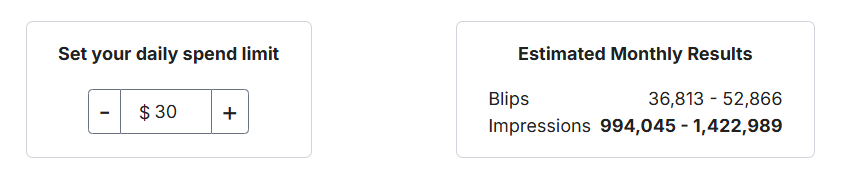
With Blip, billboard advertising in Battlefield can be surprisingly affordable because you only pay when your ad actually displays. Pricing starts at just $0.01 per display, and your total cost is simply the sum of your individual blips over time. Cost per blip changes based on time of day, location, and advertiser demand, so you can keep your spending flexible and in control.
Where can I advertise with Blip in Battlefield, Missouri?
Battlefield advertising succeeds when we match the campaign to how people actually move through the south side of the metro. Key corridors include US 60, also known as the James River Freeway, US 65 south of Springfield, I-44, and surface streets like Campbell Avenue, Battlefield Road, and Republic Road. These routes connect shoppers, commuters, and travelers across Battlefield and the larger Springfield trade area.
Why is Battlefield, Missouri a strong billboard market for Blip?
Battlefield, Missouri, is a strong billboard market because it sits inside the daily orbit of Springfield while keeping the accessibility of a fast-growing south-side suburb. The city grew 11.8% from 5,679 residents in 2010 to 6,349 in 2020, and advertisers also benefit from the much larger surrounding base in Springfield, Greene County, and neighboring Christian County. Most daily trips in this part of southwest Missouri happen by car, so roadside ads stay visible where decisions are made.
When is the best time to run billboard ads in Battlefield, Missouri?
Timing matters in Battlefield because the market blends commuter behavior, school calendars, shopping cycles, and tourism patterns. Spring is strong for home services and weather-related repair, summer adds family movement and travel toward Branson, and late July and August are especially valuable for back-to-school traffic. From November through December, shopping and restaurant traffic picks up around south Springfield and Battlefield Mall.
How does Blip help with billboard targeting in Battlefield, Missouri?
Blip is especially useful in Battlefield because this is a market where timing, direction, and corridor selection matter as much as raw impressions. We can emphasize morning commuters, lunch and errand traffic, after-work traffic, or weekend Branson-bound travel by using dayparting. Blip’s reporting also makes it easier to test one corridor, compare results, and shift budget toward the strongest fit.
Do I need a contract to advertise with Blip in Battlefield?
No, Blip has no long-term contracts or minimum commitments. You can start, pause, or stop your campaign at any time.
How fast can I launch a billboard campaign with Blip in Battlefield?
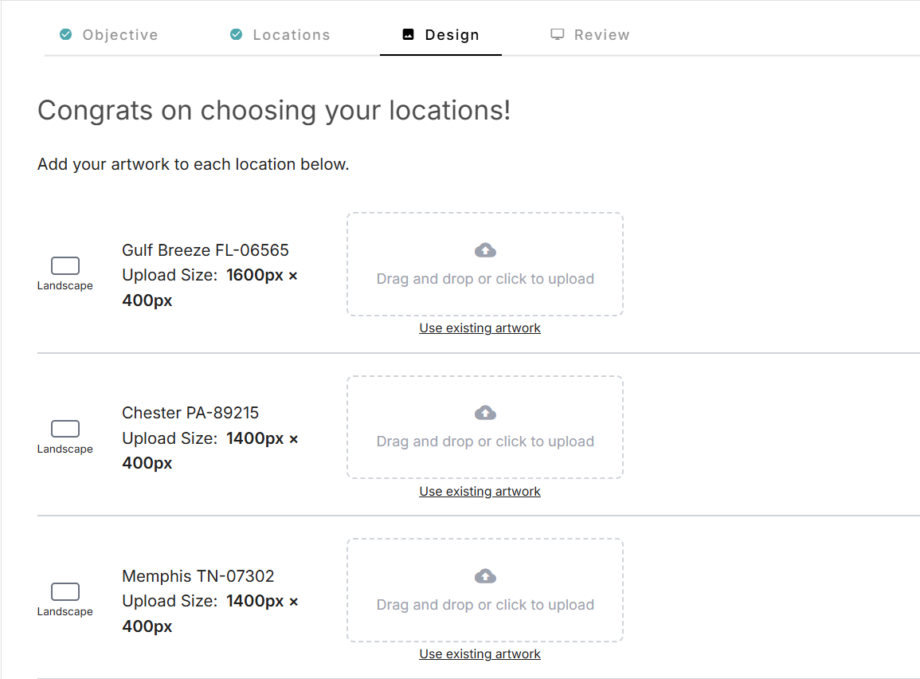
You can have your campaign live in minutes. Create a free account, select your locations, set your budget, upload your design, and start running once approved.
Where can I advertise with Blip in Battlefield?
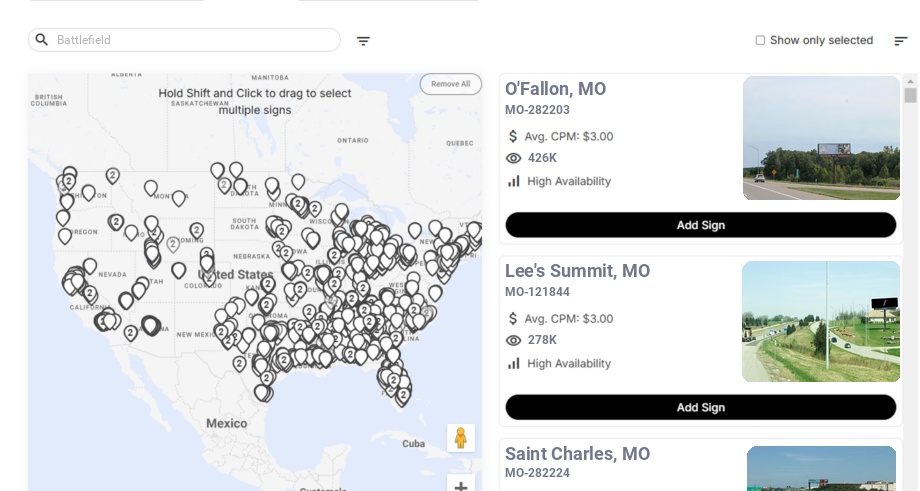
Blip has digital billboards in Battlefield. You can browse available locations on a map, choose the ones that fit your audience, and start advertising right away.
Still have questions? Launch a campaign in minutes — no contracts, no commitments.
Start Your CampaignBattlefield Billboard Advertising Guide
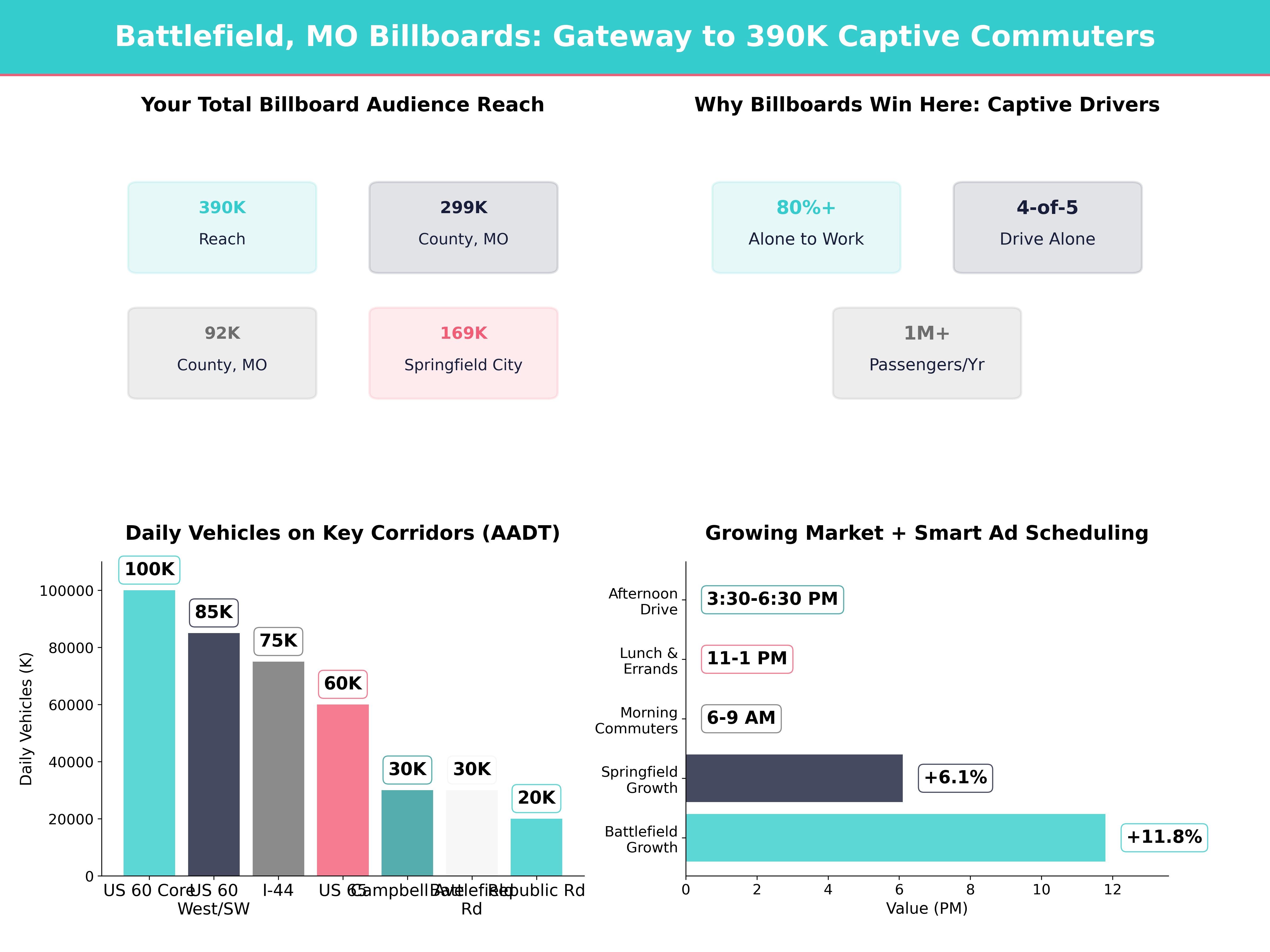
Battlefield, Missouri, is a strong billboard market because it sits inside the daily orbit of Springfield while keeping the accessibility of a fast-growing south-side suburb that grew 11.8% from 5,679 residents in 2010 to 6,349 in 2020. The City of Battlefield had 6,349 residents in 2020, up from 5,679 in 2010, and advertisers also benefit from the much larger surrounding base of 169,176 people in Springfield, 298,915 in Greene County, and 91,678 in neighboring Christian County. Most daily trips in this part of southwest Missouri happen by car, with drive-alone commuting above 80% in both counties, so roadside ads stay visible where decisions are made. When we add south Springfield retail traffic and leisure travel toward Branson about 40 miles away, Battlefield becomes a practical place to build frequency without buying more market than we need.
Battlefield Market Overview
Battlefield works best when we treat it as both a standalone suburb and part of the larger Springfield trade area. The city itself grew by 11.8% from 2010 to 2020, which tells us that the local customer base is not static. Nearby Springfield also grew from 159,498 residents in 2010 to 169,176 in 2020, a gain of about 6.1%, and that matters because many Battlefield residents work, shop, study, and seek care there.
If we combine Greene County and Christian County, the immediate cross-county audience reaches 390,593 residents. That is a meaningful local footprint for home services, retail, health care, restaurants, legal services, schools, churches, and entertainment brands. It also creates enough scale for regional advertisers that want southwest Missouri exposure without buying statewide media.
What the local economy means for billboard advertisers in Battlefield
The Springfield Area Chamber of Commerce and regional business leaders consistently point to health care, education, manufacturing, logistics, retail, and tourism as core economic engines. Employers such as CoxHealth, Mercy, Missouri State University, Bass Pro Shops
Recent county labor data from MERIC have generally kept Greene County and Christian County in the 2% to 4% unemployment range, which points to an active working population. For billboard advertisers, that usually means three things:
- Consistency matters. We can justify always-on messaging because the region produces year-round commute and errand traffic.
- Location matters more than market size. A board near the right route often outperforms a broader but less relevant buy.
- Directional relevance matters. Drivers in this market respond well to ads that match where they are headed, such as work, school, shopping, or weekend recreation.
Car dependence is a major advantage in Battlefield
Battlefield is roughly 10 miles southwest of downtown Springfield, and the trip is typically made by car. Commuting profiles collected by the Missouri Census Data Center show that more than 4 out of 5 workers in both Greene County and Christian County drive alone to work, and the share using a car, truck, or van is even higher once carpools are included. That level of auto dependence is exactly what makes digital billboards so valuable here.
Key Traffic Corridors Around Battlefield
Battlefield advertising succeeds when we match the campaign to how people actually move through the south side of the metro. In practice, that means understanding the regional freeways that feed Springfield, plus the commercial arterials that handle shopping, school, and service traffic.
US 60, the James River Freeway, and south Springfield reach
According to Missouri Department of Transportation traffic maps, the busiest segments of US 60, also known as the James River Freeway, regularly exceed 100,000 vehicles per day near the core south Springfield interchanges. Even farther west and southwest, many segments still run in the 80,000 to 90,000 AADT range.
This corridor is especially useful because it connects west Springfield, south Springfield, US 65, and the retail districts around Battlefield Mall
- Retail, restaurants, and entertainment benefit because drivers are already in shopping mode.
- Health care and professional services benefit because the freeway feeds the south-side medical and office districts.
- Regional brands benefit because US 60 offers reach well beyond Battlefield alone.
US 65 south of Springfield and the Branson funnel
US 65 is the market’s most important north-south tourism and commuter route. MoDOT counts on key segments between Springfield, Ozark Nixa commonly land around 55,000 to 65,000 vehicles per day, with strong directional patterns tied to workdays and weekends.
This matters because US 65 does two jobs at once. On weekdays, it carries commuters between Christian County and Springfield. On weekends, it becomes a gateway for traffic continuing toward Branson, which sits about 40 miles south of Battlefield.
Advertisers that usually do well on this corridor include:
- Family attractions and restaurants. They can capture Friday outbound and Sunday inbound leisure traffic.
- Auto dealers, banks, and health care brands. They can stay in front of daily Christian County commuters.
- Homebuilders and real estate services. They can reach households moving around the Ozark, Nixa, and south Springfield growth band.
I-44 and north Springfield regional traffic
Battlefield businesses that need metro-wide or regional awareness should not ignore I-44. Around Springfield, MoDOT counts on major I-44 segments often sit in the 70,000 to 80,000 AADT range. Even though I-44 is north of Battlefield, it is critical for reaching freight traffic, hotel guests, event visitors, and business travelers entering the market from Tulsa, St. Louis, Joplin, and the rest of southern Missouri.
This corridor is especially helpful for:
- Hotels, convention-related services, and attractions. They can catch visitors before they choose where to stop.
- Industrial suppliers and B2B companies. They can reach decision-makers moving through the region.
- Airport-adjacent or regional service brands. They can build awareness beyond the immediate south side.
Campbell Avenue, Battlefield Road, and Republic Road
The surface-street network around south Springfield and Battlefield is where intent often becomes action. On major commercial segments, MoDOT and local planning documents commonly show 30,000-plus daily vehicles on Campbell Avenue, 30,000-plus on busy stretches of Battlefield Road, and 20,000-plus on high-activity portions of Republic Road.
These streets matter because they sit closer to stores, clinics, gyms, schools, and restaurants than the freeway does. If we are promoting same-day service, immediate turns, or local brand recall, these corridors are often stronger than a pure reach play.
- Home services can use them to stay visible near neighborhoods with high homeowner density.
- Urgent care, dental, vision, and specialty clinics can use them to reach people already navigating errands.
- Quick-service restaurants, grocery stores, and local retailers can use them to trigger near-term visits.
Audience Segments We Can Reach in Battlefield
Battlefield is not a one-audience market. We can use its location to reach several overlapping groups, and each one responds to slightly different timing and message strategies.
Battlefield commuters and cross-county workers
The biggest audience is still the weekday driver. Battlefield sits between suburban neighborhoods and the employment centers of Springfield, so our messaging can catch people twice in the same day. Because drive-alone commuting exceeds 80% in both Greene County and Christian County, repeated billboard exposure has a real chance to build memory.
This audience is strong for:
- Financial services.
- Health care providers.
- Home services.
- Fast casual dining.
- Fitness, wellness, and personal care.
Students, faculty, and education households near Battlefield
The broader Springfield market has a substantial education audience. Missouri State University enrolled 23,418 students in fall 2023, and the city also includes Drury University Evangel University Ozarks Technical Community College Springfield Public Schools serves roughly 24,000 students, with additional family traffic coming from Nixa Public Schools, Ozark School District, and Republic School District.
That mix creates several opportunities. We can run student-oriented campaigns around apartments, tutoring, coffee, technology, and part-time jobs. We can also run parent-oriented campaigns for youth activities, pediatric care, family dining, and back-to-school retail.
Families and homeowners around Battlefield
Battlefield’s growth from 5,679 to 6,349 residents over one decade signals an expanding homeowner base. South Springfield, Battlefield, Ozark, Nixa, and Republic all attract families looking for access to jobs, schools, and retail without leaving southwest Missouri.
This audience is especially responsive to ads for:
- Roofing, HVAC, plumbing, pest control, and lawn care.
- Family entertainment and dining.
- Grocery, pharmacy, and health services.
- Churches, schools, and community organizations.
Tourists and weekend travelers passing Battlefield
Battlefield also benefits from travel spillover. Branson is about 40 miles south, Springfield-Branson National Airport 1 million passengers annually in recent years, and Springfield attractions such as Wonders of Wildlife Dickerson Park Zoo, Discovery Center of Springfield, and Springfield Cardinals games generate steady visitor movement.
We should think about this audience in directional terms. Southbound traffic often responds to lodging, dining, and entertainment. Northbound return traffic often responds to shopping, health care, grocery, furniture, and household services.
Seasonal Opportunities for Battlefield Billboard Campaigns
Timing matters in Battlefield because the market blends commuter behavior, school calendars, shopping cycles, and tourism patterns. We usually get the best results when we adapt creative and budgets by season instead of treating the whole year the same way.
Spring in Battlefield, from March through May
Spring in southwest Missouri is prime time for home services, weather-related repair, lawn care, landscaping, and allergy or urgent-care messaging. As soon as we move into March, consumers start planning projects, and by April and May the service calendar gets crowded.
This is a strong time for:
- Storm restoration and roofing.
- HVAC tune-ups before summer heat.
- Outdoor living, lawn, and garden offers.
- Tax, legal, and financial messages ahead of filing deadlines.
Summer in Battlefield, from June through August
Summer adds both local family movement and regional leisure travel. Drivers head toward Branson, Silver Dollar City, lakes, parks, and Springfield attractions. This is also when school is out, which shifts traffic later into the day and increases family errand travel.
We should pay extra attention to Friday afternoon, Saturday morning, and Sunday evening patterns on US 65 and the James River Freeway. Summer is also a natural fit for ads tied to Bass Pro Shops Wonders of Wildlife
Back-to-school and fall routines in Battlefield
Late July and August are especially valuable because several audience streams overlap at once. The Ozark Empire Fair boosts regional event traffic in late July and early August, Missouri State University returns for the fall term, K-12 districts resume classes, and routine commuting snaps back into place.
From August through November, billboard campaigns often perform well for:
- Student housing and furniture.
- Medical, dental, and vision appointments.
- Youth sports, family dining, and retail.
- Car maintenance and tire services.
- Political and issue campaigns in election years.
The Birthplace of Route 66 Festival Springfield Cardinals season, which typically runs from April through September, also help extend downtown and north-side event traffic into early fall.
Holiday and winter demand in Battlefield
From November through December, we usually see stronger shopping, restaurant, and gift-related traffic around south Springfield and Battlefield Mall January and February, the market often shifts toward tax services, indoor entertainment, health care, gyms, and practical household services.
Winter campaigns do not need tourist volume to succeed. They succeed by matching the routines people keep even in cold or wet weather, especially commuting, school drop-offs, and medical visits.
Billboard Design Tips for Battlefield Audiences
Battlefield does not reward vague creative. This market responds best when our ad looks local, feels practical, and gives drivers a reason to act soon.
Use Battlefield and Springfield place names that drivers recognize
Specific geography improves recall. “South Campbell,” “Battlefield,” “James River Freeway,” “near Battlefield Mall,” “in Ozark,” and “exit now” are more useful than broad regional language. Because many campaigns here are trying to catch drivers already in motion, wayfinding language can be powerful when the board is close enough to the business.
Match the Ozarks lifestyle instead of using generic stock imagery
Southwest Missouri audiences often respond to visuals that reflect everyday local life. Outdoor imagery, families, homes, trucks, sports, lakes, and practical before-and-after visuals usually feel more native to this market than abstract corporate art. Earth tones, deep blues, greens, black, and high-contrast white text often work well because they fit the regional outdoors culture while still standing out in traffic.
Lead with trust, value, and immediacy in Battlefield
Battlefield-area drivers often favor straightforward promises over clever copy. We usually perform better with clear offers such as pricing, timing, convenience, or credibility. Examples include “Free Estimate,” “Open Late,” “Same-Day Care,” “Locally Owned,” or a bold price point in large type.
For this market, big numerals are especially effective. If we have a strong price, year, discount, phone number fragment, or short URL, we should make that the visual anchor.
Tailor creative by corridor and direction of travel
A commuter board on Campbell Avenue should not look identical to a weekend-travel board on US 65. On commuter routes, we should emphasize routine needs such as food, appointments, childcare, or home services. On southbound leisure routes, we should emphasize fun, convenience, and immediate stops. Because digital boards rotate fast, our message needs to be legible in about 7.5 to 10 seconds, which means one idea, one brand cue, and one action.
Regional Strategies Across Battlefield and Nearby Communities
The best Battlefield campaigns usually combine local precision with regional spillover. We do not need to blanket the whole metro equally. We need to choose the sub-areas that match our customer journey.
Battlefield and south Springfield
This is the best zone for businesses that depend on households, regular errands, or repeat service. Campaigns for dentists, med spas, urgent care, gyms, daycares, HVAC companies, roofing firms, furniture stores, and local restaurants are often strongest here.
The advantage is intent. Drivers on south Springfield arterials are often already shopping or comparing options, not just passing through.
Republic and west-side growth routes
Republic
This strategy is especially useful when we want more than one suburban audience without going fully metro-wide.
Nixa, Ozark, and the US 65 south corridor
Nixa and Ozark
If our business serves Christian County at all, it is usually smart to think of Battlefield and the US 65 corridor as one connected consumer zone.
North Springfield and I-44
North Springfield is less about Battlefield neighborhoods and more about regional reach. We should add this zone when our goals include event traffic, hotels, logistics, wholesale, or broad awareness across the entire Springfield area.
A good example is a local brand that wants south-side frequency but also wants to be seen by airport users, convention visitors, and highway travelers entering the region.
Using Blip Tools in Battlefield
Blip is especially useful in Battlefield because this is a market where timing, direction, and corridor selection matter as much as raw impressions. We can use the platform to make those local adjustments without building a rigid long-term buy.
Dayparting works well in Battlefield
Because so much of the market is commuter-based, time targeting can be very practical. We can emphasize:
- 6:00 a.m. to 9:00 a.m. for morning commuters.
- 11:00 a.m. to 1:00 p.m. for lunch and errand traffic.
- 3:30 p.m. to 6:30 p.m. for school pickup, after-work traffic, and dinner decisions.
- Friday afternoon through Sunday evening for Branson-bound and returning leisure traffic.
That lets us spend more aggressively when the audience is most relevant instead of spreading budget evenly across low-value hours.
Flexible budgeting helps us chase Battlefield seasonality
A Battlefield campaign rarely needs the same budget in February that it needs in August or December. We can raise budgets around back-to-school, holiday shopping, the Ozark Empire Fair, and summer travel weekends, then scale back when demand is lower. That flexibility is especially helpful for local businesses with variable lead volume.
Real-time analytics make corridor testing practical
In a market with several viable routes, we do not always know in advance whether Campbell, US 60, or US 65 will perform best for our category. Blip’s reporting makes it easier to test one corridor, compare results, and shift budget toward the strongest fit. That is often more efficient than committing early to one static plan.
Artwork tools help us localize fast
Battlefield campaigns often need more than one version of the same ad. We might run one creative for Springfield commuters, another for Branson-bound travelers, and another for school-season family traffic. Blip’s artwork tools make those quick local swaps much easier than traditional production cycles.
Getting Started With Billboard Rental in Battlefield
Renting a billboard in Battlefield is usually easiest when we begin with the customer journey, not the board inventory. We should decide whether we want local walk-in traffic, broader brand awareness, lead generation, event attendance, or seasonal demand capture. Once that goal is clear, the right map strategy becomes much easier.
Start with a realistic service radius in Battlefield
If our business draws customers from a tight local area, we should concentrate on boards within roughly 3 to 5 miles of the location and use directional copy. If our business serves the whole south side or both Greene and Christian counties, we should widen the footprint to include US 60, US 65, and south Springfield arterials.
That distinction matters because proximity-based campaigns and market-wide awareness campaigns should not be built the same way.
Choose Battlefield billboards by objective, not just by traffic
High traffic matters, but it is not the only factor. We should evaluate each location by:
- The route’s purpose, such as commuting, shopping, or tourism.
- The direction of travel.
- The board’s distance from our business.
- The surrounding land use, such as retail, residential, medical, or event space.
- The time of day when our audience is most likely to respond.
Sometimes a 20,000-plus AADT retail street near the point of decision will outperform a much larger freeway count for a neighborhood business.
Launch a small test before we scale in Battlefield
For many advertisers, a good starting point is 2 to 4 digital boards on one or two related corridors. That is enough to compare locations and learn which audience segment reacts best.
Because we are not locked into a traditional contract structure, we can refine creative, hours, and geography quickly instead of waiting through a long fixed term. Blip also simplifies the rental process because we can choose boards on a map, set a comfortable daily budget, upload artwork, and go live without the usual back-and-forth that comes with conventional billboard buying. Since pricing starts at $0.01 per display, we can test messages affordably before expanding.
Measure success with local signals
In a market like Battlefield, success usually shows up in practical ways. We should watch for increases in direct traffic, branded search, calls, walk-ins, appointment volume, promo-code usage, and traffic from the exact communities we targeted.
If one board is visible on the route people use before they buy, it can be more valuable than a broader placement that looks impressive on paper. Battlefield is a very workable billboard market because it combines suburban growth, strong car dependence, regional shopping patterns, and weekend travel spillover. When we align the right corridor, the right season, and the right message, billboard rental here can be both efficient and scalable.