Billboards near Gladstone, MO
No Minimum Spend. No Long-Term Contracts. Just Results.
Trusted by Leading Brands


Billboard advertising
near Gladstone has never been easier



How much is a billboard near Gladstone?
Why Choose Blip for Billboard Advertising near Gladstone
-
Blip lets Gladstone brands launch fast on Northland roadside screens near I-29, I-35, and US-169—no agency delays.
-
Set a daily budget that fits Gladstone's family-focused market and pay only for the blips your ad gets.
-
Daypart around Gladstone commute peaks, lunch runs, and school-dismissal traffic to reach drivers when they're moving.
-
No contracts means you can test Gladstone campaigns for Worlds of Fun, Oak Grove Park, or local services, then adjust anytime.
-
Blip's real-time analytics show what works in Gladstone, so you can shift spend as Northland traffic and weekend event crowds change.
-
Use Blip's creative tools to refresh Gladstone ads fast with bold, short messages that pop at highway speeds.
Frequently Asked Questions About Billboard Advertising near Gladstone
How much does a billboard cost near Gladstone, Missouri with Blip?
With Blip, advertising on Gladstone billboards is flexible, because you set your own daily budget and only pay for the digital “blips” your ad receives. Each blip is a short display on rotating digital billboards serving the Gladstone area, and the cost per blip depends on when and where your ad appears and on advertiser demand. That means the total cost is simply the sum of those individual blips over time, giving you complete control.
Where can I advertise with Blip near Gladstone, Missouri?
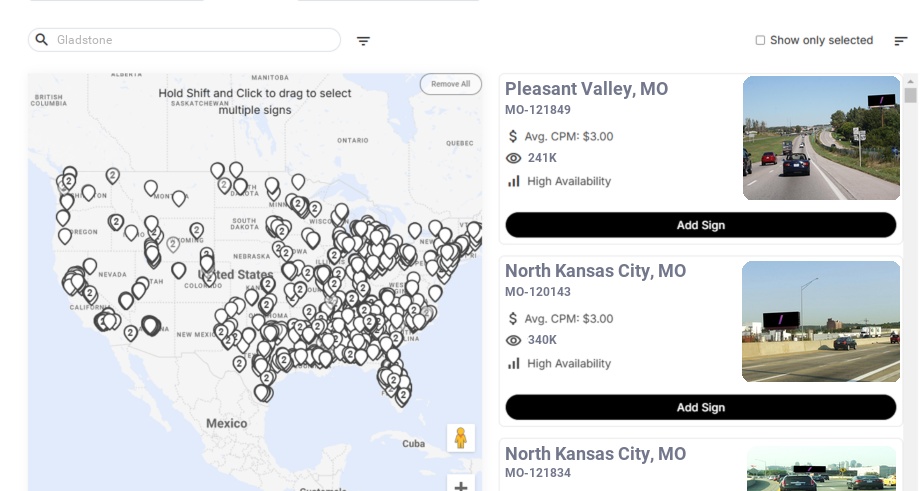
Our 10 digital billboards serving the Gladstone area are located in nearby North Kansas City, within about 5–6 miles of central Gladstone. This placement allows us to capture both local and regional traffic flows. Key corridors include I‑29 / I‑35, US‑169, MO‑9, and local arterials like North Oak Trafficway, Antioch Road, and Vivion Road.
What kind of audience can Blip reach in Gladstone, Missouri?
Gladstone is a mature, stable suburb in Clay County with about 27,000 residents and part of the larger Kansas City metro of roughly 2.2 million people. Around 60–65% of households in the Gladstone/Clay County area are owner‑occupied, and roughly 25–28% of residents are under 18. The area is also highly car-dependent, with roughly 75–80% of workers commuting by driving alone.
When is the best time to run Gladstone, Missouri billboards with Blip?
A strong Gladstone-area campaign pays attention to when audiences are on the road, and the biggest windows are the morning commute, midday, the afternoon school/errand window, and the evening commute. Weekdays often account for around 70% of weekly traffic volume on commuter corridors, while Thursday-Friday and weekends are strong for events, dining, and entertainment. Seasonal spikes also matter, with spring home improvement, summer attractions, fall back-to-school, and winter holiday shopping all creating good opportunities.
What roads and traffic patterns matter most for Gladstone, Missouri billboards?
The strongest impressions come from nearby North Kansas City corridors serving the Gladstone area. I‑29 / I‑35 often exceeds 90,000–110,000 vehicles on segments near North Kansas City, and US‑169 typically runs around 70,000–80,000 vehicles per day on key sections. Local feeders like North Oak Trafficway, Antioch Road, and Vivion Road also funnel thousands of daily trips into those highways.
Do I need a contract to advertise with Blip near Gladstone?
No, Blip has no long-term contracts or minimum commitments. You can start, pause, or stop your campaign at any time.
How fast can I launch a billboard campaign with Blip near Gladstone?
You can have your campaign live in minutes. Create a free account, select your locations, set your budget, upload your design, and start running once approved.
Where can I advertise with Blip near Gladstone?
Blip has digital billboards near Gladstone. You can browse available locations on a map, choose the ones that fit your audience, and start advertising right away.
Still have questions? Launch a campaign in minutes — no contracts, no commitments.
Start Your CampaignGladstone Billboard Advertising Guide
Gladstone, Missouri sits in the heart of Kansas City’s “Northland,” with steady commuter traffic, strong household incomes, and family-oriented neighborhoods that brands can reach through digital billboards near Gladstone in adjacent North Kansas City Worlds of Fun, and local Gladstone hotspots like Linden Square Oak Grove Park
Gladstone Market Overview: Why the Northland Matters
Gladstone is a mature, stable suburb in Clay County, just north of downtown Kansas City. According to 2020 data, the city’s population is about 27,000 residents, and it is part of the larger Kansas City metro of roughly 2.2 million people. Regional planning and economic development resources such as the City of Gladstone, Clay County, and the Mid-America Regional Council highlight the Northland as one of the metro’s most stable residential areas.
We see several key strengths for billboard advertising near the Gladstone area:
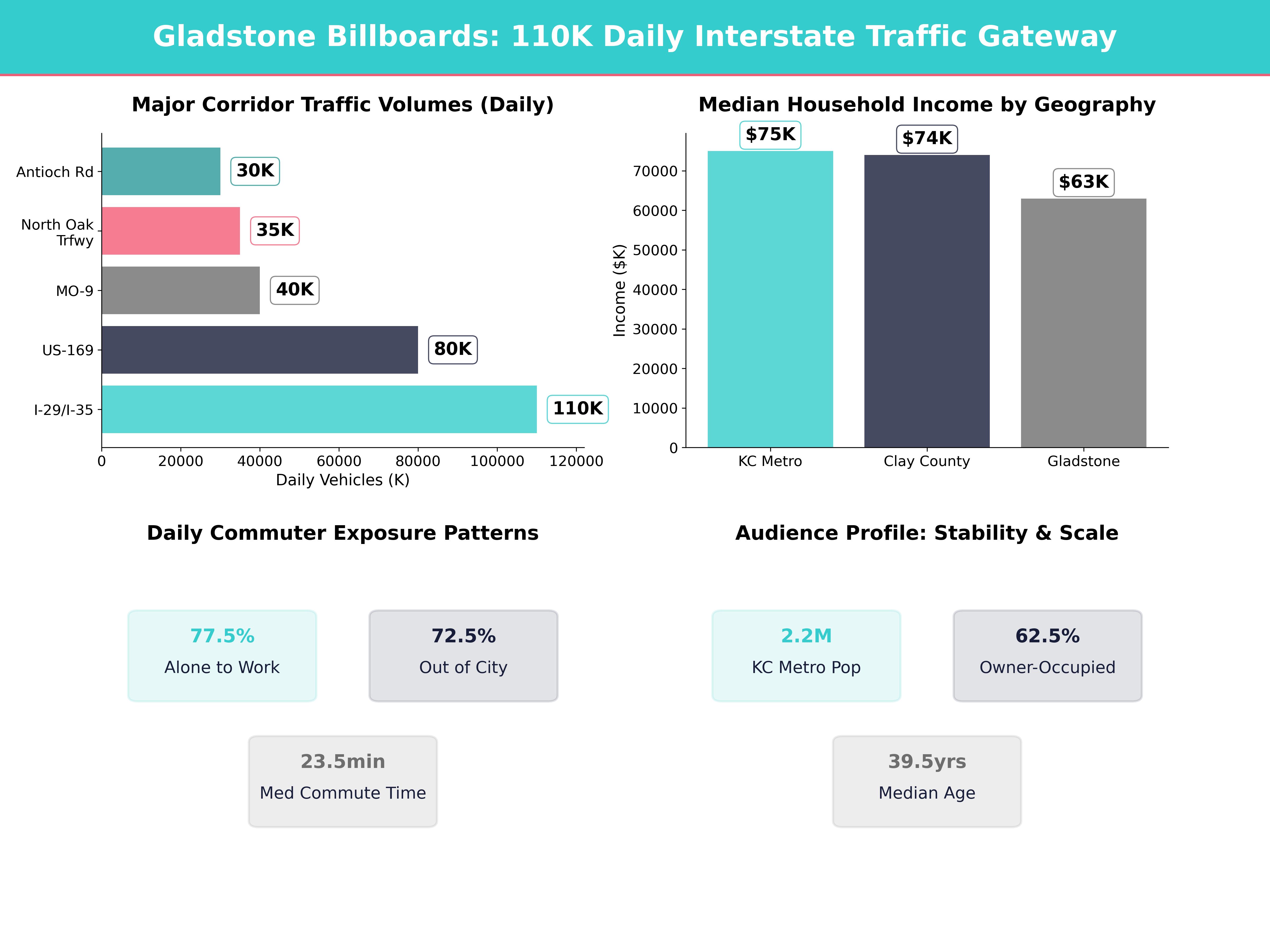
- Middle‑class stability: Median household income in Gladstone is in the low–$60,000s (around $62,000–$64,000), with Clay County overall above $70,000 (about $72,000–$75,000). The broader Kansas City metro has moved into the mid‑$70,000s. This income profile supports robust spending in categories like home services, healthcare, automotive, and family entertainment.
- Homeownership and families: Around 60–65% of households in the Gladstone/Clay County area are owner‑occupied, and roughly 25–28% of residents are under 18. That mix of stable homeowners and active families drives demand for schools, youth activities, pediatric and family healthcare, home improvement, and family‑focused retail.
- Commuter orientation: Roughly 75–80% of workers in the Northland commute by driving alone, with another 8–10% carpooling. Only about 1–2% regularly use transit, which underscores how car‑dependent this market is. Median commute times run about 22–25 minutes, meaning repeated daily exposures to the same billboard locations.
- Regional draw: Nearby attractions such as Worlds of Fun & Oceans of Fun (about 7 miles from Gladstone) attract several hundred thousand to over a million visits per season, depending on the year and event lineup. The Kansas City region overall hosts more than 20 million visitors annually, according to Visit KC, generating billions of dollars in visitor spending and a steady stream of non‑local impressions for area billboards.
Local government and community details from the City of Gladstone and regional tourism insights from Visit KC and Visit Clay underscore that the Northland is both a stable residential base and a gateway to broader Kansas City commerce, including downtown Kansas City, Missouri North Kansas City
Understanding the Gladstone‑Area Audience
To create effective creative and targeting strategies, it helps to understand who we’re talking to in the Gladstone area:
- Age profile: Median age is around 39–40, slightly higher than the Kansas City metro overall (around 37–38). Roughly one‑third of residents fall into the 25–44 age band, a prime demographic for home buying, parenting, and career advancement, while another 25–30% are 45–64, representing established homeowners with higher average spending power.
- Education & employment: In Clay County, over 30% of adults hold a bachelor’s degree or higher, and more than 90% have at least a high school diploma. The Kansas City metro’s unemployment rate in recent years has generally held in the low single digits (often around 3–4%), regularly trending below national averages. Major employment sectors for Northland residents include healthcare, professional and technical services, logistics and warehousing, manufacturing, and public sector/education jobs tied to districts like North Kansas City Schools.
-
Commuting patterns:
- Average commute time is roughly 22–25 minutes for Gladstone and Clay County residents.
- Around 70–75% of workers commute out of their home city for work, with a large share traveling south toward downtown Kansas City, North Kansas City’s industrial zones, or east and west along I‑435 and I‑35 to major employment centers and warehouse districts.
- Transit use remains low (about 1–2%), even with regional services from RideKC, reinforcing the importance of roadside media.
-
Cultural and leisure habits:
- Residents frequent local events at Linden Square Oak Grove Park
- Regional sports (including the Kansas City Chiefs and Kansas City Royals), arts, and dining in downtown and the Crossroads Arts District The Kansas City Star KCUR.
- Shopping trips commonly center on nearby retail nodes along North Oak Trafficway and Antioch Road, and major power centers and big‑box clusters across the Northland, many of which sit within a 10‑ to 20‑minute drive of central Gladstone.
These patterns tell us that Northland billboards near Gladstone must speak to busy, car‑dependent families who are in their vehicles multiple times a day for work commutes, errands, youth activities, and entertainment.
Where the Impressions Come From: Key Corridors Near Gladstone
Our 10 digital billboards serving the Gladstone area are located in nearby North Kansas City, within about 5–6 miles of central Gladstone. This placement allows us to capture both local and regional traffic flows documented by Missouri Department of Transportation (MoDOT) traffic data and regional transportation agencies:
- I‑29 / I‑35 (downtown loop feeders): Combined annual average daily traffic (AADT) often exceeds 90,000–110,000 vehicles on segments near North Kansas City, with some stretches climbing above 120,000 vehicles per day during peak years. These corridors carry a large share of Gladstone and Clay County commuters heading south, as well as regional travelers moving between the Northland, the airport area, and downtown.
- US‑169 (Broadway Extension): Typical AADT on key sections near downtown Kansas City and North Kansas City runs around 70,000–80,000 vehicles per day. This route is a primary spine for Northland commuters, connecting residential pockets north of Gladstone with downtown jobs and entertainment.
- MO‑9 and Burlington Corridor: MO‑9 carries roughly 25,000–40,000 vehicles per day in the North Kansas City area, linking industrial employers, the North Kansas City business district
-
Local arterials feeding highways: Roads such as:
- North Oak Trafficway: Commonly posts 25,000–35,000 vehicles per day on key segments.
- Antioch Road: Frequently falls in the 20,000–30,000 vehicles‑per‑day range near major shopping areas.
- Vivion Road: Segments near highway interchanges often see 15,000–25,000 vehicles daily.
These arterials act as primary feeders into I‑29, I‑35, and US‑169, funneling tens of thousands of daily trips across short distances—and passing within the viewing zones of our boards.
By aligning creative scheduling with the heaviest flows along these arteries, we can use Blip to maximize cost‑effective impressions from both Gladstone‑area residents and visitors heading through the Northland and into downtown Kansas City, Missouri
Seasonality and Timing Strategies for the Gladstone Area
A strong Gladstone‑area campaign pays attention to when audiences are on the road. The Kansas City metro experiences clear seasonal patterns and weekly rhythms that show up in both traffic and retail data from tourism and economic development groups such as Visit KC and the Greater Kansas City Chamber of Commerce
Daily patterns
- Morning commute (6:30–9:00 a.m.): Roughly 25–30% of daily traffic on major corridors occurs in the morning and evening peaks. This window is ideal for service businesses (home services, medical, auto repair), employment ads, and B2B messages targeting workers heading to North Kansas City industrial centers or downtown.
- Midday (11:00 a.m.–2:00 p.m.): Many restaurants see 30–40% of weekday transactions during lunch periods. This makes midday strong for restaurants, quick‑service food, retail, and healthcare (walk‑in clinics, dental offices) as people travel for lunch breaks or errands.
- Afternoon school/errand window (2:30–5:00 p.m.): School dismissals and youth activities lead to a spike in local traffic around school days. With roughly one‑quarter of area residents under 18, this window is particularly valuable for family‑oriented brands, childcare, youth sports, and tutoring.
- Evening commute (4:00–7:00 p.m.): Evening peaks often rival or slightly exceed morning volumes, capturing both homebound commuters and early‑evening diners and shoppers. This window is effective for entertainment, dining, fitness, and impulse‑decision messaging (“Tonight only,” “Happy hour,” “Call before 8 p.m.”).
Weekly patterns
- Monday–Wednesday: Weekdays often account for around 70% of weekly traffic volume on commuter corridors, with Monday–Wednesday skewed toward work and errand trips. Commuters are focused; this is strong for practical, needs‑based messaging—auto repair, healthcare appointments, financial services, and professional services.
- Thursday–Friday: Regional event calendars from Visit KC and coverage by outlets like KSHB 41 and KMBC 9 show a rising concentration of events and nightlife as the weekend approaches. This is perfect for weekend‑oriented creative—events, restaurants, retail sales, and entertainment near downtown or North Kansas City.
- Weekends: While pure commuter traffic dips, weekend AADT remains robust on major corridors, and parking lots at retail centers often peak on Saturday afternoons. This is a prime time for leisure, tourism, family activities, and local events messaging.
Seasonal considerations
- Spring (March–May): Home improvement spending typically climbs in spring across the region, with hardware and garden sectors often seeing double‑digit percentage gains over winter months. Demand spikes for home improvement, lawn care, landscaping, HVAC tune‑ups, real estate, and outdoor recreation. Households receiving tax refunds frequently increase discretionary spend in March and April.
- Summer (June–August): Outdoor venues and attractions, including Worlds of Fun, summer festivals at Linden Square
- Fall (September–November): Back‑to‑school, high school sports, and youth leagues drive spending on apparel, tutoring, healthcare, and fast food. Retailers begin ramping up pre‑holiday promotions, and political campaigns intensify in even‑numbered years, driving demand and competition for prime billboard inventory.
- Winter (December–February): Holiday shopping, year‑end automotive deals, and New Year’s fitness and healthcare campaigns perform well. Auto dealers often post some of their strongest sales weeks in late December; gyms and wellness providers see membership inquiries spike 30–50% in early January. Tax preparers start pushing heavily in February as filing season begins.
With Blip, we can precisely concentrate budget in the hours, days, and months when Gladstone‑area audiences are most receptive and traffic volumes are highest.
Creative Best Practices for the Gladstone Area
Traffic speeds and viewing distances on highways around North Kansas City and the Gladstone area are high, often 55–65 mph on interstates and 40–45 mph on key arterials. At 60 mph, drivers cover about 88 feet per second, which typically gives them only 6–8 seconds in the primary viewing cone of a billboard. That means we should tailor creative:
- Limit text: Aim for 6–8 words or fewer. For example, “Northland’s Fastest ER – 10 Mins Away” or “Gladstone HVAC – 24/7 Service.” Studies in out‑of‑home show that creative with fewer than seven words is recalled significantly more often than text‑heavy designs.
- Use bold, high‑contrast colors: Strong contrast (dark text on light backgrounds or vice versa) can increase legibility at speed by 20–30% compared with low‑contrast palettes. Bright colors stand out against the urban/industrial backdrop near North Kansas City and the greenery of the Northland.
-
Emphasize location: Gladstone‑area residents respond to hyper‑local language:
- “Serving the Gladstone area since 1998”
- “Just south of Gladstone on North Oak”
- “Near Antioch & Vivion – 5 Minutes Away”
- Highlight time‑sensitive offers: Dynamic messaging like “Tonight Only,” “Weekends in Gladstone Area,” or “Game Day Special” taps into the area’s strong sports and event culture around Chiefs, Royals, local high schools, and Northland festivals.
- Local landmarks & language: References to Linden Square Oak Grove Park Worlds of Fun, the North Kansas City
- Easy calls to action: Use short URLs, brand names that are easy to search, or simple prompts (“Search ‘Gladstone Dentist’”) so drivers can recall the message later. Typical recall studies show that vanity URLs and simple brand‑name searches can lift post‑exposure web traffic by double‑digit percentages.
Because our billboards are digital, we can rotate multiple creatives—e.g., a brand ad, a price promotion, and an event‑specific message—throughout the day. This lets us align content with context (morning commute vs. evening dining) and continually test which messages yield the strongest response on Gladstone billboards and across the broader Northland.
Using Blip Tools to Target the Gladstone Area Effectively
Blip’s platform is designed to help advertisers of all sizes run campaigns near the Gladstone area with precision and flexibility. Whether you are testing billboard advertising near Gladstone for the first time or scaling an existing campaign, here’s how we recommend using the tools for this specific market:
-
Location selection: Choose the North Kansas City boards closest to:
- Major commuting paths from Gladstone into downtown Kansas City and the Downtown KC business district.
- Routes to Worlds of Fun/Oceans of Fun and Northland shopping centers highlighted by Visit Clay.
- Industrial and office clusters that employ many Gladstone residents, including the North Kansas City business and industrial areas
-
Dayparting (time‑of‑day targeting):
- Service businesses: Emphasize morning and evening commute hours to reach 9‑to‑5 workers who make up the bulk of weekday traffic.
- Restaurants & QSR: Focus on lunch (11 a.m.–2 p.m.) and evening (4–8 p.m.), which commonly account for 60–70% of daily restaurant revenue.
- Events & entertainment: Lean into Thursday–Sunday evenings, when event attendance and nightlife traffic spikes across the metro.
-
Budget control: With Blip’s per‑“blip” pricing, advertisers can:
- Start small (as low as a few dollars per day) and still generate thousands of weekly impressions by concentrating on high‑traffic hours.
- Scale up on high‑impact days (e.g., weekends in summer, major holidays, or during marquee events promoted by Visit KC).
- Pause or shift spend in real time based on call volume, store traffic, POS data, or online performance metrics.
-
Creative rotation & testing: Upload multiple creatives, then:
- A/B test different headlines (“Gladstone Dentist” vs. “Northland Family Dentist”) and measure impact via search queries, web sessions, or call tracking.
- Test offer styles (percentage discounts vs. fixed dollar savings) to see which converts better.
- Swap seasonal creative (e.g., heating vs. cooling, back‑to‑school vs. holiday) instantly, without any printing or installation delay, aligning with real‑world weather patterns and school calendars from districts like North Kansas City Schools.
This level of control is particularly powerful in the Gladstone area, where daily commuting patterns and weekend entertainment habits vary significantly across the week and across seasons. It also makes billboard rental near Gladstone accessible to smaller advertisers who need flexibility, not long‑term contracts.
Example Campaign Approaches by Business Type
To make these strategies concrete, here are sample approaches tailored to common advertiser categories in the Gladstone area.
Local Restaurants & Breweries
- Target: Residents traveling between Gladstone, North Kansas City, and downtown. Within a 10‑minute drive radius of central Gladstone, you can reach more than 40,000–50,000 people, many of whom dine out multiple times per week.
-
Timing:
- Weekdays: 11 a.m.–2 p.m. and 4–8 p.m.
- Weekends: All afternoon and evening, with Saturday often being the highest‑traffic dining day.
-
Creative ideas:
- “Northland BBQ – 5 Mins from Gladstone Area – Exit Now”
- “Kids Eat Free Tues – Near Gladstone on North Oak”
-
Tactics:
- Increase blips around events listed by Visit KC, Visit Clay, or local coverage from outlets like The Kansas City Star KCUR, when more people head out for dining and nightlife.
- Tie creative to sports schedules (Chiefs, Royals, college games), using “Game Day” or “Post‑Game” offers to capture surges in bar and restaurant traffic.
Home Services (HVAC, Plumbing, Roofing, Lawn Care)
- Target: Homeowners in the Gladstone area and wider Northland, where 60–65% of households own their homes and average home ages are several decades old—fueling steady maintenance demand.
-
Timing:
- Weekdays: 6:30–9 a.m. and 4–7 p.m., when decision‑makers commute.
- Weekends: Late mornings (9 a.m.–noon) when people run errands and are more available to schedule service.
-
Creative ideas:
- “Gladstone‑Area AC Repair – 24/7 – Call Now”
- “Roof Leaks? Northland Pros – Free Estimates”
-
Tactics:
- Increase impressions during seasonal spikes (heat waves above 90°F, cold snaps below freezing, and spring storms), which often generate double‑digit percentage increases in service calls.
- Reference local weather and geography (“Storm Damage in Gladstone Area? Call Us”) to increase relevance and response rates.
Healthcare, Dental, and Urgent Care
- Target: Families and working professionals who commute south through North Kansas City. In Clay County, tens of thousands of residents are covered by employer‑sponsored insurance and seek care within 10–20 minutes of home or work.
-
Timing:
- Weekdays: 7–10 a.m., 11 a.m.–2 p.m., 4–7 p.m.
-
Creative ideas:
- “Walk‑In Clinic – 10 Mins from Gladstone Area – Open Late”
- “Northland Pediatric Dentist – New Patients Welcome”
-
Tactics:
- Promote convenience (evening and weekend hours, same‑day appointments) and proximity to major corridors.
- Tie messaging to local employers or school calendars from North Kansas City Schools and nearby districts, referencing school physicals, sports injuries, or immunization seasons.
Education, Youth Programs, and Camps
- Target: Parents living in the Gladstone area but commuting throughout the metro. With roughly 25–28% of local residents under 18, the youth market is a major opportunity.
-
Timing:
- Afternoon (2:30–6:30 p.m.) during school months when parents are in “kid mode.”
- All day in late spring/early summer for camp registrations, when camps try to fill 80–100% of their slots.
-
Creative ideas:
- “After‑School Tutoring Near Gladstone – Enroll Now”
- “Northland Summer Camp – Ages 6–14 – Limited Spots”
-
Tactics:
- Increase blips during key enrollment months (March–May for summer; July–September for school‑year activities).
- Mention proximity to Gladstone landmarks, schools, and parks to reduce perceived friction (“5 Minutes from Linden Square”).
Events & Attractions
From local festivals in Linden Square Visit KC and Visit Clay, out‑of‑home is a powerful driver of attendance.
- Target: Both local residents and visitors passing through North Kansas City, including the millions of annual visitors to the Kansas City region.
-
Timing:
- Heaviest in the 7–14 days leading up to the event, when awareness and intent can shift quickly.
- Concentrated Thursday–Sunday, afternoons and evenings, when event attendance is highest.
-
Creative ideas:
- “Free Concert This Saturday – Linden Square – 7 p.m.”
- “Northland Festival – Near Gladstone – This Weekend Only”
-
Tactics:
- Use countdown messaging (“3 Days Until…”) leading up to the event, which has been shown in event marketing to improve urgency and attendance.
- Switch to “Happening Tonight” or “Today Only” creative on event days, and consider adding early‑day reminders for all‑day festivals.
Local Context, Regulations, and Community Alignment
Outdoor advertising in Missouri is governed at the state and local level. To align with community expectations near the Gladstone area:
-
Check local regulations: While our boards are in North Kansas City serving the Gladstone area, it’s smart to stay aware of policies from:
- City of Gladstone
- City of North Kansas City
- Clay County
- Business‑oriented groups such as the Gladstone Area Chamber of Commerce and North Kansas City Business Council can also provide guidance on business‑friendly practices and community expectations.
- Respect community values: Gladstone is family‑oriented and community‑driven, with a strong focus on schools, parks, and safety. Campaigns that emphasize family, local pride, health, and community involvement tend to resonate strongly and face less resistance.
- Leverage local news & stories: Referencing coverage from The Kansas City Star KCUR, FOX4 Kansas City
We should always ensure creative complies with applicable advertising guidelines (no misleading claims, appropriate content for all ages) and reflects positively on the Northland community and its institutions.
Measuring Success and Optimizing Over Time
Digital out‑of‑home near the Gladstone area works best when we treat it like a performance channel:
-
Define clear goals: Decide whether success is foot traffic lift, phone calls, coupon redemptions, website sessions, form fills, or event attendance. For example, even a modest campaign that lifts store visits by 5–10% over baseline can represent a strong ROI when average transaction values are high.
-
Create trackable offers: Use:
- Unique promo codes for “GLADSTONE” or “NORTHLAND.”
- Dedicated phone numbers.
- Custom URLs (e.g., /gladstone or /northland) on your website.
Many advertisers see measurable uplifts—such as 10–30% increases in direct and branded search volume—during active billboard flights when tracking is set up properly.
-
Coordinate with digital channels: Align billboard creative with social and search campaigns targeting the same Northland/Gladstone area. If search volume for your brand name or promo code spikes during a billboard flight, that’s a strong signal of impact. Local marketers often observe that 40–60% of customers who mention seeing a billboard also interacted with a digital touchpoint.
-
Iterate based on data:
- Shift spend to the days and times correlated with higher response, based on POS data, website analytics, and call logs.
- Replace lower‑performing creatives with fresh concepts, prioritizing those that yield higher response rates per thousand impressions.
- Adjust geographic emphasis among the 10 boards serving the Gladstone area to favor locations yielding better store visits or lead volume, informed by customer ZIP codes and feedback.
By combining local knowledge of the Gladstone area with Blip’s flexible scheduling, budgeting, and creative tools, we can build campaigns that consistently reach Northland drivers at the right moments—turning everyday commutes into measurable opportunities for your brand with billboards near Gladstone and across the wider Kansas City Northland.