Billboards in Overland, MO
No Minimum Spend. No Long-Term Contracts. Just Results.
Trusted by Leading Brands


Billboard advertising
in Overland has never been easier
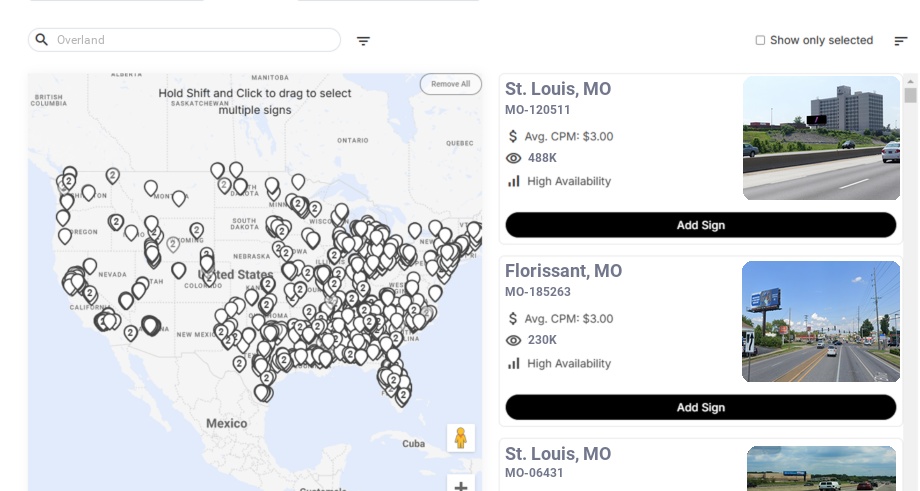



How much is a billboard in Overland?
Why Choose Blip for Billboard Advertising in Overland
-
Blip lets Overland brands launch fast on I-170, I-70, and Page Avenue commuters—no long setup, just instant highway reach.
-
Set a daily budget for Overland and scale up when airport traffic spikes near Lambert or holiday travel picks up.
-
Use dayparting in Overland to hit 6:30-9 a.m. and 3:30-6:30 p.m. when commuters flood the inner-belt and retail corridors.
-
No contracts with Blip means Overland businesses can test ads for sports fans, families, or airport workers and shift anytime.
-
Track real-time results in Overland and tweak your creative for Lindbergh, I-270, or Lambert-area traffic as patterns change.
Frequently Asked Questions About Billboard Advertising in Overland
How much does a billboard cost near Overland, Missouri with Blip?
With Blip, you control exactly how much you spend on Overland billboards by setting a daily budget that can be adjusted anytime, so you can start small and scale up as you see results. Each ad is a short “blip” on digital billboards near Overland, Missouri, and you only pay for the individual blips you receive. Pricing for each blip varies based on the time of day, location serving the Overland area, and advertiser demand, so your total cost is simply the sum of all those brief ad displays.
Where can I advertise with Blip near Overland, Missouri?
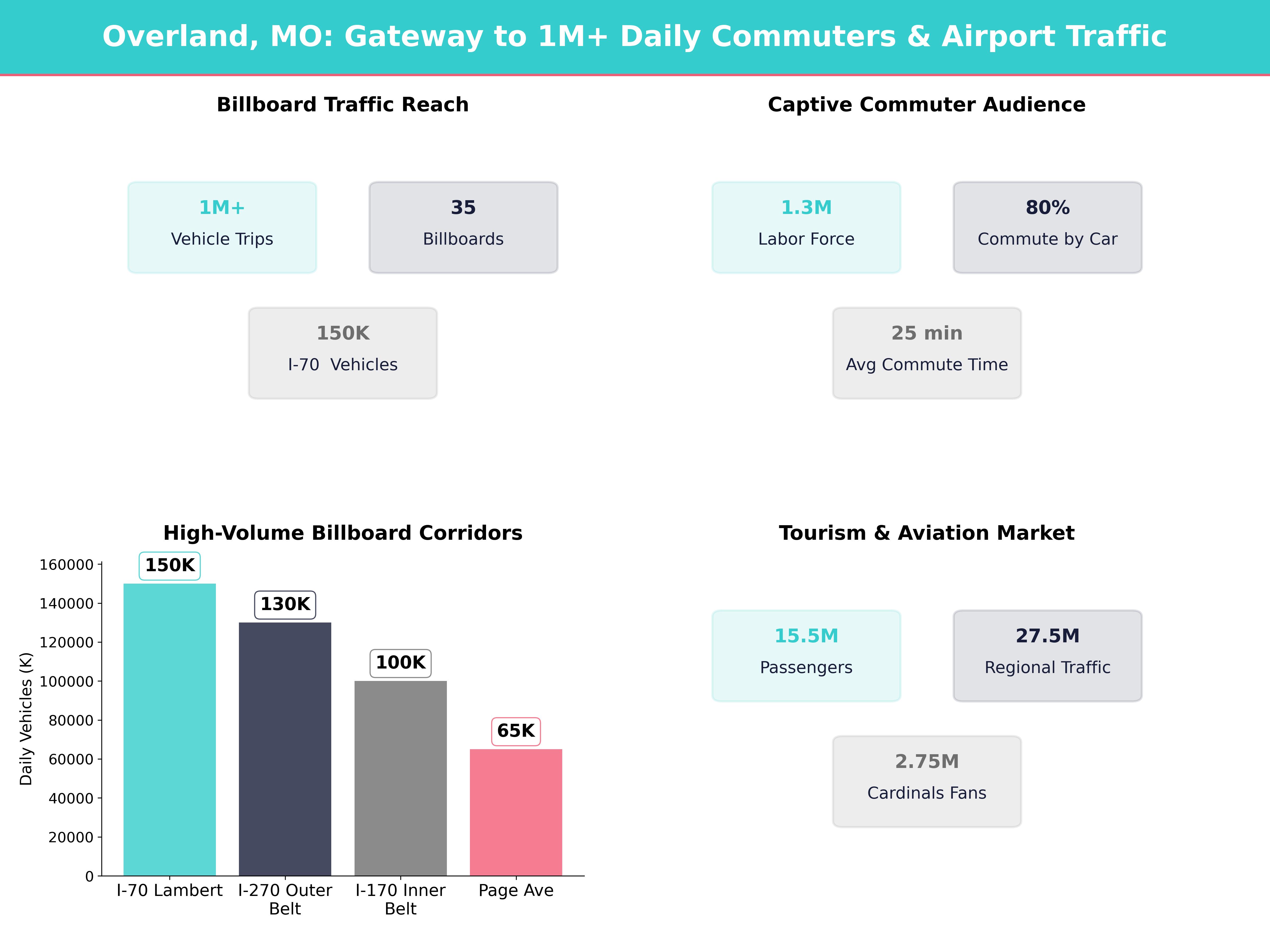
There are 35 digital billboards serving the Overland area in nearby cities like Berkeley, Maryland Heights, Hazelwood, Florissant, St. Louis, Ballwin, and Saint Charles. In aggregate, these boards are positioned along roadways that collectively see well over 1 million vehicle trips per day. Digital billboards near Overland give us powerful ways to reach commuters, travelers, and local families right where they move every day.
What kinds of people can Blip reach in Overland, Missouri?
The Overland area is a working, commuting, family-oriented community, so your billboards can speak to several overlapping audiences. Daily commuters, airport travelers and employees, families and suburban households, students and young professionals, and events and sports fans all move through these corridors. A single worker might see the same advertiser 4–6 times per week without any extra spend if boards are placed on both legs of their route.
When is the best time to run Blip ads in Overland, Missouri?
Morning drive from 6:30–9:00 a.m. is best for commuters heading from Overland toward downtown, Clayton, or the airport and industrial zones. Evening drive from 3:30–6:30 p.m. is great for retail, restaurants, and service reminders as people return home. If you want upper-funnel brand exposure, securing consistent presence across both peaks on multiple corridors can allow the average commuter to see your ad 10–20 times per month.
Why is Overland, Missouri a strong market for billboard advertising with Blip?
Overland itself is a compact, working- and middle-class community in central St. Louis County, home to roughly 16,000 residents in just about 5 square miles. It’s surrounded by larger employment centers and regional destinations that drive substantial traffic, making Overland billboards especially attractive for marketers who want repeated exposure among local households and workers. The St. Louis metro area also has around 2.8 million residents and a labor force of about 1.3–1.4 million workers, with 80–85% commuting primarily by car.
Do I need a contract to advertise with Blip in Overland?
No, Blip has no long-term contracts or minimum commitments. You can start, pause, or stop your campaign at any time.
How fast can I launch a billboard campaign with Blip in Overland?
You can have your campaign live in minutes. Create a free account, select your locations, set your budget, upload your design, and start running once approved.
Where can I advertise with Blip in Overland?
Blip has digital billboards in Overland. You can browse available locations on a map, choose the ones that fit your audience, and start advertising right away.
Still have questions? Launch a campaign in minutes — no contracts, no commitments.
Start Your CampaignOverland Billboard Advertising Guide
The Overland, Missouri area sits at the heart of one of the most traveled and commercially active hubs in St. Louis County St. Louis Lambert International Airport, dense residential neighborhoods, and busy retail corridors all within a few miles, digital billboards near Overland give us powerful ways to reach commuters, travelers, and local families right where they move every day. For local brands that depend on drive-time visibility, billboard advertising near Overland offers a cost-effective way to stay top-of-mind in these high-traffic zones.
Why the Overland Area Is a High-Value Billboard Market
Overland itself is a compact, working- and middle-class community in central St. Louis County, home to roughly 16,000 residents in just about 5 square miles (over 3,000 people per square mile, significantly denser than many outer suburbs). It’s surrounded by larger employment centers and regional destinations that drive substantial traffic, making Overland billboards especially attractive for marketers who want repeated exposure among local households and workers:
- St. Louis County overall has close to 1,000,000 residents and roughly 520,000 jobs, much of it concentrated in the inner-ring suburbs around Overland.
- The St. Louis metro area counts around 2.8 million residents and a labor force of about 1.3–1.4 million workers, with 80–85% commuting primarily by car, creating reliable drive-time audiences on highways and main arterials. Regional economic data are regularly summarized by the East-West Gateway Council of Governments
- St. Louis Lambert International Airport, just north of Overland in Berkeley, handled about 15–16 million passengers in 2023, with publicly reported figures showing a steady rebound since 2020. The airport also supports over 7,000 on-site jobs in airlines, concessions, TSA, and support services, plus thousands more in surrounding logistics and hospitality.
The Overland area is also surrounded by active municipal and county governments and regional promotion organizations that consistently drive visitors and economic activity:
- The City of Overland government
- St. Louis County government and services
- Explore St. Louis (regional tourism and conventions)
- St. Louis Lambert International Airport
- The St. Louis Economic Development Partnership (regional business and job growth)
Tourism adds additional volume to these local audiences. Explore St. Louis 25–30 million annual visitors, who generate billions in direct spending on hotels, dining, attractions, and shopping—much of it channeled through the same highways and corridors Overland residents use daily.
With 35 digital billboards serving the Overland area in nearby cities like Berkeley, Maryland Heights, Hazelwood, Florissant, St. Louis, Ballwin, and Saint Charles, we can tap into this regional energy and blanket the core corridors Overland residents use daily. In aggregate, these boards are positioned along roadways that collectively see well over 1 million vehicle trips per day, giving even modest Blip budgets a chance to reach large, repeat audiences with efficient billboard advertising near Overland and its neighboring communities.
Key Driving Patterns and Hotspots for Digital Billboards Near Overland
Overland is boxed in by some of the most important transportation arteries in the St. Louis region. Understanding how people move through the area helps us decide where and when to concentrate Blip campaigns and which Overland billboards and nearby faces to prioritize.
For regional context on traffic volumes, incident patterns, and construction, we frequently reference:
- The Missouri Department of Transportation (MoDOT) – St. Louis District
- The MoDOT Traveler Information Map (real-time traffic and closures)
Highways and major routes
- I-170 (Inner Belt Expressway) runs just east of Overland and connects I-70 to I-64/US 40. Sections near Overland can see around 90,000–110,000 vehicles per day, with peak-hour volumes exceeding 6,000 vehicles per lane in the heaviest segments.
- I-70, north of Overland near Berkeley and Hazelwood, is a major east–west freight and commuter route, with some segments around Lambert Airport carrying close to 150,000 vehicles per day. MoDOT data indicate that heavy trucks can make up 10–15% of this flow, important for B2B and logistics messaging.
- I-270 to the north, near Florissant and Hazelwood, is the outer beltway, typically drawing around 120,000–140,000 vehicles per day, functioning as a key bypass for drivers moving between West County, North County, and Illinois.
- MO-364 / Page Avenue, just south of Overland, funnels commuters between St. Charles County, Maryland Heights, and central St. Louis County, with many stretches handling in the range of 60,000–70,000 vehicles per day.
- Lindbergh Boulevard (US-67) intersects I-70 north of Overland, cutting through Hazelwood and Florissant and supporting 30,000–45,000 vehicles daily, including strong retail-oriented traffic.
This combination of inner-belt, outer-belt, and radial highways means the average area commuter often passes multiple billboard faces on a typical day, increasing frequency for campaigns that run across several corridors simultaneously.
Digital billboards near Overland in these nearby cities position your message along these high-traffic flows:
- Berkeley (2.9 miles away) – Ideal for reaching airport travelers, employees, and I-70/I-170 commuters. City info: City of Berkeley
- Maryland Heights (5.3 miles) – Reaches Page Avenue commuters, office parks, and entertainment-goers at Westport Plaza and Hollywood Casino Amphitheatre. City info: City of Maryland Heights
- Hazelwood (5.8 miles) – Captures I-270 and Lindbergh Boulevard traffic, including industrial parks and logistics centers that support several thousand manufacturing and distribution jobs. City info: City of Hazelwood
- Florissant (7.7 miles) – Dense residential area feeding I-270 and Lindbergh, with strong exposure to North County families; Florissant’s population is roughly 50,000 residents, making it one of the larger suburbs in the county. City info: City of Florissant
- St. Louis (8.2 miles) – Boards near downtown and central corridors reach regional workers, sports fans, and tourists in addition to Overland-area commuters. The City of St. Louis has about 290,000 residents but supports roughly 180,000–200,000 daily workers and thousands of visitors for sports and conventions.
- Ballwin (9.3 miles) and Saint Charles (9.5 miles) – Great for cross-county commuters and shoppers traveling between West County, St. Charles County, and the Overland area. Ballwin (about 30,000 residents) and the City of Saint Charles (about 70,000 residents) are strong retail and dining hubs.
For more on traffic volumes and construction patterns, we often refer again to the MoDOT St. Louis District. Knowing when and where congestion builds (and how it changes with projects) helps us pinpoint optimal dayparts and locations for campaigns and decide which boards provide the best value among billboards near Overland.
Audience Profiles We Can Reach in the Overland Area
The Overland area is not a tourist-only or business-only zone; it’s a working, commuting, family-oriented community. Your billboards can effectively speak to several overlapping audiences:
Daily commuters
- A large share of Overland-area residents commute to nearby job centers in Clayton 75–80% of workers work outside their home municipality, which lines up with Overland’s pattern of outbound commuting.
- Average commute times in St. Louis County hover around 24–26 minutes, meaning lots of captive eyeballs on I-170, I-70, I-270, and Page Avenue. Roughly 15–20% of commuters spend 30 minutes or more each way.
- Many drivers travel through multiple jurisdictions daily (for example, Overland → Maryland Heights → St. Charles or Overland → Berkeley → downtown), making our distributed billboard network particularly powerful. A single worker might see the same advertiser 4–6 times per week without any extra spend if boards are placed on both legs of their route.
Airport travelers and employees
-
With more than 15 million annual passengers and thousands of employees at St. Louis Lambert International Airport, the Berkeley and Hazelwood billboards are strong for:
- Airport parking and hotel offers
- Rideshares and shuttle services
- Tourism, attractions, and event venues
- Local brands welcoming visitors or promoting “while you’re in town” offers
- Airport activity peaks around early morning (business departures), late afternoon, and evening, making those windows valuable for time-sensitive offers. During holiday travel periods, daily passenger counts can spike 20–30% above typical days.
- The airport’s economic footprint, according to local economic development reports, exceeds $3 billion annually in regional impact, underscoring how many service businesses depend on this travel corridor.
Families and suburban households
- Overland and surrounding municipalities have a strong base of families living in single-family homes or low-rise multifamily housing. In many inner-ring suburbs, 60–70% of households are owner-occupied, and the typical household size is around 2.3–2.6 people, skewing toward family living.
- Median household incomes in central and North County suburbs generally fall in the $50,000–$80,000 range, supporting demand for everyday services (healthcare, education, home repair) and mid-range retail.
- These residents frequently shop at strip malls and big-box centers in nearby municipalities, which are often adjacent to major routes where digital billboards shine.
- Service-oriented advertisers—plumbers, HVAC, healthcare clinics, dentists, auto repair—can leverage this stable, repeat local audience to build recognition that converts over time rather than in a single exposure.
Students and young professionals
- The University of Missouri–St. Louis (UMSL) in nearby Normandy draws thousands of students, commuters, and staff who travel these same corridors daily. UMSL has roughly 15,000 students (undergraduate, graduate, and professional) plus 1,000+ faculty and staff, many of whom commute from Overland, Hazelwood, Florissant, and St. Charles County.
- Young professionals commuting between the city, the airport corridor, and West County frequently pass boards in St. Louis, Maryland Heights, Hazelwood, and Ballwin. This group is particularly responsive to campaigns for apartments, fitness, nightlife, and career training.
Events and sports fans
-
Cardinals games at Busch Stadium, Blues games at Enterprise Center, soccer matches at CITYPARK, and major concerts in Maryland Heights draw surges of regional traffic from the Overland area. In a typical season:
- The St. Louis Cardinals draw around 2.5–3.0 million fans per year to Busch Stadium.
- The St. Louis Blues attract roughly 700,000–800,000 fans per regular season at Enterprise Center.
- St. Louis CITY SC matches at CITYPARK bring 22,000+ fans per game, often from throughout the metro.
- Concerts and festivals in and around downtown and Maryland Heights create predictable “event spikes” when traffic volume on I-70, I-170, I-64, and Page Avenue increases 1–2 hours before and after major shows.
- Tourism and events promoted by Explore St. Louis
Timing Your Blip Campaign for Maximum Impact
Blip’s pay-per-blip model and scheduling tools let us align your impressions with the rhythms of the Overland area, so you buy exposure when it matters most.
Rush hours
- Morning drive (6:30–9:00 a.m.) – Best for commuters heading from Overland toward downtown, Clayton, or the airport/industrial zones. On key corridors, as much as 35–40% of weekday daily traffic passes during the combined morning and evening peaks. Use directional messages (“This exit,” “10 minutes away”) near relevant boards.
- Evening drive (3:30–6:30 p.m.) – Great for retail, restaurants, and service reminders as people return home. Emphasize convenience, dinner offers, and “tonight only” promotions.
- If you want upper-funnel brand exposure, securing consistent presence across both peaks on multiple corridors (I-170 + I-70 + Page) can allow the average commuter to see your ad 10–20 times per month, a frequency level often associated with strong recall in out-of-home (OOH) studies.
Weekday vs. weekend
- Weekdays are ideal for B2B, recruiting, healthcare, and service-based businesses targeting commuters and workers. Office-heavy suburbs like Clayton 50–100% higher than their residential base due to inbound workers.
-
Weekends see increased leisure travel toward shopping centers, casinos, historic districts (like Main Street in Saint Charles), parks, and events. Weekend-focused Blips can be especially effective for:
- Entertainment and nightlife (Maryland Heights, downtown St. Louis)
- Family attractions and tourism
- Retail sales and “this weekend only” promotions
- Retail analytics often show Friday–Sunday accounting for 40–50% of weekly store traffic for many brick-and-mortar businesses, so front-loading impressions into those days can amplify campaign ROI.
Events and seasonal patterns
We can time campaigns around:
-
Sports seasons
- St. Louis Cardinals (MLB): roughly April–September (plus October if playoffs), with 81 regular-season home games.
- St. Louis Blues (NHL): October–April, 41 regular-season home games, plus playoffs.
- St. Louis CITY SC (MLS): late February/March–October, roughly 17 regular-season home matches.
- Concert season at venues like Hollywood Casino Amphitheatre in Maryland Heights, which can draw 15,000–20,000 attendees on show nights and hosts 30–40 concerts per season.
- Holiday shopping surges in November–December along major retail corridors in St. Louis County and St. Charles, when many retailers see 25–30% of annual sales concentrated into roughly 8 weeks.
- Back-to-school campaigns serving districts around Overland and UMSL traffic in August–September, when spending on apparel, electronics, and school supplies typically jumps 10–20% over summer baselines.
Blip lets us change bids by time-of-day and day-of-week, so you can, for example, bid higher during Friday afternoon and Saturday mid-day leading into big weekends while keeping a baseline presence the rest of the week.
Crafting Effective Creative for the Overland Area
The Overland area is dominated by fast-moving traffic and working commuters. Strong creative needs to be legible at a glance and locally relevant.
Design for quick comprehension
Industry research from out-of-home associations consistently finds that drivers have 6–8 seconds to process a billboard at highway speeds. To match that:
- Limit to 6–8 words of primary text and one clear call-to-action (CTA).
- Use high contrast color combinations (e.g., white/yellow on dark blue or black, or red on white) to stand out against the typically green/brown roadside environment. Contrast ratios of at least 4.5:1 are recommended for readability.
- Make your logo large enough to be recognizable from 500–700 feet away, which often means your logo should occupy 10–15% of the canvas height on highway boards.
- Avoid cluttered details like long URLs; instead, use short domains, memorable phrases, or QR codes when boards sit near lower-speed surface roads (under 40 mph).
Local references and wording
-
Refer to known routes and landmarks that Overland-area residents immediately recognize:
- “Off Page at Bennington” (Maryland Heights area)
- “5 minutes from Lambert” (for airport-proximate services)
- “On Lindbergh just past I-270” (Hazelwood/Florissant corridor)
- “Short drive from Overland” or “Serving the Overland area”
- Consider referencing local teams or colors tastefully—Cardinals red, Blues blue—especially during playoff pushes or opening days. Aligning with major local sports can be especially powerful on days when tens of thousands of fans are traveling through key corridors.
Different creative by direction and corridor
Because our 35 digital billboards serving the Overland area span several municipalities and directions, we can tailor creative:
- Inbound to St. Louis or Clayton – Emphasize professional services, downtown/east-of-Overland attractions, morning coffee, and commuter essentials. These commutes often include higher-income workers, with median household incomes in some inner-ring job centers exceeding $80,000–$90,000.
- Outbound toward St. Charles and West County – Focus on shopping, family entertainment, weekend plans, and larger-ticket purchases like autos and home improvement, as these corridors connect to some of the region’s highest retail sales volumes.
- Near Lambert Airport – Prioritize airport parking, hotels, car rentals, rideshare apps, tourism, and “Welcome to St. Louis” branding for regional or national chains.
With Blip, you can upload multiple creatives and assign them to specific boards or time windows, so your Overland-area campaign can speak differently to each audience while maintaining a cohesive brand look.
Smart Budgeting and Testing With Blip in the Overland Area
Digital boards near Overland are valuable because you can scale up or down quickly and concentrate spend without committing to a long-term static buy. When you are exploring billboard rental near Overland, this flexibility allows you to match your spend closely to business needs, seasons, and local events.
Start targeted, then expand
-
Begin by focusing on 3–10 high-value boards that align with your geography:
- For Overland residents heading east/south: I-170 and St. Louis city-facing boards.
- For airport and industrial traffic: Berkeley and Hazelwood boards close to I-70 and I-270.
- For cross-county shoppers: Maryland Heights, Ballwin, and Saint Charles boards along key shopping corridors.
- A typical starting point many small and mid-sized advertisers use in markets like this is $20–$50 per day focused on 1–3 dayparts. Even at this level, Blip can deliver hundreds to a few thousand impressions per day, depending on bids and board selection.
- As you see results (e.g., uplift in search traffic, calls, or store visits), incrementally add more locations to broaden reach.
Use Blip’s bidding flexibility
- Bid higher during critical windows—like weekday rush hours or the days surrounding a big sale or event—while maintaining lower bids at off-peak times.
- Many advertisers in mid-sized markets see strong results with a modest daily budget when it’s concentrated on specific dayparts. For example, spending the same daily amount but only during 7–9 a.m. and 4–6 p.m. often yields more impactful frequency than spreading impressions thin all day.
- For big tentpole periods (Black Friday week, back-to-school, major sports playoffs), some brands temporarily increase daily budgets by 50–100% for a 7–10 day burst to dominate local mindshare.
A/B test creative
Use at least two versions of your artwork in the Overland area:
- Version A: Price-focused, strong offer (e.g., “$49 Tune-Up – 5 Minutes from Lambert”).
- Version B: Brand-focused, trust messaging (e.g., “Airport Area’s Most Trusted HVAC – Since 1985”).
Rotate them on the same boards and compare performance via:
- Direct response (calls, coupon redemptions, URL hits)
- Store mentions (“We saw your billboard near the airport”)
- Online metrics correlated with Blip flight dates
Advertisers who systematically test creative variations often see 10–30% improvements in response rates over the first few months just by refining offers, headlines, and visuals.
Local Regulations and Best Practices
While we handle the digital billboard side, it’s worth understanding the regulatory environment in the Overland area:
- Municipal sign codes and zoning can vary between Overland, Berkeley, Maryland Heights, Hazelwood, Florissant, Ballwin, Saint Charles, and the City of St. Louis.
-
For on-premise and local signage questions, advertisers often reference:
- City of Overland
- St. Louis County (unincorporated and county-wide resources)
- City of St. Louis building and zoning
- City of Saint Charles Community Development (sign regulations and permits)
- For state-level guidance on outdoor advertising near highways, see MoDOT.
Digital boards in our Blip network already comply with applicable regulations, so you don’t need separate permits to advertise on them. However, knowing the local landscape helps you maintain consistent messaging between your billboards and any on-site signage or print campaigns in the Overland area.
Campaign Ideas for Common Overland-Area Advertisers
To make things more concrete, here are practical concepts suited to Overland-area audiences:
Auto dealers and repair shops
- Focus boards on I-170, I-70, and Page Avenue near your dealership or shop. These corridors alone handle more than 300,000 vehicles per day, so even a small share of attention can translate into substantial lead volume.
- Use simple CTAs: “Exit Now,” “Next Right,” “10 Minutes from Overland on Page.”
- Highlight limited-time promotions (0% APR weekend, free diagnostics, seasonal tire swaps). Auto-related searches and purchases typically spike 20–25% during extreme weather and tax refund season—good times to increase bids.
Healthcare providers and clinics
- Target morning and evening rush on I-170 and surface routes near Overland. Healthcare systems often aim for 10–20% annual growth in new patients in competitive metros; OOH helps feed that pipeline.
- Emphasize convenience (“Same-Day Appointments Near Overland,” “Walk-In Urgent Care by Lambert”).
- Use directional cues to nearby hospital systems or urgent care locations, and consider rotating creatives to call out different services (urgent care, pediatrics, imaging) on different days or dayparts.
Home services (HVAC, roofing, plumbing, landscaping)
- Run weather-aware campaigns—hot days, stormy weeks, or the start of allergy season—when demand can rise 30–50% over baseline.
- Pair Overland-proximate messaging with airport, Hazelwood, and Florissant boards to cover a wide “service radius” of 10–20 miles, which often matches where these companies are most profitable.
- Promote financing, emergency service, and local trust (“Serving the Overland area for 25+ Years”). Long-tenured local brands can lean into that history as a differentiator.
Restaurants and retail
- Restaurants along Page, Olive, Lindbergh, or in nearby Maryland Heights and Saint Charles can target dinner and weekend traffic. These corridors include several power centers where anchors report thousands of customer visits per day.
- Try time-specific creatives: “Lunch Specials 11–2,” “Kids Eat Free Tonight,” “Weekend Sale Ends Sunday.”
- Use proximity hooks: “2 Lights Ahead,” “Across from Westport,” or “Over the Bridge in Historic St. Charles.”
- Coordinate with local tourism and downtown agencies like Downtown STL, Inc. for cross-promotions tied to festivals or events.
Education and recruiting
- Schools, trade programs, and employers can target Overland-area residents commuting toward UMSL, downtown, and industrial parks. Workforce agencies in the St. Louis region routinely report tens of thousands of open positions, especially in healthcare, logistics, and skilled trades.
- Messages like “Now Hiring – Start This Week” or “Training for Airport Careers Near Overland” resonate in this jobs-heavy corridor.
- Use short URLs and QR codes that drive directly to application or information pages, and consider pairing OOH with local job fairs promoted by groups like the St. Louis Agency on Training and Employment (SLATE).
Measuring Success and Iterating
To keep your Overland-area billboard campaigns efficient and accountable, we recommend:
-
Tracking response paths
- Use short, memorable URLs or vanity domains tied to your billboard campaigns.
- Track increases in direct web traffic and branded search during your Blip flights. Many advertisers see 5–20% lifts in branded search volume while campaigns are active.
-
Using unique offers or codes
- “Mention this billboard for 10% off” or use campaign-specific promo codes.
- Monitor how many redemptions correlate with particular bursts of impressions. Even a few dozen incremental redemptions per month can fully cover OOH spend for many local businesses.
-
Comparing against local news and event cycles
- Monitor Overland-area and regional coverage from outlets like the St. Louis Post-Dispatch, FOX 2, KMOV, and KSDK. These outlets collectively reach hundreds of thousands of local readers and viewers each week, shaping what people talk and think about as they drive.
- Sync your campaigns with major local stories, weather, or events that are likely to drive spikes in travel or interest—for example, severe weather alerts (good for home services), playoff runs (great for sports bars and apparel), or major business expansions (ideal for recruiting and B2B).
Because Blip allows rapid changes in creative, locations, and schedules, we can adapt campaigns quickly based on what the data tells us. Over time, this iterative approach lets you build a strong, efficient presence on the 35 digital billboards serving the Overland area—reaching the people who live, work, and travel near Overland at the moments they’re most ready to notice and act, and making the most of billboard rental near Overland for sustained local growth.