Billboards near University City, MO
No Minimum Spend. No Long-Term Contracts. Just Results.
Trusted by Leading Brands


Billboard advertising
near University City has never been easier
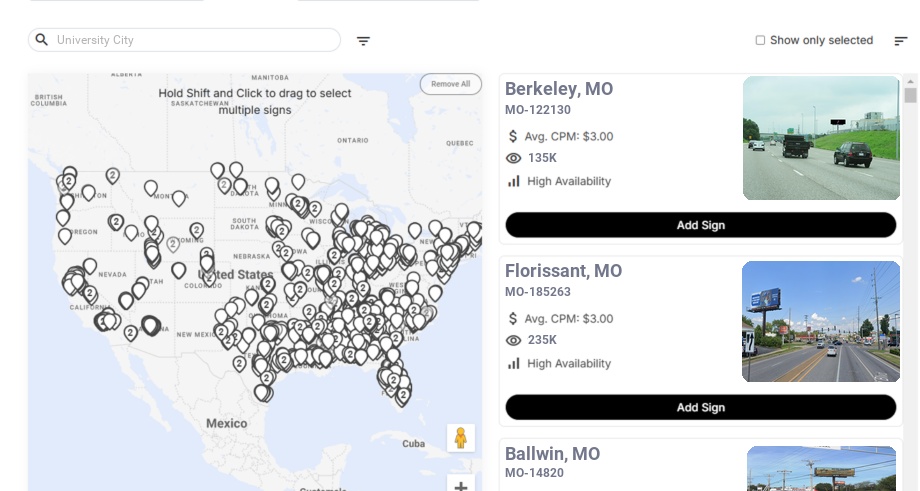



How much is a billboard near University City?
Why Choose Blip for Billboard Advertising near University City
Blip lets you launch fast in University City, hitting I-170 and I-64 commuters without traditional buying hassles.
Set flexible budgets for University City and scale around Delmar Loop events, Washington University traffic, or airport rushes.
Use dayparting in University City to reach morning I-70 commuters, lunch crowds, or weekend Loop visitors when attention is highest.
No contracts with Blip means you can test University City boards near Barnes-Jewish, then shift spend as results come in.
Track University City performance in real time and swap creative fast for students, families, and MetroLink riders.
Blip’s creative tools help you tailor bold, local copy for University City’s educated, media-savvy audience in seconds.
Frequently Asked Questions About Billboard Advertising near University City
How much does a billboard cost near University City, Missouri with Blip?
With Blip, you control exactly what you spend on University City billboards by setting a daily budget that can be adjusted anytime, so you can start small and scale up as you see results. Each “blip” is a 7.5–10 second ad display, and you only pay for the blips you receive, making it easy to run flexible, targeted campaigns in the University City area without overspending. The price of individual billboards near University City, Missouri depends on when and where your ads appear and current advertiser demand, so your total cost over time is simply the sum of each blip delivered.
Where can I advertise near University City, Missouri with Blip?
Access 40 digital University City billboards serving the University City area, concentrated in nearby Berkeley, Maryland Heights, Hazelwood, Florissant, and Ballwin. While the University City government tightly manages signage within city limits, digital billboards in nearby municipalities provide powerful coverage of the University City area and function as de facto University City billboards for daily commuters and visitors. This tight radius provides consistent visibility without depending on inventory inside city limits.
What kind of audience does University City, Missouri billboards reach?
The University City area is one of the most diverse, educated, and media-savvy markets in the St. Louis region. More than 50% of residents have a bachelor’s degree or higher, and roughly 10–15% of residents are foreign-born, adding cultural diversity and multilingual potential for campaigns targeting international students, professionals, and families. University City sits directly west of St. Louis and borders the region’s urban core, giving advertisers access to both city and inner-suburban audiences.
When is the best time to run billboards near University City, Missouri with Blip?
Digital billboards give us flexibility to adjust by hour, day, and season, and in the University City area the morning commute, midday, evening commute, and late night each offer different opportunities. Morning commute is high-value for professional services and healthcare, while evenings are strong for family-oriented messaging, entertainment, fitness, and errands. Weekdays focus on commuters, students, and workers, while weekends emphasize leisure and family activities in and near the University City area.
Why are University City, Missouri billboards effective for commuters and visitors?
University City sits near major corridors including I‑170, I‑64/US‑40, and I‑70, and nearby traffic volumes are high enough to create strong visibility for billboard campaigns. The Delmar Loop alone draws an estimated 1 million+ visitors annually, and Lambert–St. Louis International Airport handled over 13 million passengers in 2023. This mix of commuters, students, workers, and visitors makes billboard advertising near University City a strong fit for a wide range of brands.
Do I need a contract to advertise with Blip near University City?
No, Blip has no long-term contracts or minimum commitments. You can start, pause, or stop your campaign at any time.
How fast can I launch a billboard campaign with Blip near University City?
You can have your campaign live in minutes. Create a free account, select your locations, set your budget, upload your design, and start running once approved.
Where can I advertise with Blip near University City?
Blip has digital billboards near University City. You can browse available locations on a map, choose the ones that fit your audience, and start advertising right away.
Still have questions? Launch a campaign in minutes — no contracts, no commitments.
Start Your CampaignUniversity City Billboard Advertising Guide
The University City area is one of the most diverse, educated, and media-savvy markets in the St. Louis region. With 40 digital billboards within roughly 10 miles—concentrated in nearby Berkeley St. Louis, Maryland Heights, Hazelwood, Florissant, and Ballwin—we can build highly targeted campaigns that put messages in front of residents, students, professionals, and visitors moving through and around University City every day. For brands specifically seeking billboards near University City, this tight radius provides consistent visibility without depending on inventory inside city limits.
Understanding the University City Area Market
University City sits directly west of St. Louis and borders the region’s urban core, giving advertisers access to both city and inner-suburban audiences and making University City billboards especially effective for reaching cross‑market traffic.
Key market facts to inform your strategy:
-
Population & households
- University City’s population is around 34,000–35,000 residents, with roughly 15,000–16,000 households, according to recent estimates shared by the City of University City.
- Average household size hovers around 2.1–2.2 persons, reflecting a mix of singles, couples, and smaller families—ideal for both individual and household-oriented messaging.
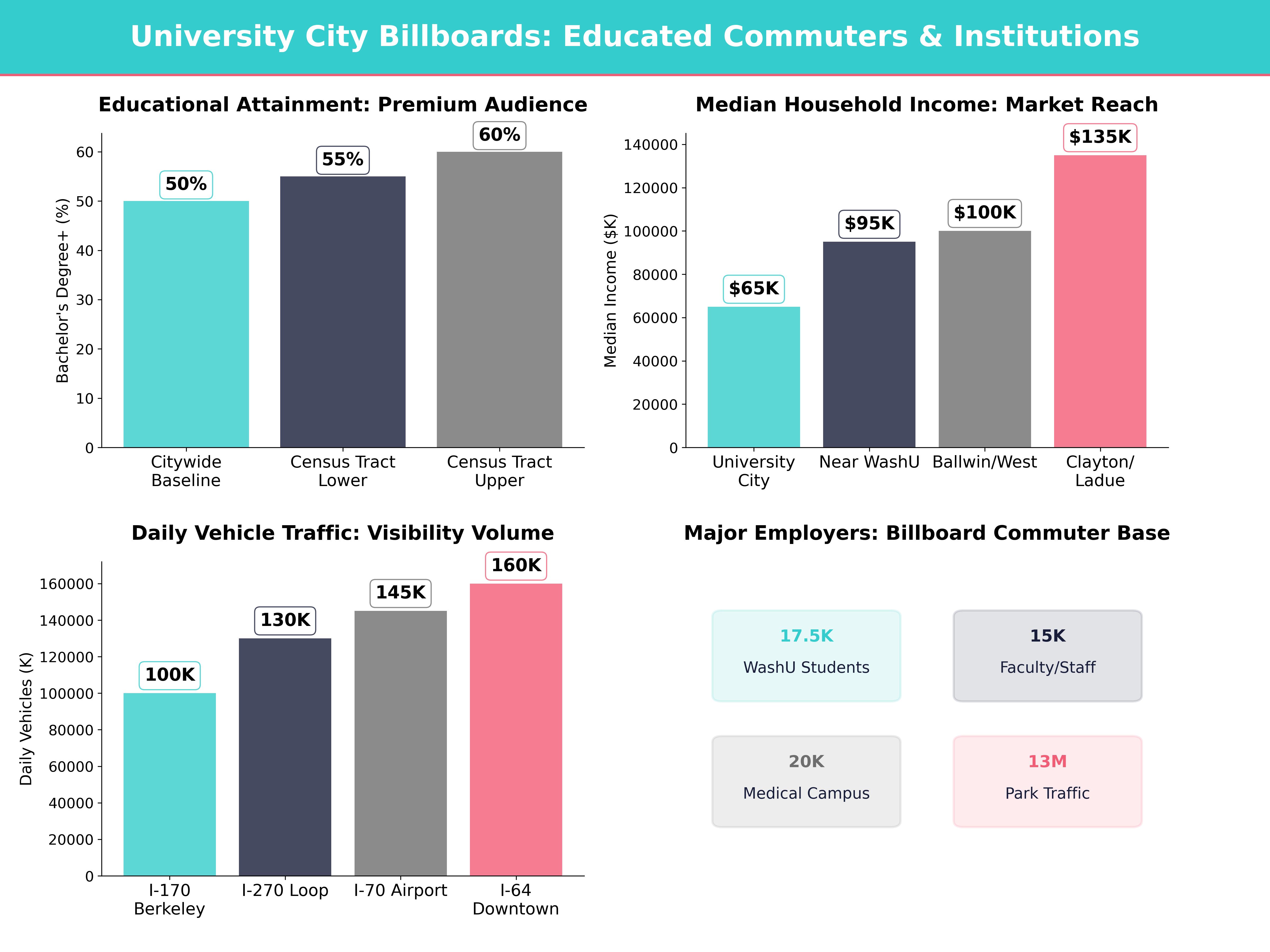
- More than 50% of residents have a bachelor’s degree or higher, and local estimates from regional planners put that share closer to 55–60% in some census tracts, well above the national rate of roughly the low- to mid‑30% range. This means messages can assume a relatively high level of media literacy and sophistication.
- Roughly 10–15% of residents are foreign-born, adding cultural diversity and multilingual potential for campaigns targeting international students, professionals, and families.
-
Income & spending power
- Median household income in University City is in the $60,000–$70,000 range, with several neighborhoods (especially near Washington University) significantly above that, often exceeding $90,000–$100,000.
- In nearby inner-ring suburbs such as Clayton Ladue, median household incomes frequently top $120,000–$150,000, which materially increases the average spending power of drivers and transit riders moving through the University City trade area.
- St. Louis County $70,000s, with a consumer spending profile where households often allocate 12–15% of expenditures to food away from home, 5–7% to entertainment, and 5–10% to healthcare, giving clear priority categories for billboards.
-
Education & institutional presence
- Washington University in St. Louis enrolls about 17,000–18,000 students across undergraduate, graduate, and professional programs and employs more than 15,000 faculty and staff regionwide. A significant share of these students and employees live, shop, and commute through the University City area.
- Nearby, the Washington University Medical Campus and Barnes-Jewish Hospital collectively employ 20,000+ workers, many commuting along I‑64, Forest Park Parkway, and arterial roads that intersect with the University City area.
- The Delmar Loop, a major entertainment and retail district partly in University City, is recognized by the American Planning Association as one of the “10 Great Streets in America” and draws an estimated 1 million+ visitors annually for dining, nightlife, music venues, and festivals. See more at the Delmar Loop’s official site
- University City is served by the University City School District, which educates approximately 2,500–3,000 students across its schools, creating recurring traffic patterns for school drop‑off, pick‑up, athletic events, and performances. Learn more at the School District of University City.
-
Regional context
- The St. Louis metro has about 2.8 million residents and roughly 1.3–1.4 million jobs, and University City sits near its geographic and economic center, within a 15–20 minute drive of most major employment nodes in central and mid‑St. Louis County.
- Lambert–St. Louis International Airport, just north of University City, handled over 13 million passengers in 2023 and reported more than 160,000 aircraft operations (takeoffs and landings). This drives traffic on nearby interstates and arterials where our billboards serve the University City area.
- Metro Transit – St. Louis operates the MetroLink light rail and bus network that together generated tens of millions of passenger trips annually pre‑pandemic; current ridership is rebuilding, with recent reports showing MetroLink providing roughly 8–10 million trips per year and buses another 10–12 million. Several high-use routes run directly through or adjacent to University City.
Implications for your campaign: this is a relatively educated, culturally engaged audience with meaningful discretionary income, a large student/young-professional population, and strong regional draw. Your creative can be smart, locally grounded, and experience-focused while still appealing to families and long-time residents, making billboard advertising near University City a strong fit for a wide range of brands.
Where Our 40 Billboards Reach the University City Area
While the University City government tightly manages signage within city limits, digital billboards in nearby municipalities provide powerful coverage of the University City area and function as de facto University City billboards for daily commuters and visitors:
-
Berkeley (≈4.6 miles from University City)
Near Lambert Airport and I‑170/I‑70. Ideal for:- Reaching air travelers, hospitality workers, and airport-adjacent businesses—in 2023, Lambert Airport supported an estimated 5,000+ on‑airport jobs and thousands more in surrounding hotels, logistics firms, and service businesses.
- Capturing north–south commuters between central St. Louis County and North County; MoDOT counts on I‑170 through this area show 90,000–110,000 vehicles per day, with peak-hour flows that make short, brand-first messages particularly effective.
-
St. Louis (≈7.5 miles)
Boards on key corridors feeding into University City, such as I‑64/US‑40, I‑44, and surface streets. Useful for:- Drawing city residents to University City area restaurants, shops, and events—downtown and central St. Louis attract 11–13 million visitors annually, according to Explore St. Louis
- Regional service brands (healthcare, legal, financial) that want a central presence; the City of St. Louis and central corridor host more than 200,000 jobs, feeding daily two‑way commuter flows.
-
Maryland Heights (≈8.2 miles)
A major employment and entertainment hub with Centene, World Wide Technology, the Centene Community Ice Center, and the Hollywood Casino Amphitheatre. Great for:- Reaching office commuters and event-goers who also frequent the University City area; Maryland Heights alone houses 45,000+ jobs and the amphitheater can host 20,000+ attendees per event during peak concert season.
- Promoting concerts, festivals, and entertainment options; seasonal series at venues like the amphitheater and the nearby Centene Community Ice Center draw hundreds of thousands of visitors annually.
-
Hazelwood (≈8.4 miles) & Florissant (≈9.3 miles)
Strong coverage of North County residential communities and industrial corridors. Effective for:- Retailers, educational institutions, and healthcare providers in or near the University City area seeking broader reach; Hazelwood and Florissant together account for 70,000–80,000 residents and a large share of St. Louis County’s manufacturing, logistics, and warehouse employment.
- Workforce recruitment for employers accessible via I‑270 and I‑170; these corridors carry 120,000–140,000+ vehicles per day in some segments, including significant commercial truck traffic linked to business parks and distribution centers.
-
Ballwin (≈9.6 miles)
A high-income western suburb with substantial family traffic. Ideal for:- Promoting private schools, after-school programs, and attractions in the University City area; Ballwin and neighboring suburbs like Ellisville and Manchester feature median household incomes frequently in the $90,000–110,000 range and homeownership rates above 70%, signaling strong demand for family services and home improvement.
- Higher-ticket local services (home improvement, financial advisors, elective healthcare) aimed at affluent households that are willing to travel 15–20 minutes for quality and value.
By selectively using these 40 boards, we can surround the University City area—hitting inbound commuters, local residents traveling to other suburbs, and visitors circulating through the broader St. Louis region. For advertisers considering billboard rental near University City, this cluster of locations provides a flexible way to scale presence up or down while still owning the main approach routes.
Traffic Patterns and High-Value Corridors
To understand when and where to bid for impressions on our digital billboards serving the University City area, it’s helpful to look at MoDOT traffic volumes and typical commuting flows.
According to the Missouri Department of Transportation traffic counts:
-
I‑170 (running north–south just east of University City)
- Carries roughly 90,000–110,000 vehicles per day in segments near I‑64 and I‑70.
- Peak-hour volumes can reach 6,000–8,000 vehicles per hour per direction, especially during the 7–9 a.m. and 4–6 p.m. commute.
- Key corridor for residents of University City, Clayton Ladue, and Richmond Heights traveling to the airport, North County, or Westport/Maryland Heights.
-
I‑70 near Lambert Airport & Berkeley
- Often exceeds 140,000–150,000 vehicles per day.
- A significant share—often 15–20%—is heavy truck and commercial vehicle traffic, meaning strong visibility for B2B and logistics-linked brands.
- High volume of regional and interstate traffic, including freight and out-of-town visitors.
-
I‑64/US‑40 to the south (through St. Louis and into St. Louis County)
- Segments near downtown and mid-county see 150,000–170,000+ vehicles per day.
- Average travel times between mid‑St. Louis County and downtown are typically 15–25 minutes outside of peak congestion, making this the primary commute route for many professionals.
- Major route for professionals commuting between western suburbs and the city, as well as for visitors accessing destinations like the Gateway Arch Busch Stadium.
-
I‑270 loop (through Maryland Heights, Hazelwood, Florissant, and near Ballwin)
- Averages 120,000–140,000 vehicles per day along many segments, serving as the region’s main beltway.
- Certain interchanges—particularly near I‑70, Page Avenue, and Manchester Road—see some of the region’s heaviest congestion, creating more dwell time for billboard viewing.
Typical travel behaviors relevant to the University City area:
- Many University City area residents commute east to jobs in St. Louis, Clayton, and the Central West End, or west/north to Westport, Maryland Heights, and the airport area. St. Louis regional transportation studies indicate that more than 60% of working residents commute to jobs outside their home municipality.
- Evening and weekend traffic spikes into the Delmar Loop and nearby shopping/dining districts, especially during events like the Loop Ice Carnival, street festivals, and concerts at venues such as The Pageant
- Students and staff connected to Washington University and nearby Barnes-Jewish Hospital and the Washington University Medical Campus generate consistent weekday flows; the medical campus alone logs thousands of daily patient visits in addition to its large workforce.
- Nearby attractions such as Forest Park—which draws an estimated 13 million+ visitors annually to the Saint Louis Zoo Saint Louis Art Museum
Implications: prioritize boards along I‑170, I‑64, and I‑70 in nearby cities during weekday rush hours to reach commuters, then tilt toward arterials and entertainment corridors (including Maryland Heights and central St. Louis boards) on evenings and weekends for leisure-focused messaging. This mix ensures your billboard advertising near University City tracks closely with how people actually move through the market.
Key Audience Segments in the University City Area
We can design campaigns that speak directly to specific high-value segments:
1. University & Young Professionals
- Washington University’s 17,000+ students and more than 15,000 employees are heavily concentrated around the University City area and the Central West End.
- Median age in University City is in the low to mid-30s, compared with the St. Louis regional median in the late‑30s to early‑40s, reflecting a large young-professional population.
- Household composition data show a relatively high share of non-family households (often 40–50% or more), consistent with student and young-professional markets.
- These audiences are heavy users of public transit and rideshare: Metro reports that a significant portion of daily riders are students and workers in central corridors, and the proximity to two MetroLink stations (Delmar Loop and Skinker) enhances car‑optional living.
- National and regional surveys indicate that people in their 20s and early 30s allocate more than 30% of discretionary spending to experiences (dining, travel, entertainment), aligning with Loop-oriented offerings.
Messaging tips:
- Use short, clever copy and contemporary design.
- Emphasize proximity to transit (e.g., MetroLink and major bus routes—see Metro Transit – St. Louis).
- Promote mobile-friendly calls to action: QR codes or simple URLs; nearly 95% of young adults own smartphones, and mobile web usage dominates in this age group.
Vertical examples:
- Food delivery apps, late-night eateries, live music venues, specialty coffee, fitness studios, co-working spaces, student housing.
2. Families & Long-Term Residents
- The University City area and western/northern suburbs like Ballwin and Florissant have significant numbers of family households and homeowners; in many suburbs, 60–70%+ of occupied housing units are owner-occupied.
- University City itself has a high share of long-term residents who have lived in the same home for 10+ years, supporting campaigns that stress trust and continuity.
- Families typically devote 30%+ of their budgets to housing, 15–20% to transportation, and 15–20% to food, with additional targeted spending on education, childcare, and healthcare.
Messaging tips:
- Highlight reliability, safety, and community involvement.
- Include local landmarks or events, such as University City in Bloom, the Loop Ice Carnival, or neighborhood names residents recognize (e.g., “Near the Loop,” “Minutes from Clayton”).
- Promote seasonal services tied to typical suburban cycles—spring home projects, back‑to‑school, and year‑end healthcare and insurance deadlines.
Vertical examples:
- Pediatricians and family clinics, private schools, home improvement contractors, financial planners, auto dealers, and insurance agencies.
3. Visitors & Regional Shoppers
- The Delmar Loop’s estimated 1M+ annual visitors, plus 13M+ airport passengers and regional event attendees, generate a strong visitor market.
- Downtown St. Louis attractions—like the Gateway Arch, Cardinals games at Busch Stadium, and Blues games at the Enterprise Center (see Explore St. Louis millions of event attendees annually. Busch Stadium alone hosts 3 million+ fans in strong seasons, and Enterprise Center hosts 40+ NHL home games plus concerts and special events each year.
- Nearby cultural institutions in and around Forest Park, such as the Saint Louis Zoo and Saint Louis Art Museum, collectively attract 10–13 million visits annually, increasing cross-regional travel through the corridors serving the University City area.
- Shoppers traveling from outer suburbs into central St. Louis County routinely pass through or near University City using I‑64, I‑170, or key arterials.
Messaging tips:
- Use strong visuals with simple directions: “5 minutes west of the Loop,” “Off I‑170 at Delmar.”
- Feature time-limited offers or events to prompt immediate action; research on OOH effectiveness shows that clear calls to action can raise response by 20–30%.
- Highlight parking availability, transit access, and walkability, which matter to visitors deciding between multiple destinations.
Vertical examples:
- Hotels, museums, festivals, seasonal attractions, and destination retail in or near the University City area.
Timing Your Campaign with Local Rhythms
Digital billboards give us flexibility to adjust by hour, day, and season. In the University City area, consider:
Daily Patterns
-
Morning commute (6:30–9:30 a.m.)
High-value time for:- Professional services, financial institutions, B2B brands, healthcare, and higher-priced consumer goods.
- Messaging that focuses on planning and decision-making (“Schedule your checkup,” “Refinance this month,” “Enroll for fall classes”).
- Regionally, more than 70% of workers commute by car, and morning peak periods consistently see the highest volumes on I‑170 and I‑64 around University City.
-
Midday (11 a.m.–2 p.m.)
- Great for food, retail, and appointment-based businesses; restaurant studies show that 35–45% of weekday dine‑out occasions occur at lunch.
- Emphasize lunch specials, same-day service, or “walk-ins welcome.”
- Capture students and hospital staff who have flexible lunchtime windows and are already traveling to and from the Delmar Loop, Central West End, and Clayton.
-
Evening commute (3:30–7:00 p.m.)
- Strong for family-oriented messaging, entertainment, fitness, and errands.
- Promote events “tonight,” “this weekend,” or short-term promotions.
- Traffic data typically show a second pronounced peak in this window, often slightly longer in duration than the morning peak, creating extended exposure opportunities.
-
Late night (after 9 p.m.)
- Target late-night dining, bars, music venues, and transportation services around the Delmar Loop and downtown St. Louis.
- Late-night traffic volumes are lower, but dwell time and attention for illuminated digital boards increase, which benefits visually bold creatives.
Weekly & Seasonal Trends
-
Weekdays
- Focus on commuters, students, and workers.
- Great for B2B, education, healthcare, and recurring errands.
- Many MetroLink and bus lines report higher weekday ridership, adding transit riders who also notice nearby roadside digital displays.
-
Weekends
- Emphasize leisure and family activities: restaurants, entertainment, shopping in and near the University City area.
- Ideal for promoting festivals and events in the Loop or at nearby venues like The Pageant and Delmar Hall.
- Visitor and tourism data for St. Louis show that weekend leisure trips make up a large share of overnight stays, with hotel occupancy spikes often tied to sports, concerts, and conventions.
-
Academic calendar
- Late August/September and January: strong windows for promoting housing, banking, mobile plans, and student discounts as students return; Washington University alone welcomes thousands of new and returning students in these periods, plus families visiting for move‑in.
- Mid‑semester (October–November and March–April): good for promoting affordable entertainment, dining, and wellness services as academic stress peaks.
- Finals and graduation periods: opportunity for celebration-oriented campaigns, gift retailers, and restaurants; commencement weekends can draw tens of thousands of visitors regionwide.
-
Sports seasons
- Cardinals (MLB), Blues (NHL), and university sports create periodic spikes in cross-city travel.
- Time promotions around major home games and playoffs—local news outlets like the St. Louis Post-Dispatch, KSDK 5 On Your Side, and KMOV News 4 help track schedules and big-event coverage.
- On big game days, traffic around downtown and key approach routes can rise 10–20%, extending travel times and billboard viewing windows.
With Blip, we can schedule campaigns precisely in these windows, ensuring your budget is concentrated when your audience is most likely to notice and act on your billboard advertising near University City.
Creative Best Practices for the University City Area
To stand out on digital billboards serving the University City area:
-
Assume fast-moving, educated viewers
- Most boards are on interstates and major arterials where drivers have 3–7 seconds to absorb a message; studies of OOH eye‑tracking confirm that simple, high-contrast designs dramatically increase recall in this window.
- Use 6–8 words max in your main line; support with a clear logo and one strong image.
- Research from OOH industry groups regularly shows that ads with a single, focused message can improve ad recall by up to 30% versus cluttered creatives.
-
Leverage local identity
- Reference familiar names: “Near the Delmar Loop,” “Just off I‑170,” “Minutes from Clayton.”
- Incorporate recognizable visuals: the Loop’s neon, the trolley, local skyline elements, or University City’s iconic lion gates.
- Tie into beloved regional destinations like Forest Park or the Missouri Botanical Garden when relevant; both attract millions of visits annually and have high name recognition among locals.
-
Design for legibility
- Use high-contrast color combinations (dark background, light text or vice versa).
- Sans-serif fonts at large sizes; avoid scripts or thin weights.
- Keep logos big and clean—industry guidelines often suggest logos occupy at least 15–20% of the creative area for optimal recognition at highway speeds.
-
Drive measurable action
- Use short URLs or branded domains, not long strings.
- Consider “Search: Your Brand UCity” to encourage immediate mobile search; more than 80–85% of adults now report using smartphones while on the go, and mobile search is frequently triggered by OOH exposure.
- QR codes can work on slower arterials or near intersections, but are less effective on high-speed interstates; reserve them for boards near stoplights or lower-speed approaches.
-
Adapt creative by location
- Airport- and interstate-adjacent boards near Berkeley and Hazelwood: focus on concise branding and regional draw, as average speeds are often 55–65 mph.
- Suburban boards near Ballwin and Florissant: emphasize family offers and services easily accessible from home, where local traffic and shopping trips dominate; speeds and congestion often allow slightly more complex visuals.
- Boards nearest the University City area: highlight hyper-local relevance, including student discounts or neighborhood-specific references. This can be especially effective on corridors where average travel speeds drop below 35–40 mph, creating more time for detailed messages and making these placements feel like true billboards near University City rather than generic regional ads.
Using Blip’s Tools Strategically Around University City
Blip’s platform lets us tailor campaigns precisely to your goals in the University City area:
-
Board-level selection
-
Choose individual boards in Berkeley, St. Louis, Maryland Heights, Hazelwood, Florissant, and Ballwin based on:
- Proximity to your business location.
- Audience profile (commuter-heavy vs family-heavy routes) informed by local traffic and demographic data.
- Direction of travel (toward the University City area vs away from it), which can be crucial for in‑the‑moment decisions like dining or retail stops.
-
Choose individual boards in Berkeley, St. Louis, Maryland Heights, Hazelwood, Florissant, and Ballwin based on:
-
Dayparting
- Bid for impressions only during hours that matter most: morning commutes for B2B, evenings for restaurants, weekends for attractions.
- Layer multiple creatives: one version during weekdays, another during weekend leisure periods.
- Use dayparting to synchronize with your own business metrics—if internal data show that 60–70% of conversions happen after 3 p.m., shift spend into that window.
-
Budget control
- Set a daily budget as low or high as you need and adjust anytime.
-
Increase bids around high-value periods like:
- University move-in weeks and graduation weekends.
- Major events in the Loop, such as the Loop Ice Carnival or summer concert series highlighted by The Loop Special Business District
- Holiday shopping season and tax refund season, when retail spending typically rises 20–40% above non‑holiday monthly averages.
- This level of control makes Blip an efficient solution for billboard rental near University City, allowing even smaller advertisers to compete on prime routes.
-
Creative rotation
-
Rotate multiple creatives to test offers and messages:
- Version A: brand awareness (“We’re your neighborhood [service] near the Loop”).
- Version B: tactical offer (“$25 off this week – Book now”).
- Shift weight toward best-performing creatives based on website traffic, phone inquiries, or promo code usage.
- Many advertisers see 10–30% performance lifts after systematically A/B testing OOH messages and focusing on winning variations.
-
Rotate multiple creatives to test offers and messages:
Campaign Ideas by Industry for the University City Area
Here are practical ways different industries can leverage our billboards serving the University City area:
Restaurants, Bars, and Cafés
- Focus boards on St. Louis and Maryland Heights corridors that funnel visitors into the University City area, especially along I‑64, I‑170, and Page Avenue.
-
Daypart for 11 a.m.–2 p.m. and 4 p.m.–10 p.m.:
- Lunch: “Loop Lunch in 5 Minutes – Exit at Delmar.”
- Dinner/nightlife: “Live Music & Late Night Bites by the Loop Tonight.”
- Food-away-from-home spending nationally accounts for roughly 50% of total food dollars, making lunchtime and evening dining a significant opportunity.
- Update creatives for seasonal patios, happy hours, or game-day specials tied to Cardinals and Blues schedules featured on outlets like KTVI FOX 2 St. Louis Public Radio.
Retail & Local Services
- Use broad coverage in Florissant, Hazelwood, and Ballwin to draw suburban shoppers to University City area boutiques, salons, or specialty services.
-
Highlight:
- “Free parking near the Loop.”
- “10 minutes from I‑170 and I‑64.”
- Retail studies show that clear “time-to-destination” messages (“10 minutes away”) can increase visit intent by double-digit percentages.
- Rotate creatives featuring different product categories or seasonal promotions—back‑to‑school, holiday gifting, spring cleaning—aligned with local shopping peaks. For location-based retailers, framing your message as being on University City billboards can help reinforce convenience and local relevance.
Education & Training
-
Target commuting professionals via boards near I‑64 and I‑170:
- “Advance Your Career – Classes Near University City Area.”
- Focus on early mornings and late afternoons when career changes are top-of-mind; survey data often show that adults consider education and financial decisions most frequently in these windows.
-
For private schools, tutoring centers, and test prep:
- Use family-oriented boards in Ballwin and Florissant during spring enrollment and back-to-school periods.
- University City and surrounding suburbs together represent tens of thousands of K‑12 students, providing a large base for enrichment and supplemental learning services.
Healthcare & Wellness
-
Promote clinics, hospitals, dental offices, and urgent care accessible to the University City area:
- “Same-Day Appointments – Minutes from the Loop.”
- “24/7 Urgent Care – Off I‑170 at [Exit].”
- Schedule heavy presence during weekday commutes when families plan appointments; healthcare providers often report higher call and booking volumes on Monday–Wednesday mornings.
- Emphasize convenience—parking, evening or weekend hours, walk‑ins—since regional surveys frequently rank convenience as a top‑3 factor in provider selection.
Real Estate & Housing
- Combine billboards in Maryland Heights, Hazelwood, Florissant, and Ballwin to reach residents considering a move closer to the city.
- St. Louis County homeownership rates sit around 65–70%, but University City and its neighbors offer a higher share of rental and mixed‑tenure housing, ideal for promotional campaigns highlighting urban convenience and neighborhood character.
-
For student housing and apartments:
- Target boards along routes students use between campus, entertainment districts, and grocery centers (e.g., Delmar Boulevard, Skinker, I‑64).
- Use time-sensitive messaging: “Now Leasing for Fall – Walk to the Loop.”
- Leasing offices often see sharp inquiry spikes (sometimes 30–50% higher) in the 60–90 days before the start of the academic term—perfect timing for short, high-frequency digital campaigns on billboards near University City.
Measuring and Optimizing Your Campaign
While billboards are a top-of-funnel medium, we can still manage and optimize performance for the University City area:
-
Track direct response
- Use unique URLs or promo codes (“UCity10”) featured only on billboards.
- Watch analytics during the time windows your ads run to see correlated bumps.
- Many advertisers report 5–20% lifts in branded search volume in ZIP codes where OOH campaigns are active.
-
Coordinate with digital
- Run search and social campaigns targeting ZIP codes overlapping the University City area and nearby suburbs.
- Align billboard and online creative so people recognize your brand when they later see your ads on their phones; consistent cross‑channel creative can improve ad recall by up to 40%.
- Use geo-fenced mobile or connected TV campaigns to “retarget” users who live near the corridors where your boards run.
-
Adjust in real time
- If you notice higher conversions from visitors during certain days (e.g., Fridays and Saturdays near Loop events), increase your Blip budget and bids in those periods.
- Swap in new creative when offers change or when promoting specific events, like a new menu launch or limited-time festival.
- Digital billboards allow near‑real‑time creative changes, often within minutes to hours, a major advantage over traditional static boards.
-
Use local news and event calendars
- Monitor outlets such as the City of University City, Explore St. Louis St. Louis Post-Dispatch for major happenings.
- Also keep an eye on regional event calendars from Downtown STL, Inc. and Great Rivers Greenway
- Align your messaging with these spikes in traffic and attention (festivals, marathons, concerts, and university events) to ride natural waves of demand rather than fighting against them.
By understanding how University City sits at the crossroads of students, professionals, families, and visitors—and by using our 40 digital billboards in nearby cities strategically—we can build campaigns that effectively reach the University City area with the right message, at the right time, on the right routes. Whether you are planning a short-term promotion or an always-on presence, this approach turns nearby locations into a powerful network of University City billboards that consistently keep your brand in front of your highest-value audiences.