Billboards in Imperial, MO
No Minimum Spend. No Long-Term Contracts. Just Results.
Trusted by Leading Brands


Billboard advertising
in Imperial has never been easier
How much is a billboard in Imperial?
Why Choose Blip for Billboard Advertising in Imperial
Blip lets you launch fast in Imperial on I-55 or Route 141, reaching commuters headed to South County and Arnold without traditional ad-buy friction.
In Imperial, set flexible budgets and pay only when ads play—ideal for testing weekend spikes from Kimmswick's Apple Butter Festival or everyday commuter traffic.
Use Blip's dayparting to hit Imperial drivers at 6-9 a.m. and 3-7 p.m., when Jefferson County's car-heavy commute makes roadside views repeat often.
No contracts in Imperial means you can scale home-service, healthcare, or retail ads around school season, holiday rushes, or a short event burst.
Blip's real-time analytics help Imperial advertisers shift spend between I-55, Route 21, and local feeders as traffic and results change.
Create and swap creative quickly with Blip for Imperial billboards—perfect for simple, bold messages aimed at families, shoppers, and weekend visitors.
Frequently Asked Questions About Billboard Advertising in Imperial
How much does a billboard cost in Imperial, Missouri with Blip?
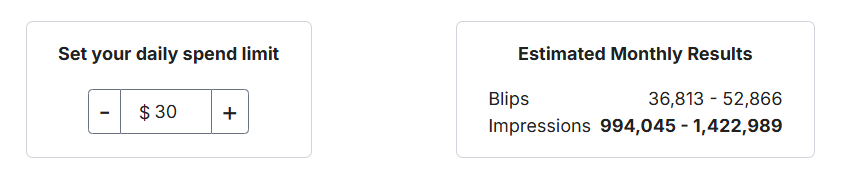
With Blip, billboard advertising in Imperial is designed to fit a wide range of budgets. You set a daily budget, and Blip’s algorithm uses it to bid on open ad slots on rotating digital billboards, so you only pay when your ad actually appears. Pricing can change based on time of day, location, and advertiser demand, and pricing starts at $0.01 per display.
Why is Imperial, Missouri a good market for Blip billboard ads?
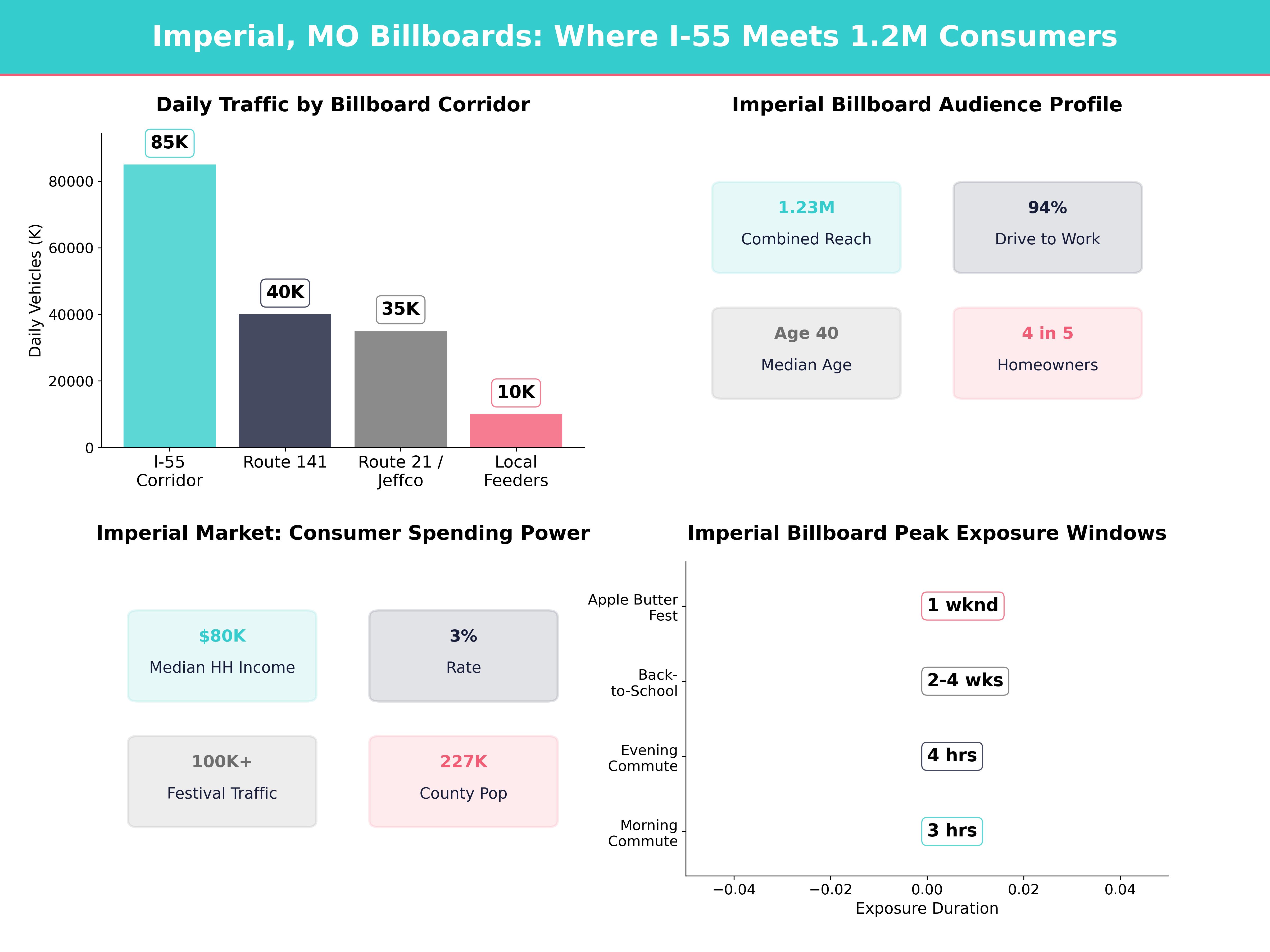
Imperial, Missouri is a strong billboard market because we can reach both a local hometown audience and a much larger commuter shed tied to South St. Louis. Imperial sits inside Jefferson County, which had 226,739 residents in the 2020 census, and it connects quickly to St. Louis County, which had 1,004,125 residents. The area is deeply car-oriented, with Jefferson County workers relying on driving for about 94% of commute trips by car, truck, or van.
Where should I place billboard ads in Imperial, Missouri with Blip?
Interstate 55 is the backbone of the Imperial advertising market, with daily traffic commonly running in the range of roughly 70,000 to 100,000+ vehicles per day through the Imperial-Arnold stretch. Missouri Route 141 generally lands in the 30,000 to 50,000+ vehicles per day range, and Missouri Route 21 often falls around 25,000 to 45,000 vehicles per day in the Arnold area. Route M, Richardson Road, and nearby neighborhood connectors can also reach 10,000+ vehicles per day near major intersections.
When is the best time to run billboard ads in Imperial, Missouri?
Morning movement tends to build from roughly 6:00 to 9:00 a.m., while evening return traffic usually concentrates from about 3:00 to 7:00 p.m. Back-to-school is one of the best recurring windows in this market, and family-service campaigns should launch 2 to 4 weeks before the first day of class. Fall is even stronger, especially in September and October when school traffic, sports, and destination visitation all increase.
What kinds of businesses work best for billboard advertising in Imperial, Missouri?
Home and property services, healthcare and dental, restaurants and retail, automotive, education and enrichment, and local events and tourism all fit the Imperial market well. The area is family-heavy, homeowner-heavy, and commuter-heavy, with a median household income around $80,000 and homeownership at roughly 4 in 5 occupied homes. That makes practical, convenient, trust-building offers especially effective.
Do I need a contract to advertise with Blip in Imperial?
No, Blip has no long-term contracts or minimum commitments. You can start, pause, or stop your campaign at any time.
How fast can I launch a billboard campaign with Blip in Imperial?
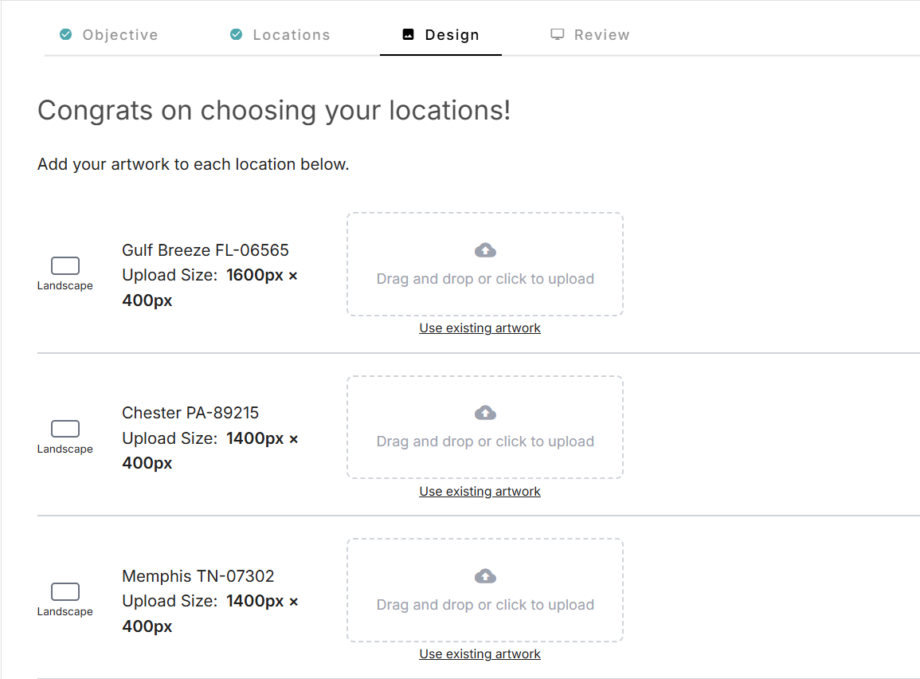
You can have your campaign live in minutes. Create a free account, select your locations, set your budget, upload your design, and start running once approved.
Where can I advertise with Blip in Imperial?
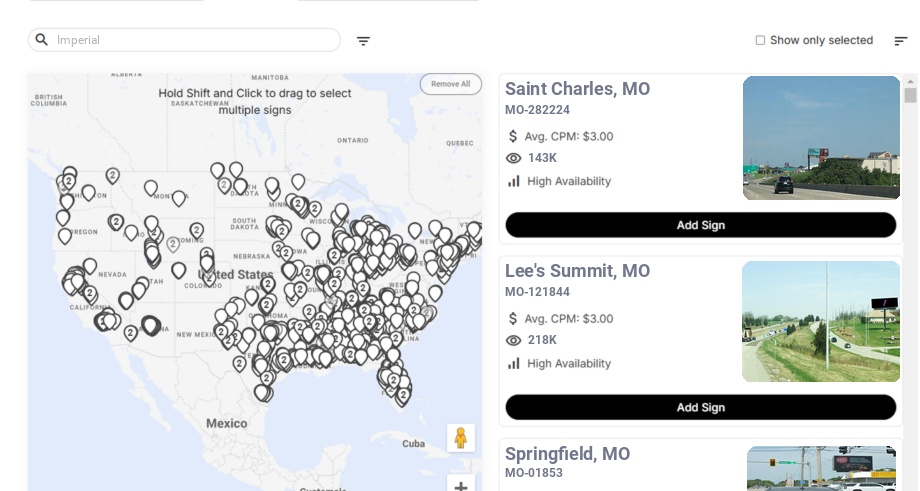
Blip has digital billboards in Imperial. You can browse available locations on a map, choose the ones that fit your audience, and start advertising right away.
Still have questions? Launch a campaign in minutes — no contracts, no commitments.
Start Your CampaignImperial Billboard Advertising Guide
Imperial, Missouri is a strong billboard market because we can reach both a local hometown audience and a much larger commuter shed tied to South St. Louis. Imperial sits inside Jefferson County 226,739 residents in the 2020 census, and it connects quickly to St. Louis County 1,004,125 residents, giving nearby advertisers access to a combined 1,230,864 people across the county line. The area is deeply car-oriented, with Jefferson County workers relying on driving for about 94% of commute trips by car, truck, or van, so roadside media can build frequency fast. We also benefit from retail gravity in Arnold, which had 20,858 residents, outdoor traffic near Mastodon State Historic Site 431 acres, and seasonal visitor flow around Kimmswick, where the Apple Butter Festival can draw 100,000+ visitors over the weekend.
Imperial, Missouri market overview
Imperial’s position in the Jefferson County trade area
Imperial works best when we treat it as part of a broader south-county and Jefferson County movement pattern, rather than as a stand-alone small community. Jefferson County 218,733 residents in 2010 to 226,739 in 2020, which was an increase of 8,006 people, or about 3.7%. That growth matters because it reflects sustained household formation, ongoing residential demand, and steady expansion along commuter corridors.
Imperial also sits near Arnold, the county’s largest city, with 20,858 residents in 2020. For many advertisers, Arnold functions as the closest major retail and service hub, while Imperial functions as the residential base that feeds it. That pattern is useful for billboards because we can speak to purchase intent before drivers reach shopping centers, restaurants, healthcare campuses, and service businesses.
The market broadens further when we look north. St. Louis County 1,004,125 nearby residents, and South County remains a routine destination for work, healthcare, entertainment, and regional shopping. For Imperial advertisers, that means a single well-placed digital billboard can serve local awareness and cross-county demand at the same time.
Organizations such as the Jefferson County Growth Association, the Jefferson County Chamber of Commerce Missouri Department of Economic Development all reinforce the area’s role as a residential, retail, logistics, and small-business market. We should read Imperial as a place where families live, commuters drive, and neighborhood spending follows predictable weekly patterns.
Demographics, income, and commuting patterns in Imperial
Imperial’s surrounding county is family-heavy, homeowner-heavy, and commuter-heavy. Jefferson County’s median household income is around $80,000, and its median age is close to 40, which tells us we are often speaking to established adults making decisions for households, vehicles, children, pets, and homes. Homeownership is also high, at roughly 4 in 5 occupied homes, which tends to boost responsiveness for categories such as roofing, HVAC, remodeling, landscaping, pest control, banking, and healthcare.
The transportation mix is especially important for billboard strategy. Data summarized through the Missouri Census Data Center and the regional context of limited local fixed-route service from Metro Transit show why drivers dominate the audience here. When about 94% of workers commute by car, truck, or van, we should expect repeat roadside exposure to do a large share of the branding work.
Labor market indicators are also healthy enough to support local advertising demand. The Missouri Economic Research and Information Center shows Jefferson County with a civilian labor force above 110,000 residents, and recent unemployment has generally stayed in the low 3% range. In practice, that means many households still have spending power, but they also value convenience, speed, and trust. Billboards that make an offer feel close, easy, and reliable tend to fit that mindset well.
What the Imperial numbers mean for billboard advertisers
These market traits point us toward several strong billboard use cases:
- Home and property services because high homeownership creates repeat demand.
- Healthcare and dental because families commute and prefer convenient providers.
- Restaurants and retail because drivers pass buying opportunities before and after work.
- Automotive because vehicle dependence is unusually high.
- Education and enrichment because school communities are large and active.
- Local events and tourism because weekend movement is concentrated and directional.
In other words, Imperial is not just a small town buy. It is a practical commuter market with suburban spending patterns and enough regional draw to support both local and metro-adjacent campaigns.
Key traffic corridors for Imperial, Missouri billboards
Interstate 55 through Imperial and Arnold
MoDOT traffic maps make it clear that Interstate 55 is the backbone of the Imperial advertising market. Through the Imperial-Arnold stretch, daily traffic commonly runs in the range of roughly 70,000 to 100,000+ vehicles per day, with heavier counts closer to the St. Louis County line and the Arnold interchanges. That volume gives us broad reach, but the bigger advantage is consistency. Drivers use I-55 every weekday for work and every weekend for shopping, dining, and leisure travel.
This corridor is especially strong for:
- Retail and restaurants targeting Arnold, South County, and impulse stops.
- Healthcare systems, urgent care, dental, and specialty clinics.
- Auto dealers, repair shops, tire stores, and insurance agencies.
- Colleges, training programs, and workforce recruiting.
- Entertainment and tourism moving north to south, and south to north.
Because travel speeds are high, we should keep I-55 creative simple, brand-forward, and highly legible.
Missouri Route 141 and the Arnold-Fenton connection
MoDOT counts along Route 141 generally land in the 30,000 to 50,000+ vehicles per day range in and around Arnold and the Meramec corridor. This route matters because it funnels movement toward Fenton
Route 141 is a smart fit for advertisers that benefit from broader suburban reach, including:
- Regional healthcare such as SSM Health St. Clare Hospital - Fenton.
- Home improvement retailers, contractors, and flooring companies.
- Financial services, legal services, and real estate.
- Family entertainment and weekend destinations.
The audience on 141 often has more trip flexibility than pure freeway commuters, so mid-morning, lunch, and weekend dayparts can work well.
Missouri Route 21 and Jeffco Boulevard
Route 21, also known locally through parts of the market as Jeffco Boulevard, is another high-value commuter path. MoDOT count stations in the Arnold area often fall around 25,000 to 45,000 vehicles per day, depending on the segment. This route links neighborhoods deeper in Jefferson County to the I-55 spine, which gives us access to residents moving between home, school, errands, and work.
Advertisers that often perform well on Route 21 include:
- Contractors and trades because homeowners are abundant.
- Workforce recruiting for logistics, manufacturing, and healthcare.
- Banks, credit unions, and tax services.
- Churches, community events, and civic messaging.
- Family dining and everyday retail.
This corridor usually rewards locally grounded messaging more than generic metro branding.
Route M, Richardson Road, and Imperial’s local feeder network
Imperial’s feeder roads matter because they catch the audience closest to the point of decision. Around Route M, Richardson Road, and nearby neighborhood connectors, local count points frequently reach 10,000+ vehicles per day near major intersections and school-oriented movement zones. The scale is smaller than I-55, but the intent can be stronger because these are drivers heading directly to neighborhoods, schools, youth activities, and nearby shopping.
These local feeders are ideal for:
- Dentists, pediatricians, and family medical providers.
- Childcare, tutoring, and extracurricular programs.
- Gyms, churches, and community organizations.
- Real estate teams and local service businesses.
- Restaurants and convenience retail serving dinner-hour traffic.
When we want action from people who live closest to Imperial, these lower-speed corridors can outperform higher-volume freeway placements on a cost-per-response basis.
Audience segments we can reach in Imperial, Missouri
Commuters and cross-county shoppers
The largest audience in Imperial is still the daily driver. With about 94% of Jefferson County workers commuting by car, truck, or van, billboards reach people during the most routine and repetitive part of their day. Morning movement tends to build from roughly 6:00 to 9:00 a.m., while evening return traffic usually concentrates from about 3:00 to 7:00 p.m. That makes commuter-oriented dayparting especially practical.
These drivers are not just going to work. They are also stopping at retail centers such as The Crossing at Jefferson County South County Center, and making service decisions on the way home. For advertisers with clear geography, such as “next exit,” “in Arnold,” or “minutes from Imperial,” this audience is highly usable.
Families, homeowners, and school communities
Imperial is an excellent family market. Jefferson County’s high homeownership rate, household income around $80,000, and median age near 40 all point toward adult decision-makers with recurring family expenses. The local school audience is substantial as well. Fox C-6 School District serves 11,000+ students, making it one of the most important recurring traffic generators in the area.
That audience is valuable for:
- Orthodontics, vision care, and pediatric medicine.
- Tutoring, music lessons, and youth sports programs.
- Family restaurants, dessert shops, and quick-service chains.
- Home services and household goods.
- Insurance, banking, and estate planning.
Because families often make decisions quickly once they trust a provider, familiar billboards can shorten the time between awareness and action.
Leisure visitors and heritage tourism audiences
Imperial also sits beside several leisure draws that create weekend and seasonal traffic. Mastodon State Historic Site 431 acres, and it gives the area a distinct outdoor and history-oriented appeal. Nearby Kimmswick adds boutique shopping, dining, festivals, and strong fall visitation. Its Apple Butter Festival is widely reported to attract 100,000+ visitors over the weekend, which dramatically changes local traffic patterns every October.
For tourism-oriented campaigns, we can reach:
- Day-trippers from South County and the wider St. Louis area.
- Couples and families on weekend drives.
- Shoppers and diners looking for locally distinctive experiences.
- Event attendees who need reminders about parking, timing, or nearby offers.
We can also benefit from broader regional leisure movement tied to Explore St. Louis Visit Missouri Grant’s Farm, which help keep southbound and northbound visitor traffic active in warmer months.
Industry workers and skilled-trades audiences
Imperial is part of a working corridor, not just a bedroom community. The I-55 spine supports logistics, warehousing, manufacturing, service trades, and construction traffic across communities such as Pevely Herculaneum Festus
This audience responds well to practical offers, including:
- Job recruiting with wage or shift information.
- Truck and fleet services.
- Safety gear, tools, and industrial supply.
- Banking and tax services.
- Convenience retail, coffee, and fuel-adjacent offers.
For shift-based workers, early morning and mid-afternoon placements can be just as important as classic commute peaks.
Seasonal and timing opportunities in Imperial, Missouri
Spring and early summer in Imperial
From March through May, we should lean into home services, outdoor recreation, lawn care, allergy care, and spring retail. This is also a good time to advertise family attractions, patios, and local dining because people start spending more time on the road for discretionary trips. Weekends often become more productive once weather improves, especially around Mastodon State Historic Site
From Memorial Day to Labor Day, summer creative should prioritize outings, family meals, cooling services, and event-driven promotions. Friday afternoon, Saturday midday, and Sunday return traffic all matter.
Back-to-school and fall in Imperial
Back-to-school is one of the best recurring windows in this market. Because Fox C-6 School District returns in mid-August, we should launch family-service campaigns 2 to 4 weeks before the first day of class. This timing works especially well for pediatric care, tutoring, school apparel, youth activities, and household services.
Fall is even stronger. September and October combine school traffic, high school sports, cooler weather, and destination visitation. Kimmswick becomes especially important in October, and the Apple Butter Festival’s 100,000+ weekend visitors can justify short, tactical campaigns aimed at dining, parking, retail, and local attraction awareness.
Holiday and winter timing in Imperial
From Thanksgiving through December, we should concentrate on giftable retail, family dining, events, and healthcare scheduling. Holiday traffic into Arnold and South County stays meaningful, and digital boards gain extra impact because darkness arrives before about 5:00 p.m. near the winter solstice. That earlier darkness makes evening commute impressions feel brighter and more dominant.
January and February are best for practical categories. Tax services, fitness, healthcare, auto care, and value-focused retail all fit the post-holiday mindset. If we want efficiency, winter is often a good time to keep branding active while competitive noise softens.
Billboard design tips for the Imperial, Missouri market
Creative style that fits Imperial drivers
Imperial audiences usually respond to clarity more than cleverness. Because I-55 traffic often moves at freeway speed, we should keep primary copy to about 6 to 8 words, feature 1 clear offer, and include 1 simple call to action. Strong contrast, bold type, and a single focal image work better than crowded layouts.
Locally, we should also design for a market that feels suburban, practical, and outdoors-oriented. Imagery that shows real homes, families, vehicles, backyards, patios, pets, or local destinations tends to feel more authentic than sleek urban stock photography. Color palettes with high contrast, such as white on dark blue, yellow on black, or red accents on neutral backgrounds, perform well against tree-lined roads and variable Missouri weather.
Messaging that feels local in Imperial
Imperial creative should sound close to home. Phrases like “In Imperial,” “Near Arnold,” “Minutes from Route M,” “South County alternative,” and “Jefferson County trusted” help us reduce perceived distance. For local businesses, trust cues such as “family-owned,” “free estimate,” “same-day service,” or “open late” are often more persuasive than abstract branding language.
Specificity matters here. We should name nearby places that people actually use, including Arnold, Kimmswick, Fenton
Vertical-specific design ideas for Imperial campaigns
For Imperial, we often see the best creative direction by category:
- Home services should feature one service, one proof point, and one response path. “Roof Leak? Free Estimate. Imperial.” is stronger than a full service menu.
- Healthcare should emphasize convenience and reassurance. “Urgent Care Near Arnold. Open 7 Days.” is more useful than broad brand language.
- Retail and restaurants should show the product first. Meal imagery, price points, and exit-based directions work well near freeway retail nodes.
- Tourism and events should lean into local character. Rustic visuals, seasonal imagery, and heritage cues fit Mastodon State Historic Site Kimmswick better than generic city skylines.
Because a Blip display runs for 7.5 to 10 seconds, we should design for instant recognition, not for detailed reading.
Regional strategies around Imperial, Missouri
Imperial core and the Route M neighborhood network
When our goal is local lead generation, we should prioritize boards that touch Imperial’s residential feeders and short daily trips. This approach is ideal for advertisers serving a 5 to 10 mile radius, such as dentists, HVAC companies, salons, gyms, churches, and real estate agents. Frequency matters more than sheer scale in this zone.
Arnold retail and interchange strategy
The Arnold cluster is where we should go when we want broader purchase intent. Arnold brings together 20,858 residents, regional shopping, and heavy interstate traffic. Boards near I-55, Route 141, and Jeffco Boulevard can capture both Imperial households and passing shoppers headed to The Crossing at Jefferson County South County Center.
This is the right submarket for restaurants, furniture, apparel, banking, auto, entertainment, and healthcare systems.
Northbound strategy toward South County and Fenton
Northbound boards are strong when we want to intercept people before they leave Jefferson County for work or shopping. This strategy is ideal for specialty care, legal services, higher education, and higher-ticket retail that competes with South County or Fenton Mercy Hospital South and SSM Health St. Clare Hospital - Fenton, depending on where we want to shape patient flow.
Southbound strategy into lower Jefferson County
Southbound messaging should feel practical and destination-based. Drivers heading toward Pevely Herculaneum Festus
Weekend leisure strategy for Kimmswick and Mastodon
For leisure traffic, we should separate weekend creative from weekday commuter creative. Boards supporting Kimmswick and Mastodon State Historic Site
Using Blip tools for Imperial, Missouri campaigns
Dayparting around Imperial traffic patterns
Imperial is a market where timing can be almost as important as location. We should use morning delivery from about 6:00 to 9:00 a.m. for northbound commuters, evening delivery from about 3:00 to 7:00 p.m. for return traffic, and weekend midday blocks for leisure and shopping behavior. That approach keeps us aligned with actual trip purpose instead of paying for generic all-day presence.
Flexible budgeting for local testing in Imperial
Imperial is also a great place to test multiple layers of reach without overcommitting. We can start with one I-55 board and one neighborhood-feeder board, then compare response. Because Blip is self-serve and pay-per-play, with pricing that starts at $0.01 per display, we can try a commuter-heavy plan, a weekend-heavy plan, or a short event burst without the long commitments traditional billboard contracts often require.
Real-time learning and creative variation
Real-time analytics are especially helpful in a market like Imperial because movement patterns are directional. We can compare northbound and southbound inventory, weekday and weekend performance, and regional versus hyperlocal placements. We should also build 2 to 3 artwork variations, such as an Imperial version, an Arnold version, and a South County version, then keep the one that earns the best traction.
If we do not have polished creative ready, Blip’s artwork tools make it easier to turn local offers into production-ready billboard designs quickly. That speed matters when we want to jump on back-to-school timing, fall festivals, or weather-driven home-service demand.
Getting started with billboard rental in Imperial, Missouri
Define the Imperial objective first
Before we rent anything, we should decide whether the campaign is built for local action, regional awareness, or event timing. A business serving mainly Imperial and Arnold should usually focus on a 5 to 10 mile trade area. A destination business, healthcare provider, or regional retailer may need a 15 to 25 mile approach that includes South County, Fenton, and lower Jefferson County.
That one decision shapes almost everything else, including which direction of travel matters, how simple the message should be, and whether we should buy commuter hours, weekend hours, or both.
Evaluate Imperial billboards by trip intent, not just by price
The best board is rarely the cheapest one or the one with the biggest number on paper. We should evaluate each location by asking:
- Is the audience heading toward our business, or away from it?
- Is the board placed 1 to 3 exits before the decision point?
- Is the route serving everyday commuters, weekend visitors, or local residents?
- Is the message readable at the likely speed of traffic?
- Is the destination close enough to feel convenient?
For many Imperial advertisers, convenience is a major conversion trigger. A board that makes us feel “right there” often beats one that is technically higher in raw volume but less relevant in location.
Build a practical first campaign in Imperial
A strong first test usually includes 2 to 3 boards, 2 to 3 creative versions, and a runtime of at least 14 days so we can see weekday and weekend patterns. We should monitor performance, then shift budget toward the placements that best match our objective. If calls, visits, or branded search lift most from Arnold-facing inventory, we can scale there. If neighborhood-feeder boards produce better lead quality, we can lean more local.
Why Blip simplifies billboard rental in Imperial
Traditional billboard buying often pushes us toward fixed terms, limited flexibility, and a slower planning cycle. Blip makes the Imperial process much easier because we can choose boards on a map, control the schedule ourselves, adjust budgets at any time, and update creative without restarting the entire buy. That flexibility is especially valuable in Imperial, where traffic patterns change by school season, commute direction, weekend tourism, and retail timing.
If we start with a clear goal, choose locations based on real trip behavior, and tailor creative to Imperial’s family-heavy, commuter-driven audience, we can make billboard rental in this market both efficient and measurable.