Billboards in Beaverton, OR
No Minimum Spend. No Long-Term Contracts. Just Results.
Trusted by Leading Brands


Billboard advertising
in Beaverton has never been easier



How much is a billboard in Beaverton?
Why Choose Blip for Billboard Advertising in Beaverton
-
Blip lets you launch Beaverton billboards fast, reaching US-26 and OR-217 commuters without a sales rep or long setup.
-
Set a budget that fits Beaverton's affluent, tech-heavy market, then scale as Nike and Intel commuter traffic responds.
-
Daypart your Beaverton campaign for AM and PM rushes, or midweek peaks when westside drivers spend more time on the road.
-
No contracts means you can test Beaverton families, school-run traffic, and Beaverton Night Market crowds without long-term risk.
-
Track Beaverton performance in real time and swap creative for rainy-season shopping trips, back-to-school, or holiday retail surges.
-
Use Blip's creative tools to tailor Beaverton ads for Silicon Forest professionals, multicultural audiences, and bilingual messaging.
Frequently Asked Questions About Billboard Advertising in Beaverton
How much does a billboard cost near Beaverton, Oregon with Blip?
With Blip, advertising on Beaverton billboards is flexible and budget-friendly, because you only pay for each short “blip” — a 7.5 to 10-second ad display on rotating digital billboards near Beaverton, Oregon. You set a daily budget when you create your campaign, and Blip automatically keeps your ads within that amount, letting you start small or scale up as you see results. The price you pay per blip changes based on when and where your ads run and on advertiser demand, so you’re always paying a fair, market-driven rate.
Where can I advertise with Blip near Beaverton, Oregon?
With three digital billboards near Beaverton serving the area from nearby Milwaukie, you can tap into high-value commuter, family, and tech-sector audiences without the cost of downtown Portland media. The three digital billboards serving the Beaverton area are located in Milwaukie, roughly 8.7 miles away. Milwaukie sits southeast of downtown Portland along key travel corridors that connect Beaverton with Portland’s central eastside, Clackamas and I-205, and inner Southeast Portland neighborhoods.
What kind of people can Beaverton billboards reach?
Beaverton is one of the most diverse, affluent, and fast-growing suburbs in Oregon, with median household incomes around $85,000–$90,000 and 45–50% of adults holding a bachelor’s degree or higher. The area includes tech and engineering professionals, families and suburban households, multicultural communities, and urban-suburban commuters. Many residents commute by car, making roadside media especially effective compared with channels that rely on downtown foot traffic only.
When is the best time to run Blip ads on Beaverton billboards?
For the Beaverton area, weekday rush hours, midday, evenings, and weekends all offer different advantages. Rush hour traffic on US-26, OR-217, and connecting routes tends to be heaviest on Tuesday–Thursday, while midday traffic can stretch your budget further and generate more impressions per dollar. Weekends are also strong for shopping, open houses, and community events.
What roads around Beaverton get the most traffic for billboard advertising?
Major routes that funnel Beaverton-area traffic include US-26, OR-217, I-5, and I-205, and they carry tens of thousands of vehicles per day. US-26 near the OR-217 interchange often sees 150,000–170,000 vehicles per day, and OR-217 between Beaverton and Tigard commonly sees 95,000–120,000 vehicles per day. The City of Beaverton also highlights Canyon Road, Beaverton-Hillsdale Highway, and Scholls Ferry Road as some of the busiest arterials in the region.
Do I need a contract to advertise with Blip in Beaverton?
No, Blip has no long-term contracts or minimum commitments. You can start, pause, or stop your campaign at any time.
How fast can I launch a billboard campaign with Blip in Beaverton?
You can have your campaign live in minutes. Create a free account, select your locations, set your budget, upload your design, and start running once approved.
Where can I advertise with Blip in Beaverton?
Blip has digital billboards in Beaverton. You can browse available locations on a map, choose the ones that fit your audience, and start advertising right away.
Still have questions? Launch a campaign in minutes — no contracts, no commitments.
Start Your CampaignBeaverton Billboard Advertising Guide
Beaverton sits at the heart of Portland's “Silicon Forest” and is one of the most diverse, affluent, and fast‑growing suburbs in Oregon. With three digital billboards near Beaverton serving the area from nearby Milwaukie, we can help you tap into high‑value commuter, family, and tech‑sector audiences without the cost of downtown Portland media. This guide walks through how to plan an effective digital billboard campaign reaching people near Beaverton using Blip’s flexible tools, whether you’re testing billboard advertising near Beaverton for the first time or scaling an existing campaign.
Understanding the Beaverton Area Market
Beaverton is a powerhouse suburban center just west of Portland, strategically positioned between downtown Portland and Hillsboro
Key market facts (latest available data):
- Population in the Beaverton area: roughly 98,000 residents, making it one of Oregon’s top 10 largest cities by population, according to recent estimates from the City of Beaverton.
- Washington County, where Beaverton is located, is home to about 610,000+ residents and has grown by roughly 10–12% over the past decade, while the broader Portland metro exceeds 2.5 million people based on regional planning figures from Metro.
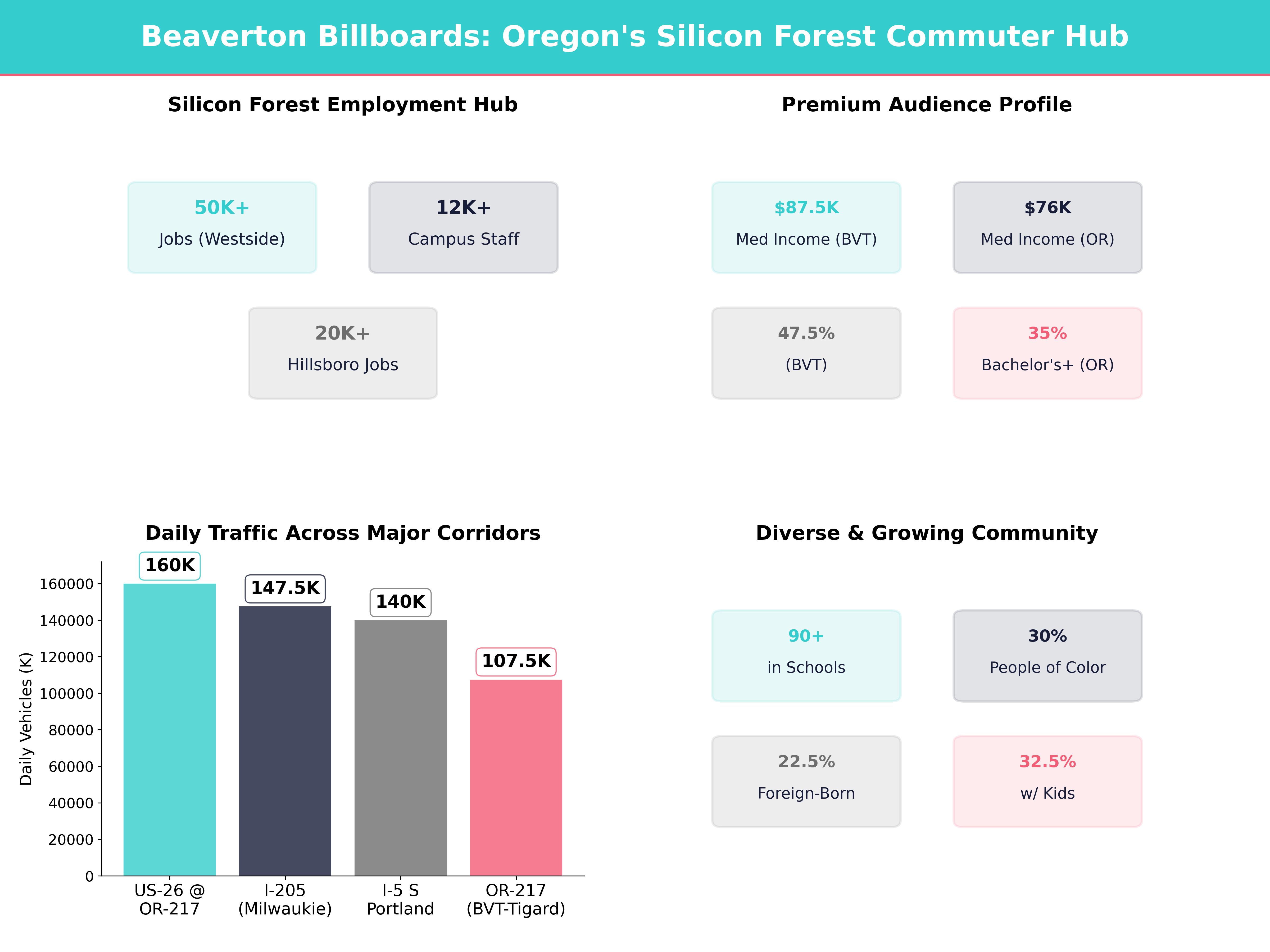
- Median household incomes in the Beaverton area are around $85,000–$90,000, well above the Oregon median (roughly $76,000), reflecting strong spending power for discretionary categories like dining, fitness, and specialty retail.
- Beaverton residents are highly educated: local estimates show that 45–50% of adults hold a bachelor’s degree or higher, compared with roughly 35% statewide, which skews the audience toward professional and knowledge‑economy workers.
- Major employers nearby include Nike’s World Headquarters just north of Beaverton, employing roughly 12,000+ people on its Beaverton campus (Nike World Headquarters) and multiple Intel campuses in neighboring Hillsboro, together supporting over 20,000 local jobs (Intel Oregon), along with a concentration of tech, bioscience, and advanced manufacturing firms documented by the City of Beaverton’s Economic Development office.
- The Beaverton School District serves more than 39,000 students across 50+ schools, according to Beaverton School District, making it one of the three largest districts in Oregon and driving substantial family‑oriented mobility across the area.
- Commuting patterns skew strongly toward driving: regional data from Oregon Department of Transportation (ODOT) and Washington County indicate that 70–75% of workers in the westside suburbs commute by car alone, with another 8–10% carpooling.
- Average one‑way commute times for Beaverton‑area workers typically fall around 25–28 minutes, slightly higher than the national average, meaning your audience spends nearly 5 hours per week on the road—prime time for billboard exposure and a strong fit for Beaverton billboards focused on daily drivers.
What this means for your billboard strategy:
- You’re speaking to affluent, educated, and multicultural audiences: tech professionals commuting to Nike and Intel, families running daily errands, and small‑business owners.
- The Beaverton area is highly car‑oriented, making roadside media especially effective compared with channels that rely on downtown foot traffic only.
- Because this is a “bridge” suburb between Portland and Hillsboro, campaigns can reach cross‑metro travelers going between work, home, entertainment, and shopping in multiple counties.
Why Billboards Near Beaverton (Not Just Downtown Portland) Matter
The three digital billboards serving the Beaverton area are located in Milwaukie, roughly 8.7 miles away. Milwaukie sits southeast of downtown Portland along key travel corridors that connect:
- Beaverton ↔ Portland’s central eastside
- Beaverton ↔ Clackamas and I‑205
- Beaverton ↔ inner Southeast Portland neighborhoods
The City of Milwaukie and Clackamas County report that Milwaukie and nearby unincorporated areas host more than 80,000 residents and a daytime population that swells with commuters heading to industrial, logistics, and retail jobs along the I‑205 corridor.
According to the Oregon Department of Transportation (ODOT), major routes that funnel Beaverton‑area traffic—such as US‑26, OR‑217, I‑5, and I‑205—carry tens of thousands of vehicles per day:
- US‑26 near the interchange with OR‑217: often 150,000–170,000 vehicles per day (AADT).
- OR‑217 between Beaverton and Tigard: commonly 95,000–120,000 vehicles per day on central segments.
- I‑205 between Milwaukie and Clackamas: more than 140,000 vehicles per day, with peaks above 155,000 on the busiest segments.
- I‑5 south of downtown Portland: 130,000–150,000+ vehicles per day, including many westside commuters cutting across the river.
Many of these trips cross the Willamette via downtown or south of the city, then feed into Milwaukie and Clackamas corridors—exactly where your digital billboards will run.
Placing your message on digital billboards near Beaverton in Milwaukie allows you to:
- Reach Beaverton‑area residents who commute through or around Portland toward the east and south.
- Capture reverse commuters who live east of the river and work for Beaverton‑ or Hillsboro‑area employers.
- Connect with shoppers traveling between Beaverton and destinations like Clackamas Town Center (a regional mall drawing more than 10 million visits annually, per Clackamas Town Center), downtown Portland, and inner Southeast Portland.
For advertisers, this often means:
- Lower CPMs than central Portland boards, with comparable or better reach among target local residents who actually shop, live, and work in the suburbs, making these Beaverton billboards a cost‑efficient option.
- Strong presence along “decision corridors”—where commuters choose where to shop, dine, and stop on their way to or from Beaverton‑area destinations.
- The ability to influence both weekday commuter flows and weekend shopping and recreation trips, which often make up 30–40% of weekly traffic on certain corridors, according to regional planning data from Metro.
Who You Can Reach in the Beaverton Area
The Beaverton area is one of the most demographically diverse places in Oregon. The City of Beaverton reports that more than 90–100 languages are spoken in local schools and that over 30% of residents are people of color. In some school clusters, students of color make up 60–70% of enrollment, illustrating just how multicultural the community is.
Key audience segments to consider:
-
Tech and Engineering Professionals
- Thousands work at Nike, Intel, Tektronix, and other Silicon Forest firms; the broader westside tech cluster supports well over 50,000 high‑tech jobs, according to regional economic profiles from Greater Portland Inc.
- Many have higher‑than‑average incomes, often $100,000–150,000+ per household, supporting premium brands, housing, financial services, and lifestyle products.
- Roughly 1 in 4 Washington County jobs is tied to manufacturing or high‑tech, making this one of the most R&D‑intensive areas on the West Coast.
- They commute across the metro, meaning boards serving the Beaverton area from Milwaukie can catch them during cross‑town travel to eastside industrial, logistics, or downtown office clusters.
-
Families and Suburban Households
- The Beaverton School District is Oregon’s third‑largest, with 39,000+ students and more than 50 schools, indicating a dense population of school‑aged children and parents.
- In many Beaverton‑area neighborhoods, 30–35% of households include children under 18, compared with roughly 26–28% nationally.
- Demand is strong for after‑school programs, medical and dental services, automotive services, family restaurants, and youth sports—categories where billboards can directly drive call and web inquiries.
-
Multicultural Communities
- The area features sizable Latino, Asian, and Pacific Islander populations; in some census tracts on the westside, 40–50% of residents identify as non‑white or multiracial.
- Nearly 20–25% of residents are foreign‑born, significantly above the state average.
- The community hosts cultural events like Beaverton Night Market, promoted through the City of Beaverton’s events page, which can attract 10,000+ visitors per season.
- Advertisers can benefit from bilingual or culturally tailored messaging and community sponsorship messaging aligned with these events.
-
Urban‑Suburban Commuters
- Many residents live near Beaverton but work in inner Portland, or vice versa, with regional commute data showing that tens of thousands of workers cross county lines daily between Multnomah, Washington, and Clackamas counties.
- TriMet’s MAX light rail and bus system carries over 200,000 weekday trips system‑wide in typical years, and many Beaverton‑area riders drive to park‑and‑ride facilities before transferring to transit. That “first‑mile” driving segment is a prime billboard touchpoint.
- Commuter flows are bidirectional: significant numbers of eastside residents travel to jobs at Nike, Intel, and other westside campuses, giving you access to both “live west / work east” and “live east / work west” segments.
When we design campaigns for the Beaverton area, we recommend tailoring creative and scheduling to one or more of these segments, instead of trying to speak to “everyone” with one generic message. Thoughtful segmentation will help any billboard advertising near Beaverton feel more relevant and personal to each audience you’re trying to reach.
Traffic Patterns and Optimal Placement Strategy
To make digital billboard campaigns work hard, we focus on where and when people are on the road.
Relevant traffic insights from ODOT and regional planning sources:
- US‑26 (Sunset Highway), the main connector between Portland, Beaverton, and Hillsboro, typically carries 130,000–170,000+ vehicles per day near the interchange with OR‑217, one of the busiest freeway junctions in Oregon.
- OR‑217, serving Beaverton and Tigard, sees around 95,000–120,000 vehicles per day on major segments, with peak‑hour speeds often dropping below 30 mph, which actually increases billboard dwell time for drivers.
- I‑205 near the Clackamas corridor and Milwaukie carries over 140,000 vehicles per day, with heavy commuter flows from the westside and Beaverton area toward Clackamas jobs, warehouses, and shopping centers in Clackamas County.
- The City of Beaverton Transportation System Plan highlights arterial corridors like Canyon Road (OR‑8), Beaverton‑Hillsdale Highway (OR‑10), and Scholls Ferry Road as some of the busiest in the region, with key segments often seeing 30,000–45,000 vehicles per day.
- Combined, Washington and Clackamas counties see well over 5 million vehicle miles traveled (VMT) per weekday, underscoring how central driving is to daily life, based on regional mobility reports from Metro.
Because our digital billboards serving the Beaverton area are in Milwaukie, we advise:
-
Target commuters traveling between Beaverton and:
- Downtown and Southeast Portland
- Clackamas (I‑205 corridor)
- Inner eastside office and industrial districts
- Use directional messaging (e.g., “Tonight in Beaverton,” “On Your Way Home to Beaverton?”) to tap decisions made mid‑commute.
- Split schedules between AM eastbound and PM westbound traffic (or vice versa), depending on where your business is relative to Beaverton.
- Consider that peak congestion can extend 3–3.5 hours in the morning and evening on some corridors, expanding the high‑value window for your blips.
With Blip, you can daypart and route‑select to lean heavier into the times and screens that best match your customer’s journey when using billboards near Beaverton.
Timing Your Blips: Dayparts and Weekparts That Matter
Digital billboards let us purchase exposure in flexible time slices (“blips”), so the when is just as important as the where.
For the Beaverton area, consider:
Weekday Rush Hours (Approx. 6:30–9:00 a.m. and 3:30–6:30 p.m.)
- Regional travel demand models from Oregon Metro show that roughly 55–60% of daily work trips in the Portland region occur during these peak windows.
- Many Beaverton‑area commuters start work between 7:00 and 9:00 a.m. at Nike, Intel, downtown Portland, and southeast industrial areas.
- Rush hour traffic on US‑26, OR‑217, and connecting routes to Milwaukie tends to be heaviest on Tuesday–Thursday, with volumes often 5–10% higher than Mondays and Fridays.
- Best for: B2B services, professional services, transit‑oriented offers, drive‑time radio tie‑ins, and “on your way” messages.
Midday (10:00 a.m.–3:00 p.m.)
- Midday traffic often represents 30–35% of total daily volumes on suburban arterials, driven by errand‑running parents, retirees, gig workers, and flexible‑schedule professionals.
- Good window for restaurants, grocery, healthcare, home services, and retail.
- Because auction competition can be lower than rush hours, your budget can stretch further—often generating 10–25% more impressions per dollar than during peaks, depending on demand.
Evenings and Late Night
- Evening entertainment and dining trips can comprise 15–20% of weekday traffic and even more on Fridays and Saturdays.
- Great for restaurants, entertainment, nightlife, streaming and gaming services, and quick‑serve food.
- Consider pairing with events at venues in the Beaverton area and greater Portland, promoted through organizations like Travel Portland Travel Oregon. Aligning flight dates with major festivals, Timbers/Thorns matches, or theater runs can multiply the impact of your impressions.
Weekends
- Saturday volumes are often near weekday levels on shopping corridors and can exceed weekday averages near major malls and retail centers.
- Data from Tualatin Valley / Washington County tourism show that leisure visitors and local day‑trippers contribute hundreds of millions of dollars in weekend spending annually across Washington County.
-
Use weekends to promote:
- Open houses and real estate
- Auto dealers and service promos
- Weekend festivals, farmers markets, and community events featured by the City of Beaverton and Washington County.
With Blip, you can run higher frequency during high‑value windows and “always‑on” lower‑level coverage at other times to keep your brand present without overspending.
Crafting Effective Creative for the Beaverton Area
Strong artwork is non‑negotiable. For fast‑moving drivers, you usually have 3–6 seconds to make an impression. In practice, that often means drivers can fully process no more than 1–2 key ideas per board viewing.
In the Beaverton area, we recommend:
1. Localized, Relatable Headlines
-
Use clear geographic cues:
- “Your Westside Dentist, Minutes from Beaverton”
- “Beaverton‑Area Parents: Free Exam for New Patients”
- If your physical location isn’t in Beaverton, your copy can still focus on convenience: “5 Exits from Beaverton,” “15 Minutes from Beaverton‑Area Neighborhoods.”
- If you are promoting a specific set of Beaverton billboards, spell out what makes your location convenient (parking, freeway access, or proximity to major employers).
- Brands that use local cues in OOH creative often see 10–20% higher recall, according to industry case studies summarized by the Outdoor Advertising Association of America (OAAA).
2. Bold Visuals That Reflect Local Life
-
Consider imagery that resonates with the region:
- Outdoor lifestyle: hiking, cycling, and wine country trips common in nearby Washington County and the Tualatin Valley.
- Tech and innovation themes that nod to the Silicon Forest.
- Family and community scenes familiar from local coverage by outlets like The Oregonian/OregonLive
- Keep key visual elements large; at 55–65 mph, smaller details become invisible.
3. Minimal Text and Strong Contrast
- Aim for 7 words or fewer in your primary line; field tests in the OOH industry show that messages with <10 words have significantly higher comprehension among drivers.
- Use high‑contrast color combinations that stand out in Oregon’s often overcast conditions (e.g., bright yellows, oranges, whites against dark backgrounds).
- Ensure your logo height is at least 15–20% of the total creative height for readability at distance.
4. Clear Calls to Action for On‑the‑Go Audiences
-
Focus on actions that can be remembered or done quickly:
- Short URLs or memorable domains
- Simple promo codes
- “Exit at [Landmark],” “Off [Highway Name] in Beaverton Area”
- For response‑driven campaigns, aim to feature one primary CTA only; multiple competing CTAs lower response rates.
5. Multilingual and Inclusive Messaging
- Given the Beaverton area’s diversity and the fact that 20–25% of residents speak a language other than English at home, consider bilingual creative for certain campaigns (e.g., English/Spanish, English/Chinese).
- Keep translations short, bold, and legible; prioritize one main language line with a short supporting line if needed.
- If you support multiple languages on your website or phone line, call that out with a compact badge or icon.
With digital, you can easily rotate multiple creatives in one campaign: one for families, one in a second language, one for tech professionals, etc., and let real‑time performance guide budget allocation.
Seasonal and Event‑Driven Opportunities
Beaverton‑area life follows recognizable seasonal rhythms that you can align your campaigns with:
Spring (March–May)
- Homebuying and home improvement activity ramps up; mortgage and real estate data consistently show a 20–30% increase in new listings and buyer activity from winter lows in the Portland metro.
- Good time for real estate, landscaping, remodeling, and outdoor recreation brands.
- Leverage events and local attractions promoted by Tualatin Valley / Washington County tourism, which reports that visitor spending in Washington County has surpassed $700–800 million annually in recent years.
Summer (June–August)
- Families travel more, and traffic to parks, outdoor malls, and regional attractions increases; in many Oregon recreation areas, summer visitation can be 2–3x winter levels.
- The Beaverton area sees numerous community events and outdoor markets; these are well covered on local calendars via the City of Beaverton and regional media.
- Great for quick‑serve restaurants, ice cream shops, outdoor events, festivals, and tourism offerings.
- Extended daylight (up to 15+ hours near the solstice) means more hours where your creative is visible in natural light.
Back‑to‑School (Late August–September)
- Beaverton School District’s large enrollment means heavy spending on school supplies, apparel, extracurriculars, and health checkups; national retail data show back‑to‑school spending often rivals or exceeds $35–40 billion nationwide each year, with strong participation from high‑income suburbs like Beaverton.
- Time‑limited promotions perform well here: “This Week Only,” “Back‑to‑School Sale,” “Sports Physicals – Same Day.”
- Consider aligning with district calendars and sports seasons posted on Beaverton School District.
Fall–Winter (October–February)
- Retail peaks around the holidays; for many merchants, 30–40% of annual revenue can occur in Q4. Traffic spikes near shopping destinations like Washington Square, Cedar Hills Crossing, and Clackamas Town Center.
- During rainy season and shorter days—Portland‑area locations average 150+ days of measurable rain per year—bright, high‑contrast creative is especially effective.
-
Also a strong season for:
- Healthcare and wellness
- Fitness memberships
- Indoor entertainment (movies, bowling, escape rooms, gaming).
- Storms and cold snaps often drive short‑notice purchasing (HVAC, auto repair, home services), where responsive digital billboard swaps can capture urgent demand.
Digital billboard flexibility lets you:
- Switch from one campaign theme to another within minutes, not weeks.
- Run countdown creatives (“3 Days Left for Beaverton‑Area Sale”), especially around sales events or openings.
- Pair campaigns with editorial coverage and promotions from local outlets like KGW or KATU, which can generate short‑term spikes in search and web traffic that your boards reinforce.
Using Blip’s Tools to Reach the Beaverton Area Efficiently
Blip’s platform is built for fine‑grained control in markets like the Beaverton area where cross‑town movement is high.
Ways to leverage it:
1. Geography Targeting
- Choose the Milwaukie boards that best align with the direction and flow of your target travelers to and from the Beaverton area.
- If you know your customers mostly live in Beaverton but work in Clackamas or east Portland, prioritize AM inbound and PM outbound impressions along commuters’ likely paths.
- Combine this with knowledge of key generators (e.g., large employers of 500+ staff, major retail centers, or health campuses) identified by city and county economic development offices.
2. Budget Control
- Set a daily or total campaign budget that fits your goals—anything from test spends of a few dollars per day to larger regional campaigns.
- Increase bids during premium windows (e.g., weekday rush hours) and lower them at off‑peak times to maximize total impressions.
- Because digital OOH can deliver thousands of plays for modest budgets, even local businesses with monthly marketing budgets of $500–$1,500 can maintain a noticeable presence with billboard rental near Beaverton that scales up or down as needed.
3. Creative Rotation and A/B Testing
- Upload multiple designs and let them rotate.
- Test different value propositions: “0% APR,” “20% Off,” “Free Consultation,” etc.
- Over a few weeks, measure which creatives correlate with lifts in web traffic, calls, or store visits (using Google Analytics, call tracking, or POS data).
- Industry benchmarks suggest that strong creative optimization can improve recall and response by 20–40% compared with a “set‑and‑forget” approach.
4. Dayparting and Weekparting
-
Use dayparting to ensure your message appears when your audience is most active. For example:
- Childcare or tutoring: weekdays 2–8 p.m.
- Restaurants and entertainment: evenings and weekends.
- B2B or professional services: weekday morning and midday.
- Adjust weekparting for pay cycles—e.g., running heavier around the 1st and 15th of the month, when many households receive paychecks or benefits.
5. Always‑On Brand Coverage
- Run a low daily budget year‑round near the Beaverton area to maintain continuous awareness.
- Layer in short bursts of heavier spend (e.g., 10–14 days) around openings, sales, or events.
- This “always‑on + bursts” model mirrors approaches used by national advertisers in the Portland market and can smooth out demand swings for local businesses that rely on billboard advertising near Beaverton for steady visibility.
Example Campaign Approaches for Beaverton‑Area Advertisers
To make the strategy concrete, here are hypothetical concepts tailored to the Beaverton area:
Local Dental Practice Serving Beaverton Families
- Target: Parents commuting through corridors between Beaverton and eastside neighborhoods. In many Beaverton‑area ZIP codes, 25–30% of residents are under age 18, expanding the pediatric dental opportunity.
- Schedule: Weekday mornings and late afternoons during school commute times, when school‑related trips can account for 10–15% of local traffic.
-
Creative:
- “Beaverton‑Area Families: Kids’ Check‑Ups This Week”
- Simple URL and phone, smiling family image, high contrast.
- Goal: Drive appointment requests and new‑patient signups by leveraging Beaverton billboards commuters see every day.
Tech Employer Hiring Engineers for a Beaverton‑Area Campus
- Target: Engineers commuting to and from tech hubs across the metro, including tens of thousands of workers in Washington County’s high‑tech sector.
- Schedule: Weekday rush hours plus midday, high frequency for 4–6 weeks.
-
Creative:
- “Build the Future in the Beaverton Area – Now Hiring Engineers”
- Short URL or QR code for careers page.
- Goal: Employer branding and direct applicants, timed with coverage in The Oregonian/OregonLive WorkSource Oregon.
Regional Retailer Launching a New Store Near Beaverton
- Target: Shoppers across westside suburbs and east Portland traveling near Milwaukie; regional mall data show that trade areas commonly span 10–15 miles in the Portland metro.
- Schedule: Heavy two‑week push before and after opening, including weekends, when shopping trips typically spike 20–30% over weekday baselines.
-
Creative Phases:
- Countdown: “New Store Near Beaverton Opens in 7 Days”
- Launch: “Now Open – Grand Opening Specials This Weekend”
- Sustaining: “Your New Beaverton‑Area Store – Exit [Landmark].”
- Goal: Foot traffic, awareness, and cross‑shopping from existing eastside customers using billboards near Beaverton as the primary launch medium.
Measuring and Optimizing Your Campaign
Even though billboards are an offline medium, we can still make them highly accountable:
- Track website traffic lifts during campaign periods vs. baseline, focusing on users from the Beaverton and Portland metro area. A lift of 10–30% in local sessions during your flight is common for well‑executed OOH.
- Use custom URLs or QR codes on creative to see direct response; OOH campaigns that incorporate short, trackable URLs have reported click‑through or visit rates that translate to 0.01–0.05% of exposed audiences taking measurable action.
-
For physical locations in or near the Beaverton area, watch for:
- Increases in walk‑ins or inquiries
- Customers mentioning, “I saw your sign”
- Coupon redemptions tied to billboard‑only offers.
- Supplement with simple brand‑lift surveys or intercepts at your point of sale, asking new customers how they heard about you; many OOH advertisers find that 15–25% of respondents cite billboards when campaigns are active.
Over 4–8 weeks, you’ll typically see patterns emerge that guide future investment:
- Which days or dayparts correlate with biggest lifts?
- Does a particular message significantly outperform others?
- Do certain campaigns pair well with local news, events, or weather (e.g., rainy‑day deals)?
With that feedback loop, you can iterate creative and scheduling, using our digital billboards serving the Beaverton area as a flexible testbed for your broader marketing strategy and future billboard rental near Beaverton.
By combining Beaverton’s strong demographics, high commuter flows, and community‑driven culture with Blip’s precise control over when and where your ads appear, you can build powerful, efficient campaigns that reach the people who matter most. Whether you’re growing a neighborhood business, a regional brand, or a large employer, the Beaverton area offers a uniquely attractive audience—and digital billboards near Beaverton give you the visibility to capture it.