Billboards in Hermiston, OR
No Minimum Spend. No Long-Term Contracts. Just Results.
Trusted by Leading Brands


Billboard advertising
in Hermiston has never been easier



How much is a billboard in Hermiston?
Why Choose Blip for Billboard Advertising in Hermiston
-
Choose Blip in Hermiston to launch fast on I-84 and US 395, where commuter and freight traffic keeps your ad seen without the old-school hassle.
-
Hermiston advertisers can set flexible budgets and only pay when ads run—perfect for testing during Farm-City Pro Rodeo and Umatilla County Fair weeks.
-
No contracts mean Hermiston businesses can pause or scale anytime, ideal for seasonal swings in agriculture, harvest, and summer travel.
-
Use Blip's real-time analytics in Hermiston to see what works on I-84 vs. local arterials, then shift spend toward the best-performing corridor.
-
Blip's creative tools help Hermiston brands build bilingual, family-focused ads that connect with a young, car-based audience on US 395 and OR 207.
Frequently Asked Questions About Billboard Advertising in Hermiston
How much does a billboard cost in Hermiston with Blip?
With Blip, billboard advertising in Hermiston can fit a wide range of budgets because you only pay when your ad actually displays. Pricing starts at just $0.01 per display, and your daily budget guides Blip’s algorithm as it bids for open ad slots. Since cost per blip changes based on time of day, location, and advertiser demand, you stay in control while the system works to keep your advertising efficient.
Where can I advertise with Blip in Hermiston to reach the most traffic?
Hermiston gives us one of eastern Oregon’s clearest billboard opportunities because it combines a growing local population with nonstop regional highway movement on Interstate 84 and US 395. Interstate 84 is the dominant east-west corridor for the area, with count stations commonly in the 23,000 to 33,000 AADT range. US 395 is the market’s main north-south spine, and counts on the busiest Hermiston-area sections generally land in the 15,000 to 19,000 AADT range.
Why is Hermiston a good market for billboard advertising with Blip?
Hermiston is not just a small city with local errands. It is a trade center for western Umatilla County, nearby communities in Morrow County, and cross-border traffic moving through the Columbia Basin, with Hermiston holding about 23.9% of Umatilla County’s residents. That growth matters because more rooftops, more shopping trips, more service demand, and more repeat impressions can make billboard campaigns work harder.
What kind of people do billboards in Hermiston reach?
Hermiston has a relatively young population, with a median age in the low 30s, and about 36% of residents identify as Hispanic or Latino. Mobility patterns strongly favor outdoor advertising, with about 76.6% of workers driving alone to work and about 11.8% carpooling. The average commute is 16.1 minutes, which means many trips are short, repeated, and highly routinized.
When is the best time to run billboard ads in Hermiston with Blip?
Summer is one of Hermiston’s best billboard seasons because temperatures regularly climb into the 90s, local produce identity becomes more visible, road trips increase, and fairgrounds activity intensifies. Spring is also a practical buying season, while fall restores commuter consistency and winter can be strong for illuminated boards during the late-afternoon commute. With Blip’s flexible daily budgets, you can concentrate spending during high-value weeks instead of committing the same amount all month.
Do I need a contract to advertise with Blip in Hermiston?
No, Blip has no long-term contracts or minimum commitments. You can start, pause, or stop your campaign at any time.
How fast can I launch a billboard campaign with Blip in Hermiston?
You can have your campaign live in minutes. Create a free account, select your locations, set your budget, upload your design, and start running once approved.
Where can I advertise with Blip in Hermiston?
Blip has digital billboards in Hermiston. You can browse available locations on a map, choose the ones that fit your audience, and start advertising right away.
Still have questions? Launch a campaign in minutes — no contracts, no commitments.
Start Your CampaignHermiston Billboard Advertising Guide
Hermiston gives us one of eastern Oregon’s clearest billboard opportunities because it combines a growing local population of 19,354 residents in 2020 (roughly 20,000 today) with nonstop regional highway movement on Interstate 84 and US 395, where ODOT traffic counts commonly range from 23,000 to 33,000 AADT and 15,000 to 19,000 AADT, respectively. The Portland State University Population Research Center counted 19,354 residents in Hermiston 2020, and recent local estimates place the city at roughly 20,000 residents while it continues to serve as a retail and service hub for western Umatilla County. Most local trips happen by car, with about 76.6% of workers driving alone, 11.8% carpooling, and an average commute of 16.1 minutes, and Oregon Department of Transportation traffic counts show that the city also benefits from heavy movement on Interstate 84 and the routes connecting Umatilla Boardman Pendleton Eastern Oregon Trade and Event Center Farm-City Pro Rodeo with more than 30,000 fans and the Pendleton Round-Up with roughly 50,000 attendees each year, we get a market where well-placed digital billboards can work for both local businesses and regional brands.
Hermiston Market Overview for Billboard Advertising
Hermiston is not just a small city with local errands. It is a trade center for western Umatilla County, nearby communities in Morrow County 23.9% of Umatilla County’s 80,865 residents.
Population growth and regional pull in Hermiston
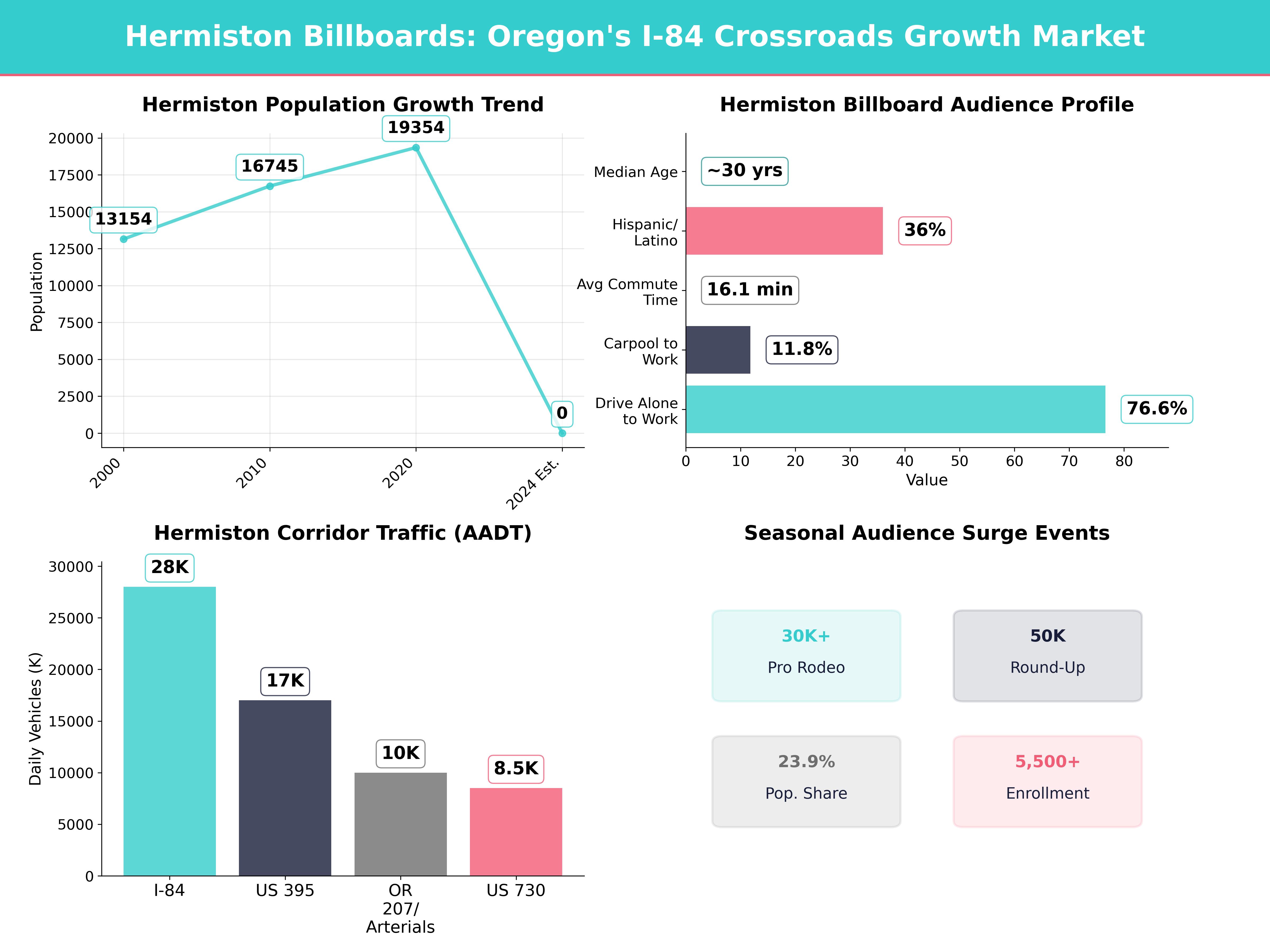
According to the Portland State University Population Research Center, Hermiston grew from 13,154 residents in 2000 to 16,745 in 2010, and then to 19,354 in 2020. That equals 15.6% growth in the last decade, and 47.1% growth since 2000. For billboard advertisers, that matters because growth usually means more rooftops, more shopping trips, more service demand, and more repeat impressions.
The same 2020 count placed Umatilla County at 80,865 residents. That means Hermiston held about 23.9% of the county’s population, or nearly 1 in 4 county residents. In practical terms, a billboard campaign in Hermiston can influence more than just city residents because so much of the county’s shopping, healthcare, and event traffic flows through this market.
Demographics, mobility, and what they mean for advertisers in Hermiston
According to Data USA, Hermiston has a relatively young population, with a median age in the low 30s, and about 36% of residents identify as Hispanic or Latino. That mix makes Hermiston especially strong for family retail, healthcare, schools, telecom, financial services, grocery, and automotive advertisers. It also makes bilingual creative a smart local tactic rather than a niche tactic.
Mobility patterns strongly favor outdoor advertising. Data USA reports that about 76.6% of workers drive alone to work, about 11.8% carpool, and the average commute is 16.1 minutes. Those numbers tell us two important things:
- We should expect strong repeated road exposure because daily life is vehicle-centered.
- We should value frequency because many drivers follow the same short routes every weekday.
On the economic side, the Oregon Employment Department identifies agriculture, food processing, manufacturing, healthcare, retail, and transportation as major pillars in the local labor market. The presence of employers tied to agriculture, distribution, warehousing, food production, and healthcare means billboard messaging can work across several dayparts, including early-morning shifts, mid-day errands, and after-work trips.
Key Traffic Corridors for Digital Billboards in Hermiston
Hermiston’s travel patterns are shaped by a handful of high-value roadways. When we understand which routes deliver commuter frequency and which routes deliver regional reach, we can choose billboard placements more strategically.
Interstate 84 in Hermiston
According to the Oregon Department of Transportation, Interstate 84 is the dominant east-west corridor for the area. Count stations on Hermiston-area segments commonly fall in the 23,000 to 33,000 AADT range, depending on the exact segment and interchange. The busiest areas near the US 395 connection and the split toward I-82 are the most valuable because they combine local traffic, freight movement, and through-travel.
This corridor is especially useful for advertisers that need broad reach, including:
- Travel centers, quick-service restaurants, and convenience brands, because freeway travelers often make immediate stop decisions.
- Hotels, healthcare systems, and regional retailers, because Interstate 84 captures people coming from outside Hermiston.
- Recruiting campaigns, because this route reaches logistics, industrial, and shift-based workers from several communities.
Interstate 84 is also the best fit when we want regional frequency across multiple communities instead of only in-town saturation.
US 395 through Hermiston
US 395 is the market’s main north-south spine, and it is one of the most important roads for in-town and near-town decision making. ODOT counts on the busiest Hermiston-area sections generally land in the 15,000 to 19,000 AADT range. This route connects neighborhoods, schools, retail, medical services, and the freeway system, so it is where we can build repeated familiarity with local residents.
Advertisers that benefit most from US 395 include:
- Healthcare clinics, dental offices, and urgent care providers, because patients often make appointments close to home.
- Auto dealers, tire stores, and home service companies, because drivers on this route are already in an active errand mindset.
- Grocers, banks, and family restaurants, because US 395 captures the same households several times per week.
If our goal is steady local recall inside Hermiston rather than one-time pass-through exposure, US 395 should be near the top of our list.
OR 207 and central Hermiston arterials
OR 207 and the central Hermiston street network matter because they translate freeway traffic into everyday local commerce. Depending on the segment, ODOT and local counts generally place these in-town arterials in roughly the 8,000 to 12,000 daily vehicle range. That level is lower than Interstate 84, but it often delivers better local relevance and stronger same-day action.
These placements are especially useful for:
- Retail promotions, because shoppers can act within minutes.
- Schools, childcare, and youth activities, because family trips cluster along predictable local routes.
- Community events and seasonal offers, because residents read these boards in a local frame of mind.
For many Hermiston businesses, a central arterial board can outperform a freeway board if the objective is foot traffic rather than broad awareness.
US 730 and the Umatilla connection
US 730 links Hermiston to Umatilla Port of Umatilla, and access toward Washington. ODOT counts in this corridor commonly fall around 7,000 to 10,000 AADT, which is lower than Interstate 84 but still meaningful because the audience mix includes workers, travelers, and regional leisure traffic.
This corridor works well for:
- Industrial suppliers and recruiting campaigns, because it reaches port, warehouse, and transportation audiences.
- River recreation, lodging, and casino marketing, because it serves travelers heading toward the Columbia River and nearby attractions.
- Cross-border retail and service businesses, because it helps us intercept movement between Oregon and southeast Washington.
When we want to reach both local workers and non-local travelers without paying for the broadest interstate exposure, US 730 can be a smart middle ground.
Audience Segments We Can Reach in Hermiston
Hermiston’s billboard value comes from the fact that several useful audiences overlap in a compact geography. That overlap lets us build campaigns that feel local without sacrificing regional scale.
Daily commuters and local errand traffic in Hermiston
Because 76.6% of workers drive alone and 11.8% carpool, Hermiston remains a strong commuter and errand-driving market. The average commute of 16.1 minutes means many trips are short, repeated, and highly routinized. For advertisers, that pattern favors frequency over novelty.
We can use this segment for:
- Local retail campaigns that need repeated reminders.
- Healthcare campaigns that depend on trust and familiarity.
- Home services that benefit from top-of-mind recall when a need appears.
This is also the audience most likely to respond well to geographic convenience messages such as “In Hermiston,” “Near downtown,” or “Next right on 395.”
Agricultural, food processing, and logistics workers around Hermiston
The Oregon Employment Department, the Port of Umatilla, the Port of Morrow, and major regional employers all point to the same conclusion: this is a working landscape shaped by farming, food production, freight, warehousing, and support services. That matters because these workers often travel early, travel consistently, and respond to direct utility-driven messaging.
Recruiters, workwear brands, financial services, truck centers, healthcare providers, and quick-service food operators can all benefit from this audience. In Hermiston, practical value often beats aspirational branding, especially on commuter corridors.
Families, students, and education-focused households in Hermiston
The Hermiston School District serves more than 5,500 students, and the city’s young population supports a strong family-oriented consumer base. Blue Mountain Community College also maintains a Hermiston presence that keeps education and workforce-development messaging relevant year-round.
This segment is ideal for:
- Pediatric, dental, vision, and family healthcare campaigns.
- Grocery, retail, and back-to-school promotions.
- Youth sports, enrichment programs, tutoring, and childcare providers.
Because these households make repeated weekday trips tied to school and work schedules, they are especially receptive to consistent digital billboard frequency.
Tourists, eventgoers, and regional travelers near Hermiston
Hermiston also benefits from a meaningful visitor layer. The Farm-City Pro Rodeo regularly draws more than 30,000 fans, and the nearby Pendleton Round-Up attracts roughly 50,000 attendees each year. Hermiston sits about 30 miles west of Pendleton, about 25 miles east of Boardman, about 8 miles south of Umatilla, and roughly 35 miles from the Tri-Cities.
That location gives us access to travelers heading toward:
- The Umatilla County Fair EOTEC
- Wildhorse Resort & Casino and Pendleton event traffic.
- River recreation near Hat Rock State Park.
- Cross-border shopping and service trips between Oregon and Washington.
For tourism, hospitality, dining, and event advertising, Hermiston can function as both a destination market and an intercept market.
Seasonal and Timing Opportunities in Hermiston
Timing matters in Hermiston because traffic is shaped by agriculture, school calendars, event surges, and weather-related behavior. When we align campaign timing with those patterns, billboard dollars usually work harder.
Spring opportunities in Hermiston
Spring is a practical buying season. Agricultural preparation ramps up, employers increase hiring, and households start spending on healthcare, taxes, landscaping, home improvement, and vehicles. We should think of March through May as a strong setup period for:
- Recruitment campaigns.
- Farm supply and equipment support services.
- Tax, insurance, and financial messaging.
- Lawn, garden, irrigation, and home exterior services.
Spring is also a good time to establish frequency before the market gets noisier in summer.
Summer opportunities in Hermiston
Summer is one of Hermiston’s best billboard seasons. Temperatures regularly climb into the 90s, local produce identity becomes more visible, road trips increase, and fairgrounds activity intensifies. We should be especially attentive from late July through August because the Umatilla County Fair Farm-City Pro Rodeo bring visitors, workers, and local families into a tighter attention window.
This is the ideal period for:
- Cold beverages, restaurants, and convenience retail.
- HVAC, auto service, and tire promotions.
- Hotels, attractions, and entertainment venues.
- Healthcare campaigns tied to urgent needs, hydration, or summer scheduling.
Summer is also when bright, high-contrast creative tends to perform well because daylight is intense and road traffic volumes are steady.
Fall opportunities in Hermiston
Fall creates a different kind of value. Back-to-school routines restore commuter consistency, harvest activity keeps roads active, and regional travel grows again around the Pendleton Round-Up in September. This is when we should lean into offers with urgency and utility.
Strong fall billboard categories include:
- Retail and telecom offers tied to school routines.
- Banking and financing campaigns.
- Healthcare enrollment and appointment reminders.
- Truck, tire, battery, and winter-prep services.
Because daily patterns become more predictable in fall, frequency-based campaigns often improve.
Winter opportunities in Hermiston
Winter is less tourist-heavy than late summer, but it is still valuable because road dependence does not disappear. In fact, shorter days can make illuminated boards feel more prominent during the late-afternoon commute, especially from about 4 p.m. to 7 p.m. Winter is a strong window for:
- Holiday retail and restaurant campaigns.
- Healthcare, pharmacy, and wellness messaging.
- Tax-prep, insurance, and financial planning services.
- Home services that want to stay top of mind before spring demand returns.
In Hermiston, winter campaigns usually work best when the message is clear, useful, and locally relevant.
Billboard Design Tips for the Hermiston Market
Hermiston rewards creative that feels grounded, direct, and locally aware. We should not design for a generic urban market when the audience is a mix of local families, practical shoppers, industrial workers, and highway travelers.
Use bilingual and family-centered messaging in Hermiston
Because about 36% of Hermiston residents identify as Hispanic or Latino, bilingual or Spanish-language variants can be especially effective. We do not need every board to be fully bilingual, but we should strongly consider Spanish variants for healthcare, telecom, grocery, family retail, education, and community services.
In this market, we usually get better results from warm, clear, family-centered imagery than from abstract lifestyle visuals. Local audiences tend to respond to credibility, convenience, and value.
Build Hermiston creative around practical relevance
Hermiston is shaped by agriculture, freight, schools, healthcare, and regional travel. That means our strongest creative often uses:
- Color palettes that feel connected to the region, such as harvest gold, produce green, melon red, denim blue, and strong black contrast.
- Visual cues like trucks, fields, families, fairgrounds, western events, and recognizable local-service environments.
- Copy that signals proximity, such as “In Hermiston,” “Next exit,” “Minutes away,” or “Open late.”
For freeway boards, immediate-action language works well because many viewers are making fuel, food, lodging, or service decisions in real time. For in-town boards, trust language works better because repeat exposure gives us time to build familiarity.
Keep Hermiston billboard messages short and directional
Because each digital billboard play is only about 7.5 to 10 seconds, and because many Hermiston placements are read at speed, we should keep the message compact. In this market, one offer, one location cue, and one call to action is usually enough.
A Hermiston-friendly message often includes:
- A recognizable business category.
- A simple benefit or price cue.
- A location cue that reduces decision friction.
That structure fits both local commuters and freeway travelers.
Regional Strategies Around Hermiston
Hermiston works best when we think in zones rather than as a single undifferentiated market. The right strategy depends on whether we want neighborhood frequency, commuter repetition, or regional pass-through reach.
Central Hermiston strategy
Central Hermiston is where we should focus when we want repeated local exposure. This area is best for healthcare, family retail, schools, local restaurants, auto service, and professional services. The audience here is more likely to be residents on routine trips, so our creative should emphasize convenience, trust, and same-day action.
If our store, clinic, or office is within a 5- to 10-minute drive of the board, central placements often make more sense than freeway placements.
South Hermiston and Interstate 84 interchange strategy
The approaches to Interstate 84 are best when we want to combine local commuters with regional traffic. These boards are strong for travel services, chain retail, recruitment, and brands that want larger reach. They are also useful for businesses that depend on customers coming from outside Hermiston.
If our campaign needs both awareness and immediate stop potential, this zone is often the most efficient compromise.
Umatilla and Highway 730 strategy
The Hermiston-to-Umatilla corridor serves a different audience mix. Here, we reach port-related traffic, river-oriented leisure travel, industrial workers, and people moving toward Washington. For campaigns tied to logistics, workforce hiring, river recreation, hotels, or regional service providers, this zone can be highly efficient.
This strategy becomes even more valuable when we want to add reach beyond Hermiston without jumping straight to a multi-county buy.
Boardman, Stanfield, and Pendleton extension strategy
Hermiston sits between several meaningful feeder communities. Stanfield is about 10 miles away, Boardman 25 miles west, and Pendleton 30 miles east. If we need broader regional reach, we should think about sequencing billboards across these corridors instead of relying on a single location.
This broader strategy works especially well for:
- Multi-location retailers.
- Regional healthcare systems.
- Colleges and workforce programs.
- Event, casino, and hotel campaigns.
- Recruiting efforts that pull from several towns.
In a market like Hermiston, a small network of coordinated boards can often outperform one premium board used in isolation.
Using Blip Effectively in Hermiston
Blip’s tools are especially useful in Hermiston because the market has clear traffic peaks, event bursts, and distinct corridor types. We can use that flexibility to match real local behavior instead of buying the same schedule every day.
Budget and daypart strategies for Hermiston
In Hermiston, we should usually start with the dayparts that match the audience we want. Morning commute windows, lunch periods, after-school periods, and late-afternoon drive times all serve different categories.
A practical approach often looks like this:
- We prioritize 6 a.m. to 9 a.m. and 3 p.m. to 7 p.m. for commuter-facing services.
- We add 11 a.m. to 2 p.m. for restaurants, retail, and same-day service businesses.
- We increase evening coverage during fair, rodeo, and event weeks at EOTEC
Because Blip lets us use flexible daily budgets, we can concentrate spending during high-value weeks instead of committing the same amount all month. That is especially helpful in Hermiston, where August and September can produce stronger event-driven returns than slower periods.
Creative testing and local optimization in Hermiston
Hermiston is a strong market for creative testing because the audience changes noticeably by corridor. We can run one version for Interstate 84 travelers, another for in-town family traffic, and a third bilingual version for local service categories. We can then compare which message earns better performance.
Blip’s artwork tools also make it practical to create fast variants for:
- English and Spanish messaging.
- Event-specific offers.
- Seasonal creative tied to harvest, fair, or rodeo traffic.
- Localized location cues such as “Near downtown Hermiston” or “Off I-84.”
That flexibility matters because Hermiston rewards relevance.
Measuring what works in Hermiston
Real-time analytics are especially valuable here because some boards drive repeated local impressions while others deliver wider but less frequent traveler reach. We should evaluate Hermiston campaigns based on the objective we set at the start.
If we want awareness, we should favor consistency on major corridors. If we want immediate response, we should compare boards based on proximity, daypart, and message clarity. In many cases, the winning setup is not the single busiest board. It is the board that matches the right audience with the right decision moment.
Getting Started with Billboard Rental in Hermiston
Renting a billboard in Hermiston should begin with a simple question: are we trying to reach local residents repeatedly, capture freeway travelers, or do both? Once we answer that, the rest of the process becomes much easier.
What to expect when renting a billboard in Hermiston
Traditional outdoor buying in smaller markets often involves fixed terms, phone-based negotiations, and limited flexibility. That can be frustrating in Hermiston because traffic patterns vary so much between commuter corridors, in-town boards, and event-driven routes. A rigid schedule can force us to spend heavily during low-value periods.
With Blip, we can start smaller, test multiple locations, and pay only when the ad actually runs, with pricing that starts at $0.01 per display. That structure is useful in Hermiston because it lets us learn the market before scaling the campaign.
How we should evaluate Hermiston billboard locations
When we compare billboard options in Hermiston, we should look at five things:
- The corridor’s job, because Interstate 84 serves travelers differently than US 395 serves residents.
- The likely audience, because a truck corridor, a school route, and a retail corridor do not behave the same way.
- The direction of travel, because a board aimed at inbound traffic may outperform one aimed at outbound traffic.
- The distance to our business, because a restaurant 2 miles away can use urgency differently than a clinic 10 minutes away.
- The timing of demand, because event weeks, harvest weeks, and school weeks are not equal.
A local medical office, for example, should usually choose repeat exposure close to Hermiston neighborhoods and shopping routes. A hotel, truck stop, casino, or event venue should usually lean harder into Interstate 84 or the routes feeding Umatilla and Pendleton.
A practical launch plan for Hermiston billboard campaigns
We usually recommend a straightforward launch sequence:
- We define the goal first, such as awareness, visits, calls, hiring, or event attendance.
- We choose one or two priority corridors instead of scattering the budget too widely.
- We build concise creative with one message and one location cue.
- We run the campaign for enough time to compare weekdays, weekends, and key dayparts.
- We review performance and shift budget toward the boards and time windows that match our goal.
That process is simpler than the traditional billboard model, and it fits Hermiston especially well because the market rewards testing, local timing, and corridor-specific strategy. When we use those advantages well, Hermiston can deliver dependable billboard value for both hometown businesses and brands that want regional eastern Oregon exposure.