Billboards in Lake Oswego, OR
No Minimum Spend. No Long-Term Contracts. Just Results.
Trusted by Leading Brands


Billboard advertising
in Lake Oswego has never been easier



How much is a billboard in Lake Oswego?
Why Choose Blip for Billboard Advertising in Lake Oswego
-
Blip lets you launch fast in Lake Oswego and reach commuters on Highway 43, I-5, and OR-217 without a sales rep.
-
Set a flexible budget for Lake Oswego billboards and tap affluent shoppers and families near Kruse Way and downtown traffic.
-
Daypart your Lake Oswego ads for 6:30-9:30 a.m. and 3:30-7 p.m. to catch peak commuter flows on 99E and I-5.
-
No contracts means you can test Lake Oswego campaigns around school, retail, and event surges, then shift if needed.
-
Use Blip's real-time analytics and creative tools to refine Lake Oswego messages for rain, weekend lake traffic, and premium audiences.
Frequently Asked Questions About Billboard Advertising in Lake Oswego
How much does a billboard cost near Lake Oswego, Oregon with Blip?
With Blip, you decide exactly how much you want to spend each day on Lake Oswego billboards, and our platform automatically keeps your digital campaign within that budget. Each “blip” is a brief 7.5–10 second display on rotating digital billboards near Lake Oswego, Oregon, and you only pay for the blips you receive. Costs vary based on when you choose to advertise, where the boards serving the Lake Oswego area are located, and overall advertiser demand.
Where can I advertise with Blip near Lake Oswego, Oregon?
With three Blip digital boards nearby—two in Portland and one in Milwaukie within about 10 miles—we can tap into the daily flows of commuters, shoppers, and families who live, work, and play near Lake Oswego. Our three digital billboards serving the Lake Oswego area are strategically positioned in nearby Milwaukie and Portland to intercept daily travel flows. For many brands, this combination of locations becomes a de facto Lake Oswego billboards network that follows residents through their daily routines.
What kind of audience do Lake Oswego billboards with Blip reach?
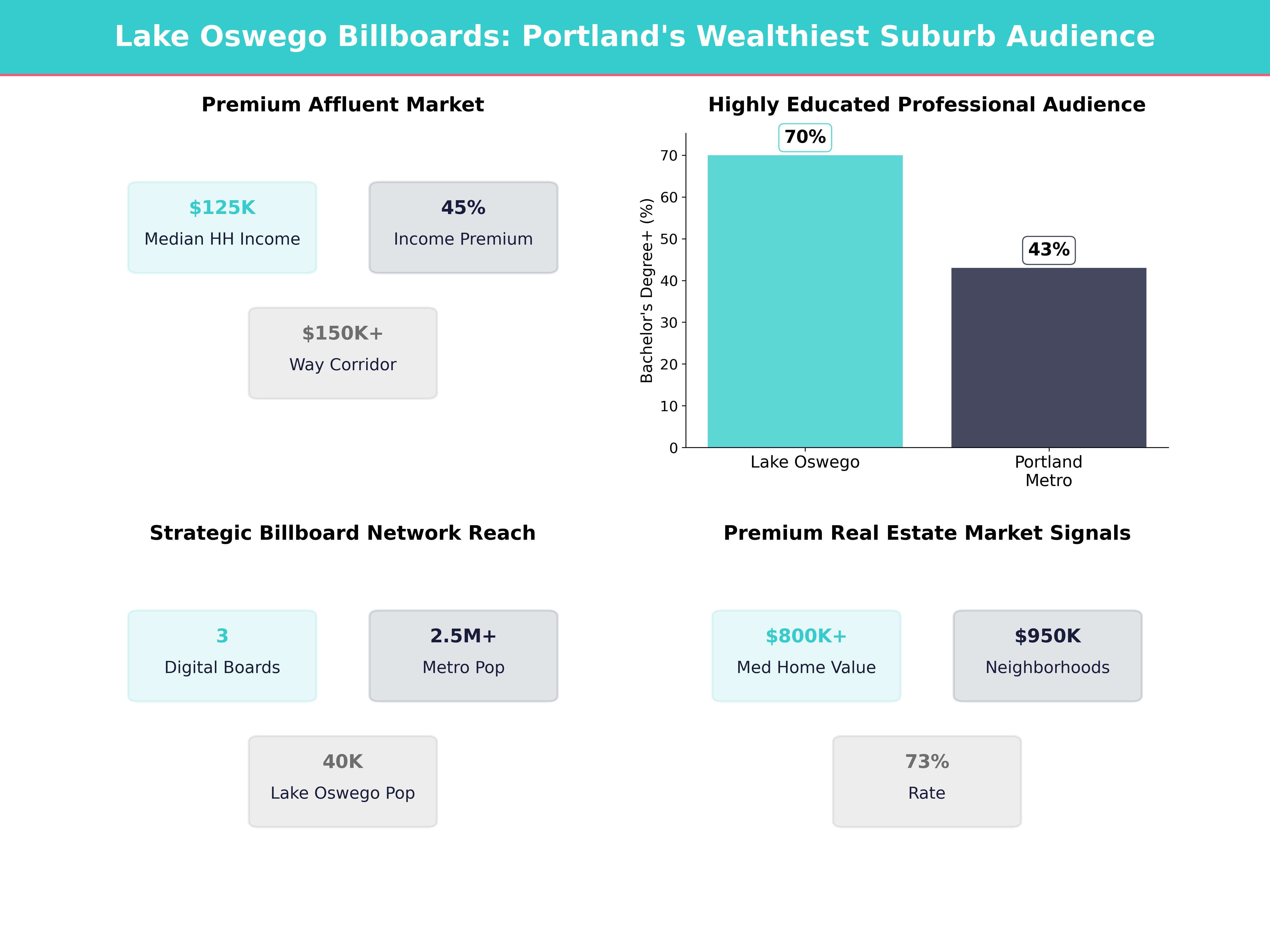
Lake Oswego, Oregon, offers one of the most desirable and affluent audiences in the Portland metropolitan region, and digital billboards serving the Lake Oswego area give us a flexible, data-driven way to reach them. Recent estimates put Lake Oswego’s population at around 40,000–41,000 residents, with a median household income in the $120,000–$130,000 range—roughly 40–50% higher than many surrounding Portland neighborhoods. More than 70% of adults hold a bachelor’s degree or higher, creating a sophisticated audience that responds well to clear, benefit-driven, and premium-leaning messaging.
When should I run a Blip campaign for Lake Oswego commuters?
Lake Oswego–area commuters generate reliable drive-time impressions on Portland and Milwaukie routes. Regional travel surveys show that 50–60% of daily trips occur during morning and evening peaks, making these periods especially valuable. We can adjust Blip scheduling to heavily weight these time blocks, potentially allocating 60–80% of impressions to weekday peaks if commuters are your primary target.
What boards near Lake Oswego get the most traffic for Blip?
Milwaukie sits just east of Lake Oswego across the Willamette River, and busy stretches of OR-99E in this corridor can see 35,000–45,000 vehicles per day. Nearby Portland locations also provide access to I-5, OR-217, and central Portland corridors, which carry hundreds of thousands of vehicles per day. By targeting boards in Milwaukie and Portland that align with Lake Oswego commuters’ paths, we can effectively reach the Lake Oswego area without needing structures inside city limits.
Do I need a contract to advertise with Blip in Lake Oswego?
No, Blip has no long-term contracts or minimum commitments. You can start, pause, or stop your campaign at any time.
How fast can I launch a billboard campaign with Blip in Lake Oswego?
You can have your campaign live in minutes. Create a free account, select your locations, set your budget, upload your design, and start running once approved.
Where can I advertise with Blip in Lake Oswego?
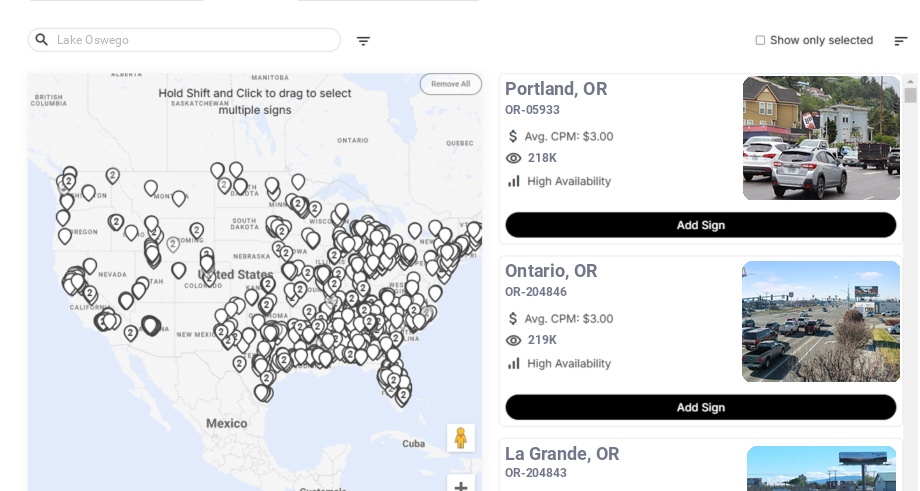
Blip has digital billboards in Lake Oswego. You can browse available locations on a map, choose the ones that fit your audience, and start advertising right away.
Still have questions? Launch a campaign in minutes — no contracts, no commitments.
Start Your CampaignLake Oswego Billboard Advertising Guide
Lake Oswego, Oregon, offers one of the most desirable and affluent audiences in the Portland metropolitan region, and digital billboards serving the Lake Oswego area give us a flexible, data-driven way to reach them. With three Blip digital boards nearby—two in Portland and one in Milwaukie within about 10 miles—we can tap into the daily flows of commuters, shoppers, and families who live, work, and play near Lake Oswego. For advertisers specifically searching for billboards near Lake Oswego, these nearby placements function as Lake Oswego billboards in practice, capturing the same high-value audience along their most common routes.
Understanding the Lake Oswego Area Market
Lake Oswego is a high-income, education-focused community with strong purchasing power—ideal for advertisers who want quality impressions over sheer volume and are considering billboard advertising near Lake Oswego as a way to reach premium prospects.
-
Population & income profile
Recent estimates put Lake Oswego’s population at around 40,000–41,000 residents, with the City of Lake Oswego reporting a median household income in the $120,000–$130,000 range—roughly 40–50% higher than many surrounding Portland neighborhoods. Median family income in some census tracts along the Kruse Way corridor exceeds $150,000. More than 70% of adults hold a bachelor’s degree or higher, compared with roughly 40–45% for the broader Portland metro, creating a sophisticated audience that responds well to clear, benefit-driven, and premium-leaning messaging.Local economic snapshots from the City of Lake Oswego and regional data shared by Metro (the Portland-area regional government) reflect this higher-income, highly educated profile.
-
Commuting patterns
Lake Oswego sits just south of Portland and west of Milwaukie, with many residents commuting for work and services:- The Portland region has an estimated 2.5+ million residents in the metropolitan statistical area, and Lake Oswego is tightly integrated into this labor market.
- In pre-pandemic counts, roughly 70–75% of Lake Oswego workers commuted by car, with 10–15% using transit, walking, or biking. Hybrid work has reduced some daily trips, but regional agencies report traffic volumes returning to 85–95% of pre‑2020 levels on major corridors.
- A significant share of Lake Oswego workers commute to Portland’s downtown and inner eastside via Highway 43, I‑5, and OR‑217, while others travel toward Clackamas and Milwaukie using McLoughlin Blvd (OR‑99E) and connecting arterials.
- Average commute times in the greater Portland area hover around 26–27 minutes, with many Lake Oswego–to–Portland trips falling in the 20–35 minute range. This creates repeated, predictable exposure opportunities on major corridors where our boards are located.
- Regional transit options from TriMet and park-and-ride facilities along I‑5 and 99E also funnel riders past key billboard locations.
-
Local economy & anchors
The City of Lake Oswego highlights strong professional services, healthcare, finance, and retail sectors:- The Kruse Way and Krieger office corridors host hundreds of thousands of square feet of Class A office space, supporting thousands of high-income workers.
- The city regularly reports unemployment rates 1–2 percentage points lower than national averages, reflecting a stable local economy.
- Retail vacancy in desirable submarkets around Lake Oswego and Kruse Way has often been measured in the low single digits (3–6%), signaling strong tenant demand and steady shopper traffic.
Key activity nodes include:
- Downtown Lake Oswego and the Oswego Lake waterfront, where community events and weekend traffic draw both locals and visitors.
- Major grocery and retail centers such as Lake Grove, Bridgeport-area retail to the south (Tigard/Tualatin), and nearby hubs in southwest Portland and Milwaukie. Centers anchored by national grocers typically see tens of thousands of weekly visits, according to regional retail reports.
These patterns mean that audiences from Lake Oswego regularly pass through nearby Portland and Milwaukie where our digital boards are located, making billboard advertising near Lake Oswego highly efficient when boards are placed just outside city limits on these main corridors.
For more background on the community, the City of Lake Oswego and the Lake Oswego Chamber of Commerce both provide helpful local economic and community profiles, including business counts, employment by sector, and event calendars.
Where Our Boards Reach People Near Lake Oswego
Our three digital billboards serving the Lake Oswego area are strategically positioned in nearby Milwaukie and Portland to intercept daily travel flows. When you’re exploring billboard rental near Lake Oswego, these locations provide the closest, highest-impact options for reaching local residents on their normal commutes.
-
Milwaukie (about 4.3 miles from Lake Oswego)
Milwaukie sits just east of Lake Oswego across the Willamette River. Key advantages:- Proximity to OR‑99E (McLoughlin Blvd), a major north–south arterial connecting Oregon City Oregon Department of Transportation (ODOT) reports that busy stretches of 99E in this corridor can see 35,000–45,000 vehicles per day, giving advertisers repeated daily exposure.
- Heavy commuter and retail traffic moving between Clackamas County suburbs and Portland, including shoppers heading to and from Clackamas Town Center, which can attract 10–15 million visits per year according to regional retail estimates.
- Strong exposure to residents of Lake Oswego traveling to Clackamas Town Center, Oregon City, or inner southeast Portland for big-box retail, services, and entertainment.
- Milwaukie’s own population is around 21,000 residents, with thousands more coming in daily via 99E and SE McLoughlin for work and shopping.
Local planning and traffic information from the City of Milwaukie and Clackamas County provide additional detail on corridor volumes and development hotspots, helping refine which billboards near Lake Oswego will see the audience mix you want.
-
Portland (about 7.7 miles from Lake Oswego)
Nearby Portland locations allow us to reach Lake Oswego–area commuters as they head to and from work:- Access to I‑5, OR‑217, and central Portland corridors, which carry hundreds of thousands of vehicles per day. ODOT traffic maps show many freeway segments in the Portland region with average daily traffic (ADT) of 100,000–150,000+ vehicles, and some interchanges exceeding 180,000 vehicles per day.
- Downtown Portland and the Central City employ more than 120,000 workers on a typical weekday, according to city and Prosper Portland data, many of whom travel from south and west side suburbs like Lake Oswego.
- Strong mix of professional commuters, students from institutions such as Portland State University (over 20,000 students), and urban shoppers visiting key districts highlighted by Travel Portland
- Portland proper has a population of roughly 650,000 residents, so boards here can simultaneously reach Lake Oswego drivers and broader metropolitan audiences.
By targeting boards in Milwaukie and Portland that align with Lake Oswego commuters’ paths, we can effectively reach the Lake Oswego area without needing structures inside city limits, while also tapping into the broader audiences documented by the City of Portland and Metro. For many brands, this combination of locations becomes a de facto Lake Oswego billboards network that follows residents through their daily routines.
Key Audience Segments in the Lake Oswego Area
Because Lake Oswego has a distinct demographic profile, message and creative strategy should be tuned to its audience. Understanding these segments helps you decide which billboards near Lake Oswego and which dayparts will deliver the best return.
-
Affluent homeowners & families
- Homeownership rates in Lake Oswego are often reported in the 70–75% range, well above many urban Portland neighborhoods.
- Median home values frequently exceed $800,000, and it is common to see neighborhood medians above $900,000–$1,000,000, especially near Oswego Lake and the Lake Grove area.
- Roughly 30–40% of households are families with children under 18, creating strong demand for quality-of-life services.
- Strong interest in home improvement, landscaping, design, financial services, and private education.
- Responsive to aspirational visuals and language that emphasizes quality, reliability, and long-term value.
-
Professionals & executives
- A large share of employed residents work in management, business, finance, healthcare, legal, tech, and professional services—often 40–50%+ of the labor force.
- Many commute to high-salary job centers along Kruse Way, downtown Portland, the Sunset Corridor tech cluster, and medical campuses like Oregon Health & Science University, which itself employs more than 18,000 people regionally.
- Time-constrained but brand-aware: they respond to concise, polished visuals and clear calls-to-action.
- Good fit for B2B services, high-end consumer offerings, and professional services (law, wealth management, medical/dental, corporate wellness).
-
Active families & youth activities
- The Lake Oswego School District serves roughly 7,000–8,000 students, with schools frequently ranked among the top in Oregon for test scores and graduation rates.
- District graduation rates often exceed 90–95%, outpacing state averages by 10–15 percentage points.
- Youth sports, club teams, summer camps, and academic enrichment programs are heavily utilized; many local families enroll in multiple activities per child each season.
- Businesses offering tutoring, camps, sports programs, healthcare, and family-oriented attractions can benefit from targeted rush-hour and weekend schedules.
-
Local shoppers & lifestyle enthusiasts
- Household retail spending is elevated by both higher incomes and strong preference for local businesses. It’s common for Lake Oswego households to spend 20–30% more than national averages in categories like dining out, fitness, and personal services.
- Downtown Lake Oswego and Lake Grove attract thousands of visitors during seasonal events, with popular festivals drawing 5,000–20,000 attendees depending on the event, according to city and Visit Lake Oswego
- Residents support independent boutiques, restaurants, and services both in Lake Oswego and nearby urban districts.
- Dining, fitness, spa, and cultural offerings can benefit from boards on the routes residents use for shopping and entertainment, making billboard rental near Lake Oswego particularly appealing for these categories.
Local outlets like the Lake Oswego Review and Pamplin Media’s community coverage
Timing Your Blip Campaign for Maximum Impact
One of our biggest advantages with Blip is the ability to schedule ads by hour and day. For the Lake Oswego area, we recommend planning around daily patterns so your Lake Oswego billboards strategy aligns with real-world behavior.
Weekday commuter windows
Lake Oswego–area commuters generate reliable drive-time impressions on Portland and Milwaukie routes. Regional travel surveys show that 50–60% of daily trips occur during morning and evening peaks, making these periods especially valuable.
-
Morning commute (approx. 6:30–9:30 a.m.)
- Capture residents heading toward downtown Portland, the Kruse Way corridor, Milwaukie, and Clackamas.
- Freeway speeds are often reduced to 20–35 mph during this window on segments of I‑5 and OR‑217, giving drivers several seconds of clear billboard visibility.
-
Ideal for:
- Coffee shops and breakfast concepts
- Transit park-and-ride promotions
- B2B, professional services, and recruitment
- Urgent-care, dental, and healthcare reminders (“Call today,” “Same-day appointments”)
-
Evening commute (approx. 3:30–7:00 p.m.)
- Reach people on their way home when they’re making decisions about dinner, errands, and family plans.
- Evening travel typically accounts for 25–30% of daily traffic volumes on key corridors, with higher discretionary spending decisions made in this period.
-
Ideal for:
- Restaurants and delivery
- Retail promotions, grocery deals, and local events
- Fitness and wellness offers
- Home services (“Get your estimate scheduled tonight”)
We can adjust Blip scheduling to heavily weight these time blocks, potentially allocating 60–80% of impressions to weekday peaks if commuters are your primary target. For example, a professional-services campaign might assign 40% of impressions to the evening peak, 30% to the morning, and the remaining 30% to midday.
Midday and off-peak opportunities
-
Midday (10:00 a.m.–3:00 p.m.)
- Strong for retirees, at-home workers, and parents running errands. In many suburban corridors, midday traffic still represents 30–40% of daily volumes while congestion is lower.
- Good window for healthcare, salons/spas, home services, and local retail.
- Lower competition for impressions can stretch smaller budgets further; advertisers can often achieve 10–20% more plays per dollar in off-peak windows compared with heavy commuter periods.
-
Evening & weekend leisure (after 7:00 p.m. and weekends)
- Capture people going out to dinner, entertainment venues, shopping areas, or returning from day trips. Travel and tourism reports for the Portland region show that over 50% of visitor spending occurs on weekends and evenings.
-
Ideal for:
- Restaurants and bars
- Entertainment, theaters, and events
- Tourism-related messaging for Portland, Willamette Valley, and Oregon Coast
Portland-focused visitor outlets like Travel Portland Oregon’s Mt. Hood Territory (Clackamas County tourism) often highlight evening and weekend activities, reinforcing these behaviors.
Seasonal Opportunities Around Lake Oswego
Seasonality in the Lake Oswego area is pronounced, and aligning creative with the calendar can lift performance. The Portland region’s climate sees roughly 36–40 inches of annual rainfall, with about 150+ days of measurable precipitation, which shapes when and how people travel and how frequently they encounter billboards near Lake Oswego on their daily drives.
-
Winter & early spring (January–March)
- Shorter daylight hours (sunset as early as 4:30 p.m. in December and around 6:00–7:00 p.m. by March) and wetter weather, but high commuter consistency—regional traffic data often shows only 5–10% reductions vs. summer.
- Many residents refocus on finances and health; local tax preparers and medical providers see appointment spikes of 20–30% over annual averages.
- Good themes: New Year’s resolutions, tax season services, home organization, and indoor activities.
- Use high-contrast designs to cut through rain and overcast skies.
-
Spring & early summer (April–June)
- Increase in outdoor events, sports, and home improvement. Home-improvement and garden centers frequently report double‑digit percentage sales increases during this period.
- Community events like farmers markets, local festivals, and school-related activities ramp up. The Lake Oswego Farmers’ Market 2,000–5,000 visitors on peak Saturdays.
- Great for landscaping, contractors, garden centers, outdoor recreation, and family attractions.
-
Summer (July–August)
- More leisure travel and regional tourism; some commuters vacation, but local travel and weekend trips spike. Tourism data from Travel Portland shows summer hotel occupancy rates often 10–20 percentage points higher than winter months.
- Emphasize events near the lake, outdoor dining, and regional destinations.
- Tourism-driven campaigns can leverage boards in Portland and Milwaukie to catch both locals and visitors passing through on routes from Portland International Airport (see the Port of Portland) to the Willamette Valley or Oregon Coast.
-
Back-to-school & fall (September–November)
- Back-to-school shopping, extracurricular enrollments, and home maintenance before winter. National retail benchmarks regularly show back-to-school as the second-largest retail season, driving spending spikes on clothing, tech, and supplies.
- Education, tutoring, sports programs, medical/dental checkups, and service businesses (roofing, HVAC, landscaping winterization) perform well.
- Fall community events and sports schedules bring families onto the road in the afternoons, increasing local impression opportunities.
Local calendars from the City of Lake Oswego Parks & Recreation and community organizations can help pinpoint event dates to time short bursts of intensive Blip activity.
Crafting Effective Creative for the Lake Oswego Area
Because Lake Oswego audiences are busy and discerning, creative must be both refined and immediately legible. Effective creative is what turns generic billboard advertising near Lake Oswego into messaging that feels tailored and relevant.
Visual style and tone
-
Clean, premium aesthetic
Reflect the city’s upscale feel:- Minimalist layouts
- High-quality photography
- Limited color palette with strong contrast
- Professional typography
-
Messaging hierarchy
On a digital billboard, we typically get 3–6 seconds of viewing time. Focus on:- A single, bold benefit or headline (ideally 5–8 words; avoid more than 10–12 words).
- A simple call-to-action (e.g., “Schedule today,” “Visit in Lake Grove,” “Order tonight”).
- A short URL or memorable brand name; phone numbers only if very short and easy to remember.
-
Local resonance
Subtle localization signals help build trust:- Reference “serving the Lake Oswego area” or nearby landmarks (“Just off Kruse Way,” “Minutes from downtown Lake Oswego”).
- Use imagery that reflects local lifestyles: families at the lake, active professionals, local parks, and waterfront scenes.
- Mention proximity in minutes (“5 minutes from 99E,” “8 minutes from downtown Lake Oswego”)—drivers often estimate distance this way more than in miles.
Content ideas by sector
-
Home services
- Before/after visuals of home upgrades; studies show visual proof can increase ad recall by 20–30% compared with text-only messages.
- Time-sensitive offers tied to weather (“Prepare for winter storms,” “Summer backyard ready?”).
- Mention neighborhood familiarity (“Trusted in the Lake Oswego area for 20+ years”) to tap into community-oriented decision-making.
-
Healthcare & wellness
- Stress convenience and quality (“Same-day appointments near Lake Oswego,” “Top-rated pediatric care”).
- Use simple icons (tooth, stethoscope, heart) for immediate recognition; iconography can cut comprehension time to under 1 second.
- Feature short benefit phrases: “Less waiting, more caring,” “In-network, close to home.”
-
Education & youth programs
- Emphasize outcomes: “Boost grades this semester,” “Build STEM skills.”
- Include age ranges or grade levels so parents can instantly self-identify.
- For short enrollment windows, highlight dates (“Enroll by Sept. 10”) to create urgency.
-
Restaurants & retail
- High-impact food or product photography—bright color contrast can boost attention by up to 30% in outdoor formats.
- Clear offers: “Happy hour 3–6,” “20% off this weekend.”
- Directional cues: “5 minutes from Lake Oswego,” “Off McLoughlin Blvd in Milwaukie.”
- Include simple icons for services like takeout, delivery, or online ordering.
Using Blip’s Flexibility to Test and Optimize
Digital billboards near Lake Oswego allow us to treat outdoor advertising more like a digital campaign—test, learn, and refine.
A/B testing creative
We can upload multiple designs to run on the same boards and compare performance over time by:
- Tracking web traffic spikes, call volume, or in-store visits around periods when certain creatives run more heavily. Many advertisers see 10–25% swings in response rates between different outdoor creative executions.
-
Testing:
- Different headlines (price-focused vs. quality-focused)
- Different calls-to-action (“Call today” vs. “Book online”)
- With/without special offers
- Local reference vs. generic message (“Lake Oswego families save” vs. “Save today”)
Even small differences—such as featuring a recognizable local reference—can significantly increase recall and conversion, especially in tightly knit communities.
Daypart and day-of-week testing
Because Blip lets us choose exactly when ads run, we can experiment with:
- Weekday-only vs. weekend-heavy campaigns
- Concentrated commuter targeting vs. more balanced schedules
- Promoting different offers by time of day (e.g., lunch vs. dinner specials)
- Shifting impressions toward days that over-index for your category (for example, regional data often shows Thursday–Sunday accounting for 60–70% of restaurant revenue)
For example, a restaurant might allocate 70% of impressions between 3:30–7:30 p.m.**, then adjust based on which days drive the most redemptions or online orders. If Friday and Saturday codes consistently outperform, we can reallocate 10–20% of weekly impressions into those days.
Budget flexibility
With Blip, we can:
- Start small—often with daily budgets comparable to modest social campaigns (for instance, $20–$50 per day)—and scale up proven segments.
-
Increase budget for short, crucial windows:
- 2–3 weeks before a major event or sale
- Seasonal push for home improvement or healthcare
- Back-to-school or holiday shopping periods
This approach is particularly useful for smaller Lake Oswego–area businesses that want to appear on the same major corridors as larger brands without committing to long-term, fixed buys. Many local advertisers begin with a 4–8 week pilot, then increase spend by 25–50% on the best-performing boards and time windows.
Aligning with Local Media and Community Activity
To maximize impact, we can sync billboard messaging with other local media and community moments, turning Lake Oswego billboards into a consistent touchpoint that reinforces what people are seeing and hearing elsewhere.
-
Coordinate with local news and campaigns
When running PR, print, or digital campaigns with outlets like The Oregonian/OregonLive Lake Oswego Review, we can:- Mirror key headlines or taglines on billboards.
- Use the same visual theme and URL for coherent cross-channel branding.
- Time outdoor flights to coincide with feature stories, email campaigns, or sponsored content—brands often see 15–30% higher overall response when channels are aligned.
-
Leverage community events
Use Blip to promote:- Festivals, charity events, and galas
- School fundraisers, sports tournaments, and performances
- Local business promotions or sidewalk sales
Running event-focused creative 7–14 days ahead of time, with heavier impressions in the final 3–5 days, usually produces strong awareness and attendance lift. For large community events promoted by the City of Lake Oswego or Clackamas County, consider doubling impressions in the final 48–72 hours before the event.
-
Public service and civic messaging
Organizations and public agencies serving the Lake Oswego area can use digital boards for:- Safety campaigns (winter driving, wildfire season, water safety).
- Civic engagement (elections, town halls, public meetings).
- Community health and emergency alerts.
Resources such as Clackamas County’s site (https://www.clackamas.us/), the City of Lake Oswego, the City of Milwaukie, and Oregon.gov pages are useful for aligning with public initiatives and awareness months.
Putting It All Together for the Lake Oswego Area
To build an effective Blip campaign serving the Lake Oswego area, we recommend:
-
Define the primary Lake Oswego–area audience segment
- Affluent homeowners, professionals, families, or specific niches like students or seniors.
- Use local data (income, age distribution, school enrollment) from the City of Lake Oswego and Lake Oswego Chamber of Commerce to refine your target and clarify whether you need all-purpose billboard advertising near Lake Oswego or highly niche messaging.
-
Choose boards in Milwaukie and Portland that align with your audience’s most common routes
- Focus on paths to downtown Portland, Milwaukie, Clackamas, or Kruse Way.
- Prioritize corridors with daily traffic volumes above 40,000–50,000 vehicles, as reported by ODOT and local transportation plans.
-
Schedule around behavior
- Heavy commuter dayparting for professionals and school families (targeting the 6:30–9:30 a.m. and 3:30–7:00 p.m. windows).
- Midday and weekend weighting for retail, family activities, and tourism.
- Adjust over time based on which days and hours correlate with tangible response metrics.
-
Design creative for clarity and local relevance
- Simple, premium visuals with strong contrast and a single, clear message; keep total word count to 10–12 words or fewer when possible.
- Local references like “serving the Lake Oswego area” or “minutes from Kruse Way.”
- Include directional or time-based cues (“Off 99E in Milwaukie,” “8 minutes from downtown LO”) to help drivers connect the ad to action.
-
Test, track, and refine
- Run multiple creatives and compare performance over 2–4 week intervals.
- Adjust scheduling and budgets based on measurable response (web traffic, calls, code redemptions, or foot traffic).
- Reinvest incrementally (e.g., +20–30%) into the combinations of message, board, and daypart that consistently produce better outcomes.
By combining a deep understanding of the Lake Oswego area with the precision and flexibility of Blip’s digital billboards in nearby Milwaukie and Portland, we can build campaigns that not only reach this high-value market, but also adapt quickly as we learn what resonates best—turning high-traffic corridors into reliable, data-informed drivers of local business growth for anyone seeking effective billboard rental near Lake Oswego.