Billboards in Salem, OR
No Minimum Spend. No Long-Term Contracts. Just Results.
Trusted by Leading Brands


Billboard advertising
in Salem has never been easier
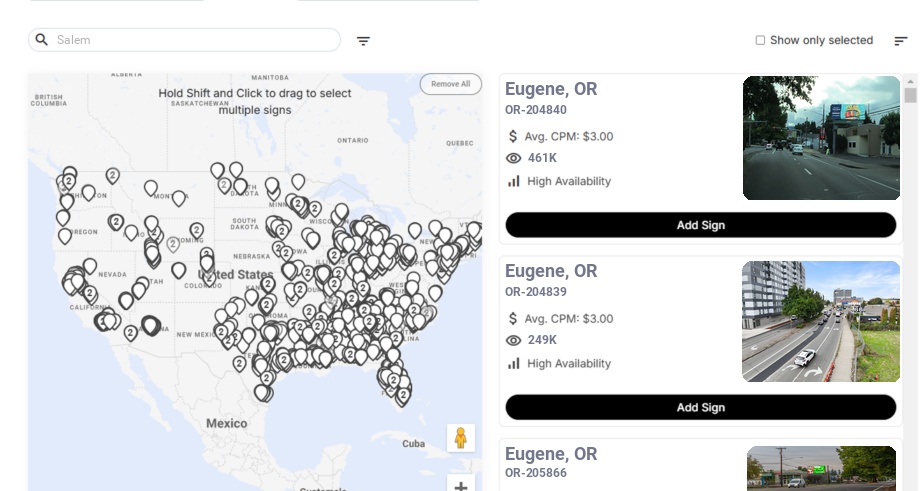
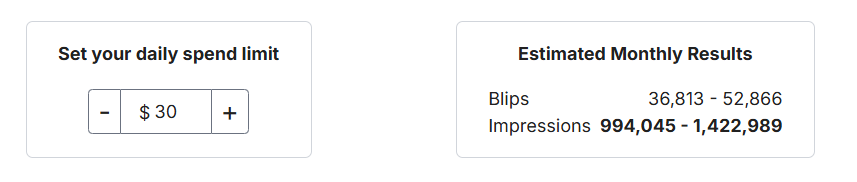
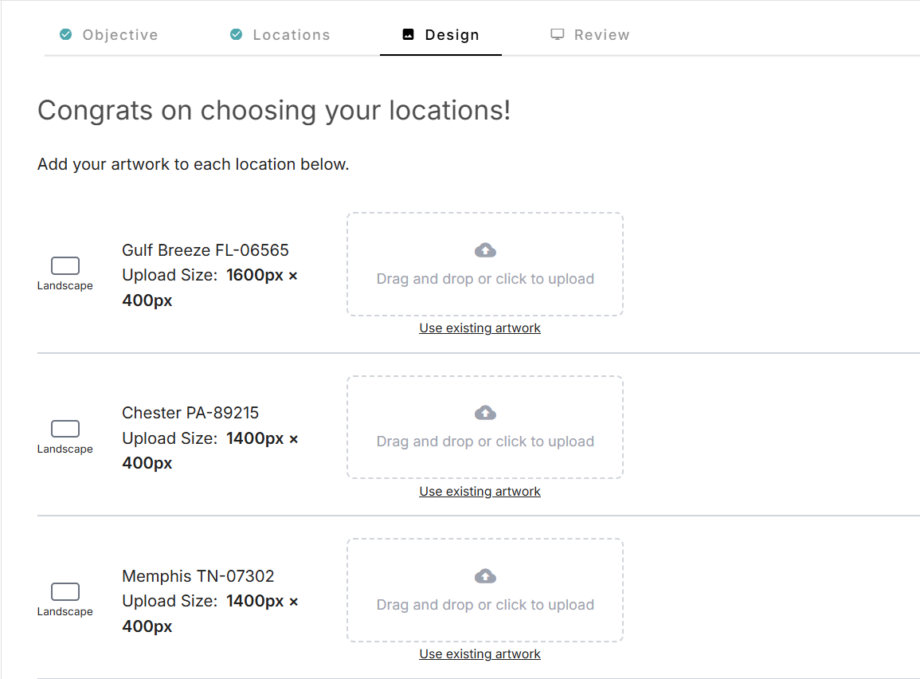
How much is a billboard in Salem?
Why Choose Blip for Billboard Advertising in Salem
-
Choose Blip in Salem to launch self-serve ads fast on I-5, OR 22, or the bridges—no contracts, no fuss.
-
Set a Salem daily budget with Blip and reach commuters on Salem Parkway, Lancaster, and Kuebler only when your ad plays.
-
Daypart Salem campaigns for rush hour, downtown lunch, or weekend Silver Falls traffic to match real travel patterns.
-
Track Salem results in real time and shift spend between Capitol-area workers, families, and visitors as you learn what works.
-
Use Blip’s creative tools to tailor Salem ads for state workers, bilingual households, or fairground-season visitors.
Frequently Asked Questions About Billboard Advertising in Salem
How much does a billboard cost in Salem with Blip?
With Blip, billboard advertising in Salem is designed to fit real budgets. You set a daily budget, and Blip’s algorithm uses it to bid for open ad slots on rotating digital billboards, so you only pay when your ad actually displays. Each “blip” is a 7.5-to-10-second ad, and pricing can vary based on time of day, location, and advertiser demand, starting at just $0.01 per display.
Where can I advertise with Blip in Salem to reach the most people?
Interstate 5 is the biggest reach driver in the market, with Salem-area segments commonly landing in the 90,000 to 110,000+ AADT range. The OR 22 bridge system is another strong option, with roughly 70,000 to 80,000 vehicles per day across the two one-way bridges combined. Salem Parkway, OR 99E, Lancaster Drive, Commercial Street, and Kuebler Boulevard also serve important local traffic patterns.
What makes Salem a strong billboard market for Blip?
Salem gives us a strong billboard market because it combines capital-city stability, steady commuter traffic, and year-round Willamette Valley tourism. The city had 175,535 residents in the 2020 Census, and the two-county Marion County and Polk County market totaled 434,439 residents. More than 75% of workers drive alone, which keeps digital billboards highly visible across daily routines.
When is the best time to run Salem billboard ads with Blip?
Salem is not a one-season market, which is one of its biggest advantages. In odd-numbered years, the long legislative session can last up to 160 days, and in even-numbered years, the short session can last up to 35 days. Spring through early fall is also a major visitor season, and late August and September bring back-to-school and fair-related demand.
How should I target Salem billboard ads for local families and bilingual audiences?
More than 1 in 5 Salem residents identify as Hispanic or Latino, which makes bilingual or bicultural creative a smart option in many categories. Family spending is also a central part of the Salem market, with Salem-Keizer Public Schools serving about 38,000 students. Clear Spanish copy, or paired English-and-Spanish creative rotations, can make a meaningful difference in recall and relevance.
Do I need a contract to advertise with Blip in Salem?
No, Blip has no long-term contracts or minimum commitments. You can start, pause, or stop your campaign at any time.
How fast can I launch a billboard campaign with Blip in Salem?
You can have your campaign live in minutes. Create a free account, select your locations, set your budget, upload your design, and start running once approved.
Where can I advertise with Blip in Salem?
Blip has digital billboards in Salem. You can browse available locations on a map, choose the ones that fit your audience, and start advertising right away.
Still have questions? Launch a campaign in minutes — no contracts, no commitments.
Start Your CampaignSalem Billboard Advertising Guide
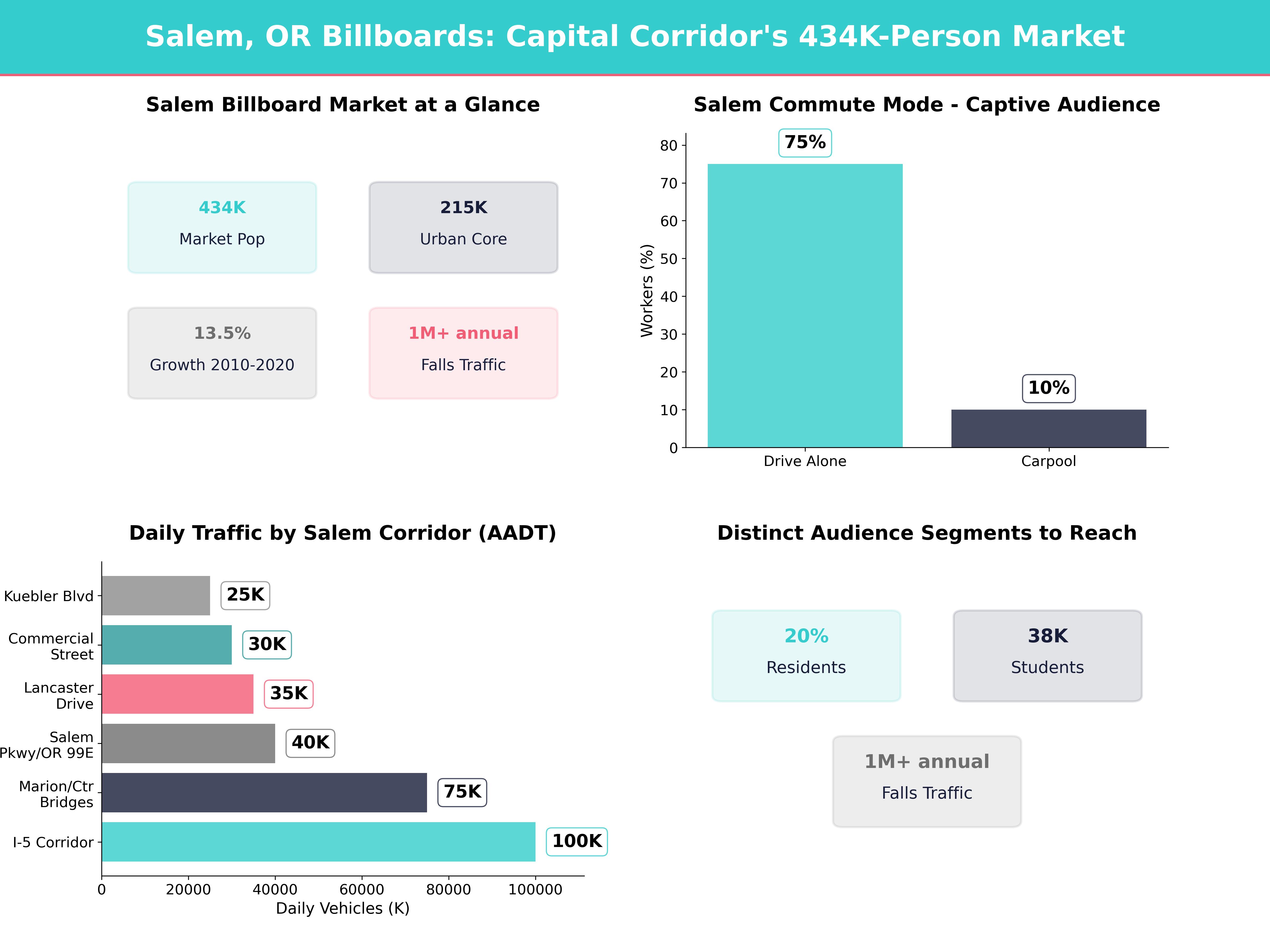
Salem gives us a strong billboard market because it combines capital-city stability, steady commuter traffic, and year-round Willamette Valley tourism, including 1 million+ annual visits to Silver Falls State Park. The City of Salem 175,535 residents in the 2020 Census, and the two-county Marion County and Polk County 434,439 residents. We also benefit from a travel pattern that is still overwhelmingly road based, with more than 75% of workers driving alone and transit use in the low single digits, which keeps digital billboards highly visible across daily routines. Between Interstate 5, the OR 22 river crossing, state-government activity, and visitor traffic heading to places like Silver Falls State Park, The Oregon Garden
Market Overview for Salem Billboard Advertising
Salem is Oregon’s capital and one of the state’s largest population centers, which gives us a market with both local depth and regional pull. The city grew from 154,637 residents in 2010 to 175,535 in 2020, which was an increase of 20,898 people, or 13.5%. In the same decade, Marion County grew from 315,335 to 346,868, and Polk County grew from 75,403 to 87,571. Combined, the two counties increased from 390,738 to 434,439, which was growth of 11.2%.
That matters for billboard advertisers because Salem is not just a single-city buy. It is a two-county trade area with commuters, government employees, students, parents, healthcare workers, and visitors all moving through the same corridors. When we also include neighboring Keizer, which had 39,376 residents in 2020, the Salem-Keizer core alone reaches 214,911 people.
Economically, Salem is unusually balanced for a mid-sized market. We have the stabilizing effect of Oregon state government, major healthcare activity anchored by Salem Health, higher education through Willamette University, Chemeketa Community College, and Corban University, and a surrounding farm-and-food economy that ties the city to the broader Willamette Valley. That mix helps billboard campaigns because demand is not dependent on a single employer or one short tourist season.
Commuting behavior also strongly favors out-of-home advertising. Transportation planning data used by SKATS Salem-Keizer Area Transportation Study 75% of workers drive alone, carpooling is around 10%, and transit use stays in the low single digits despite the presence of Cherriots. That is exactly the kind of market where repeated roadside visibility can outperform channels that rely on people sitting at desks or spending time on one platform.
Salem also has meaningful cultural and language diversity. More than 1 in 5 Salem residents identify as Hispanic or Latino, which makes bilingual or bicultural creative a smart option in many categories, especially healthcare, education, retail, financial services, and community events. For us, the takeaway is clear: Salem rewards campaigns that are geographically precise, commuter aware, and locally relevant.
What Salem’s Numbers Mean for Advertisers
When we look at those numbers together, three strategic advantages stand out.
- We get a city large enough for frequency, but compact enough that a smart mix of corridors can still cover the market efficiently.
- We get population growth that has been solid rather than flat, which helps businesses that need to build brand recognition over time.
- We get a road-first market where billboards fit naturally into how people move through work, shopping, school, and recreation.
Key Traffic Corridors for Digital Billboards in Salem
Salem’s travel patterns are concentrated enough that corridor selection makes a major difference. When we choose locations around the routes that ODOT and SKATS
I-5 Through Salem and Keizer
Interstate 5 is the biggest reach driver in the market. ODOT traffic counts on Salem-area segments of I-5 commonly land in the 90,000 to 110,000+ AADT range, depending on the segment and year. That makes it the strongest option for advertisers who need regional scale rather than just neighborhood exposure.
This corridor works especially well because Salem sits roughly 47 miles south of Portland, and about 65 miles north of Eugene. We can use I-5 to reach residents, business travelers, statewide advocacy groups, shoppers moving between Woodburn
I-5 is especially effective for these categories:
- Regional retail and dining brands can use I-5 to capture travelers before they choose where to stop.
- Hospitals, urgent care centers, legal firms, and colleges can use I-5 for broad awareness across the entire metro trade area.
- Hotels, attractions, and event venues can use I-5 to intercept visitors headed toward downtown Salem, the Oregon State Fair
OR 22 and the Marion Street and Center Street Bridge System
The Willamette River crossing is one of Salem’s defining advertising opportunities. ODOT counts on the OR 22 approaches and the paired Marion Street Bridge Center Street Bridge 70,000 to 80,000 vehicles per day across the two one-way bridges combined. That concentration gives us high-frequency exposure to commuters moving between West Salem, downtown, and the east side.
This corridor is excellent for advertisers that benefit from urgency or local conversion. Restaurants, coffee shops, grocery stores, urgent care providers, entertainment venues, and service businesses all benefit when they reach people who are just minutes from downtown, Salem Center Salem Convention Center, and the state office core.
Salem Parkway and OR 99E
Salem Parkway and OR 99E create a north-south spine through the city’s urban core. On busy segments, ODOT traffic maps often show volumes in the 35,000 to 45,000 AADT range. This is a strong corridor when we want broad local reach but do not need interstate-level geography.
This route is particularly useful for:
- Auto dealers and service businesses that want repeated weekday frequency.
- Healthcare, education, and professional services that want visibility near dense residential and employment zones.
- Event promoters and downtown destinations that need to remind local audiences rather than intercept long-distance travelers.
Lancaster Drive, Market Street, and Silverton Road
East Salem’s retail and residential arteries are some of the most practical billboard buys in the market. Busy sections of Lancaster Drive commonly operate in roughly the 30,000 to 40,000 AADT range, with Market Street and Silverton Road adding heavy neighborhood-shopping flow.
We should think of this area as Salem’s high-volume, high-intent everyday commerce zone. It is excellent for discount retail, telecom, QSR, grocery, family dining, staffing, healthcare, and bilingual campaigns. Because the east side serves a broad mix of households and trip purposes, messages that are clear, price-forward, and action-oriented tend to perform well here.
Commercial Street and Kuebler Boulevard in South Salem
Commercial Street south of downtown and the Kuebler Boulevard beltline are essential for South Salem coverage. Commercial Street segments often sit in the 25,000 to 35,000 AADT range, while Kuebler segments commonly run around 20,000 to 30,000. Those are not interstate numbers, but they are highly valuable because they capture consistent daily-use traffic tied to shopping, schools, healthcare, and neighborhood services.
This area is a strong fit for home services, healthcare, grocery, specialty retail, childcare, fitness, and local institutions. If we have a business in South Salem, a well-placed digital board here can often be more relevant than a broader but less targeted interstate unit.
Audience Segments We Can Reach in Salem
Salem works best when we stop thinking about one generic “local audience” and instead map campaigns to the city’s real movement patterns and economic roles.
Salem Commuters and State-Government Professionals
As the home of the Oregon State Legislature and many state agencies, Salem has a built-in audience of government workers, advocates, legal professionals, consultants, and civic organizations. Oregon’s regular long legislative session in odd-numbered years can run up to 160 days, and the short session in even-numbered years can run up to 35 days. That creates predictable windows when downtown traffic, media attention, and business travel all increase.
For us, that means campaigns for law firms, public affairs groups, B2B services, restaurants, event venues, and professional recruiting can all benefit from heavier weight near the Capitol and downtown during session periods.
Salem Families and Household Decision-Makers
Family spending is a central part of the Salem market. Salem-Keizer Public Schools serves about 38,000 students, making it one of the largest school districts in Oregon. That gives us a huge audience of parents and caregivers making recurring decisions about healthcare, food, after-school activities, tutoring, orthodontics, childcare, and home services.
Family-oriented campaigns also benefit from Salem’s recreational anchors. Minto-Brown Island Park 1,200 acres, and it reinforces Salem’s identity as a place where weekends revolve around parks, youth activities, and practical local errands. When we advertise to families here, convenience matters as much as brand personality.
College Students and Young Adults in the Salem Orbit
Salem is not a classic college town, but it absolutely has a strong student layer. Willamette University, Chemeketa Community College, Corban University, and nearby Western Oregon University 15 miles west of Salem, create multiple academic calendars, move-in periods, athletic schedules, and campus-event cycles.
This audience is valuable for apartments, mobile services, entertainment, food delivery, coffee, healthcare, and entry-level recruiting. It is also highly time sensitive, which makes digital billboard scheduling especially useful around semester starts, graduation season, and major campus events.
Salem’s Visitor and Leisure Audience
Tourism in Salem is more diverse than many advertisers expect. Silver Falls State Park, about 25 miles east of Salem, spans more than 9,000 acres and is famous for the 10 waterfalls on its Trail of Ten Falls. In recent years, the park has drawn well over 1 million visits annually. Nearby Silverton 80-acre Oregon Garden
Closer in, Travel Salem promotes downtown museums, wineries, food, and events, while the Oregon State Fairgrounds Willamette Heritage Center, the Hallie Ford Museum of Art, and the Elsinore Theatre create year-round reasons to visit. That makes Salem billboards attractive not just for local businesses, but also for attractions, hotels, tasting rooms, and regional events.
Salem’s Hispanic and Bilingual Consumer Base
Because more than 20% of Salem residents are Hispanic or Latino, we should treat bilingual creative as a strategic option, not a niche tactic. This is especially true on the east side, in family-oriented categories, and for community-serving businesses. Clear Spanish copy, or paired English-and-Spanish creative rotations, can make a meaningful difference in recall and relevance.
Seasonal and Timing Opportunities in Salem
Salem is not a one-season market, which is one of its biggest advantages. We can keep campaigns active year-round, then intensify them around predictable civic, school, tourism, and retail moments.
Salem Legislative Cycles and Civic Calendars
From January forward, Salem’s government identity becomes a major timing factor. In odd-numbered years, the long session can last up to 160 days, and in even-numbered years, the short session can last up to 35 days. During those windows, downtown boards gain extra value for restaurants, hotels, legal services, advocacy campaigns, media organizations, and professional events.
We also see strong potential around conferences and meetings tied to the Salem Convention Center, the Downtown Salem Association
Salem Spring and Summer Tourism
Spring through early fall is Salem’s most obvious visitor season. We can align with outdoor travel, garden tourism, valley wine trips, and weekend recreation through Travel Salem, Silver Falls State Park, The Oregon Garden Enchanted Forest. Seasonal events such as the World Beat Festival Salem Art Fair & Festival Salem Saturday Market also create excellent local awareness windows.
For us, this is the time to advertise hospitality, entertainment, family attractions, wineries, breweries, outdoor gear, and event tickets. Friday afternoon and weekend dayparting can be especially effective when we want to catch leisure travelers before they commit to a plan.
Salem Back-to-School and Late-Summer Demand
Late August and September are high-opportunity months because several demand cycles overlap. The Oregon State Fair
With about 38,000 students in Salem-Keizer Public Schools, back-to-school campaigns can be powerful for healthcare, tutoring, athletics, orthodontics, restaurants, retail, and wireless. We can also use this window to shift messaging from visitor-oriented summer creative into practical fall offers that match real family behavior.
Salem Holiday and Winter Advertising Windows
Winter in the Willamette Valley changes driving conditions and attention patterns. Days shorten quickly, and sunset arrives before 5 p.m. around midwinter, which increases the value of strong evening-commute visibility. Holiday campaigns can also align with Christmas in the Garden Elsinore Theatre, and convention or banquet traffic.
For us, winter is a strong season for indoor entertainment, healthcare, automotive service, heating and home services, legal help, tax preparation, and practical retail. Salem’s weather often makes comfort, reliability, and immediacy more persuasive than aspirational branding.
Billboard Design Tips for the Salem Market
Good Salem creative should feel like it belongs here. We do not need generic Pacific Northwest imagery when the city already gives us specific visual and cultural cues to work with.
Use Salem-Specific Visual Identity
Salem is the “Cherry City,” the state capital, and a gateway to farms, vineyards, parks, and small-town destinations. Creative that uses cherry reds, deep greens, gold accents, Capitol-dome silhouettes, orchard imagery, bridge motifs, or valley landscape photography can feel immediately more local than generic stock visuals.
We should also think about audience intent by corridor. On I-5, travelers are moving fast and making stop-or-continue decisions. On Lancaster or Commercial, they are in errand mode. Near downtown, they are more likely thinking about government, events, dining, or appointments. Salem rewards creative that reflects those different moods.
Lead with Practical Value in Salem Messaging
Salem is a pragmatic market. State workers, healthcare employees, parents, students, and commuters often respond well to messages that answer a clear question quickly. We should favor lines such as “Open Late in South Salem,” “3 Minutes from Downtown,” “Now Taking New Patients,” or “Exit Here for Fairgrounds Parking” over abstract brand statements.
That does not mean creative has to be bland. It means Salem billboards work best when the headline, location cue, and offer all fit into one fast read.
Consider Bilingual Creative in the Right Salem Zones
Because the city’s Hispanic and Latino population is more than 20%, we should seriously evaluate Spanish-language or dual-language creative, especially on east-side and family-serving routes. Healthcare, schools, workforce training, financial services, grocery, and community events can all benefit from this approach.
We can also rotate language versions by board or by daypart instead of forcing a single ad to do everything at once. In Salem, that flexibility is often more effective than cramming too much text into one design.
Design for Salem’s Weather and Light Conditions
Salem’s gray winter skies and early darkness reward contrast. Bright whites, deep blues, saturated reds, and clean typography generally read better than subtle palettes during the wet season. Seasonal creative should also reflect local emotional cues. Cozy food, dry interiors, warm service, family convenience, and reliability all make more sense here in November than beach imagery or overly summery color stories.
Regional Strategies Across Salem and Nearby Communities
Salem is compact, but it is not uniform. We get better results when we divide the market into functional zones rather than buying it as one blob on a map.
Downtown Salem and the Capitol Mall
Downtown Salem is our best zone for civic audiences, dining, events, and professional services. It is where the Oregon State Legislature, the Salem Convention Center, the Downtown Salem Association
We should prioritize this zone for legal, government relations, trade groups, conferences, nonprofit campaigns, restaurants, arts organizations, and healthcare practices that serve a daytime workforce. Timing matters here as much as geography, especially during session and conference periods.
North Salem, Keizer, and the I-5 Reach Zone
North Salem and Keizer give us broad regional reach. This is the best area for advertisers that need volume from commuters, through-travelers, chain retail customers, and people moving between Salem and the Portland side of the valley. It also helps with campaigns aimed at shoppers headed toward Woodburn Premium Outlets
We should lean into this zone when awareness is the priority and when the advertiser serves people well beyond a single neighborhood.
East Salem and the Lancaster Retail Belt
East Salem is where we often go for practical, conversion-oriented campaigns. The Lancaster corridor is one of the city’s best fits for value retail, family dining, healthcare, staffing, auto services, and bilingual outreach. This area is especially useful when we need to reach diverse households repeatedly through everyday shopping trips.
In many cases, east-side boards can be the workhorse layer that turns a broad Salem campaign into something that actually drives visits.
South Salem and the Commercial and Kuebler Corridor
South Salem works well for neighborhood-scale campaigns with strong household relevance. Healthcare, dental, childcare, fitness, grocery, home improvement, private schools, and local restaurants all fit naturally here. Because these routes serve recurring local patterns, frequency can matter more than sheer traffic volume.
For us, this is where a business with a specific catchment area can stop paying for wasted reach and focus on nearby consumers who are already moving in the right direction.
West Salem and Polk County Feeders
West Salem is essential because river crossings compress so much traffic. It also acts as the front door for commuters and visitors coming from Dallas Monmouth Independence Western Oregon University
This area also helps with weekend leisure travel, especially for people heading toward Polk County wine country, the coast connection, or destinations such as Spirit Mountain Casino.
Using Blip Tools and Capabilities in Salem
Salem is a market where Blip’s flexibility is genuinely useful because the city has several distinct audience rhythms packed into a manageable footprint.
We Can Start with a Salem Corridor Test
A practical way to enter Salem is to test a small cluster of boards instead of overcommitting to one location. We might combine an I-5 unit for broad reach, an OR 22 bridge-area unit for cross-river frequency, and a Lancaster or Commercial unit for local conversion. That approach usually tells us quickly whether the campaign needs more scale, more neighborhood relevance, or a stronger commuter focus.
We Can Daypart Around Salem’s Real Routines
Salem has pronounced traffic waves that fit digital scheduling well. Morning commute periods, lunch hours near downtown and hospitals, afternoon school-and-errand traffic, and Friday leisure travel all create distinct opportunities. Legislative periods, fair dates, and campus move-in windows also justify short tactical bursts instead of one static all-month schedule.
We Can Rotate Creative by Submarket
Because Salem’s zones behave differently, we do not need one message to do everything. We can run broad brand creative on I-5, family-oriented offers on Lancaster, bilingual messaging on selected east-side routes, and destination-focused copy near downtown or the fairgrounds. That is especially helpful in a market where the same business may want to reach both locals and pass-through travelers.
We Can Use Real-Time Feedback to Tighten the Plan
Salem is small enough that optimization can happen quickly. If one corridor is outperforming the others, we can shift budget there. If weekend traffic is stronger than weekday traffic for a tourism offer, we can lean into that. If a particular headline works better in West Salem than on the interstate, we can localize the creative instead of forcing one statewide message everywhere.
Getting Started with Billboard Rental in Salem
Renting a billboard in Salem should start with strategy, not inventory. The city offers enough variety that almost any business can find a fit, but the best-fit board depends on whether we want awareness, immediate visits, event attendance, recruiting, or long-term brand lift.
We Should Define the Job of Each Salem Billboard
Before we pick locations, we should ask one simple question: what single job is this board supposed to do? An I-5 board may be there to build regional awareness. A downtown board may be there to reach lawmakers or office workers. A Lancaster board may be there to drive weekend store visits. A South Salem board may be there to stay top of mind inside a tight service radius.
When we define the job first, location choice becomes much easier.
We Should Evaluate Salem Locations by Trip Type
In Salem, we usually get better results when we match boards to the way people are traveling.
- We should use I-5 when we need the biggest possible regional audience.
- We should use OR 22 and the bridge system when we need repeated exposure to cross-river commuters.
- We should use Lancaster, Commercial, Salem Parkway, or Kuebler when we need shoppers, families, and neighborhood traffic close to a destination.
- We should pay attention to direction of travel, distance to the exit, and likely destination mindset before choosing a board.
We Can Expect a Much Simpler Rental Process
Traditional out-of-home buying often means longer commitments, slower turnaround, and less control over timing. Salem advertisers do not always need that. With Blip, we can test the market, launch quickly, adjust creative for the fair or legislative session, and pause or expand without negotiating a long contract. That is especially valuable in a market like Salem, where timing and geography often matter more than brute-force spending.
We Should Start Small, Measure, and Expand
For many Salem advertisers, a 2- to 4-week pilot across 3 to 5 well-chosen digital boards is a smart starting point. We can compare commute-heavy placements against neighborhood placements, test one practical headline against one brand-forward headline, and let the results tell us where to scale.
Salem is a very workable billboard market because it is large enough to matter, small enough to optimize, and structured around a handful of highly readable travel patterns. When we align our message with Salem’s commuters, families, state-government cycles, and visitor flow, digital billboard advertising here can be both efficient and surprisingly versatile.