Billboards near Santa Clara, OR
No Minimum Spend. No Long-Term Contracts. Just Results.
Trusted by Leading Brands


Billboard advertising
near Santa Clara has never been easier
How much is a billboard near Santa Clara?
Why Choose Blip for Billboard Advertising near Santa Clara
-
Blip lets you launch Santa Clara billboards fast, reaching River Road and OR-99 commuters without contracts or setup hassle.
-
Set a flexible budget on Blip for Santa Clara and scale up around Beltline and I-5 traffic when demand is highest.
-
Daypart your Santa Clara ads for Eugene/Springfield rush hours—Blip puts your message in front of commuters, students, and shoppers.
-
Track Santa Clara campaign results in real time, then pause or adjust as River Road, Valley River Center, and school traffic shifts.
-
Use Blip’s creative tools to build Santa Clara billboard ads that stand out on overcast days and speak to families, workers, and visitors.
Frequently Asked Questions About Billboard Advertising near Santa Clara
How much does a billboard cost near Santa Clara, Oregon with Blip?
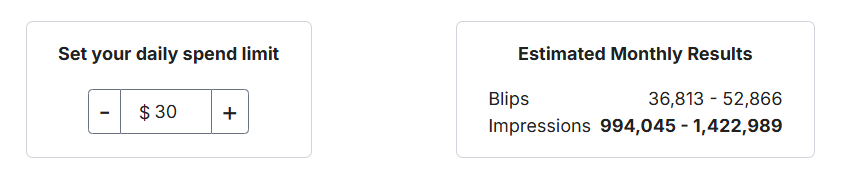
With Blip, you control exactly what you spend on Santa Clara billboards by setting your own daily budget, whether that’s a few dollars a day or more. Each ad “blip” is a short 7.5 to 10-second display, and you only pay for the blips you receive, based on when and where your ad runs and current advertiser demand in the Santa Clara area. Because Blip uses flexible pay-per-blip pricing, your total cost is simply the sum of your chosen blips over time, and you can raise, lower, or pause your budget whenever you like.
Where can I advertise with Blip near Santa Clara, Oregon?
Santa Clara sits at the northern edge of Eugene, blending suburban neighborhoods, shopping corridors, and commuter routes that connect directly to Eugene and Springfield. With 14 digital billboards serving the Santa Clara area from nearby Eugene and Springfield, we can build highly targeted campaigns that follow residents along their most-used roads, shopping areas, and commute paths. Our digital billboards in nearby Eugene and Springfield are positioned along and near these high-traffic routes.
What kind of traffic do Santa Clara, Oregon billboards reach?
Santa Clara’s visibility is built around River Road, OR-99, Beltline Highway, and nearby I-5, which together carry well over 200,000 vehicle trips per day in the Eugene–Springfield area. River Road handles 18,000–25,000 vehicles per day in key North Eugene segments, while Beltline segments routinely exceed 60,000–75,000 vehicles per day. This captures north-south commuting, shopping trips, and regional through-traffic.
Who will see Blip billboards near Santa Clara, Oregon?
Because Santa Clara sits at the junction of suburban and urban Eugene lifestyles, several distinct audience segments are accessible via digital billboards serving the area. These include commuting professionals and public employees, families and homeowners, students and young adults, and visitors and event attendees. The age profile is mixed, with young families, long-time homeowners, and a strong student/young adult presence flowing through from the University of Oregon and Lane Community College.
When is the best time to run billboards near Santa Clara, Oregon with Blip?
With Blip’s pay-per-blip model, campaigns can be aligned with seasonal and weekly patterns rather than running a static schedule year-round. Morning commute, midday, evening commute, and evenings and weekends are all highlighted as useful timing windows depending on the audience. Fall, the holiday season, and spring and summer are especially important periods because traffic, tourism, and shopping activity all rise.
Do I need a contract to advertise with Blip near Santa Clara?
No, Blip has no long-term contracts or minimum commitments. You can start, pause, or stop your campaign at any time.
How fast can I launch a billboard campaign with Blip near Santa Clara?
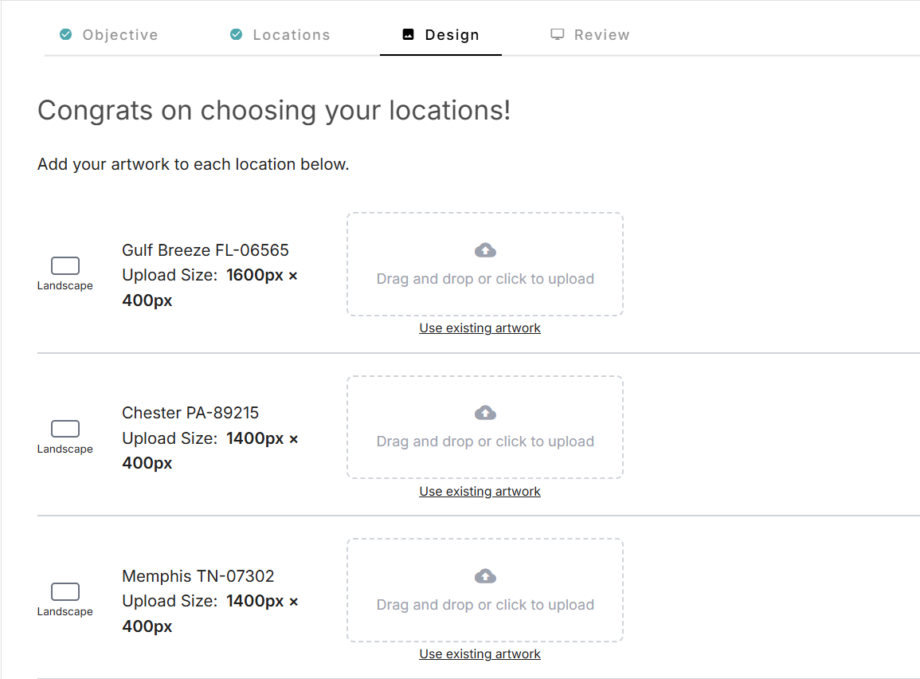
You can have your campaign live in minutes. Create a free account, select your locations, set your budget, upload your design, and start running once approved.
Where can I advertise with Blip near Santa Clara?
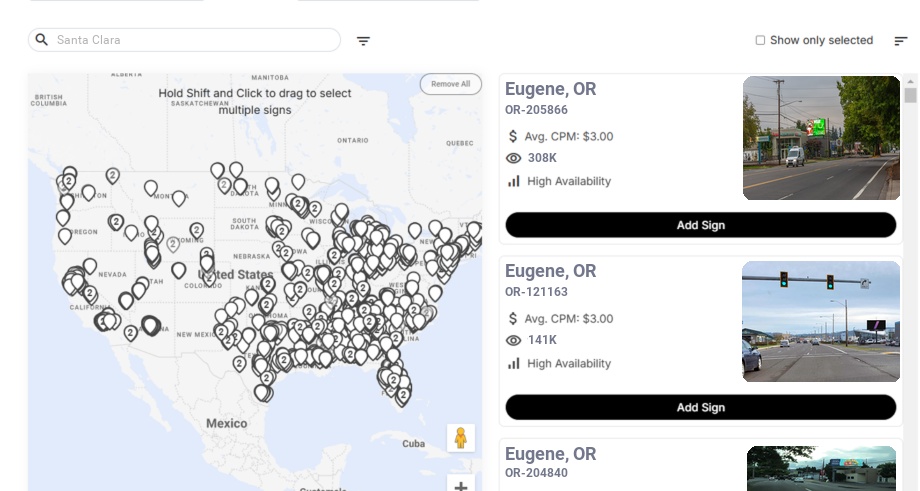
Blip has digital billboards near Santa Clara. You can browse available locations on a map, choose the ones that fit your audience, and start advertising right away.
Still have questions? Launch a campaign in minutes — no contracts, no commitments.
Start Your CampaignSanta Clara Billboard Advertising Guide
Santa Clara, Oregon sits at the northern edge of Eugene, blending suburban neighborhoods, shopping corridors, and commuter routes that connect directly to Eugene and Springfield. With 14 digital billboards serving the Santa Clara area from nearby Eugene and Springfield, we can build highly targeted campaigns that follow residents along their most-used roads, shopping areas, and commute paths. For brands comparing options for billboards near Santa Clara, this mix of residential density and regional connectivity makes the neighborhood especially efficient for reaching both locals and through-traffic.

Understanding the Santa Clara Area Market
Santa Clara is one of the fastest-evolving residential areas near Eugene. While it’s technically an unincorporated community, it functions as a dense, active neighborhood of North Eugene:
- The City of Eugene estimates Santa Clara and neighboring River Road together include well over 30,000 residents, with Santa Clara alone commonly estimated in the 13,000–15,000 resident range, based on neighborhood planning data from the City of Eugene
- The broader City of Eugene has about 180,000–182,000 residents, and Lane County as a whole has just under 390,000 residents, according to recent population estimates in county and city planning summaries from Lane County City of Eugene.
- City neighborhood and housing reports show Eugene’s median household income in the mid–$60,000s (around $63,000–$67,000), with North Eugene/Santa Clara skewing slightly higher than some central neighborhoods because of higher homeownership and more dual‑income households.
- In many North Eugene neighborhoods, homeownership rates top 55–60%, compared with lower rates closer to downtown, and roughly two‑thirds of households in suburban tracts have access to two or more vehicles, according to local transportation and housing summaries.
- The age profile is mixed: young families, long-time homeowners, and a strong student/young adult presence flowing through from the University of Oregon and Lane Community College, which together contribute well over 30,000 students into the daily population.
Because Santa Clara is tightly linked to Eugene and Springfield for work, shopping, and entertainment, billboards near the Santa Clara area reach:
- Daily commuters to downtown Eugene, the University of Oregon, and major employers along I‑105 and Highway 99. The City of Eugene 60–65% of workers drive alone to work and another 8–10% carpool, making roadside media especially impactful.
- Shoppers traveling to big-box and regional retail in Eugene and Springfield, including major centers near Valley River Center, Gateway, and West Eugene that collectively attract tens of thousands of shopping trips each week.
- Students and faculty from the University of Oregon (23,000+ students and around 5,000 employees in recent years) moving between campus, housing, and suburban amenities, and thousands more students from Lane Community College who commute across the metro.
- Visitors drawn by regional events, sports, and outdoor tourism promoted through Travel Lane County / Eugene Cascades & Coast. Recent research from the organization shows that visitors to Lane County generate over $1.2 billion in annual spending and support roughly 13,000 local jobs.
Digital billboards serving the Santa Clara area let us tap into this combined local and regional audience with flexible budgets and precise control over timing and locations. For advertisers evaluating Santa Clara billboards against other local media, this combination of reach and targeting flexibility makes billboard advertising near Santa Clara a strong backbone for an omni-channel strategy.
Key Traffic Corridors and Where Our Boards Matter Most
Santa Clara’s visibility is built around a few crucial corridors that connect directly into Eugene and Springfield, where our 14 digital boards are located. Together, these routes carry well over 200,000 vehicle trips per day in the Eugene–Springfield area, according to the Oregon Department of Transportation (ODOT) and local transportation plans:
- River Road: A primary north–south arterial through Santa Clara into downtown Eugene. City of Eugene transportation documents show key River Road segments in North Eugene handling 18,000–25,000 vehicles per day, making it one of North Eugene’s heaviest‑traveled corridors and a daily touchpoint for Santa Clara residents.
- OR‑99 (Highway 99): Running parallel to River Road just west, ODOT traffic counts commonly fall in the 24,000–32,000 vehicles‑per‑day range near Santa Clara and north Eugene. This is a prime commuter and freight corridor, and a major route for service vehicles, trades, and logistics.
- Beltline Highway (OR‑569): The main east–west bypass that connects Santa Clara and North Eugene to I‑5, Springfield, and West Eugene. ODOT reports show Beltline segments in North Eugene routinely above 60,000–75,000 vehicles per day, with some interchanges among the busiest in Lane County.
- I‑5 Nearby: While not directly in Santa Clara, I‑5 just east of the area records well over 70,000–80,000 vehicles per day through the Eugene–Springfield metro. This captures regional and long-distance traffic, including freight and tourism headed to Portland, Salem, and southern Oregon.
Our digital billboards in nearby Eugene (approx. 4.4 miles from Santa Clara) and Springfield (approx. 7.9 miles from Santa Clara) are positioned along and near these high-traffic routes. This allows us to:
- Capture north‑south commuting between Santa Clara, downtown Eugene, and employment hubs at the Lane County Courthouse PeaceHealth RiverBend Medical Center
- Align campaigns with shopping trips as people travel from Santa Clara to major commercial centers in Eugene and Springfield, including the Valley River Center and Gateway area.
- Reach regional through‑traffic on Beltline and I‑5 that still regularly stops for services, retail, and events in the Santa Clara area and greater Eugene–Springfield, particularly near Eugene Airport and key interchanges.
When planning, it’s helpful to think in terms of these flows: “Where is my audience coming from, and where are they going?” Then we select boards and dayparts that intersect those movements so your billboard advertising near Santa Clara consistently appears along audience travel paths.
Audience Segments in the Santa Clara Area
Because Santa Clara sits at the junction of suburban and urban Eugene lifestyles, several distinct audience segments are accessible via digital billboards serving the area.
1. Commuting Professionals and Public Employees
- The City of Eugene, Lane County Government PeaceHealth together employ tens of thousands of people; local economic summaries regularly cite 30,000–40,000 jobs in government, education, and health services across the metro.
- Regional commuting in the Eugene area is dominated by driving: city and regional mobility studies show around 60–65% of workers drive alone, 8–10% carpool, 10–15% walk or bike, and 5–7% use transit via Lane Transit District.
- Many of these workers live in or pass through Santa Clara, using River Road, Highway 99, Beltline, and I‑105 on a daily basis. That means a typical weekday commuter can easily log 10–20 billboard impressions per week on the same route when campaigns are dayparted effectively.
Implication for campaigns: Advertisers targeting professional services, healthcare, financial services, trades, and recruiting should favor weekday morning (6–9 a.m.) and evening (4–7 p.m.) spots near primary commuter corridors. This is where carefully placed Santa Clara billboards deliver repeated exposure to high-value working audiences.
2. Families and Homeowners
- Santa Clara has historically higher homeownership rates than central Eugene, with more single-family homes, yards, and multi-car households, according to the Santa Clara neighborhood planning materials from the City of Eugene over half of occupied housing units are owner‑occupied.
- Local schools in North Eugene, such as North Eugene High School and several Eugene School District 4J elementary and middle schools, draw predictable daily car traffic before and after school. High schools alone can generate 1,000–1,500 student trips per day, plus staff and family vehicles.
- Family‑oriented venues, from youth sports fields to grocery centers, create regular evening and weekend traffic along River Road and Beltline.
Implication for campaigns: Perfect for home services, family-oriented activities, healthcare, and retail. Afternoon and early evening rotations near shopping routes (especially trips toward Eugene’s commercial hubs) are ideal, and billboard rental near Santa Clara can keep your message in front of the same families week after week as they run daily errands.
3. Students and Young Adults
- The University of Oregon’s student enrollment sits at 23,000+, according to the UO Office of Institutional Research, and Lane Community College serves tens of thousands of students annually across credit and non‑credit programs, with several thousand commuting on any given weekday.
- Students and young adults represent a large 18–29 demographic that is highly mobile. Local transportation plans show this age group is more likely to bike, walk, or use transit, but a majority still drive or ride in cars for regional trips.
- Many students live in North and West Eugene or commute through Eugene–Springfield using Beltline, I‑105, OR‑99, and LTD bus routes.
Implication for campaigns: Entertainment, nightlife, quick-service restaurants, and subscription services should skew to evening and weekend schedules, especially around boards that see traffic heading toward downtown Eugene and campus-adjacent districts like the UO campus, the 5th Street Public Market, and the Riverfront area.
4. Visitors and Event Attendees
- Travel Lane County reports that tourism in the Eugene–Springfield region supports roughly 13,000 jobs and brings in over $1.2 billion in visitor spending annually, driven by track & field events, university sports, wine country tourism, and outdoor recreation. See the regional visitor data from Eugene Cascades & Coast
- Major events at Autzen Stadium, Hayward Field, and the Hult Center for the Performing Arts draw large out‑of‑town audiences. Autzen Stadium crowds often exceed 50,000 fans per game, and international track meets at Hayward Field can draw tens of thousands of spectators across an event week.
- Local event hubs such as the Eugene Saturday Market and downtown concert venues generate regular seasonal visitor spikes.
Implication for campaigns: Hotels, restaurants, attractions, and retail can layer campaigns around known event calendars and weekends, with increased budgets and impressions on travel corridors from I‑5 and Beltline into Eugene’s core. For many of these categories, billboard advertising near Santa Clara is one of the first brand touchpoints visitors see as they enter the metro.
Seasonality and Timing: When to Turn Up Your Blips
With Blip’s pay‑per‑“blip” model, we can align spending with the Santa Clara area’s specific seasonal and weekly patterns rather than running a static schedule year‑round. Seasonal tourism data from Eugene Cascades & Coast shows that visitor volumes and spending can swing 20–40% between off‑peak and peak months, which translates directly into different levels of roadside traffic and purchase intent.
Seasonal patterns to consider:
-
Fall (September–November):
- University of Oregon fall term and football season bring a surge of students, parents, and fans. Autzen Stadium (just a few miles south of Santa Clara) hosts crowds often exceeding 50,000 per game, adding thousands of extra vehicles onto I‑5, Beltline, and local arterials on game days.
- Lodging occupancy during home games regularly jumps 10–20 percentage points compared with non‑event weekends.
- This is prime time for housing, insurance, food & beverage, and entertainment campaigns.
-
Holiday Season (November–December):
- Regional shopping trips rise sharply; Eugene–Springfield retail centers report some of their highest foot traffic and sales during this period, with many retailers seeing 20–30% of annual revenue in the November–December window.
- Traffic counts around major retail nodes can spike by 10–15% on key weekends.
- Retailers, e‑commerce brands, and service providers can use higher‑frequency blips, especially evenings and weekends, on boards serving major shopping and dining routes.
-
Spring & Summer (April–August):
- Outdoor recreation and tourism peak, fueled by the region’s rivers, trails, and proximity to the coast and mountains. Visitor spending in Oregon’s coastal and Willamette regions typically peaks in July–August, and Lane County mirrors that pattern.
- Major track and field events at Hayward Field and other sports events bring national attention, increasing hotel and restaurant demand.
- Ideal for lodging, recreation, outdoor gear, festivals, and family activity promotions.
Weekly and daily timing:
Using Blip, we can set campaigns to run only during the hours that matter. For the Santa Clara area, we typically consider:
-
Morning Commute (6–9 a.m.):
- High visibility to workers leaving residential neighborhoods in Santa Clara and heading into Eugene and Springfield. In many North Eugene corridors, a substantial share—often 30–40% of daily traffic—occurs in the combined morning and evening commute windows.
- Best for professional services, healthcare, education, and traffic‑driving messages with clear calls to action (“Call today,” “Open at 8 a.m.”).
-
Midday (11 a.m.–2 p.m.):
- Captures lunch traffic and mid‑shift errands. For many restaurants and retail centers, midday can represent 25–35% of weekday transactions.
- Strong for restaurants, quick‑service, coffee shops, auto services, and appointment‑based businesses.
-
Evening Commute (4–7 p.m.):
- Heavy cross‑town travel between Eugene and Springfield and back to Santa Clara; in some segments, p.m. peak‑hour volumes rival the morning rush.
- Effective for retail, grocery, childcare, gyms, and reminders to visit after work.
-
Evenings & Weekends:
- Best for entertainment, dining, nightlife, and big‑ticket discretionary spending. Weekend days often see higher average trip lengths as people travel farther for shopping and leisure, making freeway and Beltline boards particularly valuable.
- If your business is near one of the main retail corridors people reach after driving through the Santa Clara area, we can concentrate impressions here.
Crafting Creative That Works for the Santa Clara Area
Because our boards serve a mix of commuters, families, and students, we should keep creative clean and impactful. National outdoor advertising benchmarks show that creative adhering to best practices can improve ad recall by 20–40% compared with cluttered designs.
1. Design for Quick Comprehension
Drivers on Beltline or OR‑99 have seconds to absorb your message. Based on industry best practices:
- Use 7 words or fewer for your main headline; studies from major OOH networks indicate that recall drops sharply beyond 8–10 words.
- Prioritize one key message and one clear call‑to‑action (CTA).
- Make your logo and brand name large and high‑contrast; on digital boards serving Santa Clara, a logo height of at least 1/6 of the creative height is typically advisable to maintain readability at 400–600 feet viewing distance.
2. Match Visuals to Local Identity
Santa Clara audiences recognize and respond to local context:
- Incorporate subtle references to local landmarks (Willamette River, nearby bike paths, Autzen Stadium skyline, or the region’s evergreen landscape).
- Use color palettes that stand out against Oregon’s often overcast skies—bright warm colors (yellow, orange, clean white) can outperform muted tones, with tests frequently showing 10–20% higher recognition for high‑contrast designs.
- If you’re a local business, including a simple line like “Just south of Santa Clara on River Road” or “10 minutes from Santa Clara” grounds your message and improves recall.
3. Tailor Messages to Santa Clara Lifestyles
Different segments see your boards at different times and for different reasons:
- Families: Emphasize convenience, savings, and trust (“Family dental care minutes from Santa Clara”). Many family‑focused categories—like healthcare and grocery—see repeat weekly or monthly visits, so sustained billboard presence builds familiarity.
- Students/Young Adults: Highlight deals, experiences, and digital CTAs (“Scan to get 20% off tonight” with a large, scannable QR code near the edge of your creative for stopped or slow traffic areas). QR code usage has grown sharply in recent years, with national surveys showing 40%+ of consumers scanning at least one code per month.
- Commuters: Focus on top‑of‑mind awareness and problem‑solving (“Plumbing emergency? Save this number.”). Professional and home‑service brands often see uplifts in direct and branded search volume of 10–30% during sustained OOH campaigns.
4. Take Advantage of Digital Flexibility
Because Blip uses digital boards, we can:
- Rotate multiple creatives within one campaign (e.g., 3–6 versions) to test which messaging drives more response.
-
Run daypart‑specific creative:
- Breakfast imagery in the morning, dinner at night.
- “Call today” during office hours; “Visit our website now” after hours.
-
Update messages for events and news:
- React to local stories from outlets like the Register-Guard KEZI 9 News, or KLCC with contextually relevant creative (“Game day special” during UO sports coverage, for example).
- Tie into event calendars from Eugene Cascades & Coast to feature timely offers during high‑visitor weekends.
Using Geography Strategically: Where to Emphasize Blips
With 14 digital billboards serving the Santa Clara area from Eugene and Springfield, we can distribute impressions intelligently based on your goals. For many advertisers, reaching the same driver 3–5 times per week is a useful starting benchmark for building awareness.
1. Hyper‑Local Santa Clara and North Eugene Focus
If your business is physically located in or near Santa Clara, we recommend:
- Prioritizing boards nearest to River Road, Highway 99, and Beltline access points that residents use daily. These routes channel much of the 18,000–30,000 daily vehicles moving in and out of the neighborhood.
- Running higher frequency during school and commuting windows to reach repeat local drivers; a well‑structured schedule can reach the same local commuter dozens of times per month.
- Emphasizing “nearby” language and simple directions (“3 minutes from Beltline on River Road”) to capture spur‑of‑the‑moment decisions.
This approach ensures that billboards near Santa Clara function almost like large-format neighborhood signage, reinforcing proximity and ease of access.
2. Metro‑Wide Brand Awareness
If you serve the entire Eugene–Springfield metro:
- Spread impressions across boards in Eugene and Springfield, including corridors that connect Santa Clara to downtown Eugene, the Glenwood area, and Springfield’s Gateway district, which is another retail and lodging hub.
- Use generic metro references like “Serving the Santa Clara area and all of Eugene–Springfield” to connect your brand to both the neighborhood and the broader region.
- Maintain steady baseline coverage, then temporarily increase budgets around peak retail or event periods (home football games, major concerts at the Hult Center, large track meets at Hayward Field).
3. Destination and Attraction Campaigns
For attractions, recreation, or hospitality:
- Focus on boards that catch I‑5 and Beltline traffic heading into Eugene and Springfield, as well as routes that locals from Santa Clara use to reach entertainment districts and the downtown riverfront.
- Use distance‑based messaging (“Exit in 2 miles,” “10 minutes from downtown Eugene,” or “Short drive from the Santa Clara area”) to convert drivers into visitors. Clear, succinct wayfinding has been shown to increase stop‑in behavior for roadside attractions and services by 5–15%.
- Coordinate with visitor patterns through Eugene Airport and key gateways highlighted by Travel Lane County to time campaigns when visitor arrivals spike.
For many of these destination campaigns, flexible billboard rental near Santa Clara lets you scale up quickly during peak season and scale down when visitor flows ease.
Leveraging Local Events and Media Cycles
The Eugene–Springfield region has an unusually strong event calendar for a metro of its size, amplified by coverage from:
- Register-Guard
- KEZI 9 News
- KLCC Public Radio
- Event listings via Eugene Cascades & Coast
Events that should influence your Blip scheduling include:
- University of Oregon home football games (fall):
Each game can bring tens of thousands of visitors and millions of dollars in local spending, with visible increases in hotel occupancy, restaurant lines, and freeway traffic. - Major track and field events at Hayward Field:
National and international meets can stretch across 4–10 days, creating sustained demand for lodging, dining, and shopping. - Festivals and cultural events (Eugene Saturday Market, downtown art events, concerts):
The long‑running Eugene Saturday Market alone attracts thousands of visitors on busy Saturdays during its main season.
We can coordinate campaigns to:
- Start 7–10 days before a major event to catch planning and booking behavior, when visitors are searching for hotels, restaurants, and things to do.
- Peak during the event week or weekend with higher frequency and event‑specific messaging (for example, “Game Day Parking Special” or “Show your ticket for 10% off”).
- Shift creative after the event to encourage repeat visits (“Loved your trip? Visit our showroom in the Santa Clara area” or “Locals’ special this week only”).
Budgeting and Frequency Recommendations
Blip’s model lets us start small and scale as results come in. For businesses targeting the Santa Clara area, consider:
-
Test Phase (2–4 weeks):
- Modest daily budget targeted to 3–6 of the most relevant boards along River Road, OR‑99, Beltline, and I‑5 approaches.
- Focus on one or two strong time windows (e.g., morning and evening commute), where combined peak hours can represent 40%+ of daily traffic.
- Rotate at least 3 creative variations to see which produces more web traffic or store visits.
-
Scale Phase (following 4–12 weeks):
- Increase budgets on top‑performing boards and time slots, aiming for a frequency where frequent‑route drivers see your message 3–7 times per week.
- Maintain a minimum exposure such that, for typical traffic volumes, an average commuter might see your message dozens of times over a month‑long campaign.
- Expand to more boards in Eugene and Springfield if you’re seeking metro‑wide brand familiarity and want to reach additional corridors feeding in from West Eugene, Glenwood, and Gateway.
Since actual impression counts and pricing are dynamic, we encourage advertisers to monitor performance alongside basic metrics like:
- Changes in direct and branded search traffic (via your web analytics).
- Coupon or QR code redemptions tied specifically to billboard creative.
- Store foot traffic or call volume trends aligned with your on/off dates.
- Geographic shifts in customer origin, particularly from ZIP codes in and around Santa Clara and North Eugene.
Taken together, these indicators help refine how you use Santa Clara billboards over time, guiding which boards you rent, how long you appear, and which messages produce the strongest return.
Measuring Success in the Santa Clara Area
Even without individual‑level tracking, we can measure impact effectively:
- Before‑and‑after analysis:
Compare weekly sales, calls, or inquiries in the Santa Clara area for 4 weeks prior to your Blip campaign, during the campaign, and 4 weeks after. Look for percentage changes (for example, a 10–20% uplift in calls during the campaign window). - Geography‑based signals:
If you draw customers from specific ZIP codes around Santa Clara, track changes in customer addresses or service calls from those ZIPs during active billboard periods. Even a 5–10% increase in orders from local ZIPs can be significant for high‑value services. - Offer codes and URLs:
Use short, memorable URLs (“BrandNameSC.com”) or promo codes (“SANTACLARA10”) visible only on your billboards to quantify response. A small but trackable redemption rate (for example, 0.5–2% of exposed customers) can represent a strong return if your average transaction value is high. - Search lift:
Monitor branded search impressions and clicks for your business name within the Eugene–Springfield region during campaign windows. Many advertisers see double‑digit percentage increases in branded search volume when OOH is active and creative is clear.
Over time, we can refine which boards, times, and creative combinations reliably move these indicators upward.
Putting It All Together
Digital billboards serving the Santa Clara area give us a powerful way to reach:
- Commuters moving between Santa Clara, Eugene, and Springfield.
- Families and homeowners along River Road and Highway 99.
- Students, visitors, and event‑goers passing through the region.
By combining:
- Local audience insight backed by city, county, and tourism data,
- Strategic use of our 14 digital billboards near Santa Clara,
- Carefully timed dayparting and seasonal budgeting, and
- Simple, locally grounded creative,
we can turn flexible Blip campaigns into a consistent driver of awareness and action for businesses that depend on customers in the Santa Clara area. Whether you are testing billboard advertising near Santa Clara for the first time or scaling an established presence with additional billboard rental near Santa Clara, the same data-driven approach applies.
When we align our digital billboard strategy with how Santa Clara residents and visitors actually move through the Eugene–Springfield region, Blip becomes one of the most efficient tools available for getting in front of the right people at the right time—often delivering millions of impressions per month across the full network when budgets and schedules are set correctly.