Utah Billboards
No Minimum Spend. No Long-Term Contracts. Just Results.
Give your brand a joyful jolt with Utah billboards that pop, sparkle, and get noticed. With Blip, you pick the map, set any daily budget, choose your timing, and launch bold billboards in Utah with ease.
Trusted by Leading Brands


How much does a billboard cost in Utah?
Why Choose Blip for Billboard Advertising in Utah
Choose Blip in Utah to launch digital billboard campaigns yourself and tap major corridors like I-15, I-80, and I-215 without the usual buying hassle. It’s a fast fit for a state where commuters, airport travelers, and Wasatch Front traffic move all day.
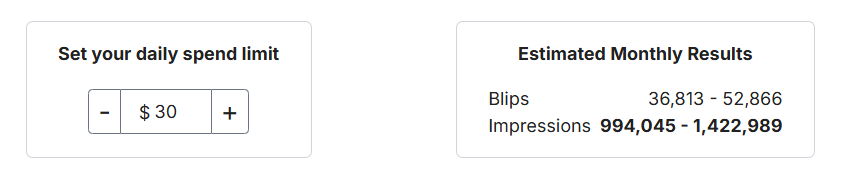
With Blip, Utah advertisers can set flexible daily budgets and scale up or down as needed, whether you’re reaching Salt Lake County commuters or testing demand in Utah County’s Silicon Slopes growth zone. No minimums or contracts make it easy to start small and adjust as results come in.
Utah’s traffic shifts by time of day and season, and Blip’s dayparting lets you match your message to the moment. Run commuter-focused ads on weekday I-15 rush hours, then switch to ski, convention, or summer road-trip messaging when Utah’s audience changes.
Use Blip’s real-time analytics to see how your Utah billboard campaign performs across high-volume routes and visitor corridors, from the Salt Lake City airport belt to southern Utah travel routes near St. George. That makes it easier to refine spend based on what actually drives engagement.
Blip’s creative tools help you build Utah-ready billboards that feel local, whether you’re speaking to suburban families, university students, or tourism audiences heading to Park City and the ski resorts. Quick creative updates make it simple to keep pace with Utah’s fast-changing audience mix.
Frequently Asked Questions About Billboard Advertising in Utah
How much does a billboard cost in Utah with Blip?
Where are the best Blip billboard locations in Utah for reaching commuters?
What makes Utah a strong billboard market for Blip?
When is the best time to run billboards in Utah with Blip?
How should I target different audiences on Utah billboards?
Do I need a contract to advertise with Blip in Utah?
How fast can I launch a billboard campaign with Blip in Utah?
Where can I advertise with Blip in Utah?
Still have questions? Launch a campaign in minutes — no contracts, no commitments.
Start Your CampaignUtah Billboard Advertising Guide
Utah gives us one of the strongest billboard markets in the Mountain West. This includes Utah billboards that benefit from growth, geography, and mobility all reinforcing each other. Recent state estimates from the Kem C. Gardner Policy Institute 3.5 million residents, and roughly 4 in 5 Utahns live along the concentrated urban spine of the Wasatch Front about 79%). Daily life is still heavily road-based, with about 75.6% of workers driving alone and about 9.4% carpooling, so major highway impressions matter. On top of the commuter base, Utah adds year-round visitor demand through 15 ski resorts, a nearly 27 million-passenger airport, and nationally known outdoor destinations promoted by the Utah Office of Tourism

Utah Billboard Advertising Market Overview
Utah’s market is unusually efficient for outdoor advertising Utah because so much of the population is concentrated in a handful of fast-growing counties. According to the Kem C. Gardner Policy Institute 55,000 residents in the most recent annual estimate, which was about 1.6% growth. That pace matters because it keeps new rooftops, new retail, new schools, and new commuter patterns coming online.
Utah’s population concentration creates efficient billboard reach
A large share of the state lives in just a few counties. Salt Lake County has more than 1.2 million residents. Utah County has more than 700,000 residents. Davis County, Weber County, and Washington County 375,000, 275,000, and 200,000+ residents, respectively. Together, those five counties hold roughly 2.8 million residents.
For advertisers, that means we do not need to blanket every rural corner of the state to build meaningful reach. A smart mix across Salt Lake City West Valley City, Sandy, Draper, Lehi, Orem Provo, Layton, and Ogden
Utah is young, family-oriented, and increasingly diverse
Utah’s median age is about 32 (31.8), which is one of the youngest profiles in the country. That youthfulness supports categories like higher education, apartments, QSR, telecom, entertainment, and first-time financial products. It also supports family-centered categories because Utah households are still heavily oriented around parenting, schools, youth sports, healthcare, and home improvement.
Utah is also becoming more diverse. About 15% of Utahns identify as Hispanic or Latino (roughly 15.2%), which makes bilingual or culturally relevant creative especially useful in parts of Salt Lake County, western Utah County, and growing areas of southern Utah. Organizations like the Utah Hispanic Chamber of Commerce are a good reminder that inclusive creative is not a niche tactic here.
Utah’s economy supports both consumer and B2B billboard campaigns
The state economy is broad enough to support many advertiser types at once. Recent labor market reports from the Utah Department of Workforce Services have kept unemployment near 3%, and the state’s business base spans technology, healthcare, education, construction, logistics, manufacturing, tourism, and professional services. The Governor’s Office of Economic Opportunity Silicon Slopes
That diversity helps billboard buyers because we can build campaigns for both broad consumer demand and very targeted professional audiences. A home services brand, a regional hospital, a SaaS company, a university, and a ski resort can all justify Utah placements, but they will not all use the same corridors or timing.
Utah remains highly auto-oriented
Even with expanding transit from the Utah Transit Authority, including the 89-mile FrontRunner line from Ogden to Provo, Utah remains a driving market first. Most workers still commute by car, and many families make regular cross-county trips for work, shopping, school, church, sports, and recreation.
For billboard advertisers, this means frequency matters. It also means local relevance matters. A board on a commuter route can perform differently at 7:30 a.m. than it does at 2:00 p.m., and the right message for a weekday office commuter may be different from the right message for a Saturday ski traveler or a Sunday return trip from St. George.
Key Traffic Corridors for Utah Digital Billboards
Utah’s travel patterns are built around a relatively compact set of major routes, and that is a major advantage for digital out-of-home. Traffic data from the Utah Department of Transportation consistently shows that a handful of interstates and arterial corridors carry outsized visibility across the state.
I-15 through the Wasatch Front
Interstate 15 is Utah’s signature billboard corridor. In central Salt Lake County, high-volume segments commonly run around 250,000 to 275,000+ vehicles per day. In northern Utah County, especially around Lehi, American Fork Provo, many segments fall in the 180,000 to 220,000 AADT range. Through Davis County, volumes commonly remain in the 150,000 to 190,000 range.
This one corridor links the state’s densest residential areas, tech clusters, university markets, and retail zones. It is especially strong for the following advertiser types:
- Healthcare systems, urgent care groups, and specialists can build repeated visibility across multiple counties.
- Retail, QSR, and entertainment brands can use commuter repetition to stay top of mind.
- Universities and trade schools can reach students, parents, and working adults across a wide geography.
- Home services brands can stay in front of suburban homeowners moving between work and errands.
I-80, downtown Salt Lake, and the airport belt
Interstate 80 is essential if we want to reach downtown, cross-state traffic, and airport-oriented travelers. In the Salt Lake City 140,000 to 180,000 vehicles per day. This route also ties directly into Salt Lake City International Airport, which handled nearly 27 million passengers in 2023.
The corridor becomes even more valuable when we pair it with downtown destinations like the Salt Palace Convention Center, which offers more than 675,000 square feet of exhibit and meeting space, and visitor demand tracked by Visit Salt Lake.
This corridor is ideal for the following campaigns:
- Hotels, attractions, restaurants, and event promoters can capture incoming visitors before they settle into plans.
- Financial, legal, and professional services firms can target downtown workers and convention travelers.
- Airport parking, rideshare, and travel-adjacent businesses can stay relevant close to the terminal approach.
I-215 and the Salt Lake belt routes
Interstate 215 is critical because it distributes traffic around the east and south sides of the valley. Depending on the segment, AADT commonly ranges from about 100,000 to 170,000. That makes it one of the best frequency-building tools in the state, especially for reaching Sandy, Murray Taylorsville Cottonwood Heights, and eastern valley commuters.
We should use this belt for brands that depend on affluent suburban households, dense healthcare corridors, and repeat professional traffic. Medical groups, orthodontics, financial services, family entertainment, and premium retail are all good fits here.
SR-201, Bangerter Highway, and Mountain View Corridor
Utah’s west-side growth story is visible on these routes. State Route 201 commonly carries about 60,000 to 100,000 vehicles per day on key segments. Bangerter Highway 50,000 to 90,000 range, and Mountain View Corridor typically runs around 30,000 to 60,000, depending on the segment.
These routes matter because west and southwest valley growth has been substantial, and the traffic mix includes commuters, logistics workers, construction trades, and family households. We should look here for the following categories:
- Auto dealers, tire brands, and repair shops because the audience is vehicle-dependent and route-based.
- Home improvement, HVAC, roofing, and trades because the west side includes large residential growth pockets.
- Warehouse employers, staffing firms, and B2B services because the corridor supports industrial movement as well as consumer travel.
US-89, Legacy Parkway, and I-84 in northern Utah
Northern Wasatch Front routes give us strong regional coverage without Salt Lake County pricing or clutter. In Davis County, US-89 commonly carries about 40,000 to 70,000 vehicles per day, while Legacy Parkway 40,000 to 60,000. Around Ogden Weber County, I-84 segments often reach 70,000+ AADT.
These corridors are strong for family retail, healthcare, regional employers, grocery, schools, and entertainment. They also work well for brands that want Wasatch Front scale but need a lower-cost way to build frequency north of Salt Lake.
I-15 in southern Utah
Traffic is lighter in southern Utah than along the Wasatch Front, but it is still meaningful, especially near St. George, Washington, Hurricane, and gateway travel toward the state’s parks and recreation areas. Around the St. George market, I-15 segments often fall in the 40,000 to 70,000 AADT range.
That level is enough to support strong campaigns for tourism, retirement services, healthcare, home services, recreation retail, and regional dining. Because Washington County 200,000 residents and continues to grow, southern Utah should not be treated as a seasonal afterthought.
Utah Outdoor Advertising Audience Segments
Utah is not a single-audience state. It is a commuter market, a student market, a tourism market, and a family market at the same time. The best billboard strategy identifies which audience is dominant on each corridor and in each season.
Commuters and suburban households in the Wasatch Front
The state’s core billboard audience is the daily driver. Roughly 75% to 76% of workers drive alone to work, and roughly 9% to 10% carpool. When we add school drop-offs, shopping trips, youth sports, and weekend recreation, the reach of road-based media expands even further.
This audience is especially valuable in Salt Lake County, Utah County, Davis County, and Weber County, which together account for about 2.6 million residents. Categories that fit this segment include healthcare, financial services, real estate, insurance, home services, grocery, and local retail.
Students and young adults across Utah’s university network
Utah has one of the West’s best higher-education billboard audiences. The University of Utah enrolls about 35,000 students. Brigham Young University is also around 35,000. Utah Valley University serves more than 43,000 students. Utah State University 28,000, Weber State University is around 30,000, and Salt Lake Community College 40,000+ students annually.
That puts the addressable college audience well above 200,000 students across the state, even before we count faculty, staff, and visiting families. Boards near Salt Lake City Provo, Orem Logan, and Ogden
Visitors, convention travelers, and ski guests
Utah’s tourism audience is unusually broad because it combines urban visitors, mountain travelers, and long-distance road-trippers. Ski Utah represents 15 resorts, and the state has posted ski seasons with more than 6 million skier visits. The Park City Chamber & Visitors Bureau, Visit Salt Lake, and Greater Zion
This audience is ideal for the following categories:
- Hotels, restaurants, and attractions can drive last-minute decisions.
- Healthcare and urgent care providers can serve visitors who need immediate local options.
- Luxury retail, real estate, and financial brands can target affluent ski and convention audiences.
- Outdoor gear and vehicle-related services can connect with recreation-minded travelers.
Industrial, construction, and trades audiences
Utah’s west-side corridors and northern county routes also carry a practical working audience made up of warehouse, logistics, manufacturing, construction, and service-trade employees. This is especially relevant near Salt Lake City Davis County, and Weber County.
For staffing firms, commercial suppliers, workwear brands, truck services, and B2B software with regional sales teams, these roads can outperform more tourism-oriented placements. The message should be direct, useful, and locally grounded.
Ready to reach your audience in Utah?
Start Your Campaign →Seasonal Timing for Utah Billboard Rental
Utah rewards advertisers who think in seasons. Weather, school calendars, ski traffic, summer road trips, and signature events all change where attention concentrates and what people need.
Winter in Utah favors ski, holiday, and weather-driven campaigns
Utah’s ski season usually runs from late November into April, and the strongest demand often lands between December and March. During that window, boards connected to Park City, Deer Valley Resort, Park City Mountain, Alta Ski Area, and Snowbird can support hospitality, apparel, vehicle, and food campaigns.
January is especially valuable because it combines strong ski traffic with the Sundance Film Festival, which brings concentrated attention to the Park City area and the airport-to-resort travel path. Along the Wasatch Front, winter also boosts demand for healthcare, home heating, legal services, gyms, and indoor family entertainment.
Spring and summer in Utah shift attention to travel and moving season
From May through September, Utah’s tourism map broadens. The Utah Office of Tourism
Event timing also matters. The Utah Arts Festival typically lands in June, and Days of ’47 July 24. In southern Utah, summer boards can support both destination demand and local service demand in a market that keeps attracting new residents.
Fall in Utah is ideal for back-to-school, sports, and local services
Most K-12 districts and universities ramp back up in mid-August or late August, which makes late summer and early fall one of Utah’s best windows for education, apartments, orthodontics, grocery, youth activities, and family entertainment. The Utah State Board of Education calendar rhythm gives us a predictable reset point each year.
Fall also layers in college football, conference traffic, and local events such as the Utah State Fair, which runs in September. Downtown Salt Lake City April and October general conference weekends of The Church of Jesus Christ of Latter-day Saints.
Day-of-week timing can matter as much as season
In Utah, weekdays and weekends can behave very differently. Weekday boards on I-15 and I-215 are commuter-heavy. Friday afternoons can capture weekend recreation departures. Sunday afternoons and evenings often catch return traffic from mountain trips, family visits, and southern Utah travel. If we can shift spend by daypart and day of week, Utah usually rewards that precision.
Utah Billboard Design Tips for Local Relevance
Utah audiences respond well when creative feels native to the market instead of copied from a generic national playbook. Local relevance in Utah often comes from landscape cues, weather awareness, family-oriented messaging, and a clean visual style.
Use Utah-specific visual cues instead of generic western imagery
Along the Wasatch Front, mountain silhouettes, snow, alpine blues, and crisp winter contrast feel familiar. In southern Utah, red-rock palettes and desert tones are real environmental cues, not clichés. In Park City and resort-oriented areas, polished minimalism often fits better than loud discount creative. In Utah County, cleaner tech-forward visuals can align well with the Silicon Slopes
We should also remember that winter inversion conditions can flatten the real landscape in the Salt Lake Valley. High-contrast color blocks, bold type, and simple layouts often stand out better than subtle gradients during those months.
Keep copy short because Utah roads move fast
Utah is a high-speed driving state. Urban freeways often move at 65 to 70 mph, and rural interstate stretches can reach 80 mph. That makes short copy even more important than usual.
A Utah-ready billboard creative approach should usually include the following elements:
- One clear promise so drivers understand the offer in a few seconds.
- One memorable brand cue such as a local landmark reference, distinctive color, or product visual.
- One action such as a short URL, a simple brand name, or a direct category claim.
Match tone to the local audience
In family-heavy suburbs, direct value propositions and practical benefits often work better than irony or ambiguity. In resort corridors, premium visuals and confidence can outperform cluttered price-based creative. In student areas, we can be more playful and energetic, especially near Brigham Young University, Utah Valley University, Weber State University, and the University of Utah.
Because about 15% of Utah’s population is Hispanic or Latino (roughly 15.2%), bilingual variations can also improve relevance in the right submarkets. We do not need to translate every board statewide, but we should absolutely consider it where community makeup and local business demand support it.
Regional Strategies for Utah Outdoor Advertising
A statewide Utah campaign works best when we stop thinking of Utah as one market and start treating it as several connected billboard zones.
Utah billboard strategy for Salt Lake County and the airport core
This is the state’s broadest-reach zone for billboards in Utah. Salt Lake County alone has more than 1.2 million residents, and it combines the densest freeway volumes with the state’s largest concentration of jobs, healthcare, media, events, and visitor arrivals.
We should use this zone when we need mass awareness, business credibility, or event-driven visibility. It is especially effective for hospitals, legal services, financial brands, live entertainment, conventions, and consumer brands that want both commuter and visitor reach.
Utah County billboard rental strategy for Silicon Slopes and family growth
Utah County is large enough to justify its own strategy. With more than 700,000 residents, plus about 35,000 students at BYU and 43,000+ at UVU, the county blends suburban families, startup employees, students, and entrepreneurs.
We should emphasize I-15 and adjacent growth corridors around Lehi, American Fork Provo. Tech recruiting, apartments, healthcare, telecom, family retail, youth activities, and home services are all strong fits here.
Utah outdoor advertising strategy for Davis and Weber counties
Together, Davis County and Weber County add about 650,000 residents. These counties provide a strong blend of commuters, military-adjacent households, family retail demand, and regional employers. I-15, US-89, Legacy Parkway, and I-84 give us useful ways to layer frequency north of Salt Lake County.
This region is often a strong value play. If we want Wasatch Front presence but need to stretch budget efficiently, northern counties can deliver solid household reach for healthcare, grocery, automotive, entertainment, and education brands.
Utah billboard strategy for Park City and mountain tourism corridors
Resident population is smaller in the mountain markets, but visitor intensity is high. Park City, the Utah Olympic Legacy Foundation, and resort partners create a premium audience that includes skiers, second-home owners, event attendees, and affluent leisure travelers.
We should treat these boards differently from mass commuter boards. Creative should be cleaner, more upscale, and often more seasonal. Luxury retail, destination dining, hospitality, real estate, and health and wellness brands are especially good fits.
Utah billboard advertising strategy for St. George and southern Utah
Southern Utah deserves standalone attention. Washington County 200,000 residents, and the Greater Zion Convention & Tourism Office
This market works well for retirement communities, medical providers, home services, regional restaurants, tourism businesses, and recreation brands. It can also serve as a smart extension market for Las Vegas-oriented advertisers who want visibility farther into the Intermountain West.
Ready to reach your audience in Utah?
Start Your Campaign →Using Blip Tools for Utah Digital Billboards
Utah is an excellent market for flexible digital buying because travel patterns change by corridor, by season, and by time of day. We can use Blip’s tools for billboard advertising in Utah to match that reality instead of locking into one static plan.
Use dayparting around Utah commute and recreation windows
For Wasatch Front commuter boards, we should usually prioritize morning and late-afternoon drive windows. For airport and downtown boards, midday and evening can matter more because of arrivals, conventions, and events. For ski or resort routes, weekend mornings and Sunday return periods can be especially valuable.
Split budgets by region instead of treating Utah as one buy
A test budget can go farther when we divide it across a few strategic zones, such as Salt Lake City Utah County, and St. George, and then compare results. If one corridor produces stronger lift, stronger recall, or better web traffic, we can shift spend quickly without rebuilding the whole campaign.
Rotate creative for commuter, student, and tourism audiences
Utah rewards localized messaging. We can run one version for suburban healthcare decision-makers, another for students in Provo and Logan, and another for ski or convention visitors. Blip’s artwork tools make that kind of regional variation much easier to execute than a one-size-fits-all board.
Use real-time analytics to follow Utah’s seasonality
Because Utah changes so much from January ski traffic to August back-to-school to September local events, analytics matter. We should watch which boards, time blocks, and creative versions are doing the most work, then keep refining. That is the practical advantage of digital billboards in Utah: we can move with the market instead of waiting for the next print cycle.