Billboards in Des Moines, WA
No Minimum Spend. No Long-Term Contracts. Just Results.
Catch eyes and spark curiosity with Des Moines billboards made easy. Blip lets you instantly launch flexible campaigns on billboards near Des Moines, Washington, choosing your budget, schedule, and creative. With four digital signs serving the Des Moines area, outdoor advertising just got way more fun.
Billboard advertising
in Des Moines has
never been easier
HERE'S HOW IT WORKS
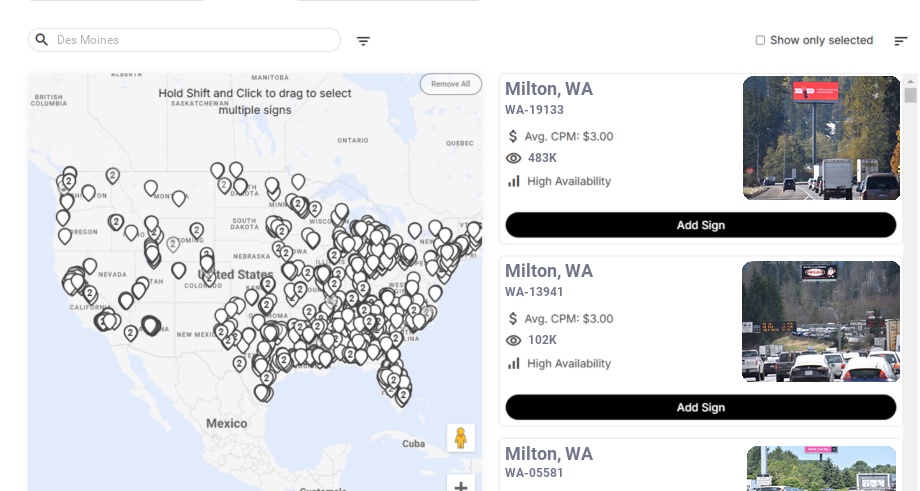
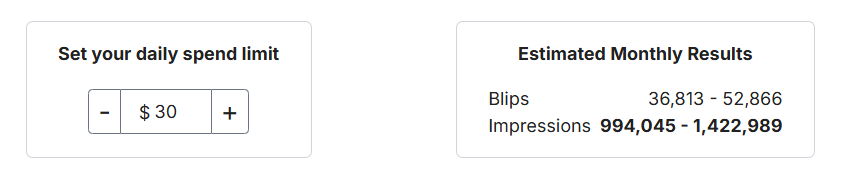
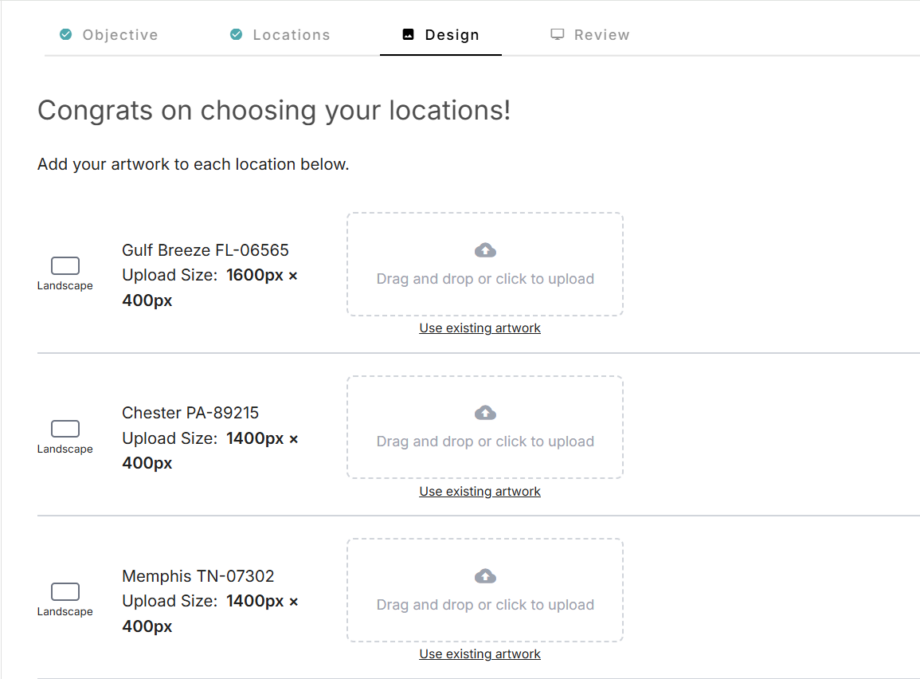
How much is a billboard in Des Moines?
Billboards in other Washington cities
Des Moines Billboard Advertising Guide
The Des Moines Seattle and Tacoma. With four digital billboards near Des Moines (including locations in Milton, about 9.5 miles away) serving the Des Moines area, we can help you turn regional traffic patterns and local demographics into measurable results for your brand. Whether you’re testing Des Moines billboards for the first time or expanding an existing campaign, the market’s density and connectivity make every impression count.
Understanding the Des Moines Area Market
Des Moines sits along the east shore of Puget Sound between Seattle and Tacoma, with quick access to both I-5 and State Route 99 (Pacific Highway S). The city’s central location and strong transportation links mean that campaigns near Des Moines can reach local residents, regional commuters, and travelers in a single strategy, especially when you pair multiple Des Moines billboards within a coordinated flight.
Key facts that matter for advertisers:
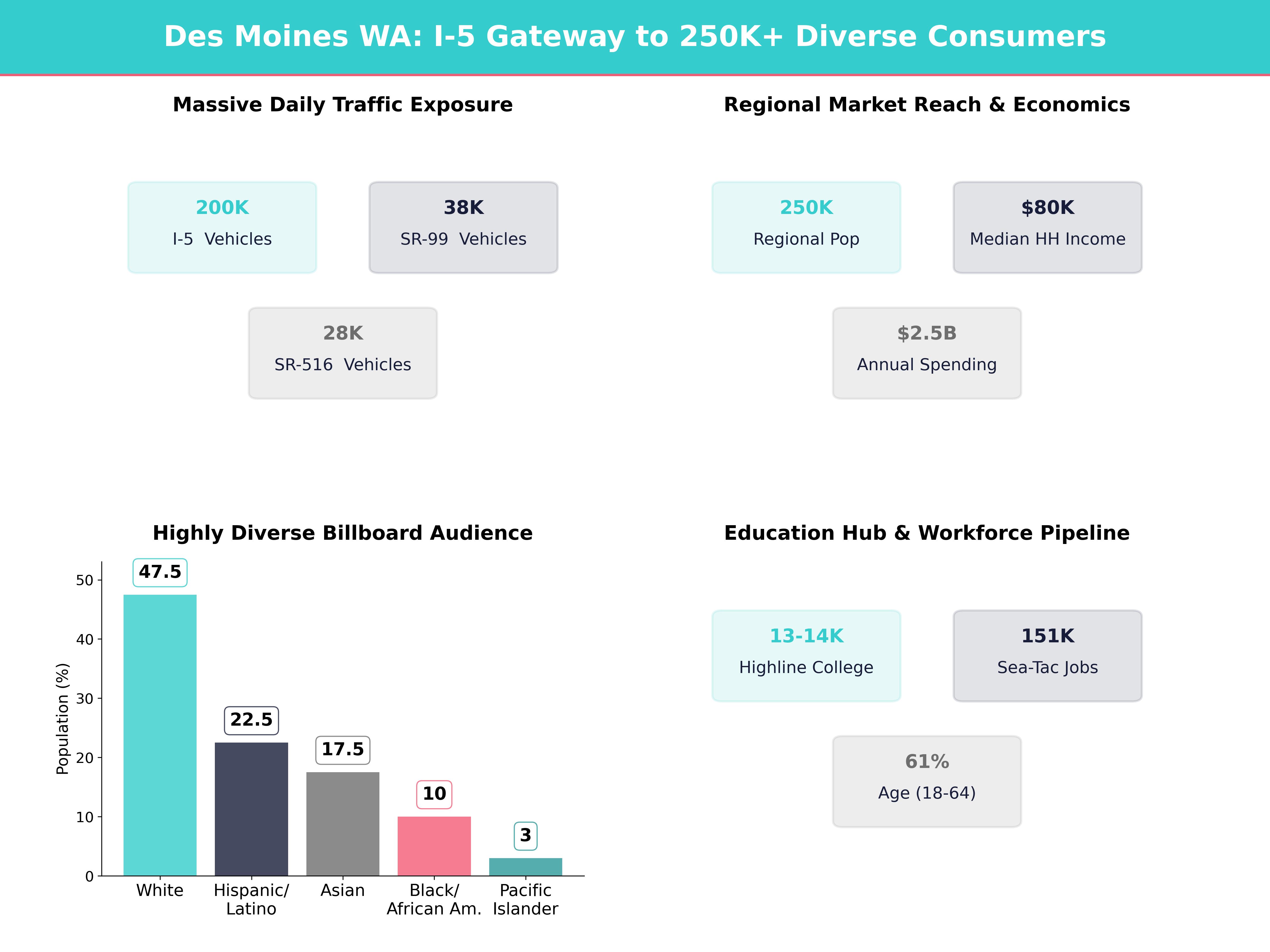
- Population: Des Moines had about 32,900 residents in 2020 and has continued to grow, with local and regional estimates putting the current population in the 34,000–35,000 range as new multifamily projects and infill housing come online near the waterfront and along Pacific Highway. Neighboring cities expand your effective reach to more than 250,000 people when you include Kent Federal Way, SeaTac
- Age profile: The median age is around 38–39, very close to the statewide median, giving you a balanced mix of young adults, families, and older adults. Roughly 24–26% of residents are under 18, 60–62% are working-age adults (18–64), and 13–15% are 65+.
- Economic context: King County $106,000, while many South King County communities, including Des Moines, fall in the $70,000–$90,000 range. Within a 10–15 minute drive of Des Moines, total annual consumer spending easily exceeds $2–3 billion across categories like groceries, dining, retail, auto, healthcare, and home services.
- Jobs and commuting: Nearby Seattle-Tacoma International Airport (Port of Seattle) supports roughly 151,000 direct and indirect jobs region-wide, while the Kent Valley industrial corridor is one of the largest distribution hubs on the West Coast, with more than 80 million square feet of industrial and warehouse space. In King County, around 60–65% of workers drive alone to work and another 8–10% carpool—prime audiences for roadside media.
- Education & campus activity: Highline College in Des Moines typically serves about 13,000–14,000 students annually (credit, non-credit, and continuing education). Roughly 45–50% of students take at least one class online or hybrid, but thousands still move to and from campus weekly, creating consistent billboard exposure along Pacific Highway and nearby corridors.
Helpful local resources to get a feel for the area:
- City of Des Moines: https://www.desmoineswa.gov
- Seattle Southside tourism (Des Moines is part of this region): https://www.seattlesouthside.com
- Des Moines Marina & waterfront info: https://www.desmoineswa.gov/marina
- City of Milton (where nearby billboards are located): https://www.cityofmilton.net
- Pierce County (Milton & regional context): https://www.piercecountywa.gov
- King County regional data and services: https://kingcounty.gov
- Regional news: The Seattle Times Kent Reporter Federal Way Mirror Waterland Blog (Des Moines)
Digital billboards near Des Moines tap into a daily flow of drivers moving between:
- Des Moines and Kent, Federal Way, Tacoma, and Seattle
- Residential neighborhoods east of I-5 and job centers in the Kent Valley
- Sea-Tac Airport, distribution hubs, retail clusters, and the Des Moines waterfront
Sea-Tac handled about 45–52 million passengers per year in recent years, with daily averages often above 120,000 travelers, many of whom access the airport via I‑5, SR 509, and SR 99—routes that overlap with your billboard inventory and make billboard advertising near Des Moines especially efficient for reaching both residents and visitors.
By strategically targeting these flows with Blip’s flexible scheduling and budgeting tools, you can deliver high-frequency impressions to the audiences that matter most to your business.
Who You’re Reaching: Demographics & Audience Segments
Des Moines is one of the more diverse communities in South King County, which has important implications for your creative and message strategy.
Based on recent local and county-level data:
-
Ethnic diversity (Des Moines & nearby South King County communities combined): roughly
- 45–50% White
- 15–20% Asian
- 8–12% Black or African American
- 20–25% Hispanic or Latino (any race)
- 2–4% Native Hawaiian and Other Pacific Islander, among the highest shares in Washington, with strong Samoan and other Polynesian communities
In some nearby ZIP codes, over 70% of residents are people of color, so inclusive creative is not optional—it is expected.
- Households: Around 2.6–2.7 people per household. Roughly 55–60% of households are family households, and upward of 15–20% are multigenerational (three or more generations under one roof), which affects everything from grocery and retail habits to healthcare decisions.
- Housing mix: Within the broader Des Moines–Kent–Federal Way band, owner-occupancy rates often run 55–60%, with 40–45% renter households. Renters tend to be more mobile and responsive to location-based offers (quick-service restaurants, entertainment, transit, and services).
- Language: In many South King County communities, 30–40% of residents speak a language other than English at home, including Spanish, Tagalog, Vietnamese, and Pacific Island languages. In some school catchment areas, more than 80 languages are spoken among students and families.
- Commuting patterns: Typical commute times for South King County residents fall in the 30–35 minute range, with significant flows toward Seattle, SeaTac, Renton, Kent, and Tacoma—prime windows for repeated billboard exposure.
How to use this in your billboard strategy near Des Moines:
-
Lean into inclusive imagery
Use diverse faces and family-oriented visuals that reflect the community. Ads that mirror real local demographics can increase recall and favorability. National OOH studies show that creative perceived as “locally relevant” can lift ad recall by 10–20 percentage points compared to generic imagery. -
Consider bilingual or simple language
With up to 2 in 5 residents speaking a language other than English at home, bilingual or simplified English messaging can materially increase relevance. On a digital billboard, 7 words or fewer is a good target. Bilingual headlines work especially well when the second language is used for just a few key words (“Free Checkup / Examen Gratis”) to maintain quick readability. -
Target life stages
- Younger adults and students (18–30) traveling to/from Highline College, service jobs, and airport-related employment.
- Working families commuting to Kent, Tacoma, or Seattle who often make shopping and dining decisions on the road.
- Older residents who are highly active in local churches, civic events, and waterfront recreation, and who drive frequently outside of peak rush-hour periods.
When we build campaigns near Des Moines and Milton with these realities in mind, we can create billboard messages that feel local, not generic, and make your Des Moines billboards work harder for each audience segment.
Traffic Patterns & High-Value Corridors
Des Moines is threaded by a few key arteries that drive most of the outdoor advertising value. The Washington State Department of Transportation (WSDOT) publishes annual average daily traffic (AADT) counts that illustrate just how busy these corridors are:
- I-5 (near Des Moines & Milton): One of the busiest interstates on the West Coast. In South King County and North Pierce County, AADT commonly exceeds 200,000 vehicles per day, with some segments trending toward 220,000+. Our boards near Milton plug directly into this north–south stream connecting Tacoma, Fife, Federal Way, Des Moines, SeaTac, and Seattle, making them a core part of effective billboard advertising near Des Moines.
- State Route 99 (Pacific Highway S): A major commercial corridor, often carrying 30,000–45,000 vehicles per day in various segments between Federal Way and SeaTac. Frontage businesses—auto dealers, restaurants, clinics, and retail—depend on this visibility. On some stretches near SeaTac and Des Moines, volumes can edge above 45,000 on busy days.
- State Route 516 (Kent-Des Moines Road): Connects the Des Moines waterfront to I‑5 and the Kent Valley. Depending on the segment, you’ll typically see 20,000–35,000 vehicles daily. This route feeds commuters to large distribution centers and industrial employers that collectively employ tens of thousands of workers.
These flows are shaped by heavy commuter movement:
- Morning peaks: roughly 6:00–9:00 AM (northbound toward Seattle / SeaTac, and eastbound toward Kent).
- Afternoon/evening peaks: roughly 3:00–7:00 PM (southbound toward Federal Way/Tacoma and westbound back to Des Moines/waterfront).
- Airport-related surges: Sea-Tac’s early-morning departures and late-evening arrivals create additional peaks around 5–7 AM and 9–11 PM, especially near primary access routes.
On top of this, Sound Transit’s regional system (Sound Transit) reports tens of thousands of daily riders on routes that interconnect with local arterials—bus riders who still rely on cars for part of their trip or ride with friends and family.
With Blip, you can target these exact time windows so your ads near Des Moines appear primarily when your ideal customers are on the road—no need to pay equally for low-traffic overnight hours unless that’s part of your strategy.
Timing Your Campaign: Dayparts, Days, and Seasons
Digital billboards near Des Moines let you buy ad “blips” in precise time windows. To maximize results, align your schedule with how locals actually move and spend.
By time of day
-
Morning commute (6–9 AM)
Captures the bulk of the 60–65% of workers who drive alone plus carpoolers and airport-bound travelers.
Best for:- Coffee shops, breakfast spots, and convenience retail
- Professional services (“Call us today”, “Need an injury lawyer?”)
- Transit and parking offers near Sea-Tac or regional job centers
-
Midday (10 AM–3 PM)
Traffic volumes typically drop 15–30% from peak rush hours but remain steady along retail corridors.
Reaches: retirees, shift workers, stay-at-home parents, and students.
Good for:- Restaurants/lunch specials
- Healthcare (urgent care, dental, vision, clinics)
- Education and training (certifications at Highline College-area providers)
- Government and civic services based at City Hall or King County facilities
-
Evening (3–7 PM)
The heaviest exposure window for commuters, often matching or exceeding morning peak volumes.
Ideal for:- Retail promotions and same-day offers
- Entertainment, gyms, and classes (“Tonight at 7 PM”, “Join this week”)
- Local politics and ballot measures during election season, when voter awareness can surge by 20–30% in the weeks prior to ballots dropping
-
Late night (after 8 PM)
Overall volumes are lower—often 40–60% below peak—but inventory is usually cheaper.
Good for:- Gaming and entertainment
- Delivery apps and late-night food
- 24-hour or on-call services (emergency vet, towing, restoration)
By day of week
- Monday–Friday: Commuter-heavy, more consistent impressions, especially along I‑5, SR 516, and SR 99. Many corridors see weekday volumes 10–20% higher than weekends.
-
Weekend (Saturday–Sunday):
- Families heading to the Des Moines Marina & Beach Park, Saltwater State Park hundreds to several thousand visitors on a sunny summer weekend day.
- Good for restaurants, events, weekend sales, and tourism-oriented businesses promoted through regional channels like Seattle Southside.
By season
-
Spring & Summer (roughly April–September):
- Waterfront, marina activities, and nearby parks significantly increase weekend and evening traffic. During peak summer, Des Moines Marina events, festivals, and boat traffic can push visitor counts into the thousands per weekend.
- Consider campaigns for boating, dining, ice cream/coffee shops, outdoor events, festivals, and tourism services. Tourism organizations report that more than 60% of leisure trips to the Seattle Southside area occur between late spring and early fall.
-
Fall & Winter:
- Emphasize back-to-school, holiday shopping, healthcare (flu shots, urgent care), and services that help in rainy, darker months (auto repair, home maintenance). Retail spending in November–December can account for 20–25% of annual sales in some categories.
- Sunset falls as early as 4:20 PM in winter; illuminated digital boards stand out more, so evening schedules become particularly valuable for visibility and brand recall.
With Blip, you can pre-schedule these seasonal pivots and adjust dayparts in real time if you see particular days or hours performing better for your business.
Creative Strategy for the Des Moines Area
To cut through on busy corridors near Des Moines and Milton, your artwork must be simple, bold, and culturally tuned.
1. Use bold contrasts and large type
- Aim for one key message, one image or icon, and one clear call to action. Industry research suggests that simplifying creative can increase message comprehension by up to 40% at highway speeds.
- Use high-contrast color combinations (e.g., dark blue/yellow, black/white, purple/white) to stand out in cloudy or rainy conditions common in the region. The greater Seattle area records about 150–160 rainy days per year, and overcast skies dominate much of fall and winter—making bright, saturated colors a smart choice.
2. Reflect local landmarks and lifestyle
Consider tying your visuals or copy to recognizable regional elements:
- The Des Moines Marina and waterfront pedestrian paths
- Mount Rainier views, especially appealing on clear days
- The idea of “Seattle Southside” (common tourism branding)
- Planes and travel (Sea-Tac Airport is just north of Des Moines)
- Local schools and mascots via Highline Public Schools
A simple line like “5 minutes from the Des Moines Marina” or “Just off I‑5 near Milton” gives geographic grounding and makes your message feel local. Clear distance or exit references can increase intent to visit by 10–15% compared to generic copy like “Visit us today”, and they help nearby drivers connect your Des Moines billboards to real-world landmarks.
3. Respect drive-by readability
On I‑5 and similar high-speed roads, drivers have just 3–5 seconds to process your message.
Best practices:
- 7 words or fewer in the main line
- Font height equivalent to at least 1.5–2 feet in real-world scale (roughly 12–18 inches of letter height per 100 feet of viewing distance)
- Logos kept simple and large; avoid taglines in tiny text
- Use short URLs or vanity domains; QR codes work best on slower corridors like SR 99 or near intersections, not on high-speed freeway boards
4. Test variants for different audiences
Because Des Moines is so diverse, you may want to run:
- One version featuring family-oriented imagery (for households and parents)
- Another version featuring younger adults or campus life (for Highline College and service workers)
- A bilingual variant for Spanish-speaking or Pacific Islander audiences where appropriate
- A “visitor” version targeting airport and marina traffic with references to hotels, attractions, and dining
With Blip, you can rotate multiple creatives on the same boards and let performance metrics (site traffic, promo code use, inquiries) guide which variant you keep funding.
Leveraging Local Events & Community Rhythms
Des Moines and nearby communities have recurring patterns you can build campaigns around.
Key seasonal and recurring drivers:
- Waterfront & Marina events: Des Moines Marina and Beach Park host concerts, car shows, farmers markets, and community events during late spring and summer. Some events draw 1,000–3,000+ attendees on a single day. Event calendars are often posted on the city site: https://www.desmoineswa.gov
-
Highline College cycles ( Highline College Events
- Enrollment pushes: late summer and early winter
- Finals and graduation periods: late spring and late fall
These windows align with spikes in interest for education services, tutoring, housing, food, and transportation offers.
-
High school sports and activities:
- Nearby schools (e.g., Mount Rainier HS, Highline HS, and other Highline Public Schools campuses) bring evening and weekend traffic patterns with games and performances. A single football game can draw 500–2,000 spectators, many driving in from surrounding neighborhoods.
-
Regional sports & concerts:
- Fans driving from South King County to Seattle or Tacoma for Mariners, Seahawks, Sounders, OL Reign, or concerts at venues like Climate Pledge Arena and the Tacoma Dome often use I‑5 and SR 99. Major events can cause traffic surges of 10–20% on game and concert days.
-
Local government and civic activity:
- City council meetings, public hearings, and community programs posted on the City of Des Moines and City of Milton sites create predictable bursts of traffic to civic centers and business districts.
Campaign ideas tied to these rhythms:
-
“Show this screen for 10% off after the game tonight” (paired with social media remarketing).
- “Headed to the marina? Stop by for…” plus a time-bound offer during summer weekends.
- Short enrollment-surge campaigns for schools, training centers, or child care during August–September and December–January.
- Election-season campaigns focused on name recognition and simple issue framing during the 3–4 weeks when ballot awareness peaks.
Because Blip lets you start and stop campaigns at any time, you can run tightly timed bursts around these events instead of paying for constant year-round exposure, making billboard rental near Des Moines more affordable and efficient for smaller organizations and community-focused brands.
Strategic Use of Our Milton Boards to Reach the Des Moines Area
Our four digital billboards serving the Des Moines area include inventory in Milton, about 9.5 miles away. While that may seem slightly removed, these boards reach a key slice of your potential audience:
- Commuters traveling between Federal Way, Milton, Fife, Tacoma, and Des Moines/SeaTac. I‑5 volumes through this corridor routinely exceed 180,000–200,000 vehicles per day, giving you strong frequency.
- Residents of Pierce County 930,000 residents, and a meaningful share commute north toward SeaTac and Seattle, passing near these boards multiple times per week.
- Drivers using I‑5 and parallel routes who frequently pass within that radius—many 3–5 days per week, creating repeated exposures that build brand recall.
How to maximize these boards:
-
Directional messaging:
“Exit at Kent-Des Moines Rd – 10 minutes north”
“Just 2 exits past Des Moines”
This can drive traffic from south of Des Moines up into your trade area. Studies show that adding clear distance or exit information can increase store-visit lift from OOH campaigns by 10–20%. -
Regional brand building:
If you serve customers across South King and Pierce Counties (auto dealers, healthcare systems, retailers, credit unions, and banks), Milton placements amplify brand familiarity before people reach your Des Moines, Kent, Federal Way, or Tacoma locations. -
Time-split strategies:
Run:- Southbound-focused creative in afternoon/evening (when Des Moines workers are driving home through the corridor)
- Northbound-focused creative in mornings (when Pierce County residents head toward SeaTac or Seattle jobs)
Blip’s location and directional targeting give you more control over how these boards work together to blanket the Des Moines area with your message and ensure each billboard rental near Des Moines contributes to a cohesive regional footprint.
Budgeting and Optimization with Blip
Because Blip operates on a pay-per-“blip” model (a “blip” is a single, brief ad display), you can start campaigns near Des Moines at very low daily budgets and scale as you learn what works.
In many markets, advertisers begin with daily budgets as low as $10–$20 per day, then increase spending to $50–$100+ per day on proven high-performing days or corridors. Digital OOH campaigns often report cost-per-thousand (CPM) ranges in the $2–$10 range, depending on location and competition.
Practical workflow we recommend:
-
Start with a test phase (2–4 weeks)
- Focus on 1–2 boards serving the Des Moines area, including Milton.
- Choose 1–3 time windows that match your audience (e.g., 6–9 AM, 3–7 PM).
- Run 2–3 creative variations to compare performance.
-
Measure downstream results
-
Watch for changes in:
- Web traffic from South King/Pierce County ZIP codes
- Direct searches for your brand name (often up 10–30% during active OOH campaigns)
- Store visits or calls during your ad windows
- Use dedicated URLs, QR codes, or promo phrases like “Mention ‘Marina Billboard’ for 10% off” to attribute response.
-
Watch for changes in:
-
Refine your targeting
- Shift more budget to the dayparts and boards that correlate with better performance.
- Pause underperforming creatives and test new visuals or offers.
- Consider adding weekend-only or event-specific bursts when you see above-average conversion rates.
-
Scale during proven high-return periods
- Once you identify high-ROI windows (e.g., weekday PM on I‑5 near Milton, or weekend midday before marina traffic), increase your budget there and use Blip’s cost controls to avoid overspending in lower-value hours.
- For key retail seasons (back-to-school, Black Friday, winter holidays), many advertisers temporarily double or triple budgets for 2–6 weeks to capture heightened demand.
Because every impression is purchased in small increments, you maintain total flexibility to adapt as your business and the Des Moines area market evolve and to adjust your billboard rental near Des Moines as your goals change.
Putting It All Together
Billboard advertising near Des Moines, Washington, is uniquely powerful because it sits at the intersection of:
- A diverse, family-oriented community with strong working- and middle-class buying power
- Heavy north–south commuter traffic along I‑5 and SR 99, plus east–west flows on SR 516 to the Kent Valley
- Year-round flows to the waterfront, the airport, and regional job centers, with daily vehicle volumes on key routes often exceeding 30,000–200,000+
- Strong visitor and tourism activity driven by the waterfront, nearby parks, and Sea-Tac Airport’s tens of millions of annual passengers
By pairing data-driven scheduling and geographic targeting with simple, locally tuned creative, you can use Blip’s digital billboards near Des Moines and Milton to:
- Build brand awareness across South King and Pierce Counties
- Drive traffic to your storefronts, websites, and events
- Support short, tactical pushes around sales, holidays, and community events
- Reach both everyday residents and high-value travelers moving between the airport, waterfront, and regional job centers
When we plan campaigns around real traffic patterns, local demographics, and seasonal rhythms in the Des Moines area, even modest budgets can deliver significant visibility and measurable business impact, making Des Moines billboards a smart, flexible component of your broader marketing mix.