Billboards in Kent, WA
No Minimum Spend. No Long-Term Contracts. Just Results.
Trusted by Leading Brands


Billboard advertising
in Kent has never been easier



How much is a billboard in Kent?
Why Choose Blip for Billboard Advertising in Kent
Blip lets you launch Kent billboards yourself in minutes, so you can reach SR-167 and I-5 commuters without traditional buying hassles.
Kent's shift workers and freight traffic make timing matter—Blip dayparting helps you hit morning and evening peaks on SR-167 and SR-516.
Set a flexible daily budget in Kent and Blip keeps you on track, perfect for testing bursts around Cornucopia Days or ShoWare events.
Blip-optimized campaigns can auto-pick Kent placements and timing to match your goals, from East Hill shoppers to Kent Valley industrial workers.
Track Kent campaign results in real time, then shift spend fast as commuter patterns, rainy-season traffic, or weekend event crowds change.
Use Blip's creative tools to build bold, high-contrast ads for Kent's multilingual audience and crowded corridors like Kent-Kangley and SR-99.
Frequently Asked Questions About Billboard Advertising in Kent
How much does a billboard cost in Kent, Washington with Blip?
With Blip, you can advertise on digital Kent billboards using any budget that works for you, because you set a daily budget and Blip automatically keeps your campaign within that limit. Each ad “blip” is a brief 7.5 to 10-second display on rotating billboards in Kent, Washington, and you only pay for the individual blips you receive. Your cost per blip changes based on when and where you choose to show your ad, as well as overall advertiser demand, giving you flexibility to match your goals.
Where can I advertise with Blip in Kent, Washington to reach commuters?
Kent’s value as a billboard market comes from its position between Seattle and Tacoma and its role as a logistics and industrial hub. Major routes include I-5, which carries over 200,000 vehicles per day through the South King County stretch, and SR-167, which runs directly through the Kent Valley industrial area and often carries 130,000–140,000 daily vehicles. To reach regional audiences, incorporate I-5 and SR-99-visible locations where available in your Blip selections.
When is the best time to run Blip ads on Kent, Washington billboards?
Blip’s ability to choose specific times of day is especially powerful in Kent, where commute traffic is heavy but patterns differ between industrial and residential areas. Typical patterns include a morning peak from 6:00–9:00 a.m. and an evening peak from 3:30–7:00 p.m., with strong midday traffic for errands and retail visits. With Blip, you can explicitly set your schedule to hit only the most valuable windows instead of paying for overnight or low-yield hours.
Why is Kent, Washington a strong market for Blip billboard advertising?
Kent is one of Washington’s fastest-growing mid-sized cities and a key economic hub in South King County, which is why many brands consider billboards in Kent a core part of their regional media mix. It sits in the heart of the Seattle–Tacoma corridor and combines a dense industrial valley, busy commuter routes, and diverse neighborhoods. Kent is also one of the most diverse cities in the Pacific Northwest, with a majority of residents being people of color and students speaking more than 130 languages and dialects at home.
What kind of businesses should use billboards in Kent, Washington with Blip?
Different industries can leverage Kent’s geography and audience in specific ways, and the same network of billboards can serve hyper-local businesses, regional brands, and national advertisers. For B2B, hiring, and industrial services, prioritize boards along SR-167 and routes connecting to the Kent Valley, where tens of thousands of shift workers and truck drivers pass daily. For consumer retail, dining, and entertainment, target SR-516, Kent-Kangley, and corridors leading to downtown and East Hill.
Do I need a contract to advertise with Blip in Kent?
No, Blip has no long-term contracts or minimum commitments. You can start, pause, or stop your campaign at any time.
How fast can I launch a billboard campaign with Blip in Kent?
You can have your campaign live in minutes. Create a free account, select your locations, set your budget, upload your design, and start running once approved.
Where can I advertise with Blip in Kent?
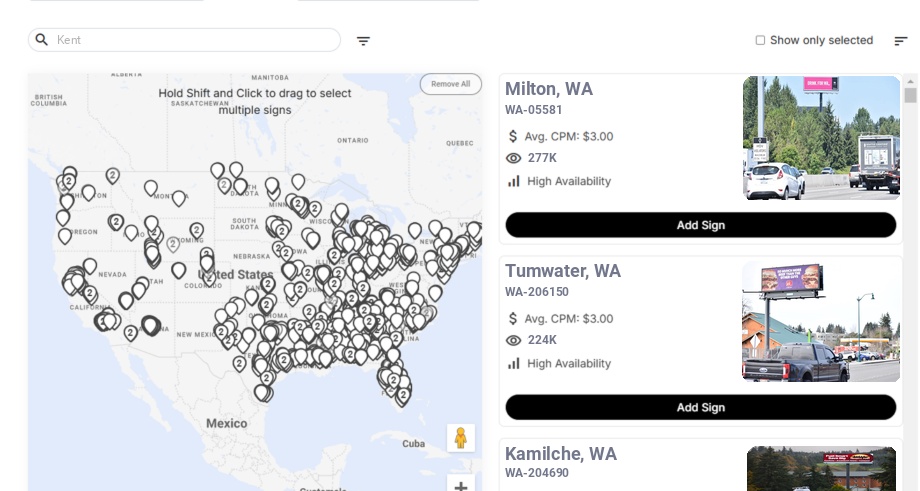
Blip has digital billboards in Kent. You can browse available locations on a map, choose the ones that fit your audience, and start advertising right away.
Still have questions? Launch a campaign in minutes — no contracts, no commitments.
Start Your CampaignKent Billboard Advertising Guide
Kent, Washington sits in the heart of the Seattle–Tacoma corridor and combines a dense industrial valley, busy commuter routes, and diverse neighborhoods. That mix makes Kent a powerful place to run a flexible, highly targeted digital billboard campaign with Blip—if we align our creative, timing, and placements with how the city actually lives and moves. When we understand how people use Kent billboards along these major corridors, we can turn everyday drive time into consistent, efficient local visibility.
Understanding Kent’s Market at a Glance
Kent is one of Washington’s fastest‑growing mid‑sized cities and a key economic hub in South King County, which is why many brands consider billboards in Kent a core part of their regional media mix.
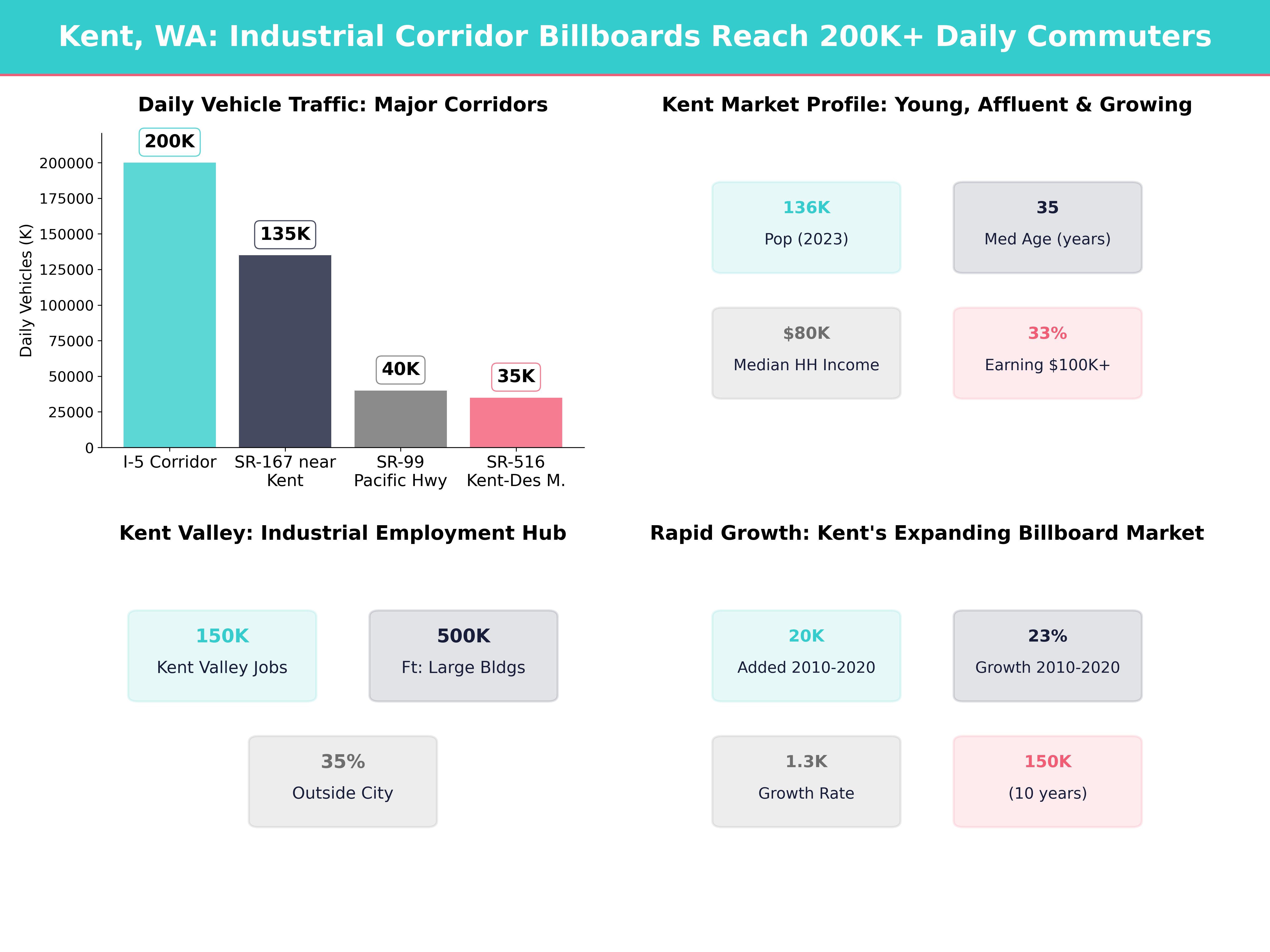
- Population: Around 136,000 residents as of 2023 estimates, making Kent the 6th largest city in Washington and the 3rd largest in King County after Seattle and Bellevue. Local planning documents from the City of Kent
- Growth: The city added more than 20,000 residents between 2010 and 2020, roughly a 22–23% increase, and continues to add roughly 1,000–1,500 residents per year based on recent building permit and school enrollment trends.
- Age: The median age is about 34–35, several years younger than the national median (around 39). Nearly 60% of residents are under age 40, and roughly 1 in 4 residents is under 18, which pushes campaigns toward working families, young professionals, and early‑career workers.
- Income: Median household income is in the upper $80,000s per year, with many two‑earner households commuting to jobs in Seattle, Tacoma, and the Kent Valley industrial area. About 30–35% of households earn $100,000 or more annually, while a substantial share still falls in the $50,000–$75,000 range, underscoring the importance of value messaging.
- Employment base: Kent sits in one of the largest industrial employment centers in the Pacific Northwest. The broader Kent Valley industrial corridor—covering Kent, Auburn Puget Sound Regional Council.
- Diversity: Kent is one of the most diverse cities in the Pacific Northwest. A majority of residents are people of color, with large Asian, Black, and Latino communities and many multilingual households. Local school demographics from Kent School District show that students speak more than 130 languages and dialects at home, signaling very high cultural and linguistic diversity in the broader community.
For background on Kent’s economic landscape and community initiatives, we can reference the City of Kent Visit Kent Kent Downtown Partnership King County
Implication for billboard strategy:
- Avoid one‑size‑fits‑all “generic” creative. Inclusive imagery and language resonate better in a city where no single group is the majority and more than 100 languages are present in schools.
- Emphasize family‑oriented benefits (schools, kids’ activities, neighborhood services) and quality‑of‑life messaging that appeals to the nearly 25% of residents under 18 and the many households with children.
- Promote value and convenience rather than only luxury. Median income is solid, but King County’s cost of living index is roughly 30–40% higher than the U.S. average; residents are cost‑conscious in a high‑cost region.
Key Traffic Corridors and Commuter Patterns
Kent’s value as a billboard market comes from its position between Seattle and Tacoma and its role as a logistics and industrial hub. Kent billboards placed along these high‑volume connectors can efficiently reach both local residents and regional travelers.
Major routes and patterns (vehicle counts from WSDOT):
- I‑5 (Interstate 5) – West of Kent, carries over 200,000 vehicles per day through the South King County stretch between Seattle and Tacoma, with some segments between Tukwila and Federal Way surpassing 220,000–230,000 average daily vehicles. This is ideal for reaching regional commuters and long‑distance travelers.
-
SR‑167 (Valley Freeway) – Runs directly through the Kent Valley industrial area. Many segments carry 120,000+ vehicles per day, with key stretches near Kent commonly recording 130,000–140,000 daily vehicles when counting both directions. This is key for:
- Workers commuting to and from Kent’s warehouses, manufacturing, and logistics centers.
- Heavy truck and freight traffic associated with the Port of Seattle and Port of Tacoma—together moving tens of millions of tons of cargo each year, according to the Port of Seattle and Port of Tacoma.
- SR‑516 / Kent‑Des Moines Road – Connects I‑5 to Kent’s core and further east. Typical segments handle roughly 30,000–40,000 vehicles per day, with volumes spiking during commute hours and weekend shopping periods as drivers head to retail centers near downtown and East Hill.
- Kent‑Kangley Road (SE 256th St/SR‑516 east of downtown) – Major east‑west arterial serving East Hill neighborhoods and retail corridors, commonly carrying 25,000–35,000 vehicles per day in busy segments.
- SR‑99 (Pacific Highway S) – West of Kent, with a mix of local businesses, auto dealers, hotels, and dining. Segments between SeaTac Des Moines
- Proximity to Sea‑Tac Airport – Seattle‑Tacoma International Airport handled over 51 million passengers in 2019, dipped during the pandemic, and rebounded to more than 45 million passengers per year recently. Thousands of Kent residents work in airport‑related jobs, many commuting via I‑5, SR‑99, and SR‑516, creating steady, year‑round flows of shift workers and travelers.
- Transit Hubs – The Kent Sounder Station and multiple park‑and‑ride facilities draw drivers into downtown before they switch to rail or buses. Sound Transit’s Kent Station info
Implication for billboard strategy:
- For B2B, hiring, and industrial services, prioritize boards along SR‑167 and routes connecting to the Kent Valley, where tens of thousands of shift workers and truck drivers pass daily.
- For consumer retail, dining, and entertainment, target SR‑516, Kent‑Kangley, and corridors leading to downtown and East Hill, where daily traffic volumes in the tens of thousands are dominated by local residents.
- To reach regional audiences (Seattle–Tacoma commuters, airport travelers), incorporate I‑5 and SR‑99–visible locations where available in your Blip selections to tap into 200,000+ daily I‑5 travelers and 40,000+ SR‑99 drivers.
Timing Your Blips: When Kent Is on the Road
Blip’s ability to choose specific times of day is especially powerful in Kent, where commute traffic is heavy but patterns differ between industrial and residential areas. Smart timing ensures that digital billboards in Kent are showing when your best prospects are actually on the road.
Regional transportation studies from WSDOT and Sound Transit show that peak commute periods can double or even triple travel times on SR‑167 and I‑5 compared to off‑peak hours, which means more driver exposure to boards during those windows.
Typical patterns (approximated from regional traffic data and local commuting trends):
-
Morning peak: 6:00–9:00 a.m.
- SR‑167 inbound toward Kent Valley industrial centers, with heavy truck volumes.
- East Hill and West Hill drivers heading down to the valley or out toward I‑5 and job centers in Seattle, Tukwila, Renton, and Tacoma.
-
Evening peak: 3:30–7:00 p.m.
- Reverse of morning flows, with extra congestion on east‑west roads like SR‑516 and Kent‑Kangley as workers return to residential neighborhoods.
-
Midday (10:00 a.m.–2:00 p.m.):
- Strong for errands, retail, and service visits; many grocery and big‑box stores report some of their highest weekday visit counts in this band.
- Significant commercial and freight movement throughout the valley as warehouses and distribution centers operate multiple shifts.
-
Evenings and weekends:
- Traffic bumps around shopping areas, restaurants, and venues like the accesso ShoWare Center during events. The arena seats about 6,100 for hockey and can host 7,800+ for concerts, drawing large surges of vehicles before and after events.
- Leisure travel to outdoor recreation (Lake Meridian, the Green River, and regional parks) spikes on summer weekends, and Visit Kent
Dayparting strategy examples:
-
B2B / industrial services / staffing agencies
- Concentrate impressions 5:30–9:00 a.m. and 3:00–6:30 p.m. weekdays on SR‑167 and industrial corridors, when thousands of shift workers and truck drivers are on the road.
-
Retail, groceries, home services
- Heavier 10:00 a.m.–7:00 p.m., including weekends, near residential and retail corridors, to capture midday errands and after‑work shopping trips.
-
Restaurants and entertainment
- Focus on 11:00 a.m.–2:00 p.m. (lunch) and 4:30–9:00 p.m. (dinner and events), especially Thursdays–Sundays, aligning with ShoWare event start times, peak movie showings, and evening dining.
With Blip, we can explicitly set our schedule to hit only the most valuable windows instead of paying for overnight or low‑yield hours where traffic volumes may be 60–80% lower than the daytime peaks. This kind of precision is what makes digital Kent billboard advertising especially efficient compared with traditional, fixed‑schedule placements.
Tailoring Creative to Kent’s Demographics
Kent’s diversity and age profile should directly shape our designs and messaging.
Key demographic considerations:
-
Racial and ethnic diversity
- No single racial or ethnic group is a majority. Local data show that more than half of residents identify as people of color, and in many neighborhoods, that share is 60% or higher.
- Significant Asian, Black, and Latino populations, along with many recent immigrants from Africa, Latin America, and Asia, create demand for culturally aware messaging.
-
Language
- A substantial portion of households speak a language other than English at home; school data suggest well above 30%, with some elementary schools reporting more than 60% of students speaking a non‑English home language.
-
Household structure
- Many family households with children, including multigenerational homes. In Kent School District, roughly 25,000–26,000 students are enrolled across more than 40 schools, which implies tens of thousands of parents and caregivers making daily school‑related trips.
-
Commute and work patterns
- In South King County, it is common for 30–40% of workers to commute to jobs outside their home city, especially to Seattle, Bellevue, and Sea‑Tac–related employment zones, meaning many residents see the same key corridors twice daily.
Creative implications:
- Use inclusive visuals. Show a range of ages and ethnic backgrounds. Ads that “look like Kent” perform better than generic stock imagery, especially in a city where schools report over 130 languages and no single racial group dominates.
- Simple English, potential bilingual touches. Keep wording short and clear. For campaigns aimed at specific communities, consider a concise bilingual line or call‑out—but keep in mind the 6–8 word best practice for readability at speed.
- Emphasize family and community benefits. “Keep your family active this winter,” “Help your student get ahead this summer,” or “Jobs close to home in Kent Valley” match local priorities in a city where roughly one quarter of residents are under 18.
- Value, not just prestige. Highlight savings, convenience, and time‑saving benefits more than pure luxury cues, recognizing that housing and transportation costs in King County consume a large share of middle‑income household budgets.
Event‑Driven and Seasonal Opportunities
Kent’s calendar creates many natural spikes in local attention. Pairing Blip campaigns with these windows can significantly increase recall and maximize the impact of your billboard rental in Kent.
Key recurring events and seasons:
-
Sports and concerts at accesso ShoWare Center
- Home to the Seattle Thunderbirds ShoWare Center event calendar and schedule extra Blips 2–3 hours before major events and immediately afterward to reach both inbound and outbound traffic.
-
Kent Cornucopia Days
- One of the region’s bigger community festivals, typically drawing 100,000+ visitors over a mid‑July weekend according to organizers. Check announcements from the City of Kent Kent Cornucopia Days for dates and details, and consider 3–7‑day campaigns leading into the festival.
-
Fourth of July Splash at Lake Meridian
- A major community celebration with large local attendance; the City of Kent
-
Kent Farmers Market / Saturday Market
- Weekly seasonal markets bring regular foot and car traffic into downtown; updates often appear via the Kent Downtown Partnership
-
Back‑to‑school and graduation
- Kent School District is one of the largest in Washington, with around 25,000+ students. Late summer/fall and late spring are high‑impact times for tutoring, youth programs, apparel, tech, and family services.
Seasonal messaging tactics:
-
Rainy fall and winter (October–March):
- Kent and greater Seattle often record over 150 rainy days per year and around 35–40 inches of annual precipitation. Promote indoor activities, home improvement, auto care, and financial planning that align with this season.
- Use high‑contrast colors (white or bright text on dark backgrounds) to remain legible in low‑light and rainy conditions common during short winter days.
-
Spring (April–June):
- Emphasize outdoor recreation gear, landscaping, real estate, and seasonal hiring. As weather improves, trail and park use climbs sharply according to King County Parks
-
Summer (June–September):
- Focus on events, travel, food and beverage, festivals, and back‑to‑school later in the season.
- Longer daylight—up to ~16 hours of daylight near the solstice in June—means evening Blips are still clearly visible for commuters and eventgoers.
Because Blip allows us to run short campaigns, we can intensify spend for a few days around a specific weekend (like Cornucopia Days), then scale back, instead of committing to long static flights that may not align with peak attention.
Strategies by Business Type
Different industries can leverage Kent’s geography and audience in specific ways. The same network of billboards in Kent can serve hyper‑local businesses, regional brands, and national advertisers if each tailors its approach.
Local Retail and Services
-
Target boards near:
- East Hill and West Hill residential corridors, where tens of thousands of residents live in single‑family neighborhoods and apartment communities.
- Downtown Kent approaches and SR‑516, which carry 30,000–40,000 vehicles per day on some segments.
-
Run heavier on:
- Midday and early evening, capturing work‑from‑home residents during the day and commuters running errands on the way home.
- Weekends, especially Saturdays, which many retailers see as their highest‑traffic day.
-
Creative ideas:
- “5 minutes from Kent Station – Exit SR‑516 now.”
- “Same‑day appointments in Kent – Call today.”
- Clear value propositions: “Oil change in 20 minutes,” “Free estimate,” “No appointment needed.”
Restaurants, Coffee, and Entertainment
-
Focus near:
- Downtown and ShoWare Center approaches, where event nights can bring thousands of extra vehicles through nearby intersections in the two hours before start time.
- Corridors feeding into major retail clusters and Sea‑Tac‑adjacent hotel zones, tapping into both local residents and visitors staying in South King County hotels.
-
Timing:
- Lunch (11:00 a.m.–2:00 p.m.) for workers in the Kent Valley; industrial parks often operate staggered shifts, so traffic remains elevated beyond a single lunch hour.
- Evenings (4:30–9:00 p.m.) on Thursdays–Sundays, especially event nights, when families and groups head out to dine or attend shows.
-
Creative approaches:
- “Heading to the game? Park, then eat with us – 0.5 miles ahead.”
- “Kids eat free Tuesdays in Kent – Exit here.”
- Use mouth‑watering photography with minimal text; studies of out‑of‑home effectiveness commonly show that image‑heavy, text‑light creative can increase recall by 20–30% compared with cluttered designs.
B2B, Logistics, and Industrial Services
Kent is home to a huge cluster of distribution centers, manufacturers, and aerospace suppliers, which makes focused Kent billboard advertising a strong complement to sales outreach and recruiting.
- Major employers include Amazon, Boeing, REI, Blue Origin, and numerous logistics companies in the Kent Valley. Local coverage from outlets like the Kent Reporter
-
Strategy:
- Prioritize SR‑167 and roads directly feeding the industrial valley, where tens of thousands of freight and employee trips originate daily.
- Concentrate campaigns on weekday morning and evening commute windows, when average speeds on SR‑167 often drop significantly, giving drivers more dwell time with your creative.
-
Message angles:
- “Need warehouse staff by Monday? Call [Brand] today.”
- “Reduce your freight costs on SR‑167 – Learn more at [short URL].”
- Minimal, benefit‑driven copy with a standout logo and clear contact path.
Hiring and Workforce Recruitment
With a large working‑age population and ongoing demand for warehousing, manufacturing, retail, and professional roles, Kent is a strong hiring market. Digital billboard rental in Kent can quickly boost awareness of open positions among people already commuting to job centers.
-
Focus:
- Boards along commute corridors (SR‑167, SR‑516, Kent‑Kangley) used by both Kent residents and workers commuting in from Auburn, Renton, Federal Way, and Covington.
- High‑traffic routes between Kent and neighboring cities, where daily cross‑city commuter flows can reach tens of thousands of trips.
-
Copy examples:
- “$23/hr + benefits in Kent Valley – Apply today at [short URL].”
- “Now hiring night shifts in Kent – Scan to apply.”
- “No experience? Paid training in Kent – Text ‘JOB’ to [number].”
-
Pair with:
- Short‑term bursts when application volumes drop, such as late winter or mid‑summer.
- Coordinated online campaigns targeting Kent ZIP codes (98030, 98031, 98032, 98042, etc.) for consistent messaging across channels.
Political, Advocacy, and Public Awareness Campaigns
Kent’s diverse, growing electorate and its swing‑suburban profile make it a high‑value area for political and issue messaging.
-
Timing:
- Heavier in the 8–10 weeks before elections; ballot mailing typically begins 2–3 weeks before Election Day in King County, per King County Elections
- Daypart across commute and evening hours to reach both workers and stay‑at‑home voters.
-
Tactics:
- Use simple, strong calls to action: “Vote by Nov. 5,” “Learn the facts at [short URL].”
- Adapt messages to emphasize local impact—schools, safety, transportation, small business—citing local priorities highlighted in City of Kent Kent Reporter
- Ensure creative complies with any disclosure and sponsorship rules outlined by Washington’s Public Disclosure Commission, which oversees political advertising requirements.
Using Blip Tools Effectively in Kent
Blip’s flexibility is particularly useful in a varied market like Kent. Instead of buying a single static board for a month, you can treat Kent billboards like a dynamic, test‑and‑learn channel.
Practical tactics:
-
Location clustering
-
Build clusters of boards serving:
- Commuters (SR‑167 and I‑5 corridor), where some locations see 120,000–220,000 daily vehicles.
- Local shoppers (East Hill, West Hill, downtown approaches), often in the 20,000–40,000 vehicles‑per‑day range with a strong local‑resident mix.
- Eventgoers (routes to ShoWare Center and downtown) where traffic volumes spike sharply during event windows.
- Compare performance by cluster: which set of locations drives more web traffic, calls, or store visits? Use cluster‑level metrics to shift 10–20% of budget toward the best‑performing corridors.
-
Build clusters of boards serving:
-
Daypart experimentation
- Start with 2–3 core dayparts (morning commute, midday, evening).
- Shift 20–30% of impressions between dayparts every week for a month to see where engagement lifts—this kind of structured testing can often reveal 30–50% performance differences between peak and off‑peak hours.
- Drop low‑performing windows and double down on high‑performing ones, especially during Monday–Thursday commute periods where exposure is most consistent.
-
Seasonal budgeting
-
Allocate more budget to:
- July event season (Cornucopia Days, July 4th), when festival attendance can exceed 100,000 in a single weekend.
- November–December retail and service pushes, when many sectors see 20–40% of annual sales.
- Seasonal hiring waves (late spring for summer hires, late summer and early fall for warehouse/holiday hires).
- Reduce spend in traditionally slower periods and run “maintenance” visibility that keeps brand awareness alive at a lower frequency.
-
Allocate more budget to:
-
A/B creative testing
-
Run two versions of a Blip in rotation:
- Example: “20% off this week” vs. “Buy 1 Get 1 Free.”
- Or “Kent Valley jobs – $23/hr” vs. “Kent Valley jobs – Benefits day one.”
-
Measure impact with:
- Unique URLs or QR codes per creative.
- Offer codes in store (“Show this code from our billboard”) or call tracking numbers.
- After 1–2 weeks (or after reaching a few thousand estimated impressions per variant), pause the weaker creative and iterate on the winner to continually push response rates higher.
-
Run two versions of a Blip in rotation:
Creative Best Practices for Kent Billboards
Finally, we should adapt design fundamentals to Kent’s environment and driving conditions so that billboard rental in Kent delivers clear, memorable messages.
Design tips:
- Text count: 6–8 words max; 1 clear call to action. Out‑of‑home studies consistently show that short‑copy creatives can increase message comprehension by 20–30% compared with longer text at highway speeds.
- Font size: Large, bold sans‑serif; avoid thin or script fonts that blur in rain or at highway speeds of 45–60 mph.
- Contrast: Light text on dark backgrounds or vice versa; this matters in low‑light, overcast, or rainy conditions that Kent sees much of the year. Remember that winter days can have fewer than 9 hours of daylight.
-
Color choices:
- Avoid relying on subtle color differences (e.g., light blue on dark blue).
- Use one dominant brand color plus a strong accent for CTAs to keep designs simple and memorable.
-
Logo and brand recall:
- Place the logo large and in a consistent location (e.g., bottom right).
- Assume viewers have 3–5 seconds; can they recognize your brand instantly and recall at least one key message?
-
CTAs for a mobile audience:
- Short URLs, branded domains, or QR codes sized large enough to scan in slow traffic.
- Phrases like “Search ‘[Brand Kent]’” can be easier to remember than long URLs, especially on congested corridors like SR‑167 where drivers may be in motion.
-
Weather‑aware creative:
- Consider rotating seasonally relevant creatives: “Rainy day specials,” “Get ready for summer,” etc.
- Use photography and color palettes that pop against gray skies; saturated colors (deep blues, reds, bright yellows) often stand out better than muted tones in the Pacific Northwest climate.
Bringing It All Together
Kent’s unique combination of a diverse population, strong industrial base, and high‑volume commuter routes creates a rich environment for digital billboards. By:
- Targeting the right corridors (SR‑167, SR‑516, Kent‑Kangley, I‑5, SR‑99),
- Aligning dayparts with commuter and shopper behavior informed by local traffic patterns,
- Designing inclusive, high‑contrast creative that reflects Kent’s communities and multilingual reality, and
- Leveraging Blip’s flexibility to test, refine, and seasonally scale,
we can build billboard campaigns that not only get seen, but actually drive measurable action. Thoughtful Kent billboard advertising turns everyday commutes into a steady stream of impressions that support both short‑term promotions and long‑term brand growth.
For additional local context and inspiration, it’s useful to keep an eye on outlets like the Kent Reporter Seattle Times City of Kent Visit Kent King County