Billboards near Issaquah, WA
No Minimum Spend. No Long-Term Contracts. Just Results.
Trusted by Leading Brands


Billboard advertising
near Issaquah has never been easier




How much is a billboard near Issaquah?
Why Choose Blip for Billboard Advertising near Issaquah
Launch on Blip in Issaquah in minutes—self-serve access puts your ad on I-90, Front Street, and nearby corridors without the usual back-and-forth.
Use Blip-optimized campaigns in Issaquah to auto-shift spend across commuter, school-run, and weekend recreation traffic toward your goals.
Keep budgets flexible in Issaquah—start small, pause anytime, and pay only when your ad plays on nearby digital billboards.
Daypart your Issaquah campaign for morning I-90 commuters, Friday mountain traffic, or Salmon Days crowds when timing matters most.
Track Issaquah results in real time with Blip and move budget fast if Renton, Sammamish, or I-90 placements outperform.
Build Issaquah creative fast with Blip tools—make bold, simple ads that stand out on gray days and speak to local families and outdoor travelers.
Frequently Asked Questions About Billboard Advertising near Issaquah
How much does a billboard cost in Issaquah with Blip?
Blip makes billboard advertising in the Issaquah area flexible and affordable. Pricing is pay-per-play, starting at just $0.01 per display, and the cost per blip changes based on time of day, location, and advertiser demand. You set a daily budget that works for you, and you only pay when your ad actually appears.
Where can I advertise with Blip in Issaquah?
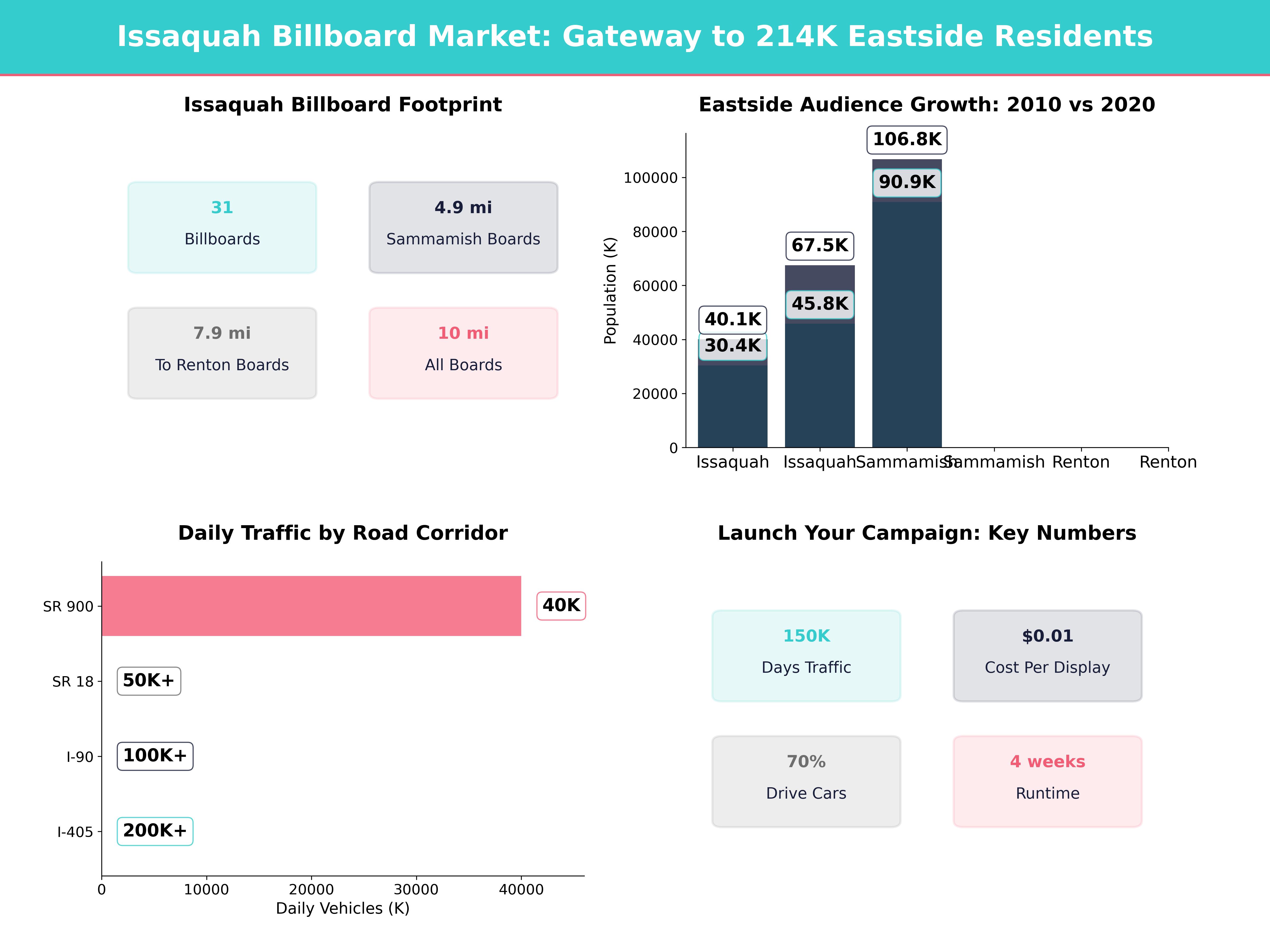
We can reach people in the Issaquah area through 31 digital billboards in nearby Sammamish and Renton, with inventory as close as 4.9 miles and 7.9 miles away, respectively, and all of it within 10.0 miles of the city. That gives us efficient access to drivers using the corridors that serve the Issaquah area every day, especially those moving between Eastside neighborhoods, job centers, and recreation destinations. For local businesses, regional brands, and event promoters, the Issaquah area offers repeat exposure without requiring a large traditional outdoor buy.
Why is the Issaquah area good for billboard advertising with Blip?
The market near Issaquah is one of the Eastside’s strongest settings for digital billboard advertising because work trips, school trips, shopping, and outdoor travel all converge on a compact set of roads. The Issaquah area is also highly car-oriented, and recent ACS estimates indicate that about 7 in 10 workers in the area who commute use a car, truck, or van. Even with transit options, daily movement is still shaped primarily by freeways, arterials, school runs, and shopping trips.
What roads in Issaquah should I target for billboard ads?
According to Washington State Department of Transportation traffic counts, the I-90 corridor through the Issaquah area regularly carries well over 100,000 vehicles per day on key segments. I-405, SR 18, and SR 900 also expand reach near Issaquah, with I-405 commonly exceeding 200,000 vehicles per day on busy segments and SR 18 near the I-90 interchange typically carrying more than 50,000 vehicles per day. These roads help reach commuters, shoppers, and recreation travelers across the Issaquah area.
When is the best time to run billboard ads in Issaquah with Blip?
From roughly May through September, the Issaquah area becomes more recreation-heavy, making this a strong window for outdoor brands, quick-service restaurants, family entertainment, healthcare, fitness, home improvement, and travel-related offers. Early October is one of the clearest event-driven windows in the market because of Salmon Days, which typically draws about 150,000 visitors. From November through February, mountain travel and holiday errands create useful billboard opportunities, especially for eastbound I-90 and return-trip visibility during winter weekends.
Do I need a contract to advertise with Blip near Issaquah?
No, Blip has no long-term contracts or minimum commitments. You can start, pause, or stop your campaign at any time.
How fast can I launch a billboard campaign with Blip near Issaquah?
You can have your campaign live in minutes. Create a free account, select your locations, set your budget, upload your design, and start running once approved.
Where can I advertise with Blip near Issaquah?
Blip has digital billboards near Issaquah. You can browse available locations on a map, choose the ones that fit your audience, and start advertising right away.
Still have questions? Launch a campaign in minutes — no contracts, no commitments.
Start Your CampaignIssaquah Billboard Advertising Guide
The market near Issaquah is one of the Eastside’s strongest settings for digital billboard advertising because work trips, school trips, shopping, and outdoor travel all converge on a compact set of roads. We can reach people in the Issaquah area through 31 digital billboards in nearby Sammamish and Renton, with inventory as close as 4.9 miles and 7.9 miles away, respectively, and all of it within 10.0 miles of the city. That gives us efficient access to drivers using the corridors that serve the Issaquah area every day, especially those moving between Eastside neighborhoods, job centers, and recreation destinations. For local businesses, regional brands, and event promoters, the Issaquah area offers repeat exposure without requiring a large traditional outdoor buy.
Issaquah area market overview
The City of Issaquah had 40,051 residents in the 2020 Census, up from 30,434 in 2010. Nearby Sammamish had 67,455 residents, up from 45,780 in 2010, and nearby Renton had 106,785 residents, up from 90,927 in 2010. Those three cities alone total 214,291 residents, which gives advertisers a meaningful immediate market before we even add nearby travelers from Bellevue, Newcastle King County 2,269,675 residents in 2020, up from 1,931,249 in 2010, making the broader trade area one of the deepest consumer pools in the Pacific Northwest.
Economically, the Issaquah area benefits from a mix of corporate employment, healthcare, education, retail, and recreation spending. Major employers and institutions tied to the local economy include Costco Wholesale SanMar, Swedish Issaquah Issaquah School District, and major employment centers in Bellevue, Seattle, and Renton. That matters for billboards because it creates multiple trip purposes across the same road network. We are not relying on one downtown core or one commuter pattern alone.
The Issaquah area is also highly car-oriented. Recent ACS estimates indicate that about 7 in 10 workers in the area who commute use a car, truck, or van. Even with service from Sound Transit Route 554 and King County Metro 271, daily movement is still shaped primarily by freeways, arterials, school runs, and shopping trips. That makes roadside media especially effective for building recognition through repeated exposure.
Why the Issaquah area is commercially attractive
We see several structural advantages in this market.
First, the Issaquah area sits at the junction of residential affluence and regional movement. Family-heavy neighborhoods in Issaquah Highlands
Second, the market behaves like both a suburb and a gateway. On weekdays, we reach Eastside professionals moving toward Bellevue, Seattle, Renton, and local employers. On weekends, we reach people headed to parks, lakes, trailheads, shopping districts, and mountain destinations east of the Issaquah area.
Third, the local identity is unusually strong. Brands that reference outdoor recreation, family routines, salmon season, schools, or Eastside convenience often feel naturally connected to the audience. That gives us room to build creative that feels local instead of generic.
Key traffic corridors serving the Issaquah area
The roads that serve the Issaquah area are exactly why nearby digital billboards can be so effective. A relatively small number of corridors carry a very large share of movement, which means the right placement can create frequency quickly.
I-90 is the main east-west spine for the Issaquah area
According to Washington State Department of Transportation traffic counts, the I-90 corridor through the Issaquah area regularly carries well over 100,000 vehicles per day on key segments. For advertisers, that makes I-90 the primary visibility engine for the market.
Westbound I-90 serves morning commuters headed toward Bellevue and Seattle, and eastbound I-90 captures the return trip in the afternoon and evening. The corridor also carries destination traffic for shopping, errands, dining, healthcare appointments, and recreation. Because I-90 is the freeway most directly associated with the Issaquah area, it is often the first place we look when the goal is broad market awareness.
This corridor is especially useful for:
- Professional services that want weekday commuter reach.
- Retail and dining brands that want to stay visible on both outbound and return trips.
- Entertainment, tourism, and recreation brands that benefit from Friday, Saturday, and Sunday traffic.
- Healthcare, urgent care, and family service providers that want repeated exposure near common drive patterns.
I-405, SR 18, and SR 900 expand reach near Issaquah
The nearby I-405 corridor in Renton is one of the region’s highest-volume roadways. On busy segments, WSDOT counts commonly exceed 200,000 vehicles per day.
That matters for the Issaquah area because many residents, workers, and shoppers move between Issaquah, Renton, Bellevue, and South King County on connected routes. If we want scale beyond one east-west freeway, I-405 is the strongest nearby complement.
SR 18 is another important connector. Near the I-90 interchange, it typically carries more than 50,000 vehicles per day. This route helps us reach drivers moving between the Issaquah area, Auburn Maple Valley, and the freight, logistics, and residential markets to the south. For automotive, retail, restaurants, and regional services, that widening of the audience can be valuable.
SR 900, also known as the Sunset and Renton-Maple Valley corridor in different sections, adds local and subregional utility. Depending on the segment, traffic volumes generally fall in the 20,000-to-40,000 range. That is lower than I-90 or I-405, but it often brings us closer to neighborhood-level errands, repeat shopping patterns, and school-related driving.
Local choke points create repeat visibility
Beyond the main highways, the Issaquah area has several repeat-use approach routes and interchange zones that strengthen billboard performance. Front Street, Highlands Drive, the I-90 ramps, and the Sammamish-to-Issaquah connection channels all concentrate daily movement. We may not need dozens of boards to stay top of mind if we place ads along the few routes people use over and over again.
Audience segments near Issaquah
A strong billboard market is not only about road volume. It is also about the variety of people using those roads. The Issaquah area stands out because we can reach commuters, families, students, shoppers, and recreation travelers in the same campaign.
Commuters and working professionals in the Issaquah area
The commuter audience is the backbone of the market. The Issaquah area sends workers west toward Bellevue and Seattle, south toward Renton, and locally toward major employers and service hubs. Corporate anchors such as Costco Wholesale SanMar, Swedish Issaquah Boeing, and the broader Eastside tech ecosystem create a large pool of professionals who drive the same routes repeatedly.
This audience responds well to campaigns for:
- Financial services.
- Healthcare and elective care.
- Real estate.
- Business services.
- Restaurants and coffee.
- Automotive services.
- Mobile apps, software, and recruiting.
Because many Eastside professionals still have flexible work schedules, we often recommend more than just a standard rush-hour plan. Morning and evening drive times remain important, but midday exposure can also matter in the Issaquah area because hybrid workers still make lunch, appointment, gym, and school-run trips.
Families and students in the Issaquah area
The Issaquah School District serves about 19,000 students, which makes the family and education audience especially important. This is a strong market for pediatric care, orthodontics, tutoring, child enrichment, youth sports, camps, grocery, family dining, and home services.
Family households shape traffic patterns throughout the week. We see that in school commute windows, after-school activity trips, weekend retail runs, and seasonal shopping. Neighborhoods tied to the Issaquah area, including Issaquah Highlands Sammamish, produce highly repetitive exposure opportunities because the same drivers often repeat the same loops.
For student-oriented advertisers, the market is less about one dominant university and more about K-12 decision-makers. That can be even more valuable because billboard messaging reaches both the student passenger and the parent who makes the purchase.
Recreation and outdoor visitors near Issaquah
The Issaquah area has unusually strong outdoor demand. Lake Sammamish State Park covers 531 acres. Cougar Mountain Regional Wildland Park 3,100 acres. Squak Mountain State Park Natural Area 1,545 acres, and Tiger Mountain State Forest 13,000 acres of additional recreation land nearby. Together, the nearby public recreation lands total more than 18,000 acres.
That outdoor base gives us access to hikers, runners, cyclists, paddlers, dog owners, and families planning day trips. It is a very good fit for outdoor gear, sporting goods, athletic apparel, restaurants, coffee, vehicles, healthcare, and destination retail.
Winter adds another layer. The Summit at Snoqualmie operates 4 base areas, and I-90 traffic headed toward Snoqualmie Pass increases the value of eastbound and return-trip visibility during ski season. If we want to reach active adults and families headed into the mountains, the Issaquah area is one of the most natural gateway markets in Western Washington.
Event, arts, and retail audiences serving the Issaquah area
The Issaquah area also benefits from strong local culture and seasonal visitation. Salmon Days typically draws about 150,000 visitors across a 2-day festival in early October. That is a major burst of local attention for restaurants, retailers, healthcare providers, entertainment venues, and community organizations.
Other audience anchors include the Downtown Issaquah Association Gilman Village, Village Theatre, the Northwest Railway Museum, and the Issaquah Salmon Hatchery
Seasonal and timing opportunities in the Issaquah area
Timing matters in any market, but it matters even more near Issaquah because the audience shifts by season, weather, and school calendar.
Spring and summer opportunities near Issaquah
From roughly May through September, the Issaquah area becomes more recreation-heavy. Warmer weather increases trips to Lake Sammamish State Park, trailheads, downtown shopping, and weekend dining. This is a strong window for outdoor brands, quick-service restaurants, family entertainment, healthcare, fitness, home improvement, and travel-related offers.
We often like Friday afternoon, Saturday daytime, and Sunday evening weight in summer campaigns because those periods align with day trips and return traffic. Brands tied to home projects, landscaping, patios, deck building, roofing, and outdoor living can also benefit because suburban households are especially active during these months.
Fall timing around school and Salmon Days
Late August and September are important because the school calendar resets family routines. Back-to-school is a strong period for healthcare, tutoring, orthodontics, after-school programs, youth athletics, and family dining. It is also a good time for retailers and service businesses that want to re-enter the weekly routine of local households.
Early October is one of the clearest event-driven windows in the market because of Salmon Days. Since the festival draws about 150,000 visitors, we typically like to build campaigns 2 to 3 weeks before the event and continue through event weekend if the advertiser has a timely offer. Brands with strong local identity can do especially well here because the Issaquah area is paying attention to itself.
Winter and holiday timing serving the Issaquah area
From November through February, mountain travel and holiday errands create useful billboard opportunities. Ski and snowboard traffic builds on eastbound I-90, holiday shopping increases in local commercial zones, and darker afternoons make bold digital creative stand out.
This season works well for:
- Restaurants and coffee.
- Gift retailers.
- Automotive service, tire, and collision brands.
- Healthcare and urgent care.
- Heating, plumbing, and other home services.
- Winter recreation brands.
- Financial and tax-prep services as the calendar turns.
Because the Issaquah area is a gateway to the Cascades, Friday afternoon eastbound visibility and Sunday return-trip visibility can be especially useful during winter weekends.
Billboard design tips for the Issaquah market
Strong locations still need the right creative. In the Issaquah area, the best billboard designs usually balance Eastside polish with local relevance.
Creative that feels natural to the Issaquah area
We usually recommend simple, modern, high-contrast creative for this market. The local audience skews busy, visually saturated, and accustomed to polished brand presentation. Clean typography and one clear offer usually outperform clutter.
A good working rule is to keep the message to about 6 to 8 words, plus one brand mark and one action. If we try to include too many product features, the board becomes much harder to absorb at freeway speed. In most cases, one logo, one headline, and one call to action is enough.
Visually, the geography gives us helpful cues. Creative that references evergreens, mountains, lake recreation, neighborhoods, or active family lifestyles often feels more native to the area than generic stock imagery. That does not mean every ad needs a trail or mountain. It means the tone should match the market: practical, outdoors-aware, and quality-conscious.
Design for weather, speed, and direction of travel
The Issaquah area has many gray days and lower-light afternoons for much of the year, so contrast matters. White text on dark backgrounds, bold accent colors, and clear product shots tend to read better than pale or low-contrast palettes. This is especially important from November through March.
We also tailor messages to route context. A board serving morning I-90 commuters may do best with convenience, speed, professionalism, or a short-form brand message. A board catching Friday leisure traffic may work better with family dining, outdoor gear, entertainment, or retail urgency. If a location is close to a real turn, exit, or destination, directional language can be effective, but only when it is genuinely accurate.
Local businesses should not be afraid to sound local. References to the Issaquah area, the Sammamish Plateau, Renton access, salmon season, or mountain weekends can make an ad feel immediately relevant.
Regional strategies around the Issaquah area
Because Blip’s inventory serving the Issaquah area is in nearby Sammamish and Renton, we usually think in zones rather than in one isolated placement.
Use Sammamish boards to reach family neighborhoods serving the Issaquah area
The closest billboard city is Sammamish, at 4.9 miles from Issaquah. These placements are useful when we want more residential and family-weighted exposure. They are especially good for healthcare, schools, tutoring, enrichment programs, grocery, real estate, home services, and local retail.
Sammamish-oriented campaigns work well when the goal is repeated familiarity rather than one-time tourism traffic. The audience here is routine-driven, which is exactly what many local service advertisers want.
Use Renton boards to add scale and commuter volume near Issaquah
Renton is 7.9 miles from Issaquah, and its nearby boards give us access to larger-volume commuting patterns tied to I-405 and connected routes. This is where we often go when an advertiser wants more scale, more business visibility, or stronger south-corridor exposure.
Renton-area boards can be especially effective for:
- Automotive brands.
- Regional healthcare systems.
- Recruiting campaigns.
- Retailers with multiple locations.
- Restaurants and entertainment.
- Financial and insurance brands.
- B2B and professional services.
Because the I-405 corridor is so busy, these placements are useful for broad awareness even when the conversion point is closer to the Issaquah area.
Build a corridor mix instead of relying on one route
The strongest strategy is often a blend. We can use Sammamish boards for neighborhood and family frequency, Renton boards for commuter scale, and I-90-serving inventory for the core east-west journey tied to the Issaquah area. Even a plan built around 2 or 3 well-matched boards can create strong repetition if those boards sit on routes people use multiple times per week.
For many advertisers, we recommend thinking in these terms:
- Weekday commuters for awareness and consideration.
- Weekend travelers for retail, dining, and recreation.
- Seasonal bursts for events, school timing, and holidays.
Blip tools for campaigns serving the Issaquah area
Blip’s platform is well suited to a market like this because the Issaquah area is dynamic by daypart and season. If we want hands-on control, we can run a manual campaign and select specific digital billboards in nearby Sammamish and Renton ourselves. If we want faster setup and automated allocation, we can use Blip’s optimized campaign option to let the system distribute spend across the 31 boards serving the Issaquah area.
That flexibility matters here. We may want heavier weekday weight on commuter corridors, more Friday-through-Sunday delivery during recreation season, or short bursts before Salmon Days and holiday shopping. Blip makes those adjustments easy without the friction of a long traditional outdoor buying cycle.
A few capabilities are especially useful in this market:
- We can start with almost any budget because pricing is pay-per-play, beginning at $0.01 per display.
- We can target dayparts that match local driving patterns instead of paying evenly across every hour.
- We can swap creative quickly when messaging shifts from back-to-school to holiday, or from weekday commuters to ski weekends.
- We can watch performance in real time and move budget if one corridor is outperforming another.
Each ad display is a 7.5-to-10-second blip, which is ideal for concise, high-frequency visibility on the roads serving the Issaquah area.
Getting started with billboard rental near Issaquah
Renting a billboard near Issaquah is easiest when we begin with the objective, not the map. If the goal is lead generation for a local service business, we should prioritize routes used repeatedly by families and commuters. If the goal is broad regional awareness, we should add higher-volume boards near Renton and I-405. If the goal is event attendance or retail traffic, we should emphasize timing and direction of travel.
How we evaluate billboard fit for the Issaquah area
We usually look at five factors before launching:
- We identify whether the advertiser wants commuters, families, recreation travelers, or a mix of all three.
- We match the billboard’s corridor to the audience’s actual route, such as I-90 for east-west commuters, or Renton-area inventory for I-405 volume.
- We consider direction of travel because morning and evening traffic often represent different mindsets.
- We compare the board’s route context with the conversion point, such as a restaurant, clinic, store, or event venue.
- We plan the schedule around weekly and seasonal behavior instead of assuming the same hours matter every day.
What to expect from Blip versus traditional billboard buying
Traditional billboard companies often make advertisers negotiate inventory, accept fixed terms, and wait longer to make changes. Blip simplifies the process by letting us launch online, set our own budget, adjust timing, and refine the campaign as we learn. That is especially helpful near Issaquah because traffic patterns change with weather, school, and recreation season.
We also like the ability to test before scaling. A new advertiser can start with a modest budget, learn which nearby boards best serve the Issaquah area, and then expand. There are no long-term contracts or required minimum spends, so we can build a campaign around the real opportunity instead of a preset package.
A practical launch plan for advertisers serving the Issaquah area
For most advertisers, this is a smart way to begin:
- We choose one primary audience first, such as families, commuters, or recreation travelers.
- We launch for at least 2 weeks if we want an initial read, and 4 weeks if we want steadier frequency across routines.
- We prepare 2 creative versions when possible, such as a weekday message and a weekend message, or a general brand ad and an offer-based ad.
- We decide whether a manual campaign or an optimized campaign better fits our time and control preferences.
- We review performance, then shift spend toward the corridors and time windows producing the best visibility.
For advertisers who want efficient Eastside exposure, the Issaquah area is a very practical place to start. The combination of 31 nearby digital billboards, strong commuter routes, family-heavy neighborhoods, and year-round recreation travel gives us multiple ways to build awareness near Issaquah without the delays and rigidity that usually come with traditional billboard rental.