Billboards in Suquamish, WA
No Minimum Spend. No Long-Term Contracts. Just Results.
Trusted by Leading Brands


Billboard advertising
in Suquamish has never been easier
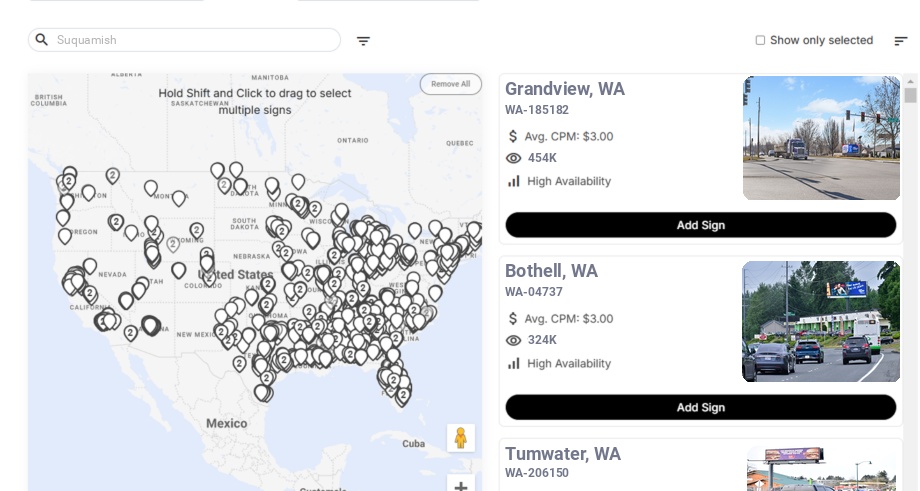



How much is a billboard in Suquamish?
Why Choose Blip for Billboard Advertising in Suquamish
Blip lets you launch Suquamish ads fast on SR-305, reaching Bainbridge ferry and Agate Pass commuters without a long-term commitment.
Set a flexible budget for Suquamish and pay only for the blips you want—ideal for testing on commuter peaks and weekend casino traffic.
Daypart Suquamish campaigns for 6-9 a.m. and 3:30-7 p.m. to catch Kitsap commuters, then shift spend to Thursday-Sunday visitors.
No contracts means you can adjust Suquamish billboard creative around Clearwater Casino events, ferry surges, or summer tourism spikes anytime.
Track Suquamish performance in real time with Blip, then swap creatives to match SR-305 travelers, tribal community members, and destination visitors.
Frequently Asked Questions About Billboard Advertising in Suquamish
How much does a billboard cost in Suquamish, Washington with Blip?
With Blip, you control exactly what you spend on Suquamish billboards by setting a daily budget that can be changed any time. Each “blip” is a 7.5 to 10-second ad display on rotating digital billboards in Suquamish, Washington, and you only pay for the blips you receive. Costs vary based on when and where your ad shows and on advertiser demand, so your total spend over time is simply the sum of each individual blip.
Where can I advertise with Blip in Suquamish, Washington?
Most billboard impressions in the Suquamish area will come from State Route 305, which connects Bainbridge Island, the Agate Pass Bridge, and Poulsbo. This corridor carries daily commuters, tribal community members, casino and resort visitors, and seasonal tourists heading to and from the Seattle–Bainbridge ferry. By focusing on SR-305 screens, you can reach traffic flowing to and from Bainbridge Island ferry and between Suquamish and Poulsbo/Silverdale.
Who sees Suquamish billboard ads on Blip?
Suquamish puts your brand in front of a uniquely concentrated mix of tribal community members, Kitsap commuters, Seattle-bound professionals, and destination visitors. The Suquamish trade area also pulls from local tribal and non-Tribal residents, Seattle–Bainbridge and Kitsap commuters, tourists and leisure travelers, and a military and contractor population tied to Naval Base Kitsap. This gives Suquamish billboards a regional—not just local—reach.
When is the best time to run Blip billboards in Suquamish, Washington?
Morning and evening rush hours on SR-305, roughly 6:00–9:00 a.m. and 3:30–6:30 p.m. on weekdays, are prime inventory for reaching working professionals and commuters. Weekend afternoons and evenings skew more toward leisure visitors and local families, ideal for hospitality, retail, and entertainment. In summer, Saturday traffic can exceed typical weekday volumes by 10–15%.
Why is Suquamish, Washington a good market for billboard advertising with Blip?
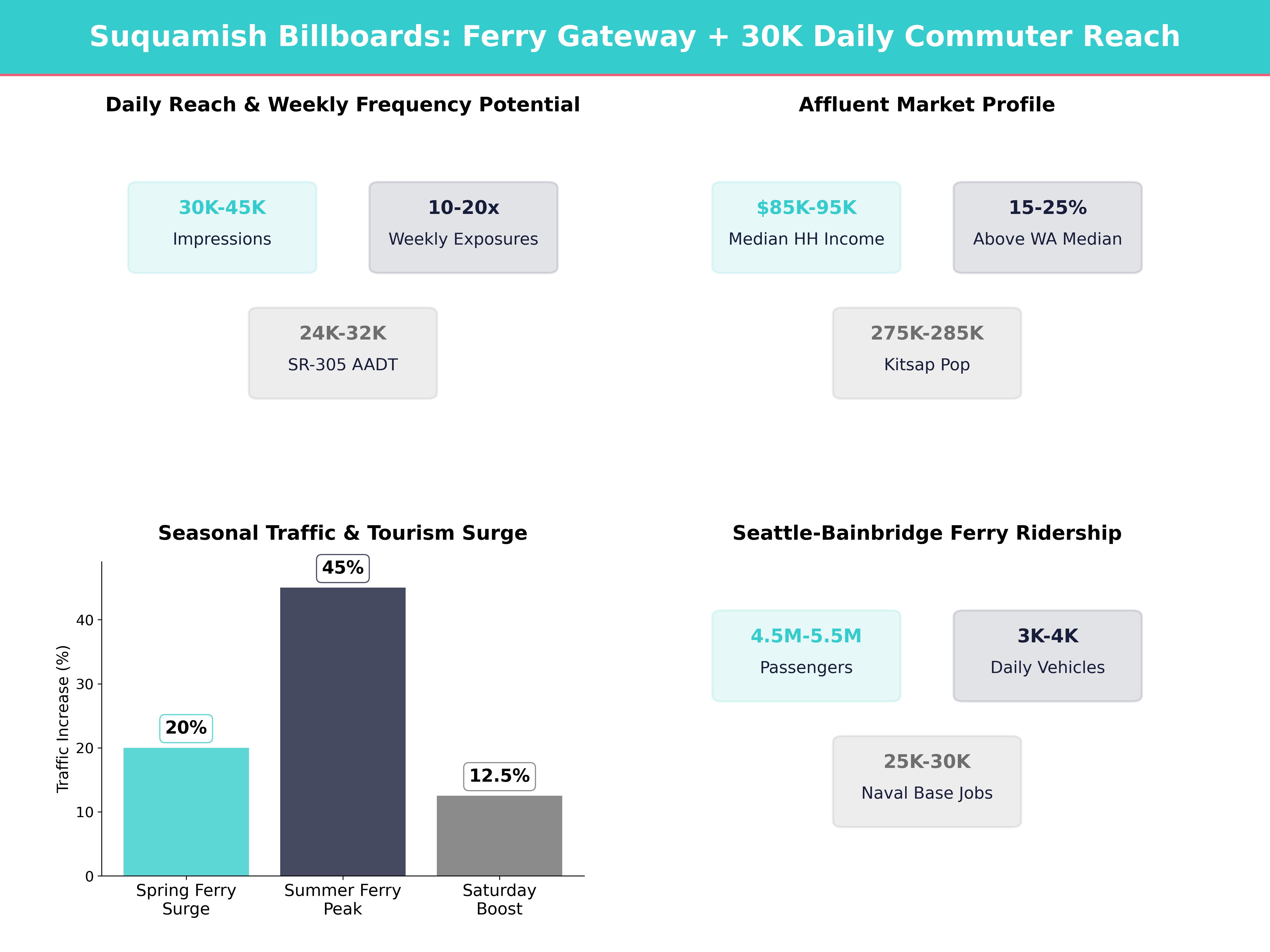
Suquamish is small, but its audience is powerful and highly mobile, which is why Suquamish billboards can deliver outsized impact relative to the town’s population. Kitsap County as a whole is home to roughly 275,000–285,000 residents, with population growth of about 8–10% since 2010, and median household income is typically reported in the $85,000–95,000 range. This combination supports a stable, middle- and upper-middle-income audience and significant cross-Puget Sound traffic.
Do I need a contract to advertise with Blip in Suquamish?
No, Blip has no long-term contracts or minimum commitments. You can start, pause, or stop your campaign at any time.
How fast can I launch a billboard campaign with Blip in Suquamish?
You can have your campaign live in minutes. Create a free account, select your locations, set your budget, upload your design, and start running once approved.
Where can I advertise with Blip in Suquamish?
Blip has digital billboards in Suquamish. You can browse available locations on a map, choose the ones that fit your audience, and start advertising right away.
Still have questions? Launch a campaign in minutes — no contracts, no commitments.
Start Your CampaignSuquamish Billboard Advertising Guide
Suquamish puts your brand in front of a uniquely concentrated mix of tribal community members, Kitsap commuters, Seattle-bound professionals, and destination visitors. Because digital billboards here often sit along State Route 305—the lifeline between Bainbridge Island, the Agate Pass Bridge, and the rest of Kitsap County—we can reach people repeatedly on the same high-frequency travel corridors, then use Blip’s controls to time and target messages when they’re most likely to act. For brands considering Suquamish billboard advertising, this combination of steady commuter flow and tourism traffic makes the area especially efficient.
The Suquamish Market at a Glance
Suquamish is small, but its audience is powerful and highly mobile, which is why Suquamish billboards can deliver outsized impact relative to the town’s population.
- Suquamish itself is a compact community of a few thousand residents within the Port Madison Indian Reservation, home to the Suquamish Tribe.
- Kitsap County as a whole is home to roughly 275,000–285,000 residents, with population growth of about 8–10% since 2010, according to long‑range planning summaries from Kitsap County and regional forecasts.
- The county’s age profile skews solidly working‑age: about 60–65% of residents fall between 18 and 64, supporting a strong commuter and consumer base.
- Median household income in Kitsap County is typically reported in the $85,000–95,000 range, placing it 15–25% above the Washington State median and supporting demand for higher‑value goods and services.
- Homeownership rates in Kitsap hover around 65–70%, indicating a large base for home improvement, landscaping, and financial services.
- A large portion of local workers are tied to defense, high tech, healthcare, and professional services centered around Naval Base Kitsap 25,000–30,000 active‑duty, civilian, and contractor jobs, with a regional economic impact routinely cited in the multi‑billion‑dollar range.
For advertisers, this means:
- A stable, middle- and upper-middle-income audience that can support higher-value purchases, frequent dining out, and destination entertainment.
- Significant cross-Puget Sound traffic to and from Seattle, giving Suquamish billboards a regional—not just local—reach.
- Strong tribal, cultural, and tourism traffic through venues like Suquamish Clearwater Casino Resort and the Suquamish Museum, which see steady visitation from around Kitsap and greater Puget Sound.
When we plan creative and scheduling, we should think beyond “small town” and treat Suquamish as a strategic node on a well-traveled regional corridor connecting City of Bainbridge Island, City of Poulsbo, and the wider peninsula. That’s the mindset that turns billboards in Suquamish into a core part of a Puget Sound–wide media plan.
Traffic Patterns: Where and When People See Your Ads
Most billboard impressions in the Suquamish area will come from:
-
State Route 305 (SR‑305)
- SR‑305 connects Bainbridge Island (and its ferry to Seattle), the Agate Pass Bridge, and Poulsbo, carrying both local and regional trips into the heart of North Kitsap.
- Washington State Department of Transportation (WSDOT) traffic counts along SR‑305 near Agate Pass typically show annual average daily traffic (AADT) of about 24,000–32,000 vehicles per day, depending on the specific segment and year. Peak summer counts can push several thousand vehicles above typical winter weekday volumes. You can explore detailed counts via WSDOT’s traffic data portal
- At 1.2–1.5 occupants per vehicle on commuter corridors, that translates to roughly 30,000–45,000 potential daily impressions on key SR‑305 boards.
-
This corridor carries a mix of:
- Daily commuters between Bainbridge, Suquamish, Poulsbo, and Silverdale
- Tribal community members and employees accessing services and venues on Port Madison Indian Reservation
- Casino and resort visitors, particularly Thursday–Sunday
- Seasonal tourists heading to and from the Seattle–Bainbridge ferry and exploring the Kitsap Peninsula
-
Seattle–Bainbridge Island Ferry Influence
- The Seattle–Bainbridge route is one of Washington State Ferries’ busiest. In strong pre‑pandemic years it handled around 6.0–6.5 million passengers annually (roughly 16,000–18,000 passengers per day). Even in more recent years, ridership has rebounded into the 4.5–5.5 million passengers per year range.
- Vehicle volumes on the route often average 3,000–4,000 vehicles per day, spiking on summer weekends and holidays.
- Many of those drivers continue straight onto SR‑305, passing near Suquamish on their way to Poulsbo, Kingston, or Naval Base Kitsap, meaning a significant portion of ferry traffic can be intercepted with well‑placed Suquamish‑area boards.
-
Local Destination Traffic
- The Clearwater Casino Resort complex draws a steady stream of visitors from across the region. On major event nights, traffic volumes on nearby SR‑305 can jump 10–20% compared to non‑event evenings.
- Kitsap’s broader visitor economy is substantial. Tourism reports compiled by Visit Kitsap Peninsula hundreds of millions of dollars in annual visitor spending in Kitsap County, supporting thousands of jobs in lodging, food service, retail, outdoor recreation, and transportation.
- Nearby destinations like downtown Poulsbo’s “Little Norway,” Bainbridge Island’s Winslow shopping district (promoted by Visit Bainbridge Island), and marinas along Liberty Bay and Agate Pass add constant movement of high‑value leisure travelers along SR‑305 and connecting routes.
Implications for campaigns:
- Morning and evening rush hours on SR‑305 (roughly 6:00–9:00 a.m. and 3:30–6:30 p.m. on weekdays) are prime inventory for reaching working professionals and commuters. During these windows, you can capture a high share of the 30,000+ daily vehicle trips on the corridor.
- Weekend afternoons and evenings skew more toward leisure visitors and local families, ideal for hospitality, retail, and entertainment. In summer, Saturday traffic can exceed typical weekday volumes by 10–15%.
- Because the same drivers use SR‑305 repeatedly, frequency matters: shorter, recurring Blip schedules can easily reach individual commuters 10–20 times per week when set to show during both morning and evening peaks.
With Blip, we can daypart campaigns to show most heavily during these high‑value periods, stretching budgets while still hitting people multiple times per week. This is especially valuable when you’re using Suquamish billboard advertising to stay in front of repeat commuters over several weeks or months.
Seasonality: Timing Your Message Around Suquamish’s Calendar
Suquamish and Kitsap County experience distinct seasonal patterns that should shape your billboard strategy. Hotel occupancy, ferry ridership, and traffic counts all swing noticeably between winter lows and summer highs, so timing billboard rental in Suquamish around these cycles can significantly improve performance.
Spring (March–May)
- Travel gradually ramps up as ferry tourism picks up and the weather improves. Washington State Ferries typically sees Bainbridge passenger volumes climb 15–25% from February to May.
- Local events, school sports, and outdoor activities increase weekend traffic. Community calendars from Kitsap County, City of Bainbridge Island, and City of Poulsbo start to fill with festivals, markets, and sports tournaments that draw visitors across North Kitsap.
- Hotel and short‑term rental occupancy on the Kitsap Peninsula often rises from winter lows in the 40–50% range toward 60–70% on spring weekends.
-
Use this period to:
- Launch branding campaigns ahead of the peak summer season, building awareness before competition intensifies.
- Promote home services, gardening, and outdoor recreation products as homeowners plan spring projects.
Blip tip: Increase impressions on Friday afternoons and Sunday evenings when weekend travelers are on the road and late ferries are busiest.
Summer (June–August)
- This is the peak tourism and leisure season on the Kitsap Peninsula. Regional tourism data often shows that 35–45% of annual visitor spending occurs in these three months.
- Ferry ridership and SR‑305 traffic swell as Seattle residents and out-of-area visitors explore Bainbridge, Suquamish, and Poulsbo. On some July and August days, Bainbridge ferry passenger volumes can be 40–50% higher than typical winter weekdays.
- Tribal and cultural events, waterfront festivals, and concerts at venues like Clearwater Casino add surges of visitors. Big concert weekends can produce thousands of incremental trips across a single evening.
- Long daylight hours (up to 15–16 hours of usable light in June) extend the window when billboard messages are highly visible. Sunrise before 5:15 a.m. and sunset after 9:10 p.m. mean commuters and late‑evening diners still see boards in natural light.
Use summer for:
- Aggressive promotions for restaurants, bars, breweries, and attractions.
- Tourism offers: lodging, charters, adventure tours, museums, and casinos.
- Seasonal hiring campaigns targeting teens, college students, and service workers, especially as regional unemployment rates often dip into the 3–4% range and competition for workers intensifies.
Fall (September–November)
- Commuter patterns stabilize with the school year. Traffic volumes stay strong on weekday mornings and afternoons as schools in North Kitsap and Bainbridge resume.
- Daylight shrinks, making early evenings prime time; illuminated digital billboards stand out more as it gets dark between 5:00 and 7:00 p.m. by November.
- Consumer focus shifts toward back‑to‑school, healthcare appointments before year‑end, and financial planning.
-
Great for:
- Back‑to‑school and college‑oriented offers targeting families with K‑12 and college‑age students, who make up roughly 20–25% of the county’s population.
- Professional services, healthcare, and financial planning ahead of year‑end.
- Political and issue campaigns timed to November elections; Kitsap County Elections provides local election calendars and turnout data, with general election turnout in many recent cycles often exceeding 70% of registered voters.
Winter (December–February)
- Traffic volumes soften somewhat—WSDOT counts on some routes can dip 10–20% compared to summer—but holiday shopping and casino visits still create concentrated bursts.
- Short days mean more impressions in darkness; in December, sunset is often before 4:30 p.m., meaning most evening commuters see illuminated creative.
- Kitsap retailers frequently report a disproportionate share of annual revenue in the November–December window, making timely campaigns crucial.
-
Ideal for:
- Holiday retail, events, and restaurant promotions.
- New Year’s resolution messaging for gyms, health clinics, counseling, and education.
- Branding campaigns that require lower CPMs; winter can offer better value per impression as competition for outdoor inventory eases.
With Blip’s ability to increase or decrease budgets daily, we can intensify campaigns around specific high‑impact periods—holiday weekends, big events at Clearwater Casino, or ferry traffic surges—and scale back when activity slows. This type of flexible spend control makes billboard rental in Suquamish accessible even for smaller advertisers.
Audience Profiles: Who We Reach Around Suquamish
The Suquamish trade area pulls from multiple overlapping audiences:
-
Local Tribal and Non-Tribal Residents
- Centered around Suquamish, Agate Pass, and nearby neighborhoods including parts of Poulsbo and Bainbridge.
- Frequent SR‑305 for work, shopping, school, and tribal services at facilities operated by the Suquamish Tribe.
- Often loyal to local businesses and highly responsive to community-focused messaging, especially campaigns that recognize local culture, schools, and events.
- Household sizes in many nearby neighborhoods average 2.5–3.0 people, boosting response for family‑oriented offers.
-
Seattle–Bainbridge and Kitsap Commuters
- Professionals commuting between Kitsap County and jobs in Seattle or Bellevue, as well as inter‑Kitsap commuters traveling between Bainbridge, Poulsbo, Silverdale, and Bremerton.
- Many work in tech, defense, healthcare, and other higher-income sectors; professional and technical occupations make up a significant share of Kitsap’s 120,000+ jobs, with above‑average wages.
- Regular exposure: the same individuals may see your message 10–20 times per week depending on scheduling and whether they commute both directions on SR‑305 daily.
-
Tourists and Leisure Travelers
- Visitors staying at Clearwater Casino Resort, Bainbridge Island, Poulsbo, and the wider peninsula. During peak months, North Kitsap lodging properties can reach 70–85% weekend occupancy.
- They are often in “discovery mode,” looking for food, entertainment, and activities within 5–20 miles of where they are, and more likely to respond to “Exit Now” or “Tonight Only” messaging.
- Outdoor enthusiasts are drawn to local marinas, kayak launches, fishing spots, and trailheads promoted by Visit Kitsap Peninsula
-
Military and Contractor Population
- Naval Base Kitsap
- Military households typically have steady income, with many dual‑earner families. Their spending patterns often emphasize autos, home goods, dining, and family entertainment.
- Many travel SR‑305 to access housing, retail, and entertainment across Kitsap, especially toward Silverdale’s retail core
In creative strategy, we should:
- Use higher-income, professional‑oriented messaging during weekday commutes.
- Shift to experience- and entertainment-driven messaging in the evenings and on weekends.
- Emphasize local culture and respect for tribal heritage when speaking directly to Suquamish and surrounding communities, and consider collaboration with tribal entities for campaigns touching cultural themes. This helps ensure billboards in Suquamish feel relevant and welcomed by local audiences.
Creative Strategy: What Works on Suquamish Billboards
Suquamish drivers are often moving at 45–55 mph on SR‑305, with limited viewing windows of 3–6 seconds depending on curves and sightlines. Effective creative must be instantly digestible and visually strong, especially when you are investing in Suquamish billboard advertising to reach the same drivers day after day.
Visuals
- Use bold, high‑contrast colors that stand out against evergreen forest backdrops and frequently overcast skies—deep blues, bright whites, oranges, and yellows perform well.
- Avoid low-contrast color combinations (e.g., green on dark blue) that can get lost in tree-lined stretches or on rainy days, which occur on roughly 150+ days per year in the region.
-
Feature recognizable local landmarks:
- Agate Pass Bridge silhouette
- Ferry profiles approaching or leaving Bainbridge Island
- Mount Rainier or Olympic Mountains in the distance
- Suquamish waterfront imagery or tribal artwork (if appropriate and respectful)
- For gaming, hospitality, and nightlife, bright imagery from Suquamish Clearwater Casino Resort–style experiences can immediately signal “fun” and “night out.”
Copy
- Aim for 6–8 words or fewer in the main message; studies of roadside readability show comprehension drops sharply beyond 7–8 words at highway speeds.
-
Use one dominant call-to-action (CTA) such as:
- “Exit Now at Clearwater Casino”
- “Poulsbo Brewpub – 10 Min Ahead”
- “Same‑Day Urgent Care in Poulsbo”
-
Include a simple locator:
- “Next Right”
- “3 Miles Ahead”
- “Near Bainbridge Ferry”
- Short URLs or brand names work better than full web addresses; QR codes are less effective at highway speeds, so only use them for slower local roads or if you know traffic will be stop‑and‑go.
Tone
- For tribal land and culture, be respectful and authentic. If referencing Suquamish heritage, collaboration with the Suquamish Tribe or local partners is important.
- Humor can work well for commuters who see your message daily, but it must be clear in 1–2 seconds and not depend on small text.
-
Emphasize time savings and proximity:
- “Beat I‑5 Traffic – Shop Local in Poulsbo”
- “Skip Seattle Crowds – Dine in Suquamish”
With Blip, we can upload multiple creatives and rotate them, using A/B tests to find which message and visual combination drives the best online or in‑store response. This testing approach is especially useful when you’re fine-tuning billboards in Suquamish to different segments such as commuters versus tourists.
Using Blip Strategically in the Suquamish Area
Blip’s flexibility matches Suquamish’s dynamic traffic patterns. We can combine:
Dayparting
-
Weekday Mornings (6–9 a.m.)
-
Focus on commuting professionals:
- Transit, rideshare, and parking services near the Bainbridge terminal (coordinated with information from Washington State Ferries and local park‑and‑ride lots listed by Kitsap Transit)
- Seattle‑oriented services (law, finance, B2B) that want mindshare before workers hit the office
- Quick breakfast, coffee, and drive‑thru options along the route
-
Focus on commuting professionals:
-
Weekday Evenings (3:30–7 p.m.)
-
Promote:
- Restaurants, bars, and happy hour specials
- Grocery deals and click‑and‑collect services
- Family activities and after‑work fitness
-
Promote:
-
Weekends
-
Shift budget to:
- Tourism offers, museums, and tours
- Casino promotions, events, and entertainment
- Home improvement, marine services, and outdoor recreation retail
-
Shift budget to:
Geographic Strategy
While we can’t place a Blip screen exactly anywhere, we can:
-
Focus on SR‑305 screens that catch traffic flowing:
- To and from Bainbridge Island ferry
- Between Suquamish and Poulsbo/Silverdale
-
Consider adjacent corridors where drivers continue:
- Toward Kingston ferry (to Edmonds) via SR‑307/104
- Toward Silverdale and Bremerton’s retail cores and the Silverdale Regional Center
By aligning which boards we use with where our customers are most likely headed, we increase relevance. A “Tonight Only at Clearwater Casino” message near Agate Pass captures drivers at exactly the right moment to decide their evening plans, and thoughtful placement like this can make even a modest billboard rental in Suquamish feel like a premium, high‑impact buy.
Budget and Frequency
In a smaller, high‑frequency market like Suquamish:
- We often see stronger results with consistent, medium‑level presence over 3–8 weeks rather than a short, extremely heavy burst, especially when commuters pass the same location 10+ times per week.
-
Because the same commuters see your ad daily, even modest budgets can achieve:
- 10–30 impressions per week per individual commuter (depending on schedule), translating into hundreds or thousands of impressions per month among your core target segment.
-
We can ramp up budget temporarily for:
- Holiday weekends (Memorial Day, July 4, Labor Day)
- Big events and concerts at Clearwater Casino highlighted on the resort’s calendar
- Local festivals and school events highlighted by outlets like the Kitsap Sun or North Kitsap Herald
Industry-Specific Ideas for Suquamish Advertisers
Casinos, Hotels, and Entertainment
- Target Thursday–Sunday evenings and event days when Clearwater and other venues see their highest traffic, often accounting for 50%+ of weekly gaming and entertainment revenue.
-
Use proximity messaging like:
- “Jackpot Night – Clearwater Casino – Next Exit”
-
Feature limited-time offers:
- “$50 Free Play This Weekend Only”
- “Comedy Night – Friday 8 PM – Book Now”
- Pair with digital campaigns targeting people in nearby zip codes or ferry departure areas (Seattle waterfront, Winslow/Bainbridge), using geo‑targeting informed by visitor patterns reported by Visit Kitsap Peninsula
Restaurants, Breweries, and Bars
- Focus on commuters and weekend visitors. In many Kitsap communities, 30–40% of restaurant revenue can come from Friday–Sunday trade.
-
Promote:
- Happy hour windows (e.g., “Happy Hour 3–6 PM in Suquamish”)
- “Ferry‑Friendly” timing (“Dinner Before the 8:45 Boat”)
-
Point drivers toward nearby hubs:
- Suquamish waterfront
- Downtown Poulsbo (Little Norway), linking to City of Poulsbo attractions
- Bainbridge’s Winslow district, coordinated with content from Visit Bainbridge Island
Marine, Outdoor, and Recreation Services
- Kitsap Peninsula is a hub for boating, kayaking, and hiking, with dozens of public launches and trails promoted by Visit Kitsap Peninsula 50% or more compared to winter.
-
Highlight:
- Seasonal storage, repairs, or charters
- Gear rental and outdoor tours
- Increase impressions from April–September, especially on Fridays and Saturdays when boat ramps and marinas are busiest.
Healthcare and Wellness
- Many residents travel for specialized services; billboards can keep your practice top of mind on their primary travel routes.
-
Promote:
- Urgent care with short drive times (“Urgent Care – 10 Min Ahead in Poulsbo”)
- Dental, vision, chiropractic, and behavioral health
- Open enrollment and wellness checks, especially in the October–January window when demand spikes.
- Align campaigns with back‑to‑school physicals and sports seasons, when local clinics often see appointment volume increase by 20–30%.
Auto, Home Services, and Retail
- Large catchment area: people from Kingston, Bainbridge, Suquamish, and Poulsbo often cross‑shop along SR‑305 and in nearby regional centers.
-
Promote:
- Tire and auto service before winter or road‑trip season; Kitsap’s winter months bring higher risk of rain and occasional snow/ice events that drive tire and maintenance demand.
- Contractor and remodeling services timed to spring/summer, when home improvement spending typically peaks.
- “Shop Local” campaigns appealing to Kitsap’s strong community identity, reinforced by local initiatives promoted through Kitsap County and area chambers.
Measuring and Optimizing Your Suquamish Campaign
To get the most from your Suquamish billboard investment, we should actively measure and refine.
Set Clear, Trackable Goals
Examples:
- “Increase weekend restaurant covers by 15–20% over 6 weeks.”
- “Drive 200–300 additional website visits per week from Kitsap County.”
- “Generate 50–75 extra bookings for a casino event.”
Align these goals with realistic traffic volumes and your estimated conversion rate (for example, converting 1–3% of web visitors or 5–10% of calls into paying customers).
Connect Billboard Exposure to Action
-
Use short, memorable URLs or promo codes:
- “Use code SUQ15 for 15% off”
- Create location-specific landing pages and monitor traffic from Kitsap-area IP addresses or geo‑tagged mobile visits.
- Track in‑store responses by training staff to ask, “How did you hear about us?” and log “billboard” mentions. Over a 4–8 week campaign, aim to see billboard mentions climb into the dozens or hundreds, depending on your foot traffic.
-
If you run parallel digital campaigns, watch for lift in:
- Direct traffic
- Brand‑name search queries
- Click‑throughs from Kitsap and Seattle DMA locations
Test and Iterate
-
Rotate 2–3 creatives:
- One focused on price
- One on experience
- One on urgency (“This Weekend Only”)
-
Run each version long enough (1–2 weeks minimum) to see meaningful differences in:
- Web traffic
- Call volume
- Reservations or foot traffic
- A difference of 20–30% in response between creatives is common; in that case, reduce spend on underperforming creatives and shift impressions to the top performer.
Align With Local News and Events
Keep an eye on:
- Kitsap Sun
- Kitsap Daily News
- Local city sites like City of Bainbridge Island and City of Poulsbo
- County updates via Kitsap County
When these sources highlight major events, road projects, or ferry changes that may alter traffic patterns—such as lane closures on SR‑305, ferry schedule adjustments, or large waterfront festivals—we can adjust schedules and messaging to stay relevant and maximize impressions during the heaviest travel windows. This kind of ongoing optimization helps ensure your billboards in Suquamish keep performing as conditions change.
By understanding Suquamish’s unique blend of tribal heritage, commuter traffic, and tourism flow—and pairing that insight with Blip’s flexible scheduling and creative testing—we position our billboard campaigns to punch far above the market’s population size. With precise timing, clear local relevance, and data‑driven optimization anchored in real traffic and tourism numbers, Suquamish digital billboards can become one of the most efficient and impactful components of your Puget Sound marketing strategy, whether you’re testing your first Suquamish billboard advertising campaign or scaling up ongoing billboard rental in Suquamish as a long‑term channel.