Billboards in Shoreline, WA
No Minimum Spend. No Long-Term Contracts. Just Results.
Trusted by Leading Brands


Billboard advertising
in Shoreline has never been easier



How much is a billboard in Shoreline?
Why Choose Blip for Billboard Advertising in Shoreline
Blip lets you launch Shoreline billboards in minutes, reaching I-5 and Aurora Ave N commuters without sales calls or long lead times.
Set a flexible daily budget in Shoreline and scale for peak 6–9 a.m. and 3–7 p.m. traffic toward Seattle, Lynnwood, and Bothell.
No contracts means Shoreline businesses can test ads near Lynnwood and Bothell, then shift spend as results change.
Use real-time Blip analytics to see what works on Shoreline-area corridors like I-5 and SR-99, then optimize fast.
Create high-contrast Shoreline ads with Blip’s creative tools for rainy days, school seasons, and park-going families near Puget Sound.
Frequently Asked Questions About Billboard Advertising in Shoreline
How much does a billboard cost near Shoreline, Washington with Blip?
With Blip’s flexible, pay-per-blip pricing, you control exactly how much you spend on Shoreline billboards by setting a daily budget that can be adjusted anytime. Each blip is a short 7.5 to 10-second ad display, and you only pay for the individual blips your message receives, so you can start with just a few dollars a day and scale up as you see results. The cost per blip for billboards near Shoreline, Washington varies based on the times you choose to run your ads, your chosen locations serving the Shoreline area, and overall advertiser demand.
Where can I advertise with Blip near Shoreline, Washington?
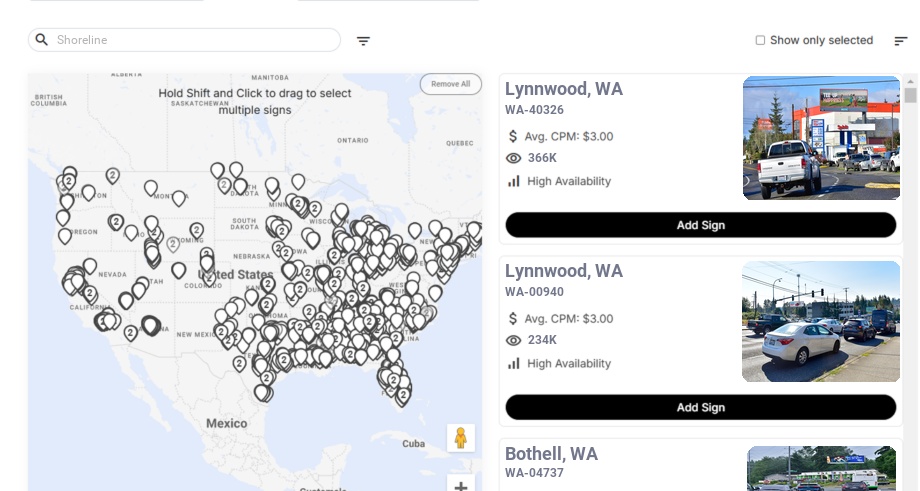
We have 4 digital billboards serving the Shoreline area from two nearby hubs, giving you practical options for billboard rental near Shoreline. Lynnwood is about 6.6 miles from Shoreline, and Bothell is about 8.2 miles from Shoreline. Because both Lynnwood and Bothell sit on major regional corridors, campaigns here can simultaneously target Shoreline residents, Seattle commuters, and shoppers and workers in the north-end suburbs.
What kind of people live in Shoreline, Washington for billboard ads with Blip?
The City of Shoreline has about 60,000–62,000 residents spread across 11.7 square miles, giving the Shoreline area a suburban, yet highly connected feel. Local and regional planning data place median household income in Shoreline at roughly $95,000–$105,000, and about 40–45% of residents hold a bachelor’s degree or higher. Racial and ethnic diversity is also a hallmark of the Shoreline area, with roughly 40–45% of residents identifying as non-white.
What are the busiest traffic routes for Shoreline, Washington billboards?
Interstate 5 in the north Seattle/Shoreline segment carries average daily volumes around 180,000–200,000 vehicles per day, making it one of the most heavily traveled corridors in the state. Aurora Avenue N / SR-99 runs parallel to I-5 and sees about 30,000–45,000 vehicles per day depending on the segment, with numerous signalized intersections that slow drivers and increase ad viewing time. I-405 near Bothell also carries 150,000–200,000 vehicles per day in many segments, extending reach into major commuter routes.
When is the best time to run Shoreline, Washington billboard ads with Blip?
We can use Blip’s flexible scheduling to concentrate your impressions during the highest Shoreline-related commuter windows based on regional traffic patterns. Weekday 6–9 a.m. typically represents 25–30% of weekday traffic on major corridors, and weekday 3–7 p.m. is often the single busiest period of the day with 30–35% of weekday volume. For digital billboard campaigns, early morning works well for professional services and afternoon works well for retail, restaurants, and same-day offers.
Do I need a contract to advertise with Blip in Shoreline?
No, Blip has no long-term contracts or minimum commitments. You can start, pause, or stop your campaign at any time.
How fast can I launch a billboard campaign with Blip in Shoreline?
You can have your campaign live in minutes. Create a free account, select your locations, set your budget, upload your design, and start running once approved.
Where can I advertise with Blip in Shoreline?
Blip has digital billboards in Shoreline. You can browse available locations on a map, choose the ones that fit your audience, and start advertising right away.
Still have questions? Launch a campaign in minutes — no contracts, no commitments.
Start Your CampaignShoreline Billboard Advertising Guide
Shoreline, Washington sits just north of Seattle, with fast-growing neighborhoods, strong household incomes, and heavy commuter traffic moving along I‑5 and Aurora Avenue N (SR‑99). With four digital billboards serving the Shoreline area from nearby Lynnwood and Bothell, we can help you tap into this high-intent, on‑the‑go audience using flexible, data-informed campaigns and convenient billboards near Shoreline.
Understanding the Shoreline Area Market
Shoreline is a dense, largely residential city that functions as a key bedroom community for Seattle and a strong hub for regional billboard advertising near Shoreline.
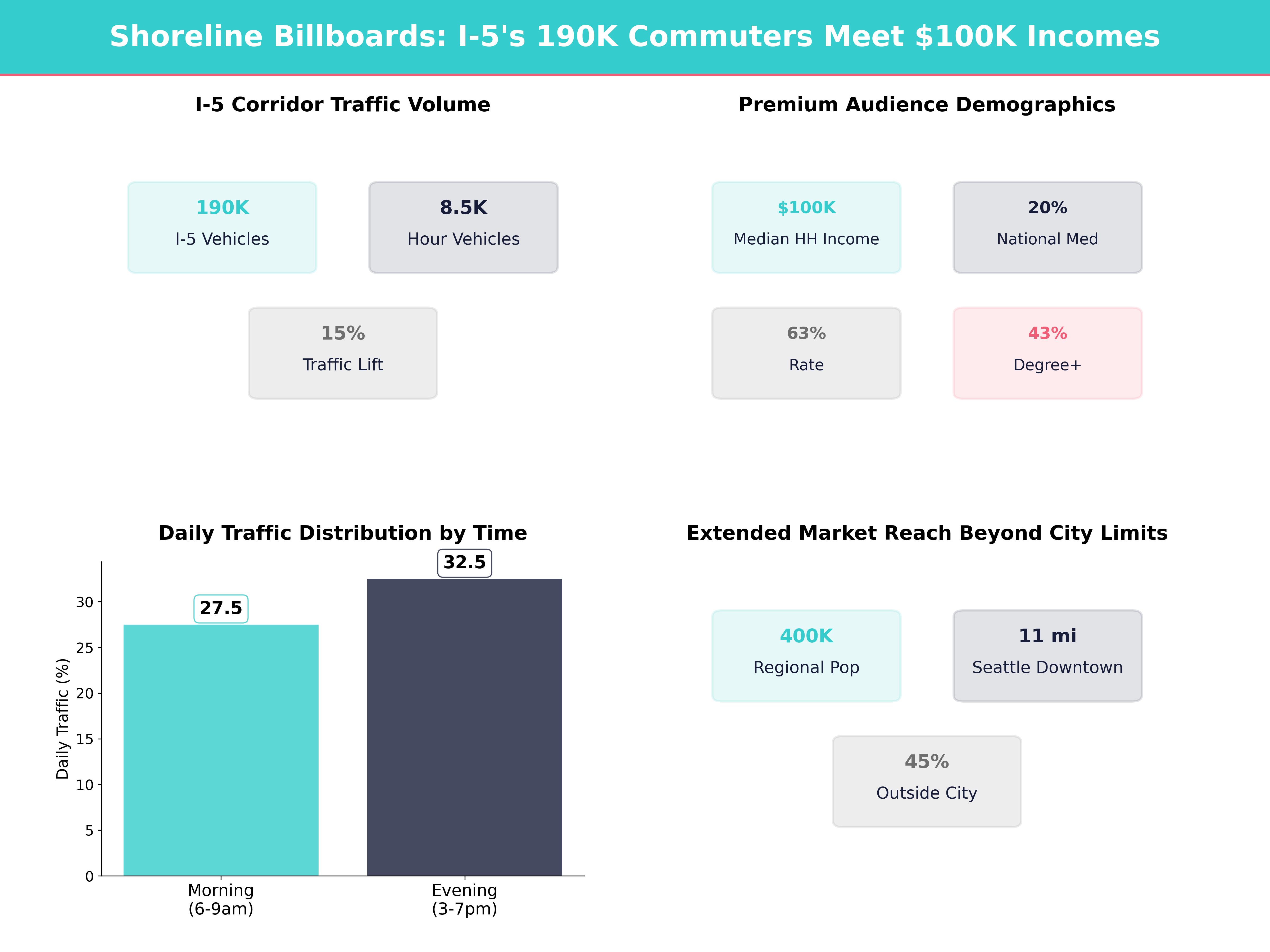
- The City of Shoreline 60,000–62,000 residents spread across 11.7 square miles, for a density of about 5,000+ residents per square mile, giving the Shoreline area a suburban, yet highly connected feel.
- Local and regional planning data place median household income in Shoreline at roughly $95,000–$105,000, which is 15–25% higher than the national median, reflecting a solid middle- to upper-middle income base.
- Owner-occupied housing typically represents around 60–65% of households, with single-family homes dominating many neighborhoods—ideal for home services, remodeling, and high-ticket purchases.
- According to the City of Shoreline, over 400 acres of parkland, 30+ parks and open spaces, and nearly 4 miles of Puget Sound shoreline make outdoor recreation a core part of local life.
- Shoreline’s proximity to Seattle (about 10–12 miles to downtown via I‑5) means many residents tap into the broader regional job market while spending their evenings and weekends in the Shoreline area.
Key implications for billboard advertisers serving the Shoreline area:
- Higher incomes and proximity to Seattle mean strong potential for discretionary spending—restaurants, home services, automotive, financial services, and lifestyle brands all perform well here when promoted on Shoreline billboards and nearby corridors.
- Local economic profiles show a strong concentration of workers in professional services, tech, healthcare, and education, sectors that tend to have above-average purchasing power and respond to convenience messaging.
- Many residents commute to Seattle, Lynnwood, Bothell, and beyond: regional commute statistics indicate that 40–50% of employed residents work outside Shoreline, so messaging tailored to commuters and professionals is especially effective.
- Strong civic engagement and local pride—reflected in active neighborhood associations and frequent coverage in Shoreline Area News and the City of Shoreline channels—mean that campaigns that feel “hyper-local” to neighborhoods like Richmond Beach, Meridian Park, and Echo Lake can build more trust and response when featured on billboards near Shoreline.
Where Our Billboards Reach: Lynnwood & Bothell Corridors
We have 4 digital billboards serving the Shoreline area from two nearby hubs, giving you practical options for billboard rental near Shoreline:
- Lynnwood (about 6.6 miles from Shoreline)
Lynnwood is a major retail and transportation node north of Shoreline, with the redeveloped Alderwood Mall and the new Lynnwood Link light rail extension. The City of Lynnwood cites a residential population of roughly 40,000–42,000, but a daytime population that swells by tens of thousands thanks to regional shopping and employment, with Alderwood’s 200+ stores and restaurants and roughly 1.3 million square feet of retail drawing visitors from across North King and Snohomish counties.
Billboards here reach Shoreline residents traveling for shopping, dining, and commuting up and down I‑5, as well as visitors staying in Lynnwood’s 20+ hotels and attending events at the Lynnwood Event Center. These placements function as effective Shoreline billboards for both northbound and southbound traffic. - Bothell (about 8.2 miles from Shoreline)
Bothell straddles King and Snohomish counties and hosts a tech, biotech, and education cluster near the University of Washington Bothell and Cascadia College. The City of Bothell lists a population in the 50,000–55,000 range, with strong job growth in software, life sciences, and advanced manufacturing along the I‑405 corridor.
The UW Bothell and Cascadia College campus together serve over 10,000 students, creating a steady flow of young adult commuters and staff. Our boards near Bothell capture Shoreline area commuters heading toward employment centers in Bothell, Kirkland, and Redmond via I‑405 and SR‑522, extending the reach of billboard advertising near Shoreline into major Eastside job centers.
Because both Lynnwood and Bothell sit on major regional corridors, campaigns here can simultaneously target:
- Residents of the Shoreline area
- Seattle commuters using I‑5, I‑405, and SR‑522
- Shoppers and workers in Lynnwood, Bothell, and the north-end suburbs
This extended reach can be especially powerful for brands that serve a broader North King / South Snohomish footprint, covering a combined regional population of 400,000+ residents within a 15–20 minute drive of the Shoreline-area boards.
Traffic Flows and Optimal Placement Strategy
The Shoreline area is framed by a few dominant traffic arteries that drive demand for billboards near Shoreline:
- Interstate 5 (I‑5): WSDOT traffic counts show average daily volumes around 180,000–200,000 vehicles per day on I‑5 in the north Seattle/Shoreline segment, making it one of the most heavily traveled corridors in the state. Peak-direction volumes during rush hours can exceed 8,000–9,000 vehicles per hour.
WSDOT’s traffic data portal at wsdot.wa.gov 10–20% higher than weekends. - Aurora Avenue N / SR‑99: This surface highway runs parallel to I‑5, with many Shoreline residents using it for shorter commutes and access to local businesses. Various WSDOT counts put daily traffic on SR‑99 in the north-end at 30,000–45,000 vehicles per day depending on the segment, with numerous signalized intersections that naturally slow drivers and increase ad viewing time, making this corridor well suited for Shoreline billboards.
- I‑405 / SR‑522 near Bothell: The I‑405 corridor 150,000–200,000 vehicles per day in many segments, serving commuters headed to tech and industrial jobs on the Eastside. SR‑522 adds another 40,000–60,000 vehicles per day around Bothell and Woodinville, including freight, winery traffic, and Eastside commuters.
Our Lynnwood and Bothell billboards position your message along feeder routes that Shoreline residents actually use:
-
Lynnwood boards intercept Shoreline area drivers heading to/from:
- Alderwood retail area and the 196th St SW commercial corridor
- Edmonds and Mountlake Terrace via I‑5 and SR‑104
- I‑405 and the Eastside via I‑5 north, capturing part of the 200,000+ daily trips that move through the I‑5/I‑405 interchange
-
Bothell boards intercept Shoreline area drivers headed toward:
- Bothell and Woodinville (SR‑522), including the Woodinville wine district’s 100+ wineries and tasting rooms promoted by Woodinville Wine Country
- Kirkland, Bellevue, and Renton (I‑405), which collectively host hundreds of thousands of jobs in tech, healthcare, and services
- UW Bothell and Cascadia College campuses, with thousands of daily trips by students, faculty, and staff
We can use Blip’s flexible scheduling to concentrate your impressions during the highest Shoreline‑related commuter windows based on regional traffic patterns:
- Weekday 6–9 a.m.: Typically represents 25–30% of weekday traffic on major corridors, with strong southbound and westbound flows toward Seattle and the Eastside.
- Weekday 3–7 p.m.: Often the single busiest period of the day, with 30–35% of weekday volume as return traffic moves toward the Shoreline area and North Snohomish County.
Demographics and Audience Segments in the Shoreline Area
Shoreline’s demographics are diverse, well-educated, and family-oriented, making billboard advertising near Shoreline a strong complement to digital and print outreach:
- The City of Shoreline notes that about 40–45% of residents hold a bachelor’s degree or higher, significantly above national averages and aligned with strong knowledge-based employment in nearby Seattle and the Eastside.
- Racial and ethnic diversity is a hallmark of the Shoreline area, with roughly 40–45% of residents identifying as non-white, and sizable Asian, Black, Hispanic/Latino, and multiracial communities reflected in local schools and community programming highlighted by the Shoreline School District.
-
Age distribution is fairly balanced:
- Large clusters of 25–44 year-olds (often 30%+ of the population), representing prime working age and early family formation
- A significant share of 45–64 year-olds (roughly 20–25%), often established homeowners with higher spending power
- A strong segment of children and teens under 18, typically around 18–22% of residents, supported by the Shoreline School District, which serves about 9,000+ students across its schools.
- Nearby institutions such as Shoreline Community College, which enrolls several thousand students annually and draws a substantial international student population, add a layer of young adult and global audiences commuting through the area.
Implications for billboard messaging:
- Middle- to high-income positioning works well—premium services, home improvement, healthcare, and financial products benefit from messaging that emphasizes quality, expertise, and convenience rather than just price.
- Cultural and linguistic diversity supports campaigns that are bilingual or culturally attuned; localized creatives can resonate strongly for health care, education, community services, and financial institutions.
- Family-focused messaging (education, healthcare, recreation, after-school programs) maps well to the local school and youth population, particularly when coordinated with the Shoreline School District calendar and youth sports seasons covered by outlets like Shoreline Area News.
Commuter Patterns and Daypart Strategy
Nearly half or more of Shoreline area workers commute to jobs outside the city, many into Seattle, Northgate, Lynnwood, and the Eastside. Local transportation planning documents from the City of Shoreline
- Heavy reliance on I‑5 and Aurora Ave N for work trips, with thousands of daily Shoreline-origin vehicles feeding into these corridors.
- Growing transit use, including express bus routes and future light rail stations at Shoreline South/148th and Shoreline North/185th on the Lynnwood Link Extension. Sound Transit projections anticipate tens of thousands of daily boardings along this extension once fully open, which will influence park‑and‑ride and feeder traffic patterns around Shoreline.
- Active walking and biking for short local trips; city plans call for expanding the network of multi-use paths and bike lanes to better connect neighborhoods to transit and commercial areas.
For digital billboard campaigns:
- Target early morning (6–9 a.m.) for professional services, coffee and breakfast, transit‑oriented messaging, and “before-work” calls to action. This window often captures one-quarter or more of daily commuter traffic.
- Target afternoon (3–7 p.m.) for retail, restaurants, entertainment, and same‑day or weekend offers that commuters can act on as they head back toward the Shoreline area. This is typically the heaviest travel window on weekdays.
- Consider weekend daytimes for family‑oriented services, events, outdoor recreation, and shopping; Shoreline residents frequently travel to Lynnwood retail centers, the Edmonds waterfront (promoted by Visit Edmonds Explore Bothell
With Blip, you can daypart your buys so your ads predominantly run during these peak Shoreline‑relevant windows rather than paying for low-intent late-night impressions that represent a small fraction of total daily traffic.
Seasonality and Local Events to Leverage
Shoreline’s mild marine climate and community-oriented culture create strong seasonal patterns you can build into your flighting and your strategy for billboard rental near Shoreline:
-
Spring (March–May)
- Average high temperatures climb from the 50s into the low 60s, and rainfall begins to taper off, spurring home and yard improvement.
- Parks and trail usage ramps up at places like Richmond Beach Saltwater Park Interurban Trail double-digit percentage increases in park visitation compared to winter.
- Great window for landscapers, contractors, garden centers, outdoor recreation, and local attractions.
-
Summer (June–August)
- Long daylight hours—Seattle’s latitude brings 15.5–16 hours of light around the June solstice—mean more visibility for daytime digital boards and higher evening traffic to outdoor venues.
- Community events and festivals in the broader region: Shoreline-area neighborhood events, Lynnwood’s “Love Your Block” initiatives, Edmonds waterfront festivals promoted by Visit Edmonds, and Seattle summer happenings promoted via Visit Seattle. These events can draw daily crowds of several thousand visitors.
- Strong season for tourism, outdoor dining, camps, and family activities, with many local attractions reporting peak attendance during July and August.
-
Fall (September–November)
- Back-to-school (Shoreline School District, Shoreline Community College, and UW Bothell) creates a spike in education and youth-related needs; schools collectively serve tens of thousands of students in the immediate region.
- Health care, flu shots, and insurance open enrollment messaging perform well as local health providers and insurers ramp up outreach; clinics often see noticeable appointment spikes in October and November.
- Retailers begin holiday promotions in late October, making this a prime window for early shoppers.
-
Winter (December–February)
- Holiday shopping and dining campaigns can target Shoreline area residents traveling to Lynnwood and Bothell retail centers, which typically see their highest sales volumes of the year in November–December.
- Shorter days (as little as 8.5 hours of daylight in December) increase the value of bright, high-contrast digital creatives in the late afternoon and early evening.
- Post-holiday period is ideal for fitness, healthcare, financial planning, and home services as residents refocus on “reset” goals.
We recommend aligning your Blip campaigns with these seasonal peaks and using shorter, intense flights (for example, 2–4 weeks before major local events or back‑to‑school) to maximize recall during key decision windows. Tracking sales or website lifts around these dates will help fine‑tune future seasonal timing.
Creative Best Practices for the Shoreline Area
To resonate with drivers in and around the Shoreline area, we recommend:
-
Lead with clear, high-contrast visuals
- Frequent rain and overcast skies—Seattle-area locations commonly see 150+ days of measurable precipitation per year—mean your designs must “pop.”
- Use high contrast colors (e.g., dark backgrounds with bright text or vice versa) and avoid low-contrast palettes that can wash out in gray conditions or glare.
-
Keep copy ultra-concise
- Aim for 7 words or fewer of main text; commuters on I‑5 and surrounding highways have only 3–6 seconds to process your message at typical speeds of 40–60 mph.
- Use one strong call-to-action: “Exit at 179th,” “Book Today,” or “Visit in Lynnwood.”
-
Localize your message
- Reference recognizable landmarks or subareas: “Serving the Shoreline area,” “Near Aurora & 185th,” or “Minutes from Richmond Beach.”
- Include directional cues if relevant: “Just off I‑5 in Lynnwood,” “Next to Alderwood,” or “Off SR‑522 in Bothell.”
-
Design for diverse audiences
- Imagery that reflects the Shoreline area’s racial and cultural diversity feels more authentic and aligns with local school and community initiatives highlighted by the City of Shoreline.
- If your business already serves multilingual customers, consider testing English plus a secondary language version, especially for health care, education, or community services that are frequently promoted through local channels like Shoreline Area News.
-
Weather- and commute-aware messaging
- Use Blip’s flexibility to run weather-appropriate creatives (e.g., rain gear, auto services, comfort food) during the rainy season, when wet-weather driving can stretch commute times by 10–30%.
- For commuter-focused offers, speak directly to pain points: “Skip traffic with mobile pickup,” or “10 minutes from home in the Shoreline area,” and highlight time savings or easy parking.
Using Blip’s Tools Strategically for Shoreline-Area Campaigns
Our platform allows you to tailor your campaigns to the unique rhythms of the Shoreline area and get more from billboard advertising near Shoreline:
-
Dayparting: Focus your budget on high-value commute windows and weekend shopping hours. For example:
- Professional service firm: allocate 80% of budget to weekday 6–9 a.m. and 4–7 p.m. when commuter traffic is heaviest.
- Restaurant or entertainment venue: allocate 70% of budget to evenings and weekends, which often account for a disproportionate share of dining and entertainment spend.
-
Geographic concentration:
- For purely Shoreline-focused campaigns, allocate more impressions to boards positioned along routes most heavily used by Shoreline area commuters between Lynnwood and Bothell, where you can tap into a combined corridor traffic of hundreds of thousands of vehicles per day. This approach effectively turns our inventory into a network of Shoreline billboards without requiring in-city structures.
- For broader Northend campaigns, spread impressions more evenly across all four boards to hit multiple audience streams (Seattle-bound, Eastside-bound, and Snohomish County-bound).
-
Budget flexibility:
- Start with a modest daily budget to establish baseline performance, then ramp up spend during peak seasons (holidays, back-to-school, spring home improvement) when local businesses often see double-digit percentage increases in foot traffic or online activity.
- Adjust dynamically based on sales data, Google Analytics patterns, or foot traffic trends and cross-reference these with local news, events, and weather conditions reported by outlets like The Seattle Times KING 5.
-
A/B testing creatives:
- Test two versions of your message at the same board set—e.g., one with a price-focused CTA and one with a brand/benefit CTA.
- Track which creative aligns with upticks in website visits, search queries, or store traffic from the Shoreline area. Even a 5–10% difference in response can significantly improve return on ad spend when you scale the winning creative.
Vertical-Specific Ideas for the Shoreline Area
Different industries can capitalize on the Shoreline area’s dynamics in targeted ways using billboards near Shoreline and the adjacent corridors:
-
Local Retail & Restaurants
- Promote “on your way home” offers to Shoreline area commuters traveling through Lynnwood and Bothell, where daily corridor traffic can top 150,000–200,000 vehicles.
- Use distance-based CTAs: “5 minutes off I‑5,” “Next exit after 220th St SW,” or “Just off SR‑522 in Bothell.”
- Highlight time-bound deals that match commute windows (e.g., “Happy Hour 4–6 p.m.”).
-
Home Services & Contractors
- High homeownership rates and older housing stock in parts of the Shoreline area mean strong demand for roofing, remodeling, HVAC, and landscaping. Many homes were built in the 1950s–1970s, making upgrades and energy-efficiency improvements common.
- Time campaigns around spring/summer and after major weather events, when inquiries can spike by 20–30% for certain trades.
- Emphasize local expertise and fast response times within Shoreline, Lynnwood, and Edmonds.
-
Healthcare & Dental
- Position your clinic as the convenient choice for families in the Shoreline area commuting past Lynnwood or Bothell.
- Highlight same-day appointments, urgent care, or pediatric specialties; clinics often report higher no-show reduction when patients are reminded via multiple channels, including OOH.
- Reference proximity to major corridors: “Off I‑5 at 175th,” or “Near UW Bothell.”
-
Education & Youth Programs
- Target parents around back‑to‑school and mid-year enrollment periods for tutoring, private schools, enrichment programs, and camps. Shoreline and nearby districts serve tens of thousands of K–12 students, creating a large recurring market.
- Reference the Shoreline School District calendar and nearby higher-ed hubs like Shoreline Community College and UW Bothell.
- Consider promoting registration deadlines, test prep dates, or camp start weeks, which can generate urgency and higher response rates.
-
Tourism, Entertainment, and Events
- Promote attractions in Seattle, Edmonds, Lynnwood, or Bothell to Shoreline area families seeking nearby outings; many local attractions are reachable within 15–30 minutes by car.
- Align campaigns with major regional events highlighted by Visit Seattle, Visit Edmonds, the City of Lynnwood, the City of Bothell, and local news outlets like The Seattle Times and Shoreline Area News.
- Use countdown-style messaging (“3 days left,” “This weekend only”) to capture last-minute planners during heavy weekend traffic periods.
Measuring and Optimizing for the Shoreline Area
To get the most from your campaigns:
-
Define a Shoreline-area goal
- Examples: more bookings from Shoreline ZIP codes, increased web traffic from Shoreline IP locations, or higher in-store visits from north-end neighborhoods.
- Set specific numeric targets, such as a 10–20% lift in Shoreline-area website sessions or a 5% increase in store transactions from targeted ZIP codes.
-
Track locally
- Use unique URLs, promo codes, or QR codes that you only show on your Shoreline-area billboard creatives; even a 1–3% scan or redemption rate can represent a strong OOH response.
- Monitor changes in traffic from north Seattle/Shoreline/Lynnwood/Bothell in Google Analytics and your POS or CRM, comparing campaign vs. non-campaign periods.
-
Iterate by board and time
- If ads near Lynnwood drive more responses during weekends, shift weekend budget there and watch for an additional 5–10% improvement in ROI.
- If Bothell boards perform best in the morning for tech or professional services, increase your morning share of impressions and monitor lead volume from Eastside ZIP codes.
-
Align with local news and infrastructure changes
- The opening of new Sound Transit light rail stations in the Shoreline area and ongoing WSDOT corridor projects will change travel patterns. Use these milestones—often covered in depth by The Seattle Times and Shoreline Area News—to test new messaging and timing as routes and commuter habits evolve.
- When major construction or traffic changes occur (lane closures, new ramps, transit station openings), adjust your creatives to emphasize alternate routes, new access points, or “easier than ever to reach” positioning.
By understanding the Shoreline area’s demographics, commuter flows, and local culture—and leveraging our flexible digital billboards in nearby Lynnwood and Bothell—you can build campaigns that reach the right people at the right moments, all while keeping your budget under precise control and grounded in real, local data. This strategy makes it simple to use Shoreline billboards and nearby placements as a powerful, scalable channel for billboard advertising near Shoreline.