Billboards near Mercer Island, WA
No Minimum Spend. No Long-Term Contracts. Just Results.
Trusted by Leading Brands


Billboard advertising
near Mercer Island has never been easier




How much is a billboard near Mercer Island?
Why Choose Blip for Billboard Advertising near Mercer Island
Blip lets you launch on Mercer Island's I-90 corridor fast, reaching 150K+ daily vehicles without a sales rep or long setup.
Use Blip to target Mercer Island commuters by daypart—hit Seattle-bound mornings and Eastside evenings when traffic repeats most.
No contracts or minimums on Blip make Mercer Island easy to test, then scale with budget control as demand shifts.
Blip-optimized campaigns auto-pick the best Mercer Island area boards near Seattle, Renton, and SeaTac to stretch reach.
Track Mercer Island results in real time and adjust for airport travel, school seasons, or Mariners game traffic as trends change.
Build Mercer Island creative in Blip's tools and keep it clean for freeway-speed viewing on I-90 and other Puget Sound corridors.
Frequently Asked Questions About Billboard Advertising near Mercer Island
How much does a billboard cost in Mercer Island with Blip?
Blip makes billboard advertising in the Mercer Island area flexible and accessible. Instead of paying a fixed price up front, you set a daily budget and only pay when your ad actually appears as a 7.5-to-10-second “blip” on a rotating digital billboard serving the Mercer Island area. Pricing is dynamic, so the cost per blip can change based on time of day, location, and advertiser demand. Your total cost is simply the sum of the blips your ad runs.
Where can I advertise with Blip near Mercer Island?
With 46 digital billboards serving the Mercer Island area from nearby Renton, Seattle, SeaTac, and Sammamish, we can reach commuters, travelers, families, and eventgoers without needing inventory on the island itself. Our inventory serving the Mercer Island area is clustered close to the city itself, including boards in Renton just 4.6 miles away, Seattle just 4.8 miles away, SeaTac 8.0 miles away, and Sammamish 9.8 miles away. That tight radius matters because the Mercer Island audience is regional by behavior.
Why is Mercer Island a strong billboard market with Blip?
Mercer Island is one of the most strategically placed billboard markets in Puget Sound because it sits on the I-90 corridor between Seattle and the Eastside, where traffic volumes near the island routinely exceed 150,000 vehicles per day. That gives advertisers a level of exposure that would be impressive in a much larger city. The area near Mercer Island offers a rare mix of daily frequency and premium audience quality.
Who do billboards in Mercer Island reach?
The Mercer Island area combines affluent households, strong cross-lake commute patterns, and quick access to major destinations, backed by median household income well above $150,000 and more than 3 in 4 adults holding a bachelor’s degree or higher. The first major audience is the daily commuter, but the Mercer Island area is also a family market and an education market. Nearby boards can also reach travelers, visitors, and event-driven audiences moving through SeaTac and Seattle.
When is the best time to advertise in Mercer Island with Blip?
From May through September, the Mercer Island area benefits from strong leisure movement, while late August through October is one of our favorite timing windows because consumer routines become more predictable again. For many advertisers, commuter dayparts matter most during fall, especially from 6 a.m. to 10 a.m. and 3 p.m. to 7 p.m. From November through March, we typically shift strategy rather than reduce it because holiday shopping, airport travel, ski weekends, and indoor entertainment become more relevant.
Do I need a contract to advertise with Blip near Mercer Island?
No, Blip has no long-term contracts or minimum commitments. You can start, pause, or stop your campaign at any time.
How fast can I launch a billboard campaign with Blip near Mercer Island?
You can have your campaign live in minutes. Create a free account, select your locations, set your budget, upload your design, and start running once approved.
Where can I advertise with Blip near Mercer Island?
Blip has digital billboards near Mercer Island. You can browse available locations on a map, choose the ones that fit your audience, and start advertising right away.
Still have questions? Launch a campaign in minutes — no contracts, no commitments.
Start Your CampaignMercer Island Billboard Advertising Guide
Mercer Island is one of the most strategically placed billboard markets in Puget Sound because it sits on the I-90 corridor between Seattle and the Eastside, where traffic volumes near the island routinely exceed 150,000 vehicles per day. With 46 digital billboards serving the Mercer Island area from nearby Renton, Seattle, SeaTac Sammamish, we can reach commuters, travelers, families, and eventgoers without needing inventory on the island itself. That matters because the Mercer Island area combines affluent households, strong cross-lake commute patterns, and quick access to major destinations, including Downtown Seattle, Seattle-Tacoma International Airport, and Eastside job centers, backed by median household income well above $150,000 and more than 3 in 4 adults holding a bachelor’s degree or higher. For advertisers that want efficient regional reach, the area near Mercer Island offers a rare mix of daily frequency and premium audience quality.
Mercer Island area market overview
A compact city with outsized regional influence
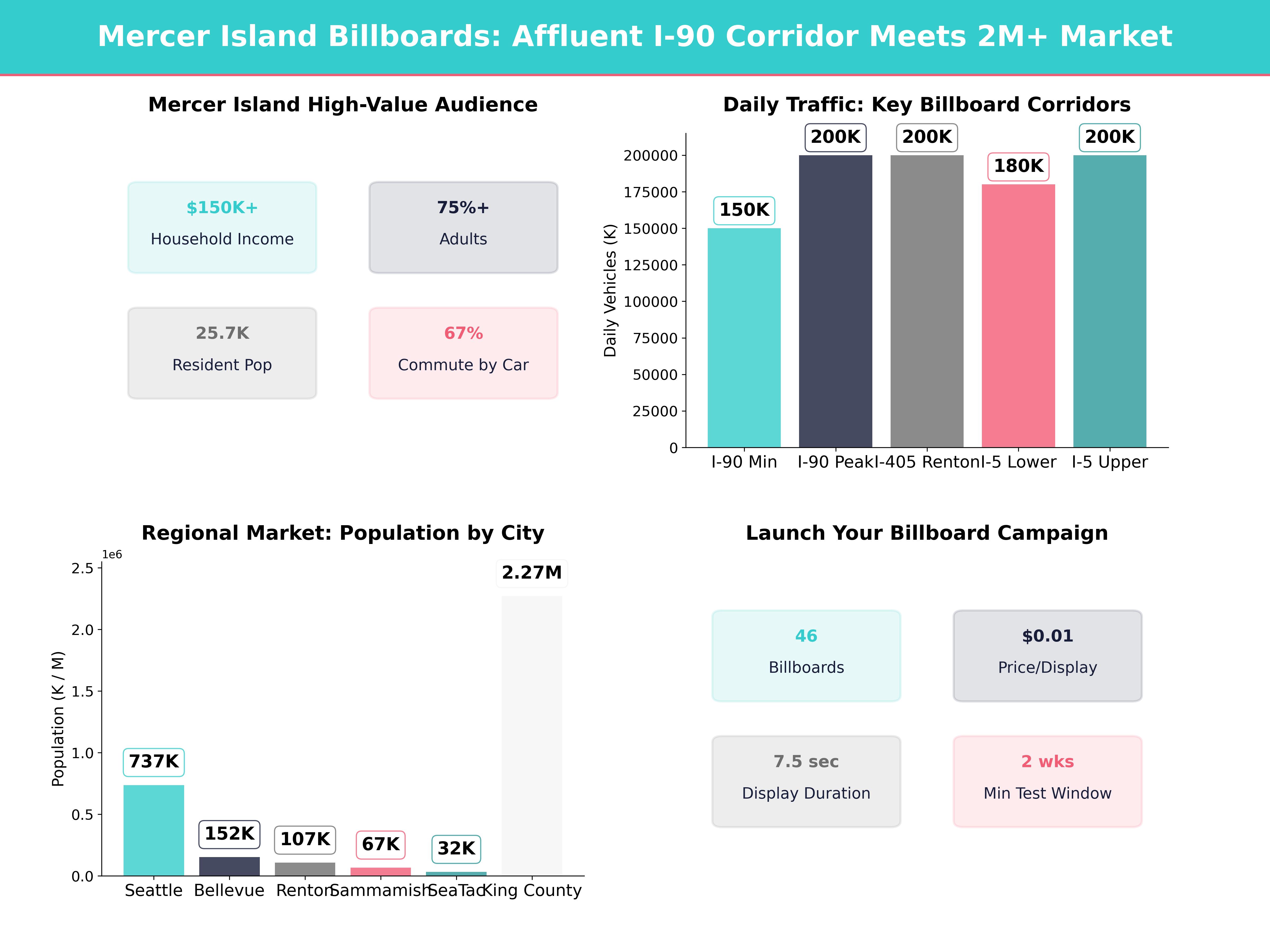
The City of Mercer Island 25,748 residents at the 2020 Census, and its footprint is only about 6.3 square miles. On its own, that is a relatively small city, but the surrounding trade area is much larger. Within a short drive, the reachable market includes Seattle at 737,015 residents, Bellevue at 151,854, Renton at 106,785, Sammamish at 67,455, SeaTac 31,856, and King County 2,269,675 overall.
That scale is exactly why billboard strategy near Mercer Island works so well. We are not only speaking to island households. We are also speaking to people who work across the lake, shop on both sides of Lake Washington
Mercer Island-area households also bring meaningful purchasing power. Recent ACS estimates place median household income well above $150,000, and educational attainment is exceptionally high, with more than 3 in 4 adults holding a bachelor’s degree or higher. For many advertisers, that combination supports premium positioning, whether we are promoting healthcare, higher education, financial services, home improvement, real estate, or destination retail.
Commuting habits keep outdoor media relevant near Mercer Island
Even in a transit-rich metro, the Mercer Island area remains heavily shaped by car travel. Recent commute estimates show roughly 6 in 10 Mercer Island workers drive alone to work, and about 2 in 3 commute by car when carpooling is included. Across King County 50%, which helps explain why roadside visibility still matters so much in this market.
At the same time, Mercer Island sits on one of the region’s strongest transit spines. Sound Transit connections, light rail expansion, and regional bus service all reinforce movement between Seattle and the Eastside throughout the day. That means billboard campaigns serving the Mercer Island area can benefit from both classic rush-hour repetition and all-day circulation driven by shopping, appointments, school trips, and entertainment.
Key traffic corridors serving the Mercer Island area
I-90 is the defining corridor near Mercer Island
I-90 is the only interstate that directly serves Mercer Island, and it is the main reason this market punches above its population size. According to Washington State Department of Transportation traffic maps, I-90 near Mercer Island routinely carries 150,000-plus vehicles per day, and the busiest bridge-related approaches are often around 200,000 daily vehicles or more. That gives advertisers a level of exposure that would be impressive in a much larger city.
The road’s directional logic is especially useful. Westbound traffic connects the Mercer Island area to Downtown Seattle, the stadium district, major hospitals, universities, and the Seattle Convention Center. Eastbound traffic connects the Mercer Island area to Bellevue, Sammamish, and the broader Eastside. Because many people repeat that movement several times a week, we can build frequency quickly with well-placed digital boards near the corridor.
Supporting corridors expand Mercer Island-area reach
We also use nearby corridors to extend the Mercer Island audience beyond the island’s immediate approaches.
- I-405 through Renton regularly carries 200,000-plus vehicles per day on major segments. It is one of the best ways to reach Mercer Island-area consumers who move north-south for work, healthcare, airport access, and shopping.
- I-5 through Seattle often carries roughly 180,000 to 200,000 vehicles per day on busy central segments. It helps us reinforce campaigns aimed at downtown workers, stadium crowds, students, and urban event traffic serving the Mercer Island area.
- SR 518 near SeaTac 90,000 to 120,000 vehicles per day. That makes it valuable for airport, hotel, parking, tourism, and visitor-oriented campaigns.
- SR 520 carries roughly 100,000 vehicles per day across Lake Washington on many counts. It does not directly touch Mercer Island, but it helps define the broader east-west movement pattern that marketers should understand when planning Eastside saturation.
Why nearby-city billboards still work for the Mercer Island market
Our inventory serving the Mercer Island area is clustered close to the city itself. We have boards in Renton just 4.6 miles away, in Seattle just 4.8 miles away, in SeaTac 8.0 miles away, and in Sammamish 9.8 miles away. That tight radius matters because the Mercer Island audience is regional by behavior. People do not stay within one municipal boundary. They commute, travel, study, attend events, and shop across the full Seattle-Eastside corridor.
Mercer Island area audience segments
Commuters and cross-lake professionals
The first major audience is the daily commuter. Mercer Island sits between the job cores of Seattle and the Eastside, so many local professionals move through I-90 every weekday. That makes the area near Mercer Island especially strong for campaigns in recruiting, healthcare, higher education, financial services, legal services, tech, home services, and premium consumer brands.
This audience also tends to be repeatable. A worker who sees a message near Seattle in the morning may see the same brand again near Renton or Sammamish later in the week. That repetition is valuable for brand recall, especially when we keep the creative simple and consistent.
Families and school-centered households
The Mercer Island area is also a family market. The Mercer Island School District serves roughly 4,000 students, which creates predictable demand around school calendars, youth activities, tutoring, orthodontics, camps, enrichment, family dining, and local services. For many household-focused businesses, this is one of the best audience groups to target near Mercer Island.
We also like to remember that Mercer Island-area families often shop and schedule services across a broader Eastside and Seattle radius. A pediatric practice, tutoring program, contractor, summer camp, or family entertainment brand does not have to rely only on one neighborhood. It can use digital boards near Mercer Island to stay present throughout the routes families already use.
Students, faculty, and education audiences
Education is another important audience segment serving the Mercer Island area. The University of Washington Seattle campus enrolls more than 50,000 students, and Seattle University enrolls roughly 7,000. These campuses draw students, parents, faculty, and staff from across the metro, including households that travel through Mercer Island corridors.
That makes nearby boards useful for graduate programs, continuing education, student housing, healthcare systems, bookstores, restaurants, and job recruitment. Education-focused campaigns also benefit from highly seasonal planning, especially around late summer, early fall, and January term starts.
Travelers, visitors, and event-driven audiences
The Mercer Island area is unusually close to regional visitor demand. Seattle-Tacoma International Airport handled 50.9 million passengers in 2023, which makes SeaTac-side inventory valuable for hospitality, transportation, insurance, tourism, and business services. Nearby boards can reach both Mercer Island-area residents heading to the airport and visitors heading back into Seattle or across the Eastside.
Seattle’s event economy is another major factor. The Seattle Convention Center offers nearly 1.5 million square feet of event space. T-Mobile Park seats 47,929, Lumen Field seats 68,740, and Climate Pledge Arena seats about 17,100 for hockey. Those venues generate steady surges for dining, entertainment, rideshare, urgent care, retail, and local attractions that serve the Mercer Island area.
Recreation and weekend movement
Outdoor recreation also shapes travel behavior near Mercer Island. Summer pushes people toward the water, parks, and Seattle events, while winter sends many Eastbound I-90 travelers toward The Summit at Snoqualmie and the Cascades. For ski shops, automotive brands, outdoor gear, hot beverage concepts, wellness brands, and weekend destinations, this movement can create excellent seasonal billboard windows.
Seasonal and timing opportunities near Mercer Island
Spring and summer campaigns near Mercer Island
From May through September, the Mercer Island area benefits from strong leisure movement. School is winding down, tourism rises, wedding and graduation season arrives, and Seattle events create regular traffic surges. Visit Seattle, Seafair, ballgames, concerts, and waterfront activity all contribute to denser travel patterns.
The Seattle Mariners alone bring 81 regular-season home games to Seattle each year, which creates a long runway for restaurants, bars, entertainment brands, parking services, and local retailers. Summer is also a strong time for home improvement, real estate, healthcare specialties, camps, and family attractions serving the Mercer Island area.
Back-to-school and fall routine resets
Late August through October is one of our favorite timing windows near Mercer Island because consumer routines become more predictable again. The Mercer Island School District, University of Washington, and Seattle University all contribute to a visible return of school-year traffic. This is often when education, dental, orthodontic, fitness, tutoring, healthcare, and financial planning campaigns perform especially well.
For many advertisers, commuter dayparts matter most during fall. We usually see the clearest alignment during 6 a.m. to 10 a.m. and 3 p.m. to 7 p.m., especially on Seattle-side and Renton-side inventory serving the Mercer Island area.
Winter travel and weather-driven messaging
From November through March, we typically shift strategy rather than reduce it. The Mercer Island area still moves constantly, but the motivations change. Holiday shopping, airport travel, ski weekends, indoor entertainment, tax season, healthcare appointments, and wellness messaging all become more relevant.
This is when high-contrast creative matters most. It is also when SeaTac boards can become especially valuable because of holiday departures and arrivals. Brands tied to hospitality, travel, urgent care, legal services, accounting, and seasonal retail often do well in this window.
Billboard design tips for the Mercer Island market
Keep the message short for freeway-speed viewing
Most of the billboards serving the Mercer Island area are working in high-speed traffic environments. At roughly 55 to 60 mph, drivers do not have time for dense copy. We recommend one idea, one visual, and one call to action. In practice, that usually means 7 words or fewer in the main headline.
This is especially important around I-90 approaches, interchange zones, and airport-serving roads where drivers are making lane and route decisions quickly. If we need more explanation than that, we are usually better off simplifying the offer rather than adding more text.
Use geographic cues that feel local
The Mercer Island audience responds well to creative that reflects its real movement patterns. We often see stronger resonance from cues like “Minutes off I-90,” “Seattle-side convenience,” “Eastside pickup,” or “Easy airport access” than from overly generic branding. Those phrases acknowledge how people actually orient themselves near Mercer Island.
Visuals can help too. Deep blues, evergreen greens, clean whites, skyline silhouettes, bridge imagery, and polished lifestyle photography often feel more natural in this market than loud, cluttered discount-store aesthetics. For family brands, neighborhood warmth tends to work. For professional services, calm authority tends to work.
Design for gray-weather visibility
Western Washington weather affects readability for a large part of the year. From roughly October through April, overcast skies and rain reduce contrast. We usually recommend bold type, bright highlights, fewer design elements, and strong separation between background and copy.
We also advise advertisers serving the Mercer Island area to avoid relying on small logos, thin fonts, or detailed product shots. A simple face, a recognizable product, or a clean icon usually performs better than intricate compositions when drivers only have a few seconds to notice the ad.
Match the tone to an affluent, educated audience
Mercer Island-area households often respond well to messaging built around trust, expertise, convenience, outcomes, and quality. That does not mean price never matters. It does mean that premium framing often outperforms bargain framing unless low price is the true competitive advantage.
For example, a home services brand may do better with “Trusted Roof Repair Before Winter” than with a generic sales-heavy message. A healthcare brand may do better with “Expert Care, Easier Eastside Access” than with a list of specialties. We want the creative to feel confident, useful, and locally relevant.
Regional strategies near Mercer Island
Seattle boards for westbound commuters and event traffic
Our Seattle inventory is just 4.8 miles from Mercer Island, which makes it ideal for westbound commuters, stadium visitors, convention attendees, students, and downtown professionals. We use Seattle-side boards when a brand wants to influence workday decisions, event-night spending, or urban destination visits serving the Mercer Island area.
This cluster is especially strong for healthcare, legal services, restaurants, entertainment, universities, recruiting, and premium retail. It is also useful when advertisers want to be visible before office arrivals or before fans reach the stadium district.
Renton boards for I-405 and South King County movement
Our Renton inventory is only 4.6 miles from Mercer Island and is excellent for north-south movement tied to I-405. We often use Renton-side boards when brands want to capture commuters heading toward South King County, logistics corridors, healthcare providers like Valley Medical Center, or cross-market shoppers.
This strategy works well for auto, healthcare, recruiting, home services, insurance, education, and consumer brands with broad regional appeal. Renton inventory also helps when the goal is frequency beyond a pure Seattle play.
SeaTac boards for travel and visitor demand
Our SeaTac 8.0 miles from Mercer Island and adds a different kind of audience. These boards are strong for reaching travelers, airport workers, hotel guests, and visitors moving through the Seattle Southside tourism corridor.
We like this cluster for hospitality, parking, legal services, insurance, healthcare, higher education, attractions, and any brand that benefits from broad regional awareness. It is especially helpful during holiday travel periods, summer tourism, and convention-heavy weeks.
Sammamish boards for Eastside household depth
Our Sammamish inventory is 9.8 miles from Mercer Island and helps us extend reach into affluent Eastside residential patterns. Even though Mercer Island and Sammamish are different cities, the audience overlap is real in categories like family services, healthcare, tutoring, finance, home remodeling, and premium retail.
We use Sammamish-side boards when a brand wants deeper household penetration beyond Seattle-facing traffic alone. This cluster is often a smart complement to I-90-focused campaigns because it reaches Eastside decision-makers who share many of the same spending traits as Mercer Island-area households.
Using Blip to reach the Mercer Island area
When we want broad coverage across the full Mercer Island-area network
If the goal is awareness across the full region, a Blip-optimized campaign is usually the easiest starting point. It lets us tap into the best mix across the 46 digital billboards serving the Mercer Island area while the platform adjusts toward stronger opportunities by time, location, and demand.
That approach is useful when we want to reach multiple audience groups at once, such as commuters, families, and travelers. It is also a good fit for advertisers who know their target market but do not want to manually choose every board.
When manual selection makes more sense
A manual campaign is better when we already know the corridor strategy. If we only want Seattle boards on weekday mornings, Renton boards during the afternoon commute, or SeaTac boards around holiday travel, map-based selection gives us that control.
This is especially helpful for local service businesses, schools, event promotions, or retail brands that know exactly where their customers come from. Manual selection also makes creative testing easier because we can pair specific messages with specific travel contexts.
Why Blip works well in a market like Mercer Island
The Mercer Island area is built around repeated trips, directional traffic, and fast-changing daily patterns. That is where flexible digital buying helps. Short 7.5- to 10-second blips are well suited to simple commuter messaging, and pay-per-play entry pricing starting at $0.01 per display makes it practical to test ideas before scaling them.
We can also shift messaging quickly. A school-focused ad can give way to a holiday retail ad. A recruiting campaign can move toward weekend event traffic. A travel brand can increase visibility around peak airport periods. Real-time analytics make that kind of adaptation much easier than it is with more rigid outdoor buying models.
Getting started with billboard rental near Mercer Island
Start with a clear goal, not just a location list
The best first step is to define what success should look like. Are we trying to build awareness in the Mercer Island area, increase store visits, promote a local event, recruit employees, or support seasonal demand? The answer affects whether we prioritize Seattle commuters, Eastside families, SeaTac travelers, or a combination of all three.
We usually recommend choosing one primary audience first. That keeps the campaign focused and makes the results easier to interpret.
Evaluate boards by travel pattern
When we rent billboards serving the Mercer Island area, we should think in terms of movement rather than municipal boundaries. Seattle inventory is excellent for westbound work and event traffic. Renton inventory is strong for I-405 connections and South King County movement. SeaTac inventory is useful for airport and visitor reach. Sammamish inventory adds Eastside household depth.
In many cases, it makes sense to start with 2 to 4 corridor clusters rather than trying to appear everywhere at once. That approach usually gives us better frequency and cleaner learning.
Keep the first campaign simple
Traditional billboard companies often rely on rep-led availability checks, negotiated packages, and fixed 4-week cycles. Blip makes the process much lighter. We can launch online, adjust timing, swap creative, and control spend without long contracts or minimum commitments.
For a first campaign near Mercer Island, we usually recommend one clean creative, one clear offer, and a test window of at least 2 weeks, with 4 weeks being even better if we want to compare weekday and weekend behavior. After that, we can look at which nearby-city boards, dayparts, and messages deserve more investment.
Build from what the Mercer Island area already does every day
The biggest advantage of advertising near Mercer Island is that the audience already moves through highly predictable routes. People cross I-90, head to Seattle events, travel through SeaTac, and circulate through Eastside family and retail patterns every week. When we align the campaign with those routines, billboard advertising becomes much easier to plan and much easier to scale.
That is why the Mercer Island area is such a strong fit for digital out-of-home. We have a concentrated, affluent local base, a 46-board nearby network, and several of Washington’s busiest traffic corridors working together in one compact geography.