Billboards near Fort Lewis, WA
No Minimum Spend. No Long-Term Contracts. Just Results.
Trusted by Leading Brands


Billboard advertising
near Fort Lewis has never been easier
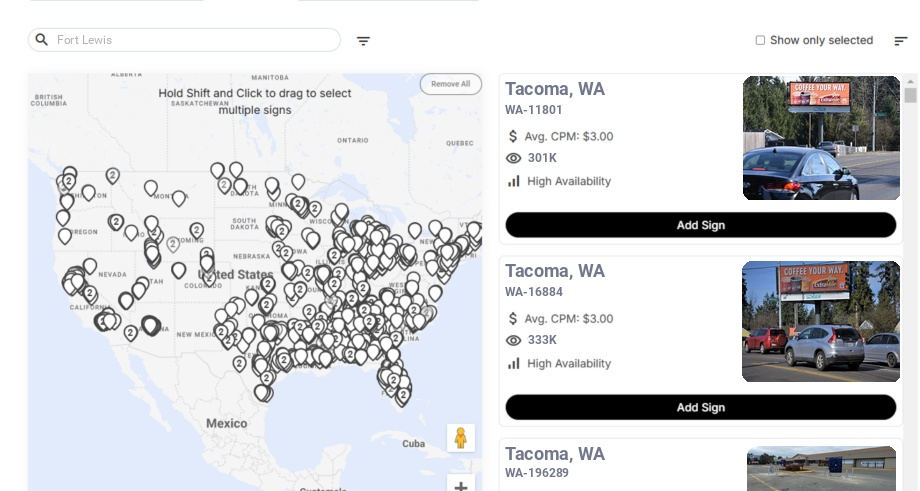



How much is a billboard near Fort Lewis?
Why Choose Blip for Billboard Advertising near Fort Lewis
Blip lets Fort Lewis ads launch fast, so you can reach I-5 commuters and JBLM households in minutes.
Choose Blip-optimized buying in Fort Lewis and let the platform match your budget to Tacoma corridors and peak drive times.
No contracts with Blip means Fort Lewis businesses can test around the 1st, 15th, or summer moves and pause anytime.
Track Fort Lewis campaign results in real time, then shift spend when I-5, SR 512, or event traffic performs best.
Use Blip creative tools to build clear Fort Lewis billboards for military families, students, and South Sound shoppers.
Frequently Asked Questions About Billboard Advertising near Fort Lewis
How much does a billboard cost in Fort Lewis with Blip?
Blip makes billboard advertising in the Fort Lewis area flexible and affordable. You set a daily budget that works for you, and Blip only charges when your ad actually appears as a 7.5-to-10-second “blip” on a rotating digital billboard serving the Fort Lewis area. Pricing is pay-per-play, starting at just $0.01 per display, and the cost per blip can vary based on time of day, location, and advertiser demand.
Where can I advertise with Blip in Fort Lewis, Washington?
Our 2 digital billboards serving the Fort Lewis area are both in Tacoma, just 8.2 miles from Fort Lewis and within 10 miles of the market, which makes them well positioned to capture everyday regional traffic. Because our digital billboards are in Tacoma, they are particularly effective for capturing drivers moving between the Fort Lewis area and Tacoma’s retail, medical, event, and employment districts. Tacoma placements are valuable because they intercept trips tied to work, healthcare, shopping, entertainment, and military-related travel moving north and south on I-5.
Why is billboard advertising in Fort Lewis with Blip a good fit for military families and commuters?
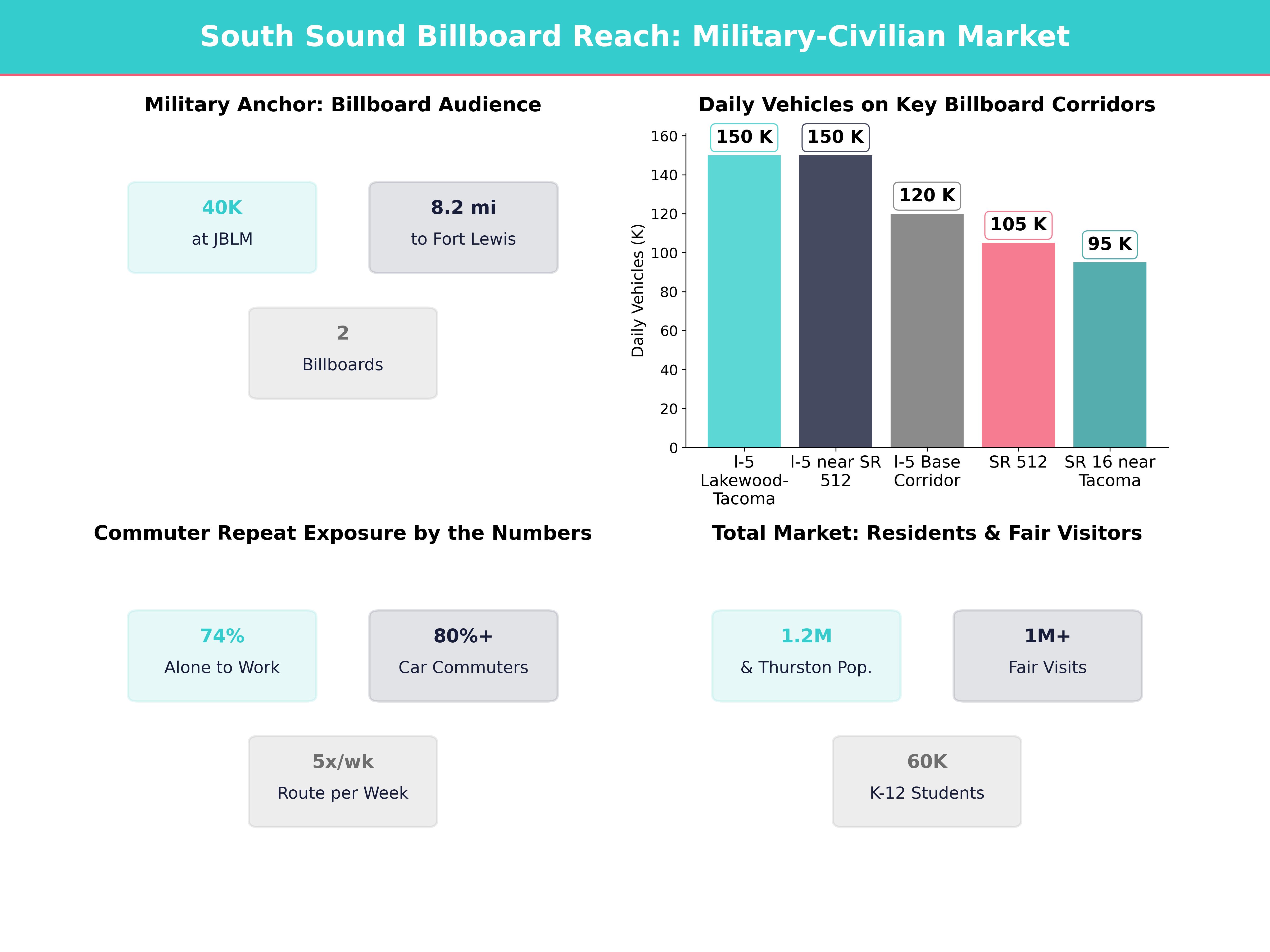
Advertising near Fort Lewis works especially well because the market is highly mobile, economically diverse, and tied to some of the busiest travel routes in the South Sound, including a major military footprint at Joint Base Lewis-McChord with roughly 40,000 active-duty service members. From an out-of-home perspective, the Fort Lewis area is still a windshield market, and roughly 73% to 75% of workers in Pierce and Thurston counties drive alone to work, with total commuting by car typically climbing above 80% when carpools are included. That is exactly why billboard advertising near Fort Lewis can work so well.
What roads in Fort Lewis, Washington get the most traffic for billboard ads?
The single most important route serving the Fort Lewis area is I-5. WSDOT traffic counts regularly place I-5 segments between Lakewood and Tacoma in the 130,000 to 170,000 vehicles per day range, depending on the exact segment and year. Segments near the SR 512 connection commonly exceed 150,000 daily vehicles, and even the I-5 stretches through the base-adjacent corridor often remain above 120,000 daily vehicles.
When should I run Blip ads in Fort Lewis to reach the most drivers?
We generally recommend heavier rotation during common windows like 6:00 a.m. to 9:00 a.m. for morning commute exposure, 11:00 a.m. to 1:00 p.m. for lunch and errand traffic, and 3:00 p.m. to 7:00 p.m. for afternoon commute and family pickups. Those time blocks are especially useful when we want to align spend with the most habitual driving periods near Fort Lewis. Blip’s algorithm uses your budget to bid for available ad slots and helps maximize your reach without wasting spend.
Do I need a contract to advertise with Blip near Fort Lewis?
No, Blip has no long-term contracts or minimum commitments. You can start, pause, or stop your campaign at any time.
How fast can I launch a billboard campaign with Blip near Fort Lewis?
You can have your campaign live in minutes. Create a free account, select your locations, set your budget, upload your design, and start running once approved.
Where can I advertise with Blip near Fort Lewis?
Blip has digital billboards near Fort Lewis. You can browse available locations on a map, choose the ones that fit your audience, and start advertising right away.
Still have questions? Launch a campaign in minutes — no contracts, no commitments.
Start Your CampaignFort Lewis Billboard Advertising Guide
Advertising near Fort Lewis works especially well because the market is highly mobile, economically diverse, and tied to some of the busiest travel routes in the South Sound, including a major military footprint at Joint Base Lewis-McChord 40,000 active-duty service members. The Fort Lewis area sits along the Interstate 5 corridor, connecting military households, civilian workers, port and logistics employees, students, shoppers, and event visitors moving between Tacoma, Lakewood, DuPont Puyallup Olympia. Our 2 digital billboards serving the Fort Lewis area are both in Tacoma, just 8.2 miles from Fort Lewis and within 10 miles of the market, which makes them well positioned to capture everyday regional traffic. For advertisers that want flexibility, strong commuter visibility, and the ability to adjust messaging quickly, the Fort Lewis area is one of Washington’s most practical digital billboard markets, reaching a South Sound population of more than 1.2 million residents across Pierce Thurston counties.
Fort Lewis area market overview
The Fort Lewis area sits inside a large South Sound trade area
We should think about the Fort Lewis area as part of a broader South Sound consumer zone rather than a single-point destination. The market is influenced by Joint Base Lewis-McChord, Tacoma, Lakewood, DuPont Pierce County Thurston County, all of which contribute to daily travel and spending patterns near Fort Lewis.
According to population counts reported through the Washington State Office of Financial Management, the nearby municipal and county base is substantial, with more than 1.2 million residents across Pierce and Thurston counties.
- Tacoma had a 2020 population of 219,346.
- Lakewood had a 2020 population of 63,612.
- DuPont 2020 population of 9,807.
- Pierce County 2020 population of 921,130.
- Thurston County had a 2020 population of 294,793.
That means the two counties most closely tied to the Fort Lewis area accounted for a combined 1,215,923 residents in 2020. Even if we only look at Tacoma, Lakewood, and DuPont, the nearby city total reaches 292,765 residents, and that still excludes many unincorporated communities that interact with the Fort Lewis area every day.
The local economy is broader than the base alone
The Fort Lewis area benefits from a layered economy. Military activity is a major driver, with Joint Base Lewis-McChord anchoring roughly 40,000 active-duty service members, but it is supported by logistics, education, healthcare, retail, transportation, and maritime trade through the Port of Tacoma and the Northwest Seaport Alliance. Major regional institutions such as MultiCare Virginia Mason Franciscan Health University of Washington Tacoma, and Pacific Lutheran University reinforce year-round demand for housing, services, food, healthcare, banking, storage, auto repair, entertainment, and family retail.
For advertisers, this matters because the Fort Lewis area is not dependent on one audience type. We can reach active-duty households, civilian employees, healthcare workers, students, tradespeople, and regional shoppers with the same billboard network serving the Fort Lewis area.
Car commuting remains the dominant behavior near Fort Lewis
From an out-of-home perspective, the Fort Lewis area is still a windshield market. Regional commute profiles from agencies such as the Puget Sound Regional Council and the Thurston Regional Planning Council 73% to 75% of workers in Pierce and Thurston counties drive alone to work, and total commuting by car typically climbs above 80% when carpools are included.
That is exactly why billboard advertising near Fort Lewis can work so well. When more than 4 out of 5 workers are traveling by car, repeated roadside exposure becomes a practical way to build recall during everyday routines rather than only during special events.
Key traffic corridors serving the Fort Lewis area
Interstate 5 is the main spine for the Fort Lewis area
The single most important route serving the Fort Lewis area is I-5. It connects the market north to Tacoma and Seattle, south to Olympia, and directly through the JBLM corridor. Because our digital billboards are in Tacoma, they are particularly effective for capturing drivers moving between the Fort Lewis area and Tacoma’s retail, medical, event, and employment districts.
Washington State Department of Transportation traffic counts regularly place I-5 segments between Lakewood and Tacoma in the 130,000 to 170,000 vehicles per day range, depending on the exact segment and year. Segments near the SR 512 connection commonly exceed 150,000 daily vehicles, and even the I-5 stretches through the base-adjacent corridor often remain above 120,000 daily vehicles.
For advertisers, that means one thing: I-5 is not just a commuter road. It is the route that serves military travel, shift changes, retail trips, medical appointments, freight movement, and weekend recreation near Fort Lewis.
SR 512 helps extend Fort Lewis area reach east and southeast
State Route 512 is one of the most useful connectors for brands trying to influence the Fort Lewis area from the Tacoma side. It links I-5 with Puyallup, South Hill, and other fast-growing eastern Pierce County communities. WSDOT counts near the I-5 interchange often place SR 512 around 100,000 to 110,000 vehicles per day.
That makes SR 512 especially useful for advertisers in categories such as healthcare, home services, auto sales, family entertainment, storage, legal services, and retail. Many households east of the Fort Lewis area use SR 512 to access jobs, shopping, and appointments tied to Tacoma and Lakewood, so the corridor expands the practical audience well beyond base-linked traffic.
SR 16 and Tacoma arterials add another layer of regional flow
State Route 16 is also important because it feeds Tacoma from the west and northwest. WSDOT counts on SR 16 near Tacoma are often in the 90,000 to 100,000 vehicles per day range. That route helps deliver affluent commuters, service buyers, event visitors, and weekend travelers into the same Tacoma zones that also serve the Fort Lewis area.
On surface routes, corridors such as Pacific Avenue and SR 7 often carry roughly 30,000 to 50,000 vehicles per day, depending on the segment. We do not rely on those roads as primary billboard corridors for Fort Lewis area campaigns, but they help explain why Tacoma-based billboard placements can still influence shoppers and commuters whose trips start or end near Fort Lewis.
Transit matters, but the Fort Lewis area is still road-led
Sound Transit and Pierce Transit both play important roles in regional mobility, and the Tacoma Dome Station is a major transfer point. Even so, the Fort Lewis area remains overwhelmingly road-led for daily reach.
That is why digital billboards near Fort Lewis are strongest when we align them with I-5 commuter windows, shopping peaks, and event-driven travel surges.
Audience segments we can reach near Fort Lewis
Military households and civilian workers are a core Fort Lewis area audience
The Fort Lewis area includes one of the most important military concentrations in the Pacific Northwest, and that creates unusually steady demand for practical, everyday categories. Brands offering apartments, storage, dental care, urgent care, legal services, moving help, banking, insurance, wireless plans, automotive service, and family dining often fit especially well.
We also know that military-related spending patterns have recurring timing cues. Pay cycles on the 1st and 15th of each month can create useful moments for promotions tied to value, speed, and convenience. Seasonal relocation patterns also matter, especially from May through August, when moving, housing, storage, school transfer, and service-switching decisions often rise.
Commuters make the Fort Lewis area a frequency market
Because more than 80% of workers in the surrounding counties commute by car when solo driving and carpooling are combined, the Fort Lewis area rewards frequency. A commuter may see the same route 5 days a week, which means even a short-run campaign can build memory if the message is consistent.
This is especially helpful for:
- Restaurants trying to capture dinner traffic on weekday evenings.
- Healthcare providers trying to stay top of mind for appointment booking.
- Retailers promoting weekend sales before Friday afternoon trips.
- Service businesses that need repeated exposure before a consumer takes action.
Students and young adults add another layer near Fort Lewis
The college market near Fort Lewis is not the only audience, but it is large enough to matter. University of Washington Tacoma serves about 5,000 students, Pacific Lutheran University enrolls roughly 2,600 students, and University of Puget Sound serves about 2,100 students. Clover Park Technical College and Tacoma Community College add still more student movement to the area.
That creates opportunities for advertisers in affordable food, apartments, internet services, banking, tutoring, healthcare, apparel, and entertainment. It also means late-summer and back-to-school timing can matter even for brands that are not traditionally “student” brands, because households often make new spending decisions when school schedules reset.
Families, shoppers, and event visitors expand the audience beyond weekdays
The Fort Lewis area also connects to regional family traffic. Tacoma Public Schools, Clover Park School District, and Bethel School District serve more than 60,000 K-12 students combined across the corridor, which supports demand for pediatric care, family restaurants, home improvement, childcare, tutoring, and recreation.
Event traffic is another important layer. The Washington State Fair in Puyallup draws more than 1 million visits over roughly 20 days each September, making it one of the largest recurring audience opportunities in the region. Major shows at the Tacoma Dome, conventions at the Greater Tacoma Convention Center Travel Tacoma also bring extra discretionary spending into the same road network serving the Fort Lewis area.
Seasonal and timing opportunities near Fort Lewis
Spring in the Fort Lewis area brings mobility and event momentum
Spring is a strong time to restart awareness campaigns near Fort Lewis. Weather improves, moving activity begins to rise, and the Daffodil Festival puts regional attention on Pierce County with 4 parades in 1 day across multiple cities.
For spring campaigns, we often like categories such as:
- Home services before summer project season.
- Family healthcare before sports and travel season.
- Auto maintenance before road-trip traffic picks up.
- Local retail tied to tax refunds, graduations, and spring cleaning.
Summer near Fort Lewis rewards convenience, family offers, and relocation messaging
Summer is one of the best windows for the Fort Lewis area because travel volume stays high and military relocation activity tends to intensify. From May through August, advertisers in housing, storage, moving, furniture, child-focused services, and quick-turn local services can benefit from strong relevance.
Summer also brings more discretionary travel to the South Sound. Visitors heading toward Experience Olympia & Beyond, waterfront areas, parks, and mountain recreation create added regional flow. Campaigns that emphasize convenience, same-day availability, extended hours, and easy access usually perform well in this period.
Fall near Fort Lewis is excellent for fairs, school routines, and daily frequency
Fall is arguably the most balanced season for billboard advertising serving the Fort Lewis area. School calendars stabilize, commuters fall back into routine, and the Washington State Fair adds a major regional draw in September with 1 million-plus visits over 20 days.
This is a strong season for:
- Colleges and training programs.
- Healthcare enrollment and wellness messaging.
- Restaurants and retail tied to football weekends.
- Family entertainment and holiday pre-planning.
- Services aimed at newly settled households after summer moves.
Winter near Fort Lewis favors clear offers and high-contrast creative
Winter in the Fort Lewis area is darker, wetter, and more routine-driven. That environment can actually help strong billboard creative, because consumers are commuting in repeated patterns and often making practical spending decisions around holidays, healthcare, auto maintenance, indoor recreation, and value shopping.
We generally recommend heavier rotation during these common windows:
- 6:00 a.m. to 9:00 a.m. for morning commute exposure.
- 11:00 a.m. to 1:00 p.m. for lunch and errand traffic.
- 3:00 p.m. to 7:00 p.m. for afternoon commute and family pickups.
Those time blocks are not the only ones that work, but they are especially useful when we want to align spend with the most habitual driving periods near Fort Lewis.
Billboard design tips for campaigns serving the Fort Lewis area
We should design for speed, rain, and routine
The Fort Lewis area is driven by moving traffic and repeated exposures, so creative needs to read instantly. On fast regional corridors, we usually recommend a headline of 5 to 7 words, a single offer, and no more than 1 clear call to action. If a driver needs more than a glance to understand the ad, the message is probably too crowded.
Because the South Sound has many gray days, contrast matters. Deep navy, evergreen, black, white, bright yellow, and saturated red often cut through overcast conditions better than pale backgrounds or low-contrast photography.
Local visual cues can help the ad feel more relevant
We often see stronger local resonance when creative reflects the geography near Fort Lewis instead of looking generic. Useful visual cues can include a Mount Rainier silhouette, evergreen lines, water-inspired blues, or clean military-adjacent themes such as reliability, readiness, trust, and service.
That does not mean every ad should use patriotic imagery. In fact, overly literal military creative can feel forced when the offer does not match. What usually works better is practical relevance, such as:
- “Open Late.”
- “Military Discount.”
- “Same-Day Appointments.”
- “Storage Near JBLM.”
- “Family Dentistry.”
Those messages fit the Fort Lewis area because they match real needs and real routines.
Simplicity matters more than cleverness near Fort Lewis
The best-performing billboard ideas serving the Fort Lewis area are often direct rather than witty. Commuters near Fort Lewis respond well to clarity, utility, and familiarity. We generally recommend:
- 1 brand name.
- 1 main promise.
- 1 memorable visual.
- 1 short URL or response path.
If we need to communicate pricing, we should use a concrete number that people can remember quickly, such as “Oil Change from $49” or “Storage Units from $79,” assuming the advertiser can support the claim. Specific numbers are usually more persuasive than broad phrases such as “Great Deals.”
Regional strategies around the Fort Lewis area
Tacoma is the gateway strategy for the Fort Lewis area
Because our 2 digital billboards serving the Fort Lewis area are in Tacoma, we should use Tacoma as the gateway strategy rather than trying to mimic hyperlocal saturation. Tacoma placements are valuable because they intercept trips tied to work, healthcare, shopping, entertainment, and military-related travel moving north and south on I-5.
For many advertisers, this means we should emphasize awareness and directional fit. If your business draws from the full South Sound, Tacoma boards can efficiently support broad regional recognition while still staying close to the Fort Lewis area.
The Lakewood and South Tacoma side of the market favors practical categories
The Fort Lewis area’s strongest adjacent commercial patterns sit toward Lakewood and South Tacoma. This part of the market is especially good for restaurants, urgent care, dental offices, apartments, self-storage, auto service, furniture, and value retail.
When we build campaigns for this audience, we usually focus on speed, access, price, and family practicality. Messaging like “Open 7 Days,” “Book Today,” “Move In This Week,” or “Free Consultation” fits the rhythm of the corridor better than luxury-style branding with no immediate action.
The eastern Pierce County audience adds scale to Fort Lewis area campaigns
Communities connected by SR 512 and nearby routes, including Puyallup, South Hill, Spanaway, and the Bethel area, add meaningful scale. These households may not identify as part of Fort Lewis day to day, but their driving patterns still intersect with the same regional infrastructure that serves the Fort Lewis area.
This audience is especially useful for:
- Family entertainment.
- Medical specialists.
- Legal services.
- Weekend retail.
- Home improvement.
- Seasonal promotions.
If your business serves the broader South Sound rather than only a few blocks around the base, this spillover audience can materially improve results.
Southbound travel toward DuPont and Olympia supports service and hospitality brands
The corridor south of the Fort Lewis area matters too. DuPont Olympia market promoted by Experience Olympia & Beyond support travel tied to government, education, tourism, and military movement. That makes southbound messaging useful for hotels, relocation services, storage, moving companies, fuel and convenience offers, and healthcare providers serving residents across county lines.
Blip tools for advertising near Fort Lewis
We can match Blip’s buying options to Fort Lewis area strategy
For campaigns serving the Fort Lewis area, Blip is useful because it lets us choose the level of control that matches the goal. If we want precise placement, we can manually select the 2 Tacoma digital billboards serving this market and line up the campaign with key commute windows. If we want broader efficiency, we can use Blip-optimized buying and let the platform allocate spend to the strongest opportunities automatically.
That flexibility matters in a market like Fort Lewis, where audiences shift by time of day. Morning commuters, lunchtime errand drivers, afternoon pickups, and weekend event traffic are not the same audience, and we do not always want to spend the same way in every hour.
Blip’s format works well for short, repeatable Fort Lewis area messaging
Each Blip ad display is a 7.5-to-10-second spot, which fits the Fort Lewis area well because most effective roadside messages here are short and practical. Pricing starts at $0.01 per display, so we can test timing, creative, and messaging without committing to a rigid traditional structure.
We also like the ability to adjust quickly. If a restaurant wants heavier exposure on Friday evenings, if a clinic wants weekday commute traffic, or if a storage operator wants to lean into summer moving season, we can shift the schedule without rebuilding the entire campaign from scratch.
Real-time measurement helps us refine local campaigns faster
Blip’s reporting makes it easier to see whether a Fort Lewis area campaign is pacing the way we expect. We can monitor spend, review delivery, compare creative versions, and make practical changes while the campaign is still live.
That is especially useful for local advertisers that want to learn which mix of time, message, and season produces the best traction.
Getting started with billboard rental near Fort Lewis
Start with one clear objective for the Fort Lewis area
The first step is deciding what success looks like. For the Fort Lewis area, the objective is usually one of three things: broad awareness, timely traffic generation, or repeated reminder messaging.
A dentist might want appointment calls. A restaurant might want dinner traffic. A storage operator might want visibility during peak moving season.
We usually recommend starting with 1 primary goal rather than stacking too many outcomes into the same creative.
Choose the Fort Lewis area audience before choosing the message
Because the Fort Lewis area includes commuters, military households, students, families, and event visitors, the audience definition should come before the artwork. Ask questions such as:
- Are we targeting weekday commuters or weekend families?
- Are we trying to reach military-linked households during a relocation period?
- Are we promoting a Tacoma-side destination that depends on northbound traffic?
- Are we focused on immediate response or long-term name recognition?
Those answers help determine the best daypart, offer, and tone.
Evaluate billboard fit based on travel behavior, not only map distance
A billboard that is close to Fort Lewis on a map is not automatically the right billboard. What matters more is whether the location sits on a route that your audience already uses.
Our Tacoma billboards are just 8.2 miles from Fort Lewis, but their real value comes from the fact that they serve one of the market’s most important movement patterns between Tacoma and the Fort Lewis area. When we evaluate fit, we look at:
- Direction of travel.
- Commuter timing.
- Nearby interchanges.
- Retail and service destinations.
- Whether the ad is meant for awareness or immediate action.
Blip simplifies the rental process compared with traditional billboard buying
Traditional billboard buying often involves quote requests, back-and-forth sales calls, fixed packages, and less flexibility once the campaign is booked. Blip simplifies that process by letting us launch online, set the budget ourselves, upload creative, choose manual or optimized buying, and make changes whenever the campaign needs to evolve.
That is especially helpful near Fort Lewis, where timing matters. If you want to increase exposure around the 1st and 15th, push harder during 6:00 a.m. to 9:00 a.m. and 3:00 p.m. to 7:00 p.m., or swap creative for a seasonal offer, Blip makes that much easier than waiting on a traditional sales cycle.
A smart first campaign near Fort Lewis is usually simple
For most advertisers, the best starting point is a 2- to 4-week test with one strong offer, one clean creative concept, and a schedule built around the most relevant driving hours. After launch, we can review performance, compare timing windows, and decide whether to expand reach, narrow targeting, or rotate fresh creative.
That approach keeps risk manageable while still taking advantage of what makes the Fort Lewis area attractive: heavy road use, recurring commuter patterns, military-linked household demand, and close access to Tacoma-based digital billboard inventory serving the market.